CREEP AND SHRINKAGE IN CONCRETE
STRUCTURES
PRESENTEDTO:
MR. NOMAN IQBAL
PRESENTED BY:
GROUP#2
CET(09__18)
http://uetrasul.uet.edu.pk
University of Engineering
and Technology, Rasul,
Mandi Bahauddin, Pakistan
Introduction
Definitions
 Creep is time dependent deformations of
concrete under permanent loads (self weight),
PT forces and permanent displacement.
 When concrete is subjected to compressive
loading it deforms instantaneously.This
immediate deformation is called instantaneous
strain. Now, if the load is maintained for a
considerable period of time, concrete undergoes
additional deformations even without any
increase in the load.This time-dependent strain
is termed as creep.
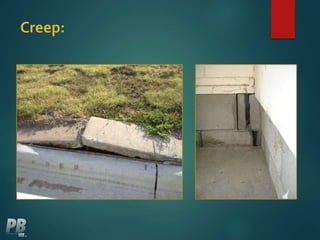
Creep
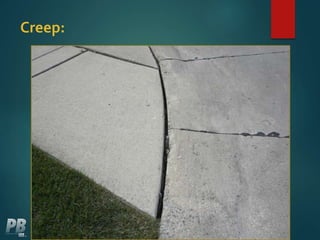
Creep:
Creep:
Introduction
Factors Affecting Creep
 Concrete mix proportion
 Aggregate properties
 Age at loading
 Curing conditions
 Cement properties
 Temperature
 Stress level
Factors affecting creep
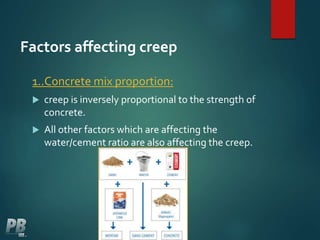
1..Concrete mix proportion:
 The amount of paste content and its quality is
one of the most important factors influencing
creep.
 A poorer paste structure undergoes higher creep.
 creep increases with increase in water/cement
ratio.
Factors affecting creep
1..Concrete mix proportion:
 creep is inversely proportional to the strength of
concrete.
 All other factors which are affecting the
water/cement ratio are also affecting the creep.
Factors affecting creep
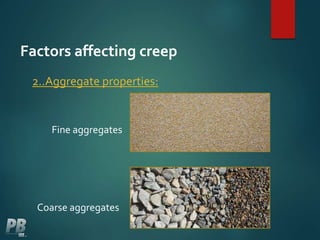
2..Aggregate properties:
 Aggregate undergoes very little creep.
 It is really the paste which is responsible for the
creep.
 Aggregates influence creep of concrete through
a restraining effect on the magnitude of creep.
Factors affecting creep
2..Aggregate properties:
 The higher the modulus of elasticity the less is
the creep.
 Light weight aggregate shows substantially
higher creep than normal weight aggregate.
Factors affecting creep
2..Aggregate properties:
Fine aggregates
Coarse aggregates
Factors affecting creep
3..Age at loading
 Age at which a concrete member is loaded will
have a predominant effect on the magnitude of
creep.
 The quality of gel improves with time. Such gel
creeps less.
 Whereas a young gel under load being not so
stronger creeps more.
Factors affecting creep
3..Age at loading
 The moisture content of the concrete being
different at different age also influences the
magnitude of creep.
Factors affecting creep
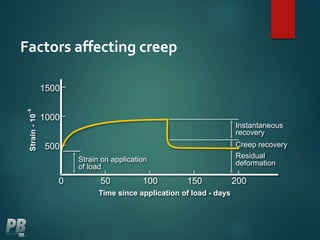
0 50 100 150 200
Instantaneous
recovery
Creep recovery
Residual
deformation
500
1000
1500
Strain on application
of load
Time since application of load - days
Strain-10
-6
Factors affecting creep
4..Curing condition:
 In view of the smallness of creep strains, the
amount of water expelled during creep from the
micro pores into the macro pores (or vice versa)
must also be small, probably much less than 0.1
percent of the volume of concrete (since typically
creep strains do not exceed 0.001, and even this
is not due entirely to water but also to expelled
solids).
 Larger the curing smaller the creep.
Factors affecting creep
4..Curing condition:
Factors affecting creep
5..Cement properties:
 The type of cement effects creep in so far as it
influence the strength of the concrete at the time
of application of load.
 Fineness of cement affects the strength
development at early ages and thus influence
creep.
Factors affecting creep
5..Cement properties:
 The finer the cement the higher its gypsum
requirement so that re grinding of cement in
laboratory without the addition of gypsum
produces an improperly retarded cement, which
exhibits high creep.
Factors affecting creep
6..Temperature:
 The rate of creep increases with temperature up
to about 700 C when, for a 1:7 mix and 0.6 w/c
ratio.
 It is approximately 3.5 times higher than at 210 C.
 Between 700 C and 960 C it drops off to 1.7 times
tan at 210 C.
Factors affecting creep
6..Temperature:
 As far as low temperature is concerned, freezing
produces a higher initial rate of creep but it
quickly drops to zero.
 At temperature between 100C and 300C, Creep is
about one half of creep at 210C.
Factors affecting creep
7..Stress level:
 There is a direct proportion between creep and
applied stress.
 There is no lower limits of proportionality
because concrete undergoes creep even at very
low stress.
 Higher the stress higher will be the creep.
Creep analysis
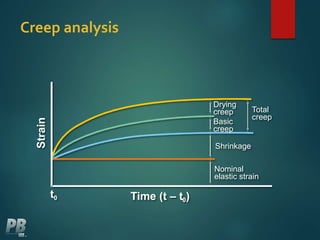
Drying
creep
Basic
creep
Total
creep
Shrinkage
Nominal
elastic strain
Time (t – t )0
t0
Strain
Creep Analysis
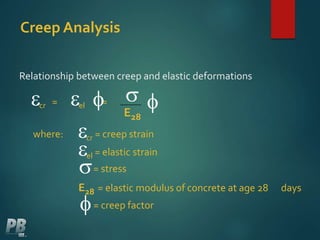
Relationship between creep and elastic deformations
cr = el =
E28
where: cr = creep strain
el = elastic strain
= stress
E28 = elastic modulus of concrete at age 28 days
= creep factor
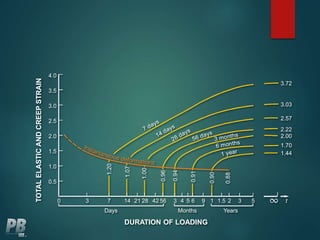
4.0
3.5
3.0
2.5
2.0
1.5
3.72
3.03
2.57
2.22
2.00
1.70
1.44
1.0
0.5
0 3 7 14 21 28 42 56 3 4 5 6 9 1 1.5 2 3 5
Days Months Years
1.20
1.07
1.00
0.96
0.91
0.94
0.90
0.88
t
DURATION OF LOADING
TOTALELASTICANDCREEPSTRAIN
Effects of creep on concrete
structures
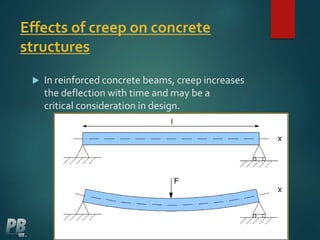
 In reinforced concrete beams, creep increases
the deflection with time and may be a
critical consideration in design.
Effects of creep on concrete
structures
 In eccentrically loaded columns, creep increases
the deflection and can load to buckling.
Effects of creep on concrete
structures
 Loss of pre stress due to creep of concrete in pre
stressed concrete structure.
Effects of creep on concrete
structures
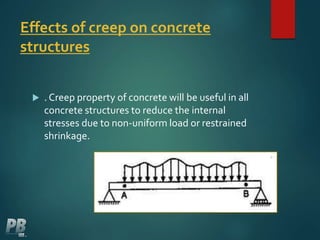
 . Creep property of concrete will be useful in all
concrete structures to reduce the internal
stresses due to non-uniform load or restrained
shrinkage.
Effects of creep on concrete
structures
In mass concrete structures such as dams, on
account of differential temperature conditions at
the interior and surface, creep is harmful and by
itself may be a cause of cracking in the interior of
dams
Introduction:
 Definition:
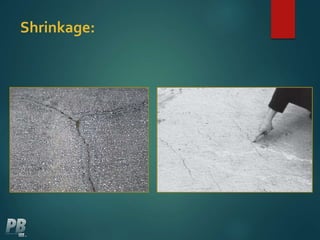
 Shrinkage is shortening of concrete due to drying
and is independent of applied loads.
 Shrinkage of concrete is the time-dependent
strain measured in an unloaded and unrestrained
specimen at constant temperature.
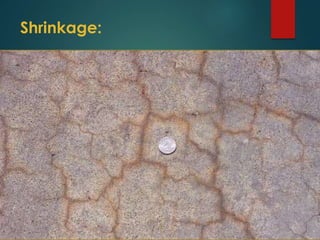
Shrinkage:
Shrinkage:
Introduction
Factors Affecting Shrinkage
 Drying conditions
 Time
 Water cement ratio
Factors Affecting Shrinkage
1..Drying conditions:
 The most important factor is the drying
condition or the humidity in the
atmosphere.
 No shrinkage will occur if the concrete
is placed in one hundred percent
relative humidity.
Factors Affecting Shrinkage
2..Time:
 The shrinkage rate will decrease rapidly with
time.
 It has been documented that fourteen to thirty-
four percent of the twenty year shrinkage will
occur within two weeks of it being poured.
 Within one year of the concrete being poured,
shrinkage will be about sixty-six to eighty-five
percent of the twenty year shrinkage.
Factors Affecting Shrinkage
3..Water cement ratio:
 The water to cement ratio will influence the
amount of shrinkage that occurs.
 The concrete’s richness also affects the
shrinkage.
 The process of swelling and then drying affects
the concrete’s integrity and the shrinkage.
Introduction:
Types of shrinkage
 Plastic Shrinkage
 Drying Shrinkage
 Autogeneous Shrinkage
 Carbonation Shrinkage
Types of shrinkage
1..Plastic shrinkage:
 Plastic shrinkage happens soon after the
concrete is poured in the forms.
 The water evaporates and results in a reduction
of volume, this causes the concrete on the
surface to collapse.
 The aggregate particles or the reinforcement
comes in the way of subsidence due to which
cracks may appear at the surface or internally
around the aggregate or reinforcement
Types of shrinkage
1..Plastic shrinkage:
 High water/cement ratio, badly proportioned
concrete, rapid drying, greater bleeding,
unintended vibration etc., are some of the
reasons for plastic shrinkage.
 Plastic shrinkage can be reduced mainly by
preventing the rapid loss of water from surface.
 It can be reduced by covering the surface with
polyethylene sheeting immediately after it is
poured.
Types of shrinkage
1..Plastic shrinkage:
Types of shrinkage
1..Plastic shrinkage
Types of shrinkage
1..Plastic shrinkage
Types of shrinkage
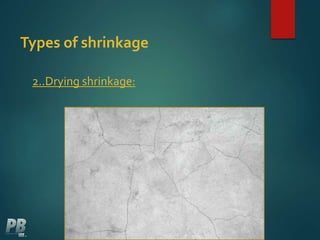
2..Drying shrinkage:
 Just as the hydration of cement is an ever lasting
process, the drying shrinkage is also an ever
lasting process when concrete is subjected to
drying conditions.
 The loss of free water contained in hardened
concrete, does not result in any appreciable
dimension change.
 It is the loss of water held in gel pores that causes
the change in the volume
Types of shrinkage
2..Drying shrinkage:
 Under drying conditions, the gel water is lost
progressively over a long time, as long as the
concrete is kept in drying conditions.
 The magnitude of drying shrinkage is also a
function of the fineness of gel.
 The finer the gel the more is the shrinkage.
 It has been pointed out earlier that the high
pressure steam cured concrete with low specific
surface of gel, shrinks much less than that of
normally cured cement gel.
Types of shrinkage
2..Drying shrinkage:
Types of shrinkage
2..Drying shrinkage:
Types of shrinkage
2..Drying shrinkage:
Types of shrinkage
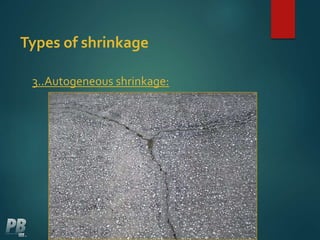
3..Autogeneous shrinkage:
 In a conservative system i.e. where no moisture
movement to or from the paste is permitted,
when temperature is constant some shrinkage
may occur.The shrinkage of such a conservative
system is known as autogeneous shrinkage.
 Autogeneous shrinkage is of minor importance
and is not applicable in practice to many
situations except that of mass of concrete in the
interior of a concrete dam.
Types of shrinkage
3..Autogeneous shrinkage:
Types of shrinkage
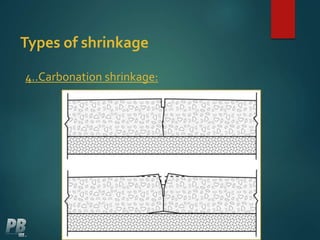
4..Carbonation shrinkage:
 Carbonation shrinkage is a phenomenon very
recently recognized and is very important.
 Carbon dioxide present in the atmosphere reacts
in the presence of water with hydrated cement.
 Calcium hydroxide gets converted to calcium
carbonate and also some other cement
compounds are decomposed.
Types of shrinkage
4..Carbonation shrinkage:
 Such a complete decomposition of calcium
compound in hydrated cement is chemically
possible even at the low pressure of carbon
dioxide in normal atmosphere.
 Carbonation penetrates beyond the exposed
surface of concrete only very slowly.
 The rate of penetration of carbon dioxide
depends also on the moisture content of the
concrete and the relative humidity of the
ambient medium.
Types of shrinkage
4..Carbonation shrinkage:
 Carbonation is accompanied by an increase in
weight of the concrete and by shrinkage.
 Carbonation shrinkage is probably caused by the
dissolution of crystals of calcium hydroxide and
deposition of calcium carbonate in its place.
 As the new product is less in volume than the
product replaced, shrinkage takes place.
Types of shrinkage
4..Carbonation shrinkage:
Types of shrinkage
4..Carbonation shrinkage:
Creep and ShrinkageTypical Time Curve
Strain
Strain
Time Time
Creep strain
Instantaneous
strain
TYPICAL CREEP –TIMECURVE TYPICAL SHRINKAGE –TIMECURVE
Effects of Shrinkage
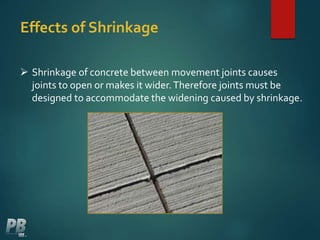
 Shrinkage of concrete between movement joints causes
joints to open or makes it wider.Therefore joints must be
designed to accommodate the widening caused by shrinkage.
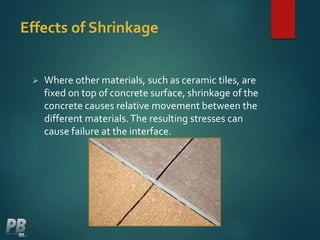
Effects of Shrinkage
 Where other materials, such as ceramic tiles, are
fixed on top of concrete surface, shrinkage of the
concrete causes relative movement between the
different materials.The resulting stresses can
cause failure at the interface.
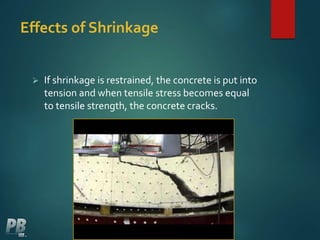
Effects of Shrinkage
 If shrinkage is restrained, the concrete is put into
tension and when tensile stress becomes equal
to tensile strength, the concrete cracks.
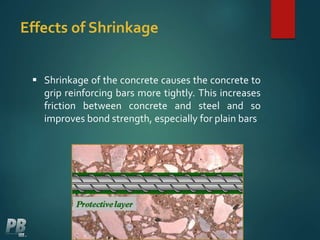
Effects of Shrinkage
 Shrinkage of the concrete causes the concrete to
grip reinforcing bars more tightly. This increases
friction between concrete and steel and so
improves bond strength, especially for plain bars
Effects of Shrinkage
 The deflection of flexural members is increased
by shrinkage. This is because the lightly
reinforced compression zone is free to shrink
more than heavily reinforced tension zone.
Effects of Shrinkage
 Shrinkage causes a reduction in pre-stressing force. When
calculating pre-stressing forces, designers take into account to
ensure that residual stress is structurally adequate.
Prevention of Shrinkage
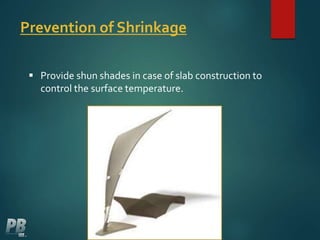
 Provide shun shades in case of slab construction to
control the surface temperature.
Prevention of shrinkage
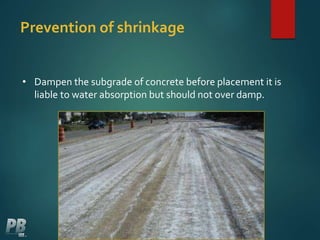
• Dampen the subgrade of concrete before placement it is
liable to water absorption but should not over damp.
Prevention of shrinkage
• Try to start the curing soon after finishing
Prevention of shrinkage
• Use chemical admixtures to accelerate the
setting time of concrete.
Conclusions
In order to avoid the negative impacts of long-
term creep and shrinkage:
1. Good understanding of creep and shrinkage
behaviors.
2. Accurate estimation of creep and shrinkage on
structural concrete design.
3. Proper counter measures of long-term creep and
shrinkage effects.
4. Implement simple structural details .
THANK YOU
Creep and shrinkage

Creep and shrinkage

  • 1.
    CREEP AND SHRINKAGEIN CONCRETE STRUCTURES PRESENTEDTO: MR. NOMAN IQBAL PRESENTED BY: GROUP#2 CET(09__18) http://uetrasul.uet.edu.pk University of Engineering and Technology, Rasul, Mandi Bahauddin, Pakistan
  • 2.
    Introduction Definitions  Creep istime dependent deformations of concrete under permanent loads (self weight), PT forces and permanent displacement.  When concrete is subjected to compressive loading it deforms instantaneously.This immediate deformation is called instantaneous strain. Now, if the load is maintained for a considerable period of time, concrete undergoes additional deformations even without any increase in the load.This time-dependent strain is termed as creep.
  • 3.
  • 4.
  • 5.
  • 6.
    Introduction Factors Affecting Creep Concrete mix proportion  Aggregate properties  Age at loading  Curing conditions  Cement properties  Temperature  Stress level
  • 7.
    Factors affecting creep 1..Concretemix proportion:  The amount of paste content and its quality is one of the most important factors influencing creep.  A poorer paste structure undergoes higher creep.  creep increases with increase in water/cement ratio.
  • 8.
    Factors affecting creep 1..Concretemix proportion:  creep is inversely proportional to the strength of concrete.  All other factors which are affecting the water/cement ratio are also affecting the creep.
  • 9.
    Factors affecting creep 2..Aggregateproperties:  Aggregate undergoes very little creep.  It is really the paste which is responsible for the creep.  Aggregates influence creep of concrete through a restraining effect on the magnitude of creep.
  • 10.
    Factors affecting creep 2..Aggregateproperties:  The higher the modulus of elasticity the less is the creep.  Light weight aggregate shows substantially higher creep than normal weight aggregate.
  • 11.
    Factors affecting creep 2..Aggregateproperties: Fine aggregates Coarse aggregates
  • 12.
    Factors affecting creep 3..Ageat loading  Age at which a concrete member is loaded will have a predominant effect on the magnitude of creep.  The quality of gel improves with time. Such gel creeps less.  Whereas a young gel under load being not so stronger creeps more.
  • 13.
    Factors affecting creep 3..Ageat loading  The moisture content of the concrete being different at different age also influences the magnitude of creep.
  • 14.
    Factors affecting creep 050 100 150 200 Instantaneous recovery Creep recovery Residual deformation 500 1000 1500 Strain on application of load Time since application of load - days Strain-10 -6
  • 15.
    Factors affecting creep 4..Curingcondition:  In view of the smallness of creep strains, the amount of water expelled during creep from the micro pores into the macro pores (or vice versa) must also be small, probably much less than 0.1 percent of the volume of concrete (since typically creep strains do not exceed 0.001, and even this is not due entirely to water but also to expelled solids).  Larger the curing smaller the creep.
  • 16.
  • 17.
    Factors affecting creep 5..Cementproperties:  The type of cement effects creep in so far as it influence the strength of the concrete at the time of application of load.  Fineness of cement affects the strength development at early ages and thus influence creep.
  • 18.
    Factors affecting creep 5..Cementproperties:  The finer the cement the higher its gypsum requirement so that re grinding of cement in laboratory without the addition of gypsum produces an improperly retarded cement, which exhibits high creep.
  • 19.
    Factors affecting creep 6..Temperature: The rate of creep increases with temperature up to about 700 C when, for a 1:7 mix and 0.6 w/c ratio.  It is approximately 3.5 times higher than at 210 C.  Between 700 C and 960 C it drops off to 1.7 times tan at 210 C.
  • 20.
    Factors affecting creep 6..Temperature: As far as low temperature is concerned, freezing produces a higher initial rate of creep but it quickly drops to zero.  At temperature between 100C and 300C, Creep is about one half of creep at 210C.
  • 21.
    Factors affecting creep 7..Stresslevel:  There is a direct proportion between creep and applied stress.  There is no lower limits of proportionality because concrete undergoes creep even at very low stress.  Higher the stress higher will be the creep.
  • 22.
  • 23.
    Creep Analysis Relationship betweencreep and elastic deformations cr = el = E28 where: cr = creep strain el = elastic strain = stress E28 = elastic modulus of concrete at age 28 days = creep factor
  • 24.
    4.0 3.5 3.0 2.5 2.0 1.5 3.72 3.03 2.57 2.22 2.00 1.70 1.44 1.0 0.5 0 3 714 21 28 42 56 3 4 5 6 9 1 1.5 2 3 5 Days Months Years 1.20 1.07 1.00 0.96 0.91 0.94 0.90 0.88 t DURATION OF LOADING TOTALELASTICANDCREEPSTRAIN
  • 25.
    Effects of creepon concrete structures  In reinforced concrete beams, creep increases the deflection with time and may be a critical consideration in design.
  • 26.
    Effects of creepon concrete structures  In eccentrically loaded columns, creep increases the deflection and can load to buckling.
  • 27.
    Effects of creepon concrete structures  Loss of pre stress due to creep of concrete in pre stressed concrete structure.
  • 28.
    Effects of creepon concrete structures  . Creep property of concrete will be useful in all concrete structures to reduce the internal stresses due to non-uniform load or restrained shrinkage.
  • 29.
    Effects of creepon concrete structures In mass concrete structures such as dams, on account of differential temperature conditions at the interior and surface, creep is harmful and by itself may be a cause of cracking in the interior of dams
  • 30.
    Introduction:  Definition:  Shrinkageis shortening of concrete due to drying and is independent of applied loads.  Shrinkage of concrete is the time-dependent strain measured in an unloaded and unrestrained specimen at constant temperature.
  • 31.
  • 32.
  • 33.
    Introduction Factors Affecting Shrinkage Drying conditions  Time  Water cement ratio
  • 34.
    Factors Affecting Shrinkage 1..Dryingconditions:  The most important factor is the drying condition or the humidity in the atmosphere.  No shrinkage will occur if the concrete is placed in one hundred percent relative humidity.
  • 35.
    Factors Affecting Shrinkage 2..Time: The shrinkage rate will decrease rapidly with time.  It has been documented that fourteen to thirty- four percent of the twenty year shrinkage will occur within two weeks of it being poured.  Within one year of the concrete being poured, shrinkage will be about sixty-six to eighty-five percent of the twenty year shrinkage.
  • 36.
    Factors Affecting Shrinkage 3..Watercement ratio:  The water to cement ratio will influence the amount of shrinkage that occurs.  The concrete’s richness also affects the shrinkage.  The process of swelling and then drying affects the concrete’s integrity and the shrinkage.
  • 37.
    Introduction: Types of shrinkage Plastic Shrinkage  Drying Shrinkage  Autogeneous Shrinkage  Carbonation Shrinkage
  • 38.
    Types of shrinkage 1..Plasticshrinkage:  Plastic shrinkage happens soon after the concrete is poured in the forms.  The water evaporates and results in a reduction of volume, this causes the concrete on the surface to collapse.  The aggregate particles or the reinforcement comes in the way of subsidence due to which cracks may appear at the surface or internally around the aggregate or reinforcement
  • 39.
    Types of shrinkage 1..Plasticshrinkage:  High water/cement ratio, badly proportioned concrete, rapid drying, greater bleeding, unintended vibration etc., are some of the reasons for plastic shrinkage.  Plastic shrinkage can be reduced mainly by preventing the rapid loss of water from surface.  It can be reduced by covering the surface with polyethylene sheeting immediately after it is poured.
  • 40.
  • 41.
  • 42.
  • 43.
    Types of shrinkage 2..Dryingshrinkage:  Just as the hydration of cement is an ever lasting process, the drying shrinkage is also an ever lasting process when concrete is subjected to drying conditions.  The loss of free water contained in hardened concrete, does not result in any appreciable dimension change.  It is the loss of water held in gel pores that causes the change in the volume
  • 44.
    Types of shrinkage 2..Dryingshrinkage:  Under drying conditions, the gel water is lost progressively over a long time, as long as the concrete is kept in drying conditions.  The magnitude of drying shrinkage is also a function of the fineness of gel.  The finer the gel the more is the shrinkage.  It has been pointed out earlier that the high pressure steam cured concrete with low specific surface of gel, shrinks much less than that of normally cured cement gel.
  • 45.
  • 46.
  • 47.
  • 48.
    Types of shrinkage 3..Autogeneousshrinkage:  In a conservative system i.e. where no moisture movement to or from the paste is permitted, when temperature is constant some shrinkage may occur.The shrinkage of such a conservative system is known as autogeneous shrinkage.  Autogeneous shrinkage is of minor importance and is not applicable in practice to many situations except that of mass of concrete in the interior of a concrete dam.
  • 49.
  • 50.
    Types of shrinkage 4..Carbonationshrinkage:  Carbonation shrinkage is a phenomenon very recently recognized and is very important.  Carbon dioxide present in the atmosphere reacts in the presence of water with hydrated cement.  Calcium hydroxide gets converted to calcium carbonate and also some other cement compounds are decomposed.
  • 51.
    Types of shrinkage 4..Carbonationshrinkage:  Such a complete decomposition of calcium compound in hydrated cement is chemically possible even at the low pressure of carbon dioxide in normal atmosphere.  Carbonation penetrates beyond the exposed surface of concrete only very slowly.  The rate of penetration of carbon dioxide depends also on the moisture content of the concrete and the relative humidity of the ambient medium.
  • 52.
    Types of shrinkage 4..Carbonationshrinkage:  Carbonation is accompanied by an increase in weight of the concrete and by shrinkage.  Carbonation shrinkage is probably caused by the dissolution of crystals of calcium hydroxide and deposition of calcium carbonate in its place.  As the new product is less in volume than the product replaced, shrinkage takes place.
  • 53.
  • 54.
  • 55.
    Creep and ShrinkageTypicalTime Curve Strain Strain Time Time Creep strain Instantaneous strain TYPICAL CREEP –TIMECURVE TYPICAL SHRINKAGE –TIMECURVE
  • 56.
    Effects of Shrinkage Shrinkage of concrete between movement joints causes joints to open or makes it wider.Therefore joints must be designed to accommodate the widening caused by shrinkage.
  • 57.
    Effects of Shrinkage Where other materials, such as ceramic tiles, are fixed on top of concrete surface, shrinkage of the concrete causes relative movement between the different materials.The resulting stresses can cause failure at the interface.
  • 58.
    Effects of Shrinkage If shrinkage is restrained, the concrete is put into tension and when tensile stress becomes equal to tensile strength, the concrete cracks.
  • 59.
    Effects of Shrinkage Shrinkage of the concrete causes the concrete to grip reinforcing bars more tightly. This increases friction between concrete and steel and so improves bond strength, especially for plain bars
  • 60.
    Effects of Shrinkage The deflection of flexural members is increased by shrinkage. This is because the lightly reinforced compression zone is free to shrink more than heavily reinforced tension zone.
  • 61.
    Effects of Shrinkage Shrinkage causes a reduction in pre-stressing force. When calculating pre-stressing forces, designers take into account to ensure that residual stress is structurally adequate.
  • 62.
    Prevention of Shrinkage Provide shun shades in case of slab construction to control the surface temperature.
  • 63.
    Prevention of shrinkage •Dampen the subgrade of concrete before placement it is liable to water absorption but should not over damp.
  • 64.
    Prevention of shrinkage •Try to start the curing soon after finishing
  • 65.
    Prevention of shrinkage •Use chemical admixtures to accelerate the setting time of concrete.
  • 66.
    Conclusions In order toavoid the negative impacts of long- term creep and shrinkage: 1. Good understanding of creep and shrinkage behaviors. 2. Accurate estimation of creep and shrinkage on structural concrete design. 3. Proper counter measures of long-term creep and shrinkage effects. 4. Implement simple structural details .
  • 67.