International Journal of Modern Engineering Research (IJMER)
                   www.ijmer.com          Vol.3, Issue.1, Jan-Feb. 2013 pp-275-283      ISSN: 2249-6645


         Power Management in Optimized Link State Routing (OLSR)
                                Protocol

                              Dharam Vir, 1 Dr. S.K.Agarwal, 2 Dr. S.A.Imam3
              12
                   Department of Electronics Engg, YMCA University of Science & Technology, Faridabad, India
                      3
                        Department of Electronics & Comm. Engg., Jamia Millia Islamia, New Delhi, India

Abstract: In most pioneering topics in computer communications is wireless networking. One area in wireless networking is
mobile ad hoc networking. The concept of mobile ad hoc networking is based on the fact that users can communicate with
each other in network, without any form of centralized administration. In a mobile ad hoc network, nodes are often powered
by batteries. Every message can send and every computation performed drains the battery life. One solution for power
conservation in mobile ad hoc network is power management. This means that routing decisions made by the routing
protocol should be based on the power-status of the nodes. Nodes with low batteries will be less preferably for forwarding
packets than nodes with full batteries, thus increasing the life of the nodes. A routing protocol should try to minimize control
traffic, such as periodic update messages to improve the lifetime of the nodes and network. Power management in wireless
networks deals with the process of managing energy resources by means of controlling the battery discharge, adjusting the
transmission power, and scheduling of power sources. We efforts to solve this problem here we can describe the power
management issues in mobile nodes to modified Optimized Link State Routing (OLSR) protocol and it was designed on
QualNet 5.0 simulator. The modification is done in effect of power management issue in modified OLSR and existing OLSR
routing protocol with the metrics like power consumes in all three modes transmit, received and ideal modes, TC message
received, Hello message received, signal received and forward to MAC, signal received but with errors and power
consumption have been used. For simulation purpose QualNet5.0 has been used as the tool.

Keywords: Ad hoc wireless Networks, Power Management, Optimized Link State Routing (OLSR), QualNet 5.0 simulator.

                                                  I. INTRODUCTION
          Wireless sensor networks (WSN’s) have attracted a great deal of research attention due to their wide-range of
prospective applications. Applications of wireless sensor networks contain battlefield surveillance, medical monitoring,
biological detection, inventory tracking and home security. This type of network consists of collection of nodes and each
node has limited battery power capacity. There may be many possible routes available between two nodes over which data
can be able to flow. Assume that each node generated some information and this information needs to be delivered to a
destination node. Any node in the network can easily transmit their data packet to a distance node, if it has enough battery
power. If any node is far from its neighbour node then large amount of transmission power is required to transmit the data
from source to destination. After every transmission, remaining power of this node decreases and some amounts of data
transmission of this node will be eliminated from the network because of empty battery power and in similar situation there
will be a condition that no node is available for data transmission and overall lifetime of network will decreases [1].
          Existing power awareness routing protocols can generally classified as a power management or power control
protocol. In IEEE 802.11 there is already a type of power management implemented. The implantation of power awareness
routing in this task is only focusing on power control management schemes. However, to make power management schemes
for mobile ad hoc networks is most effective, an efficient message routing algorithms, coupled with good solutions for
optimizing power consumption during the transmit, received and idle modes of data. In power control routing protocols
several metrics can be used to optimize power management in routing. Minimizing the energy consumed for each message is
an evident solution that optimizes locally the power consumption. An effective routing protocol should not only focus on
individual nodes in the system but also focus on the system as a whole. The nodes have high residual power but the system is
not connected because some critical nodes have been depleted of power. Different routing schemes can be utilized, but the
two most extreme solutions to power awareness routing for a message are [1] [2]:

   Compute a path that maximizes the minimal power consumption; the path that requires the least power to transmit and
    receive a message, hereby keeping the power consumption needed to communicate as low as possible [3].
   Compute a path that maximizes the minimal residual power in the network; the path according to the residual energy of
    the nodes, hereby maximizing the lifetime of all nodes and the lifetime of the network.

     In particular, Section II presents the need for power management in mobile ad-hoc networks and optimization of power.
Section III briefly discusses the MANET routing protocols and functionality of Optimized Link State Routing (OLSR).
Section IV Simulation platform and models, result analysis are discussed in Section V. Finally, Section VI conclusion and
future work.


                                                         www.ijmer.com                                               275 | Page
International Journal of Modern Engineering Research (IJMER)
                 www.ijmer.com          Vol.3, Issue.1, Jan-Feb. 2013 pp-275-283      ISSN: 2249-6645

                              II. NEED FOR POWER MANAGEMENT IN MANETS
          The nodes in an ad hoc wireless network are constrained but limited battery power for their operation. Hence,
power management is an important issue in ad hoc networks. Power management is the process of managing power
resources by means of controlling the battery recharge, adjusting the transmission power, and scheduling of power sources
so as to increase the lifetime of the nodes of an ad hoc wireless network. The power efficiency of a node is defined as the
ratio of the amount of data delivered but the node to the total power finished [3] [12].
The reasons for power management in ad hoc wireless networks are:
 Increasing gap between the power consumption and requirements of power availability, so need to the power
     management.
 Difficult to replace or recharge the batteries. Hence, power conservation is necessary in such scenarios.
 The relay traffic allowed through a destination node is more, and then it may leads to a faster depletion of the power
     source for that node.
 The best possible value for the transmission power increases the number of real-time transmissions.
 Power control is essential to maintain the required signal to interference ratio at the receiver and to increase the channel
     capability.
 Power consumption of a wireless radio depends on the operation mode. Four types of operation modes of a radio can be
     categorized: (i) transmit mode, (ii) receive mode, (iii) idle mode, and (iv) sleep mode.
 Batteries are likely to increase the size and weight of a mobile node, to reduce the size of the battery, power
     management techniques are necessary to utilize the maximum battery capacity in the best potential way.
 The power level of a battery is finite and limits the lifetime of a node. Every message sent and every computation
     performed drains the battery, need to power management in network.

A. Classification of Power Management Schemes:
         To increase the life of an ad hoc wireless network, it is required to be aware of the capabilities and limitations of the
power resources of the nodes. For longer lifetime of the node can be achieved by increasing the battery capacity. Increasing
the capacity of the battery at the nodes can be achieved by either battery management, which concerns the internal
characteristics of the battery, or power management, which deals with maximum utilization of battery capacity [4].


                                     Fig. 1 Classification of Power Management Schemes

         The routing protocol must be designed such a way to reduce the amount of information exchanged among the
nodes, since communication incurs loss of power. Increase in the number of communication tasks also increases the traffic in
the network, which results in loss of data, retransmissions, and hence more energy consumption. The power consumption
occurs at the network layer is because of communication and calculation operations. The power conserved in communication
operations is due to transmit-receive module present in the source and destination nodes [4] [11].

B. Optimization of power [3][8]:
In mobile ad hoc networking the optimization of power consumption can be divided according to functionality into:
 The maximum power utilized for the transmission of a message.
 The maximum power utilized for the reception of a message;
 The minimum power utilized while the system is idle.
 Reducing the access amount of data transmitted across the network.
 Lower the transceiver duty cycle range.
 Lower the frequency of data transmission.
 Reduce the frame overhead.
 Implementation of reliable power management techniques.
 Reduce redundant transmission.

                                                          www.ijmer.com                                                276 | Page
International Journal of Modern Engineering Research (IJMER)
                www.ijmer.com          Vol.3, Issue.1, Jan-Feb. 2013 pp-275-283      ISSN: 2249-6645

  Reduce calculation overhead.
  For powerful routing protocol, reduce the number of retransmission across the network can be controlled effectively.
  Evaluating node density, congestion and network availability.
  For utilizing effective routing algorithm, network life time and energy will be conserved and redundant transmission
   will be reduced [13].
We suggest two corresponding optimization technique for control and manage the power consumption in ad-hoc networks:
 Optimized minimum power consumption during the idle time by switching to sleep mode; this is known as Power
   Management [5].
 Optimized minimum power consumption during communication, that is, while the system is transmitting and receiving
   messages; this is known as Power Control [5] [14].

                         III. MOBILE AD HOC NETWORK ROUTING PROTOCOLS
        There are lots of ways to classify the MANET routing protocols depending on how the protocols to hold the packet
and to deliver from source to destination. But Routing protocols are broadly classified into three types such as Proactive,
Reactive and Hybrid protocols.

A. Proactive Protocols
         These types of protocols are also called table driven protocols in which, the route to all the nodes is maintained in
routing table. Packets are transferred over the predefined route specified in the routing table. These protocols have lower
latency because all the routes are maintained at all the times. Example of Proactive protocols: Bellman Ford, DSDV, EIGRP
(Enhanced Interior Gateway Routing Protocol) OLSR (Optimized Link State Routing) [6] [7].

B. Reactive Protocols
         These types of protocols are also called as On Demand Routing Protocols where the routes are not predefined for
routing. A Source node calls for the route discovery phase to determine a new route whenever a transmission is needed. This
is a repetitive technique until it reaches the destination. Reactive techniques have smaller routing overheads but higher
latency. Example of Reactive Protocols: DSR, AODV, DYMO etc [5].

C. Hybrid Protocols
         Hybrid protocol is the combinations of reactive and proactive protocols and takes advantages of these two protocols
and as a result, routes are found rapidly in the routing zone. Example Protocol: ZRP (Zone Routing Protocol) [10].

1) OPTIMIZED LINK STATE PROTOCOL:
         The Optimized Link State Routing (OLSR) protocol, developed by the French National Institute for Research in
Computer Science and Control (INRIA), was developed for mobile ad-hoc networks. It operates in a table-driven and
proactive manner, i.e., topology information is exchanged between the nodes on periodic basis. Its main objective is to
minimize the control traffic by selecting a small number of nodes, known as Multi Point Relays (MPR) for flooding
topological information. In route calculation, these MPR nodes are used to form an optimal route from a given node to any
destination in the network. This routing protocol is particularly suited for a large and dense network. OLSR generally
proposes four types of periodic control messages, namely [6] [15]:
 Hello messages
 Topology Control (TC) messages
 Multiple Interface Declaration (MID) messages
 Host and Network Association (HNA) messages.

a)       Hello messages:
         OLSR [18] uses two kinds of the control messages: Hello and Topology Control (TC). Hello messages are
periodically exchanged within the one-hop neighborhood to obtain the neighborhood information. Using this neighborhood
information, each node in the network selects a subset of one-hop away neighbors known as the MPR set. In the MPR set, all
two-hop away neighbors are reachable through any member of the MPR set. Hello messages are used for finding the
information about the link status and the host’s neighbours. With the Hello message the Multipoint Relay (MPR) Selector set
is constructed which describes which neighbours has chosen this host to act as MPR and from this information the host can
calculate its own set of the MPRs. the Hello messages are sent only one hop away but the TC messages are broadcasted
throughout the entire network. TC messages are used for broadcasting information about own advertised neighbours which
includes at least the MPR Selector list.

b)        Topology Control (TC) messages:
          TC messages are generated and retransmitted for flooding topological information in the whole network only
through MPR nodes. Also, MID and HNA messages are relayed only by MPR nodes. Therefore, OLSR optimizes the control
traffic overhead by minimizing the size of the MPR set. An MPR member generates and retransmits TC messages. These
messages provide each node in the network with sufficient link-state information to allow route calculation [17] [18].

                                                        www.ijmer.com                                              277 | Page
International Journal of Modern Engineering Research (IJMER)
                www.ijmer.com          Vol.3, Issue.1, Jan-Feb. 2013 pp-275-283      ISSN: 2249-6645

c)        Multiple Interface Declaration (MID) messages:
          MID messages are generated by an OLSR node with multiple OLSR interfaces to notify other OLSR nodes about
its interfaces participating in the OLSR routing domain. There is also Multiple Interface Declaration (MID) messages which
are used for informing other host that the announcing host can have multiple OLSR interface addresses. The MID message is
broadcasted throughout the entire network only by MPRs [18].
          Apart from these OLSR control messages, a node associated with OLSR MANET and non-OLSR MANET
periodically issues HNA messages notifying the connected non-OLSR Networks. These HNA messages are also flooded
throughout the OLSR domain by the MPR nodes so that the external routes are learned by all the OLSR nodes.

                                         Table 1 Description of OLSR parameters:
                                  Parameters                               Description
                          OLSR-HELLO-INTERVAL              Specifies the time interval between two
                                                           consecutive HELLO messages within one-
                                                           hop    neighborhood      to  obtain the
                                                           neighborhood information.
                          OLSR-TC-INTERVAL                 Specifies the time interval between two
                                                           consecutive TC messages.
                          OLSR-MID-INTERVAL                Specifies the time interval between two
                                                           consecutive MID messages. MID messages
                                                           will be broadcasted only when an OLSR
                                                           node has multiple OLSR interfaces.
                          OLSR-HNA-INTERVAL                Specifies the time interval between two
                                                           consecutive    HNA      messages.   HNA
                                                           messages will be broadcasted only when an
                                                           OLSR node has non-OLSR interface.

          So the topological changes cause the flooding of the topological information to all available hosts in the network.
To reduce the possible overhead in the network protocol uses Multipoint Relays (MPR). The idea of MPR is to reduce
flooding of broadcasts by reducing the same broadcast in some regions in the network, more details about MPR can be found
later in this chapter. Another reduce is to provide the shortest path. The reducing the time interval for the control messages
transmission can bring more reactivity to the topological changes.

d)       Host and Network Association (HNA) messages:
There is also a “Host and Network Association” (HNA) message which provides the external routing information by giving
the possibility for routing to the external addresses. The HNA message provides information about the network- and the net
mask addresses, so that OLSR host can consider that the announcing host can act as a gateway to the announcing set of
addresses. The HNA is considered as a generalized version of the TC message with only difference that the TC message can
inform about route canceling while HNA message information is removed only after expiration time [9].

(1)     Multipoint Relays Selection:
        In this section the proposed algorithm for the selection of Multipoint Relay set is described. This algorithm is found
from [9]. Hello message can be chosen to act as MPR. The neighbour must be symmetric in order to become an MPR.
Proposed algorithm for selecting Multipoint Relay set:
 Take all the symmetric one hop neighbours which are willing to act as an MPR.
 Calculate for every neighbour host a degree, which is a number of the symmetric neighbours, that are two hops way
    from the calculating source and does not include the source or its one hop neighbours.
 Add the neighbour symmetric host to the MPR set. If it is the only neighbour from which is possible to get to the
    specific two hop neighbour, then remove the chosen host neighbours from the two hop neighbour set.
 If there are still some hosts in the two hop neighbour set, then calculate the reach ability of the each one hop neighbour,
    meaning the number of the two hop neighbours, that are yet uncovered by MPR set.
 Repeat previous step until the two hop neighbours set is empty.
 For the optimization, set the hosts in the MPR set in the increasing order basing on the willingness. If one host is taken
    away and all the two hop neighbours,

(2)       Topology Information [15]:
          In order to exchange the topological information and build the topology information base the host that were selected
as MPR need to sent the topology control (TC) message. The TC messages are broadcasted throughout the network and only
MPR are allowed to forward TC messages. The TC messages are generated and broadcasted periodically in the network. The
TC message is sent by a host in order to advertise own links in the network. The host must send at least the links of its MPR
selector set. The TC message includes the own set of advertised links and the sequence number of each message.


                                                        www.ijmer.com                                              278 | Page
International Journal of Modern Engineering Research (IJMER)
                www.ijmer.com          Vol.3, Issue.1, Jan-Feb. 2013 pp-275-283      ISSN: 2249-6645

(3)      Control traffic [15]:
All OLSR control traffic is to be transmitted over UDP. This traffic is to be broadcasted when using IPv4, but no broadcast
address is specified.

(4)      Routing Table Calculations:
         The host maintains the routing table, the routing table entries have following information: destination address, next
address, number of hops to the destination and local interface address. Next address indicates the next hop host. The
information is got from the topological set (from the TC messages) and from the local link information base (from the Hello
messages) [15].

                                 IV. SIMULATION PLATFORM AND MODELS
         In QualNet 5.0 [16] [17], a precise network topology is referred to as a scenario. A scenario allows the user to
denote all the network components and environment under which the network will operate. This includes: terrain details,
channel propagation effects including path loss, battery model, fading, and shadowing, wired and wireless subnets, network
devices such as hubs, switches and routers, the whole protocol stack selection of standards or user-configured network
components, and applications running on the network. In this work QualNet 5.0 network simulator has been used to design
modify OLSR routing protocol or an existing OLSR routing protocol of mobile ad-hoc networks. The physical medium used
is 802.11 PHY with a data rate of 2 Mbps. The MAC protocol used is the 802.11 MAC protocol, configured for MANET
mode. In this work wireless module of IEEE 802.11b is used to enable mobility of the wireless nodes. IEEE
802.11b support more accurate wireless models for propagation, path loss, multi-path fading and reception on wireless
networks. The simulations are carried out for network densities of 100 nodes respectively in 10 intervals. The area
considered for the above network densities are 1500m * 1500m. Simulations scenarios is design for modification in OLSR
and existing OLSR routing protocol for power management with the metrics like power consumes in all three modes
transmit, received and ideal modes, TC message received, Hello message received, signal received and forward to MAC,
signal received but with errors. The parameters and description is given in table1. Fig. 2 shows the running designed
scenario for modify OLSR routing protocol with number of CBR’s and nodes.

                      Table 2: Traffic and Mobility parameters for modified OLSR routing protocol.
         Parameter            Short Description                                                 Value/Type
         Topological Area     Represents topology or arrangement of mobile nodes. 1500 *1500 m2
                              Determined in x & y axis. Also known as network size or
                              dimensional area. Measured in
         No. of nodes         Nodes are communication devices or routers.                       1-100
         Pause time           The maximum amount of time, a node stays before a new 10, 20, 40
                              direction and speed is selected
         Max. speed           Maximum mobility speed of a node. Measured in meter/second. 20 m/s
         Transmission         Radio transmission range allows a mobile node to send & 250 m
         range                receive radio signals. Measured in meters
         Mobility pattern     Define movement of nodes, which is characterized by speed, Random way
                              direction, and rate of change                                     point
         Application          Denote the traffic type to be used i.e. CBR stands for constant CBR
                              bit rate. Used for real time traffic.
         PHY                  PHY stands for physical layer. 802.11b is basically IEEE 802.11b
                              wireless standard
         Packet size          Node sends & receives data in the form of packet. Measured in 512 kB
                              kilobytes.
         Packet               Every traffic source sends a packet at specific rate that is 2
         transmission rate    measured in packet/second.                                        Packets/second
         Simulation time      Total duration for which simulation runs.                         400 s
         No. of CBR           Total number of CBR connections that can be established 10
                              among different mobile nodes for communication.
         Nodes                Mobile or fixed routers with wireless receivers or wireless 100
                              transmitters which are free to move arbitrarily
         Battery Model        Battery rate capacity effect: the model which precisely estimates Linear Model
                              non-linearity effect of rated capacity versus discharge current
                              load.
         Start/ End Time      Time when the conversation ends. If end time is specified as 0, Variable
                              then conversation continue until the end of simulation.
         Simulation time      Length of simulation and time when scenario complete task.        1800 seconds


                                                        www.ijmer.com                                              279 | Page
International Journal of Modern Engineering Research (IJMER)
                www.ijmer.com          Vol.3, Issue.1, Jan-Feb. 2013 pp-275-283      ISSN: 2249-6645


Fig. 2 Snapshot of running designed scenario for modifies OLSR routing protocol with number of CBR’s and nodes.

                                              V. RESULT AND ANALYSIS
A. TC Message Received:
         Specifies the time interval between two consecutive TC messages. The TC messages are broadcasted throughout the
network and only MPR are allowed to forward TC messages. The TC messages are generated and broadcasted periodically
in the network. Host can increase its transmission rate to become more sensible to the possible link failures. When the
change in the MPR Selector set is noticed, it indicates that the link failure has happened and the host must transmit the new
TC message as soon as possible

                                                                          TC Message Received Vs No. of Nodes

                                                1000
                          TC Message Received


                                                 800

                                                 600                                                                 Modify OLSR Routing Protocol
                                                 400                                                                 OLSR Routing Protocol

                                                 200

                                                      0
                                                           10   20   30     40      50   60     70   80   90   100
                                                                                 No. of Nodes


                                                Fig. 3 TC Message received with varying nodes and OLSR routing protocols.

   Fig. 3 shows the impact variation of TC Message received with in modified OLSR routing protocol as parameter and
    also variation in no. of nodes. Following inference can be made:
   By observation from graph and analysis of designed scenario observation efforts trying minimize the link failures
    between nodes, so lifetime of nodes increases, and also saves power consumption. Hence overall performance of power
    may increases. In modified OLSR link failure less as compare OLSR routing.
   The maximum transmission rates also increase in modified OLSR and consume less power by OLSR.

B. Hello Message Received:
        Specifies the time interval between two consecutive HELLO messages within one-hop neighborhood to obtain the
neighborhood information.
                                                                     Hello Message Received Vs No. of Nodes

                                                250
                     Hello Message Received


                                                200

                                                150                                                                  Modify OLSR Routing Protocol
                                                100                                                                  OLSR Routing Protocol

                                                 50

                                                  0
                                                          10    20   30     40     50    60     70   80   90   100
                                                                                 No. of Nodes


                                    Fig. 4 Hello Message received with varying nodes and OLSR routing protocols.


                                                                                              www.ijmer.com                                         280 | Page
International Journal of Modern Engineering Research (IJMER)
                www.ijmer.com          Vol.3, Issue.1, Jan-Feb. 2013 pp-275-283      ISSN: 2249-6645

   Fig. 4 shows the impact variation of Hello message received with in modified OLSR routing protocol as parameter and
    also variation in no. of nodes. Following inference can be made:
   By observation from graph and analysis of designed scenario observation efforts for trying minimize the time interval
    between the nodes for sending information, so lifetime and scalability of nodes increases, and also saves power
    consumption. In modified OLSR the message send ratio increases with time and also increases message sending ratio as
    compare OLSR routing.

C. Signal Received but with errors:
         Number of incoming signals the radio failed to receive. PHY model is a simple radio model that supports either
Signal-to-Noise Ratio (SNR) or Bit Error Rate (BER) based reception.
 Fig. 5 shows the impact variation of Signal Received but with errors in modified OLSR routing protocol as parameter
    and also variation in no. of nodes. Following inference can be made:
 By observation from graph and analysis of designed scenario observation efforts for trying minimize the errors when 1
    mbps data received from source node to destination. In modified OLSR the errors less then as compare OLSR routing.


                                                              Signal Received but with Errors Vs No of Nodes

                                                  6000
                       Signal Received but with


                                                  5000
                                                  4000
                                 Erros


                                                                                                              Modify OLSR Routing Protocol
                                                  3000
                                                                                                              OLSR Routing Protocol
                                                  2000
                                                  1000
                                                     0
                                                         10   20   30   40     50   60   70   80   90   100
                                                                             No. of Nodes

                   Fig. 5 Signal received but with errors with varying nodes and OLSR routing protocols.

D. Signal Received and Forwards to MAC:
Number of incoming signals successfully received and forwarded to MAC.
 Fig. 6 shows the impact variation of Signal received and forwards to MAC in modified OLSR routing protocol as
   parameter and also variation in no. of nodes. Following inference can be made:
 By observation from graph and analysis of designed scenario observation efforts for trying incoming signals received
   from source node to destination node are successfully received and forwarded to MAC. In modified OLSR the received
   signals more then as compare OLSR routing.


                                                         Signal Received and Forwards to MAC Vs No. of Nodes

                                                  3500
                    Signal Received and


                                                  3000
                      Forward to MAC


                                                  2500
                                                  2000                                                        Modify OLSR Routing Protocol
                                                  1500                                                        OLSR Routing Protocol
                                                  1000
                                                  500
                                                    0
                                                         10   20   30   40     50   60   70   80   90   100
                                                                         No. of Nodes

               Fig. 6 Signal received and forwards to MAC with varying nodes and OLSR routing protocols.

Power Consumption:
          This is the ratio of the average power consumed in each node to total power. The lifetime, scalability, response time
and effective sampling frequency, all of these parameters of the wireless sensor network depend upon the power. Power
failure regularly breaks in the network. Energy is required for maintaining the individual health of the nodes, during
receiving the packets and transmitting the data as well.

                                                                                     www.ijmer.com                                           281 | Page
International Journal of Modern Engineering Research (IJMER)
               www.ijmer.com          Vol.3, Issue.1, Jan-Feb. 2013 pp-275-283      ISSN: 2249-6645

E. Power Consumed in Transmit Mode:
                                                                 Power Consumed in Transmit Mode Vs No. of Nodes

                                               0.02


                  Transmit Mode (mw)
                  Power Consumed in
                                         0.015
                                                                                                                                                                   OLSR Routing Protocol
                                               0.01
                                                                                                                                                                   Modify OLSR Routing
                                                                                                                                                                   Protocol
                                         0.005

                                                         0
                                                                 10        20        30        40        50        60        70        80        90        100
                                                                                                    No. of Nodes


                Fig. 7 Power consumed in transmit mode with varying nodes and OLSR routing protocols.

   Fig. 7 shows the impact variation of Power consumption in transmit mode with modified OLSR routing protocol as
    parameter and also variation in no. of nodes. Following inference can be made:
   By observation from graph and running scenario the maximum power consumed when distance of nodes is longer,
    hence overall performance of power manage of modified OLSR consumes less power as compare OLSR routing.
   The maximum power consumes by OLSR which is tailed by manage OLSR routing protocol.

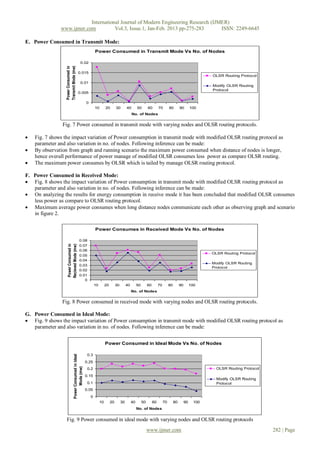
F. Power Consumed in Received Mode:
 Fig. 8 shows the impact variation of Power consumption in transmit mode with modified OLSR routing protocol as
   parameter and also variation in no. of nodes. Following inference can be made:
 On analyzing the results for energy consumption in receive mode it has been concluded that modified OLSR consumes
   less power as compare to OLSR routing protocol.
 Maximum average power consumes when long distance nodes communicate each other as observing graph and scenario
   in figure 2.

                                                                 Power Consumes in Received Mode Vs No. of Nodes

                                            0.08
                    Power Consumed in
                    Recieved Mode (mw)


                                            0.07
                                            0.06
                                                                                                                                                                   OLSR Routing Protocol
                                            0.05
                                            0.04
                                                                                                                                                                   Modify OLSR Routing
                                            0.03
                                                                                                                                                                   Protocol
                                            0.02
                                            0.01
                                               0
                                                                 10        20        30        40        50        60        70        80        90        100
                                                                                                    No. of Nodes


                Fig. 8 Power consumed in received mode with varying nodes and OLSR routing protocols.

G. Power Consumed in Ideal Mode:
 Fig. 9 shows the impact variation of Power consumption in transmit mode with modified OLSR routing protocol as
   parameter and also variation in no. of nodes. Following inference can be made:


                                                                           Power Consumed in Ideal Mode Vs No. of Nodes

                                                          0.3
                               Power Consumed in Ideal


                                                         0.25
                                     Mode (mw)


                                                          0.2                                                                                                        OLSR Routing Protocol

                                                         0.15
                                                                                                                                                                     Modify OLSR Routing
                                                          0.1                                                                                                        Protocol
                                                         0.05
                                                             0
                                                                      10        20        30        40        50        60        70        80        90     100
                                                                                                         No. of Nodes


                  Fig. 9 Power consumed in ideal mode with varying nodes and OLSR routing protocols
                                                                                                                   www.ijmer.com                                                             282 | Page
International Journal of Modern Engineering Research (IJMER)
                  www.ijmer.com          Vol.3, Issue.1, Jan-Feb. 2013 pp-275-283      ISSN: 2249-6645

      By observation from graph and running scenario the over all power consumed when distance of nodes is longer, hence
       overall performance of power manage by modified OLSR consumes less power as compare OLSR routing.
      The maximum power consumes by OLSR which is tailed by manage OLSR routing protocol.

                                                      VI. CONCLUSION
         In this article, the important issue of power management in Optimized Link State Routing (OLSR), mobile ad-hoc
wireless network is discussed. Since mobile nodes have limited battery lives, mobile networks should consume battery
power more efficiently to maximize the network life, battery power capacity, transmission power consumption, stability of
routes etc. We efforts to solve the problem of reduce the power consumption through power management issues in mobile ah
hoc network by modified Optimized Link State Routing (OLSR) protocol and results shown as above. The modified OLSR
routing protocol to minimize control traffic, periodic TC messages update, remaining battery power capacity, controlling the
battery discharge to improve the power consumption in all modes. The future scope of this protocol is to successfully
simulate it for a very large network and implement it with a voice application. For feature work we proposed to reduce the
power consumption in Reactive routing protocol is tested with less number of packets and only for packet level power
consumption for a very large network.

                                                             REFERENCES
[1]     Al-Maashri A. and M.Ould-Khaoua. 2006. “Performance Analysis of MANET Routing Protocols in the Presence of
        Self-Similar       Traffic”, In Proceedings of the 31st IEEE Conference on Local Computer Networks, Tampa, Florida,
        USA. pp. 803-806.
[2]     V. Raghunathan, C. Schurgers, S. Park, and M. B. Srivastava. Energy-aware wireless microsensor networks. IEEE
        Signal Processing Magazine, 19:40–50, 2002.
[3]     Azzedine Boukerche “Performance Evaluation of Routing Protocols for Ad Hoc Wireless Networks”, Mobile
        Networks and Applications 9, 333–342, 2004 ONT K1N- 6N5, Canada
[4]     S.W. Arms, C.P. Townsend, D.L. Churchill, J.H. Galbreath, S.W. Mundell , “Power Management for Energy
        Harvesting Wireless Sensors ” SPIE Int’l Symposium on Smart Structures & Smart Materials.
[5]     Kuppusamy, P.Thirunavukkarasu, K. Kalavathi B.; “A study and comparison of OLSR, AODV and TORA routing
        protocols in ad hoc networks” 2011 3rd IEEE international Conference on Electronics Computer Technology (ICECT),
        Issue Date: 8-10 April 2011 On page(s): 143 – 147.
[6]     Muktadir A.H.A. 2007. “Energy Consumption study of OLSR and DYMO MANET Routing Protocols” in Urban Area,
        National Conference on Communication and Information Security, Daffodil International University, Dhaka,
        Bangladesh. Pp.133-136.
[7]     Reddy P.C. and P.C. Reddy. 2006. “Performance Analysis of Ad Hoc Network Routing Protocols”, Academic Open
        Internet Journal, Volume 17.
[8]     HuseyinOzgur Tan and Ibrahim Korpeoglu, “Power Efficient Data Gathering and Aggregation in Wireless Sensor
        Networks”
[9]     R.L.Cruz and A.R.Santhanam, “Optimal Routing, Link Scheduling, and power control in Multi-Hop Networks”,
        Proceedings of INFOCOM 2003, vol. 1, pp. 702-711, April 2003.
[10]    C.K Toh, “Maximizing Battery Life Routing to Support Ubiquitous Mobile Computing in Wireless Ad Hoc
        Networks”, IEEE Communications Magazine, vol.39, no.6, pp. 138-147, June 2001.
[11]    Yunxia Chen, Student Member, IEEE, and Qing Zhao, Member, IEEE “On the Lifetime of Wireless Sensor Networks”
        IEEE Communications Letters, VOL. 9, NO. 11, November 2005.
[12]    Murthy and Garcia-Luna-Aceves, "An Efficient Routing Protocol for Wireless Networks", ACM Mobile Networks and
        App. J., Special Issue on Routing in Mobile Communication Networks, Oct. 1996, pp. 183-97.
[13]    Xu, Heidemann, Estrin, “Adaptive Energy-Conserving Routing for Multihop Ad Hoc Networks”, 2000
[14]    V. Rishiwal, M. Yadav and S. Verma, “Power Aware Routing to support Real Time Traffic in Mobile Ad-hoc
        Networks”, International Conference on Emerging Trends in Engg & Tech., IEEE, pp. 223-227, 2008
[15]    Clausen, T., Jacquet, P, Optimized Link State Routing Protocol, IETF Internet Draft, Jan2003,
        http://menetou.inria.fr/draft-ietf-manet-olsr-11.txt
[16]    QualNet documentation, ”QualNet 5.0 Model Library:Wireless”; http://www.scalablenetworks.com,
[17]    “Qualnet 5.0,” http://www.scalable-networks.com,
[18]    Wireless routing protocols www.wikipedia.com


                                                        www.ijmer.com                                            283 | Page

Bt31275283

  • 1.
    International Journal ofModern Engineering Research (IJMER) www.ijmer.com Vol.3, Issue.1, Jan-Feb. 2013 pp-275-283 ISSN: 2249-6645 Power Management in Optimized Link State Routing (OLSR) Protocol Dharam Vir, 1 Dr. S.K.Agarwal, 2 Dr. S.A.Imam3 12 Department of Electronics Engg, YMCA University of Science & Technology, Faridabad, India 3 Department of Electronics & Comm. Engg., Jamia Millia Islamia, New Delhi, India Abstract: In most pioneering topics in computer communications is wireless networking. One area in wireless networking is mobile ad hoc networking. The concept of mobile ad hoc networking is based on the fact that users can communicate with each other in network, without any form of centralized administration. In a mobile ad hoc network, nodes are often powered by batteries. Every message can send and every computation performed drains the battery life. One solution for power conservation in mobile ad hoc network is power management. This means that routing decisions made by the routing protocol should be based on the power-status of the nodes. Nodes with low batteries will be less preferably for forwarding packets than nodes with full batteries, thus increasing the life of the nodes. A routing protocol should try to minimize control traffic, such as periodic update messages to improve the lifetime of the nodes and network. Power management in wireless networks deals with the process of managing energy resources by means of controlling the battery discharge, adjusting the transmission power, and scheduling of power sources. We efforts to solve this problem here we can describe the power management issues in mobile nodes to modified Optimized Link State Routing (OLSR) protocol and it was designed on QualNet 5.0 simulator. The modification is done in effect of power management issue in modified OLSR and existing OLSR routing protocol with the metrics like power consumes in all three modes transmit, received and ideal modes, TC message received, Hello message received, signal received and forward to MAC, signal received but with errors and power consumption have been used. For simulation purpose QualNet5.0 has been used as the tool. Keywords: Ad hoc wireless Networks, Power Management, Optimized Link State Routing (OLSR), QualNet 5.0 simulator. I. INTRODUCTION Wireless sensor networks (WSN’s) have attracted a great deal of research attention due to their wide-range of prospective applications. Applications of wireless sensor networks contain battlefield surveillance, medical monitoring, biological detection, inventory tracking and home security. This type of network consists of collection of nodes and each node has limited battery power capacity. There may be many possible routes available between two nodes over which data can be able to flow. Assume that each node generated some information and this information needs to be delivered to a destination node. Any node in the network can easily transmit their data packet to a distance node, if it has enough battery power. If any node is far from its neighbour node then large amount of transmission power is required to transmit the data from source to destination. After every transmission, remaining power of this node decreases and some amounts of data transmission of this node will be eliminated from the network because of empty battery power and in similar situation there will be a condition that no node is available for data transmission and overall lifetime of network will decreases [1]. Existing power awareness routing protocols can generally classified as a power management or power control protocol. In IEEE 802.11 there is already a type of power management implemented. The implantation of power awareness routing in this task is only focusing on power control management schemes. However, to make power management schemes for mobile ad hoc networks is most effective, an efficient message routing algorithms, coupled with good solutions for optimizing power consumption during the transmit, received and idle modes of data. In power control routing protocols several metrics can be used to optimize power management in routing. Minimizing the energy consumed for each message is an evident solution that optimizes locally the power consumption. An effective routing protocol should not only focus on individual nodes in the system but also focus on the system as a whole. The nodes have high residual power but the system is not connected because some critical nodes have been depleted of power. Different routing schemes can be utilized, but the two most extreme solutions to power awareness routing for a message are [1] [2]:  Compute a path that maximizes the minimal power consumption; the path that requires the least power to transmit and receive a message, hereby keeping the power consumption needed to communicate as low as possible [3].  Compute a path that maximizes the minimal residual power in the network; the path according to the residual energy of the nodes, hereby maximizing the lifetime of all nodes and the lifetime of the network. In particular, Section II presents the need for power management in mobile ad-hoc networks and optimization of power. Section III briefly discusses the MANET routing protocols and functionality of Optimized Link State Routing (OLSR). Section IV Simulation platform and models, result analysis are discussed in Section V. Finally, Section VI conclusion and future work. www.ijmer.com 275 | Page
  • 2.
    International Journal ofModern Engineering Research (IJMER) www.ijmer.com Vol.3, Issue.1, Jan-Feb. 2013 pp-275-283 ISSN: 2249-6645 II. NEED FOR POWER MANAGEMENT IN MANETS The nodes in an ad hoc wireless network are constrained but limited battery power for their operation. Hence, power management is an important issue in ad hoc networks. Power management is the process of managing power resources by means of controlling the battery recharge, adjusting the transmission power, and scheduling of power sources so as to increase the lifetime of the nodes of an ad hoc wireless network. The power efficiency of a node is defined as the ratio of the amount of data delivered but the node to the total power finished [3] [12]. The reasons for power management in ad hoc wireless networks are:  Increasing gap between the power consumption and requirements of power availability, so need to the power management.  Difficult to replace or recharge the batteries. Hence, power conservation is necessary in such scenarios.  The relay traffic allowed through a destination node is more, and then it may leads to a faster depletion of the power source for that node.  The best possible value for the transmission power increases the number of real-time transmissions.  Power control is essential to maintain the required signal to interference ratio at the receiver and to increase the channel capability.  Power consumption of a wireless radio depends on the operation mode. Four types of operation modes of a radio can be categorized: (i) transmit mode, (ii) receive mode, (iii) idle mode, and (iv) sleep mode.  Batteries are likely to increase the size and weight of a mobile node, to reduce the size of the battery, power management techniques are necessary to utilize the maximum battery capacity in the best potential way.  The power level of a battery is finite and limits the lifetime of a node. Every message sent and every computation performed drains the battery, need to power management in network. A. Classification of Power Management Schemes: To increase the life of an ad hoc wireless network, it is required to be aware of the capabilities and limitations of the power resources of the nodes. For longer lifetime of the node can be achieved by increasing the battery capacity. Increasing the capacity of the battery at the nodes can be achieved by either battery management, which concerns the internal characteristics of the battery, or power management, which deals with maximum utilization of battery capacity [4]. Fig. 1 Classification of Power Management Schemes The routing protocol must be designed such a way to reduce the amount of information exchanged among the nodes, since communication incurs loss of power. Increase in the number of communication tasks also increases the traffic in the network, which results in loss of data, retransmissions, and hence more energy consumption. The power consumption occurs at the network layer is because of communication and calculation operations. The power conserved in communication operations is due to transmit-receive module present in the source and destination nodes [4] [11]. B. Optimization of power [3][8]: In mobile ad hoc networking the optimization of power consumption can be divided according to functionality into:  The maximum power utilized for the transmission of a message.  The maximum power utilized for the reception of a message;  The minimum power utilized while the system is idle.  Reducing the access amount of data transmitted across the network.  Lower the transceiver duty cycle range.  Lower the frequency of data transmission.  Reduce the frame overhead.  Implementation of reliable power management techniques.  Reduce redundant transmission. www.ijmer.com 276 | Page
  • 3.
    International Journal ofModern Engineering Research (IJMER) www.ijmer.com Vol.3, Issue.1, Jan-Feb. 2013 pp-275-283 ISSN: 2249-6645  Reduce calculation overhead.  For powerful routing protocol, reduce the number of retransmission across the network can be controlled effectively.  Evaluating node density, congestion and network availability.  For utilizing effective routing algorithm, network life time and energy will be conserved and redundant transmission will be reduced [13]. We suggest two corresponding optimization technique for control and manage the power consumption in ad-hoc networks:  Optimized minimum power consumption during the idle time by switching to sleep mode; this is known as Power Management [5].  Optimized minimum power consumption during communication, that is, while the system is transmitting and receiving messages; this is known as Power Control [5] [14]. III. MOBILE AD HOC NETWORK ROUTING PROTOCOLS There are lots of ways to classify the MANET routing protocols depending on how the protocols to hold the packet and to deliver from source to destination. But Routing protocols are broadly classified into three types such as Proactive, Reactive and Hybrid protocols. A. Proactive Protocols These types of protocols are also called table driven protocols in which, the route to all the nodes is maintained in routing table. Packets are transferred over the predefined route specified in the routing table. These protocols have lower latency because all the routes are maintained at all the times. Example of Proactive protocols: Bellman Ford, DSDV, EIGRP (Enhanced Interior Gateway Routing Protocol) OLSR (Optimized Link State Routing) [6] [7]. B. Reactive Protocols These types of protocols are also called as On Demand Routing Protocols where the routes are not predefined for routing. A Source node calls for the route discovery phase to determine a new route whenever a transmission is needed. This is a repetitive technique until it reaches the destination. Reactive techniques have smaller routing overheads but higher latency. Example of Reactive Protocols: DSR, AODV, DYMO etc [5]. C. Hybrid Protocols Hybrid protocol is the combinations of reactive and proactive protocols and takes advantages of these two protocols and as a result, routes are found rapidly in the routing zone. Example Protocol: ZRP (Zone Routing Protocol) [10]. 1) OPTIMIZED LINK STATE PROTOCOL: The Optimized Link State Routing (OLSR) protocol, developed by the French National Institute for Research in Computer Science and Control (INRIA), was developed for mobile ad-hoc networks. It operates in a table-driven and proactive manner, i.e., topology information is exchanged between the nodes on periodic basis. Its main objective is to minimize the control traffic by selecting a small number of nodes, known as Multi Point Relays (MPR) for flooding topological information. In route calculation, these MPR nodes are used to form an optimal route from a given node to any destination in the network. This routing protocol is particularly suited for a large and dense network. OLSR generally proposes four types of periodic control messages, namely [6] [15]:  Hello messages  Topology Control (TC) messages  Multiple Interface Declaration (MID) messages  Host and Network Association (HNA) messages. a) Hello messages: OLSR [18] uses two kinds of the control messages: Hello and Topology Control (TC). Hello messages are periodically exchanged within the one-hop neighborhood to obtain the neighborhood information. Using this neighborhood information, each node in the network selects a subset of one-hop away neighbors known as the MPR set. In the MPR set, all two-hop away neighbors are reachable through any member of the MPR set. Hello messages are used for finding the information about the link status and the host’s neighbours. With the Hello message the Multipoint Relay (MPR) Selector set is constructed which describes which neighbours has chosen this host to act as MPR and from this information the host can calculate its own set of the MPRs. the Hello messages are sent only one hop away but the TC messages are broadcasted throughout the entire network. TC messages are used for broadcasting information about own advertised neighbours which includes at least the MPR Selector list. b) Topology Control (TC) messages: TC messages are generated and retransmitted for flooding topological information in the whole network only through MPR nodes. Also, MID and HNA messages are relayed only by MPR nodes. Therefore, OLSR optimizes the control traffic overhead by minimizing the size of the MPR set. An MPR member generates and retransmits TC messages. These messages provide each node in the network with sufficient link-state information to allow route calculation [17] [18]. www.ijmer.com 277 | Page
  • 4.
    International Journal ofModern Engineering Research (IJMER) www.ijmer.com Vol.3, Issue.1, Jan-Feb. 2013 pp-275-283 ISSN: 2249-6645 c) Multiple Interface Declaration (MID) messages: MID messages are generated by an OLSR node with multiple OLSR interfaces to notify other OLSR nodes about its interfaces participating in the OLSR routing domain. There is also Multiple Interface Declaration (MID) messages which are used for informing other host that the announcing host can have multiple OLSR interface addresses. The MID message is broadcasted throughout the entire network only by MPRs [18]. Apart from these OLSR control messages, a node associated with OLSR MANET and non-OLSR MANET periodically issues HNA messages notifying the connected non-OLSR Networks. These HNA messages are also flooded throughout the OLSR domain by the MPR nodes so that the external routes are learned by all the OLSR nodes. Table 1 Description of OLSR parameters: Parameters Description OLSR-HELLO-INTERVAL Specifies the time interval between two consecutive HELLO messages within one- hop neighborhood to obtain the neighborhood information. OLSR-TC-INTERVAL Specifies the time interval between two consecutive TC messages. OLSR-MID-INTERVAL Specifies the time interval between two consecutive MID messages. MID messages will be broadcasted only when an OLSR node has multiple OLSR interfaces. OLSR-HNA-INTERVAL Specifies the time interval between two consecutive HNA messages. HNA messages will be broadcasted only when an OLSR node has non-OLSR interface. So the topological changes cause the flooding of the topological information to all available hosts in the network. To reduce the possible overhead in the network protocol uses Multipoint Relays (MPR). The idea of MPR is to reduce flooding of broadcasts by reducing the same broadcast in some regions in the network, more details about MPR can be found later in this chapter. Another reduce is to provide the shortest path. The reducing the time interval for the control messages transmission can bring more reactivity to the topological changes. d) Host and Network Association (HNA) messages: There is also a “Host and Network Association” (HNA) message which provides the external routing information by giving the possibility for routing to the external addresses. The HNA message provides information about the network- and the net mask addresses, so that OLSR host can consider that the announcing host can act as a gateway to the announcing set of addresses. The HNA is considered as a generalized version of the TC message with only difference that the TC message can inform about route canceling while HNA message information is removed only after expiration time [9]. (1) Multipoint Relays Selection: In this section the proposed algorithm for the selection of Multipoint Relay set is described. This algorithm is found from [9]. Hello message can be chosen to act as MPR. The neighbour must be symmetric in order to become an MPR. Proposed algorithm for selecting Multipoint Relay set:  Take all the symmetric one hop neighbours which are willing to act as an MPR.  Calculate for every neighbour host a degree, which is a number of the symmetric neighbours, that are two hops way from the calculating source and does not include the source or its one hop neighbours.  Add the neighbour symmetric host to the MPR set. If it is the only neighbour from which is possible to get to the specific two hop neighbour, then remove the chosen host neighbours from the two hop neighbour set.  If there are still some hosts in the two hop neighbour set, then calculate the reach ability of the each one hop neighbour, meaning the number of the two hop neighbours, that are yet uncovered by MPR set.  Repeat previous step until the two hop neighbours set is empty.  For the optimization, set the hosts in the MPR set in the increasing order basing on the willingness. If one host is taken away and all the two hop neighbours, (2) Topology Information [15]: In order to exchange the topological information and build the topology information base the host that were selected as MPR need to sent the topology control (TC) message. The TC messages are broadcasted throughout the network and only MPR are allowed to forward TC messages. The TC messages are generated and broadcasted periodically in the network. The TC message is sent by a host in order to advertise own links in the network. The host must send at least the links of its MPR selector set. The TC message includes the own set of advertised links and the sequence number of each message. www.ijmer.com 278 | Page
  • 5.
    International Journal ofModern Engineering Research (IJMER) www.ijmer.com Vol.3, Issue.1, Jan-Feb. 2013 pp-275-283 ISSN: 2249-6645 (3) Control traffic [15]: All OLSR control traffic is to be transmitted over UDP. This traffic is to be broadcasted when using IPv4, but no broadcast address is specified. (4) Routing Table Calculations: The host maintains the routing table, the routing table entries have following information: destination address, next address, number of hops to the destination and local interface address. Next address indicates the next hop host. The information is got from the topological set (from the TC messages) and from the local link information base (from the Hello messages) [15]. IV. SIMULATION PLATFORM AND MODELS In QualNet 5.0 [16] [17], a precise network topology is referred to as a scenario. A scenario allows the user to denote all the network components and environment under which the network will operate. This includes: terrain details, channel propagation effects including path loss, battery model, fading, and shadowing, wired and wireless subnets, network devices such as hubs, switches and routers, the whole protocol stack selection of standards or user-configured network components, and applications running on the network. In this work QualNet 5.0 network simulator has been used to design modify OLSR routing protocol or an existing OLSR routing protocol of mobile ad-hoc networks. The physical medium used is 802.11 PHY with a data rate of 2 Mbps. The MAC protocol used is the 802.11 MAC protocol, configured for MANET mode. In this work wireless module of IEEE 802.11b is used to enable mobility of the wireless nodes. IEEE 802.11b support more accurate wireless models for propagation, path loss, multi-path fading and reception on wireless networks. The simulations are carried out for network densities of 100 nodes respectively in 10 intervals. The area considered for the above network densities are 1500m * 1500m. Simulations scenarios is design for modification in OLSR and existing OLSR routing protocol for power management with the metrics like power consumes in all three modes transmit, received and ideal modes, TC message received, Hello message received, signal received and forward to MAC, signal received but with errors. The parameters and description is given in table1. Fig. 2 shows the running designed scenario for modify OLSR routing protocol with number of CBR’s and nodes. Table 2: Traffic and Mobility parameters for modified OLSR routing protocol. Parameter Short Description Value/Type Topological Area Represents topology or arrangement of mobile nodes. 1500 *1500 m2 Determined in x & y axis. Also known as network size or dimensional area. Measured in No. of nodes Nodes are communication devices or routers. 1-100 Pause time The maximum amount of time, a node stays before a new 10, 20, 40 direction and speed is selected Max. speed Maximum mobility speed of a node. Measured in meter/second. 20 m/s Transmission Radio transmission range allows a mobile node to send & 250 m range receive radio signals. Measured in meters Mobility pattern Define movement of nodes, which is characterized by speed, Random way direction, and rate of change point Application Denote the traffic type to be used i.e. CBR stands for constant CBR bit rate. Used for real time traffic. PHY PHY stands for physical layer. 802.11b is basically IEEE 802.11b wireless standard Packet size Node sends & receives data in the form of packet. Measured in 512 kB kilobytes. Packet Every traffic source sends a packet at specific rate that is 2 transmission rate measured in packet/second. Packets/second Simulation time Total duration for which simulation runs. 400 s No. of CBR Total number of CBR connections that can be established 10 among different mobile nodes for communication. Nodes Mobile or fixed routers with wireless receivers or wireless 100 transmitters which are free to move arbitrarily Battery Model Battery rate capacity effect: the model which precisely estimates Linear Model non-linearity effect of rated capacity versus discharge current load. Start/ End Time Time when the conversation ends. If end time is specified as 0, Variable then conversation continue until the end of simulation. Simulation time Length of simulation and time when scenario complete task. 1800 seconds www.ijmer.com 279 | Page
  • 6.
    International Journal ofModern Engineering Research (IJMER) www.ijmer.com Vol.3, Issue.1, Jan-Feb. 2013 pp-275-283 ISSN: 2249-6645 Fig. 2 Snapshot of running designed scenario for modifies OLSR routing protocol with number of CBR’s and nodes. V. RESULT AND ANALYSIS A. TC Message Received: Specifies the time interval between two consecutive TC messages. The TC messages are broadcasted throughout the network and only MPR are allowed to forward TC messages. The TC messages are generated and broadcasted periodically in the network. Host can increase its transmission rate to become more sensible to the possible link failures. When the change in the MPR Selector set is noticed, it indicates that the link failure has happened and the host must transmit the new TC message as soon as possible TC Message Received Vs No. of Nodes 1000 TC Message Received 800 600 Modify OLSR Routing Protocol 400 OLSR Routing Protocol 200 0 10 20 30 40 50 60 70 80 90 100 No. of Nodes Fig. 3 TC Message received with varying nodes and OLSR routing protocols.  Fig. 3 shows the impact variation of TC Message received with in modified OLSR routing protocol as parameter and also variation in no. of nodes. Following inference can be made:  By observation from graph and analysis of designed scenario observation efforts trying minimize the link failures between nodes, so lifetime of nodes increases, and also saves power consumption. Hence overall performance of power may increases. In modified OLSR link failure less as compare OLSR routing.  The maximum transmission rates also increase in modified OLSR and consume less power by OLSR. B. Hello Message Received: Specifies the time interval between two consecutive HELLO messages within one-hop neighborhood to obtain the neighborhood information. Hello Message Received Vs No. of Nodes 250 Hello Message Received 200 150 Modify OLSR Routing Protocol 100 OLSR Routing Protocol 50 0 10 20 30 40 50 60 70 80 90 100 No. of Nodes Fig. 4 Hello Message received with varying nodes and OLSR routing protocols. www.ijmer.com 280 | Page
  • 7.
    International Journal ofModern Engineering Research (IJMER) www.ijmer.com Vol.3, Issue.1, Jan-Feb. 2013 pp-275-283 ISSN: 2249-6645  Fig. 4 shows the impact variation of Hello message received with in modified OLSR routing protocol as parameter and also variation in no. of nodes. Following inference can be made:  By observation from graph and analysis of designed scenario observation efforts for trying minimize the time interval between the nodes for sending information, so lifetime and scalability of nodes increases, and also saves power consumption. In modified OLSR the message send ratio increases with time and also increases message sending ratio as compare OLSR routing. C. Signal Received but with errors: Number of incoming signals the radio failed to receive. PHY model is a simple radio model that supports either Signal-to-Noise Ratio (SNR) or Bit Error Rate (BER) based reception.  Fig. 5 shows the impact variation of Signal Received but with errors in modified OLSR routing protocol as parameter and also variation in no. of nodes. Following inference can be made:  By observation from graph and analysis of designed scenario observation efforts for trying minimize the errors when 1 mbps data received from source node to destination. In modified OLSR the errors less then as compare OLSR routing. Signal Received but with Errors Vs No of Nodes 6000 Signal Received but with 5000 4000 Erros Modify OLSR Routing Protocol 3000 OLSR Routing Protocol 2000 1000 0 10 20 30 40 50 60 70 80 90 100 No. of Nodes Fig. 5 Signal received but with errors with varying nodes and OLSR routing protocols. D. Signal Received and Forwards to MAC: Number of incoming signals successfully received and forwarded to MAC.  Fig. 6 shows the impact variation of Signal received and forwards to MAC in modified OLSR routing protocol as parameter and also variation in no. of nodes. Following inference can be made:  By observation from graph and analysis of designed scenario observation efforts for trying incoming signals received from source node to destination node are successfully received and forwarded to MAC. In modified OLSR the received signals more then as compare OLSR routing. Signal Received and Forwards to MAC Vs No. of Nodes 3500 Signal Received and 3000 Forward to MAC 2500 2000 Modify OLSR Routing Protocol 1500 OLSR Routing Protocol 1000 500 0 10 20 30 40 50 60 70 80 90 100 No. of Nodes Fig. 6 Signal received and forwards to MAC with varying nodes and OLSR routing protocols. Power Consumption: This is the ratio of the average power consumed in each node to total power. The lifetime, scalability, response time and effective sampling frequency, all of these parameters of the wireless sensor network depend upon the power. Power failure regularly breaks in the network. Energy is required for maintaining the individual health of the nodes, during receiving the packets and transmitting the data as well. www.ijmer.com 281 | Page
  • 8.
    International Journal ofModern Engineering Research (IJMER) www.ijmer.com Vol.3, Issue.1, Jan-Feb. 2013 pp-275-283 ISSN: 2249-6645 E. Power Consumed in Transmit Mode: Power Consumed in Transmit Mode Vs No. of Nodes 0.02 Transmit Mode (mw) Power Consumed in 0.015 OLSR Routing Protocol 0.01 Modify OLSR Routing Protocol 0.005 0 10 20 30 40 50 60 70 80 90 100 No. of Nodes Fig. 7 Power consumed in transmit mode with varying nodes and OLSR routing protocols.  Fig. 7 shows the impact variation of Power consumption in transmit mode with modified OLSR routing protocol as parameter and also variation in no. of nodes. Following inference can be made:  By observation from graph and running scenario the maximum power consumed when distance of nodes is longer, hence overall performance of power manage of modified OLSR consumes less power as compare OLSR routing.  The maximum power consumes by OLSR which is tailed by manage OLSR routing protocol. F. Power Consumed in Received Mode:  Fig. 8 shows the impact variation of Power consumption in transmit mode with modified OLSR routing protocol as parameter and also variation in no. of nodes. Following inference can be made:  On analyzing the results for energy consumption in receive mode it has been concluded that modified OLSR consumes less power as compare to OLSR routing protocol.  Maximum average power consumes when long distance nodes communicate each other as observing graph and scenario in figure 2. Power Consumes in Received Mode Vs No. of Nodes 0.08 Power Consumed in Recieved Mode (mw) 0.07 0.06 OLSR Routing Protocol 0.05 0.04 Modify OLSR Routing 0.03 Protocol 0.02 0.01 0 10 20 30 40 50 60 70 80 90 100 No. of Nodes Fig. 8 Power consumed in received mode with varying nodes and OLSR routing protocols. G. Power Consumed in Ideal Mode:  Fig. 9 shows the impact variation of Power consumption in transmit mode with modified OLSR routing protocol as parameter and also variation in no. of nodes. Following inference can be made: Power Consumed in Ideal Mode Vs No. of Nodes 0.3 Power Consumed in Ideal 0.25 Mode (mw) 0.2 OLSR Routing Protocol 0.15 Modify OLSR Routing 0.1 Protocol 0.05 0 10 20 30 40 50 60 70 80 90 100 No. of Nodes Fig. 9 Power consumed in ideal mode with varying nodes and OLSR routing protocols www.ijmer.com 282 | Page
  • 9.
    International Journal ofModern Engineering Research (IJMER) www.ijmer.com Vol.3, Issue.1, Jan-Feb. 2013 pp-275-283 ISSN: 2249-6645  By observation from graph and running scenario the over all power consumed when distance of nodes is longer, hence overall performance of power manage by modified OLSR consumes less power as compare OLSR routing.  The maximum power consumes by OLSR which is tailed by manage OLSR routing protocol. VI. CONCLUSION In this article, the important issue of power management in Optimized Link State Routing (OLSR), mobile ad-hoc wireless network is discussed. Since mobile nodes have limited battery lives, mobile networks should consume battery power more efficiently to maximize the network life, battery power capacity, transmission power consumption, stability of routes etc. We efforts to solve the problem of reduce the power consumption through power management issues in mobile ah hoc network by modified Optimized Link State Routing (OLSR) protocol and results shown as above. The modified OLSR routing protocol to minimize control traffic, periodic TC messages update, remaining battery power capacity, controlling the battery discharge to improve the power consumption in all modes. The future scope of this protocol is to successfully simulate it for a very large network and implement it with a voice application. For feature work we proposed to reduce the power consumption in Reactive routing protocol is tested with less number of packets and only for packet level power consumption for a very large network. REFERENCES [1] Al-Maashri A. and M.Ould-Khaoua. 2006. “Performance Analysis of MANET Routing Protocols in the Presence of Self-Similar Traffic”, In Proceedings of the 31st IEEE Conference on Local Computer Networks, Tampa, Florida, USA. pp. 803-806. [2] V. Raghunathan, C. Schurgers, S. Park, and M. B. Srivastava. Energy-aware wireless microsensor networks. IEEE Signal Processing Magazine, 19:40–50, 2002. [3] Azzedine Boukerche “Performance Evaluation of Routing Protocols for Ad Hoc Wireless Networks”, Mobile Networks and Applications 9, 333–342, 2004 ONT K1N- 6N5, Canada [4] S.W. Arms, C.P. Townsend, D.L. Churchill, J.H. Galbreath, S.W. Mundell , “Power Management for Energy Harvesting Wireless Sensors ” SPIE Int’l Symposium on Smart Structures & Smart Materials. [5] Kuppusamy, P.Thirunavukkarasu, K. Kalavathi B.; “A study and comparison of OLSR, AODV and TORA routing protocols in ad hoc networks” 2011 3rd IEEE international Conference on Electronics Computer Technology (ICECT), Issue Date: 8-10 April 2011 On page(s): 143 – 147. [6] Muktadir A.H.A. 2007. “Energy Consumption study of OLSR and DYMO MANET Routing Protocols” in Urban Area, National Conference on Communication and Information Security, Daffodil International University, Dhaka, Bangladesh. Pp.133-136. [7] Reddy P.C. and P.C. Reddy. 2006. “Performance Analysis of Ad Hoc Network Routing Protocols”, Academic Open Internet Journal, Volume 17. [8] HuseyinOzgur Tan and Ibrahim Korpeoglu, “Power Efficient Data Gathering and Aggregation in Wireless Sensor Networks” [9] R.L.Cruz and A.R.Santhanam, “Optimal Routing, Link Scheduling, and power control in Multi-Hop Networks”, Proceedings of INFOCOM 2003, vol. 1, pp. 702-711, April 2003. [10] C.K Toh, “Maximizing Battery Life Routing to Support Ubiquitous Mobile Computing in Wireless Ad Hoc Networks”, IEEE Communications Magazine, vol.39, no.6, pp. 138-147, June 2001. [11] Yunxia Chen, Student Member, IEEE, and Qing Zhao, Member, IEEE “On the Lifetime of Wireless Sensor Networks” IEEE Communications Letters, VOL. 9, NO. 11, November 2005. [12] Murthy and Garcia-Luna-Aceves, "An Efficient Routing Protocol for Wireless Networks", ACM Mobile Networks and App. J., Special Issue on Routing in Mobile Communication Networks, Oct. 1996, pp. 183-97. [13] Xu, Heidemann, Estrin, “Adaptive Energy-Conserving Routing for Multihop Ad Hoc Networks”, 2000 [14] V. Rishiwal, M. Yadav and S. Verma, “Power Aware Routing to support Real Time Traffic in Mobile Ad-hoc Networks”, International Conference on Emerging Trends in Engg & Tech., IEEE, pp. 223-227, 2008 [15] Clausen, T., Jacquet, P, Optimized Link State Routing Protocol, IETF Internet Draft, Jan2003, http://menetou.inria.fr/draft-ietf-manet-olsr-11.txt [16] QualNet documentation, ”QualNet 5.0 Model Library:Wireless”; http://www.scalablenetworks.com, [17] “Qualnet 5.0,” http://www.scalable-networks.com, [18] Wireless routing protocols www.wikipedia.com www.ijmer.com 283 | Page