Sundarapandian et al. (Eds): CoNeCo,WiMo, NLP, CRYPSIS, ICAIT, ICDIP, ITCSE, CS & IT 07,
pp. 225–235, 2012. © CS & IT-CSCP 2012 DOI : 10.5121/csit.2012.2419
A RELIABLE AND ENERGY EFFICIENCT
ROUTING PROTOCOL FOR MANETs
Pallavi Kaliyar1
, Kavita Pandey2
, Gagan Singla3
1
Department of Computer Engineering, Shri Ram College of Engineering &
Technology, Muzaffarnagar, India
pallavi.kaliyar@gmail.com
2
Department of Computer Engineering, Jaypee institute of information
technology, NOIDA, India
kavita.pandey@jiit.ac.in
3
Department of Computer Engineering, Aryabhatta Group of institutions,
Barnala, India
vipulgog@gmail.com
ABSTRACT
A mobile ad-hoc network (MANETs) is an infrastructure less network in which the mobile nodes
communicate with each other. Due to its various characteristics like highly dynamic topology
and limited battery power of the nodes, routing is one of the key issue. Also, it is not possible to
give a significant amount of power to the mobile nodes of ad-hoc networks. Because of all this
the energy consumption is also an important issue. Due to limited battery power, some other
issues like if some node gets fail, which results in loss of data packets and no reliable data
transfer has been raised. In this paper, an algorithm is proposed for data transmission which
detects the node failure (due to energy) before it actually happens. Because of this network
lifetime gets improved. The proposed routing algorithm is energy efficient as compared to
AODV routing algorithm. The performance is analyzed on the basis of various performance
metrics like Energy Consumption, Packet Delivery Ratio, Network Life Time, Network Routing
Overhead and number of Exhausted nodes in the network by using the NS2 Simulator.
KEYWORDS
Network Protocols, Wireless Network, Mobile Network, Energy Efficiency, AODV & Rfactor.
1. INTRODUCTION
MANETs are collection of mobile hosts (also called nodes) which are self-configure-able, self-
organize-able and self-maintain-able. Unlike the cellular network which is a single hop. In Mobile
ad-hoc networks (MANETs) mobile devices connected to each other by dynamic topology and a
multi-hop approach without having any central access point. In ad-hoc network if a device wants
to communicate with any other device it is not necessary that both nodes should be in each other
transmission range. They can be anywhere in the network and still communicate through other
226 Computer Science & Information Technology ( CS & IT )
mobile devices. It is very useful in those areas where cellular communication is not feasible or
affordable.
In MANETs one of the most important issue is routing i.e. finding a suitable route or path from
source to destination. As these are mobile devices which are not fixed, so these devices have
limited life. As the energy is consumed even when the device is in idle state or not in the real data
transfer pathway just by receiving route request packets. When the battery drains out they became
dead, which results in inability to send or receive packets. So, it will result not even in its own
data loss but also it leads to whole network failure by not sending others devices data packets. A
lot of research has been done to reduce this energy consumption in ad-hoc networks so that the
network lifetime can be improved.
The energy efficient routing protocols [23] [10] must be designed by keeping a view on nodes and
the network. The network lifetime is directly influenced by the nodes lifetime because the nodes
act in the network as router and host. One way to reduce the energy consumption is by selecting
the route with less energy consumption for end-to-end packet transmission. However these kinds
of routing protocols save significant amount of energy, but they don’t guarantee to prolong the
network lifetime. Sometimes these protocols may shorten the network lifetime since they use
specific routes repeatedly by considering the end-to-end energy consumption. Here our aim is to
reduce this extra energy consumption in a network so as to make the network life as long as
possible. To achieve this, we designed energy efficient routing protocol for MANETs which
discovers the route based on energy aware metrics, bypasses the poor-energy nodes and at the
same time pick a route that will consume less energy.
This paper is divided into a number of sections. In section 2, the related work done by various
researchers has been presented. Proposed algorithm is given in section 3. In section 4, simulation
parameters and simulation results has been given. This is followed by conclusion in section
number 5.
2. RELATED WORK
In MANETs battery power is limited, the efficient battery power management is essential to
increase the lifetime. Several researches have worked in this direction and their works is as
follows:-
Sandip Vijay et al. [3] proposed an approach named as Energy Efficient Network (EEN) which
elects “controllers, backbones and connectors” from the given network. EEN backbones stay
awake continuously and perform multi-hop packet and switching routing while other nodes in the
network remain in power-saving mode and periodically check whether they can be backbone
node or not. Author checked the energy efficiency of their algorithm on the basis of network
lifetime. Duy Ngoc Pham et al. [12] proposed another technique named as Expanding Ring
Search (ERS) this is used to reduce the number of RREQ packets, so that the nodes only process
necessary packets and discard duplicate packets to reduce overheads and to use energy efficiently
by using the Time to Live (TTL) mechanism. Author proves their result on the basis of reduced
overhead and energy consumption in the network. After this an improved ERS scheme is
proposed by Preethi et al. [5] named as Energy Efficient Expanding Ring Search Technique
(EEAODV). This approach is applied to the route discovery phase and saves energy of the nodes
by avoiding the redundant rebroadcasting of the RREQ packets. The relaying status of the node is
Computer Science & Information Technology ( CS & IT ) 227
decided based on the broadcasting of the RREQ packets by its neighbors. This technique reduces
routing overheads incurred during the route discovery process and decreases the energy
consumption even more as compared to the ERS approach.
Ashwani Kush et al. [4] proposed an approach named as COMMON POWER which works to find
the minimal common value of node transmission range to maintain the network connectivity by
choosing the nodes of same battery power. COMMON POWER attempts to satisfy three major
objectives increase the battery lifetime of all the nodes, increase the traffic carrying capacity of
the network and reducing the contention among the nodes. Authors validate their proposed
protocol by calculating number of exhausted nodes. Kwan-Woong Kim et al. [7] comes up with
another approach named as Local Route Change Algorithm (LRCA). The objective of this
approach is to reduce route failure caused by dead nodes which consume all the battery life. This
technique provides an ability of changing routes to neighboring nodes from a node which has low
battery and focus on route discovery to minimize power consumption or effective power
distribution before some of intermediate nodes fail due to their battery. Author proved their
results by showing a decrement in the number of lost packets.
LI Bing et al. [11] comes up with Cross-Layer Design of Energy approach which adopts cross-
layer mechanism and energy-aware metric to improve routing protocol to reduce the energy
consumption and then prolong the life of the whole network. In this approach, the link layer and
the routing layer work together to choose the optimized transmission power for nodes and the
route for packets. The link layer provides the energy consumption information for the routing
layer and the routing layer chooses route accordingly and conversely controls the link layer to
adjust the transmission power. They have analyzed their approach on the basis of energy
consumption and average delay. Author proved the performance is better when the traffic load is
higher in the network and reduce the energy consumption by 8% of the network. After this Sunil
Taneja et al. [13] recommended an algorithm named as Power Management of the route. This
approach takes the consideration of power awareness during route selection. They observe power
status of each and every node in the topology and further ensure the fast selection of routes with
minimal efforts and faster recovery. The scheme is incorporated with the AODV protocol and the
performance has been studied through simulation which shows as a result of less number of dead
nodes in the network and author validate their proposed algorithm by using packet delivery ratio
and number of exhausted nodes in the network.
Comparison of above described work on the basis of base protocol, performance metrics etc. is
given in the table below.
228 Computer Science & Information Technology ( CS & IT )
Table 1: Related Work
Author
Name
Reference
Base
Protocol Simulator
Performance Metrics Variable
parameters
Sandip Vijay
et al.[3]
DSR NS2[18] &
OPNET
Packet delivery rate,
Coordinators density,
Cumulative distribution
per link
Pause time, Node
density, Delivery
rates
Ashwani
Kush et al.[4]
AODV
& DSR NS2[18]
Exhausted nodes, Total
energy consume
No of Sources
S.Preethi et
al.[5]
AODV GloMoSim
[16]
Energy Consumption in
sparse and dense
medium.
No of Node, No of
Speed
Kwan-Woong
Kim et al.[7]
AODV NS2[18] No of packets. No of CBR
Connections
Nivedita N.
Joshi et al.[9]
LAR QualNet Packet Delivery Ratio,
End to End Delay,
Average Energy
Consumption
No of Nodes, No
of Speed, Packet
Rate.
LI Bing et
al.[11]
AODV
NS2[18]
Average Delay,
Consumed Energy.
No of Nodes, No
of Connections.
Duy Ngoc
Pham et
al.[12]
AODV
& DSR
Not
Mentioned
Energy Consumption,
Routing Overheads, Hop
Count, Packet Delivery
Ratio.
No of Nodes
Sunil Taneja
et al.[13]
AODV
NS2[18]
Packet Delivery Ratio,
Exhausted Nodes.
Pause time, Speed,
No of Sources.
3. PROPOSED ALGORITHM
Here the aim is to reduce the energy consumption, of the routing protocol so that network lifetime
gets improved. Many other researchers have also worked in this direction, the main advantage of
this work over the previous works is that by using this approach the network routing overhead
and number of exhausted nodes gets decreased. As well as, no node dies in the network due to
battery power because always the path with nodes having sufficient battery power has been
chosen.
Computer Science & Information Technology ( CS & IT ) 229
In proposed algorithm, the route selection depends upon the battery levels of nodes which are
divided in to three states that are dead state (Battery less than 20%), critical state (Battery less
than 50% and greater than 20%) and active state (Battery greater than 50%). To find an Energy
Efficient route, a Route REQuest (RREQ) packet is broadcasted in the network. The RREQ
packet can be processed by either the destination node or the intermediate node. The RREQ
packet contains a source ID, the link energy information for each link in the route. The
neighboring nodes do the rebroadcasting of RREQ packet only if their battery status is greater
than the selected threshold level i.e. critical state and lies in active state. Otherwise, the RREQ
packet would be queued. When the RREQ packets reaches to the intended destination, the
destination node computes the total energy of route and the Rfactor of received requests. Rfactor
is defined as follows
ܴ݂ܽܿ‫ݎ݋ݐ‬ =
ܶ‫݈ܽݐ݋‬ ‫݁ݐݑ݋ݎ‬ ݁݊݁‫ݕ݃ݎ‬
ܰ‫ݎܾ݁݉ݑ‬ ‫݂݋‬ ℎ‫ݏ݁݌݋‬ ݅݊ ‫ݐ‬ℎܽ‫ݐ‬ ‫݁ݐݑ݋ݎ‬
Whereas the Total route energy is the sum of remaining battery power of all nodes in that route.
Then sends the route reply (RREP) through the route having maximum value of Rfactor and
selects a route which is energy efficient. The calculated routes total energy is the maximum
energy of a link for that route.
Our approach is described as follows
Step1: The nodes which are not participating in the route computation process are in sleep mode
from the start.
Step2: Source node S broadcasts a route-request (RREQ) packet to its neighboring nodes.
Step3: The neighboring nodes do the rebroadcasting of RREQ packet only if their battery status
is greater than the selected threshold level. Otherwise, the RREQ packet would be queued.
Step4: When the RREQ packet reaches to the intended destination, destination selects a route
which is energy efficient (according to the defined formula). Then it constructs a route-reply
(RREP) packet and sends it back to the source node.
4. SIMULATION & PERFORMANCE RESULTS
To analyze the performance of proposed approach, NS2 [18] simulator has been used. The
simulator comes with a number of stand-alone programs which generate simulation traffic. The
agents are also attached to the traffic according to the user’s requirements. After defining all the
parameters, simulation has been started & the output is compared with standardized AODV (Ad-
hoc On-demand Distance Vector) routing protocol [23] in terms of various performance metrics
like Energy Consumption, Packet Delivery Ratio, Network Life Time, Network Routing
Overhead and number of exhausted nodes. A number of scenarios has been generated by varying
number of nodes, speed and pause time. The scenario model for examining the routing protocol
performance is given below in Table 2.
230 Computer Science & Information Technology ( CS & IT )
Table 2: Simulation Parameters
Parameters Variation of
Parameters
Area(m x m) 1000 x 1000
Nodes 10,30,50,70,90,100
Simulation Time(s) 500sec
Node Speed(m/s) 1,3,5,7,9,10
Pause Time(s) 10,15,20,25,50,100
Traffic Type FTP,CBR
Packet Size 512
Protocol Used AODV
Different types of networks exist, and the traffic pattern of each network differs from that of the
other network. Furthermore, the traffic pattern for a simulation should resemble an actual
MANET’s traffic. Most networks favor certain applications and most network applications favor
the use of a specific transport protocol. For example, the majority of traffic on one network may
use TCP while another network will primarily use UDP. Here we use both UDP and TCP traffic
flows.
Our algorithm is named as New AODV and we have compared its performance with AODV
routing protocol.
4.1 Simulation results on the basis of packet delivery ratio and network routing
overheads:-
Packet Delivery Ratio (PDR) is the ratio of total number of packets successfully received by the
destination node to the number of packets sent by the source node.
ܲ‫ܴܦ‬ =
ܰ‫ݎܾ݁݉ݑ‬ ‫݂݋‬ ‫ݐ݁݇ܿܽ݌‬ ‫݀݁ݒ݅݁ܿ݁ݎ‬
ܰ‫ݎܾ݁݉ݑ‬ ‫݂݋‬ ‫ݐ݁݇ܿܽ݌‬ ‫ݐ݊݁ݏ‬
Network Routing Overhead (NRO) is defined as the ratio of the number of routing packets sent
over a single data packet in the network.
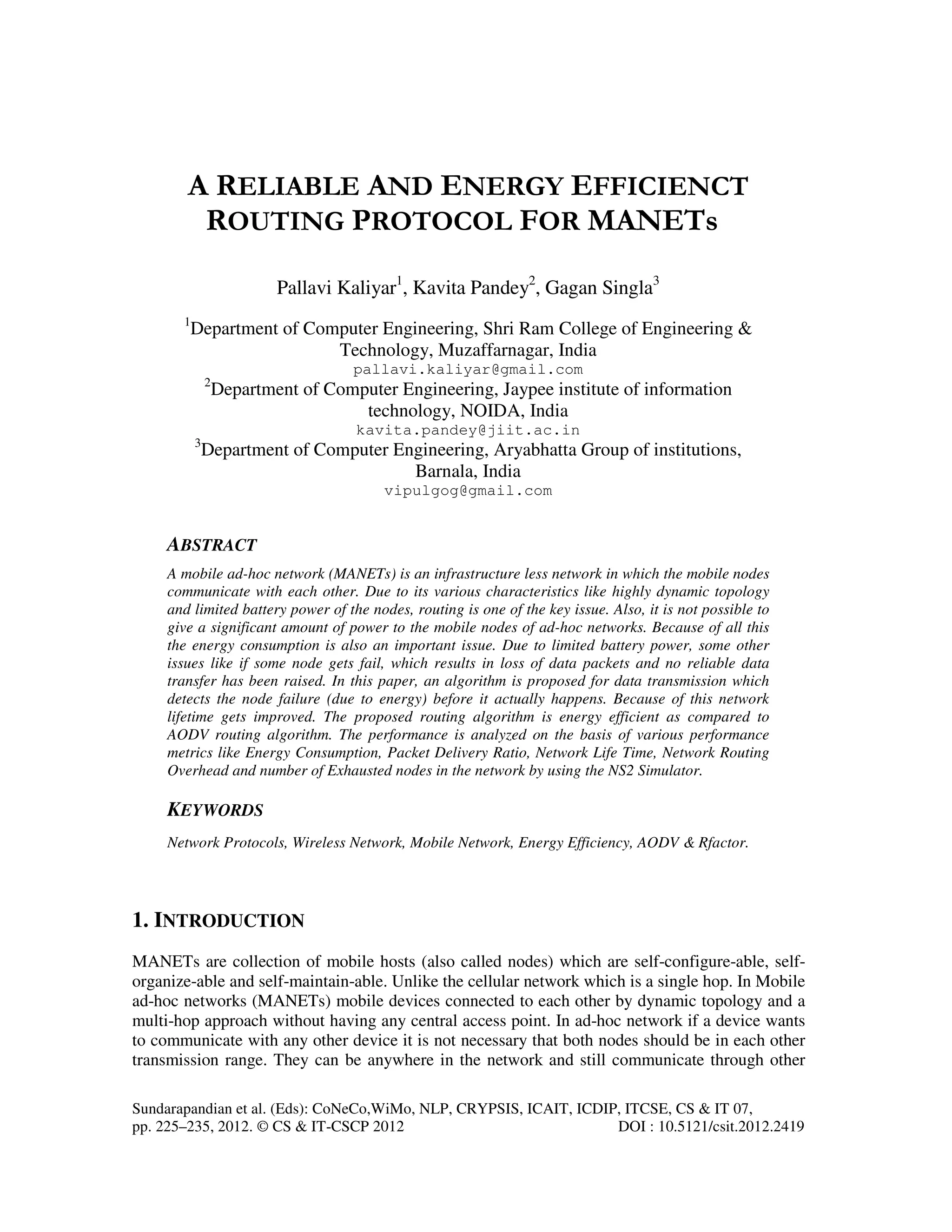
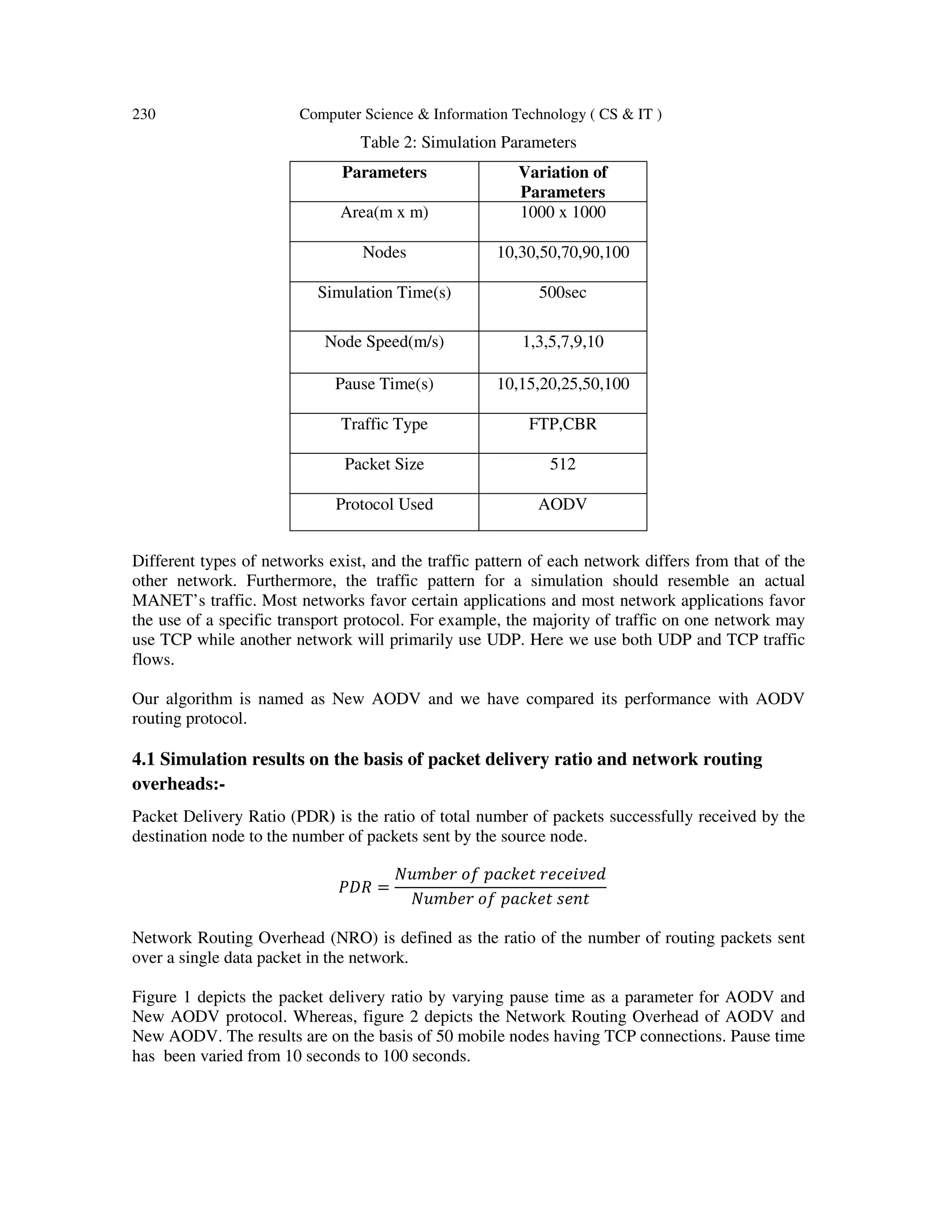
Figure 1 depicts the packet delivery ratio by varying pause time as a parameter for AODV and
New AODV protocol. Whereas, figure 2 depicts the Network Routing Overhead of AODV and
New AODV. The results are on the basis of 50 mobile nodes having TCP connections. Pause time
has been varied from 10 seconds to 100 seconds.
Computer Science & Information Technology ( CS & IT )
The results show that, the new AODV
delivery ratio and Network Routing Overhead. Because we send
(RREP) packets for a route select
Figure 1: Packet delivery ratio by varying pause time.
Figure 2: Network
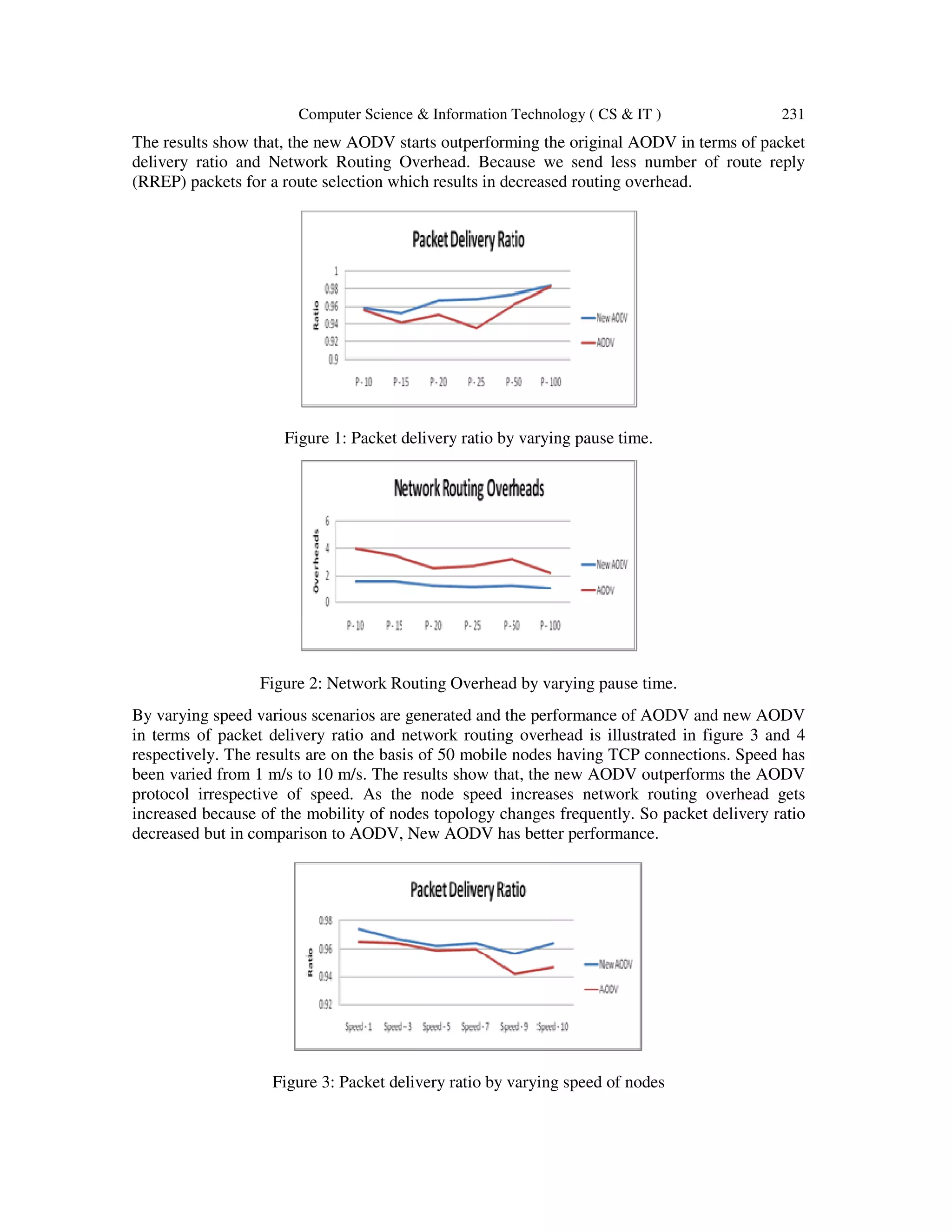
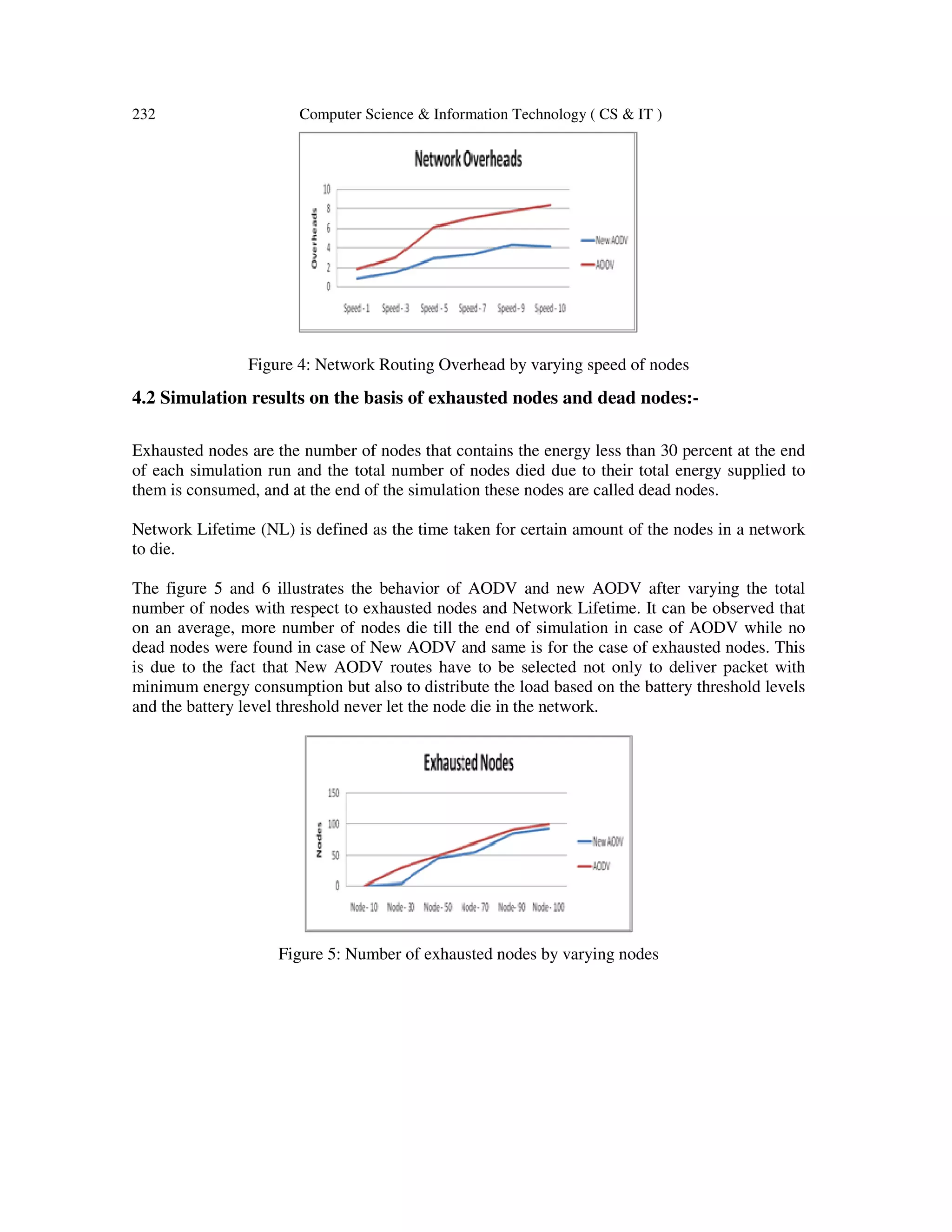
By varying speed various scenarios are generated and the performance of AODV and new AODV
in terms of packet delivery ratio
respectively. The results are on the basis
been varied from 1 m/s to 10 m/s. The results show that, the new AODV outperforms the AODV
protocol irrespective of speed.
increased because of the mobility of nodes
decreased but in comparison to AODV, New AODV has better performance.
Figure 3: Packet delivery ratio by varying speed of nodes
0.95
Ratio
Packet Delivery
0
5
Overheads
0.92
0.94
0.96
0.98
Ratio
Packet Delivery
Computer Science & Information Technology ( CS & IT )
the new AODV starts outperforming the original AODV in terms of
delivery ratio and Network Routing Overhead. Because we send less number of
packets for a route selection which results in decreased routing overhead.
Figure 1: Packet delivery ratio by varying pause time.
Figure 2: Network Routing Overhead by varying pause time.
By varying speed various scenarios are generated and the performance of AODV and new AODV
cket delivery ratio and network routing overhead is illustrated in figure 3 and 4
on the basis of 50 mobile nodes having TCP connections. Speed has
been varied from 1 m/s to 10 m/s. The results show that, the new AODV outperforms the AODV
As the node speed increases network routing overhead gets
because of the mobility of nodes topology changes frequently. So packet delivery ratio
decreased but in comparison to AODV, New AODV has better performance.
Packet delivery ratio by varying speed of nodes
0.9
0.95
1
P - 10P - 15P - 20P - 25P - 50P - 100
Packet Delivery Ratio
New AODV
AODV
0
5
P - 10P - 15P - 20P - 25P - 50P - 100
Network Routing
Overheads
New AODV
AODV
0.92
0.94
0.96
0.98
Packet Delivery Ratio
New AODV
AODV
231
AODV in terms of packet
less number of route reply
By varying speed various scenarios are generated and the performance of AODV and new AODV
is illustrated in figure 3 and 4
connections. Speed has
been varied from 1 m/s to 10 m/s. The results show that, the new AODV outperforms the AODV
network routing overhead gets
So packet delivery ratio
232 Computer Science & Information Technology ( CS & IT )
Figure 4: Network Routing Overhead
4.2 Simulation results on the basis of exhausted nodes
Exhausted nodes are the number of nodes that
of each simulation run and the total number
them is consumed, and at the end
Network Lifetime (NL) is defined as the time taken for certain amount of the nodes in a network
to die.
The figure 5 and 6 illustrates the behavior of AODV and new AODV after varying the total
number of nodes with respect to exhausted nodes and Network Lifetime.
on an average, more number of nodes die
dead nodes were found in case of
is due to the fact that New AODV routes have to be selected not only to deliver packet with
minimum energy consumption but also to distribute the
and the battery level threshold never let the node die in the network.
Figure 5: Number of e
10
Overheads
Network
0
50
100
150
Nodes
Computer Science & Information Technology ( CS & IT )
Network Routing Overhead by varying speed of nodes
Simulation results on the basis of exhausted nodes and dead nodes:-
Exhausted nodes are the number of nodes that contains the energy less than 30 percent
the total number of nodes died due to their total energy supplied to
end of the simulation these nodes are called dead nodes
is defined as the time taken for certain amount of the nodes in a network
The figure 5 and 6 illustrates the behavior of AODV and new AODV after varying the total
number of nodes with respect to exhausted nodes and Network Lifetime. It can be observed that
erage, more number of nodes die till the end of simulation in case of AODV while no
in case of New AODV and same is for the case of exhausted nodes
is due to the fact that New AODV routes have to be selected not only to deliver packet with
minimum energy consumption but also to distribute the load based on the battery threshold levels
and the battery level threshold never let the node die in the network.
Number of exhausted nodes by varying nodes
0
5
10
Network Overheads
New AODV
AODV
Exhausted Nodes
New
AODV
percent at the end
o their total energy supplied to
are called dead nodes.
is defined as the time taken for certain amount of the nodes in a network
The figure 5 and 6 illustrates the behavior of AODV and new AODV after varying the total
It can be observed that
AODV while no
for the case of exhausted nodes. This
is due to the fact that New AODV routes have to be selected not only to deliver packet with
load based on the battery threshold levels
Computer Science & Information Technology ( CS & IT )
Figure 6:
5. CONCLUSION
A lot of work has been done in the field of power aware routing over mobile ad
Their research work has been considered and an effort has been made to
AODV protocol by applying battery
This causes a large decrement in network routing overheads and exhausted nodes.
algorithm minimizes the energy consumption of a
destination, so network lifetime gets increased
utilization of battery of a node during route selection.
protocol is analyzed on the basis of Energy Consumption, Packet Delivery Ratio, Network Life
Time, Network Routing Overhead
that the proposed scheme consumes less energy in the network
get decreased. Results are better in
route selection. This Scheme gives best
moving at a high speed. At last, it can be said that by looking at the battery levels of the nodes,
performance of the routing protocol is improved and the network lifetime gets increased.
REFERENCES
[1] Sunil Taneja and Ashwani Kush,
Networks” International Journal of Innovation, Managem
[2] G.Vijaya Kumar, Y.Vasudeva Reddyr , Dr.M.Nagendra
Protocols for MANET: A Literature Survey” International
Engineering, Vol. 02, No. 03, 706
[3] Sandip Vijay, S. C. Sharma, “EEN: An Energy Efficient Multi
International Conference on Emerging Trends in Engineering and
Technology.
[4] Shwani Kush, Sunil Taneja and Divya Sharma,
International Conference on Methods and Models in Computer Science (ICM2CS
[5] S.Preethi, B. Ramachandran,
Networks” IEEE.
[6] G. Varaprasad, (2010) “Lifetime enhancement routing algorithm” Published in IET Communications.
[7] Kwan-Woong Kim1, Jeong-Soo Lee2, Kyoung
Kyung-Taek Chung4, and Byoung
Protocol in MANETs” AI 2006, LNAI 4304, pp. 897
100
DeadNodes
Computer Science & Information Technology ( CS & IT )
Figure 6: Number of dead nodes by varying nodes
in the field of power aware routing over mobile ad-hoc
Their research work has been considered and an effort has been made to modify the existing
battery thresholds and energy efficient route calculation
This causes a large decrement in network routing overheads and exhausted nodes. The
the energy consumption of a node to transfer the data from source to
destination, so network lifetime gets increased. The proposed algorithm makes
of a node during route selection. The performance of proposed routing
is analyzed on the basis of Energy Consumption, Packet Delivery Ratio, Network Life
Time, Network Routing Overhead and number of Exhausted nodes. Simulation results indicate
consumes less energy in the network and Network Routing Overhead
get decreased. Results are better in denser medium as more nodes are available at the time of
gives best results when TCP traffic is used and the nodes are
At last, it can be said that by looking at the battery levels of the nodes,
performance of the routing protocol is improved and the network lifetime gets increased.
Sunil Taneja and Ashwani Kush, (2010)“A Survey of Routing Protocols in Mobile Ad Hoc
Networks” International Journal of Innovation, Management and Technology, Vol. 1, No.
G.Vijaya Kumar, Y.Vasudeva Reddyr , Dr.M.Nagendra (2010) “Current Research Work on Routing
Protocols for MANET: A Literature Survey” International Journal on Computer Science and
706-713.
EEN: An Energy Efficient Multi-hop Ad Hoc Wireless Networks”
International Conference on Emerging Trends in Engineering and
Shwani Kush, Sunil Taneja and Divya Sharma, (2010) “Energy Efficient Routing for
International Conference on Methods and Models in Computer Science (ICM2CS-2010).
S.Preethi, B. Ramachandran, (2011) “Energy Efficient Routing Protocols for Mobile AdHoc
“Lifetime enhancement routing algorithm” Published in IET Communications.
Soo Lee2, Kyoung-Jun Hwang1, Yong-Kab Kim1, Mike M.O. Lee3,
Taek Chung4, and Byoung-Sil Chon5, (2006) “LRCA: Enhanced Energy-Aware Routing
AI 2006, LNAI 4304, pp. 897 – 901.
0
50
100
Network Lifetime
New AODV
AODV
233
hoc networks.
modify the existing
thresholds and energy efficient route calculation formula.
The proposed
node to transfer the data from source to
makes optimum
of proposed routing
is analyzed on the basis of Energy Consumption, Packet Delivery Ratio, Network Life
Simulation results indicate
and Network Routing Overhead
at the time of
traffic is used and the nodes are
At last, it can be said that by looking at the battery levels of the nodes,
performance of the routing protocol is improved and the network lifetime gets increased.
ting Protocols in Mobile Ad Hoc
ent and Technology, Vol. 1, No.3, August.
“Current Research Work on Routing
Journal on Computer Science and
Networks” First
“Energy Efficient Routing for MANET”
10).
for Mobile AdHoc
“Lifetime enhancement routing algorithm” Published in IET Communications.
Kab Kim1, Mike M.O. Lee3,
Aware Routing
234 Computer Science & Information Technology ( CS & IT )
[8] X. Xiang, X. Wang, and Y. Yang, (2011) “Supporting Efficient and Scalable Multicasting over
Mobile Ad Hoc Networks” IEEE Transactions On Mobile Computing, Vol. 10, No. 5.
[9] Nivedita N. Joshi1 and Radhika D. Joshi, (2011) “Variable Range Energy Efficient Location Aided
Routing for MANET” CCSEA 2011, CS & IT 02, pp. 321–333.
[10] Dheeraj Kumar Anand and Shiva Prakash, (2010) “A Short survey of Energy-Efficient Routing
Protocol for Mobile Ad-Hoc Networks” International Conference on Advances in Recent
Technologies in Communication and Computing.
[11] Ll Bing, JIN Zhigang and SHU Yanati, “Cross-Layer Design of Energy-Saving AODV Routing
Protocol” School of Computer Science and Technology, Tianjin University, Tianjin 300072, China.
[12] Ngoc Duy Pham and Hyunseung Choo, (2008) “ Energy Efficient Ring Search for Route Discovery in
MANETS” IEEE Communications Society subject matter experts for publication in the ICC
proceedings.
[13] Sunil Taneja, Ashwani Kush, Amandeep Makkar and Bharat Bhushan, (2011) “Power Management in
Mobile Adhoc Network” International Transaction Journal of Engineering, Management, &
International Transaction Journal of Engineering, Management, & Applied Sciences & Technologies.
[14] Ramesh Karri And Piyush Mishra, “Modeling Energy Efficient Secure Wireless Networks Using
Network Simulation” Polytechnic University, Brooklyn.
[15] K.Srinivas, A.Nagaraju, S.Ramachandram and G.Narsimha, (2010) “Performance Evaluation of
Routing Protocols in Static and Dynamic Ad-hoc Networks based on Energy Consumption” Second
Vaagdevi International Conference on Information Technology for Real World Problems.
[16] GloMoSim User Manual, http://pcl.cs.ucla.edu/projects/glomosim.
[17] D.N.Pham,V.D.Nguyen, V.T.Pham, N.T.Nguyen, X.BacD, T.D.Nguyen, C.Kuperschmidt and
T.Kaiser, (2010) “An Expending Ring Search Algorithm For Mobile Adhoc Networks”, International
Conference on Advanced Technologies for communication, Vietnam.
[18] NS-2, http://www.isi.edu/nsnam/ns/doc/index.html [Accessed August 11, 2007].
[19] Kuo-Qin Yan, Shu-Ching Wang, Mao-Lun Chiang and Lin-Yu Tseng , (2009) “A Fuzzy-based
Power-aware Management for Mobile Ad hoc Networks” ACM Digital Library, Journal Computer
Standards & Interfaces, Volume 31, Issue 1.
[20] Mohammed Tarique and Rumana Islam, (2007) “Minimum Energy Dynamic Source Routing Protocol
for Mobile Ad Hoc Networks” IJCSNS International Journal of computer Science and Network
Security, VOL 7 No. 11.
[21] M. Maleki, K. Dantu and M. Pedram, (2002) “Power-aware Source Routing in mobile ad hoc
networks” Proceedings of ISLPED ’ Monterey,CA.
[22] Kevin Fall, Kannan Varadhan, (2008) “The NS Manual”.
[23] Geetha Jayakumar, G. Gopinath, “AdHoc Mobile Wireless Networks Routing Protocols – A Review”
Journal of Computer Science 3 (8): 574-582, 2007ISSN 1549-3636
Computer Science & Information Technology ( CS & IT ) 235
Authors
Pallavi Kaliyar She received her B.E in Computer Science and Engineering from
Jaipur Engineering College & Research Center, Jaipur in 2008, M.Tech from jaypee
Institute of Information Technology, Noida in 2012. She is currently working as an
Assitant Professor in Shri Ram College of Engineering & Technology, Muzaffarnagar.
Her research interests include Mobile Adhoc Networks, Sensor networks and Network
Security.
Kavita Pandey She did B.Tech in Computer Science from M.D. University in year
2002 and M.Tech. in Computer Science from Banasthali Vidyapith University in year
2003. She is pursuing PhD from JIIT,Noida. She is working as a Senior Lecturer in
JIIT,Noida. Her current research interests include Adhoc Networks, Optimization
Techniques and Network Security.
Gagan Singla M.Tech working as an Assistant Professor in the Department of
Computer Science in Aryabhatta Group of institutions, Barnala, Punjab, India. His
research interest lies in the area of Mobile Adhoc Networks and Network Security.

A RELIABLE AND ENERGY EFFICIENCT ROUTING PROTOCOL FOR MANETs

  • 1.
    Sundarapandian et al.(Eds): CoNeCo,WiMo, NLP, CRYPSIS, ICAIT, ICDIP, ITCSE, CS & IT 07, pp. 225–235, 2012. © CS & IT-CSCP 2012 DOI : 10.5121/csit.2012.2419 A RELIABLE AND ENERGY EFFICIENCT ROUTING PROTOCOL FOR MANETs Pallavi Kaliyar1 , Kavita Pandey2 , Gagan Singla3 1 Department of Computer Engineering, Shri Ram College of Engineering & Technology, Muzaffarnagar, India pallavi.kaliyar@gmail.com 2 Department of Computer Engineering, Jaypee institute of information technology, NOIDA, India kavita.pandey@jiit.ac.in 3 Department of Computer Engineering, Aryabhatta Group of institutions, Barnala, India vipulgog@gmail.com ABSTRACT A mobile ad-hoc network (MANETs) is an infrastructure less network in which the mobile nodes communicate with each other. Due to its various characteristics like highly dynamic topology and limited battery power of the nodes, routing is one of the key issue. Also, it is not possible to give a significant amount of power to the mobile nodes of ad-hoc networks. Because of all this the energy consumption is also an important issue. Due to limited battery power, some other issues like if some node gets fail, which results in loss of data packets and no reliable data transfer has been raised. In this paper, an algorithm is proposed for data transmission which detects the node failure (due to energy) before it actually happens. Because of this network lifetime gets improved. The proposed routing algorithm is energy efficient as compared to AODV routing algorithm. The performance is analyzed on the basis of various performance metrics like Energy Consumption, Packet Delivery Ratio, Network Life Time, Network Routing Overhead and number of Exhausted nodes in the network by using the NS2 Simulator. KEYWORDS Network Protocols, Wireless Network, Mobile Network, Energy Efficiency, AODV & Rfactor. 1. INTRODUCTION MANETs are collection of mobile hosts (also called nodes) which are self-configure-able, self- organize-able and self-maintain-able. Unlike the cellular network which is a single hop. In Mobile ad-hoc networks (MANETs) mobile devices connected to each other by dynamic topology and a multi-hop approach without having any central access point. In ad-hoc network if a device wants to communicate with any other device it is not necessary that both nodes should be in each other transmission range. They can be anywhere in the network and still communicate through other
  • 2.
    226 Computer Science& Information Technology ( CS & IT ) mobile devices. It is very useful in those areas where cellular communication is not feasible or affordable. In MANETs one of the most important issue is routing i.e. finding a suitable route or path from source to destination. As these are mobile devices which are not fixed, so these devices have limited life. As the energy is consumed even when the device is in idle state or not in the real data transfer pathway just by receiving route request packets. When the battery drains out they became dead, which results in inability to send or receive packets. So, it will result not even in its own data loss but also it leads to whole network failure by not sending others devices data packets. A lot of research has been done to reduce this energy consumption in ad-hoc networks so that the network lifetime can be improved. The energy efficient routing protocols [23] [10] must be designed by keeping a view on nodes and the network. The network lifetime is directly influenced by the nodes lifetime because the nodes act in the network as router and host. One way to reduce the energy consumption is by selecting the route with less energy consumption for end-to-end packet transmission. However these kinds of routing protocols save significant amount of energy, but they don’t guarantee to prolong the network lifetime. Sometimes these protocols may shorten the network lifetime since they use specific routes repeatedly by considering the end-to-end energy consumption. Here our aim is to reduce this extra energy consumption in a network so as to make the network life as long as possible. To achieve this, we designed energy efficient routing protocol for MANETs which discovers the route based on energy aware metrics, bypasses the poor-energy nodes and at the same time pick a route that will consume less energy. This paper is divided into a number of sections. In section 2, the related work done by various researchers has been presented. Proposed algorithm is given in section 3. In section 4, simulation parameters and simulation results has been given. This is followed by conclusion in section number 5. 2. RELATED WORK In MANETs battery power is limited, the efficient battery power management is essential to increase the lifetime. Several researches have worked in this direction and their works is as follows:- Sandip Vijay et al. [3] proposed an approach named as Energy Efficient Network (EEN) which elects “controllers, backbones and connectors” from the given network. EEN backbones stay awake continuously and perform multi-hop packet and switching routing while other nodes in the network remain in power-saving mode and periodically check whether they can be backbone node or not. Author checked the energy efficiency of their algorithm on the basis of network lifetime. Duy Ngoc Pham et al. [12] proposed another technique named as Expanding Ring Search (ERS) this is used to reduce the number of RREQ packets, so that the nodes only process necessary packets and discard duplicate packets to reduce overheads and to use energy efficiently by using the Time to Live (TTL) mechanism. Author proves their result on the basis of reduced overhead and energy consumption in the network. After this an improved ERS scheme is proposed by Preethi et al. [5] named as Energy Efficient Expanding Ring Search Technique (EEAODV). This approach is applied to the route discovery phase and saves energy of the nodes by avoiding the redundant rebroadcasting of the RREQ packets. The relaying status of the node is
  • 3.
    Computer Science &Information Technology ( CS & IT ) 227 decided based on the broadcasting of the RREQ packets by its neighbors. This technique reduces routing overheads incurred during the route discovery process and decreases the energy consumption even more as compared to the ERS approach. Ashwani Kush et al. [4] proposed an approach named as COMMON POWER which works to find the minimal common value of node transmission range to maintain the network connectivity by choosing the nodes of same battery power. COMMON POWER attempts to satisfy three major objectives increase the battery lifetime of all the nodes, increase the traffic carrying capacity of the network and reducing the contention among the nodes. Authors validate their proposed protocol by calculating number of exhausted nodes. Kwan-Woong Kim et al. [7] comes up with another approach named as Local Route Change Algorithm (LRCA). The objective of this approach is to reduce route failure caused by dead nodes which consume all the battery life. This technique provides an ability of changing routes to neighboring nodes from a node which has low battery and focus on route discovery to minimize power consumption or effective power distribution before some of intermediate nodes fail due to their battery. Author proved their results by showing a decrement in the number of lost packets. LI Bing et al. [11] comes up with Cross-Layer Design of Energy approach which adopts cross- layer mechanism and energy-aware metric to improve routing protocol to reduce the energy consumption and then prolong the life of the whole network. In this approach, the link layer and the routing layer work together to choose the optimized transmission power for nodes and the route for packets. The link layer provides the energy consumption information for the routing layer and the routing layer chooses route accordingly and conversely controls the link layer to adjust the transmission power. They have analyzed their approach on the basis of energy consumption and average delay. Author proved the performance is better when the traffic load is higher in the network and reduce the energy consumption by 8% of the network. After this Sunil Taneja et al. [13] recommended an algorithm named as Power Management of the route. This approach takes the consideration of power awareness during route selection. They observe power status of each and every node in the topology and further ensure the fast selection of routes with minimal efforts and faster recovery. The scheme is incorporated with the AODV protocol and the performance has been studied through simulation which shows as a result of less number of dead nodes in the network and author validate their proposed algorithm by using packet delivery ratio and number of exhausted nodes in the network. Comparison of above described work on the basis of base protocol, performance metrics etc. is given in the table below.
  • 4.
    228 Computer Science& Information Technology ( CS & IT ) Table 1: Related Work Author Name Reference Base Protocol Simulator Performance Metrics Variable parameters Sandip Vijay et al.[3] DSR NS2[18] & OPNET Packet delivery rate, Coordinators density, Cumulative distribution per link Pause time, Node density, Delivery rates Ashwani Kush et al.[4] AODV & DSR NS2[18] Exhausted nodes, Total energy consume No of Sources S.Preethi et al.[5] AODV GloMoSim [16] Energy Consumption in sparse and dense medium. No of Node, No of Speed Kwan-Woong Kim et al.[7] AODV NS2[18] No of packets. No of CBR Connections Nivedita N. Joshi et al.[9] LAR QualNet Packet Delivery Ratio, End to End Delay, Average Energy Consumption No of Nodes, No of Speed, Packet Rate. LI Bing et al.[11] AODV NS2[18] Average Delay, Consumed Energy. No of Nodes, No of Connections. Duy Ngoc Pham et al.[12] AODV & DSR Not Mentioned Energy Consumption, Routing Overheads, Hop Count, Packet Delivery Ratio. No of Nodes Sunil Taneja et al.[13] AODV NS2[18] Packet Delivery Ratio, Exhausted Nodes. Pause time, Speed, No of Sources. 3. PROPOSED ALGORITHM Here the aim is to reduce the energy consumption, of the routing protocol so that network lifetime gets improved. Many other researchers have also worked in this direction, the main advantage of this work over the previous works is that by using this approach the network routing overhead and number of exhausted nodes gets decreased. As well as, no node dies in the network due to battery power because always the path with nodes having sufficient battery power has been chosen.
  • 5.
    Computer Science &Information Technology ( CS & IT ) 229 In proposed algorithm, the route selection depends upon the battery levels of nodes which are divided in to three states that are dead state (Battery less than 20%), critical state (Battery less than 50% and greater than 20%) and active state (Battery greater than 50%). To find an Energy Efficient route, a Route REQuest (RREQ) packet is broadcasted in the network. The RREQ packet can be processed by either the destination node or the intermediate node. The RREQ packet contains a source ID, the link energy information for each link in the route. The neighboring nodes do the rebroadcasting of RREQ packet only if their battery status is greater than the selected threshold level i.e. critical state and lies in active state. Otherwise, the RREQ packet would be queued. When the RREQ packets reaches to the intended destination, the destination node computes the total energy of route and the Rfactor of received requests. Rfactor is defined as follows ܴ݂ܽܿ‫ݎ݋ݐ‬ = ܶ‫݈ܽݐ݋‬ ‫݁ݐݑ݋ݎ‬ ݁݊݁‫ݕ݃ݎ‬ ܰ‫ݎܾ݁݉ݑ‬ ‫݂݋‬ ℎ‫ݏ݁݌݋‬ ݅݊ ‫ݐ‬ℎܽ‫ݐ‬ ‫݁ݐݑ݋ݎ‬ Whereas the Total route energy is the sum of remaining battery power of all nodes in that route. Then sends the route reply (RREP) through the route having maximum value of Rfactor and selects a route which is energy efficient. The calculated routes total energy is the maximum energy of a link for that route. Our approach is described as follows Step1: The nodes which are not participating in the route computation process are in sleep mode from the start. Step2: Source node S broadcasts a route-request (RREQ) packet to its neighboring nodes. Step3: The neighboring nodes do the rebroadcasting of RREQ packet only if their battery status is greater than the selected threshold level. Otherwise, the RREQ packet would be queued. Step4: When the RREQ packet reaches to the intended destination, destination selects a route which is energy efficient (according to the defined formula). Then it constructs a route-reply (RREP) packet and sends it back to the source node. 4. SIMULATION & PERFORMANCE RESULTS To analyze the performance of proposed approach, NS2 [18] simulator has been used. The simulator comes with a number of stand-alone programs which generate simulation traffic. The agents are also attached to the traffic according to the user’s requirements. After defining all the parameters, simulation has been started & the output is compared with standardized AODV (Ad- hoc On-demand Distance Vector) routing protocol [23] in terms of various performance metrics like Energy Consumption, Packet Delivery Ratio, Network Life Time, Network Routing Overhead and number of exhausted nodes. A number of scenarios has been generated by varying number of nodes, speed and pause time. The scenario model for examining the routing protocol performance is given below in Table 2.
  • 6.
    230 Computer Science& Information Technology ( CS & IT ) Table 2: Simulation Parameters Parameters Variation of Parameters Area(m x m) 1000 x 1000 Nodes 10,30,50,70,90,100 Simulation Time(s) 500sec Node Speed(m/s) 1,3,5,7,9,10 Pause Time(s) 10,15,20,25,50,100 Traffic Type FTP,CBR Packet Size 512 Protocol Used AODV Different types of networks exist, and the traffic pattern of each network differs from that of the other network. Furthermore, the traffic pattern for a simulation should resemble an actual MANET’s traffic. Most networks favor certain applications and most network applications favor the use of a specific transport protocol. For example, the majority of traffic on one network may use TCP while another network will primarily use UDP. Here we use both UDP and TCP traffic flows. Our algorithm is named as New AODV and we have compared its performance with AODV routing protocol. 4.1 Simulation results on the basis of packet delivery ratio and network routing overheads:- Packet Delivery Ratio (PDR) is the ratio of total number of packets successfully received by the destination node to the number of packets sent by the source node. ܲ‫ܴܦ‬ = ܰ‫ݎܾ݁݉ݑ‬ ‫݂݋‬ ‫ݐ݁݇ܿܽ݌‬ ‫݀݁ݒ݅݁ܿ݁ݎ‬ ܰ‫ݎܾ݁݉ݑ‬ ‫݂݋‬ ‫ݐ݁݇ܿܽ݌‬ ‫ݐ݊݁ݏ‬ Network Routing Overhead (NRO) is defined as the ratio of the number of routing packets sent over a single data packet in the network. Figure 1 depicts the packet delivery ratio by varying pause time as a parameter for AODV and New AODV protocol. Whereas, figure 2 depicts the Network Routing Overhead of AODV and New AODV. The results are on the basis of 50 mobile nodes having TCP connections. Pause time has been varied from 10 seconds to 100 seconds.
  • 7.
    Computer Science &Information Technology ( CS & IT ) The results show that, the new AODV delivery ratio and Network Routing Overhead. Because we send (RREP) packets for a route select Figure 1: Packet delivery ratio by varying pause time. Figure 2: Network By varying speed various scenarios are generated and the performance of AODV and new AODV in terms of packet delivery ratio respectively. The results are on the basis been varied from 1 m/s to 10 m/s. The results show that, the new AODV outperforms the AODV protocol irrespective of speed. increased because of the mobility of nodes decreased but in comparison to AODV, New AODV has better performance. Figure 3: Packet delivery ratio by varying speed of nodes 0.95 Ratio Packet Delivery 0 5 Overheads 0.92 0.94 0.96 0.98 Ratio Packet Delivery Computer Science & Information Technology ( CS & IT ) the new AODV starts outperforming the original AODV in terms of delivery ratio and Network Routing Overhead. Because we send less number of packets for a route selection which results in decreased routing overhead. Figure 1: Packet delivery ratio by varying pause time. Figure 2: Network Routing Overhead by varying pause time. By varying speed various scenarios are generated and the performance of AODV and new AODV cket delivery ratio and network routing overhead is illustrated in figure 3 and 4 on the basis of 50 mobile nodes having TCP connections. Speed has been varied from 1 m/s to 10 m/s. The results show that, the new AODV outperforms the AODV As the node speed increases network routing overhead gets because of the mobility of nodes topology changes frequently. So packet delivery ratio decreased but in comparison to AODV, New AODV has better performance. Packet delivery ratio by varying speed of nodes 0.9 0.95 1 P - 10P - 15P - 20P - 25P - 50P - 100 Packet Delivery Ratio New AODV AODV 0 5 P - 10P - 15P - 20P - 25P - 50P - 100 Network Routing Overheads New AODV AODV 0.92 0.94 0.96 0.98 Packet Delivery Ratio New AODV AODV 231 AODV in terms of packet less number of route reply By varying speed various scenarios are generated and the performance of AODV and new AODV is illustrated in figure 3 and 4 connections. Speed has been varied from 1 m/s to 10 m/s. The results show that, the new AODV outperforms the AODV network routing overhead gets So packet delivery ratio
  • 8.
    232 Computer Science& Information Technology ( CS & IT ) Figure 4: Network Routing Overhead 4.2 Simulation results on the basis of exhausted nodes Exhausted nodes are the number of nodes that of each simulation run and the total number them is consumed, and at the end Network Lifetime (NL) is defined as the time taken for certain amount of the nodes in a network to die. The figure 5 and 6 illustrates the behavior of AODV and new AODV after varying the total number of nodes with respect to exhausted nodes and Network Lifetime. on an average, more number of nodes die dead nodes were found in case of is due to the fact that New AODV routes have to be selected not only to deliver packet with minimum energy consumption but also to distribute the and the battery level threshold never let the node die in the network. Figure 5: Number of e 10 Overheads Network 0 50 100 150 Nodes Computer Science & Information Technology ( CS & IT ) Network Routing Overhead by varying speed of nodes Simulation results on the basis of exhausted nodes and dead nodes:- Exhausted nodes are the number of nodes that contains the energy less than 30 percent the total number of nodes died due to their total energy supplied to end of the simulation these nodes are called dead nodes is defined as the time taken for certain amount of the nodes in a network The figure 5 and 6 illustrates the behavior of AODV and new AODV after varying the total number of nodes with respect to exhausted nodes and Network Lifetime. It can be observed that erage, more number of nodes die till the end of simulation in case of AODV while no in case of New AODV and same is for the case of exhausted nodes is due to the fact that New AODV routes have to be selected not only to deliver packet with minimum energy consumption but also to distribute the load based on the battery threshold levels and the battery level threshold never let the node die in the network. Number of exhausted nodes by varying nodes 0 5 10 Network Overheads New AODV AODV Exhausted Nodes New AODV percent at the end o their total energy supplied to are called dead nodes. is defined as the time taken for certain amount of the nodes in a network The figure 5 and 6 illustrates the behavior of AODV and new AODV after varying the total It can be observed that AODV while no for the case of exhausted nodes. This is due to the fact that New AODV routes have to be selected not only to deliver packet with load based on the battery threshold levels
  • 9.
    Computer Science &Information Technology ( CS & IT ) Figure 6: 5. CONCLUSION A lot of work has been done in the field of power aware routing over mobile ad Their research work has been considered and an effort has been made to AODV protocol by applying battery This causes a large decrement in network routing overheads and exhausted nodes. algorithm minimizes the energy consumption of a destination, so network lifetime gets increased utilization of battery of a node during route selection. protocol is analyzed on the basis of Energy Consumption, Packet Delivery Ratio, Network Life Time, Network Routing Overhead that the proposed scheme consumes less energy in the network get decreased. Results are better in route selection. This Scheme gives best moving at a high speed. At last, it can be said that by looking at the battery levels of the nodes, performance of the routing protocol is improved and the network lifetime gets increased. REFERENCES [1] Sunil Taneja and Ashwani Kush, Networks” International Journal of Innovation, Managem [2] G.Vijaya Kumar, Y.Vasudeva Reddyr , Dr.M.Nagendra Protocols for MANET: A Literature Survey” International Engineering, Vol. 02, No. 03, 706 [3] Sandip Vijay, S. C. Sharma, “EEN: An Energy Efficient Multi International Conference on Emerging Trends in Engineering and Technology. [4] Shwani Kush, Sunil Taneja and Divya Sharma, International Conference on Methods and Models in Computer Science (ICM2CS [5] S.Preethi, B. Ramachandran, Networks” IEEE. [6] G. Varaprasad, (2010) “Lifetime enhancement routing algorithm” Published in IET Communications. [7] Kwan-Woong Kim1, Jeong-Soo Lee2, Kyoung Kyung-Taek Chung4, and Byoung Protocol in MANETs” AI 2006, LNAI 4304, pp. 897 100 DeadNodes Computer Science & Information Technology ( CS & IT ) Figure 6: Number of dead nodes by varying nodes in the field of power aware routing over mobile ad-hoc Their research work has been considered and an effort has been made to modify the existing battery thresholds and energy efficient route calculation This causes a large decrement in network routing overheads and exhausted nodes. The the energy consumption of a node to transfer the data from source to destination, so network lifetime gets increased. The proposed algorithm makes of a node during route selection. The performance of proposed routing is analyzed on the basis of Energy Consumption, Packet Delivery Ratio, Network Life Time, Network Routing Overhead and number of Exhausted nodes. Simulation results indicate consumes less energy in the network and Network Routing Overhead get decreased. Results are better in denser medium as more nodes are available at the time of gives best results when TCP traffic is used and the nodes are At last, it can be said that by looking at the battery levels of the nodes, performance of the routing protocol is improved and the network lifetime gets increased. Sunil Taneja and Ashwani Kush, (2010)“A Survey of Routing Protocols in Mobile Ad Hoc Networks” International Journal of Innovation, Management and Technology, Vol. 1, No. G.Vijaya Kumar, Y.Vasudeva Reddyr , Dr.M.Nagendra (2010) “Current Research Work on Routing Protocols for MANET: A Literature Survey” International Journal on Computer Science and 706-713. EEN: An Energy Efficient Multi-hop Ad Hoc Wireless Networks” International Conference on Emerging Trends in Engineering and Shwani Kush, Sunil Taneja and Divya Sharma, (2010) “Energy Efficient Routing for International Conference on Methods and Models in Computer Science (ICM2CS-2010). S.Preethi, B. Ramachandran, (2011) “Energy Efficient Routing Protocols for Mobile AdHoc “Lifetime enhancement routing algorithm” Published in IET Communications. Soo Lee2, Kyoung-Jun Hwang1, Yong-Kab Kim1, Mike M.O. Lee3, Taek Chung4, and Byoung-Sil Chon5, (2006) “LRCA: Enhanced Energy-Aware Routing AI 2006, LNAI 4304, pp. 897 – 901. 0 50 100 Network Lifetime New AODV AODV 233 hoc networks. modify the existing thresholds and energy efficient route calculation formula. The proposed node to transfer the data from source to makes optimum of proposed routing is analyzed on the basis of Energy Consumption, Packet Delivery Ratio, Network Life Simulation results indicate and Network Routing Overhead at the time of traffic is used and the nodes are At last, it can be said that by looking at the battery levels of the nodes, performance of the routing protocol is improved and the network lifetime gets increased. ting Protocols in Mobile Ad Hoc ent and Technology, Vol. 1, No.3, August. “Current Research Work on Routing Journal on Computer Science and Networks” First “Energy Efficient Routing for MANET” 10). for Mobile AdHoc “Lifetime enhancement routing algorithm” Published in IET Communications. Kab Kim1, Mike M.O. Lee3, Aware Routing
  • 10.
    234 Computer Science& Information Technology ( CS & IT ) [8] X. Xiang, X. Wang, and Y. Yang, (2011) “Supporting Efficient and Scalable Multicasting over Mobile Ad Hoc Networks” IEEE Transactions On Mobile Computing, Vol. 10, No. 5. [9] Nivedita N. Joshi1 and Radhika D. Joshi, (2011) “Variable Range Energy Efficient Location Aided Routing for MANET” CCSEA 2011, CS & IT 02, pp. 321–333. [10] Dheeraj Kumar Anand and Shiva Prakash, (2010) “A Short survey of Energy-Efficient Routing Protocol for Mobile Ad-Hoc Networks” International Conference on Advances in Recent Technologies in Communication and Computing. [11] Ll Bing, JIN Zhigang and SHU Yanati, “Cross-Layer Design of Energy-Saving AODV Routing Protocol” School of Computer Science and Technology, Tianjin University, Tianjin 300072, China. [12] Ngoc Duy Pham and Hyunseung Choo, (2008) “ Energy Efficient Ring Search for Route Discovery in MANETS” IEEE Communications Society subject matter experts for publication in the ICC proceedings. [13] Sunil Taneja, Ashwani Kush, Amandeep Makkar and Bharat Bhushan, (2011) “Power Management in Mobile Adhoc Network” International Transaction Journal of Engineering, Management, & International Transaction Journal of Engineering, Management, & Applied Sciences & Technologies. [14] Ramesh Karri And Piyush Mishra, “Modeling Energy Efficient Secure Wireless Networks Using Network Simulation” Polytechnic University, Brooklyn. [15] K.Srinivas, A.Nagaraju, S.Ramachandram and G.Narsimha, (2010) “Performance Evaluation of Routing Protocols in Static and Dynamic Ad-hoc Networks based on Energy Consumption” Second Vaagdevi International Conference on Information Technology for Real World Problems. [16] GloMoSim User Manual, http://pcl.cs.ucla.edu/projects/glomosim. [17] D.N.Pham,V.D.Nguyen, V.T.Pham, N.T.Nguyen, X.BacD, T.D.Nguyen, C.Kuperschmidt and T.Kaiser, (2010) “An Expending Ring Search Algorithm For Mobile Adhoc Networks”, International Conference on Advanced Technologies for communication, Vietnam. [18] NS-2, http://www.isi.edu/nsnam/ns/doc/index.html [Accessed August 11, 2007]. [19] Kuo-Qin Yan, Shu-Ching Wang, Mao-Lun Chiang and Lin-Yu Tseng , (2009) “A Fuzzy-based Power-aware Management for Mobile Ad hoc Networks” ACM Digital Library, Journal Computer Standards & Interfaces, Volume 31, Issue 1. [20] Mohammed Tarique and Rumana Islam, (2007) “Minimum Energy Dynamic Source Routing Protocol for Mobile Ad Hoc Networks” IJCSNS International Journal of computer Science and Network Security, VOL 7 No. 11. [21] M. Maleki, K. Dantu and M. Pedram, (2002) “Power-aware Source Routing in mobile ad hoc networks” Proceedings of ISLPED ’ Monterey,CA. [22] Kevin Fall, Kannan Varadhan, (2008) “The NS Manual”. [23] Geetha Jayakumar, G. Gopinath, “AdHoc Mobile Wireless Networks Routing Protocols – A Review” Journal of Computer Science 3 (8): 574-582, 2007ISSN 1549-3636
  • 11.
    Computer Science &Information Technology ( CS & IT ) 235 Authors Pallavi Kaliyar She received her B.E in Computer Science and Engineering from Jaipur Engineering College & Research Center, Jaipur in 2008, M.Tech from jaypee Institute of Information Technology, Noida in 2012. She is currently working as an Assitant Professor in Shri Ram College of Engineering & Technology, Muzaffarnagar. Her research interests include Mobile Adhoc Networks, Sensor networks and Network Security. Kavita Pandey She did B.Tech in Computer Science from M.D. University in year 2002 and M.Tech. in Computer Science from Banasthali Vidyapith University in year 2003. She is pursuing PhD from JIIT,Noida. She is working as a Senior Lecturer in JIIT,Noida. Her current research interests include Adhoc Networks, Optimization Techniques and Network Security. Gagan Singla M.Tech working as an Assistant Professor in the Department of Computer Science in Aryabhatta Group of institutions, Barnala, Punjab, India. His research interest lies in the area of Mobile Adhoc Networks and Network Security.