Wireless Communication – An overview


                     Aniruddha Chandra
                    ECE Department, NIT Durgapur
                    aniruddha.chandra@ieee.org


ECE, NIT Durgapur           A. Chandra             Wireless - Overview
Outline


Wireless Communication – General overview
Challenges in Wireless Communication
Future trends and Research areas


ECE, NIT Durgapur    A. Chandra     Wireless - Overview
Wireless Communication – General overview
         Why Wireless?
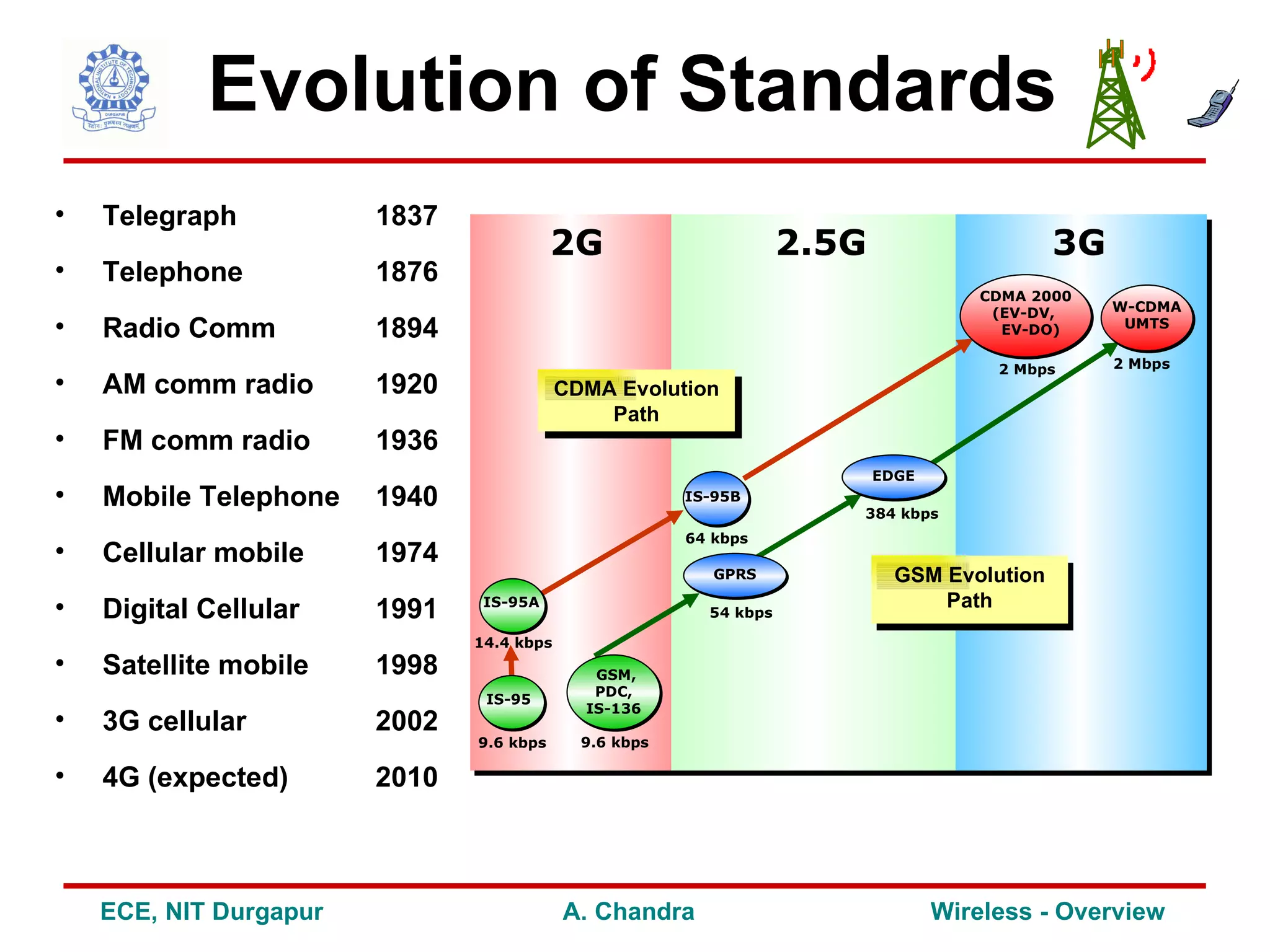
         Evolution of Standards
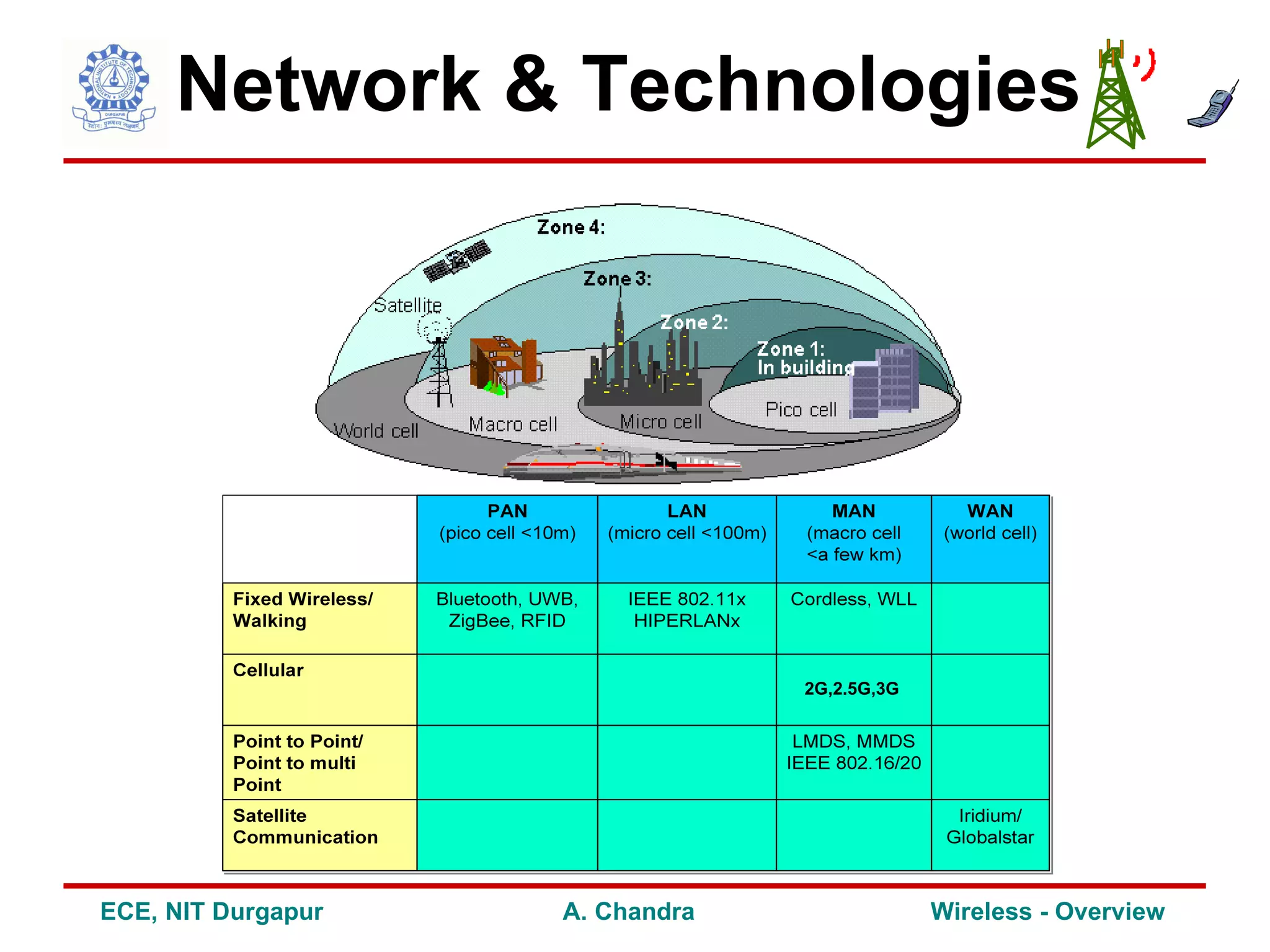
         Network & Technologies
         World Statistics
         India Statistics

Challenges in Wireless Communication
Future trends and Research areas

ECE, NIT Durgapur            A. Chandra   Wireless - Overview
Why Wireless?

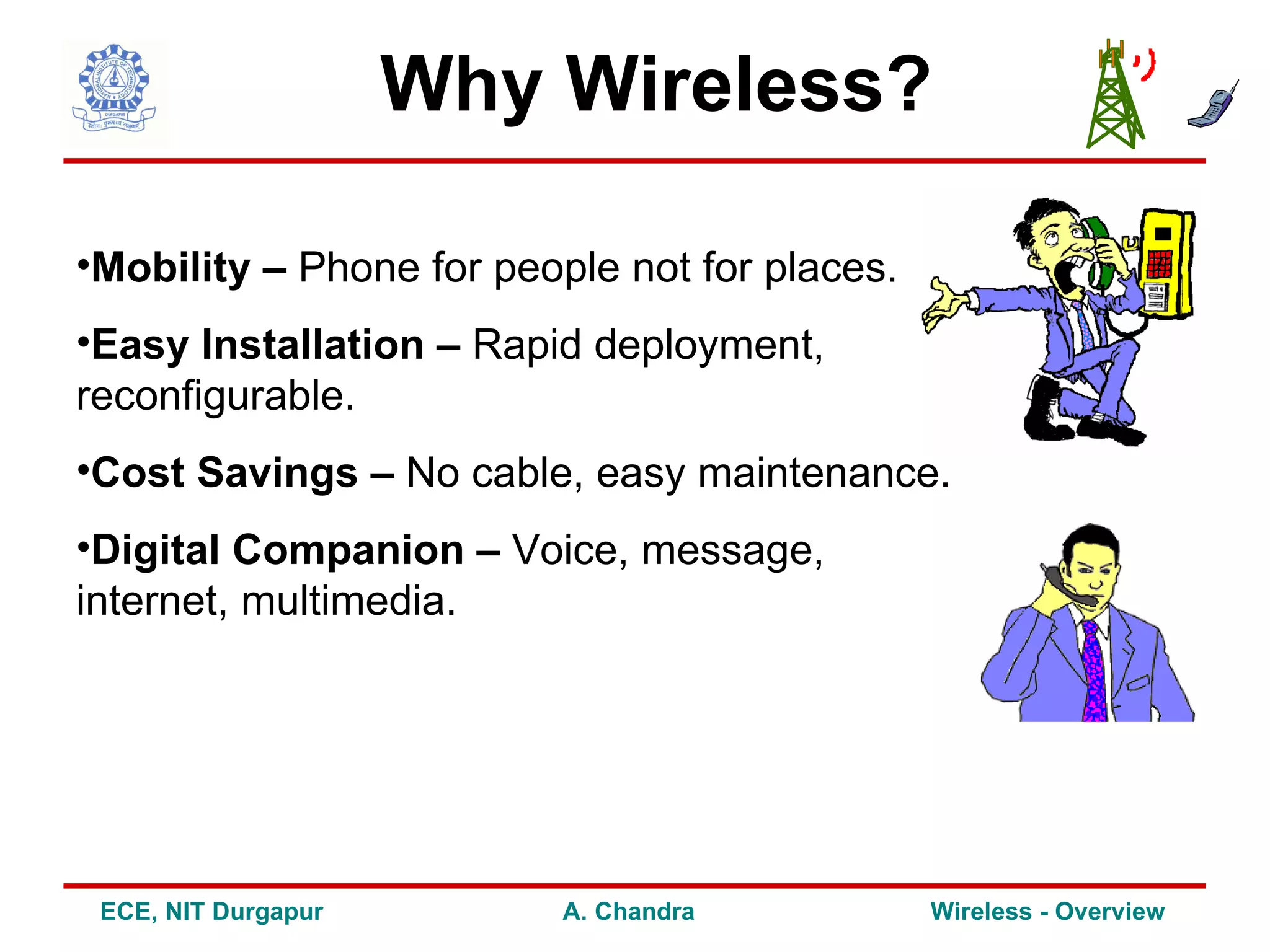
•Mobility – Phone for people not for places.
•Easy Installation – Rapid deployment,
reconfigurable.
•Cost Savings – No cable, easy maintenance.
•Digital Companion – Voice, message,
internet, multimedia.


 ECE, NIT Durgapur        A. Chandra           Wireless - Overview
Evolution of Standards
•   Telegraph           1837
                                          2G                        2.5G                     3G
•   Telephone           1876
                                                                                     CDMA 2000
                                                                                      (EV-DV,     W-CDMA
•   Radio Comm          1894                                                           EV-DO)      UMTS


                                                                                       2 Mbps     2 Mbps
•   AM comm radio       1920               CDMA Evolution
                                               Path
•   FM comm radio       1936
                                                                           EDGE
•   Mobile Telephone    1940                            IS-95B
                                                                       384 kbps
                                                        64 kbps
•   Cellular mobile     1974
                                                           GPRS              GSM Evolution
•                                                                                Path
    Digital Cellular    1991    IS-95A
                                                          54 kbps

                               14.4 kbps
•   Satellite mobile    1998                  GSM,
                                              PDC,
                                IS-95
                                             IS-136
•   3G cellular         2002
                               9.6 kbps      9.6 kbps

•   4G (expected)       2010


    ECE, NIT Durgapur                      A. Chandra                             Wireless - Overview
Network & Technologies


                                 2G,2.5G,3G


ECE, NIT Durgapur   A. Chandra                Wireless - Overview
World Statistics


•20 billion GSM
Subscribers
•3 billion CDMA
Subscribers.

*March ’06 statistics ( Source www.cdg.org
 and www.gsmworld.com)


  ECE, NIT Durgapur                          A. Chandra   Wireless - Overview
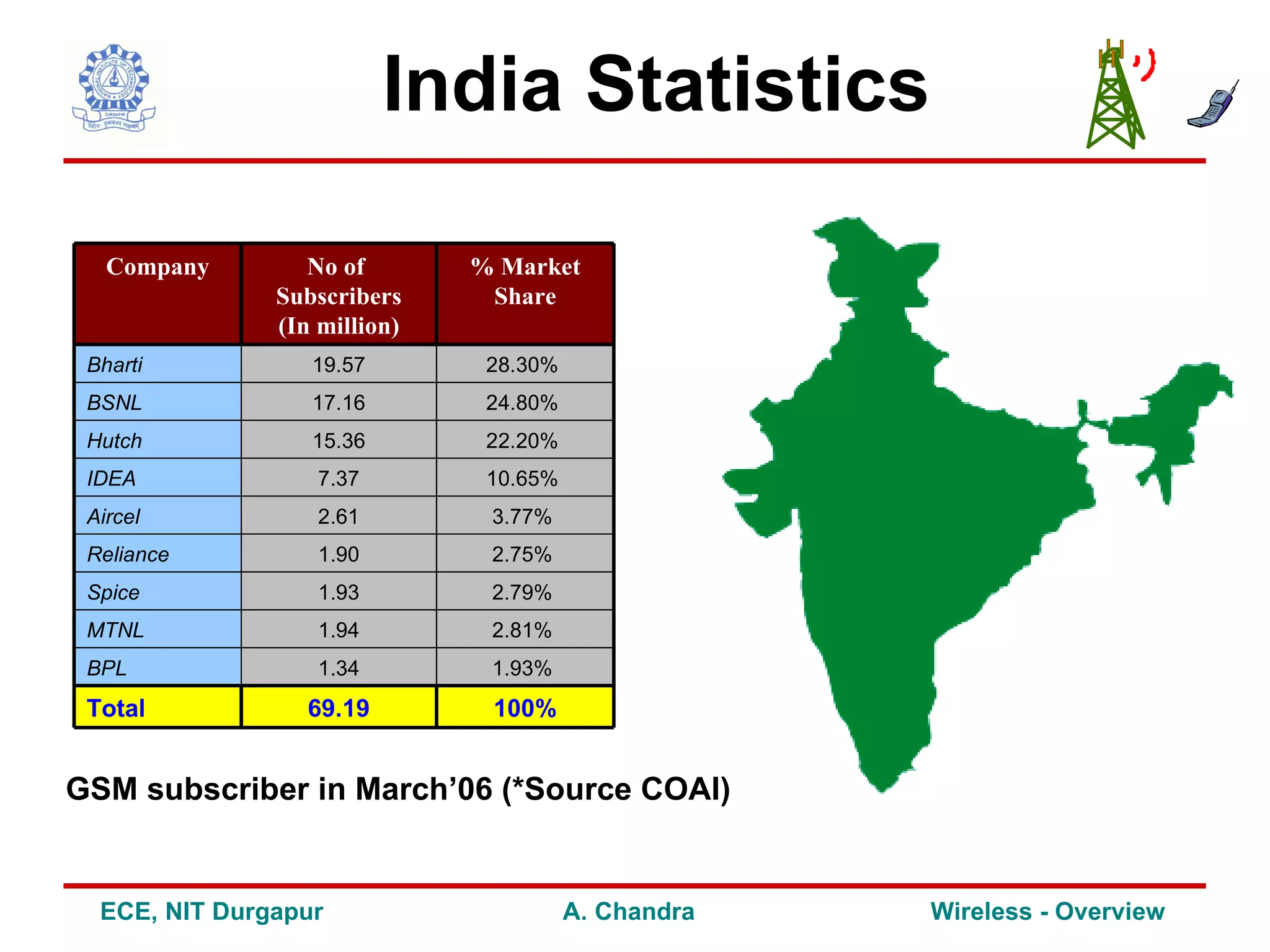
India Statistics

   Company        No of       % Market
               Subscribers     Share
               (In million)
 Bharti           19.57        28.30%
 BSNL             17.16        24.80%
 Hutch            15.36        22.20%
 IDEA              7.37        10.65%
 Aircel            2.61        3.77%
 Reliance          1.90        2.75%
 Spice             1.93        2.79%
 MTNL              1.94        2.81%
 BPL               1.34        1.93%
 Total            69.19        100%


GSM subscriber in March’06 (*Source COAI)


  ECE, NIT Durgapur                     A. Chandra   Wireless - Overview
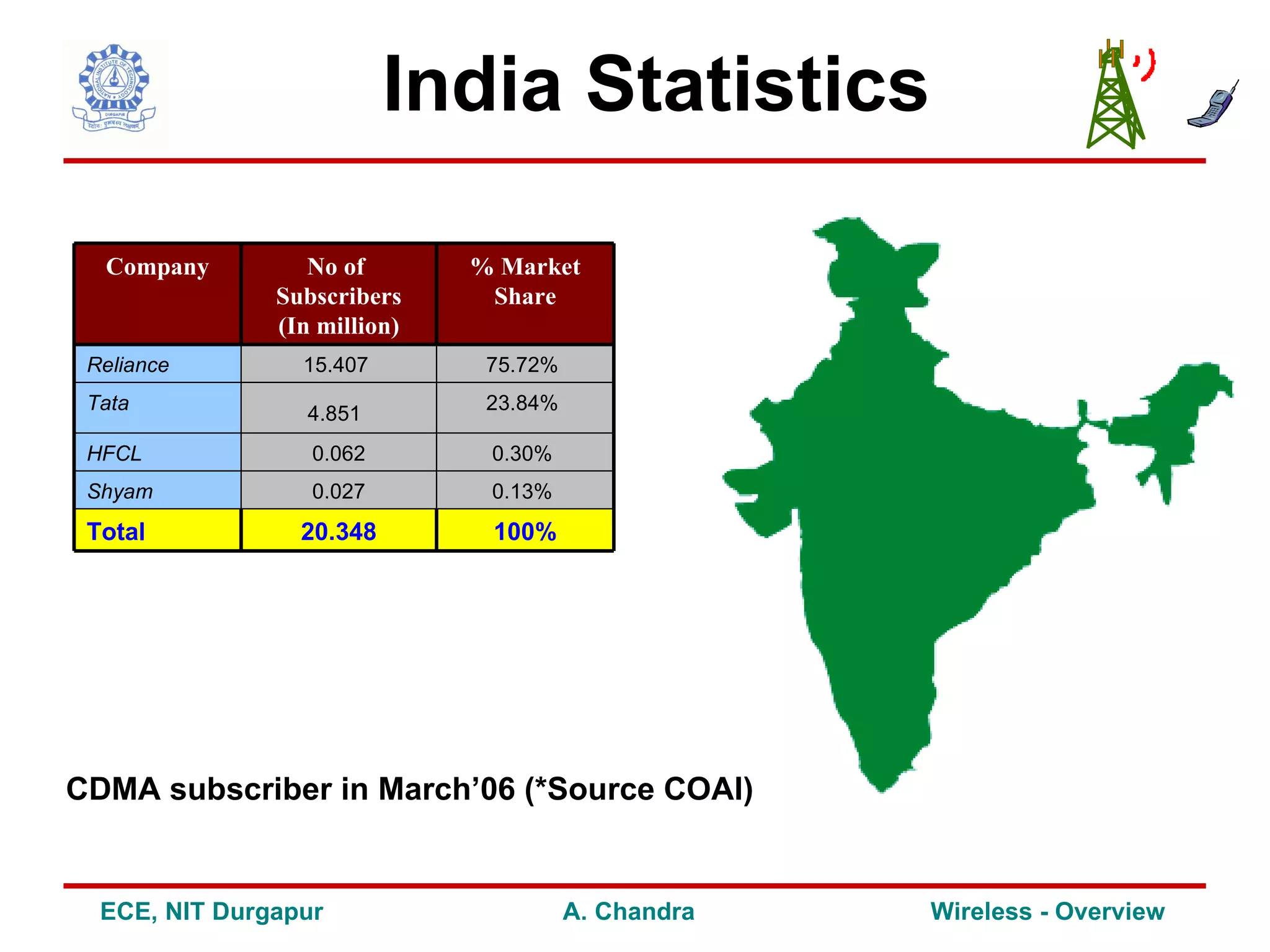
India Statistics

  Company         No of       % Market
               Subscribers     Share
               (In million)
 Reliance        15.407        75.72%
 Tata                          23.84%
                  4.851
 HFCL             0.062        0.30%
 Shyam            0.027        0.13%
 Total           20.348        100%


CDMA subscriber in March’06 (*Source COAI)


  ECE, NIT Durgapur                     A. Chandra   Wireless - Overview
India Statistics

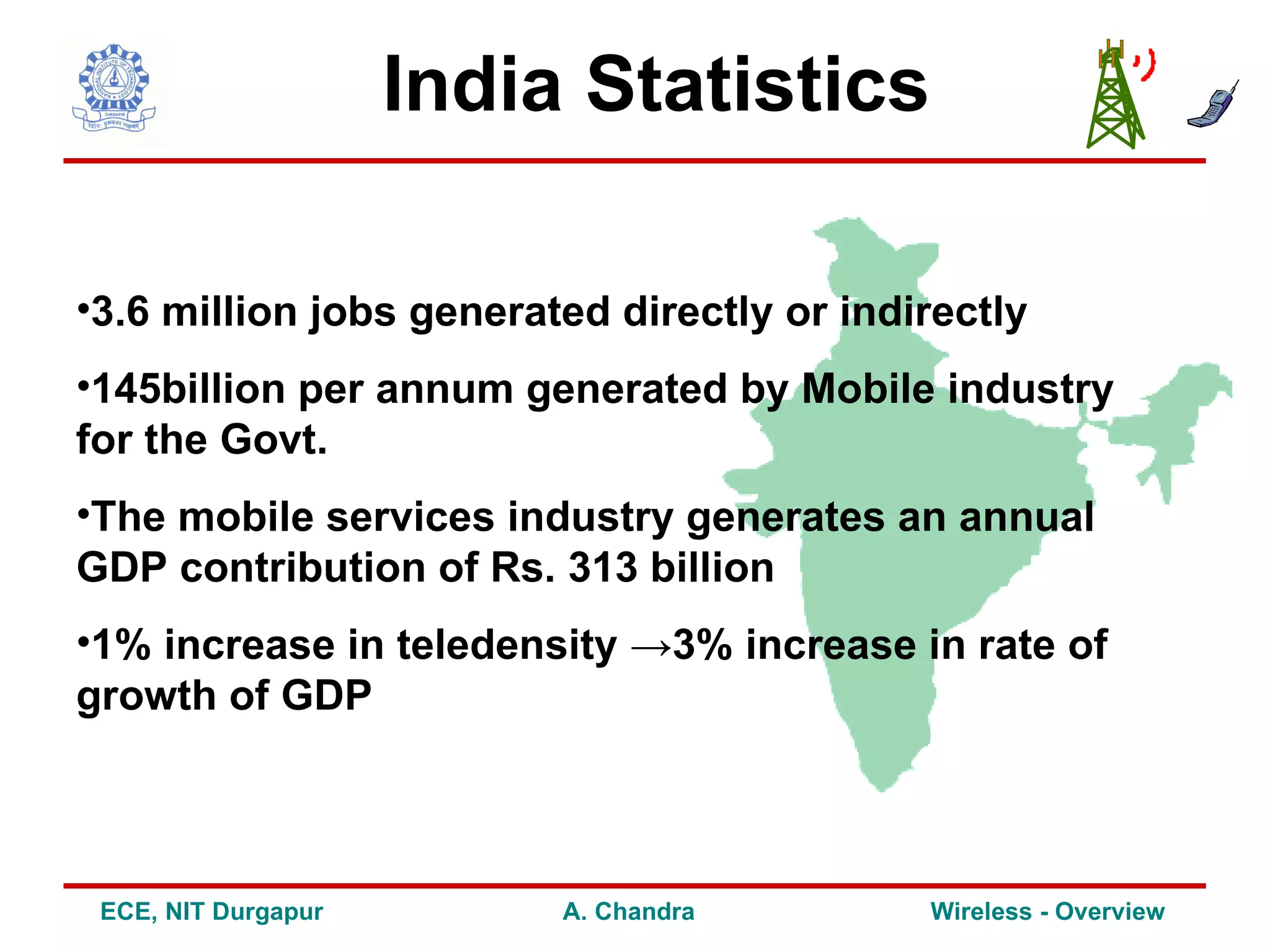
•3.6 million jobs generated directly or indirectly
•145billion per annum generated by Mobile industry
for the Govt.
•The mobile services industry generates an annual
GDP contribution of Rs. 313 billion
•1% increase in teledensity →3% increase in rate of
growth of GDP


 ECE, NIT Durgapur        A. Chandra        Wireless - Overview
India Statistics

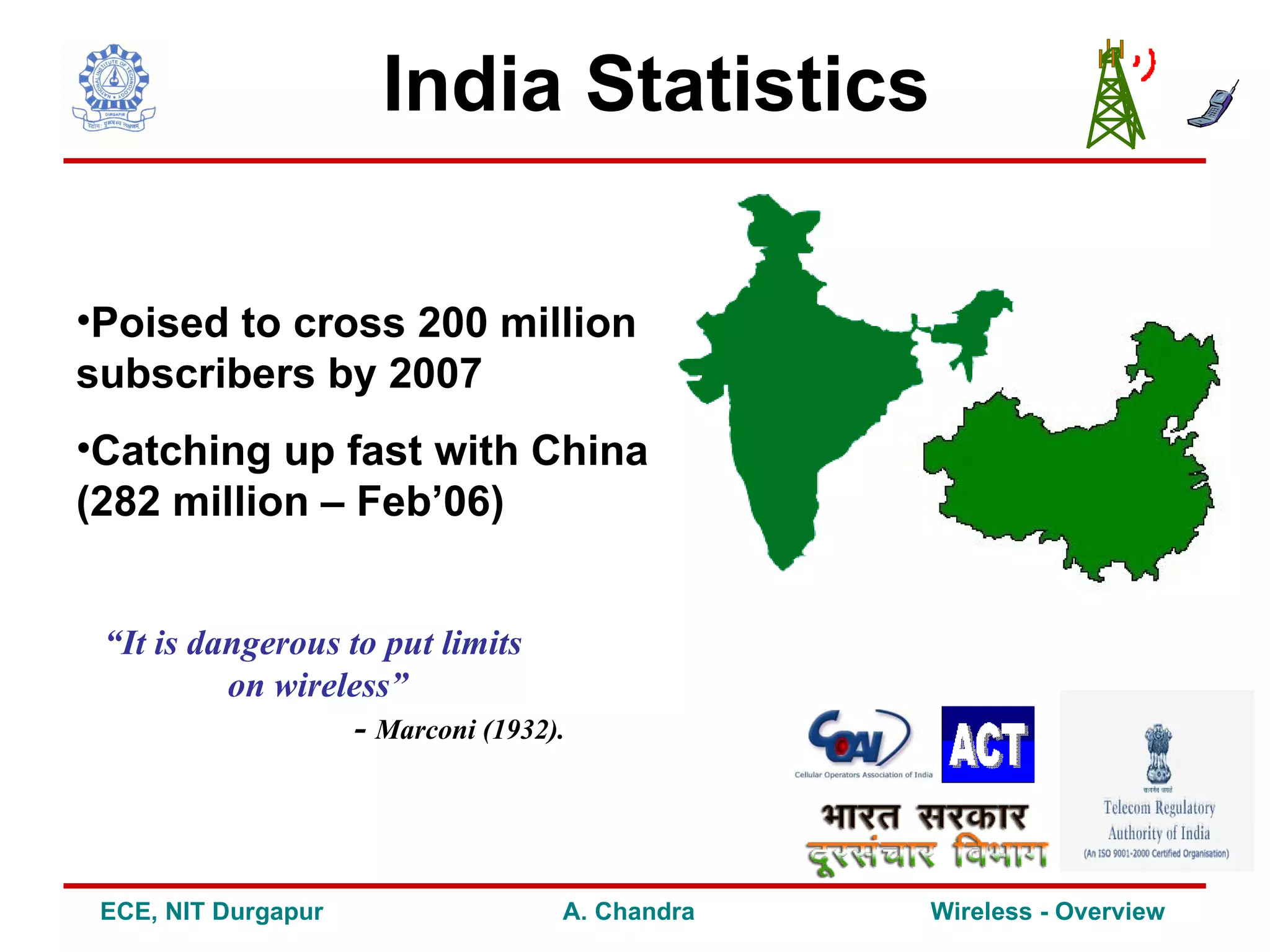
•Poised to cross 200 million
subscribers by 2007
•Catching up fast with China
(282 million – Feb’06)


 “It is dangerous to put limits
          on wireless”
                   - Marconi (1932).


 ECE, NIT Durgapur                 A. Chandra   Wireless - Overview
Wireless Communication – General overview

Challenges in Wireless Communication
          Wireless Channel
          Standardization
          Network Planning
          Other Issues
Future trends and Research areas


ECE, NIT Durgapur             A. Chandra   Wireless - Overview
Wireless Channel

•Limited Power (Size, Weight, Battery Constraints)
•Limited BW (Spectrum allocation)
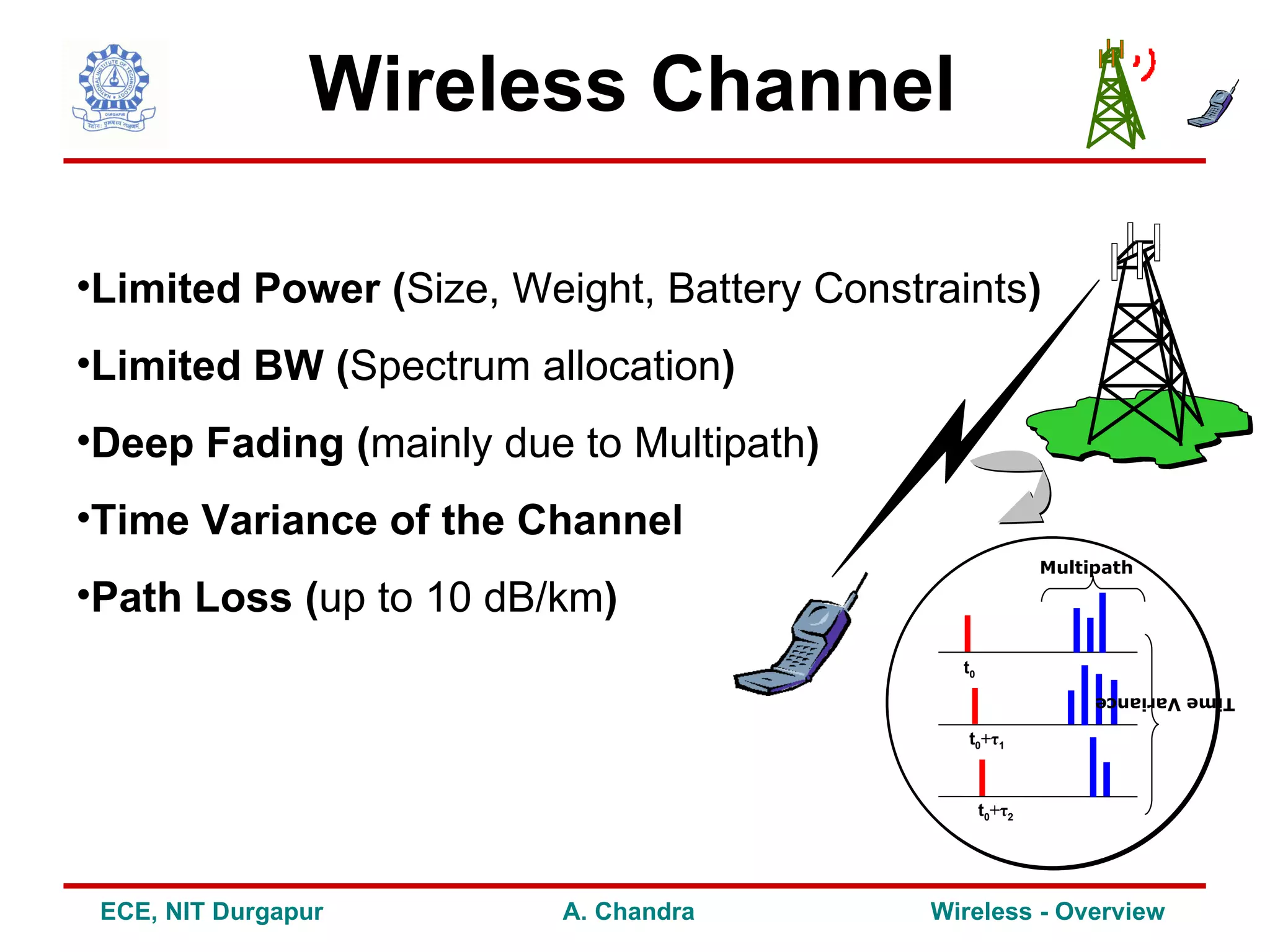
•Deep Fading (mainly due to Multipath)
•Time Variance of the Channel
                                                           Multipath

•Path Loss (up to 10 dB/km)
                                              t0
                                                                Time Variance

                                               t0+τ1


                                                   t0+τ2


 ECE, NIT Durgapur       A. Chandra         Wireless - Overview
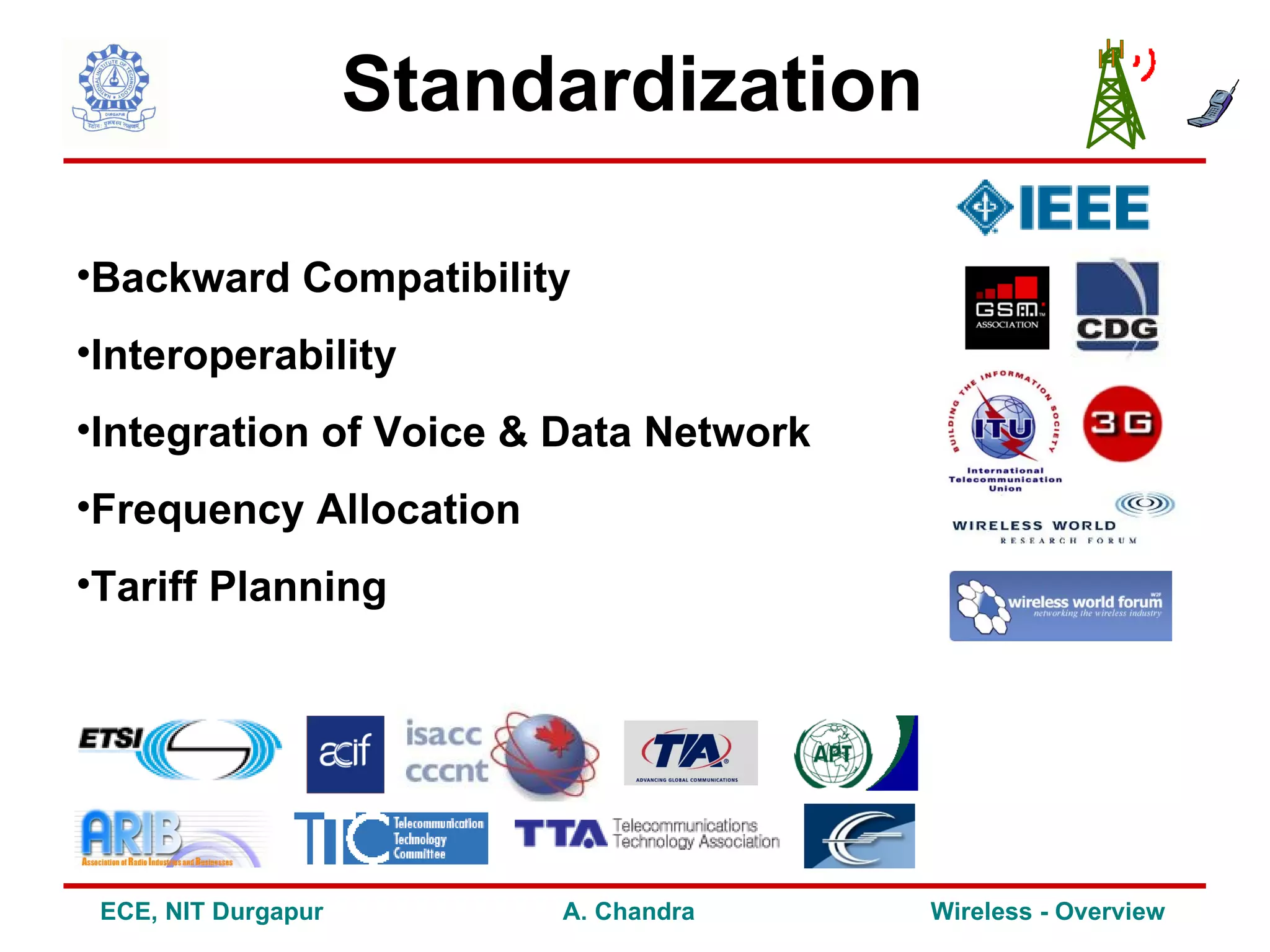
Standardization

•Backward Compatibility
•Interoperability
•Integration of Voice & Data Network
•Frequency Allocation
•Tariff Planning


 ECE, NIT Durgapur        A. Chandra   Wireless - Overview
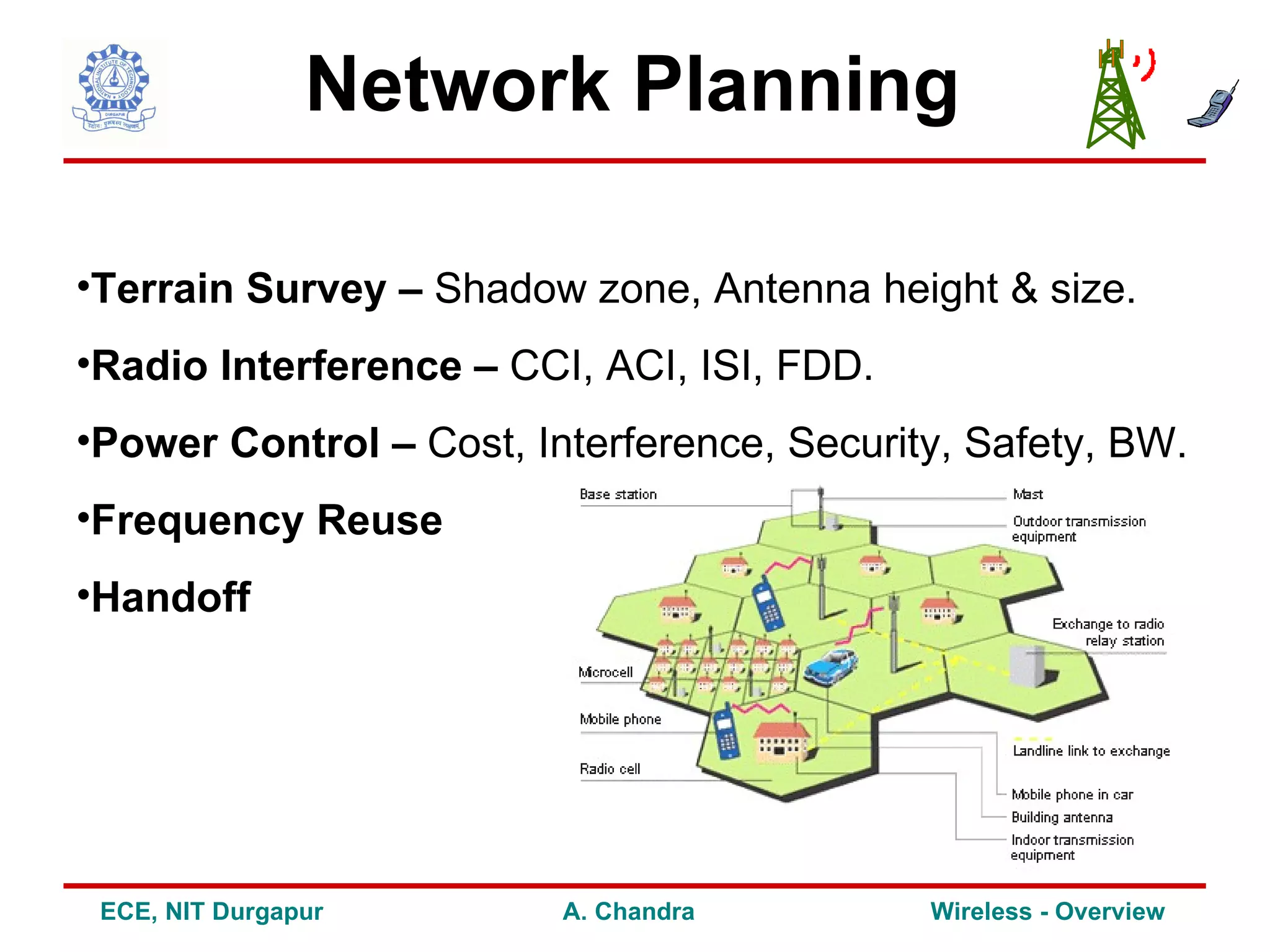
Network Planning

•Terrain Survey – Shadow zone, Antenna height & size.
•Radio Interference – CCI, ACI, ISI, FDD.
•Power Control – Cost, Interference, Security, Safety, BW.
•Frequency Reuse
•Handoff


 ECE, NIT Durgapur       A. Chandra         Wireless - Overview
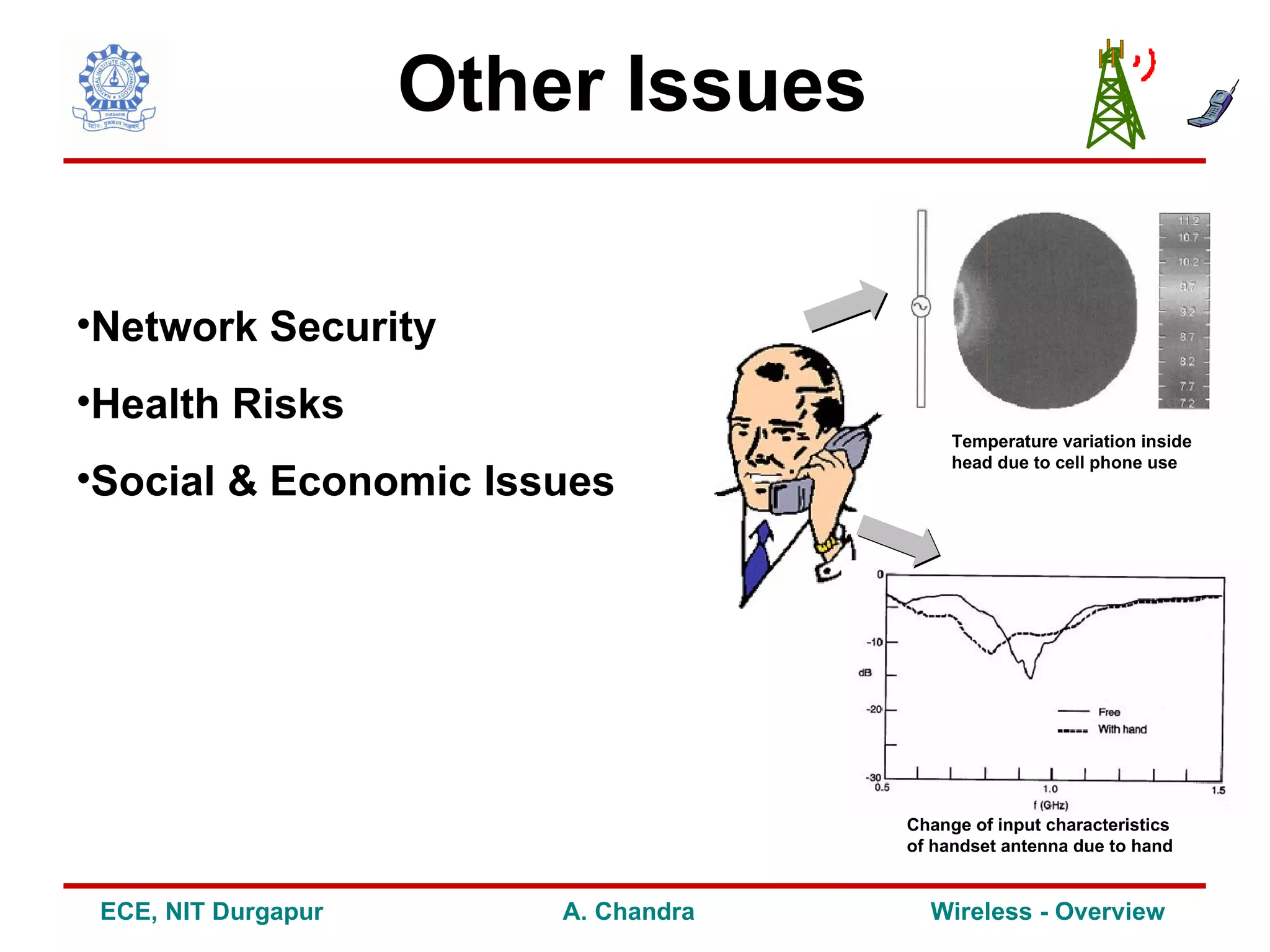
Other Issues

•Network Security
•Health Risks
                                           Temperature variation inside
                                           head due to cell phone use
•Social & Economic Issues


                                      Change of input characteristics
                                      of handset antenna due to hand


 ECE, NIT Durgapur       A. Chandra     Wireless - Overview
Wireless Communication – General overview
Challenges in Wireless Communication
Future trends and Research areas
          UWB
          OFDM
          MIMO
          Future???


ECE, NIT Durgapur      A. Chandra   Wireless - Overview
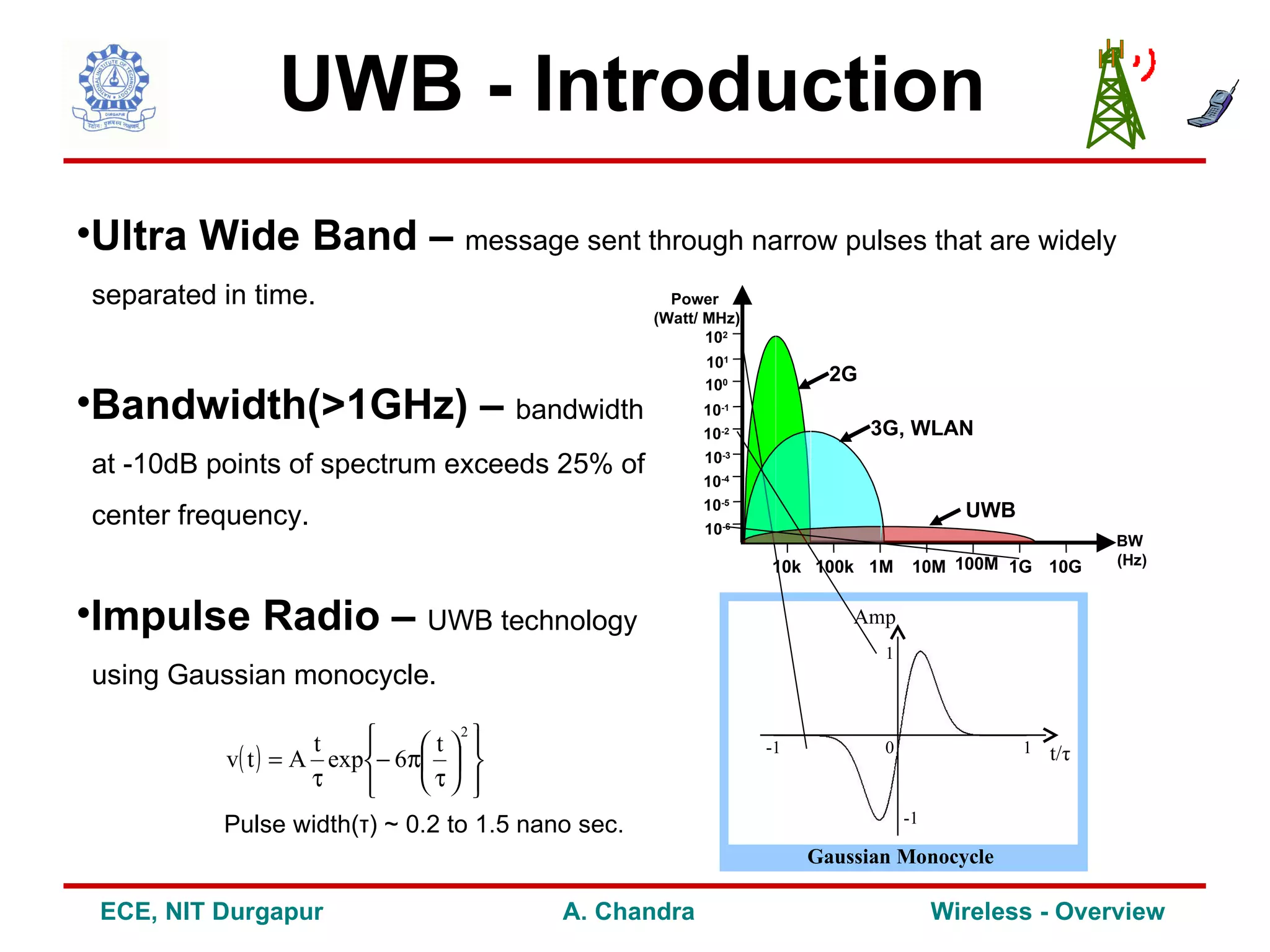
UWB - Introduction
•Ultra Wide Band – message sent through narrow pulses that are widely
 separated in time.                                  Power
                                                   (Watt/ MHz)
                                                          102
                                                         101
                                                         100
                                                                        2G
•Bandwidth(>1GHz) – bandwidth                            10-1
                                                                             3G, WLAN
                                                         10-2

 at -10dB points of spectrum exceeds 25% of              10-3
                                                         10-4
                                                         10-5                            UWB
 center frequency.                                       10-6
                                                                                                         BW
                                                                 10k 100k 1M       10M 100M 1G 10G       (Hz)


•Impulse Radio – UWB technology                                           Amp
                                                                              1
 using Gaussian monocycle.

                     t   
                             t 
                                 2
                                   
           v( t ) = A exp− 6π  
                                                                 -1           0                1   t/τ
                     τ   
                             τ 
                                                                                  -1
           Pulse width(τ) ~ 0.2 to 1.5 nano sec.
                                                                      Gaussian Monocycle

 ECE, NIT Durgapur                        A. Chandra                                   Wireless - Overview
UWB - Advantages
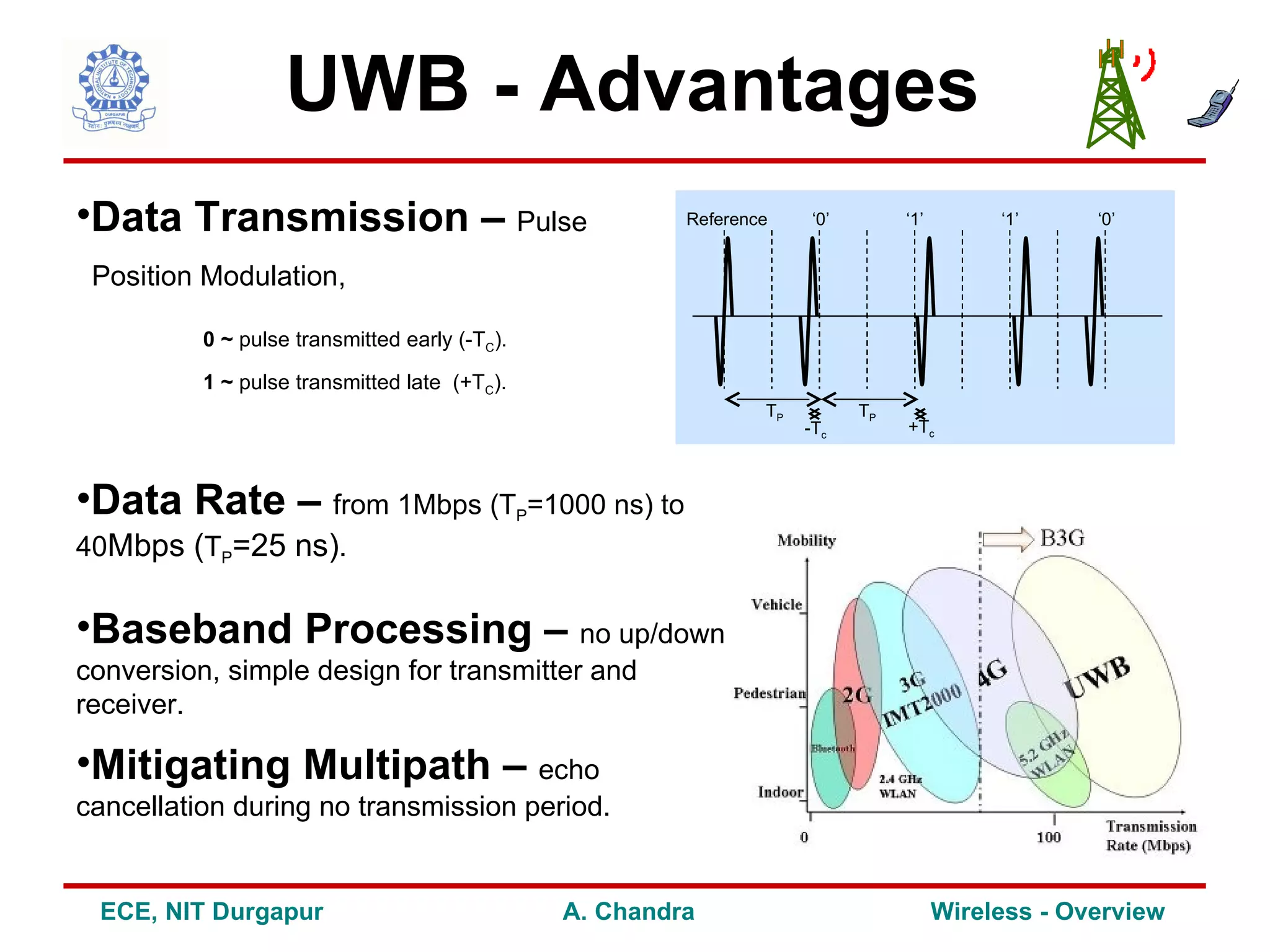
•Data Transmission – Pulse                                  Reference     ‘0’        ‘1’        ‘1’     ‘0’


 Position Modulation,

          0 ~ pulse transmitted early (-TC).

          1 ~ pulse transmitted late (+TC).
                                                                    TP          TP
                                                                         -Tc         +Tc


•Data Rate – from 1Mbps (T =1000 ns) to        P

40Mbps (TP=25 ns).


•Baseband Processing – no up/down
conversion, simple design for transmitter and
receiver.

•Mitigating Multipath – echo
cancellation during no transmission period.


 ECE, NIT Durgapur                                 A. Chandra                              Wireless - Overview
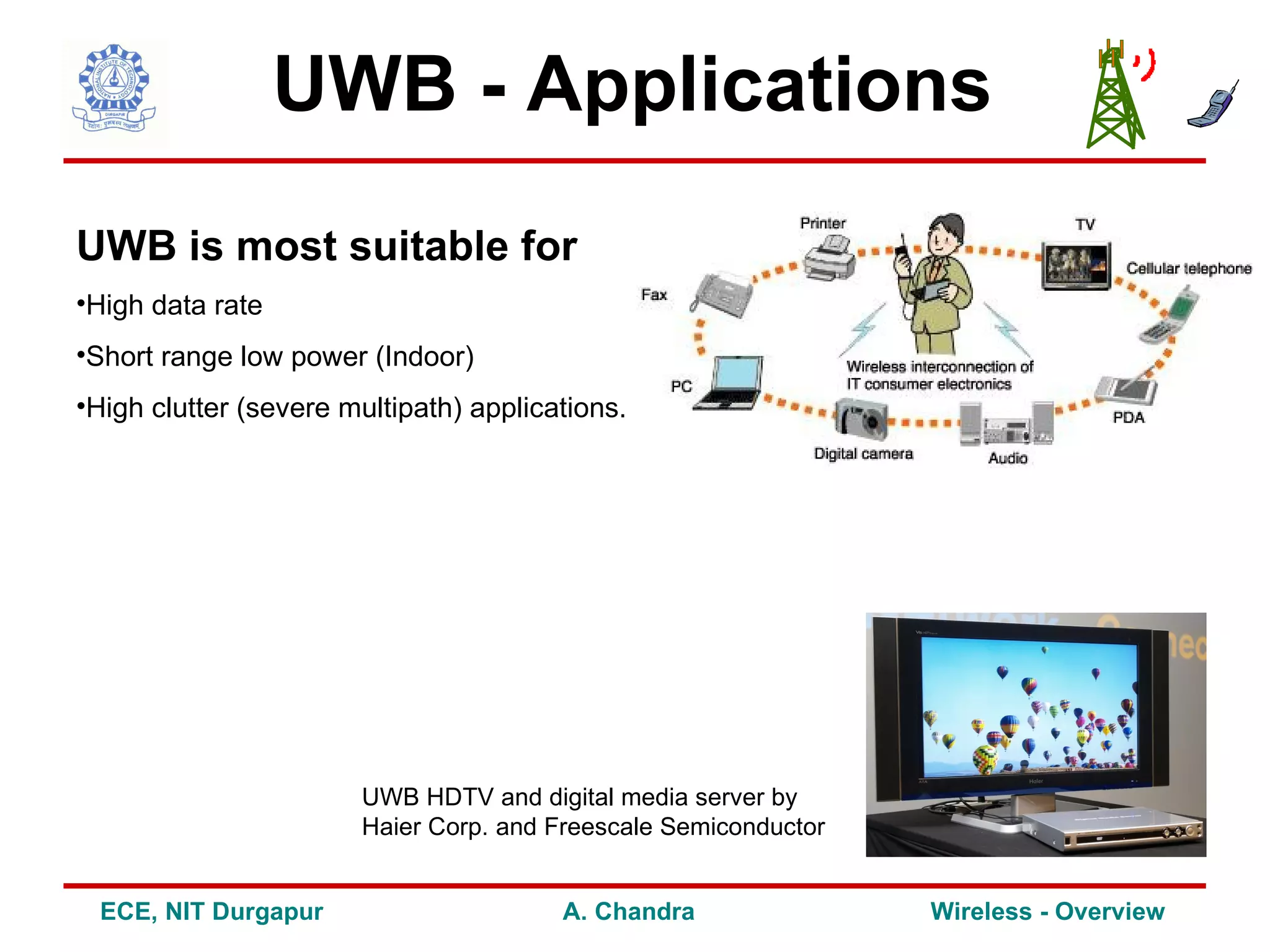
UWB - Applications
UWB is most suitable for
•High data rate
•Short range low power (Indoor)
•High clutter (severe multipath) applications.


                       UWB HDTV and digital media server by
                       Haier Corp. and Freescale Semiconductor


  ECE, NIT Durgapur                     A. Chandra               Wireless - Overview
OFDM - Introduction

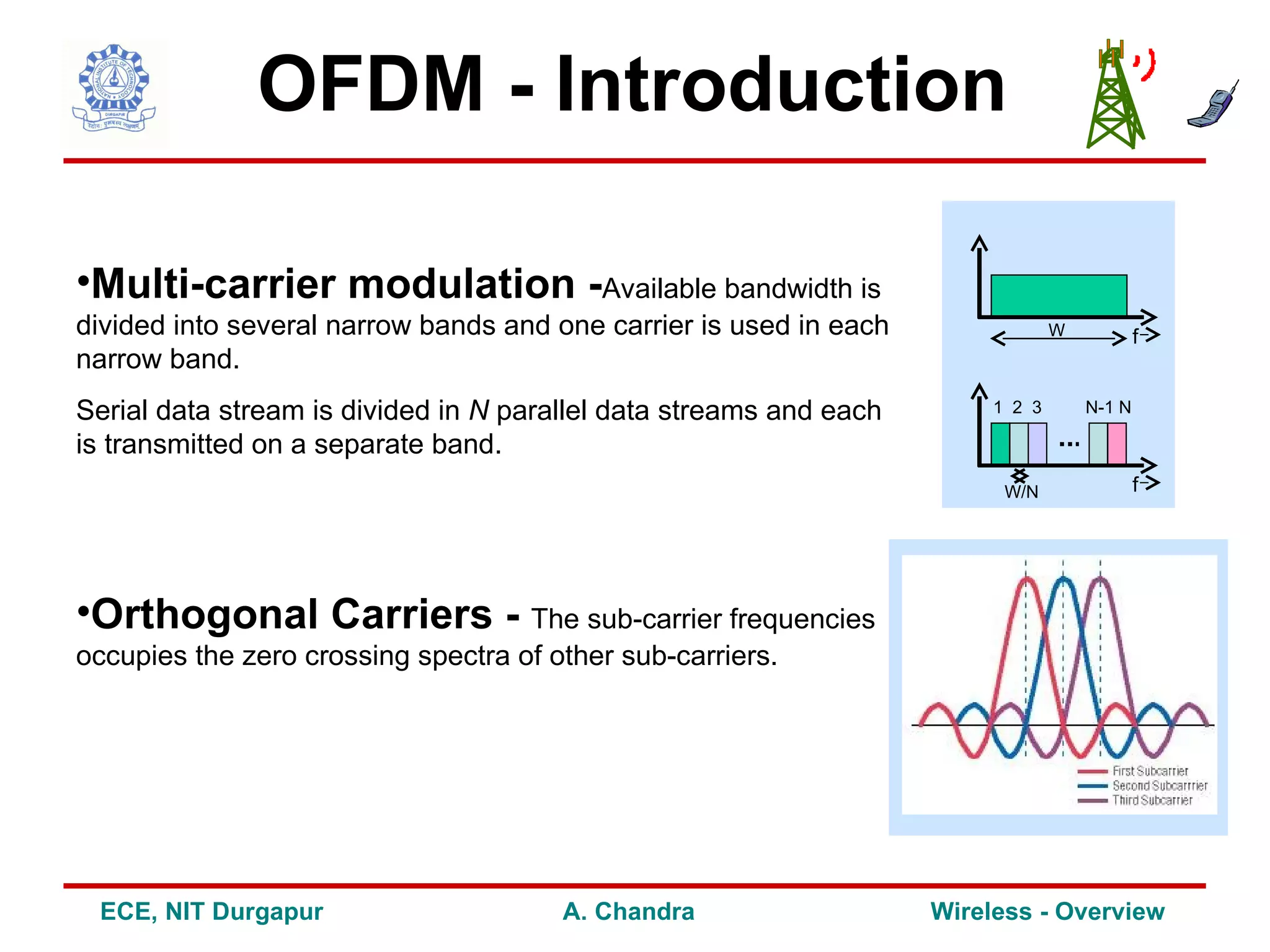
•Multi-carrier modulation -Available bandwidth is
divided into several narrow bands and one carrier is used in each                W           f
narrow band.
Serial data stream is divided in N parallel data streams and each        1 2 3       N-1 N

is transmitted on a separate band.
                                                                          W/N                f


•Orthogonal Carriers - The sub-carrier frequencies
occupies the zero crossing spectra of other sub-carriers.


 ECE, NIT Durgapur                     A. Chandra                   Wireless - Overview
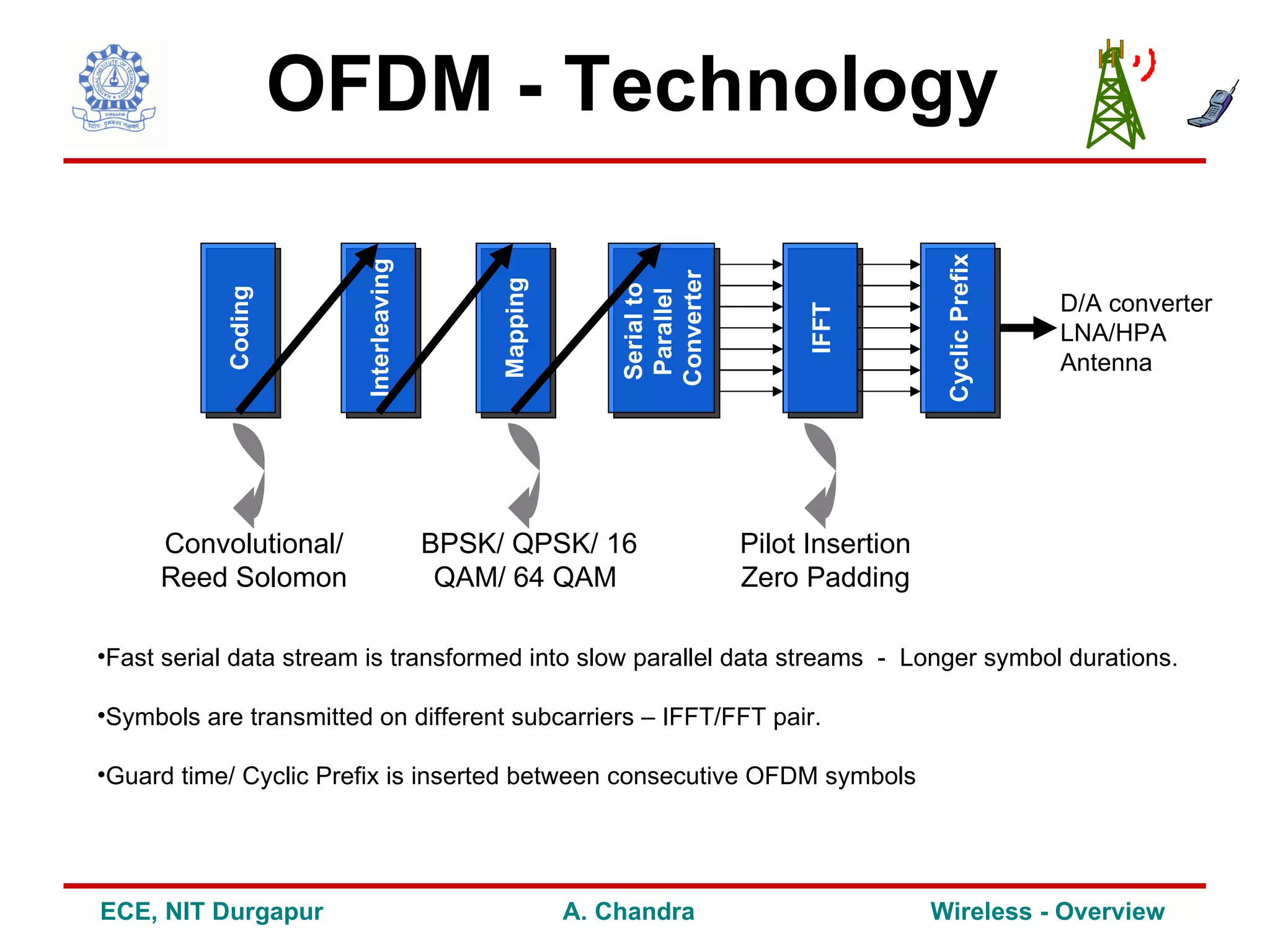
OFDM - Technology


                                                                                         Cyclic Prefix
                        Interleaving


                                                          Converter
                                            Mapping


                                                          Serial to
           Coding


                                                           Parallel
                                                                                                         D/A converter


                                                                           IFFT
                                                                                                         LNA/HPA
                                                                                                         Antenna


     Convolutional/                    BPSK/ QPSK/ 16                 Pilot Insertion
     Reed Solomon                       QAM/ 64 QAM                   Zero Padding

•Fast serial data stream is transformed into slow parallel data streams - Longer symbol durations.

•Symbols are transmitted on different subcarriers – IFFT/FFT pair.

•Guard time/ Cyclic Prefix is inserted between consecutive OFDM symbols


ECE, NIT Durgapur                                     A. Chandra                        Wireless - Overview
OFDM - Advantages
• Efficient spectrum utilization - Available bandwidth is divided into
several narrow bands and the data is transmitted in parallel on these narrow bands.


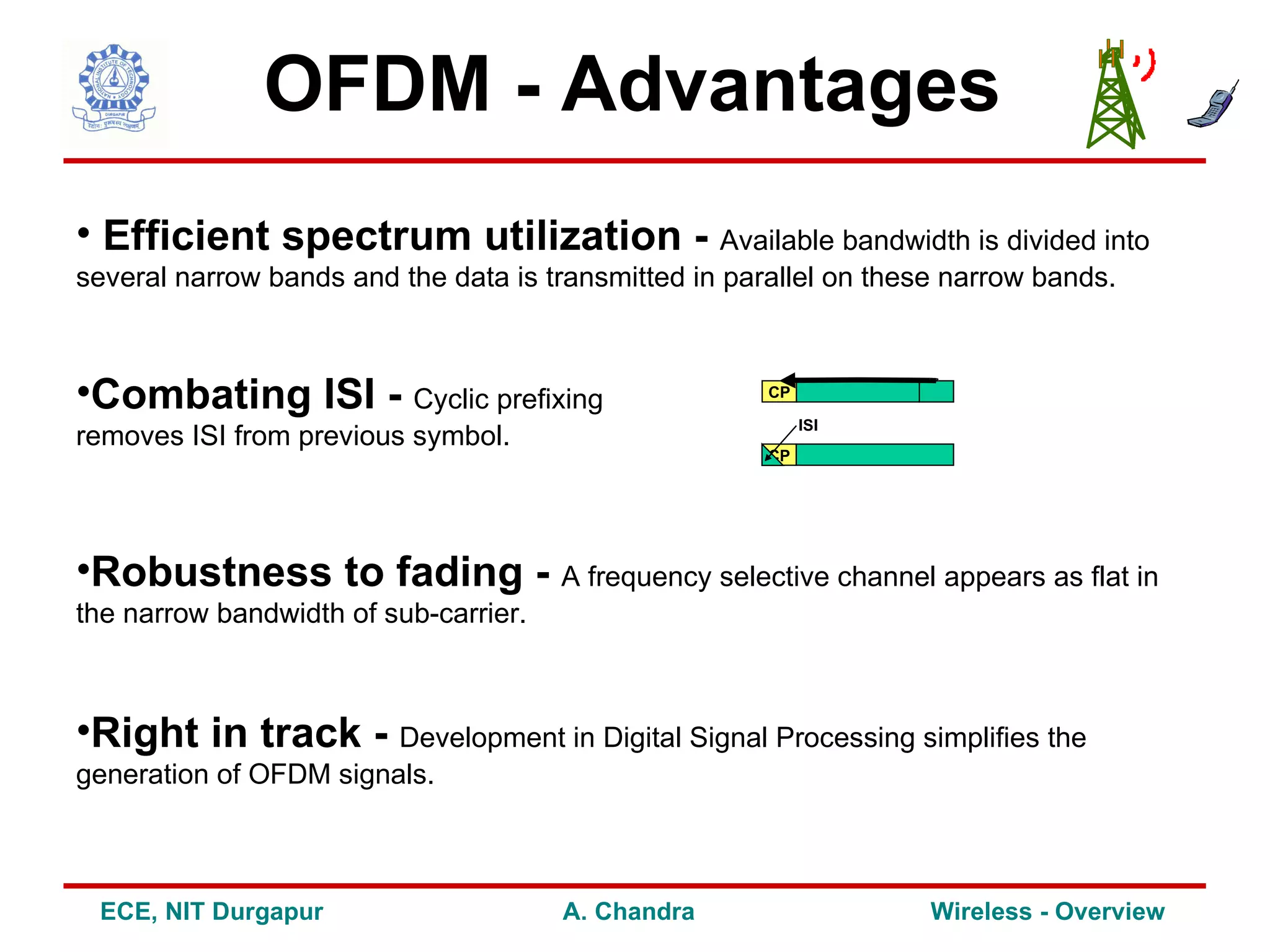
•Combating ISI - Cyclic prefixing                      CP

                                                            ISI
removes ISI from previous symbol.
                                                       CP


•Robustness to fading - A frequency selective channel appears as flat in
the narrow bandwidth of sub-carrier.


•Right in track - Development in Digital Signal Processing simplifies the
generation of OFDM signals.


 ECE, NIT Durgapur                     A. Chandra                   Wireless - Overview
OFDM - Challenges

•Much more sensitive to synchronization errors than
single-carrier systems - Synchronization of symbol duration and carrier
frequency is highly essential to maintain orthogonality among the sub-carriers


•High peak to average power ratio - OFDM signals have high
Peak to Average Power Ratio (PAPR) which leads to Out Of Band (OOB) distortion.
Also it requires amplifiers with very high linear characteristics to avoid OOB distortion.


•Wastage of bandwidth in cyclic prefix.


  ECE, NIT Durgapur                      A. Chandra                     Wireless - Overview
OFDM - Applications

•Used for wideband communication over mobile FM channels.

•Asynchronous Digital Subscriber Line (ADSL), High speed DSL, Very high speed DSL
use OFDM for transmission of high rate data.

•Digital Audio Broadcasting (DAB) and Digital Video Broadcasting (DVB).

•IEEE 802.11a and IEEE 802.11g wireless Local Area Network (WLAN) uses OFDM for
supporting high bit rate.

•European Telecommunications Standard Institute’s proposed HIPERLAN2 includes
OFDM.

•IEEE 802.16 Wireless MAN technology also proposes to use OFDM.

•Some authors have also advocated use of OFDM in mobile Ad Hoc networks.


ECE, NIT Durgapur                        A. Chandra                       Wireless - Overview
MIMO
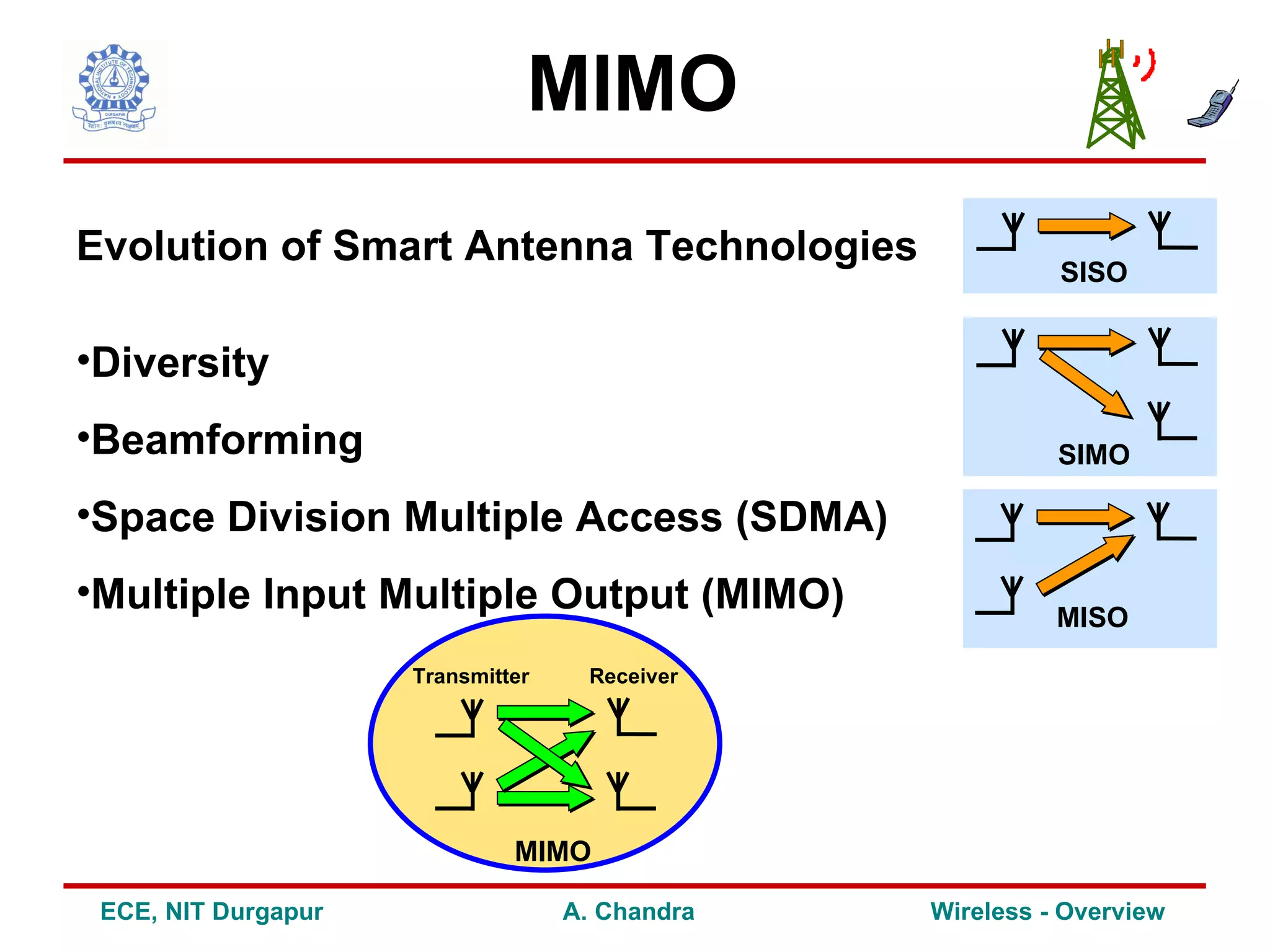
Evolution of Smart Antenna Technologies
                                                          SISO


•Diversity
•Beamforming                                              SIMO

•Space Division Multiple Access (SDMA)
•Multiple Input Multiple Output (MIMO)                    MISO
                     Transmitter     Receiver


                              MIMO

 ECE, NIT Durgapur                 A. Chandra   Wireless - Overview
MIMO
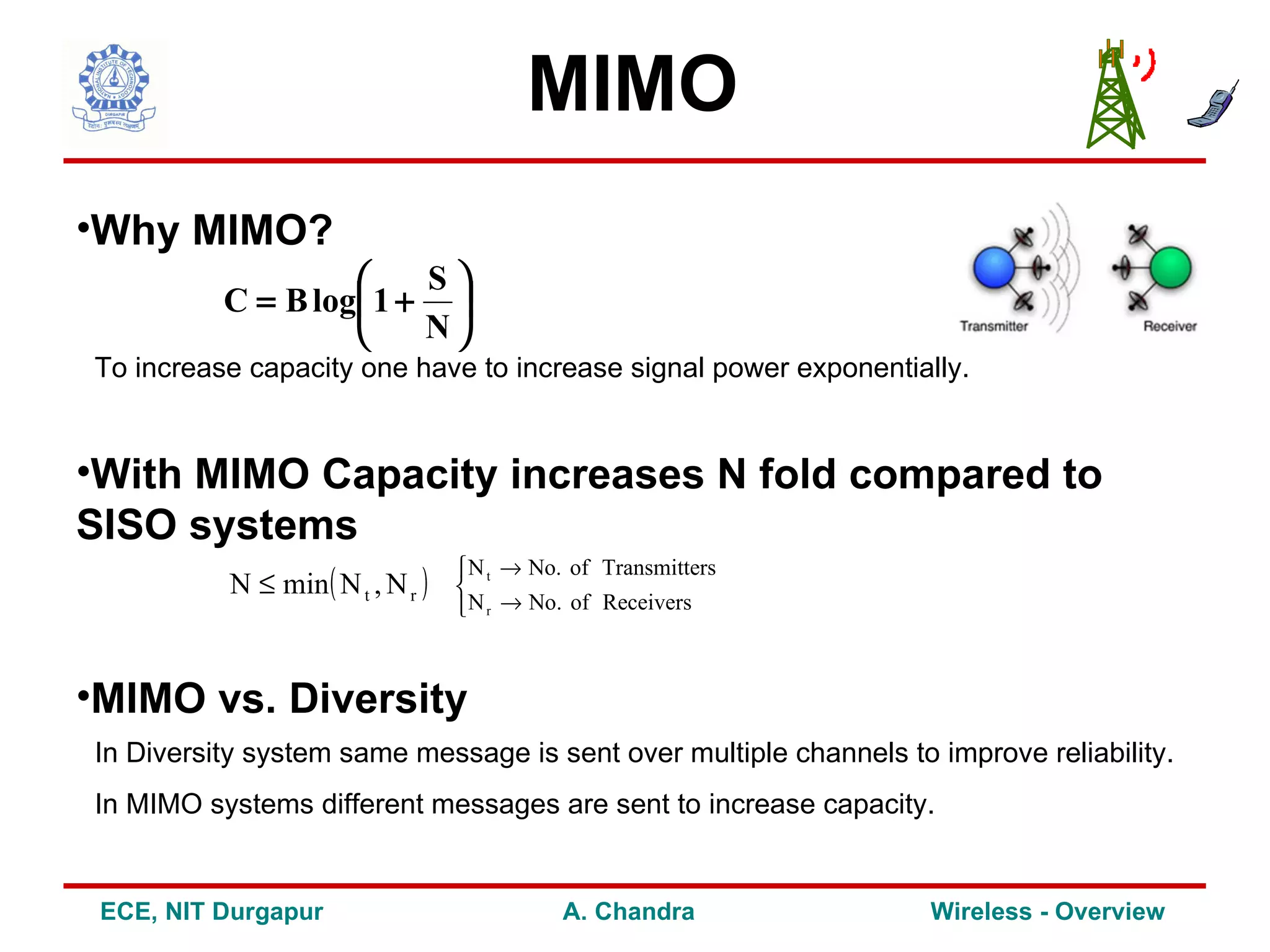
•Why MIMO?
                       S
          C = B log 1 + 
                       N
To increase capacity one have to increase signal power exponentially.


•With MIMO Capacity increases N fold compared to
SISO systems
                                   N t → No. of Transmitters
          N ≤ min ( N t , N r )   
                                   N r → No. of Receivers


•MIMO vs. Diversity
In Diversity system same message is sent over multiple channels to improve reliability.
In MIMO systems different messages are sent to increase capacity.


 ECE, NIT Durgapur                           A. Chandra            Wireless - Overview
MIMO - Technology
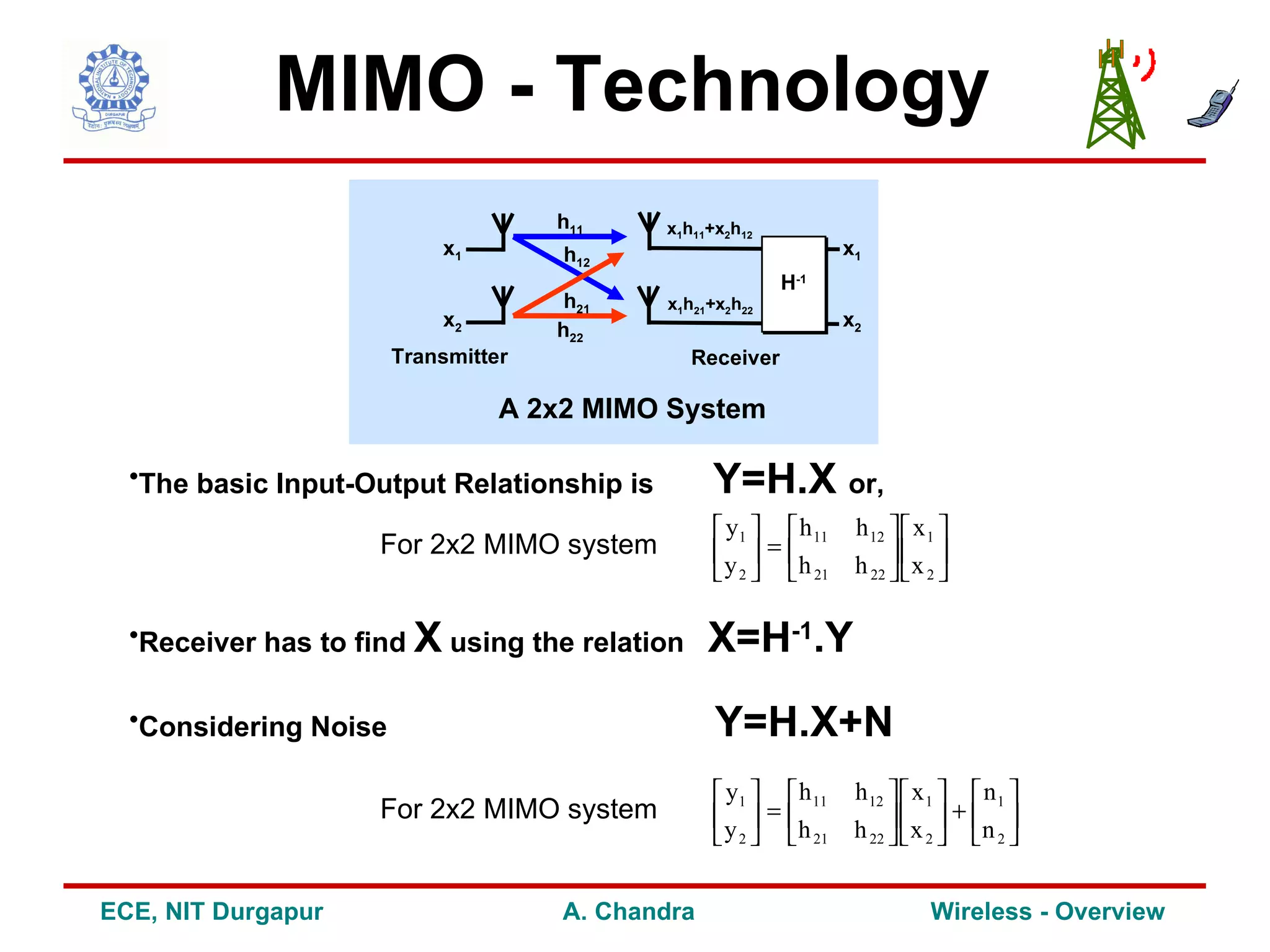
                                     h11    x1h11+x2h12
                           x1        h12                          x1
                                                          H-1
                                      h21   x1h21+x2h22
                           x2        h22                          x2
                       Transmitter             Receiver

                                 A 2x2 MIMO System

  •The basic Input-Output Relationship is         Y=H.X or,
                                                   y1   h 11    h 12   x 1 
                     For 2x2 MIMO system           y  = h
                                                   2   21       h 22   x 2 
                                                                         

  •Receiver has to find X using the relation      X=H-1.Y
  •Considering Noise                              Y=H.X+N
                                                   y1   h 11    h 12   x 1   n 1 
                     For 2x2 MIMO system           y  = h                     +
                                                   2   21       h 22   x 2  n 2 
                                                                           


ECE, NIT Durgapur                    A. Chandra                               Wireless - Overview
MIMO - Applications
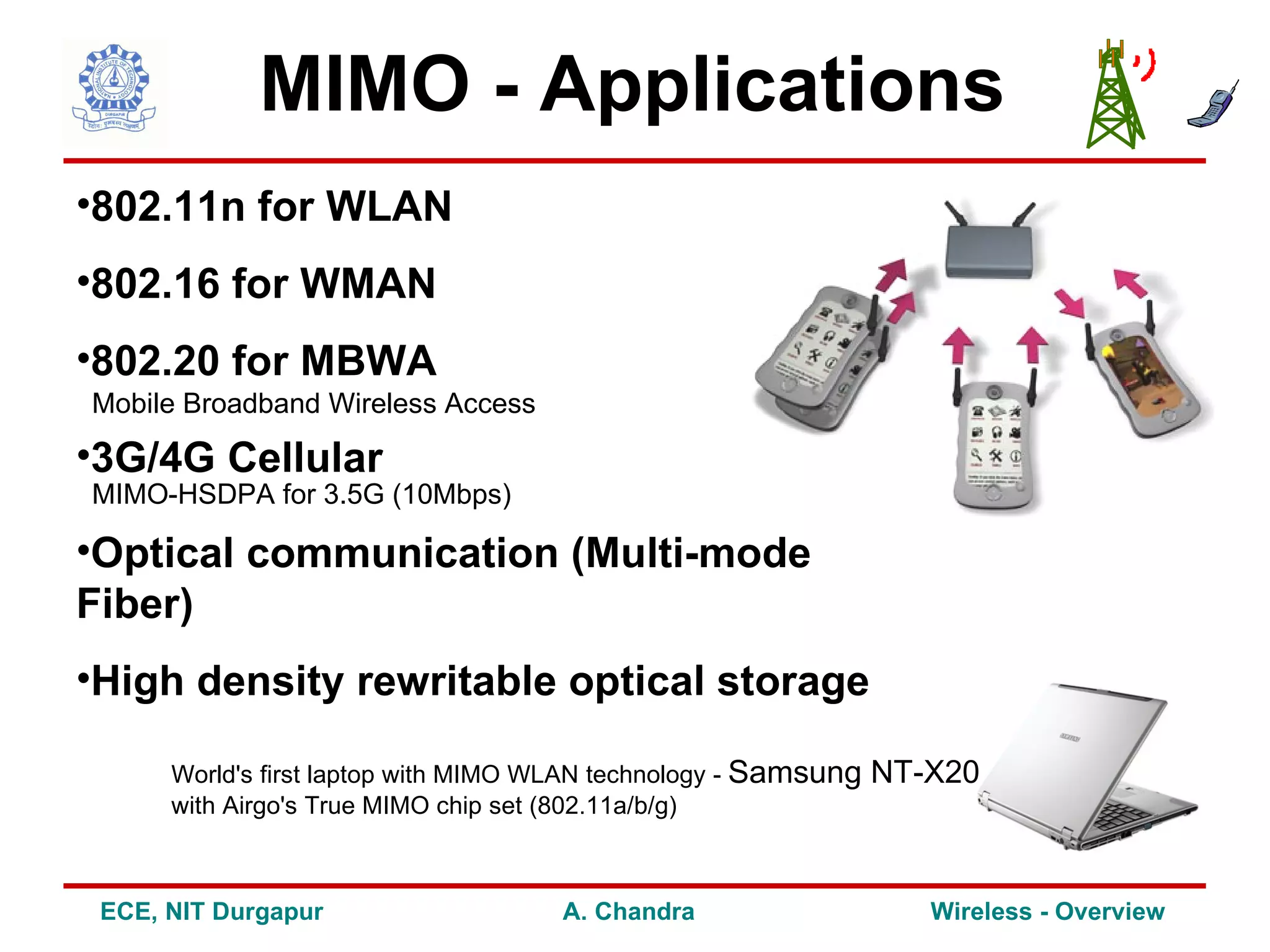
•802.11n for WLAN
•802.16 for WMAN
•802.20 for MBWA
Mobile Broadband Wireless Access

•3G/4G Cellular
MIMO-HSDPA for 3.5G (10Mbps)

•Optical communication (Multi-mode
Fiber)
•High density rewritable optical storage

      World's first laptop with MIMO WLAN technology - Samsung   NT-X20
      with Airgo's True MIMO chip set (802.11a/b/g)


 ECE, NIT Durgapur                   A. Chandra                     Wireless - Overview
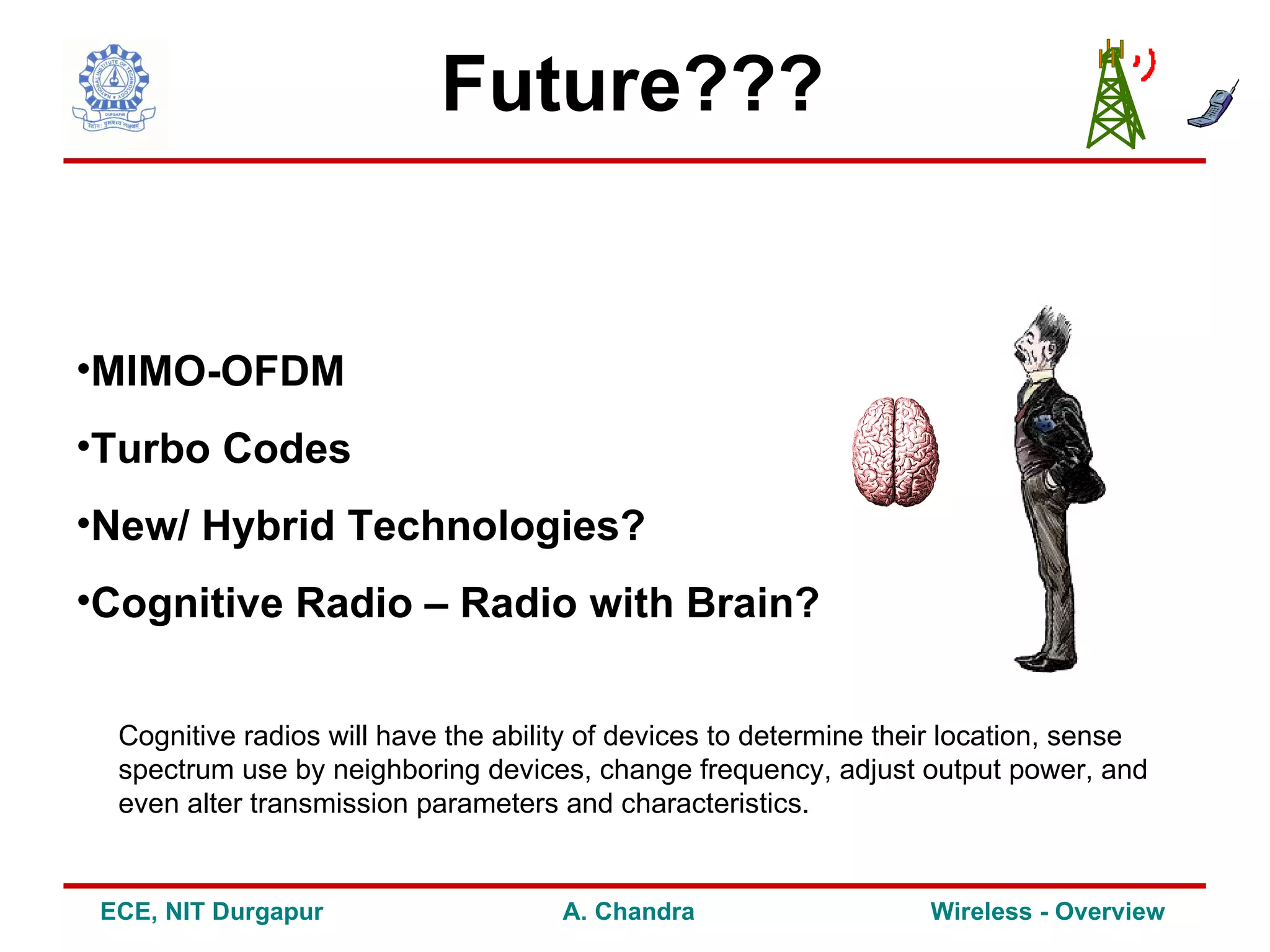
Future???


•MIMO-OFDM
•Turbo Codes
•New/ Hybrid Technologies?
•Cognitive Radio – Radio with Brain?


  Cognitive radios will have the ability of devices to determine their location, sense
  spectrum use by neighboring devices, change frequency, adjust output power, and
  even alter transmission parameters and characteristics.


 ECE, NIT Durgapur                    A. Chandra                    Wireless - Overview

wireless overview

  • 1.
    Wireless Communication –An overview Aniruddha Chandra ECE Department, NIT Durgapur aniruddha.chandra@ieee.org ECE, NIT Durgapur A. Chandra Wireless - Overview
  • 2.
    Outline Wireless Communication –General overview Challenges in Wireless Communication Future trends and Research areas ECE, NIT Durgapur A. Chandra Wireless - Overview
  • 3.
    Wireless Communication –General overview Why Wireless? Evolution of Standards Network & Technologies World Statistics India Statistics Challenges in Wireless Communication Future trends and Research areas ECE, NIT Durgapur A. Chandra Wireless - Overview
  • 4.
    Why Wireless? •Mobility –Phone for people not for places. •Easy Installation – Rapid deployment, reconfigurable. •Cost Savings – No cable, easy maintenance. •Digital Companion – Voice, message, internet, multimedia. ECE, NIT Durgapur A. Chandra Wireless - Overview
  • 5.
    Evolution of Standards • Telegraph 1837 2G 2.5G 3G • Telephone 1876 CDMA 2000 (EV-DV, W-CDMA • Radio Comm 1894 EV-DO) UMTS 2 Mbps 2 Mbps • AM comm radio 1920 CDMA Evolution Path • FM comm radio 1936 EDGE • Mobile Telephone 1940 IS-95B 384 kbps 64 kbps • Cellular mobile 1974 GPRS GSM Evolution • Path Digital Cellular 1991 IS-95A 54 kbps 14.4 kbps • Satellite mobile 1998 GSM, PDC, IS-95 IS-136 • 3G cellular 2002 9.6 kbps 9.6 kbps • 4G (expected) 2010 ECE, NIT Durgapur A. Chandra Wireless - Overview
  • 6.
    Network & Technologies 2G,2.5G,3G ECE, NIT Durgapur A. Chandra Wireless - Overview
  • 7.
    World Statistics •20 billionGSM Subscribers •3 billion CDMA Subscribers. *March ’06 statistics ( Source www.cdg.org and www.gsmworld.com) ECE, NIT Durgapur A. Chandra Wireless - Overview
  • 8.
    India Statistics Company No of % Market Subscribers Share (In million) Bharti 19.57 28.30% BSNL 17.16 24.80% Hutch 15.36 22.20% IDEA 7.37 10.65% Aircel 2.61 3.77% Reliance 1.90 2.75% Spice 1.93 2.79% MTNL 1.94 2.81% BPL 1.34 1.93% Total 69.19 100% GSM subscriber in March’06 (*Source COAI) ECE, NIT Durgapur A. Chandra Wireless - Overview
  • 9.
    India Statistics Company No of % Market Subscribers Share (In million) Reliance 15.407 75.72% Tata 23.84% 4.851 HFCL 0.062 0.30% Shyam 0.027 0.13% Total 20.348 100% CDMA subscriber in March’06 (*Source COAI) ECE, NIT Durgapur A. Chandra Wireless - Overview
  • 10.
    India Statistics •3.6 millionjobs generated directly or indirectly •145billion per annum generated by Mobile industry for the Govt. •The mobile services industry generates an annual GDP contribution of Rs. 313 billion •1% increase in teledensity →3% increase in rate of growth of GDP ECE, NIT Durgapur A. Chandra Wireless - Overview
  • 11.
    India Statistics •Poised tocross 200 million subscribers by 2007 •Catching up fast with China (282 million – Feb’06) “It is dangerous to put limits on wireless” - Marconi (1932). ECE, NIT Durgapur A. Chandra Wireless - Overview
  • 12.
    Wireless Communication –General overview Challenges in Wireless Communication Wireless Channel Standardization Network Planning Other Issues Future trends and Research areas ECE, NIT Durgapur A. Chandra Wireless - Overview
  • 13.
    Wireless Channel •Limited Power(Size, Weight, Battery Constraints) •Limited BW (Spectrum allocation) •Deep Fading (mainly due to Multipath) •Time Variance of the Channel Multipath •Path Loss (up to 10 dB/km) t0 Time Variance t0+τ1 t0+τ2 ECE, NIT Durgapur A. Chandra Wireless - Overview
  • 14.
    Standardization •Backward Compatibility •Interoperability •Integration ofVoice & Data Network •Frequency Allocation •Tariff Planning ECE, NIT Durgapur A. Chandra Wireless - Overview
  • 15.
    Network Planning •Terrain Survey– Shadow zone, Antenna height & size. •Radio Interference – CCI, ACI, ISI, FDD. •Power Control – Cost, Interference, Security, Safety, BW. •Frequency Reuse •Handoff ECE, NIT Durgapur A. Chandra Wireless - Overview
  • 16.
    Other Issues •Network Security •HealthRisks Temperature variation inside head due to cell phone use •Social & Economic Issues Change of input characteristics of handset antenna due to hand ECE, NIT Durgapur A. Chandra Wireless - Overview
  • 17.
    Wireless Communication –General overview Challenges in Wireless Communication Future trends and Research areas UWB OFDM MIMO Future??? ECE, NIT Durgapur A. Chandra Wireless - Overview
  • 18.
    UWB - Introduction •UltraWide Band – message sent through narrow pulses that are widely separated in time. Power (Watt/ MHz) 102 101 100 2G •Bandwidth(>1GHz) – bandwidth 10-1 3G, WLAN 10-2 at -10dB points of spectrum exceeds 25% of 10-3 10-4 10-5 UWB center frequency. 10-6 BW 10k 100k 1M 10M 100M 1G 10G (Hz) •Impulse Radio – UWB technology Amp 1 using Gaussian monocycle. t   t  2  v( t ) = A exp− 6π   -1 0 1 t/τ τ   τ  -1 Pulse width(τ) ~ 0.2 to 1.5 nano sec. Gaussian Monocycle ECE, NIT Durgapur A. Chandra Wireless - Overview
  • 19.
    UWB - Advantages •DataTransmission – Pulse Reference ‘0’ ‘1’ ‘1’ ‘0’ Position Modulation, 0 ~ pulse transmitted early (-TC). 1 ~ pulse transmitted late (+TC). TP TP -Tc +Tc •Data Rate – from 1Mbps (T =1000 ns) to P 40Mbps (TP=25 ns). •Baseband Processing – no up/down conversion, simple design for transmitter and receiver. •Mitigating Multipath – echo cancellation during no transmission period. ECE, NIT Durgapur A. Chandra Wireless - Overview
  • 20.
    UWB - Applications UWBis most suitable for •High data rate •Short range low power (Indoor) •High clutter (severe multipath) applications. UWB HDTV and digital media server by Haier Corp. and Freescale Semiconductor ECE, NIT Durgapur A. Chandra Wireless - Overview
  • 21.
    OFDM - Introduction •Multi-carriermodulation -Available bandwidth is divided into several narrow bands and one carrier is used in each W f narrow band. Serial data stream is divided in N parallel data streams and each 1 2 3 N-1 N is transmitted on a separate band. W/N f •Orthogonal Carriers - The sub-carrier frequencies occupies the zero crossing spectra of other sub-carriers. ECE, NIT Durgapur A. Chandra Wireless - Overview
  • 22.
    OFDM - Technology Cyclic Prefix Interleaving Converter Mapping Serial to Coding Parallel D/A converter IFFT LNA/HPA Antenna Convolutional/ BPSK/ QPSK/ 16 Pilot Insertion Reed Solomon QAM/ 64 QAM Zero Padding •Fast serial data stream is transformed into slow parallel data streams - Longer symbol durations. •Symbols are transmitted on different subcarriers – IFFT/FFT pair. •Guard time/ Cyclic Prefix is inserted between consecutive OFDM symbols ECE, NIT Durgapur A. Chandra Wireless - Overview
  • 23.
    OFDM - Advantages •Efficient spectrum utilization - Available bandwidth is divided into several narrow bands and the data is transmitted in parallel on these narrow bands. •Combating ISI - Cyclic prefixing CP ISI removes ISI from previous symbol. CP •Robustness to fading - A frequency selective channel appears as flat in the narrow bandwidth of sub-carrier. •Right in track - Development in Digital Signal Processing simplifies the generation of OFDM signals. ECE, NIT Durgapur A. Chandra Wireless - Overview
  • 24.
    OFDM - Challenges •Muchmore sensitive to synchronization errors than single-carrier systems - Synchronization of symbol duration and carrier frequency is highly essential to maintain orthogonality among the sub-carriers •High peak to average power ratio - OFDM signals have high Peak to Average Power Ratio (PAPR) which leads to Out Of Band (OOB) distortion. Also it requires amplifiers with very high linear characteristics to avoid OOB distortion. •Wastage of bandwidth in cyclic prefix. ECE, NIT Durgapur A. Chandra Wireless - Overview
  • 25.
    OFDM - Applications •Usedfor wideband communication over mobile FM channels. •Asynchronous Digital Subscriber Line (ADSL), High speed DSL, Very high speed DSL use OFDM for transmission of high rate data. •Digital Audio Broadcasting (DAB) and Digital Video Broadcasting (DVB). •IEEE 802.11a and IEEE 802.11g wireless Local Area Network (WLAN) uses OFDM for supporting high bit rate. •European Telecommunications Standard Institute’s proposed HIPERLAN2 includes OFDM. •IEEE 802.16 Wireless MAN technology also proposes to use OFDM. •Some authors have also advocated use of OFDM in mobile Ad Hoc networks. ECE, NIT Durgapur A. Chandra Wireless - Overview
  • 26.
    MIMO Evolution of SmartAntenna Technologies SISO •Diversity •Beamforming SIMO •Space Division Multiple Access (SDMA) •Multiple Input Multiple Output (MIMO) MISO Transmitter Receiver MIMO ECE, NIT Durgapur A. Chandra Wireless - Overview
  • 27.
    MIMO •Why MIMO?  S C = B log 1 +   N To increase capacity one have to increase signal power exponentially. •With MIMO Capacity increases N fold compared to SISO systems  N t → No. of Transmitters N ≤ min ( N t , N r )   N r → No. of Receivers •MIMO vs. Diversity In Diversity system same message is sent over multiple channels to improve reliability. In MIMO systems different messages are sent to increase capacity. ECE, NIT Durgapur A. Chandra Wireless - Overview
  • 28.
    MIMO - Technology h11 x1h11+x2h12 x1 h12 x1 H-1 h21 x1h21+x2h22 x2 h22 x2 Transmitter Receiver A 2x2 MIMO System •The basic Input-Output Relationship is Y=H.X or,  y1   h 11 h 12   x 1  For 2x2 MIMO system  y  = h  2   21 h 22   x 2    •Receiver has to find X using the relation X=H-1.Y •Considering Noise Y=H.X+N  y1   h 11 h 12   x 1   n 1  For 2x2 MIMO system  y  = h +  2   21 h 22   x 2  n 2      ECE, NIT Durgapur A. Chandra Wireless - Overview
  • 29.
    MIMO - Applications •802.11nfor WLAN •802.16 for WMAN •802.20 for MBWA Mobile Broadband Wireless Access •3G/4G Cellular MIMO-HSDPA for 3.5G (10Mbps) •Optical communication (Multi-mode Fiber) •High density rewritable optical storage World's first laptop with MIMO WLAN technology - Samsung NT-X20 with Airgo's True MIMO chip set (802.11a/b/g) ECE, NIT Durgapur A. Chandra Wireless - Overview
  • 30.
    Future??? •MIMO-OFDM •Turbo Codes •New/ HybridTechnologies? •Cognitive Radio – Radio with Brain? Cognitive radios will have the ability of devices to determine their location, sense spectrum use by neighboring devices, change frequency, adjust output power, and even alter transmission parameters and characteristics. ECE, NIT Durgapur A. Chandra Wireless - Overview