International
OPEN ACCESS Journal
Of Modern Engineering Research (IJMER)
| IJMER | ISSN: 2249–6645 | www.ijmer.com | Vol. 4 | Iss.10| Oct. 2014 | 1|
An Experimental Investigation of Capacity Utilization in
Manufacturing Industry
N. Jayanth1
, S. Vidyashankar2
1
Associate Professor, Dept. of Mechanical Engineering, BMS College of Engineering, Bangalore 500 019
2
Professor & P G Coordinator, Dept. of Mechanical Engg, B I T, K R Road, Bangalore – 560002
I. Introduction
For most companies, production assets are finite—utilization is a key measure and is a major
determinant of product costs. Yet with those established and even expected constraints, not all companies
perform a mid-range (between 3 to12 months) rough-cut capacity plan. This process is important for five key
reasons:
 Understand the unconstrained production requirements
 Understand available capacity
 Resolve any capacity exceptions
 Create a constrained, feasible Master Production Schedule
 Understand the total supply chain outlook
Most companies today auto-tune capacity measurement methods to their individual needs which are
fine on a small scale but on a larger global scale, where comparison and standards mean everything, a larger
widely accepted method is required. The smaller companies often end up benchmarking incoherent capacity
planning methods and this leads to a wastage of resources. With all the methods there are several pros and cons
and we have tried to eliminate and determine the best way to go about planning capacity.
Under current economic conditions, severe global competition and postponement of new equipment
purchases are causing business executives to be sensitive about all aspects of manufacturing operational costs.
In this context Overall Equipment Effectiveness (OEE) has become a hot topic among many manufacturers. It
provides a simple way to ―keep score‖ of manufacturing performance, and lean manufacturing initiatives. In
simple Words, ―Overall Equipment Effectiveness shows the effectiveness of a machine compared to the ideal
machine as a percentage.‖
II. Capacity Utilization
The investigation on optimization on capacity utilization was carried out at Cold Forging organization
situated in Bangalore. The Organization had started its journey in a humble way in 1990. The two decades
long experience focuses its vision about the future of Indian automotive and engineering industry and its
dedicated efforts in pursuing the objective of achieving higher degree of perfection.
Manufactured as original equipment for supply to O.E.M, spares and export markets the range of
Megamiles products have a wide spectra of application in heavy, medium and light carriage vehicles, passenger
cars, jeeps, tractors, two wheelers and Engineering applications.
Abstract: In the modern day competitive world, every organization demands an effective utilization of
capacity. Capacity Utilization means the maximum amount of output that can be produced in the short
run of time. A lot of planning is necessary for the proper management of capacity. Capacity planning is
one side of a coin and capacity management is the other. The capacity plans needs to be executed
flawlessly, with unpleasant surprises avoided. A managerial problem is to match the capacity with the
plans. Companies whether labour or machine intensive have a CI trend that remains fairly constant in
that particular sector. For example a company will have a monthly cumulative CI trend that could be
compared with any other company trend within the same market. The present paper makes an attempt to
study the most important parameter of the organization i.e capacity utilization of a company.
An Experimental Investigation of Capacity Utilization in Manufacturing Industry
| IJMER | ISSN: 2249–6645 | www.ijmer.com | Vol. 4 | Iss.10| Oct. 2014 | 2|
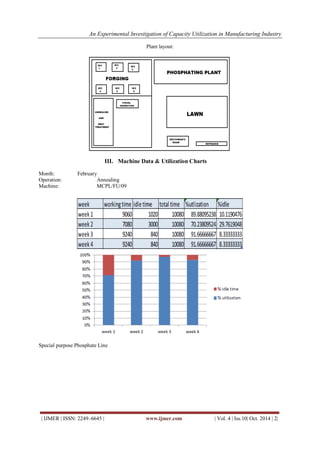
Plant layout:
III. Machine Data & Utilization Charts
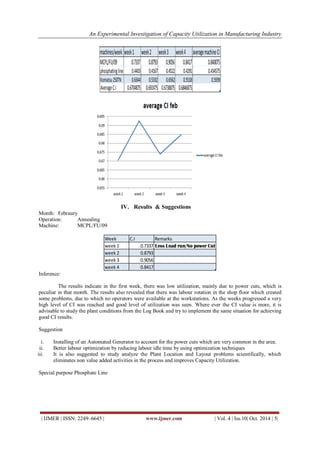
Month: February
Operation: Annealing
Machine: MCPL/FU/09
Special purpose Phosphate Line
An Experimental Investigation of Capacity Utilization in Manufacturing Industry
| IJMER | ISSN: 2249–6645 | www.ijmer.com | Vol. 4 | Iss.10| Oct. 2014 | 3|
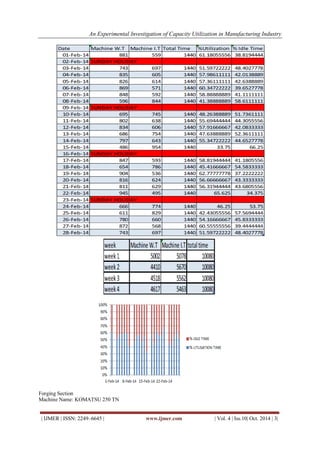
Forging Section
Machine Name: KOMATSU 250 TN
An Experimental Investigation of Capacity Utilization in Manufacturing Industry
| IJMER | ISSN: 2249–6645 | www.ijmer.com | Vol. 4 | Iss.10| Oct. 2014 | 4|
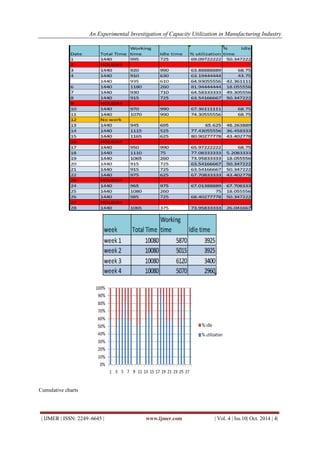
Cumulative charts
An Experimental Investigation of Capacity Utilization in Manufacturing Industry
| IJMER | ISSN: 2249–6645 | www.ijmer.com | Vol. 4 | Iss.10| Oct. 2014 | 5|
IV. Results & Suggestions
Month: Febraury
Operation: Annealing
Machine: MCPL/FU/09
Week C.I Remarks
week 1 0.7337 Less Load run/No power Cut
week 2 0.8793
week 3 0.9056
week 4 0.8417
Inference:
The results indicate in the first week, there was low utilization, mainly due to power cuts, which is
peculiar in that month. The results also revealed that there was labour rotation in the shop floor which created
some problems, due to which no operators were available at the workstations. As the weeks progressed a very
high level of CI was reached and good level of utilization was seen. Where ever the CI value is more, it is
advisable to study the plant conditions from the Log Book and try to implement the same situation for achieving
good CI results.
Suggestion
i. Installing of an Automated Generator to account for the power cuts which are very common in the area.
ii. Better labour optimization by reducing labour idle time by using optimization techniques
iii. It is also suggested to study analyze the Plant Location and Layout problems scientifically, which
eliminates non value added activities in the process and improves Capacity Utilization.
Special purpose Phosphate Line
An Experimental Investigation of Capacity Utilization in Manufacturing Industry
| IJMER | ISSN: 2249–6645 | www.ijmer.com | Vol. 4 | Iss.10| Oct. 2014 | 6|
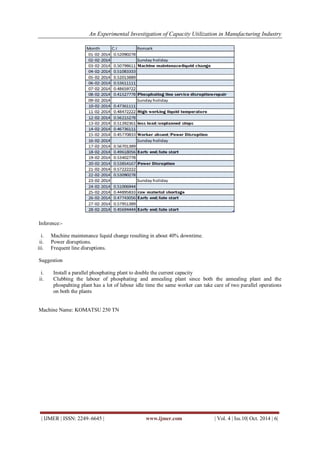
Inference:-
i. Machine maintenance liquid change resulting in about 40% downtime.
ii. Power disruptions.
iii. Frequent line disruptions.
Suggestion
i. Install a parallel phosphating plant to double the current capacity
ii. Clubbing the labour of phosphating and annealing plant since both the annealing plant and the
phospahting plant has a lot of labour idle time the same worker can take care of two parallel operations
on both the plants
Machine Name: KOMATSU 250 TN
An Experimental Investigation of Capacity Utilization in Manufacturing Industry
| IJMER | ISSN: 2249–6645 | www.ijmer.com | Vol. 4 | Iss.10| Oct. 2014 | 7|
Inference
i. No load.
ii. Power cut
iii. Settings change(30% downtime)
Suggestion
i. Increasing the capacity of phosphating plant
ii. Make flexible labour timings,reduce time delay in labour shifts to make up for time lost due to power cuts
iii. Installation of a generator to make up for power cuts
Impact on Capacitive Index (CI)
Installing of generators is a long term solution .It basically improves machine working time thus the
labour time and therefore the capacitive index. However the management has wait until the initial investment is
returned and a net profit is registered
V. Scope For Future Work
i. Detailed study of automization and installing it in the current factory.
ii. Detailed study for 3-4 months records and cost analysis
iii. We would like to see one of the advanced planning tools to be used in the future so that a plant knows its
efficiency before it is even built.This would not only increase productivityand profit, it would also reduce
redundant waste and stabilize the global economy.
REFERENCES
[1]. Shivakumar B. Burli (2011) ―Impact of Quality Management Practices on the Organizational performance of Small
and Medium Ale manufacturing industries‖. Nov -2011/ Volume-1/Issue-4/Article No-8/63
[2]. Parastoo Roghanian (2012) [14] ‖ Productivity Tools: TPM and TQM‖ Volume 2, No.4,
[3]. Determination of capacity index, year 2011, BMSCE
[4]. measuring capacity utilization in manufacturing presented by: james f. ragan
[5]. production capacity: its bases, functions and measurement. presented by: salah e. elmaghraby
[6]. The art of capacity planning: john allspaw

A04010 02 0107

  • 1.
    International OPEN ACCESS Journal OfModern Engineering Research (IJMER) | IJMER | ISSN: 2249–6645 | www.ijmer.com | Vol. 4 | Iss.10| Oct. 2014 | 1| An Experimental Investigation of Capacity Utilization in Manufacturing Industry N. Jayanth1 , S. Vidyashankar2 1 Associate Professor, Dept. of Mechanical Engineering, BMS College of Engineering, Bangalore 500 019 2 Professor & P G Coordinator, Dept. of Mechanical Engg, B I T, K R Road, Bangalore – 560002 I. Introduction For most companies, production assets are finite—utilization is a key measure and is a major determinant of product costs. Yet with those established and even expected constraints, not all companies perform a mid-range (between 3 to12 months) rough-cut capacity plan. This process is important for five key reasons:  Understand the unconstrained production requirements  Understand available capacity  Resolve any capacity exceptions  Create a constrained, feasible Master Production Schedule  Understand the total supply chain outlook Most companies today auto-tune capacity measurement methods to their individual needs which are fine on a small scale but on a larger global scale, where comparison and standards mean everything, a larger widely accepted method is required. The smaller companies often end up benchmarking incoherent capacity planning methods and this leads to a wastage of resources. With all the methods there are several pros and cons and we have tried to eliminate and determine the best way to go about planning capacity. Under current economic conditions, severe global competition and postponement of new equipment purchases are causing business executives to be sensitive about all aspects of manufacturing operational costs. In this context Overall Equipment Effectiveness (OEE) has become a hot topic among many manufacturers. It provides a simple way to ―keep score‖ of manufacturing performance, and lean manufacturing initiatives. In simple Words, ―Overall Equipment Effectiveness shows the effectiveness of a machine compared to the ideal machine as a percentage.‖ II. Capacity Utilization The investigation on optimization on capacity utilization was carried out at Cold Forging organization situated in Bangalore. The Organization had started its journey in a humble way in 1990. The two decades long experience focuses its vision about the future of Indian automotive and engineering industry and its dedicated efforts in pursuing the objective of achieving higher degree of perfection. Manufactured as original equipment for supply to O.E.M, spares and export markets the range of Megamiles products have a wide spectra of application in heavy, medium and light carriage vehicles, passenger cars, jeeps, tractors, two wheelers and Engineering applications. Abstract: In the modern day competitive world, every organization demands an effective utilization of capacity. Capacity Utilization means the maximum amount of output that can be produced in the short run of time. A lot of planning is necessary for the proper management of capacity. Capacity planning is one side of a coin and capacity management is the other. The capacity plans needs to be executed flawlessly, with unpleasant surprises avoided. A managerial problem is to match the capacity with the plans. Companies whether labour or machine intensive have a CI trend that remains fairly constant in that particular sector. For example a company will have a monthly cumulative CI trend that could be compared with any other company trend within the same market. The present paper makes an attempt to study the most important parameter of the organization i.e capacity utilization of a company.
  • 2.
    An Experimental Investigationof Capacity Utilization in Manufacturing Industry | IJMER | ISSN: 2249–6645 | www.ijmer.com | Vol. 4 | Iss.10| Oct. 2014 | 2| Plant layout: III. Machine Data & Utilization Charts Month: February Operation: Annealing Machine: MCPL/FU/09 Special purpose Phosphate Line
  • 3.
    An Experimental Investigationof Capacity Utilization in Manufacturing Industry | IJMER | ISSN: 2249–6645 | www.ijmer.com | Vol. 4 | Iss.10| Oct. 2014 | 3| Forging Section Machine Name: KOMATSU 250 TN
  • 4.
    An Experimental Investigationof Capacity Utilization in Manufacturing Industry | IJMER | ISSN: 2249–6645 | www.ijmer.com | Vol. 4 | Iss.10| Oct. 2014 | 4| Cumulative charts
  • 5.
    An Experimental Investigationof Capacity Utilization in Manufacturing Industry | IJMER | ISSN: 2249–6645 | www.ijmer.com | Vol. 4 | Iss.10| Oct. 2014 | 5| IV. Results & Suggestions Month: Febraury Operation: Annealing Machine: MCPL/FU/09 Week C.I Remarks week 1 0.7337 Less Load run/No power Cut week 2 0.8793 week 3 0.9056 week 4 0.8417 Inference: The results indicate in the first week, there was low utilization, mainly due to power cuts, which is peculiar in that month. The results also revealed that there was labour rotation in the shop floor which created some problems, due to which no operators were available at the workstations. As the weeks progressed a very high level of CI was reached and good level of utilization was seen. Where ever the CI value is more, it is advisable to study the plant conditions from the Log Book and try to implement the same situation for achieving good CI results. Suggestion i. Installing of an Automated Generator to account for the power cuts which are very common in the area. ii. Better labour optimization by reducing labour idle time by using optimization techniques iii. It is also suggested to study analyze the Plant Location and Layout problems scientifically, which eliminates non value added activities in the process and improves Capacity Utilization. Special purpose Phosphate Line
  • 6.
    An Experimental Investigationof Capacity Utilization in Manufacturing Industry | IJMER | ISSN: 2249–6645 | www.ijmer.com | Vol. 4 | Iss.10| Oct. 2014 | 6| Inference:- i. Machine maintenance liquid change resulting in about 40% downtime. ii. Power disruptions. iii. Frequent line disruptions. Suggestion i. Install a parallel phosphating plant to double the current capacity ii. Clubbing the labour of phosphating and annealing plant since both the annealing plant and the phospahting plant has a lot of labour idle time the same worker can take care of two parallel operations on both the plants Machine Name: KOMATSU 250 TN
  • 7.
    An Experimental Investigationof Capacity Utilization in Manufacturing Industry | IJMER | ISSN: 2249–6645 | www.ijmer.com | Vol. 4 | Iss.10| Oct. 2014 | 7| Inference i. No load. ii. Power cut iii. Settings change(30% downtime) Suggestion i. Increasing the capacity of phosphating plant ii. Make flexible labour timings,reduce time delay in labour shifts to make up for time lost due to power cuts iii. Installation of a generator to make up for power cuts Impact on Capacitive Index (CI) Installing of generators is a long term solution .It basically improves machine working time thus the labour time and therefore the capacitive index. However the management has wait until the initial investment is returned and a net profit is registered V. Scope For Future Work i. Detailed study of automization and installing it in the current factory. ii. Detailed study for 3-4 months records and cost analysis iii. We would like to see one of the advanced planning tools to be used in the future so that a plant knows its efficiency before it is even built.This would not only increase productivityand profit, it would also reduce redundant waste and stabilize the global economy. REFERENCES [1]. Shivakumar B. Burli (2011) ―Impact of Quality Management Practices on the Organizational performance of Small and Medium Ale manufacturing industries‖. Nov -2011/ Volume-1/Issue-4/Article No-8/63 [2]. Parastoo Roghanian (2012) [14] ‖ Productivity Tools: TPM and TQM‖ Volume 2, No.4, [3]. Determination of capacity index, year 2011, BMSCE [4]. measuring capacity utilization in manufacturing presented by: james f. ragan [5]. production capacity: its bases, functions and measurement. presented by: salah e. elmaghraby [6]. The art of capacity planning: john allspaw