BUSINESS STUDIES
    PROJECT
              MADE BY
              ANANT AGARWAL
              XI E
• INTRODUCTION AND MEANING

•IMPORTANCE OF CONTROLLING

•LIMITATIONS OF CONTROLLING

•PROCESS OF CONTROLLING
Controlling is a very important managerial function. It is concerned with
taking necessary measures or preventive actions(i.e., setting up standards;
measuring of performance,etc) to ensure achievement of organisational goal


It is a comparison of actual performance with the planned performance. If
there is any difference or deviation then finding the reasons for such deviation
and corrective measures are taken to prevent or stop the reasons in future to
reduce the deviation and improve the performance.
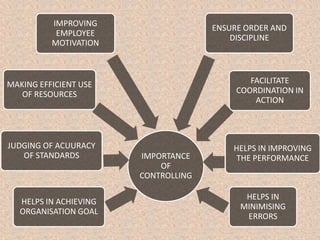
IMPROVING
                                      ENSURE ORDER AND
           EMPLOYEE
                                          DISCIPLINE
          MOTIVATION


MAKING EFFICIENT USE                          FACILITATE
   OF RESOURCES                            COORDINATION IN
                                               ACTION


JUDGING OF ACUURACY                       HELPS IN IMPROVING
   OF STANDARDS         IMPORTANCE        THE PERFORMANCE
                            OF
                        CONTROLLING

                                             HELPS IN
   HELPS IN ACHIEVING
                                            MINIMISING
   ORGANISATION GOAL
                                             ERRORS
• Helps in achieving organisational goals:

 When the plans are made in the organisation these are directed towards achievement of
organisational goal and the controlling function ensures that all activities in the organisation
take place according to plan and if there is any deviation, timely action is taken to bring back
the activities on the path of planning. When all the activities are going according to plan then
automatically these will direct towards achievement of organisational goal.

• Judging accuracy of standards:

Through strategic controlling we can easily judge whether the standard or target set are
accurate or not. An accurate control system revises standards from time to time to match
them with the environmental changes.
• Making efficient use of resources:

Each activity is performed according to predetermined standards. As a result there is most
   and effective use of resources.

• Improving employee motivation:

An effective control system communicates the goals and standards of appraisal for
   employees to subordinates well in advance.
A good control system also guides employees to come out from their problems. This free
   communication and care motives the employees to give better performance.

• Ensures order and discipline:

Control creates and atmosphere of order and discipline in the organisation. Effective
   controlling system keeps the subordibates under check over dishonesty and fraud of
   employees.
• Facilitate coordination in action:

Control helps to maintain equilibrium between means and ends. All the departments are
   controlled according to predetermined standards which are well coordinated with one
   another. Control provides unity of direction.

• Controlling helps in improving the performance of the employees:

Controlling insists on continuous check on the employees and control helps in creating an
   atmosphere of order and discipline.
There are two measures which can be exercised on employees’ performance:
a) Self appraisal report.
b) Performance appraisal report by supervisors.
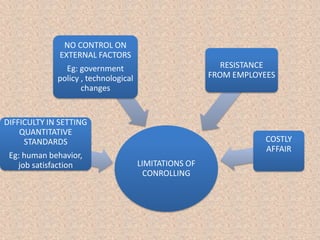
NO CONTROL ON
              EXTERNAL FACTORS
               Eg: government                             RESISTANCE
             policy , technological                    FROM EMPLOYEES
                    changes


DIFFICULTY IN SETTING
    QUANTITATIVE
     STANDARDS                                                     COSTLY
                                                                   AFFAIR
 Eg: human behavior,
   job satisfaction                   LIMITATIONS OF
                                        CONROLLING
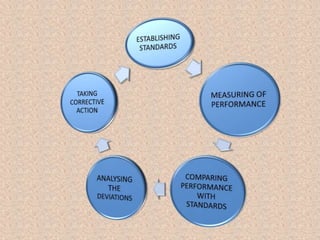
• Setting up standards:

Standards means target or the yardstick against which the actual performance is measured.
   The standards are the basis for comparing performance and hence, must be achievable
   and should be set up keeping in mind the resources of organisation and must be
   numerical or in measurable terms.

• Measuring of performance:

 After setting up of standards the performance of the employees is measured by
  evaluating the actual work done by the employees.

 When the performance can be measured numerically then it is very convenient to
  measure the performance.
 While measuring the performance the quantitative as well as qualitative aspect of
  performance is kept in mind.

 Sometimes employees achieve the quantitative standards by ignoring qualitative
  standards.

 Generally the performance of the managers is measured by looking at the overall
    efficiency level of the organisation.
Eg: the performance of research and development department is measured by change in
    technology and updation of production department. The performance should be meaured
    periodically in short period of time.

• Compare performance against standards:

After measuring of performance the manager compares the actual performance with the
    planned performance and standard.
 If there is match in both then the controlling function end there only. But if there is
  mismatch or deviation then the manager tries to find out the extent of deviation.

 If the deviation is minor then it should be ignored otherwise timely actions must be taken.

• Analysing deviations:

All deviations need not to be brought to the notice of top management. A range of deviations
    should be established and only cases beyond this range should be brought to the
    knowledge of top level mangament.

 These deviations should be classified as one’s which are to be attended urgently and the
  others which can be ignored or are not to significant.

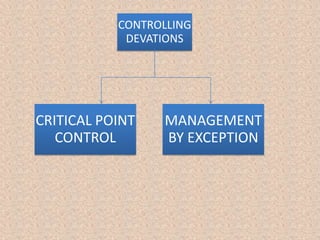
 Two ways to control these are:
1. Critical point control
2. Management by exception
CONTROLLING
            DEVATIONS


CRITICAL POINT    MANAGEMENT
   CONTROL        BY EXCEPTION
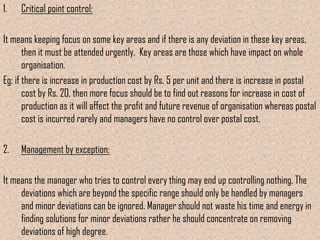
1.   Critical point control:

It means keeping focus on some key areas and if there is any deviation in these key areas,
       then it must be attended urgently. Key areas are those which have impact on whole
       organisation.
Eg: if there is increase in production cost by Rs. 5 per unit and there is increase in postal
       cost by Rs. 20, then more focus should be to find out reasons for increase in cost of
       production as it will affect the profit and future revenue of organisation whereas postal
       cost is incurred rarely and managers have no control over postal cost.

2.   Management by exception:

It means the manager who tries to control every thing may end up controlling nothing. The
     deviations which are beyond the specific range should only be handled by managers
     and minor deviations can be ignored. Manager should not waste his time and energy in
     finding solutions for minor deviations rather he should concentrate on removing
     deviations of high degree.
 Advantages of Management by exception are:

I.    It saves time and efforts of managers.

II.   It focuses attention of managers on significant matters.

III. No wastage of time and energy of managers to solve routine problems. These are
     solved by subordinates.

IV. It differentiates between critical and simple problems.
•      Taking corrective measures:

On comparing the actual performance with the planned performance, the managers will
     come to know about the deviations between the plan and actual performance.
The next step is to remove these deviations and bring back things on track i.e., according to
     plan.

 Taking corrective measures involves:

I.     Let the situation remain same if the deviations are minor.

II.    Redesign the plans if these are overstated or not matching with the present day
       business environment.

III.   Taking corrective measures to improve the performance so that in the future it
       matches with the plan.
conrolling process and management business studies

conrolling process and management business studies

  • 1.
    BUSINESS STUDIES PROJECT MADE BY ANANT AGARWAL XI E
  • 2.
    • INTRODUCTION ANDMEANING •IMPORTANCE OF CONTROLLING •LIMITATIONS OF CONTROLLING •PROCESS OF CONTROLLING
  • 3.
    Controlling is avery important managerial function. It is concerned with taking necessary measures or preventive actions(i.e., setting up standards; measuring of performance,etc) to ensure achievement of organisational goal It is a comparison of actual performance with the planned performance. If there is any difference or deviation then finding the reasons for such deviation and corrective measures are taken to prevent or stop the reasons in future to reduce the deviation and improve the performance.
  • 4.
    IMPROVING ENSURE ORDER AND EMPLOYEE DISCIPLINE MOTIVATION MAKING EFFICIENT USE FACILITATE OF RESOURCES COORDINATION IN ACTION JUDGING OF ACUURACY HELPS IN IMPROVING OF STANDARDS IMPORTANCE THE PERFORMANCE OF CONTROLLING HELPS IN HELPS IN ACHIEVING MINIMISING ORGANISATION GOAL ERRORS
  • 5.
    • Helps inachieving organisational goals: When the plans are made in the organisation these are directed towards achievement of organisational goal and the controlling function ensures that all activities in the organisation take place according to plan and if there is any deviation, timely action is taken to bring back the activities on the path of planning. When all the activities are going according to plan then automatically these will direct towards achievement of organisational goal. • Judging accuracy of standards: Through strategic controlling we can easily judge whether the standard or target set are accurate or not. An accurate control system revises standards from time to time to match them with the environmental changes.
  • 6.
    • Making efficientuse of resources: Each activity is performed according to predetermined standards. As a result there is most and effective use of resources. • Improving employee motivation: An effective control system communicates the goals and standards of appraisal for employees to subordinates well in advance. A good control system also guides employees to come out from their problems. This free communication and care motives the employees to give better performance. • Ensures order and discipline: Control creates and atmosphere of order and discipline in the organisation. Effective controlling system keeps the subordibates under check over dishonesty and fraud of employees.
  • 7.
    • Facilitate coordinationin action: Control helps to maintain equilibrium between means and ends. All the departments are controlled according to predetermined standards which are well coordinated with one another. Control provides unity of direction. • Controlling helps in improving the performance of the employees: Controlling insists on continuous check on the employees and control helps in creating an atmosphere of order and discipline. There are two measures which can be exercised on employees’ performance: a) Self appraisal report. b) Performance appraisal report by supervisors.
  • 8.
    NO CONTROL ON EXTERNAL FACTORS Eg: government RESISTANCE policy , technological FROM EMPLOYEES changes DIFFICULTY IN SETTING QUANTITATIVE STANDARDS COSTLY AFFAIR Eg: human behavior, job satisfaction LIMITATIONS OF CONROLLING
  • 10.
    • Setting upstandards: Standards means target or the yardstick against which the actual performance is measured. The standards are the basis for comparing performance and hence, must be achievable and should be set up keeping in mind the resources of organisation and must be numerical or in measurable terms. • Measuring of performance:  After setting up of standards the performance of the employees is measured by evaluating the actual work done by the employees.  When the performance can be measured numerically then it is very convenient to measure the performance.
  • 11.
     While measuringthe performance the quantitative as well as qualitative aspect of performance is kept in mind.  Sometimes employees achieve the quantitative standards by ignoring qualitative standards.  Generally the performance of the managers is measured by looking at the overall efficiency level of the organisation. Eg: the performance of research and development department is measured by change in technology and updation of production department. The performance should be meaured periodically in short period of time. • Compare performance against standards: After measuring of performance the manager compares the actual performance with the planned performance and standard.
  • 12.
     If thereis match in both then the controlling function end there only. But if there is mismatch or deviation then the manager tries to find out the extent of deviation.  If the deviation is minor then it should be ignored otherwise timely actions must be taken. • Analysing deviations: All deviations need not to be brought to the notice of top management. A range of deviations should be established and only cases beyond this range should be brought to the knowledge of top level mangament.  These deviations should be classified as one’s which are to be attended urgently and the others which can be ignored or are not to significant.  Two ways to control these are: 1. Critical point control 2. Management by exception
  • 13.
    CONTROLLING DEVATIONS CRITICAL POINT MANAGEMENT CONTROL BY EXCEPTION
  • 14.
    1. Critical point control: It means keeping focus on some key areas and if there is any deviation in these key areas, then it must be attended urgently. Key areas are those which have impact on whole organisation. Eg: if there is increase in production cost by Rs. 5 per unit and there is increase in postal cost by Rs. 20, then more focus should be to find out reasons for increase in cost of production as it will affect the profit and future revenue of organisation whereas postal cost is incurred rarely and managers have no control over postal cost. 2. Management by exception: It means the manager who tries to control every thing may end up controlling nothing. The deviations which are beyond the specific range should only be handled by managers and minor deviations can be ignored. Manager should not waste his time and energy in finding solutions for minor deviations rather he should concentrate on removing deviations of high degree.
  • 15.
     Advantages ofManagement by exception are: I. It saves time and efforts of managers. II. It focuses attention of managers on significant matters. III. No wastage of time and energy of managers to solve routine problems. These are solved by subordinates. IV. It differentiates between critical and simple problems.
  • 16.
    Taking corrective measures: On comparing the actual performance with the planned performance, the managers will come to know about the deviations between the plan and actual performance. The next step is to remove these deviations and bring back things on track i.e., according to plan.  Taking corrective measures involves: I. Let the situation remain same if the deviations are minor. II. Redesign the plans if these are overstated or not matching with the present day business environment. III. Taking corrective measures to improve the performance so that in the future it matches with the plan.