UNIT 5
CONTROLLING
• E.F.L. Breach has defined control as follows:
“Control is the process of checking actual
performance against the agreed, standards or
plans with a view to ensuring adequate progress
and satisfactory performance."
• Managerial function of control implies
measurement of actual performance, comparing
it with the standards set by plans and correction
of deviations to assure attain­
ment of objectives
according to plans.
Characteristics of Control
• The process of control has the following
characteristics:
Pervasive Function.
• Control is a function of every manager who is
performing other managerial functions like
planning, organizing, staffing and directing. It
is, in fact, a follow up action to other
‑
functions of management.
• Managers at all levels have to perform this
function to contribute to the achievement of
organizational objectives.
2. Review of Past Events.
• Control leads to appraisal of past activities.
Thus, it is looking back, the deviations in the
past are revealed by the control process. This
is also known as feedback information.
• It will help in knowing the reasons for poor
performance. Corrective actions can be
initiated accord­
ingly.
3. Forward Looking.
• Control is linked with future, as past cannot be
controlled.
• A manager can take corrective action only in
regard to future operations.
• Control is usually preventive, as presence of
control system tends to minimize wastages,
losses and deviations from standards.
4. Action Oriented.
‑
• Control implies taking corrective measures.
Action is the essence of control. The purpose of
control is achieved only when correc­
tive action is
taken on the basis of feedback information.
• It is only action, which adjusts performance to
predetermined standards whenever deviations
occur. A good system of control facilitates timely
action so that there is minimum waste of time
and energy.
5. Continuous Process.
• Just like other functions of management,
control is also a continuous activity. It involves
constant analysis of validity of standards,
policies, procedures, etc.
• It also suggests corrective actions in various
processes. It does not stop anywhere. A
manager has to perform this function
continuously along with other functions.
6. Dynamic Process.
• Control is a dynamic process. It is flexible and not
rigid. Control involves continuous review of
standards of performance and results in
corrective action, which may lead to change in
the performance of other functions of
management.
• Since management is managing a business entity,
which keeps on changing, managerial control is
also dynamic. Management will be failing in its
duty if its approach is not dynamic.
7. Control does not curtail the rights
of individuals.
• To some people, control is opposite of
freedom. It is not so. It is a preventive action
so that losses may be avoided in future. It is,
in fact, an act of guidance.
• Control in an enterprise is based on facts and
figures and not on the whims of managers. Its
purpose is to achieve and maintain acceptable
productivity from all the resources of an
enterprise.
An effective system of control will help in
achieving the following benefits:
1. Coordination.
• The size of modem business organizations is
quite large. A large amount of capital and
large number of people are employed in
them. This complicates the problem of control
as there are many units producing and
distributing different products.
• In order to coordinate their activities, an
efficient system of control is necessary.
Corrective Action.
• An efficient system of control provides the
basis for future action. Taking corrective
action may lead to modification of planning,
organizing and directing.
• Control will also check the mistakes being
repeated in future.
Decision-making.
• Control is basic to decision making. The process
‑
of control is complete when corrective actions
are taken. This involves mak­
ing a right decision as
to what type of follow up action is to be taken.
This will lead to accomplishment of organization
objectives.
• According to W.T. lerome, Control is needed both
to simplify the making of subsequent decisions
and to ensure the realization of the objectives
implicit in the original long range policy
‑
decisions."'
4. Better Planning.
• Control is the only means to ensure that the
plans are being implemented in real sense. It
points out the shortcomings of plan­
ning by
comparing the actual performance with the
planned standard and suggests steps to
improve planning.
Decentralization of Authority.
• The modern trend of business enter­
prises
towards decentralization calls for a systematic
attempt for controlling. Under decentralization,
‑
the authority of decision making is dispersed
‑
throughout the organization.
• Management must keep control in its hands to
know whether the authority is being used
properly. Without adequate controls,
decentralization cannot succeed.
6. Effective Supervision.
• Control facilitates effective supervision by pointing out
significant deviations. It keeps the subordinates under
check and kings discipline among them.
• While control cannot cure habitual dishonesty in all
cases, Management is irresponsible if it does not make
a reasonable effort to provide order and discipline
among its employees through effective control
processes."
• A good system of control detects the weak points very
quickly. This enables the expansion of span of control
at all levels in the organization.
• Limitations of Control
• A control system may be faced with the
following limitations:
• 1. An enterprise cannot control the external
factors such as government policies,
technological changes, fashion changes, social
changes, etc.
• 2. Control is an expensive process because
sufficient attention has to be to observe the
performance of the subordinates. This requires
expenditure of a lot of time and effort.
• 3. Control system loses its effectiveness when
standards of performance cannot be defined in
quantitative terms. For instance, it is very difficult
to measure human behavior and employee
morale.
4. The effectiveness of controls mainly depends
on their acceptance by the subordinates. They
may resist controls if they feel that these will
reduce or curtail their freedom. Control also
loses its significance when it is not possible to
fix the accountability of the subordinates.
Basic steps in a control process:
STEPS
• There are three basic steps in a control
process:
• Establishing standards.
• Measuring and comparing actual results
against standards.
• Taking corrective action.
Establishing Standards
• The first step in the control process is to establish standards
against which results can be measured. The standards the
managers desire to obtain in each key area should be
defined as far as possible in quantitative terms.
• Standards expressed in general terms should be avoided.
Standards need to be flexible in order to adapt to changing
conditions.
• The standard should emphasis the achievement of results
more than the conformity to rules and methods. If they do
not do so, then people will start giving more importance to
rules and methods than to the final results.
• While setting the standards, the following points have to be
borne in mind:
• (a) The standards must be clear and intelligible. If the
standards are clear and are understood by the persons
concerned, they themselves will be able to check their
performance.
• (b) Standards should be accurate, precise, acceptable and
workable.
• (c) Standards are used as the criteria or benchmarks by
which performance is measured in the control process. It
should not be either too high or too low. They should be
realistic and attainable.
• (d) Standards should be flexible i.e., capable of being
changed when the circumstances require so.
Measuring and Comparing actual
Results against Standards
• The second step in the control process is to measure the
performance and compare it with the predetermined
standards.
• Measurement of performance can be done by personal
observation, by reports, charts and statements.
• If the control system is well organised, quick comparison of
these with the standard figure is quite possible. This will
reveal variations.
• After the measurement of the actual performance, the
actual performance should be compared with the standards
fixed quickly.
• A quick comparison of actual performance with the
standard performance is possible, if the control
system is well organised.
• While comparing the actual performance with the
standards fixed, the manager has to find out not
only the extent of variations but also the causes of
variations.
• This is necessary, because some of the variations
may be unimportant, while others may be important
and need immediate corrective action by the
manager
Taking Corrective Action
• After comparing the actual performance with
the prescribed standards and finding the
deviations, the next step that should be taken
by the manager is to correct these deviations.
• Corrective action should be taken without
wasting of time so that the normal position can
be restored quickly. The manager should also
determine the correct cause for deviation.
• Taking corrective action can be achieved in
the following way:
• (a) The manager should try to influence
environmental conditions and external
situations in such a way as to facilitate the
achievement of goals.
• (b) He should review with his subordinates the
instructions given earlier so that he may be
able to give clear, complete and reasonable
instructions in future.
• (c) There are many external forces which
cannot be adjusted by the manager. They have
to be accepted as the facts of the situation,
and the executives should revise their plans in
the light of these changing forces.
31
The role of feedforward, concurrent, and
feedback controls in organizations.
Feed forward controls
32
– Employed before a work activity begins.
– Ensures that:
• Objectives are clear.
• Proper directions are established.
• Right resources are available.
– Focuses on quality of resources.
Concurrent controls
Management 9/e - Chapter 18 33

– Focus on what happens during work
process.
– Monitor ongoing operations to make sure
they are being done according to plan.
– Can reduce waste in unacceptable finished
products or services.
Feedback controls
34
– Take place after work is completed.
– Focus on quality of end results.
– Provide useful information for improving
future operations.
Flexibility
Qualities Of An Effective Control
System
Strategic
Placement
Understandability
Reasonable
Criteria
EFFECTIVE
CONTROL
SYSTEM
Timeliness
Multiple
Criteria
Corrective
Action
Accuracy
Economy
Emphasis on
Exceptions
FOM 7.17
• Effective control systems tend to have certain
common qualities, the importance of which
varies with the situation. However, we can
generalize that the following characteristics
should make a control system effective.
• 1.Accurate. An effective control system is reliable and
produces valid data.
• 2.Timeliness. An effective control system provides timely
information. Managers need good information at a time that
action can be taken to improve performance.
• 3.Economical. Managers should impose only the controls
needed to produce the desired results.
• 4.Flexible. Controls must be flexible enough to adjust
because times and conditions change.
• 5.Understandable. Employees will misunderstand or
ignore a cryptic control system.
• 6.Reasonable criteria. Control standards must be
reasonable and attainable. If they are unreasonable,
employees will not be motivated to attain the results.
• 7.Strategic placement. Management should control
the factors that are strategic to the organization. It is
impossible to control everything and the benefits will
not justify the costs of controls for everything.
• 8.Emphasis on the exception. Effective controls
minimize the routine and pinpoint the exceptional. An
example of this would be the spending limits managers
have. Higher levels of management do not need to
routinely check all expenditures--only those that are
higher than allowed.
• 9.Multiple criteria. Multiple performance measures
expedite accurate performance assessments.
• 10.Corrective action. Effective controls identify the
problem and specify the solution.
•
Budgetary control
Definition
Budgetary Control is defined as "the
establishment of budgets, relating the
responsibilities of executives to the
requirements of a policy, and the continuous
comparison of actual with budgeted results
either to secure by individual action the
objective of that policy or to provide a base
for its revision.
Salient features:
• a. Objectives: Determining the objectives to be
achieved, over the budget period, and the policy
(ies) that might be adopted for the achievement of
these ends.
• b. Activities: Determining the variety of activities
that should be undertaken for achievement of the
objectives.
• c. Plans: Drawing up a plan or a scheme of operation
in respect of each class of activity, in physical a well
as monetary terms for the full budget period and its
parts.
d. Performance Evaluation:
Laying out a system of comparison of actual
performance by each person section or
department with the relevant budget and
determination of causes for the
discrepancies, if any.
e. Control Action:
• Ensuring that when the plans are not
achieved, corrective action are taken; and
when corrective actions are not possible,
ensuring that the plans are revised and
objective achieved
Budgetary controlling Techniques
• Under this technique, different budgets are prepared
for different operations in an organization in advance.
These budgets act as standards for comparing them
with actual performance and taking necessary actions
for attaining organizational goals.
• A budget can be defined as a quantitative statement of
expected result, prepared for a future period of time.
The budget should be flexible so that necessary
changes if need be, can be easily made later according
to the requirements of the prevailing environment.
The objectives of a Budgetary
Control System
• 1.Definition of Goals
• Portraying with precision, the overall aims of the
business and determining targets of performance
for each section or department of the business.
• 2. Defining Responsibilities:
• Laying down the responsibilities of each individual
so that everyone knows what is expected of him
and how he will be judged.
• 3. Basis for Performance Evaluation:
• Providing basis for the comparison of actual
performance with the predetermined targets
and investigation of deviation, if any, of actual
performance and expenses from the budgeted
figures. It helps to take timely corrective
measures.
• 4. Optimum use of Resources:
• Ensuring the best use of all available resources
to maximize profit or production, subject to the
limiting factors.
• 5. Coordination:
• Coordinating the various activities of the business and
centralizing control, but also making a facility for the
Management to decentralize responsibility and delegate
authority.
• 6. Planned action:
• Engendering a spirit of careful forethought, assessment of
what is possible and an attempt at it. It leads to
dynamism without recklessness. It also helps to draw up
long range plans with a fair measure of accuracy.
• 7. Basis for policy:
• Providing a basis for revision of current and future
policies.
• ADVANTAGES OF THE BUDGETARY CONTROL
SYSTEM
• 1.The use of budgetary control system enables the
management of a business concern to conduct its
business activities in the efficient manner.
• 2. It is a powerful instrument used by business houses
for the control of their expenditure. It provides a
yardstick for measuring and evaluating the
performance of individuals and their departments.
• 3. It reveals the deviations to management, from the
budgeted figures after making a comparison with
actual figures
• 4.Effective utilization of various resources like
men, material, machinery and money is made
possible, as the production is planned after
taking them into account.
• 5. It helps in the review of current trends and
framing of future policies.
• 6. It creates suitable conditions for the
implementation of standard costing system in a
business organization.
• 7. It inculcates the feeling of cost consciousness
among workers.
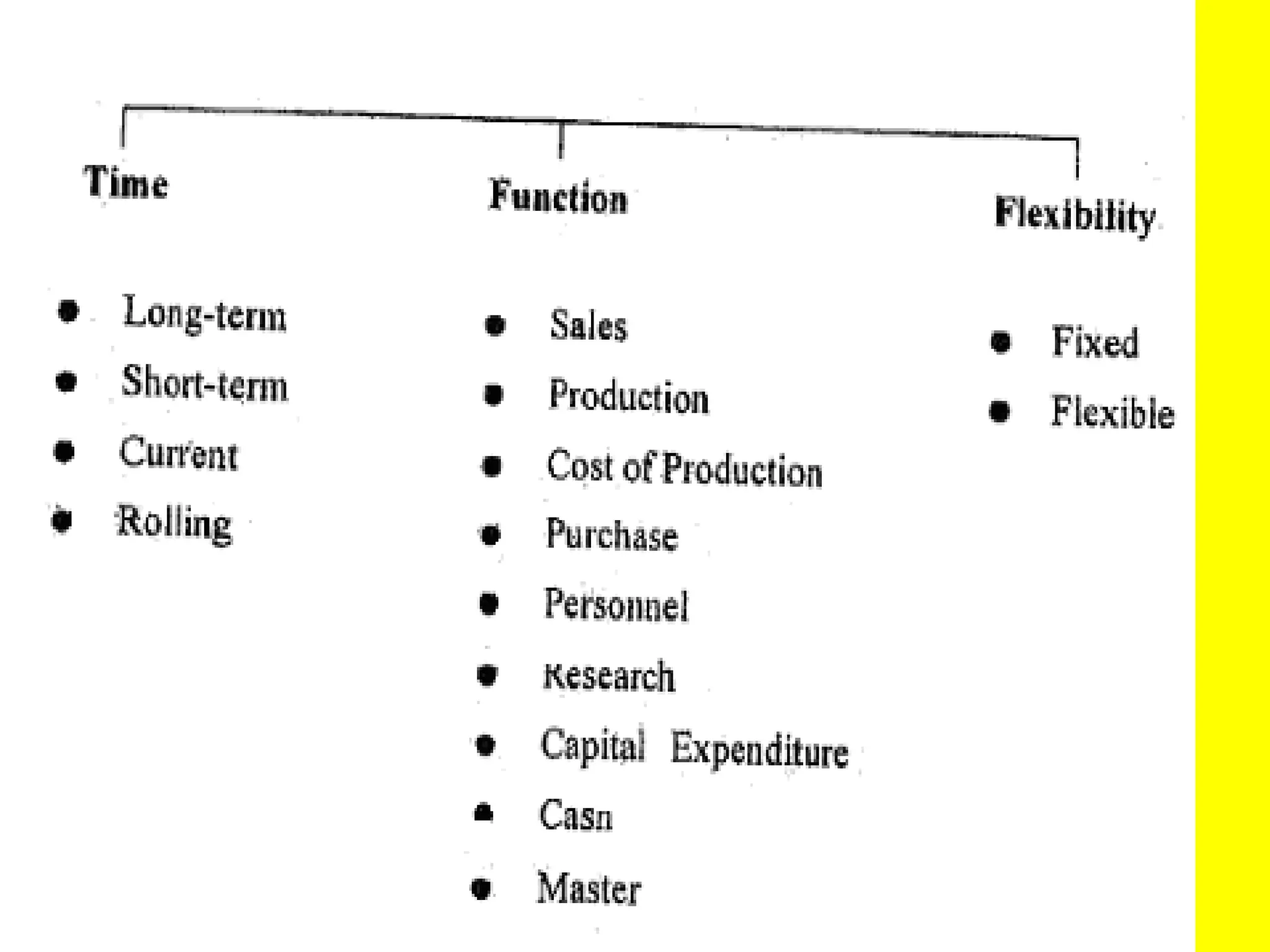
TYPES OF BUDGETS
DISADVANTAGES/LIMITATIONS OF
THE BUDGETARY CONTROL SYSTEM
• 1.Estimates:
• Budgets may or may not be true, as they are
based on estimates. The assumptions about
future events may or may not actually happen.
• 2. Rigidity:
• Budgets are considered as rigid document. Too
much emphasis on budgets may affect daytoday
operations and ignores the dynamic state of
organizational functioning.
• 3. False Sense of Security:
• Mere budgeting cannot lead to profitability. Budgets
cannot be executed automatically. It may create a
false sense of security that everything has been taken
care of in the budgets.
• 4. Lack of coordination:
• Staff cooperation is usually not available during
Budgetary Control exercise.
• 5. Time and Cost:
• The introduction and implementation of the system
may be expensive.
Zero based budget
• Start each budget period afresh-not based on
historical data
• Budgets are zero unless managers make the case for
resources-the relevant manager must justify the
whole of the budget allocation
• It means that each activity is questioned as if it were
new before any resources are allocated to it.
• Each plan of action has to be justified in terms of total
cost involved and total benefit to accrue, with no
reference to past activities.
• Zero based budgets are designed to prevent budgets
creeping up each year with inflation
Advantages of ZBB
• Forces budget setters to examine every item.
• Allocation of resources linked to results and
needs.
• Develops a questioning attitude.
• Wastage and budget slack should be eliminated.
• Prevents creeping budgets based on previous
year’s figures with an added on percentage.
• Encourages managers to look for alternatives.
Disadvantages of ZBB
• It a complex time consuming process
• Short term benefits may be emphasized to
the detriment of long term planning
• Affected by internal politics - can result in
annual conflicts over budget allocation
NON-BUDGETARY TOOLS
Breakeven Analysis
• An analysis of a product or company's sales
required to neither lose money nor make a profit,
but simply to cover costs
• A company needs to at least break even in order to
make the expense of producing a product worth the
effort. As a result, breakeven analysis is an
important feature in evaluating the risk of an
activity.
• Breakeven analysis calculates the relationship
between the fixed costs, variable costs, and profit
of the product.
62
Graphical approach to break-even
analysis.
Statistical Data and Reports
• Statistical data are being widely used for the
purpose of managerial control.
• Statistical data may be presented in the form of
statistical tables, Graphical charts or special
reports.
• The quality of presentation of essential data will
determine their efficiency for the purpose of
managerial control.
• A report is a form of systematic presentation
of information and statistical data relating to
some aspect of business. It may arise out of
available factual data, thorough enquiry,
investigation or experiment.
• The information provided by the report may
be used for the purpose of managerial
control. It will help in knowing whether the
policies of the management are being
followed and if not, what steps should be
taken to implement them.
• The task of making reports is generally
entrusted to certain specialist who will collect
the desired information and present the same
in the form of a report.
Management Audit
• By audit we mean a review or examination
of completed transactions to see whether
they represent a true state of affairs of the
business or not.
• While conducting an audit, the auditor
examines the degree of conformance of
business transactions with the accepted
business practices and the legal provisions.
•
• The main objective of financial audit is to know
the correct profit or loss of the business during a
particular year and to determine the accuracy of
the balance sheet as at the end of that year.
• Thus, audit serves as a control mechanism over
the completed transactions of the enterprise. It
detects the errors and frauds committed in the
books of accounts of the enterprise.
Ratio Analysis.
• Ratio analysis is the process of analyzing the
relationship between two sets of figures relating
to two important aspects of the company (e.g.,
current assets and current liabilities).
• A ratio may be financial, or non financial.
‑
Financial ratios are calculated from the financial
accounts of the firm such as current ratio.
Non financial ratios are calculated from the
‑
operating results of the firm such as ratio of
volume of production to man-hours worked.
Human Resource Accounting
• Human Resource Accounting (HRA) is a process of
identifying and measuring data about human
resources and communicating this information to
interested parties.
• HRA provides valuable feedback to managers
regarding the effectiveness of policies and practices.
It helps management in taking appropriate decisions
regarding the use of human resources in an
organization. Both monetary measures and
non monetary measures are used to value human
‑
resources depending on necessity.
MAINTENANCE
• The term ‘maintenance’ means to keep the
equipment in operational condition or repair
it to its operational mode. Main objective of
the maintenance is to have increased
availability of production systems, with
increased safety and optimized cost.
• As the engineering equipment becomes
sophisticated and expensive to produce and
maintain, maintenance management has to
face even more challenging situations to
maintain effectively such equipments in
industrial environment.
MAINTENANCE STRATEGIES OR
OPTIONS
A maintenance strategy or option means a scheme for
maintenance, i.e. an elaborate and systematic plan of
maintenance action. Following are the maintenance
strategies that are commonly applied in the plants.
Breakdown Maintenance or Operate to Failure or
Unplanned Maintenance
Preventive or Scheduled Maintenance
Predictive or Condition Based Maintenance
Opportunity Maintenance
Design out Maintenance
Break down maintenance
• The equipment under breakdown
maintenance is allowed to run until it breaks
down and then repairing it and putting back
to operation.
• This strategy is suitable for equipments that
are not critical and have spare capacity or
redundancy available.
PREVENTIVE MAINTENANCE
• In preventive or scheduled Maintenance,
maintenance actions such as inspection,
lubrication, cleaning, adjustment and
replacement are undertaken at fixed intervals of
numbers of hours or Kilometers.
• An effective PM program does help in avoidance
of accidents. Condition monitoring (CM) detects
and diagnoses faults and it helps in planned
maintenance based on equipment condition
• This condition based maintenance strategy or
predictive maintenance is preferred for
critical systems and for such systems
breakdown maintenance is to be avoided.
• A number of CM techniques such as
vibration, temperature, oil analysis, etc. have
been developed, which guide the users in
planned maintenance
OPPORTUNITY MAINTENANCE
• In opportunity maintenance, timing of
maintenance is determined by the procedure
adopted for some other item in the same
unit or plant.
DESIGN OUT MAINTENANCE
• In design out maintenance, the aim is to minimize the
effect of failures and in fact eliminates the cause of
maintenance.
• Although it is an engineering design problem, yet it is
often a responsibility of maintenance department
• This is opted for items of high maintenance cost that are
due to poor maintenance, poor design or poor design
outside design specifications.
• It may be mentioned that a best maintenance strategy for
each item should be selected by considering its
maintenance characteristics, cost and safety.
•
NEW CONCEPTS
• In addition to the above, new strategies concepts
such as
Proactive Maintenance,
Reliability Centred Maintenance (RCM),
Productive Maintenance (TPM), etc. have
recently been evolved to look it from different
perspectives and this has helped in developing
effective maintenance
• In proactive maintenance, the aim is identify
what can go wrong, i.e. by monitoring of
parameters that can cause failures.
• In RCM, the type of maintenance is chosen
with reliability of the system in
consideration, i.e. system functions, failures
relating to those functions and effects of the
dominant functional system failures.
• This strategy in the beginning was applied to
critical systems such as aircrafts, nuclear and
space applications. At present, this is being
extended to critical systems in the plant.
• TPM, a Japanese concept, involves total
participation of all concerned. The aim is to
have overall effectiveness of the equipment
with participation of all concerned using
productive maintenance system.
ELEMENTS OF EFFECTIVE
MAINTENANCE MANAGEMENT
An effective maintenance system includes the following
elements
Maintenance Policy
Control of materials
Preventive Maintenance
Condition Monitoring
Work Order
Job planning
 Priority and backlog control
Data recording system
Performance measurement measures or indices
•
• PERT CPM
• One of the most challenging jobs that any
manager can take on is the management of a
large-scale project that requires coordinating
numerous activities throughout the
organization.
• A myriad of details must be considered in
planning how to coordinate all these activities,
in developing a realistic schedule, and then in
monitoring the progress of the project.
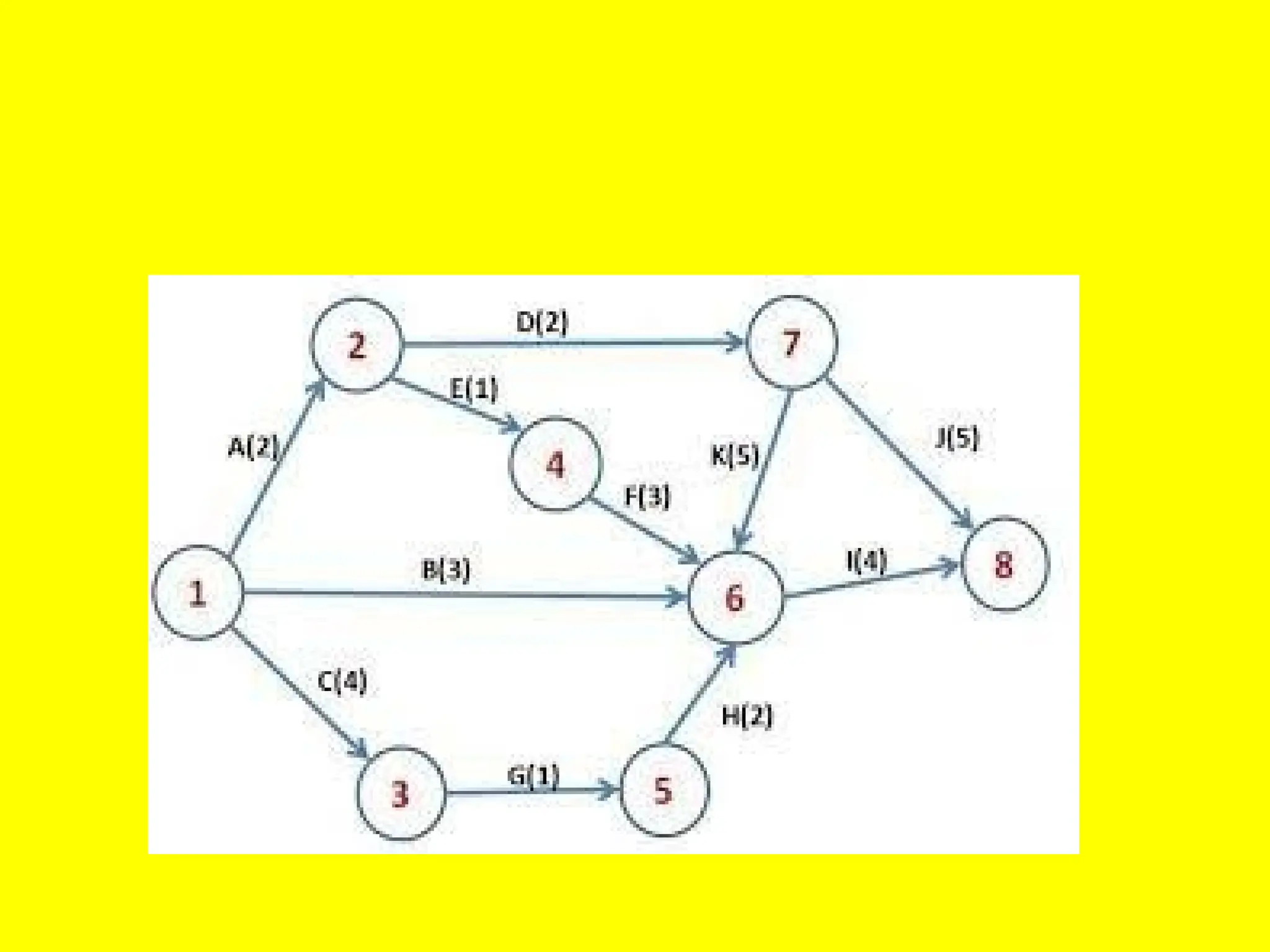
PERT& CPM
• PERT and CPM, acronyms for "program
evaluation and review technique" and "critical
path method", respectively, are network
techniques used to aid in the planning,
scheduling, monitoring, and control of activities
which are related to each other.
• For example, CPM is frequently used in the
construction industry to help organize and
schedule those activities which together
constitute a given construction project.
• PERT was first used to help coordinate the activities
in the development of the Polaris missile system.
PERT and CPM differ from each other in that activity
times are handled differently by these two closely
related techniques.
• In using CPM, one assumes the activity times are
known with certainty (deterministic activity times);
PERT allows for uncertainty and statistical variation in
activity times (stochastic activity times).
• PERT and CPM are closely related (CPM may be a
special case of PERT), and a variety of projects are
subject to analysis by either technique
• PERT and CPM have been used for a variety of projects, including
the following types.
• 1. Construction of a new plant
• 2. Research and development of a new product
• 3. NASA space exploration projects
• 4. Movie productions
• 5. Building a ship
• 6. Government-sponsored projects for developing a new weapons
system
• 7. Relocation of a major facility
• 8. Maintenance of a nuclear reactor
• 9. Installation of a management information system
• 10. Conducting an advertising campaign
JIT
• An inventory strategy companies employ to
increase efficiency and decrease waste
by receiving goods only as they are needed in
the production process, thereby reducing
inventory costs.
This method requires that producers are able to
accurately forecast demand.
• A good example would be a car manufacturer that
operates with very low inventory levels, relying on
their supply chain to deliver the parts they need to
build cars.
• The parts needed to manufacture the cars do not
arrive before nor after they are needed, rather
they arrive just as they are needed.
• This inventory supply system represents a
shift away from the older "just in case"
strategy where producers carried large
inventories in case higher demand had to be
met.
Inventory'
• The raw materials, work-in-process
goods and completely finished goods that are
considered to be the portion of a business's
assets that are ready or will be ready for sale.
• Inventory represents one of the most important
assets that most businesses possess, because
the turnover of inventory represents one of
the primary sources of revenue generation and
subsequent earnings for the company's
shareholders/owners.
Quality control
• Quality control is a process that is used to ensure a
certain level of quality in a product or service. It
might include whatever actions a business deems
necessary to provide for the control and verification
of certain characteristics of a product or service.
• Most often, it involves thoroughly examining and
testing the quality of products or the results of
services. The basic goal of this process is to ensure
that the products or services that are provided meet
specific requirements and characteristics, such as
being dependable, satisfactory, safe and fiscally
sound.
• Companies that engage in quality control typically
have a team of workers who focus on testing a
certain number of products or observing services
being done. The products or services that are
examined usually are chosen at random.
• The goal of the quality control team is to identify
products or services that do not meet a company's
specified standards of quality.
• If a problem is identified, the job of a quality control
team or professional might involve stopping
production or service until the problem has been
corrected.
• Depending on the particular service or
product as well as the type of problem
identified, production or services might not
cease entirely.
7 QC Tools :
The following are the 7 QC Tools :
Pareto Diagram
Cause & Effect Diagram
Histogram
Control Charts
Scatter Diagrams
Graphs
Check Sheets
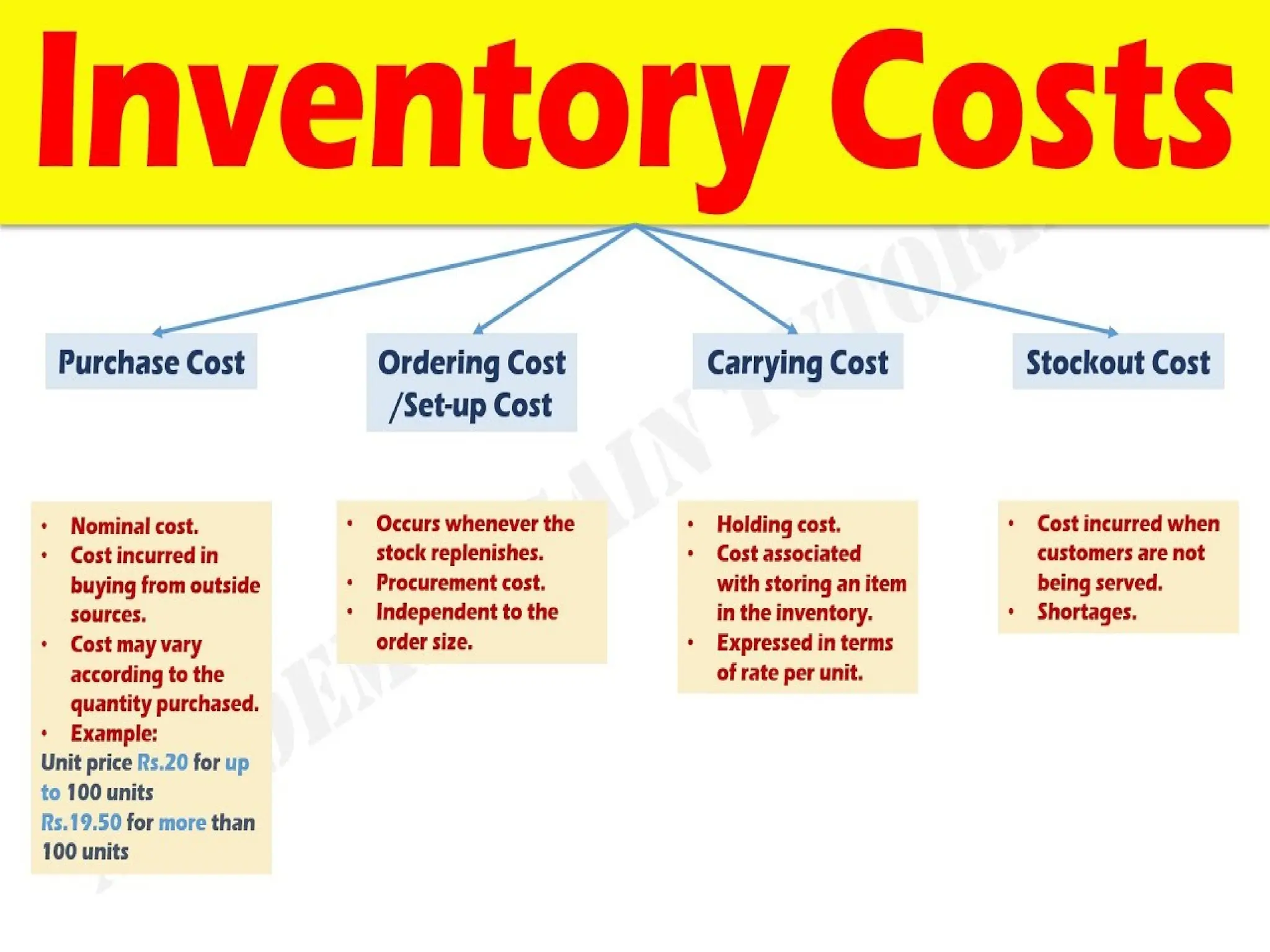
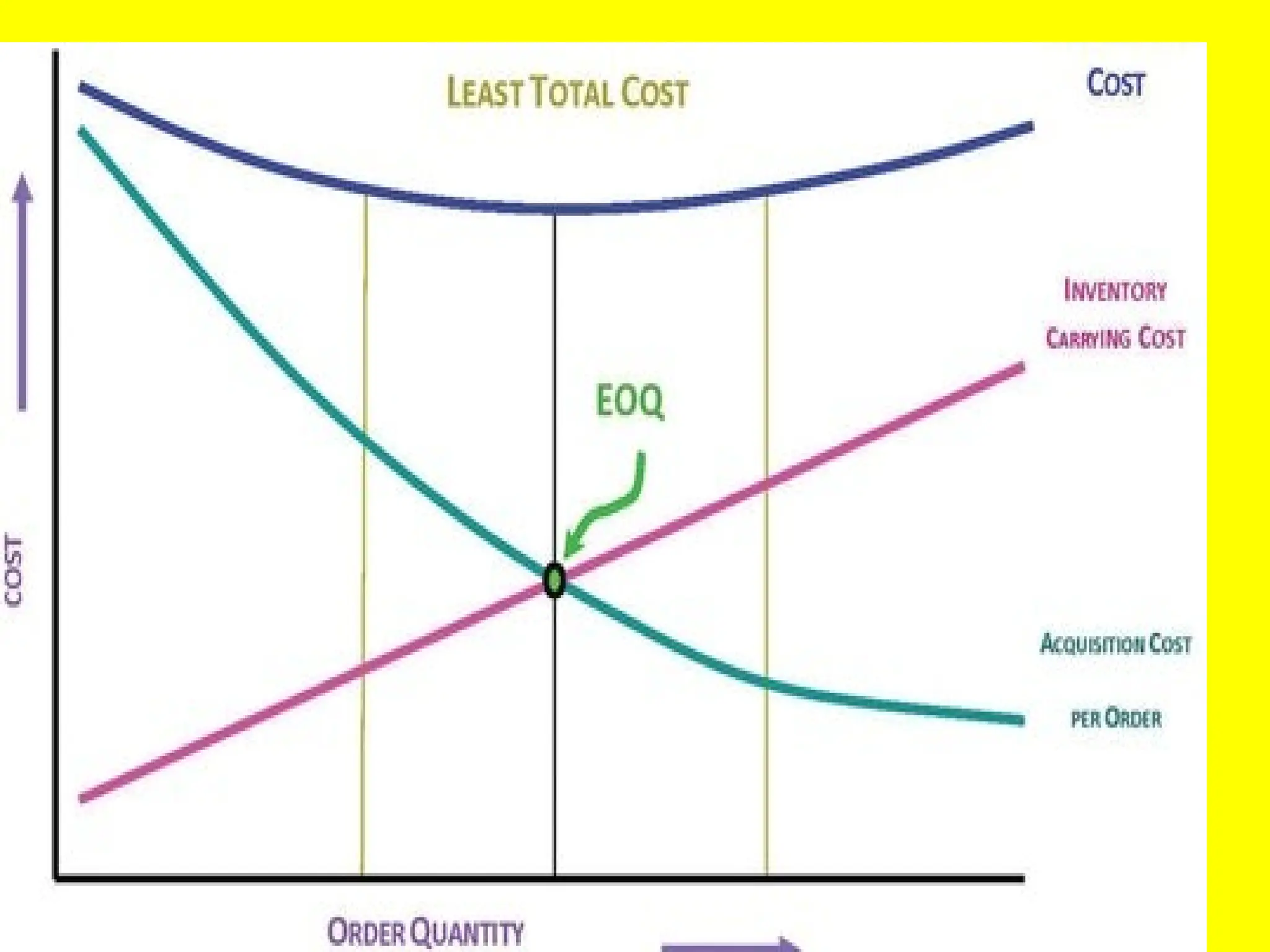
EOQ
• The economic order quantity (EOQ) is a
model that is used to calculate the optimal
quantity that can be purchased or produced
to minimize the cost of both the carrying
inventory and the processing of purchase
orders or production set-ups.
IT and Management
• During the last twenty years, the techniques for
information handing - information technology-
have developed very considerably. Information
Technology (IT) involves a combination computer
techniques, telecommunication techniques and
electronics that is used in the production,
distribution, storing and retrieval of information.
The main features of the developments within
the field of information technology are :
• Increased computer power - resulting in quicker and cheaper
computer handling
• Cheaper storage media, for example, optical media such as CD-
ROM (Compact Disc-Read Only Memory)
• The digitalisation of information - text, pictures, speech, sound and
video - facilitating the integration of different types of information
• Increased use of networks - local, national and international - for
data transmission and greater network capacity
• Smaller apparatus
• Increased dependability of hardware and software
• facilitate information handling, while at the same time increasing
the number of choices and thereby making searching more
complex.
• A computer user can control it by a user
interface. ... Computers are used to control
large and small machines which in the past
were controlled by humans. They are also in
homes, where they are used for things such as
listening to music, reading the news and
writing. Modern computers are
electronic computerhardware.
• Computers makes it possible to receive,
supply and process large volumes of data at
very highspeed. Computer reduces the cost of
all data related operations including, input,
output, storage, processing, and transmission.
• A management information system is a set of
processes that allows companies to
moveinformation through their business
operations. Business owners
and managersuse the information to make
decisions, among other things.
• The MIS satisfies the diverse needs through
variety of systems such as query system,
analysis system, modeling system and
decision support system. ... The MIS helps the
middle management in short term planning,
target setting and controlling the business
functions.
• Integrated System. A guiding principle of MIS is
that all computer-related business processes
work as a single integrated system. ...
• Better Decisions. The improved communication
MIS provides to all levels of the business
improves the decision-making skills of those in
charge. ...
• Data Quality Issues. ...
• Security Issues.
Role of Management Information
System
• • Helps in Decision making: - Management Information System (MIS) plays a
significant Role in Decision making Process of any Organization. Because in Any
organization decision is made on the basis of relevant Information and relevant
information can only be Retrieving from the MIS.
• • Helps in Coordination among the Department: - Management information
System is also helping in establishing a sound Relationship among the people
between department to department through proper exchanging of Information’s.
• • Helps in Finding out Problems: - We know that MIS provides relevant information
about the every aspect of activities. Hence, If any mistake is made by the
management then Management Information Systems (MIS) helps in Finding out
the Solution of that Problem.
• • Helps in Comparison of Business Performance: - MIS stores all Past Data and
information in its Database. That is why management information system is very
useful to compare Business organization Performance. With the help of
Management information system (MIS) Organization can analyze their
Performance whatever they did last year or Previous Years and whatever
performance in this year and also measures organization Development and
Growth.
•  Direct control: the procedure that traces the
causes of an unsatisfactory result back to the
persons responsible for it and get them to correct
their practices.
•  Preventive control: the procedure that traces
the causes of an unsatisfactory result back to
managers’ management skill and knowledge.
• PREVENTIVE CONTROL
• • The basic philosophy of preventive control
system is that the best way to correct
deviations is not to let these take place at all.
• • The basic tool of the system is to develop
better managers, who can manage problems
from a wider and intelligent perspective.
Highly qualified managers will make fewer
mistakes, thus reducing the need for direct
control
ASSUMPTIONS UNDER DIRECT AND
PREVENTIVE CONTROL
• Direct
• • All performance can be measured
• • Personal responsibility exists
• • Time expenditure is warranted
• • Mistakes can be discovered in time
• • Person responsible will take corrective steps
Preventive
• • Qualified managers make a minimum of errors
• • The management fundamentals can be used to
measure performance
• • Application of management fundamentals can be
evaluated
Advantages of Preventive Control
• • Greater accuracy is achieved in assigning
personal responsibility.
• • Preventive control encourages self-control
and make corrective action more effective.
• • Preventive control may lighten the
managerial burden caused by direct controls.
• Employees may be motivated to improve
themselves continuously.
POPULAR TECHNIQUES OF DIRECT
CONTROL
• • Budget summaries and report Budget summary is
a resume of all individual budgets. It reflects
company in terms of profit, cost, sales volume, etc.
• • Profit and loss control Income expenditure
statement, at times may be for each and every
division
• • Return on investment (ROI) Ratio of earning to
investment of capital of a company
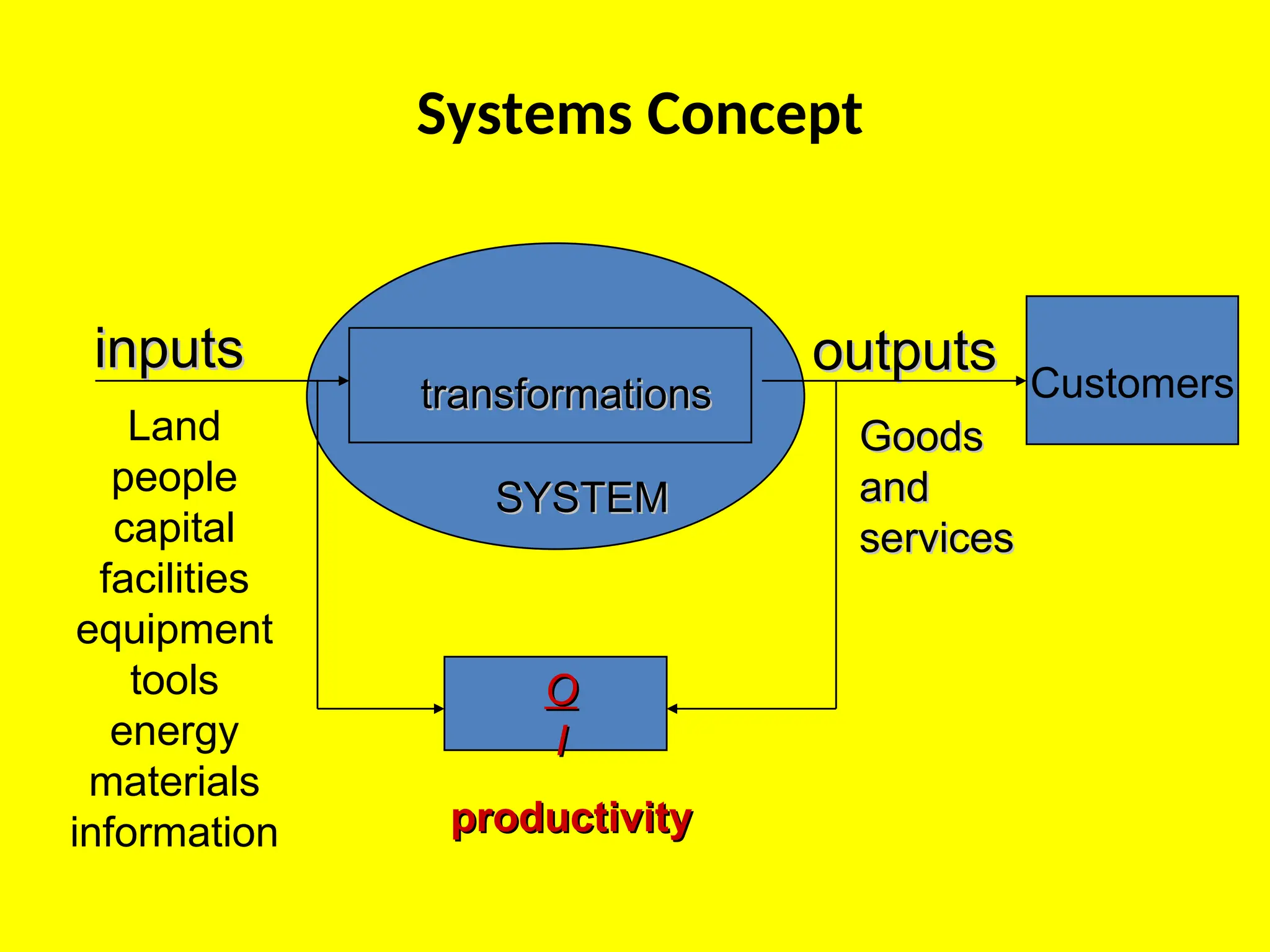
Productivity: Definition
Productivity is the relationship between the
outputs generated from a system and the
inputs that are used to create those outputs.
Mathematically
O
P =
I
Systems Concept
outputs
outputs
SYSTEM
SYSTEM
transformations
transformations
inputs
inputs
productivity
productivity
O
O
I
I
Customers
Goods
Goods
and
and
services
services
Land
people
capital
facilities
equipment
tools
energy
materials
information
Mathematically, How Can We Increase
Productivity?
Productivity Improvement
O
I
O
I
O
I
O
I
O
I
Productivity Improvement (PI) is the result of
managing and intervening in transformation
or work processes.
PI will occur if:
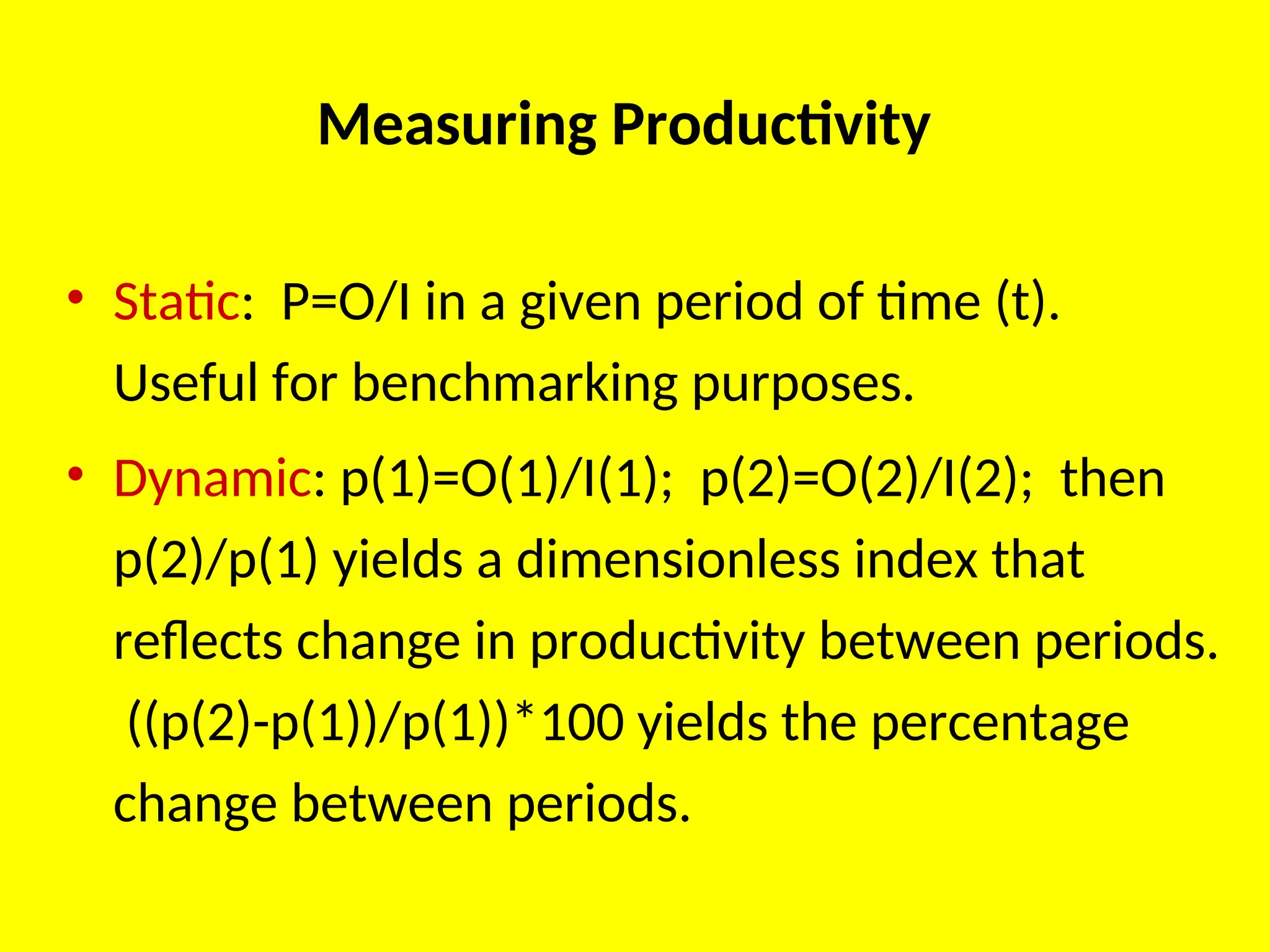
Measuring Productivity
• Static: P=O/I in a given period of time (t).
Useful for benchmarking purposes.
• Dynamic: p(1)=O(1)/I(1); p(2)=O(2)/I(2); then
p(2)/p(1) yields a dimensionless index that
reflects change in productivity between periods.
((p(2)-p(1))/p(1))*100 yields the percentage
change between periods.
Measuring Productivity (Continued)
• Partial-Factor: Uses a single “I” factor; e.g.,
output/labor-hour, sales/employee
• Multi-Factor: Uses more than one “I” factor;
e.g. output/direct costs (labor, materials, and
overhead).
• Total-Factor: Uses all “I” factors.
(Note: Total-Factor captures “trade-offs”
between input factors.)
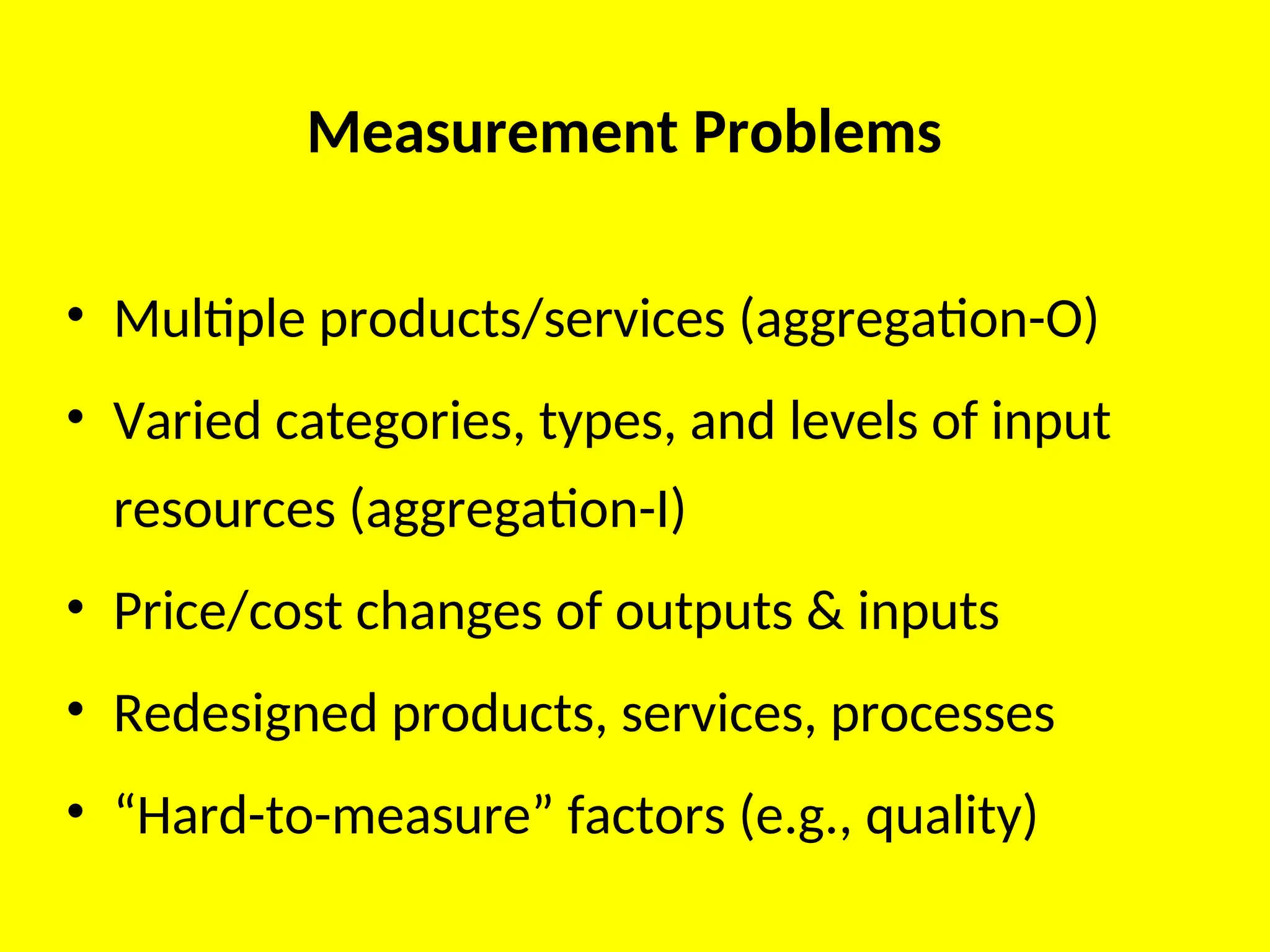
Measurement Problems
• Multiple products/services (aggregation-O)
• Varied categories, types, and levels of input
resources (aggregation-I)
• Price/cost changes of outputs & inputs
• Redesigned products, services, processes
• “Hard-to-measure” factors (e.g., quality)
Reporting
• The reporting to management is a process of
providing information to various levels
of management so as to enable in judging the
effectiveness of their responsibility centres
and become a base for taking corrective
measures, if necessary
• Reporting to Management can be defined as
an organized method of providing each
manager with all the data and only those data
which he needs for his decisions, when he
needs them and in a form which aids his
understanding and stimulates his action”.
• Meaning of Reporting:
• The term “reporting” mean different things as follows:
• (a) Narrating some facts,
• (b) Reviewing certain matter with its merits and
demerits and offering comments,
• (c) Furnishing data at regular intervals in standardized
forms,
• (d) Submitting specific information for particular
purpose upon specific request instruction.
• Management reporting refers to the formal system
whereby relevant required information is furnished to
management by means of reports constantly. Thus
‘report’ is the essence of any manage­
ment reporting
system.
• The term ‘Report’ normally refers to a formal
communication, which moves upwards, i.e., for
factual communication by a lower level to a higher
level of authority in response to orders received
from higher level. Reports provide the means of
checking the performance. A person, who is issued
with orders or instructions to do certain things,
should report back what he has done in compliance
thereof. Reports may be oral or written and also
routine or special.
Why do People do Reports for
Controlling?
• • The controls team is established to manipulate the delivery of
the project’s products outputs.
• • Controlling reports allow the control team to compare and
contrast information, analyze and interpret data, make inferences
and conclusions, and make rational decisions.
• • Control teams also make reports to present the team’s
achievements, plans, and problems on a regular basis.
Achievements can be a source of inspiration and motivation to the
team members who feel frustration when they do not meet their
goals. The team’s accomplishments can also boost the control
team’s momentum. Problems are also presented in the controlling
report for the team to know the existing and potential threats the
group is facing and is going to face.
How do Teams usually do Reports for
Controlling?
• • Reports for controlling provide vital data on the
activities, performance, status, and progress of the
team and the project.
• • The controlling report should be factual,
complete, accurate, and updated. This is to ensure
that the team and its members always get the
newest information within a specific time frame.
Also, reports allow control teams to formulate
plans, establish strategies, implement actions, and
evaluate outcomes.
• The report can indicate essential information on the team’s
issues, plans, and achievements. With this information, the
team will be able to discuss its future goals while solving and
preventing actual and potential issues. Moreover, the team
members will be able to inspire and motivate their
teammates with the team’s achievements that are included
in the controlling report.
• Quantitative data on the controlling report may also be
presented using tables, graphs, charts, and diagrams. This is
to facilitate faster appreciation and comprehension of data,
unlike a plain narrative output. These tools in presenting data
can be effective in showing the link between the past,
present and the future report.
Essentials of a Good Reporting System:
• A good reporting system is a better guide and effective tool for
efficient managerial decision ­
making.
• Hence, the essentials of a good reporting system are as follows:
• 1. Proper Form:
• In order to facilitate decision-making the information supplied
should be in proper form. The style and layout of a report depend
upon the needs of the individual who will use the same. The
report may be submitted in the form of narration [written
statement of facts], statisti­
cal tabulations, graphs, charts, etc.
• 2. Proper Time:
• Promptness is very important because information delayed is
information denied. Reports are meant for action and when
adverse tendencies or events are noticed, actions should follow
forthwith. The sooner the report is made, the quicker the
corrective action be taken.
• 3. Proper Flow of Information:
• The information should flow from the right level of authority to the level
of authority where the decisions are to be made. Further complete and
consistent infor­
mation should flow in a systematic manner.
• 4. Flexibility:
• The system should be capable of being adjusted according to the
requirements of the user. For example, production manager should be
provided with information relating to his division or area of control only.
• 5. Facilitation of Evaluation:
• The system should distinctively report deviations from standards or
estimates. Controllable factors should be distinguished from non-
controllable factors and re­
ported separately. A good reporting system
should give information required for the evaluation of each manager’s
area of responsibility in relation to the goals of the organization.
• 6. Economy:
• There is a cost for rendering information and such cost should be
compared with benefits derived from the report or loss sustained by not
having the report. Economy is an informa­
tion aspect to be considered
while developing reporting system.

Principles Of Management_Chapter 5_Controlling.ppt

  • 1.
  • 2.
    • E.F.L. Breachhas defined control as follows: “Control is the process of checking actual performance against the agreed, standards or plans with a view to ensuring adequate progress and satisfactory performance." • Managerial function of control implies measurement of actual performance, comparing it with the standards set by plans and correction of deviations to assure attain­ ment of objectives according to plans.
  • 3.
    Characteristics of Control •The process of control has the following characteristics:
  • 4.
    Pervasive Function. • Controlis a function of every manager who is performing other managerial functions like planning, organizing, staffing and directing. It is, in fact, a follow up action to other ‑ functions of management. • Managers at all levels have to perform this function to contribute to the achievement of organizational objectives.
  • 5.
    2. Review ofPast Events. • Control leads to appraisal of past activities. Thus, it is looking back, the deviations in the past are revealed by the control process. This is also known as feedback information. • It will help in knowing the reasons for poor performance. Corrective actions can be initiated accord­ ingly.
  • 6.
    3. Forward Looking. •Control is linked with future, as past cannot be controlled. • A manager can take corrective action only in regard to future operations. • Control is usually preventive, as presence of control system tends to minimize wastages, losses and deviations from standards.
  • 7.
    4. Action Oriented. ‑ •Control implies taking corrective measures. Action is the essence of control. The purpose of control is achieved only when correc­ tive action is taken on the basis of feedback information. • It is only action, which adjusts performance to predetermined standards whenever deviations occur. A good system of control facilitates timely action so that there is minimum waste of time and energy.
  • 8.
    5. Continuous Process. •Just like other functions of management, control is also a continuous activity. It involves constant analysis of validity of standards, policies, procedures, etc. • It also suggests corrective actions in various processes. It does not stop anywhere. A manager has to perform this function continuously along with other functions.
  • 9.
    6. Dynamic Process. •Control is a dynamic process. It is flexible and not rigid. Control involves continuous review of standards of performance and results in corrective action, which may lead to change in the performance of other functions of management. • Since management is managing a business entity, which keeps on changing, managerial control is also dynamic. Management will be failing in its duty if its approach is not dynamic.
  • 10.
    7. Control doesnot curtail the rights of individuals. • To some people, control is opposite of freedom. It is not so. It is a preventive action so that losses may be avoided in future. It is, in fact, an act of guidance. • Control in an enterprise is based on facts and figures and not on the whims of managers. Its purpose is to achieve and maintain acceptable productivity from all the resources of an enterprise.
  • 11.
    An effective systemof control will help in achieving the following benefits:
  • 12.
    1. Coordination. • Thesize of modem business organizations is quite large. A large amount of capital and large number of people are employed in them. This complicates the problem of control as there are many units producing and distributing different products. • In order to coordinate their activities, an efficient system of control is necessary.
  • 13.
    Corrective Action. • Anefficient system of control provides the basis for future action. Taking corrective action may lead to modification of planning, organizing and directing. • Control will also check the mistakes being repeated in future.
  • 14.
    Decision-making. • Control isbasic to decision making. The process ‑ of control is complete when corrective actions are taken. This involves mak­ ing a right decision as to what type of follow up action is to be taken. This will lead to accomplishment of organization objectives. • According to W.T. lerome, Control is needed both to simplify the making of subsequent decisions and to ensure the realization of the objectives implicit in the original long range policy ‑ decisions."'
  • 15.
    4. Better Planning. •Control is the only means to ensure that the plans are being implemented in real sense. It points out the shortcomings of plan­ ning by comparing the actual performance with the planned standard and suggests steps to improve planning.
  • 16.
    Decentralization of Authority. •The modern trend of business enter­ prises towards decentralization calls for a systematic attempt for controlling. Under decentralization, ‑ the authority of decision making is dispersed ‑ throughout the organization. • Management must keep control in its hands to know whether the authority is being used properly. Without adequate controls, decentralization cannot succeed.
  • 17.
    6. Effective Supervision. •Control facilitates effective supervision by pointing out significant deviations. It keeps the subordinates under check and kings discipline among them. • While control cannot cure habitual dishonesty in all cases, Management is irresponsible if it does not make a reasonable effort to provide order and discipline among its employees through effective control processes." • A good system of control detects the weak points very quickly. This enables the expansion of span of control at all levels in the organization.
  • 18.
  • 19.
    • A controlsystem may be faced with the following limitations: • 1. An enterprise cannot control the external factors such as government policies, technological changes, fashion changes, social changes, etc.
  • 20.
    • 2. Controlis an expensive process because sufficient attention has to be to observe the performance of the subordinates. This requires expenditure of a lot of time and effort. • 3. Control system loses its effectiveness when standards of performance cannot be defined in quantitative terms. For instance, it is very difficult to measure human behavior and employee morale.
  • 21.
    4. The effectivenessof controls mainly depends on their acceptance by the subordinates. They may resist controls if they feel that these will reduce or curtail their freedom. Control also loses its significance when it is not possible to fix the accountability of the subordinates.
  • 22.
    Basic steps ina control process:
  • 23.
    STEPS • There arethree basic steps in a control process: • Establishing standards. • Measuring and comparing actual results against standards. • Taking corrective action.
  • 24.
    Establishing Standards • Thefirst step in the control process is to establish standards against which results can be measured. The standards the managers desire to obtain in each key area should be defined as far as possible in quantitative terms. • Standards expressed in general terms should be avoided. Standards need to be flexible in order to adapt to changing conditions. • The standard should emphasis the achievement of results more than the conformity to rules and methods. If they do not do so, then people will start giving more importance to rules and methods than to the final results.
  • 25.
    • While settingthe standards, the following points have to be borne in mind: • (a) The standards must be clear and intelligible. If the standards are clear and are understood by the persons concerned, they themselves will be able to check their performance. • (b) Standards should be accurate, precise, acceptable and workable. • (c) Standards are used as the criteria or benchmarks by which performance is measured in the control process. It should not be either too high or too low. They should be realistic and attainable. • (d) Standards should be flexible i.e., capable of being changed when the circumstances require so.
  • 26.
    Measuring and Comparingactual Results against Standards • The second step in the control process is to measure the performance and compare it with the predetermined standards. • Measurement of performance can be done by personal observation, by reports, charts and statements. • If the control system is well organised, quick comparison of these with the standard figure is quite possible. This will reveal variations. • After the measurement of the actual performance, the actual performance should be compared with the standards fixed quickly.
  • 27.
    • A quickcomparison of actual performance with the standard performance is possible, if the control system is well organised. • While comparing the actual performance with the standards fixed, the manager has to find out not only the extent of variations but also the causes of variations. • This is necessary, because some of the variations may be unimportant, while others may be important and need immediate corrective action by the manager
  • 28.
    Taking Corrective Action •After comparing the actual performance with the prescribed standards and finding the deviations, the next step that should be taken by the manager is to correct these deviations. • Corrective action should be taken without wasting of time so that the normal position can be restored quickly. The manager should also determine the correct cause for deviation.
  • 29.
    • Taking correctiveaction can be achieved in the following way: • (a) The manager should try to influence environmental conditions and external situations in such a way as to facilitate the achievement of goals.
  • 30.
    • (b) Heshould review with his subordinates the instructions given earlier so that he may be able to give clear, complete and reasonable instructions in future. • (c) There are many external forces which cannot be adjusted by the manager. They have to be accepted as the facts of the situation, and the executives should revise their plans in the light of these changing forces.
  • 31.
    31 The role offeedforward, concurrent, and feedback controls in organizations.
  • 32.
    Feed forward controls 32 –Employed before a work activity begins. – Ensures that: • Objectives are clear. • Proper directions are established. • Right resources are available. – Focuses on quality of resources.
  • 33.
    Concurrent controls Management 9/e- Chapter 18 33  – Focus on what happens during work process. – Monitor ongoing operations to make sure they are being done according to plan. – Can reduce waste in unacceptable finished products or services.
  • 34.
    Feedback controls 34 – Takeplace after work is completed. – Focus on quality of end results. – Provide useful information for improving future operations.
  • 35.
    Flexibility Qualities Of AnEffective Control System Strategic Placement Understandability Reasonable Criteria EFFECTIVE CONTROL SYSTEM Timeliness Multiple Criteria Corrective Action Accuracy Economy Emphasis on Exceptions FOM 7.17
  • 36.
    • Effective controlsystems tend to have certain common qualities, the importance of which varies with the situation. However, we can generalize that the following characteristics should make a control system effective.
  • 37.
    • 1.Accurate. Aneffective control system is reliable and produces valid data. • 2.Timeliness. An effective control system provides timely information. Managers need good information at a time that action can be taken to improve performance. • 3.Economical. Managers should impose only the controls needed to produce the desired results.
  • 38.
    • 4.Flexible. Controlsmust be flexible enough to adjust because times and conditions change. • 5.Understandable. Employees will misunderstand or ignore a cryptic control system. • 6.Reasonable criteria. Control standards must be reasonable and attainable. If they are unreasonable, employees will not be motivated to attain the results. • 7.Strategic placement. Management should control the factors that are strategic to the organization. It is impossible to control everything and the benefits will not justify the costs of controls for everything.
  • 39.
    • 8.Emphasis onthe exception. Effective controls minimize the routine and pinpoint the exceptional. An example of this would be the spending limits managers have. Higher levels of management do not need to routinely check all expenditures--only those that are higher than allowed. • 9.Multiple criteria. Multiple performance measures expedite accurate performance assessments. • 10.Corrective action. Effective controls identify the problem and specify the solution.
  • 40.
  • 41.
    Definition Budgetary Control isdefined as "the establishment of budgets, relating the responsibilities of executives to the requirements of a policy, and the continuous comparison of actual with budgeted results either to secure by individual action the objective of that policy or to provide a base for its revision.
  • 42.
    Salient features: • a.Objectives: Determining the objectives to be achieved, over the budget period, and the policy (ies) that might be adopted for the achievement of these ends. • b. Activities: Determining the variety of activities that should be undertaken for achievement of the objectives. • c. Plans: Drawing up a plan or a scheme of operation in respect of each class of activity, in physical a well as monetary terms for the full budget period and its parts.
  • 43.
    d. Performance Evaluation: Layingout a system of comparison of actual performance by each person section or department with the relevant budget and determination of causes for the discrepancies, if any.
  • 44.
    e. Control Action: •Ensuring that when the plans are not achieved, corrective action are taken; and when corrective actions are not possible, ensuring that the plans are revised and objective achieved
  • 45.
    Budgetary controlling Techniques •Under this technique, different budgets are prepared for different operations in an organization in advance. These budgets act as standards for comparing them with actual performance and taking necessary actions for attaining organizational goals. • A budget can be defined as a quantitative statement of expected result, prepared for a future period of time. The budget should be flexible so that necessary changes if need be, can be easily made later according to the requirements of the prevailing environment.
  • 46.
    The objectives ofa Budgetary Control System
  • 47.
    • 1.Definition ofGoals • Portraying with precision, the overall aims of the business and determining targets of performance for each section or department of the business. • 2. Defining Responsibilities: • Laying down the responsibilities of each individual so that everyone knows what is expected of him and how he will be judged.
  • 48.
    • 3. Basisfor Performance Evaluation: • Providing basis for the comparison of actual performance with the predetermined targets and investigation of deviation, if any, of actual performance and expenses from the budgeted figures. It helps to take timely corrective measures. • 4. Optimum use of Resources: • Ensuring the best use of all available resources to maximize profit or production, subject to the limiting factors.
  • 49.
    • 5. Coordination: •Coordinating the various activities of the business and centralizing control, but also making a facility for the Management to decentralize responsibility and delegate authority. • 6. Planned action: • Engendering a spirit of careful forethought, assessment of what is possible and an attempt at it. It leads to dynamism without recklessness. It also helps to draw up long range plans with a fair measure of accuracy. • 7. Basis for policy: • Providing a basis for revision of current and future policies.
  • 50.
    • ADVANTAGES OFTHE BUDGETARY CONTROL SYSTEM
  • 51.
    • 1.The useof budgetary control system enables the management of a business concern to conduct its business activities in the efficient manner. • 2. It is a powerful instrument used by business houses for the control of their expenditure. It provides a yardstick for measuring and evaluating the performance of individuals and their departments. • 3. It reveals the deviations to management, from the budgeted figures after making a comparison with actual figures
  • 52.
    • 4.Effective utilizationof various resources like men, material, machinery and money is made possible, as the production is planned after taking them into account. • 5. It helps in the review of current trends and framing of future policies. • 6. It creates suitable conditions for the implementation of standard costing system in a business organization. • 7. It inculcates the feeling of cost consciousness among workers.
  • 53.
  • 55.
    DISADVANTAGES/LIMITATIONS OF THE BUDGETARYCONTROL SYSTEM • 1.Estimates: • Budgets may or may not be true, as they are based on estimates. The assumptions about future events may or may not actually happen. • 2. Rigidity: • Budgets are considered as rigid document. Too much emphasis on budgets may affect daytoday operations and ignores the dynamic state of organizational functioning.
  • 56.
    • 3. FalseSense of Security: • Mere budgeting cannot lead to profitability. Budgets cannot be executed automatically. It may create a false sense of security that everything has been taken care of in the budgets. • 4. Lack of coordination: • Staff cooperation is usually not available during Budgetary Control exercise. • 5. Time and Cost: • The introduction and implementation of the system may be expensive.
  • 57.
    Zero based budget •Start each budget period afresh-not based on historical data • Budgets are zero unless managers make the case for resources-the relevant manager must justify the whole of the budget allocation • It means that each activity is questioned as if it were new before any resources are allocated to it. • Each plan of action has to be justified in terms of total cost involved and total benefit to accrue, with no reference to past activities. • Zero based budgets are designed to prevent budgets creeping up each year with inflation
  • 58.
    Advantages of ZBB •Forces budget setters to examine every item. • Allocation of resources linked to results and needs. • Develops a questioning attitude. • Wastage and budget slack should be eliminated. • Prevents creeping budgets based on previous year’s figures with an added on percentage. • Encourages managers to look for alternatives.
  • 59.
    Disadvantages of ZBB •It a complex time consuming process • Short term benefits may be emphasized to the detriment of long term planning • Affected by internal politics - can result in annual conflicts over budget allocation
  • 60.
  • 61.
    Breakeven Analysis • Ananalysis of a product or company's sales required to neither lose money nor make a profit, but simply to cover costs • A company needs to at least break even in order to make the expense of producing a product worth the effort. As a result, breakeven analysis is an important feature in evaluating the risk of an activity. • Breakeven analysis calculates the relationship between the fixed costs, variable costs, and profit of the product.
  • 62.
    62 Graphical approach tobreak-even analysis.
  • 63.
    Statistical Data andReports • Statistical data are being widely used for the purpose of managerial control. • Statistical data may be presented in the form of statistical tables, Graphical charts or special reports. • The quality of presentation of essential data will determine their efficiency for the purpose of managerial control.
  • 64.
    • A reportis a form of systematic presentation of information and statistical data relating to some aspect of business. It may arise out of available factual data, thorough enquiry, investigation or experiment.
  • 65.
    • The informationprovided by the report may be used for the purpose of managerial control. It will help in knowing whether the policies of the management are being followed and if not, what steps should be taken to implement them.
  • 66.
    • The taskof making reports is generally entrusted to certain specialist who will collect the desired information and present the same in the form of a report.
  • 67.
    Management Audit • Byaudit we mean a review or examination of completed transactions to see whether they represent a true state of affairs of the business or not. • While conducting an audit, the auditor examines the degree of conformance of business transactions with the accepted business practices and the legal provisions. •
  • 68.
    • The mainobjective of financial audit is to know the correct profit or loss of the business during a particular year and to determine the accuracy of the balance sheet as at the end of that year. • Thus, audit serves as a control mechanism over the completed transactions of the enterprise. It detects the errors and frauds committed in the books of accounts of the enterprise.
  • 69.
    Ratio Analysis. • Ratioanalysis is the process of analyzing the relationship between two sets of figures relating to two important aspects of the company (e.g., current assets and current liabilities). • A ratio may be financial, or non financial. ‑ Financial ratios are calculated from the financial accounts of the firm such as current ratio. Non financial ratios are calculated from the ‑ operating results of the firm such as ratio of volume of production to man-hours worked.
  • 70.
    Human Resource Accounting •Human Resource Accounting (HRA) is a process of identifying and measuring data about human resources and communicating this information to interested parties. • HRA provides valuable feedback to managers regarding the effectiveness of policies and practices. It helps management in taking appropriate decisions regarding the use of human resources in an organization. Both monetary measures and non monetary measures are used to value human ‑ resources depending on necessity.
  • 71.
    MAINTENANCE • The term‘maintenance’ means to keep the equipment in operational condition or repair it to its operational mode. Main objective of the maintenance is to have increased availability of production systems, with increased safety and optimized cost.
  • 72.
    • As theengineering equipment becomes sophisticated and expensive to produce and maintain, maintenance management has to face even more challenging situations to maintain effectively such equipments in industrial environment.
  • 73.
    MAINTENANCE STRATEGIES OR OPTIONS Amaintenance strategy or option means a scheme for maintenance, i.e. an elaborate and systematic plan of maintenance action. Following are the maintenance strategies that are commonly applied in the plants. Breakdown Maintenance or Operate to Failure or Unplanned Maintenance Preventive or Scheduled Maintenance Predictive or Condition Based Maintenance Opportunity Maintenance Design out Maintenance
  • 74.
    Break down maintenance •The equipment under breakdown maintenance is allowed to run until it breaks down and then repairing it and putting back to operation. • This strategy is suitable for equipments that are not critical and have spare capacity or redundancy available.
  • 75.
    PREVENTIVE MAINTENANCE • Inpreventive or scheduled Maintenance, maintenance actions such as inspection, lubrication, cleaning, adjustment and replacement are undertaken at fixed intervals of numbers of hours or Kilometers. • An effective PM program does help in avoidance of accidents. Condition monitoring (CM) detects and diagnoses faults and it helps in planned maintenance based on equipment condition
  • 76.
    • This conditionbased maintenance strategy or predictive maintenance is preferred for critical systems and for such systems breakdown maintenance is to be avoided. • A number of CM techniques such as vibration, temperature, oil analysis, etc. have been developed, which guide the users in planned maintenance
  • 77.
    OPPORTUNITY MAINTENANCE • Inopportunity maintenance, timing of maintenance is determined by the procedure adopted for some other item in the same unit or plant.
  • 78.
    DESIGN OUT MAINTENANCE •In design out maintenance, the aim is to minimize the effect of failures and in fact eliminates the cause of maintenance. • Although it is an engineering design problem, yet it is often a responsibility of maintenance department • This is opted for items of high maintenance cost that are due to poor maintenance, poor design or poor design outside design specifications. • It may be mentioned that a best maintenance strategy for each item should be selected by considering its maintenance characteristics, cost and safety. •
  • 79.
    NEW CONCEPTS • Inaddition to the above, new strategies concepts such as Proactive Maintenance, Reliability Centred Maintenance (RCM), Productive Maintenance (TPM), etc. have recently been evolved to look it from different perspectives and this has helped in developing effective maintenance • In proactive maintenance, the aim is identify what can go wrong, i.e. by monitoring of parameters that can cause failures.
  • 80.
    • In RCM,the type of maintenance is chosen with reliability of the system in consideration, i.e. system functions, failures relating to those functions and effects of the dominant functional system failures. • This strategy in the beginning was applied to critical systems such as aircrafts, nuclear and space applications. At present, this is being extended to critical systems in the plant.
  • 81.
    • TPM, aJapanese concept, involves total participation of all concerned. The aim is to have overall effectiveness of the equipment with participation of all concerned using productive maintenance system.
  • 82.
    ELEMENTS OF EFFECTIVE MAINTENANCEMANAGEMENT An effective maintenance system includes the following elements Maintenance Policy Control of materials Preventive Maintenance Condition Monitoring Work Order Job planning  Priority and backlog control Data recording system Performance measurement measures or indices
  • 83.
  • 84.
    • One ofthe most challenging jobs that any manager can take on is the management of a large-scale project that requires coordinating numerous activities throughout the organization. • A myriad of details must be considered in planning how to coordinate all these activities, in developing a realistic schedule, and then in monitoring the progress of the project.
  • 86.
    PERT& CPM • PERTand CPM, acronyms for "program evaluation and review technique" and "critical path method", respectively, are network techniques used to aid in the planning, scheduling, monitoring, and control of activities which are related to each other. • For example, CPM is frequently used in the construction industry to help organize and schedule those activities which together constitute a given construction project.
  • 87.
    • PERT wasfirst used to help coordinate the activities in the development of the Polaris missile system. PERT and CPM differ from each other in that activity times are handled differently by these two closely related techniques. • In using CPM, one assumes the activity times are known with certainty (deterministic activity times); PERT allows for uncertainty and statistical variation in activity times (stochastic activity times). • PERT and CPM are closely related (CPM may be a special case of PERT), and a variety of projects are subject to analysis by either technique
  • 88.
    • PERT andCPM have been used for a variety of projects, including the following types. • 1. Construction of a new plant • 2. Research and development of a new product • 3. NASA space exploration projects • 4. Movie productions • 5. Building a ship • 6. Government-sponsored projects for developing a new weapons system • 7. Relocation of a major facility • 8. Maintenance of a nuclear reactor • 9. Installation of a management information system • 10. Conducting an advertising campaign
  • 89.
    JIT • An inventorystrategy companies employ to increase efficiency and decrease waste by receiving goods only as they are needed in the production process, thereby reducing inventory costs. This method requires that producers are able to accurately forecast demand.
  • 90.
    • A goodexample would be a car manufacturer that operates with very low inventory levels, relying on their supply chain to deliver the parts they need to build cars. • The parts needed to manufacture the cars do not arrive before nor after they are needed, rather they arrive just as they are needed.
  • 91.
    • This inventorysupply system represents a shift away from the older "just in case" strategy where producers carried large inventories in case higher demand had to be met.
  • 92.
    Inventory' • The rawmaterials, work-in-process goods and completely finished goods that are considered to be the portion of a business's assets that are ready or will be ready for sale. • Inventory represents one of the most important assets that most businesses possess, because the turnover of inventory represents one of the primary sources of revenue generation and subsequent earnings for the company's shareholders/owners.
  • 93.
    Quality control • Qualitycontrol is a process that is used to ensure a certain level of quality in a product or service. It might include whatever actions a business deems necessary to provide for the control and verification of certain characteristics of a product or service. • Most often, it involves thoroughly examining and testing the quality of products or the results of services. The basic goal of this process is to ensure that the products or services that are provided meet specific requirements and characteristics, such as being dependable, satisfactory, safe and fiscally sound.
  • 94.
    • Companies thatengage in quality control typically have a team of workers who focus on testing a certain number of products or observing services being done. The products or services that are examined usually are chosen at random. • The goal of the quality control team is to identify products or services that do not meet a company's specified standards of quality. • If a problem is identified, the job of a quality control team or professional might involve stopping production or service until the problem has been corrected.
  • 95.
    • Depending onthe particular service or product as well as the type of problem identified, production or services might not cease entirely.
  • 96.
    7 QC Tools: The following are the 7 QC Tools : Pareto Diagram Cause & Effect Diagram Histogram Control Charts Scatter Diagrams Graphs Check Sheets
  • 97.
    EOQ • The economicorder quantity (EOQ) is a model that is used to calculate the optimal quantity that can be purchased or produced to minimize the cost of both the carrying inventory and the processing of purchase orders or production set-ups.
  • 101.
    IT and Management •During the last twenty years, the techniques for information handing - information technology- have developed very considerably. Information Technology (IT) involves a combination computer techniques, telecommunication techniques and electronics that is used in the production, distribution, storing and retrieval of information. The main features of the developments within the field of information technology are :
  • 102.
    • Increased computerpower - resulting in quicker and cheaper computer handling • Cheaper storage media, for example, optical media such as CD- ROM (Compact Disc-Read Only Memory) • The digitalisation of information - text, pictures, speech, sound and video - facilitating the integration of different types of information • Increased use of networks - local, national and international - for data transmission and greater network capacity • Smaller apparatus • Increased dependability of hardware and software • facilitate information handling, while at the same time increasing the number of choices and thereby making searching more complex.
  • 103.
    • A computeruser can control it by a user interface. ... Computers are used to control large and small machines which in the past were controlled by humans. They are also in homes, where they are used for things such as listening to music, reading the news and writing. Modern computers are electronic computerhardware.
  • 104.
    • Computers makesit possible to receive, supply and process large volumes of data at very highspeed. Computer reduces the cost of all data related operations including, input, output, storage, processing, and transmission.
  • 105.
    • A managementinformation system is a set of processes that allows companies to moveinformation through their business operations. Business owners and managersuse the information to make decisions, among other things.
  • 106.
    • The MISsatisfies the diverse needs through variety of systems such as query system, analysis system, modeling system and decision support system. ... The MIS helps the middle management in short term planning, target setting and controlling the business functions.
  • 107.
    • Integrated System.A guiding principle of MIS is that all computer-related business processes work as a single integrated system. ... • Better Decisions. The improved communication MIS provides to all levels of the business improves the decision-making skills of those in charge. ... • Data Quality Issues. ... • Security Issues.
  • 108.
    Role of ManagementInformation System • • Helps in Decision making: - Management Information System (MIS) plays a significant Role in Decision making Process of any Organization. Because in Any organization decision is made on the basis of relevant Information and relevant information can only be Retrieving from the MIS. • • Helps in Coordination among the Department: - Management information System is also helping in establishing a sound Relationship among the people between department to department through proper exchanging of Information’s. • • Helps in Finding out Problems: - We know that MIS provides relevant information about the every aspect of activities. Hence, If any mistake is made by the management then Management Information Systems (MIS) helps in Finding out the Solution of that Problem. • • Helps in Comparison of Business Performance: - MIS stores all Past Data and information in its Database. That is why management information system is very useful to compare Business organization Performance. With the help of Management information system (MIS) Organization can analyze their Performance whatever they did last year or Previous Years and whatever performance in this year and also measures organization Development and Growth.
  • 109.
    •  Directcontrol: the procedure that traces the causes of an unsatisfactory result back to the persons responsible for it and get them to correct their practices. •  Preventive control: the procedure that traces the causes of an unsatisfactory result back to managers’ management skill and knowledge.
  • 110.
    • PREVENTIVE CONTROL •• The basic philosophy of preventive control system is that the best way to correct deviations is not to let these take place at all. • • The basic tool of the system is to develop better managers, who can manage problems from a wider and intelligent perspective. Highly qualified managers will make fewer mistakes, thus reducing the need for direct control
  • 111.
    ASSUMPTIONS UNDER DIRECTAND PREVENTIVE CONTROL • Direct • • All performance can be measured • • Personal responsibility exists • • Time expenditure is warranted • • Mistakes can be discovered in time • • Person responsible will take corrective steps Preventive • • Qualified managers make a minimum of errors • • The management fundamentals can be used to measure performance • • Application of management fundamentals can be evaluated
  • 112.
    Advantages of PreventiveControl • • Greater accuracy is achieved in assigning personal responsibility. • • Preventive control encourages self-control and make corrective action more effective. • • Preventive control may lighten the managerial burden caused by direct controls. • Employees may be motivated to improve themselves continuously.
  • 113.
    POPULAR TECHNIQUES OFDIRECT CONTROL • • Budget summaries and report Budget summary is a resume of all individual budgets. It reflects company in terms of profit, cost, sales volume, etc. • • Profit and loss control Income expenditure statement, at times may be for each and every division • • Return on investment (ROI) Ratio of earning to investment of capital of a company
  • 114.
    Productivity: Definition Productivity isthe relationship between the outputs generated from a system and the inputs that are used to create those outputs. Mathematically O P = I
  • 115.
  • 116.
    Mathematically, How CanWe Increase Productivity?
  • 117.
    Productivity Improvement O I O I O I O I O I Productivity Improvement(PI) is the result of managing and intervening in transformation or work processes. PI will occur if:
  • 118.
    Measuring Productivity • Static:P=O/I in a given period of time (t). Useful for benchmarking purposes. • Dynamic: p(1)=O(1)/I(1); p(2)=O(2)/I(2); then p(2)/p(1) yields a dimensionless index that reflects change in productivity between periods. ((p(2)-p(1))/p(1))*100 yields the percentage change between periods.
  • 119.
    Measuring Productivity (Continued) •Partial-Factor: Uses a single “I” factor; e.g., output/labor-hour, sales/employee • Multi-Factor: Uses more than one “I” factor; e.g. output/direct costs (labor, materials, and overhead). • Total-Factor: Uses all “I” factors. (Note: Total-Factor captures “trade-offs” between input factors.)
  • 120.
    Measurement Problems • Multipleproducts/services (aggregation-O) • Varied categories, types, and levels of input resources (aggregation-I) • Price/cost changes of outputs & inputs • Redesigned products, services, processes • “Hard-to-measure” factors (e.g., quality)
  • 121.
    Reporting • The reportingto management is a process of providing information to various levels of management so as to enable in judging the effectiveness of their responsibility centres and become a base for taking corrective measures, if necessary
  • 122.
    • Reporting toManagement can be defined as an organized method of providing each manager with all the data and only those data which he needs for his decisions, when he needs them and in a form which aids his understanding and stimulates his action”.
  • 123.
    • Meaning ofReporting: • The term “reporting” mean different things as follows: • (a) Narrating some facts, • (b) Reviewing certain matter with its merits and demerits and offering comments, • (c) Furnishing data at regular intervals in standardized forms, • (d) Submitting specific information for particular purpose upon specific request instruction. • Management reporting refers to the formal system whereby relevant required information is furnished to management by means of reports constantly. Thus ‘report’ is the essence of any manage­ ment reporting system.
  • 124.
    • The term‘Report’ normally refers to a formal communication, which moves upwards, i.e., for factual communication by a lower level to a higher level of authority in response to orders received from higher level. Reports provide the means of checking the performance. A person, who is issued with orders or instructions to do certain things, should report back what he has done in compliance thereof. Reports may be oral or written and also routine or special.
  • 125.
    Why do Peopledo Reports for Controlling? • • The controls team is established to manipulate the delivery of the project’s products outputs. • • Controlling reports allow the control team to compare and contrast information, analyze and interpret data, make inferences and conclusions, and make rational decisions. • • Control teams also make reports to present the team’s achievements, plans, and problems on a regular basis. Achievements can be a source of inspiration and motivation to the team members who feel frustration when they do not meet their goals. The team’s accomplishments can also boost the control team’s momentum. Problems are also presented in the controlling report for the team to know the existing and potential threats the group is facing and is going to face.
  • 126.
    How do Teamsusually do Reports for Controlling? • • Reports for controlling provide vital data on the activities, performance, status, and progress of the team and the project. • • The controlling report should be factual, complete, accurate, and updated. This is to ensure that the team and its members always get the newest information within a specific time frame. Also, reports allow control teams to formulate plans, establish strategies, implement actions, and evaluate outcomes.
  • 127.
    • The reportcan indicate essential information on the team’s issues, plans, and achievements. With this information, the team will be able to discuss its future goals while solving and preventing actual and potential issues. Moreover, the team members will be able to inspire and motivate their teammates with the team’s achievements that are included in the controlling report. • Quantitative data on the controlling report may also be presented using tables, graphs, charts, and diagrams. This is to facilitate faster appreciation and comprehension of data, unlike a plain narrative output. These tools in presenting data can be effective in showing the link between the past, present and the future report.
  • 128.
    Essentials of aGood Reporting System: • A good reporting system is a better guide and effective tool for efficient managerial decision ­ making. • Hence, the essentials of a good reporting system are as follows: • 1. Proper Form: • In order to facilitate decision-making the information supplied should be in proper form. The style and layout of a report depend upon the needs of the individual who will use the same. The report may be submitted in the form of narration [written statement of facts], statisti­ cal tabulations, graphs, charts, etc. • 2. Proper Time: • Promptness is very important because information delayed is information denied. Reports are meant for action and when adverse tendencies or events are noticed, actions should follow forthwith. The sooner the report is made, the quicker the corrective action be taken.
  • 129.
    • 3. ProperFlow of Information: • The information should flow from the right level of authority to the level of authority where the decisions are to be made. Further complete and consistent infor­ mation should flow in a systematic manner. • 4. Flexibility: • The system should be capable of being adjusted according to the requirements of the user. For example, production manager should be provided with information relating to his division or area of control only. • 5. Facilitation of Evaluation: • The system should distinctively report deviations from standards or estimates. Controllable factors should be distinguished from non- controllable factors and re­ ported separately. A good reporting system should give information required for the evaluation of each manager’s area of responsibility in relation to the goals of the organization. • 6. Economy: • There is a cost for rendering information and such cost should be compared with benefits derived from the report or loss sustained by not having the report. Economy is an informa­ tion aspect to be considered while developing reporting system.