Class 12
Business Studies
Chapter - 4
Planning
Planning
CHAPTER 4
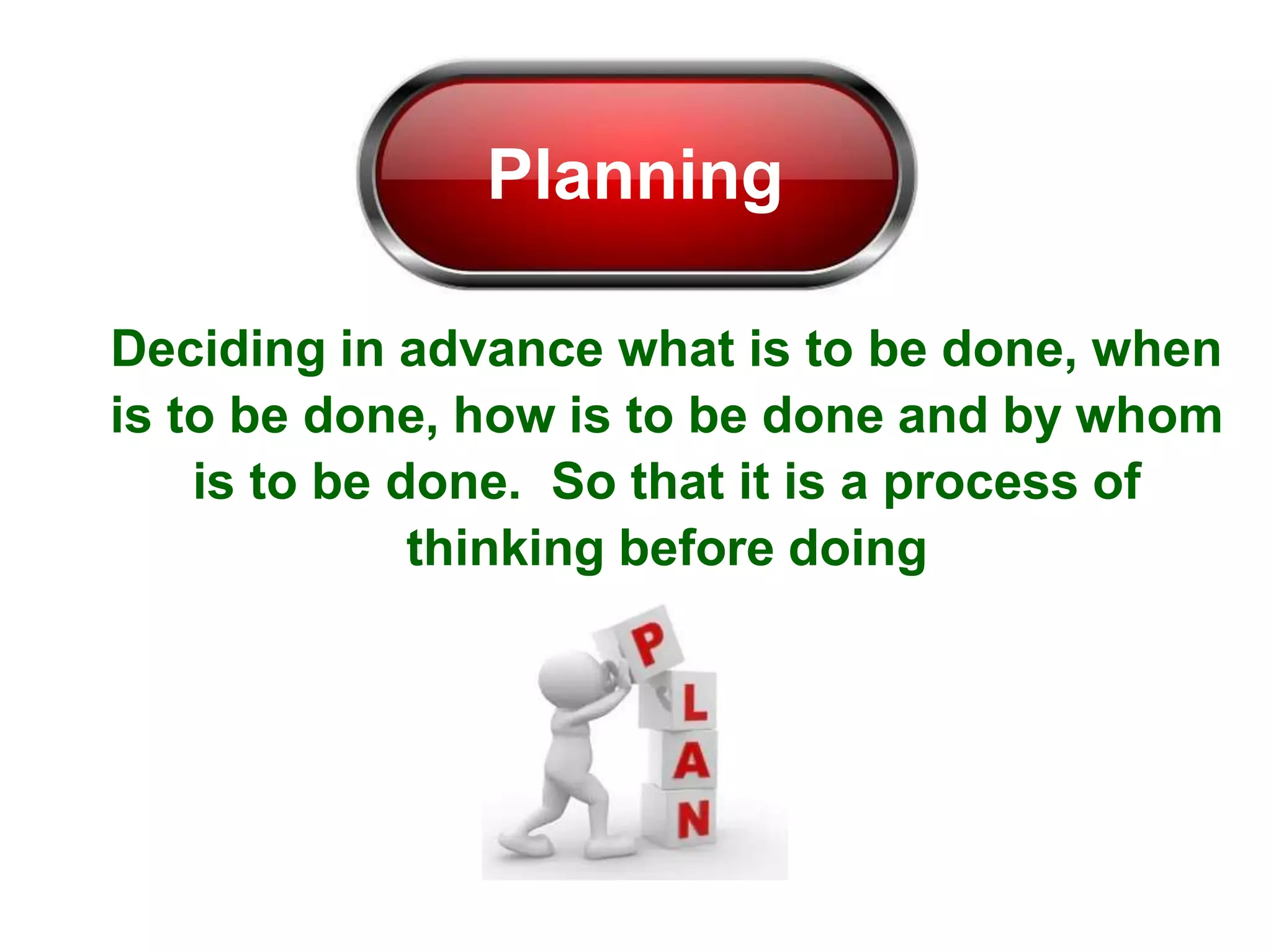
Deciding in advance what is to be done, when
is to be done, how is to be done and by whom
is to be done. So that it is a process of
thinking before doing
Planning
“Planning is deciding the best alternative among
others to perform different managerial operations
in order to achieve the predetermined goals”
– Henry Fayol
Planning
Planning
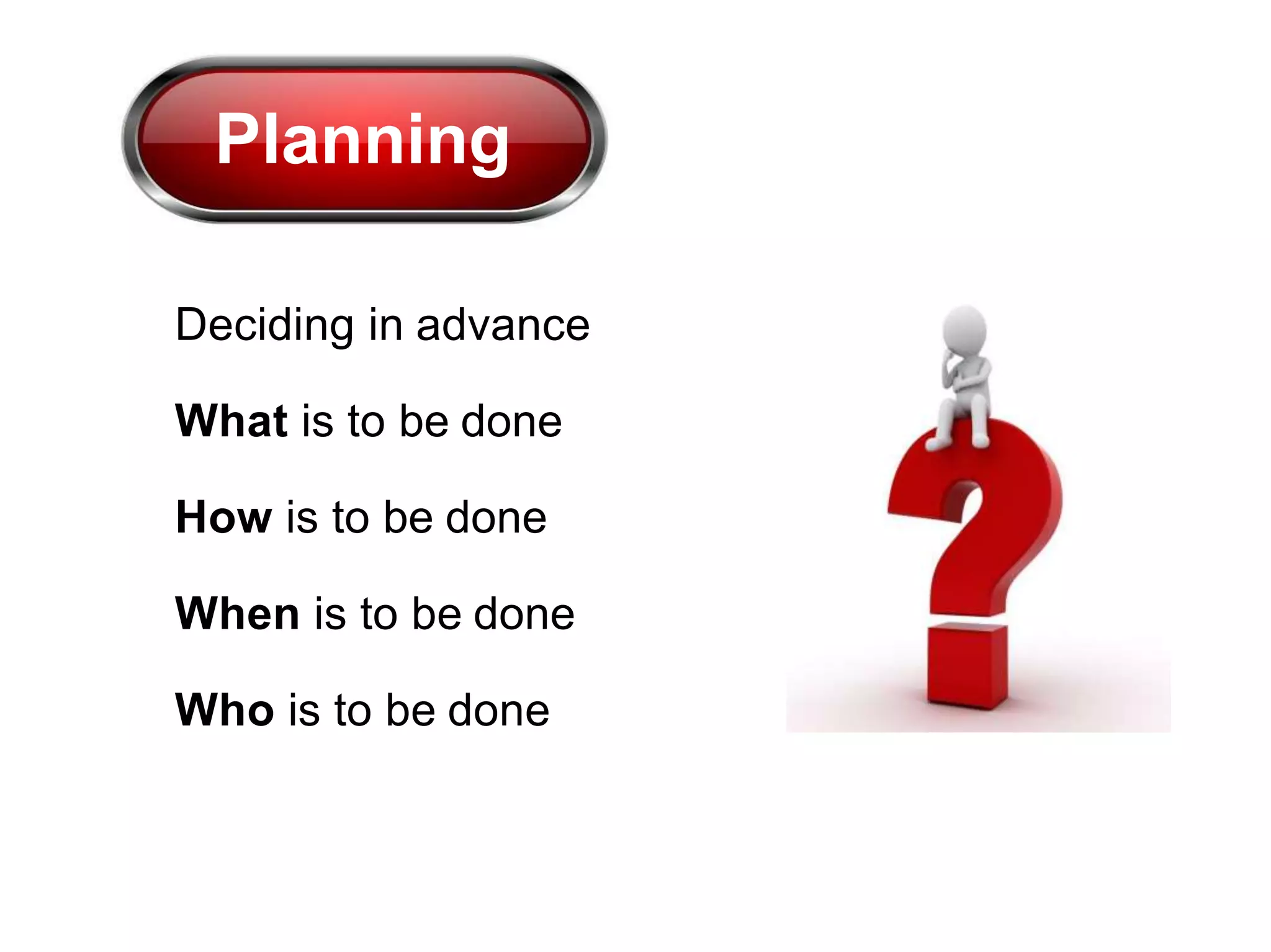
Deciding in advance
What is to be done
How is to be done
When is to be done
Who is to be done
Planning
Planning
What is to be
done
How is to be
done
When is to be
done
Who is to be
done
Importance
of
Planning
Importance of Planning
1 Planning provides direction
Planning provides direction for action
This ensures effective implementation of plans and
direction of effort towards attainment of objectives
If you don’t know where you are going, no road will
take you there
Importance of Planning
2 Planning reduces uncertainty
Planning enables an organization to cope up with
uncertainty and change
With the help of planning, an enterprise can predict
future events and make due provisions for them
Importance of Planning
3 Planning reduces overlapping and
wasteful activities
Planning co-ordinates the activities of individuals
and departments in an orderly manner, which will
help to avoid wasteful activities
Importance of Planning
4 Planning promotes innovation and
creativity
Planning is a process of thinking in advance; there
is a scope for finding better methods for
productivity
This makes the managers innovative and creative.
Importance of Planning
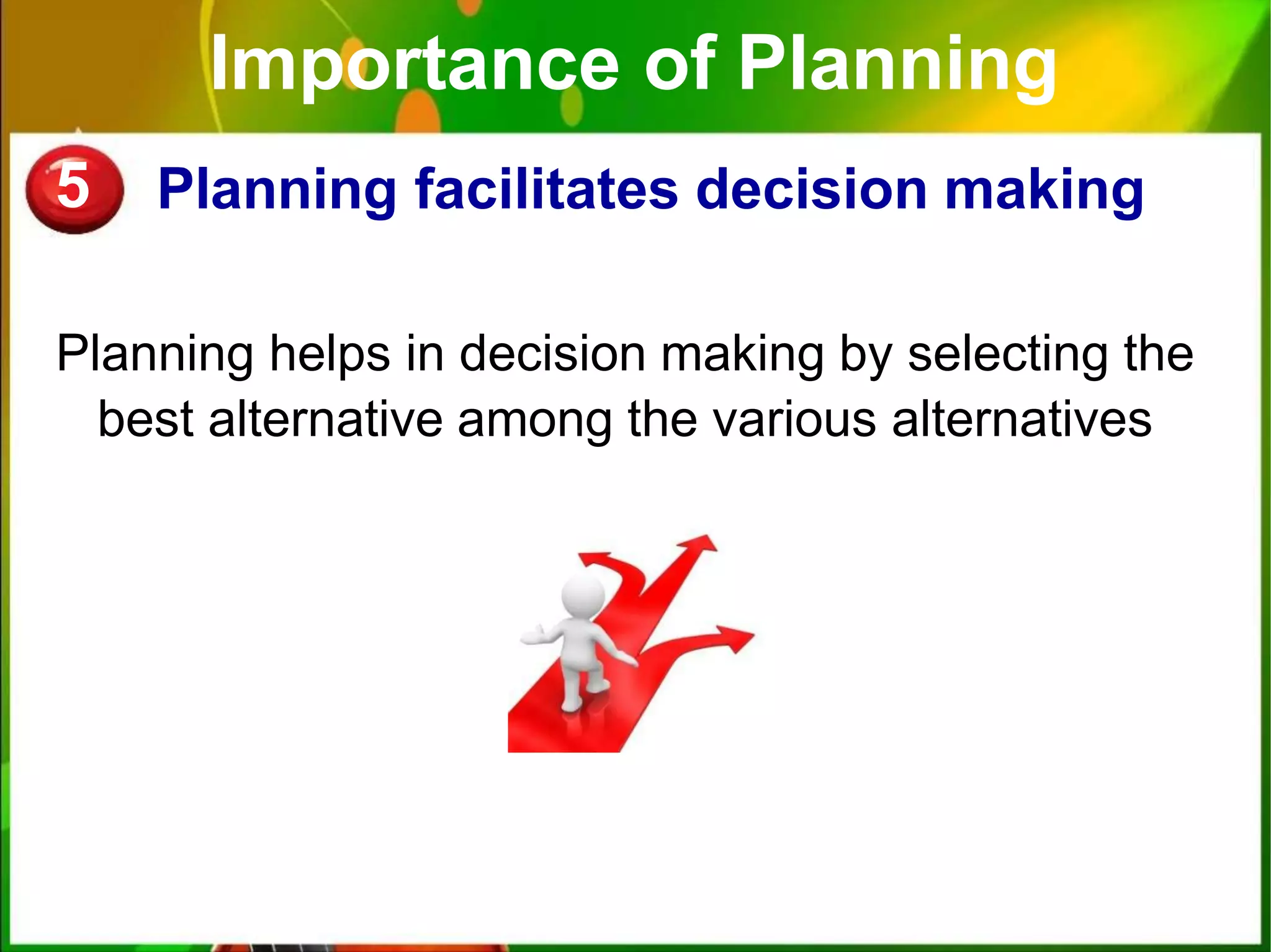
5 Planning facilitates decision making
Planning helps in decision making by selecting the
best alternative among the various alternatives
Importance of Planning
6 Planning establishes standards for
control
Plans serve as standards for evaluation of
performance
It will help to ensure proper control by comparing
the actual performance with the standard
performance
Importance of Planning
1.Provides direction
2.Reduces uncertainty
3.Reduces overlapping and wasteful
activities
4.Promotes innovation and creativity
5.Facilitates decision making
6.Establishes standards for control
Features of
Planning
Features of Planning
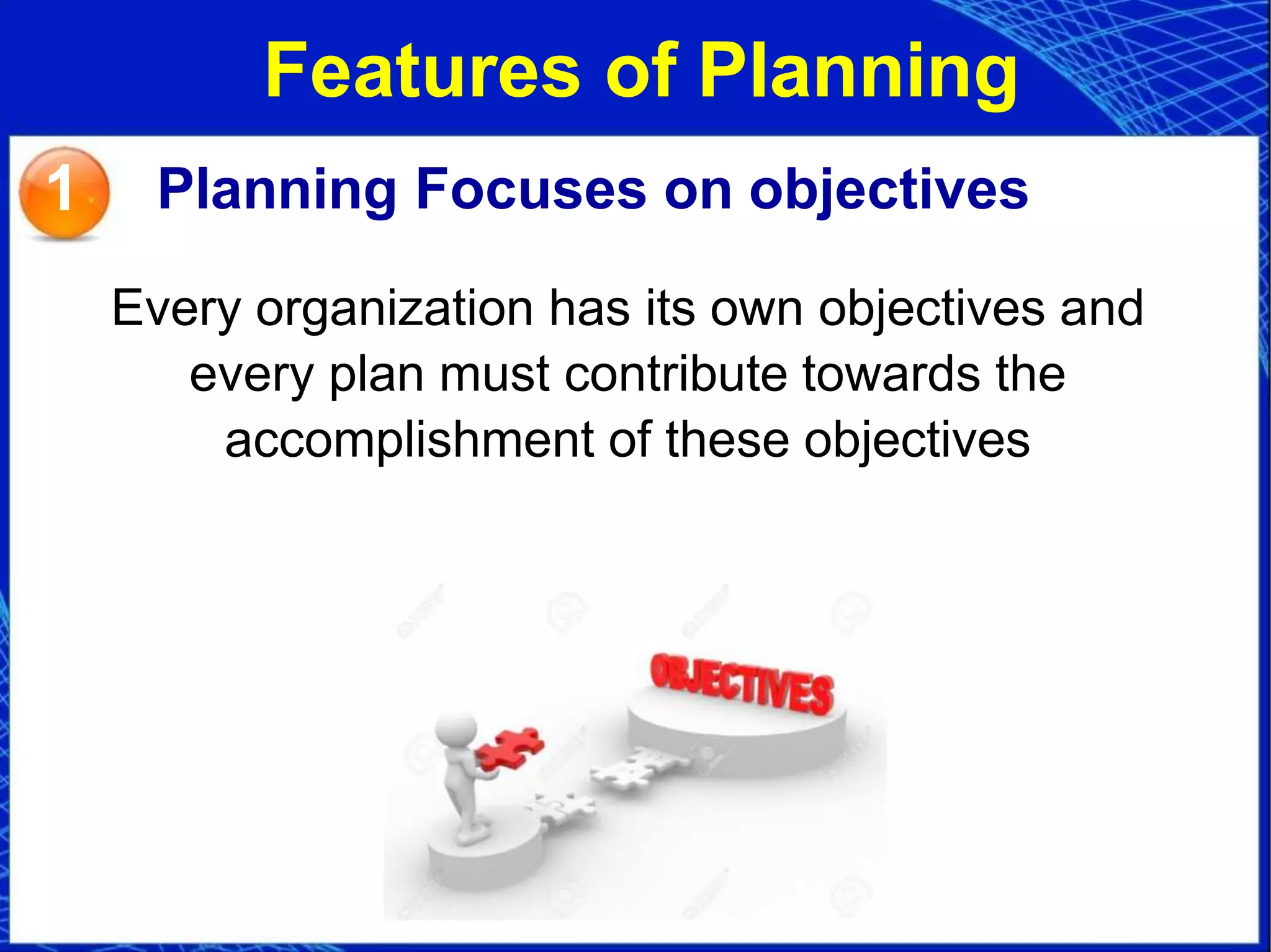
1 Planning Focuses on objectives
Every organization has its own objectives and
every plan must contribute towards the
accomplishment of these objectives
Features of Planning
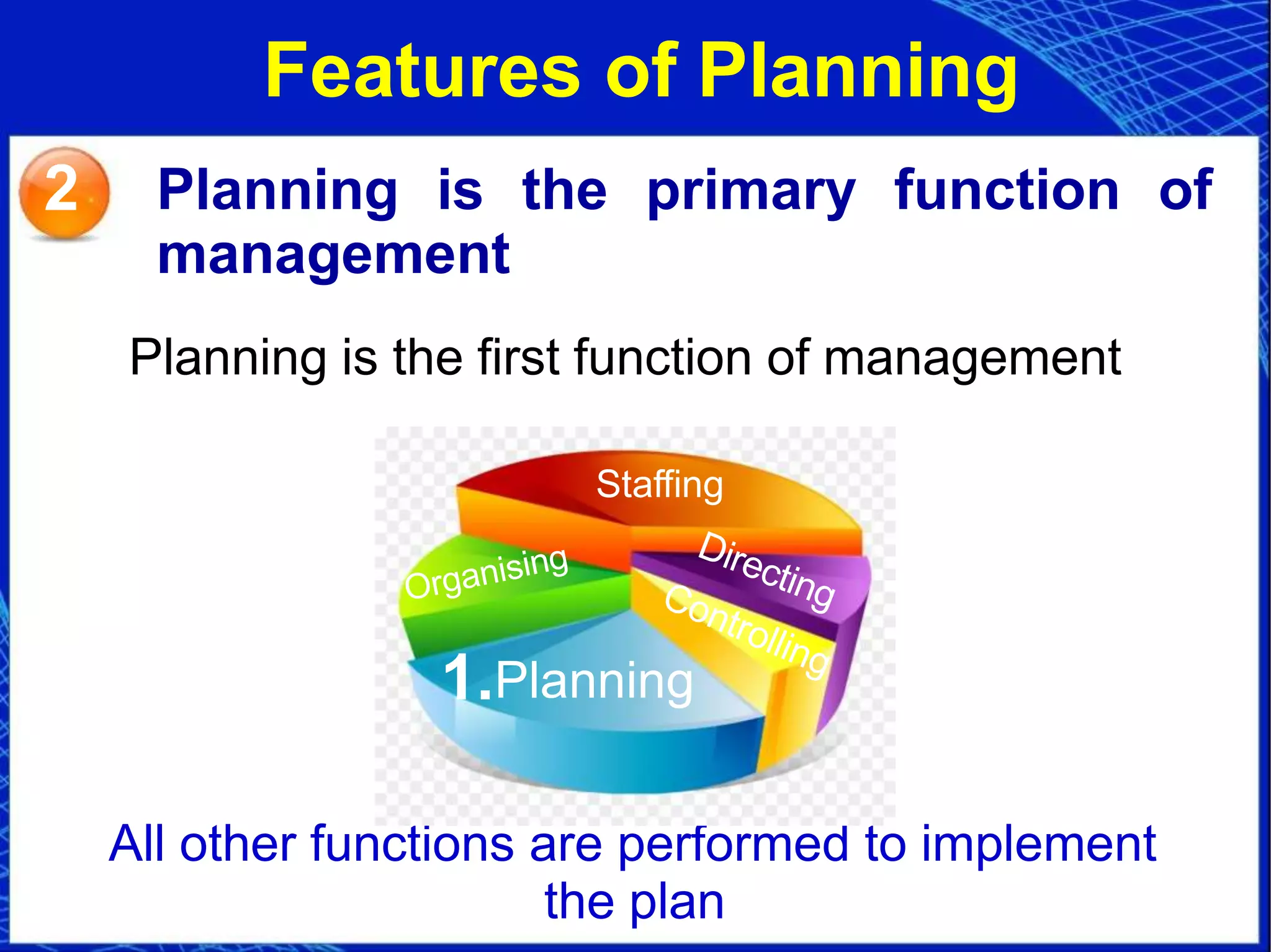
2 Planning is the primary function of
management
Planning is the first function of management
All other functions are performed to implement
the plan
Staffing
1.Planning
Features of Planning
3 Planning is pervasive
Planning is required at all levels of management
Top management - Long range plans
Middle management - Departmental plans
Lower level management - Short term plans
Features of Planning
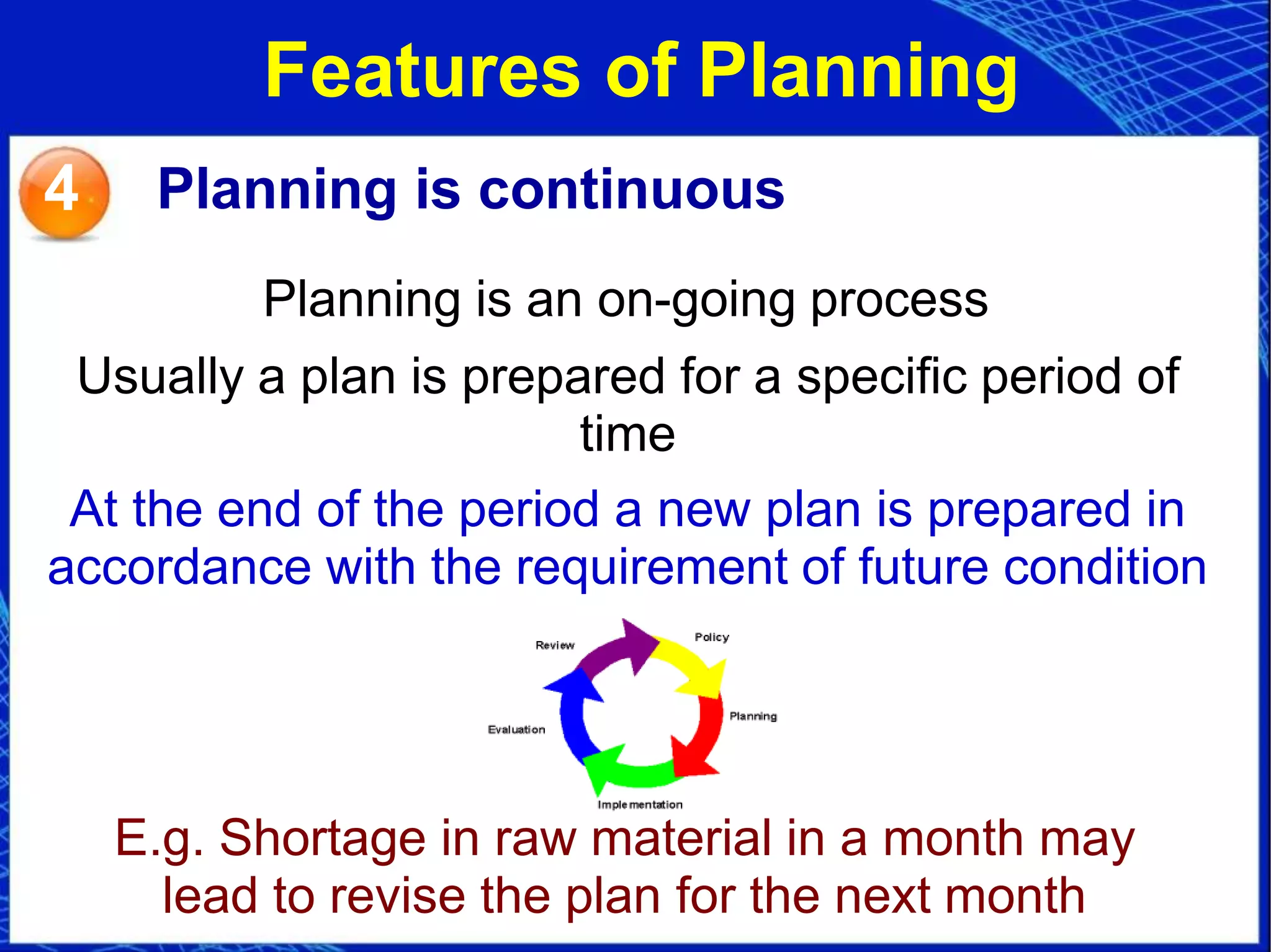
4 Planning is continuous
Planning is an on-going process
Usually a plan is prepared for a specific period of
time
At the end of the period a new plan is prepared in
accordance with the requirement of future condition
E.g. Shortage in raw material in a month may
lead to revise the plan for the next month
Features of Planning
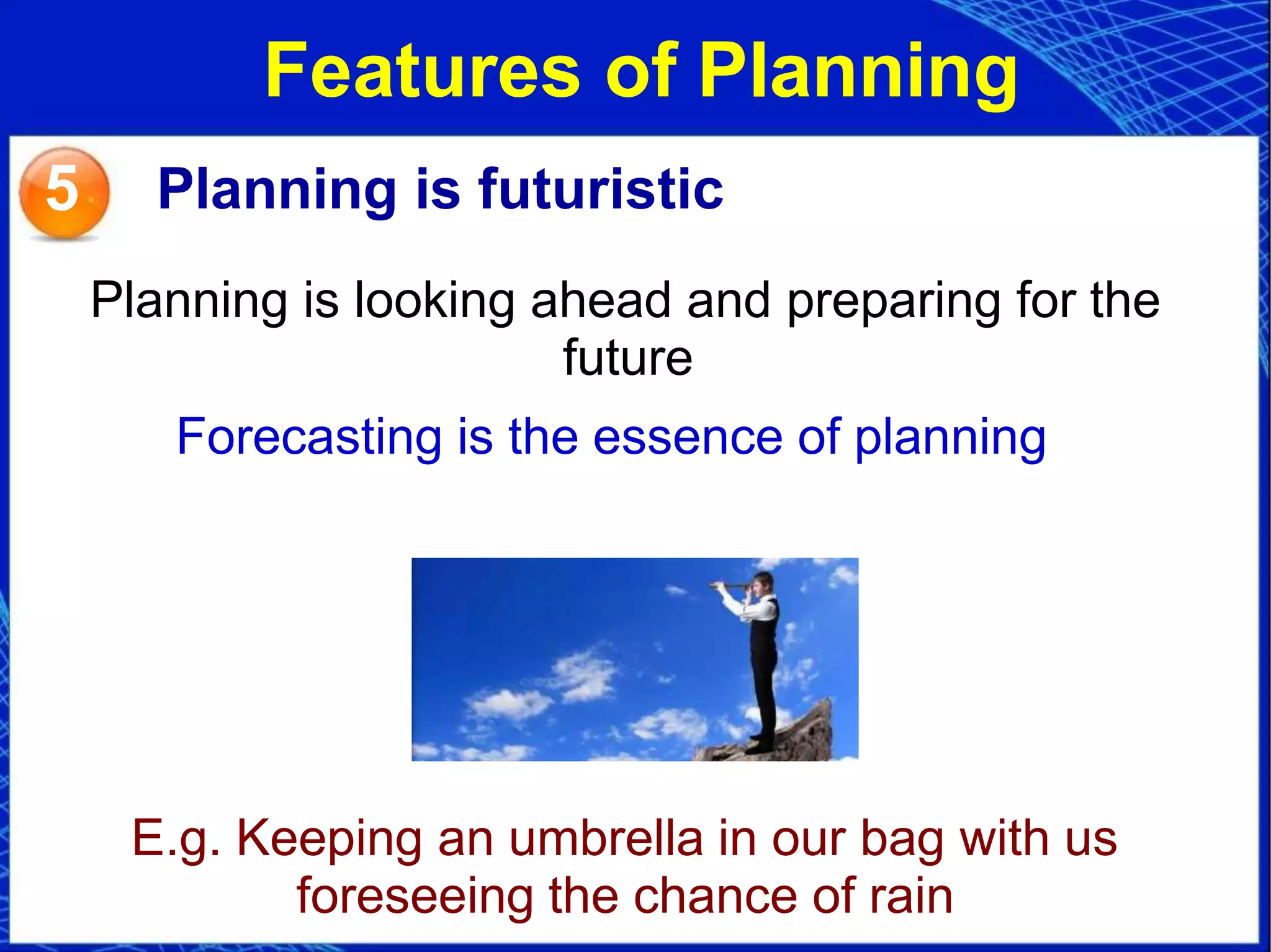
5 Planning is futuristic
Planning is looking ahead and preparing for the
future
Forecasting is the essence of planning
E.g. Keeping an umbrella in our bag with us
foreseeing the chance of rain
Features of Planning
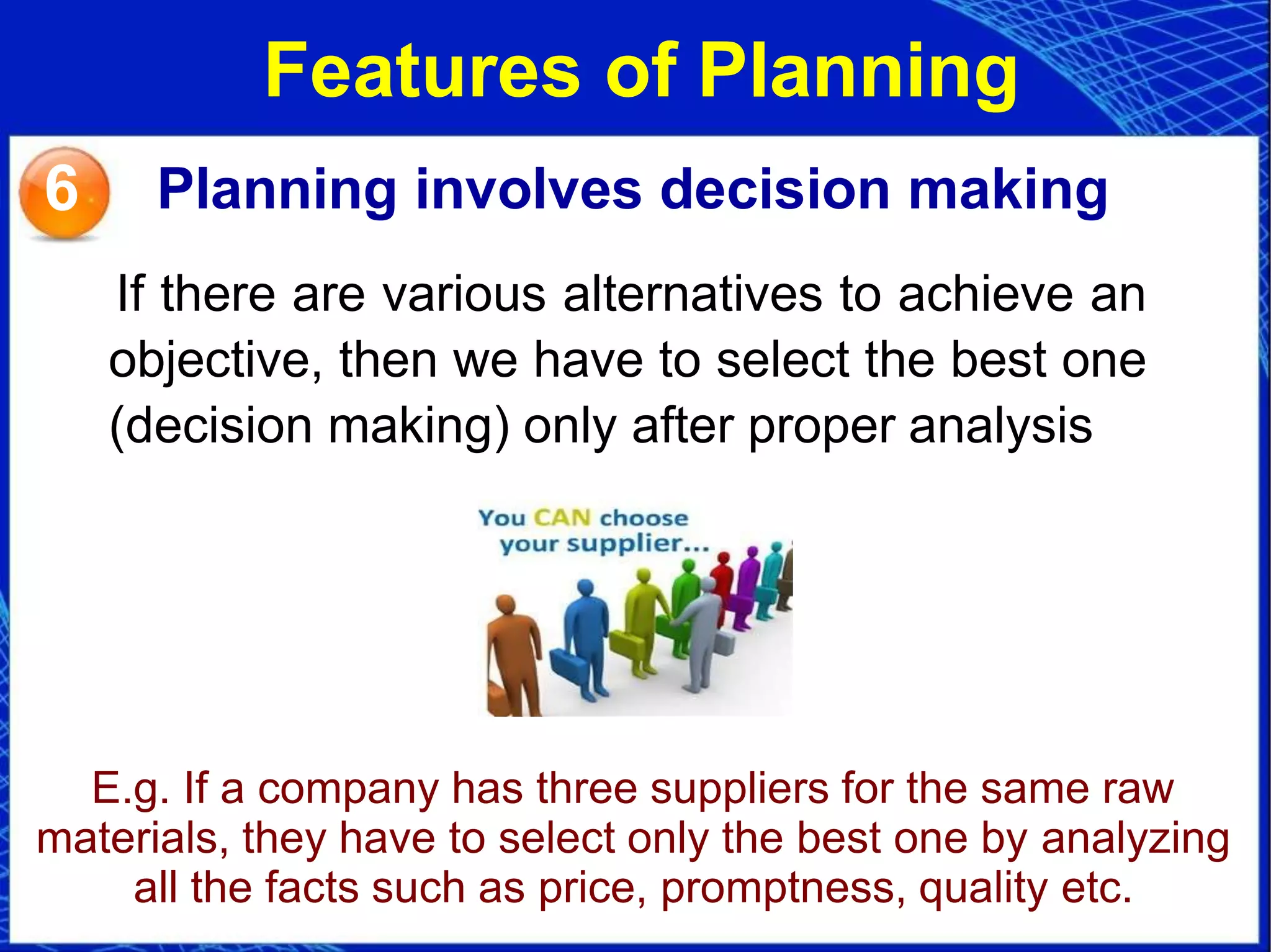
6 Planning involves decision making
If there are various alternatives to achieve an
objective, then we have to select the best one
(decision making) only after proper analysis
E.g. If a company has three suppliers for the same raw
materials, they have to select only the best one by analyzing
all the facts such as price, promptness, quality etc.
Features of Planning
7 Planning is a mental exercise
Planning is an intellectual process which involves
foresight, imagination and judgment
Features of Planning
1.Focuses on objectives
2.Primary function of management
3.Pervasive
4.Continuous
5.Futuristic
6.Involves decision making
7.Mental exercise
Limitations of
Planning
Limitations of Planning
1 Rigidity (inflexibility)
Planning restricts the individual skill, initiative and
creativity, because employees are required to work
strictly in accordance with the plans
Limitations of Planning
2 Planning may not work in dynamic
environment
The scope for planning is limited up to a certain
extent especially in the organizations having rapid
changing situations
Eg: Fashionable products
Limitations of Planning
3 Planning reduces creativity
Managers at middle and lower levels are just
implementing the plans formulated by the top
management, thus it reduces the creativity
among them
Limitations of Planning
4 Huge Cost
Planning is a very expensive and time consuming
process which involves the collection of data,
analysis, interpretation etc.
Hence it is not suitable for quick decisions as well
as for small concerns
Limitations of Planning
5 Time consuming
Sometimes plans to be drawn up take so much
time, but there is no much time left for their
implementation
Limitations of Planning
6 Does not guarantee success
Planning may create a false sense of security in
the organization that everything is going smooth; it
affects independent thinking and creativity of
managers
Limitations of Planning
1.Rigidity (inflexibility)
2.may not work in dynamic environment
3.reduces creativity
4.Huge Cost
5.Time consuming
6.Does not guarantee success
Planning Process
or
Steps in Planning
Planning Process
1 Setting the objectives
The first step in planning is the establishment of
objectives
The objectives must be clear and specific
The objective of the entire organization is laid down
first, and then it is broken down into departments
and individuals
Planning Process
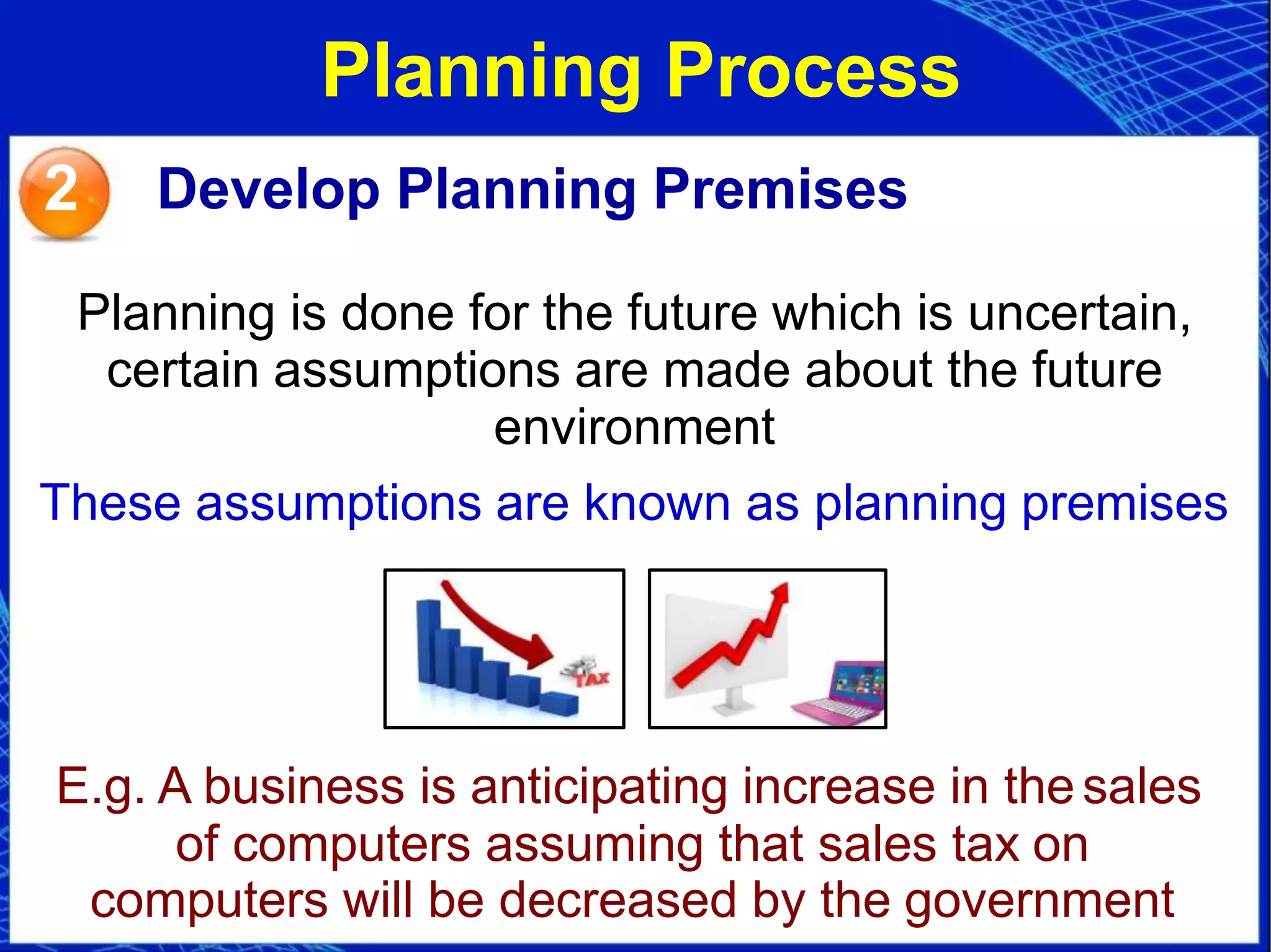
2 Develop Planning Premises
Planning is done for the future which is uncertain,
certain assumptions are made about the future
environment
These assumptions are known as planning premises
E.g. A business is anticipating increase in thesales
of computers assuming that sales tax on
computers will be decreased by the government
Planning Process
3 Identifying alternatives
There are alternative ways for achieving the
same goal
Eg: To increase sales, different ways are there, like
advertisement, reducing prices, improve quality etc.
Planning Process
4 Evaluating alternatives
The positive and negative aspects of each
alternative should be evaluated based on their
feasibility and consequences
Planning Process
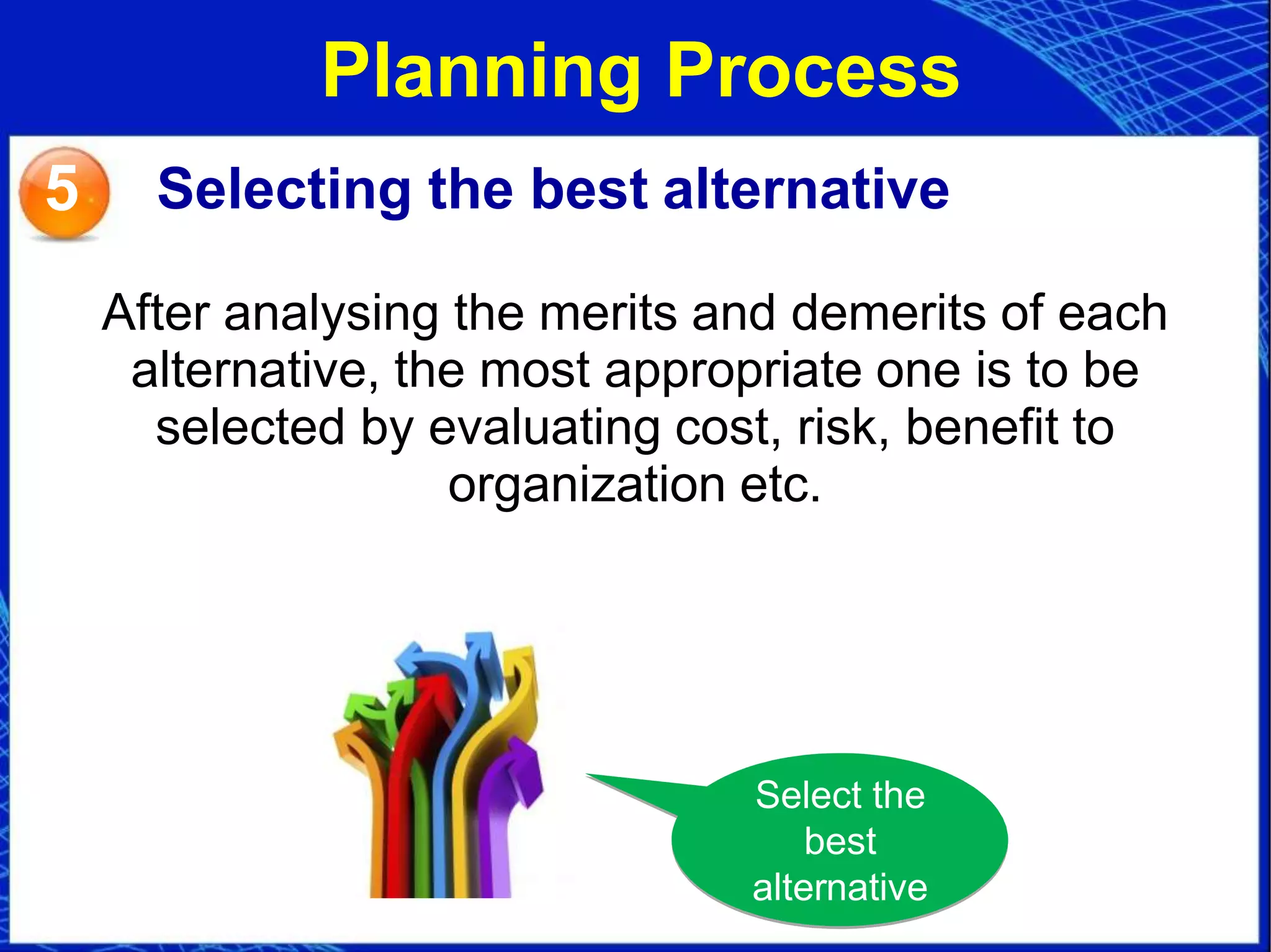
5 Selecting the best alternative
After analysing the merits and demerits of each
alternative, the most appropriate one is to be
selected by evaluating cost, risk, benefit to
organization etc.
Select the
best
alternative
Planning Process
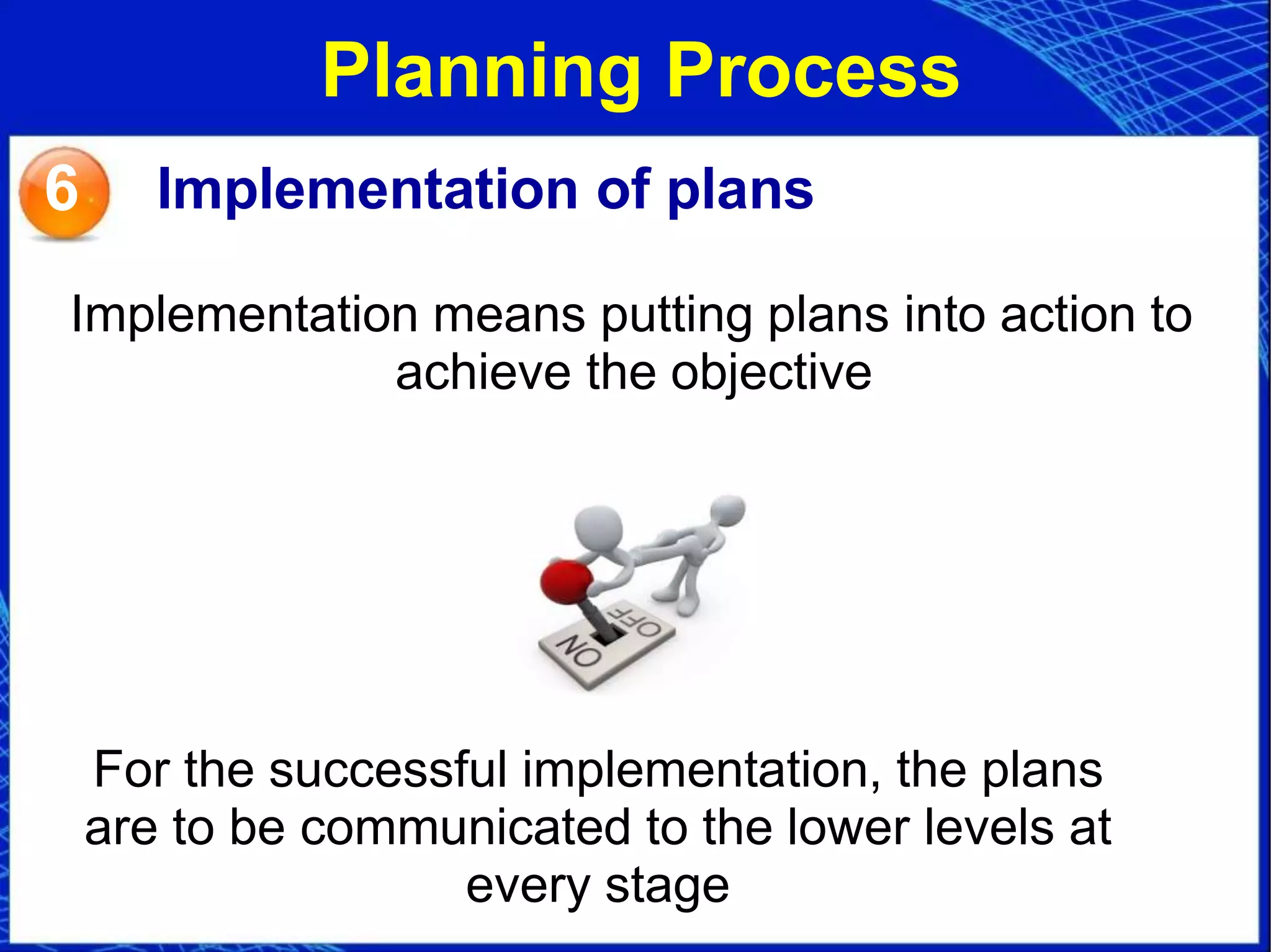
6 Implementation of plans
Implementation means putting plans into action to
achieve the objective
For the successful implementation, the plans
are to be communicated to the lower levels at
every stage
Planning Process
7 Follow Up
Plans are to be evaluated regularly to check
whether they are proceeding in right way, shortfalls
can be located and remedial actions can be taken
well in advance
Planning Process
1.Setting the objectives
2.Develop Planning Premises
3.Identifying alternatives
4.Evaluating alternatives
5.Selecting the best alternative
6.Implementation of plans
7.Follow Up
Types of Plans
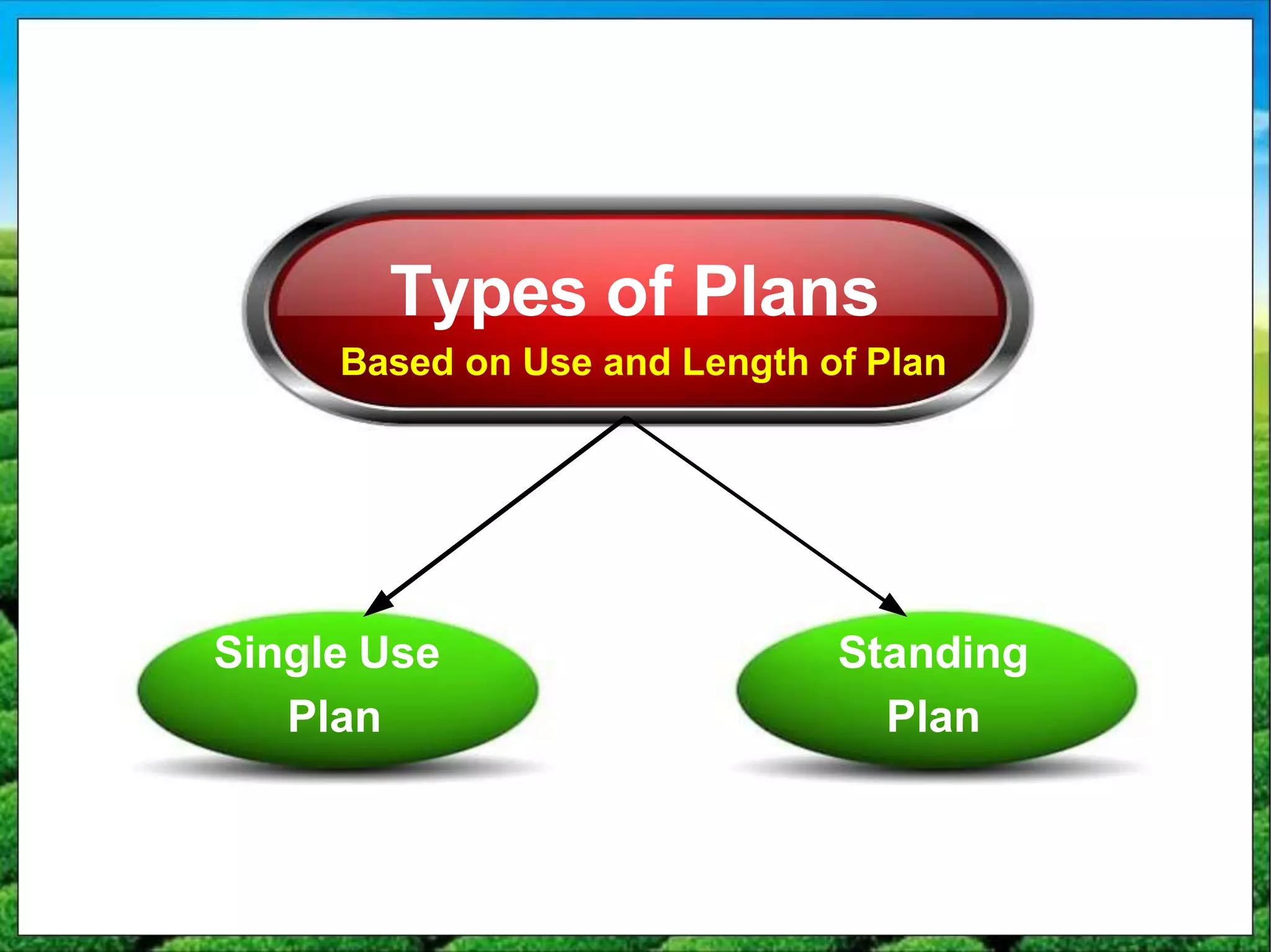
Based on Use and Length of Plan
Single Use
Plan
Standing
Plan
Developed for a one-time event or project
It is used for a course of action which is not likely to
be repeated in future
The duration may depend upon the type of project,
may be for one day, a week or a month
Single Use Plan
Single use plan includes Budgets, Programmes and Projects
such as organizing an event, seminar, conference etc.
It is used for activities that occur regularly over a
period of time
It is usually developed once but is modified from
time to time to meet business needs
Standing Plan
Standing plans include Policies, Procedures,
Methods and Rules
Types of Plans
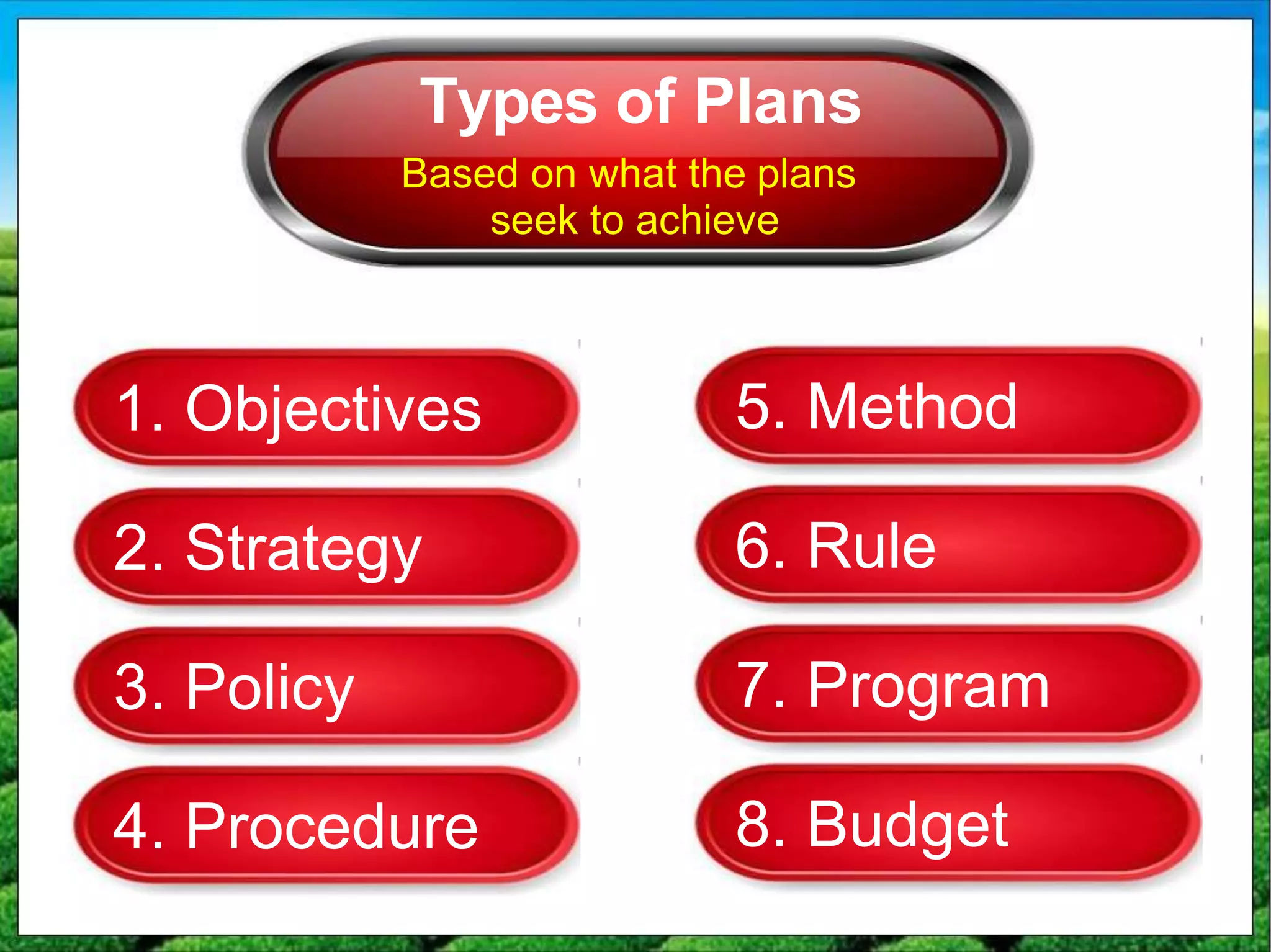
Based on what the plans
seek to achieve
1. Objectives
2. Strategy
3. Policy
4. Procedure
5. Method
6. Rule
7. Program
8. Budget
Types of Plans
1 Objectives
Objectives are the ends towards which an activity
is aimed
They are the results to be achieved
Objectives are the goals, aims or purpose that the
organization wishes to achieve
Eg: Improvement in the sale of a product by 10%.
Types of Plans
2 Strategy
It is a comprehensive plan for accomplishing an
organization’s objectives by considering the
business environment, i.e., changes in economic,
social, political, legal environment etc.
E.g., discount sale, scratch coupon, gifts for customers etc.
are some of the strategies that can be adopted for sales
promotion
Types of Plans
3 Policy
It is a guideline in decision making to various
managers
It defines the limit within which decisions can
be made
E.g. “Promotion is based on merit only” states that while
taking decision on promotion, merit will be the sole criterion
Types of Plans
4 Procedure
Procedure is a chronological order or steps to be
undertaken to enforce a policy
E.g. To implement the policy of selecting employees, the
selection procedure may be developed consisting of Inviting
applications, tests, interviews, references and then prepare
the list of selected candidates
Types of Plans
5 Rules
Rules are the guidelines for conducting an action
They specify what should be done or not to be
done in a given situation
E.g. Office opens at 10am, smoking is prohibited
inside the office
Types of Plans
6 Methods
Methods provide detailed and specific guidance for
day to day action
Eg. Time rate system or Piece rate system in wage
payment, most suitable method is to be adopted in the
organization for better performance
Types of Plans
7 Programs
It includes all the activities necessary for achieving
a given task
Installing a new machine
E.g. Opening 5 new branches in different parts of the
country, deputing employees for training, installing a new
machine etc.
Types of Plans
8 Budget
It is a plan which states the expected results of a
given period in numerical terms
E.g. Production Budget, sales budget, cash budget,
expenditure budget etc.
Types of Plans
1. Objectives
2. Strategy
3. Policy
4. Procedure
5. Rules
6. Methods
7. Programs
8. Budget
THANK YOU

Grade 12 Chapter 4 Planning .pptx

  • 1.
  • 2.
  • 3.
    Deciding in advancewhat is to be done, when is to be done, how is to be done and by whom is to be done. So that it is a process of thinking before doing Planning
  • 4.
    “Planning is decidingthe best alternative among others to perform different managerial operations in order to achieve the predetermined goals” – Henry Fayol Planning
  • 5.
    Planning Deciding in advance Whatis to be done How is to be done When is to be done Who is to be done
  • 6.
    Planning Planning What is tobe done How is to be done When is to be done Who is to be done
  • 7.
  • 8.
    Importance of Planning 1Planning provides direction Planning provides direction for action This ensures effective implementation of plans and direction of effort towards attainment of objectives If you don’t know where you are going, no road will take you there
  • 9.
    Importance of Planning 2Planning reduces uncertainty Planning enables an organization to cope up with uncertainty and change With the help of planning, an enterprise can predict future events and make due provisions for them
  • 10.
    Importance of Planning 3Planning reduces overlapping and wasteful activities Planning co-ordinates the activities of individuals and departments in an orderly manner, which will help to avoid wasteful activities
  • 11.
    Importance of Planning 4Planning promotes innovation and creativity Planning is a process of thinking in advance; there is a scope for finding better methods for productivity This makes the managers innovative and creative.
  • 12.
    Importance of Planning 5Planning facilitates decision making Planning helps in decision making by selecting the best alternative among the various alternatives
  • 13.
    Importance of Planning 6Planning establishes standards for control Plans serve as standards for evaluation of performance It will help to ensure proper control by comparing the actual performance with the standard performance
  • 14.
    Importance of Planning 1.Providesdirection 2.Reduces uncertainty 3.Reduces overlapping and wasteful activities 4.Promotes innovation and creativity 5.Facilitates decision making 6.Establishes standards for control
  • 15.
  • 16.
    Features of Planning 1Planning Focuses on objectives Every organization has its own objectives and every plan must contribute towards the accomplishment of these objectives
  • 17.
    Features of Planning 2Planning is the primary function of management Planning is the first function of management All other functions are performed to implement the plan Staffing 1.Planning
  • 18.
    Features of Planning 3Planning is pervasive Planning is required at all levels of management Top management - Long range plans Middle management - Departmental plans Lower level management - Short term plans
  • 19.
    Features of Planning 4Planning is continuous Planning is an on-going process Usually a plan is prepared for a specific period of time At the end of the period a new plan is prepared in accordance with the requirement of future condition E.g. Shortage in raw material in a month may lead to revise the plan for the next month
  • 20.
    Features of Planning 5Planning is futuristic Planning is looking ahead and preparing for the future Forecasting is the essence of planning E.g. Keeping an umbrella in our bag with us foreseeing the chance of rain
  • 21.
    Features of Planning 6Planning involves decision making If there are various alternatives to achieve an objective, then we have to select the best one (decision making) only after proper analysis E.g. If a company has three suppliers for the same raw materials, they have to select only the best one by analyzing all the facts such as price, promptness, quality etc.
  • 22.
    Features of Planning 7Planning is a mental exercise Planning is an intellectual process which involves foresight, imagination and judgment
  • 23.
    Features of Planning 1.Focuseson objectives 2.Primary function of management 3.Pervasive 4.Continuous 5.Futuristic 6.Involves decision making 7.Mental exercise
  • 24.
  • 25.
    Limitations of Planning 1Rigidity (inflexibility) Planning restricts the individual skill, initiative and creativity, because employees are required to work strictly in accordance with the plans
  • 26.
    Limitations of Planning 2Planning may not work in dynamic environment The scope for planning is limited up to a certain extent especially in the organizations having rapid changing situations Eg: Fashionable products
  • 27.
    Limitations of Planning 3Planning reduces creativity Managers at middle and lower levels are just implementing the plans formulated by the top management, thus it reduces the creativity among them
  • 28.
    Limitations of Planning 4Huge Cost Planning is a very expensive and time consuming process which involves the collection of data, analysis, interpretation etc. Hence it is not suitable for quick decisions as well as for small concerns
  • 29.
    Limitations of Planning 5Time consuming Sometimes plans to be drawn up take so much time, but there is no much time left for their implementation
  • 30.
    Limitations of Planning 6Does not guarantee success Planning may create a false sense of security in the organization that everything is going smooth; it affects independent thinking and creativity of managers
  • 31.
    Limitations of Planning 1.Rigidity(inflexibility) 2.may not work in dynamic environment 3.reduces creativity 4.Huge Cost 5.Time consuming 6.Does not guarantee success
  • 32.
  • 33.
    Planning Process 1 Settingthe objectives The first step in planning is the establishment of objectives The objectives must be clear and specific The objective of the entire organization is laid down first, and then it is broken down into departments and individuals
  • 34.
    Planning Process 2 DevelopPlanning Premises Planning is done for the future which is uncertain, certain assumptions are made about the future environment These assumptions are known as planning premises E.g. A business is anticipating increase in thesales of computers assuming that sales tax on computers will be decreased by the government
  • 35.
    Planning Process 3 Identifyingalternatives There are alternative ways for achieving the same goal Eg: To increase sales, different ways are there, like advertisement, reducing prices, improve quality etc.
  • 36.
    Planning Process 4 Evaluatingalternatives The positive and negative aspects of each alternative should be evaluated based on their feasibility and consequences
  • 37.
    Planning Process 5 Selectingthe best alternative After analysing the merits and demerits of each alternative, the most appropriate one is to be selected by evaluating cost, risk, benefit to organization etc. Select the best alternative
  • 38.
    Planning Process 6 Implementationof plans Implementation means putting plans into action to achieve the objective For the successful implementation, the plans are to be communicated to the lower levels at every stage
  • 39.
    Planning Process 7 FollowUp Plans are to be evaluated regularly to check whether they are proceeding in right way, shortfalls can be located and remedial actions can be taken well in advance
  • 40.
    Planning Process 1.Setting theobjectives 2.Develop Planning Premises 3.Identifying alternatives 4.Evaluating alternatives 5.Selecting the best alternative 6.Implementation of plans 7.Follow Up
  • 41.
    Types of Plans Basedon Use and Length of Plan Single Use Plan Standing Plan
  • 42.
    Developed for aone-time event or project It is used for a course of action which is not likely to be repeated in future The duration may depend upon the type of project, may be for one day, a week or a month Single Use Plan Single use plan includes Budgets, Programmes and Projects such as organizing an event, seminar, conference etc.
  • 43.
    It is usedfor activities that occur regularly over a period of time It is usually developed once but is modified from time to time to meet business needs Standing Plan Standing plans include Policies, Procedures, Methods and Rules
  • 44.
    Types of Plans Basedon what the plans seek to achieve 1. Objectives 2. Strategy 3. Policy 4. Procedure 5. Method 6. Rule 7. Program 8. Budget
  • 45.
    Types of Plans 1Objectives Objectives are the ends towards which an activity is aimed They are the results to be achieved Objectives are the goals, aims or purpose that the organization wishes to achieve Eg: Improvement in the sale of a product by 10%.
  • 46.
    Types of Plans 2Strategy It is a comprehensive plan for accomplishing an organization’s objectives by considering the business environment, i.e., changes in economic, social, political, legal environment etc. E.g., discount sale, scratch coupon, gifts for customers etc. are some of the strategies that can be adopted for sales promotion
  • 47.
    Types of Plans 3Policy It is a guideline in decision making to various managers It defines the limit within which decisions can be made E.g. “Promotion is based on merit only” states that while taking decision on promotion, merit will be the sole criterion
  • 48.
    Types of Plans 4Procedure Procedure is a chronological order or steps to be undertaken to enforce a policy E.g. To implement the policy of selecting employees, the selection procedure may be developed consisting of Inviting applications, tests, interviews, references and then prepare the list of selected candidates
  • 49.
    Types of Plans 5Rules Rules are the guidelines for conducting an action They specify what should be done or not to be done in a given situation E.g. Office opens at 10am, smoking is prohibited inside the office
  • 50.
    Types of Plans 6Methods Methods provide detailed and specific guidance for day to day action Eg. Time rate system or Piece rate system in wage payment, most suitable method is to be adopted in the organization for better performance
  • 51.
    Types of Plans 7Programs It includes all the activities necessary for achieving a given task Installing a new machine E.g. Opening 5 new branches in different parts of the country, deputing employees for training, installing a new machine etc.
  • 52.
    Types of Plans 8Budget It is a plan which states the expected results of a given period in numerical terms E.g. Production Budget, sales budget, cash budget, expenditure budget etc.
  • 53.
    Types of Plans 1.Objectives 2. Strategy 3. Policy 4. Procedure 5. Rules 6. Methods 7. Programs 8. Budget
  • 54.