Ankush Singla
TIMT
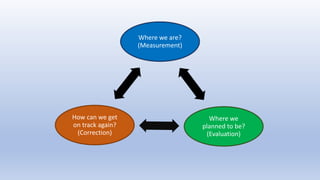
Where we are?
(Measurement)
Where we
planned to be?
(Evaluation)
How can we get
on track again?
(Correction)
Controlling
 One of the managerial function like Planning, Organizing, Staffing and Directing.
 Process of gathering and feeding back information about performance so that
decision makers can compare actual results with planned results and decide what to
do about any apparent discrepancies or problems.
 Helps to check errors and take corrective measures so that deviation from standards
are minimized and goals of the organization are achieved in a desired manner.
 It sees to it that right things happen, in the right ways and at the right time.
Definitions of Controlling
 “Managerial Controlling implies the measurement of accomplishment against
the standard and the correction of deviations to assume attainment of objectives
according to plan” -Koontz O’Donnell
 “Controlling is determining what is being accomplished, that is evaluating the
performance and if necessary, applying corrective measures so that
performance takes place according to plans” -George R. Terry
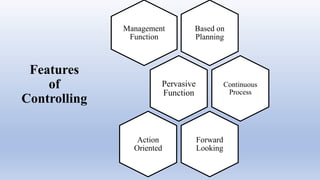
Features
of
Controlling
Based on
Planning
Management
Function
Pervasive
Function
Continuous
Process
Forward
Looking
Action
Oriented
Features of Controlling
 Management Function: Controlling is one of the managerial functions like planning, Organizing, Staffing and
Directing. Efficient control is required to be exercised in the process of management as to get better results and
to achieve organizational objectives.
 Based on Planning: Controlling cannot be exercised without planning. First the objectives are set and then
efforts are made to see whether these are accomplished or not. Whenever there is a deviation in performance or
things are not happening as per the plans then corrective measures are taken immediately. So planning provides
a base for controlling.
 Pervasive Function: Every manager working in the organization irrespective of his position has to control and
command over the activities of subordinates as to produce desired results. Not only the managers but every
organization needs to exercise effective control to secure optimum effective utilization of all resources.
 Continuous Process: Like Planning, controlling is a continuous process having no definable end. It involves
constant and regular monitoring of event and performance, analysis of standards, procedures and policies and
suggesting remedial measures to control the situation or to improve the performance.
 Action Oriented: Whenever performance is not as per the standards the immediate action is needed to correct the
things. The purpose of control will be defeated if corrective action is not taken immediately. If the sales are less
than the standard set for marketing department then steps will be taken to ensure that performance is not low in
future. If no such steps are taken then there will be a lack of control.
 Forward Looking: Control is forward looking. Past is already gone thus, cannot be controlled. Measures can be
devised to control future activities only. Past provides a base for determining controls for future. The manager will
study the past performance in order to find out the reasons for low results. A corrective action will be taken to
ensure that work in future is not adversely affected. Take for example, production for a particular month is low
than the standard. Manager will not be able to do anything about the past performance. However, he may study the
reasons for low production. He should take appropriate steps so that the same mistakes are not repeated and
production will not suffer in future.
Feed-Forward Control
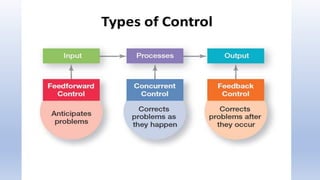
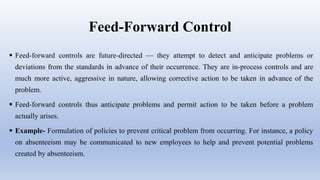
 Feed-forward controls are future-directed — they attempt to detect and anticipate problems or
deviations from the standards in advance of their occurrence. They are in-process controls and are
much more active, aggressive in nature, allowing corrective action to be taken in advance of the
problem.
 Feed-forward controls thus anticipate problems and permit action to be taken before a problem
actually arises.
 Example- Formulation of policies to prevent critical problem from occurring. For instance, a policy
on absenteeism may be communicated to new employees to help and prevent potential problems
created by absenteeism.
Concurrent Control
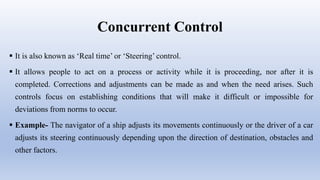
 It is also known as ‘Real time’ or ‘Steering’ control.
 It allows people to act on a process or activity while it is proceeding, nor after it is
completed. Corrections and adjustments can be made as and when the need arises. Such
controls focus on establishing conditions that will make it difficult or impossible for
deviations from norms to occur.
 Example- The navigator of a ship adjusts its movements continuously or the driver of a car
adjusts its steering continuously depending upon the direction of destination, obstacles and
other factors.
Feedback Control
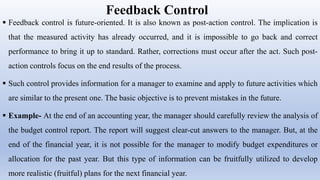
 Feedback control is future-oriented. It is also known as post-action control. The implication is
that the measured activity has already occurred, and it is impossible to go back and correct
performance to bring it up to standard. Rather, corrections must occur after the act. Such post-
action controls focus on the end results of the process.
 Such control provides information for a manager to examine and apply to future activities which
are similar to the present one. The basic objective is to prevent mistakes in the future.
 Example- At the end of an accounting year, the manager should carefully review the analysis of
the budget control report. The report will suggest clear-cut answers to the manager. But, at the
end of the financial year, it is not possible for the manager to modify budget expenditures or
allocation for the past year. But this type of information can be fruitfully utilized to develop
more realistic (fruitful) plans for the next financial year.
Prerequisites of a good control system
 Suitability: The control system should be according to the requirement, size, nature and necessity of the
enterprise. Controls in a production department will be different from those required in marketing department.
 Simplicity: Control system must be easily understandable and simple to administer. Too elaborate and
complicated controls such as mathematical formulas, statistical methods and charts are ordinarily ineffective
because they fail to communicate the meaning of their control data to persons who use them.
 Objectivity: The standards of performance and their measurement should be as far as possible be objective,
verifiable and specific. They should be definite and determinable.
 Economically Realistic: The cost of implementing a control system should be less than or at most equal to the
benefits derived from the control system.
 Flexible: Objectives, Plans, activities, people, external conditions etc. change over time. As such controlling
system needs to be flexible to adopt to the changed circumstances.
Prerequisites of a good control system
 Understandable: A control system should be clear and easily understandable to the people who will use it, so
that control becomes easy, smooth and meaningful.
 Register Deviation Quickly: The aim of control is to see that actual performance conforms to be pre-
determined goals or standards. So the best control system is one which reports deviation from the plan quickly.
 Corrective Action: A good control system besides selecting the deviation and failures, should also point out
where a deviation has occurred, what are the reasons for deviation and what corrective action should be taken.
 Forward Looking: Although instant control is considered more effective, it should also focus attention on
providing early information regarding the changes which are likely to occur in the environment.
 Interactive nature of control: In order to devise control system for an organization, care should be taken that
all types of controls have been included and optional combination of these has been prepared because various
types of control are complementary to each other.
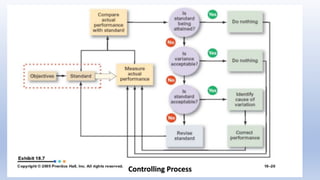
Controlling Process
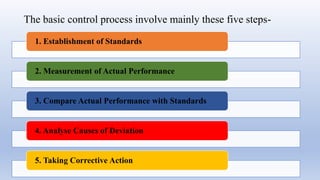
1. Establishment of Standards
2. Measurement of Actual Performance
3. Compare Actual Performance with Standards
4. Analyse Causes of Deviation
5. Taking Corrective Action
The basic control process involve mainly these five steps-
Controlling Process
1. Establishment of Standards: The first step in the process of controlling is concerned with setting
performance standards. These standards are the basis for measuring the actual performance. Thus,
standards act as a lighthouse that warns & guides the ships at sea. Standards are the benchmarks
towards which efforts of entire organization are directed. These standards can be expressed both in
quantitative and qualitative terms.
In order to facilitate easy comparison of actual performance with the standards, a manager should try to
set these standards in quantitative terms as far as possible. However, in case of qualitative standards,
effort should be made to define these standards in such a way that comparison becomes easily
understandable.
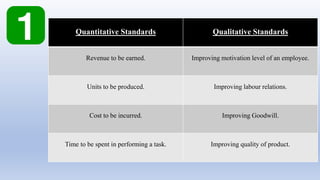
Quantitative Standards Qualitative Standards
Revenue to be earned. Improving motivation level of an employee.
Units to be produced. Improving labour relations.
Cost to be incurred. Improving Goodwill.
Time to be spent in performing a task. Improving quality of product.
Controlling Process
2. Measurement of Actual Performance: Once the standards have been determined, the next step is to measure
the actual performance. The various techniques for measuring performance are sample checking, performance
reports, personal observation etc. However, in order to facilitate easy comparison, the performance should be
measured on same basis that the standards have.
Following are some of the ways for measuring performance:
 Superior prepares a report regarding the performance of an employee.
 Various ratios like gross profit ratio, debtor turnover ratio, return on investment, current ratio etc. are calculated
at periodic intervals to measure company’s performance.
 Progress made in areas like marketing can be measured by considering the number of units, increase in market
share etc.
 In small organizations, each unit produced can be checked personally to ensure the quality standards.
 In large organization, the technique of sample checking is used. Under this technique, some pieces are
checked at random for quality specifications.
Controlling Process
Controlling Process
3. Compare Actual Performance with Standard Performance: In the controlling process, the actual
performance is compared with prescribed standard with view to identify deviation and its possible causes.
In case the performance matches with standards, the manager feels that every thing is within control. And if it
happens to be more or less than standard, it means that there is some deviation.
a) Actual Performance = Standard Performance (Zero Deviation)
b) Actual Performance > Standard Performance (Positive Deviation)
c) Actual Performance < Standard Performance (Negative Deviation)
Controlling Process
4. Analyze causes of deviation: Once deviations have been identified based on comparison of standards and
actual performance, it is the responsibility of the manager to analyze for causes for deviations. He identifies and
investigates these deviations as to get into the possible causes responsible for such situation.
Controlling Process
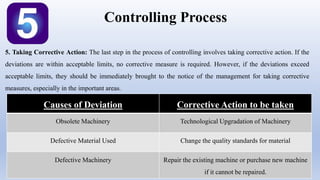
5. Taking Corrective Action: The last step in the process of controlling involves taking corrective action. If the
deviations are within acceptable limits, no corrective measure is required. However, if the deviations exceed
acceptable limits, they should be immediately brought to the notice of the management for taking corrective
measures, especially in the important areas.
Causes of Deviation Corrective Action to be taken
Obsolete Machinery Technological Upgradation of Machinery
Defective Material Used Change the quality standards for material
Defective Machinery Repair the existing machine or purchase new machine
if it cannot be repaired.
Barriers to Control Making
Resource Scarcity
Managing control typically requires a number of resources. These resources include supervisory staff,
skilled specialists, tools to measure the control of the system, and often complex statistical software and
other tracking technologies. A lack of any (or all) of these crucial inputs can drastically reduce the ability of
the control team to collect and communicate their findings. This under-funding of the control system creates
resource scarcity for the process.
Barriers to Control Making
Inaccurate Measurement
Inaccurate measurement while managing control can happen for a number of different reasons, including:
a) Inaccurate measuring devices
b) Misunderstanding of the measurement process by staff
c) Lack of staff training to determine how to measure the control process
These issues can result in inaccurate measurements, which can make the control process failure.
Barriers to Control Making
Unreasonable control standards
Employees may resist control as they think the standards of performance are set very high and are
observed strictly. On the other hand, the standards are imposed from the top management and the
subordinates have no say in their determination.
Barriers to Control Making
Check on freedom
The basic idea behind control is to check freedom as it tries to regulate the behaviour of employees
in some specified way. This specified method of doing work may not match with the liking of
employees . When there is a difference between the liking of an individuals and specified way of
doing work, control is resisted.
Barriers to Control Making
Fear of discrimination
The employees always think that they are likely to be discriminated by the controller at the time of
providing rewards and punishment. They argued that the control information on the basis of which
their performance is evaluated is not fairly considered. In this way, employees tend to resist control.
Personal Observation Method
 Observation of actual operations at work place is the most effective and the oldest method of
control.
 Under this controlling technique, the manager or supervisor ensures that each employee
perform his work as per given standards or norms.
 The physical presence of the manager and his deep involvement in work situation have definite
influence over the performance and behaviour of the subordinates working under his control.
 Limitation-
a) Time Consuming
b) Unscheduled visits of the manager at work sight may put psychological pressure on the
employees to comply with prescribed norms.
Statistical Reports and Analysis
 Statistical reports and analysis are the important instrument of the control.
 This analysis is possible by means of comparison of ratios, percentages, averages,
trends etc. of different periods to identify deviations and causes.
 Useful in Inventory control, Production control and Quality control.
 The minimum and maximum control limits are fixed and deviations within these limits
are allowed but if variations go beyond prescribed parameters then immediate steps are
taken to correct them.
 Statistical control charts are prepared and permissible limits are plotted. A look at the
chart will give an idea to the viewer of every thing is going as per plans or not.
Cost Control
 Cost control devotes the control of all costs of an enterprise in order to achieve the cost
efficiency of business.
 Cost can be classified as Fixed cost, Variable cost and Semi-Variable cost.
 There may be different methods of recording cost for various products. In each method,
Classification, Recording and Allocation of expenses may be done differently.
 In each method, there will be a system where deviations in standard and actual cost will
be reported to the concerned officials for taking corrective measures.
 The regular cost control system will help cost under check.
Budgeting
 A Budget is the monetary and quantitative expression of business plans and
policies to be pursued in the future period of time.
 The term Budgeting is used for preparing budgets and other procedures for
planning, coordination and control of business enterprise.
 A Budget is a pre-determined statement of management policy during a given
period which provides a standard for comparison with the results actually
achieved.
Production Planning and Control (PPC)
 It is an important task of Production Manager.
 It is to see that production process is properly decided in advance and is carried
out as per plan. Production planning is the function of looking ahead, anticipating
difficulties to be faced and the likely remedial steps to remove them.
 Production control guides and directs flow of production so that products are
manufactured in a best way and conform to a planned schedule and are of the
right quality.
 Techniques of PPC- Routing, Scheduling, Despatching, Inspection
Inventory Control
 It is a system which ensures the right quality of material and inventory available in the
right quantity at the right time and right place with the right amount of investment.
 Inventory control is necessary for smooth and uninterrupted functioning of production
department. Its main purpose is to maintain adequate supply of correct material at the
lowest total cost.
 Inventory control can be exercised by establishing following parameters- Safety
stock level, Maximum stock level, Reorder level, Danger level, Economic order
Quantity (EOQ)
Break Even Analysis
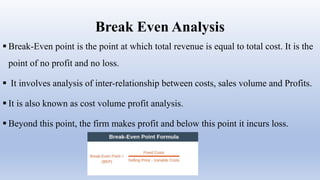
 Break-Even point is the point at which total revenue is equal to total cost. It is the
point of no profit and no loss.
 It involves analysis of inter-relationship between costs, sales volume and Profits.
 It is also known as cost volume profit analysis.
 Beyond this point, the firm makes profit and below this point it incurs loss.
Break Even Analysis
 Break Even analysis is useful technique of decision making and control.
 Practical Applications-
a) To identify the minimum sales volume required to prevent a loss or to achieve
established profit objectives
b) To provide information helpful in make or buy decisions
c) To determine data helpful in decisions to add or drop product lines.
Return on Investment (ROI)
 It measures the relationship between the amount of net profits and the size of
investment in an enterprise.
 It is a key measure of overall performance and an important technique of
financial control.
 It helps to measure whether or not invested capital has been used effectively for
generating reasonable amount of return.
 If ROI is high then the financial position of business is good and satisfactory.
Human Resource Accounting (HRA)
 HRA is a process of identifying and measuring data about human resources and
communicating this information to the interested parties.
 It involves measuring the costs incurred by an organization to recruit, select, hire, train and
develop human assets and also involves measuring the economic value of people in the
organization.
 It is concerned with measurement of cost and value of people in the organization.
 The basic theory underlying HRA is:
a) People are valuable resources of an organization
b) Information on investment and values of human resources is useful for decision making in
the organization
Human Resource Accounting (HRA)
 Advantage of HRA-
a) It serves as basis for efficient planning and management of human resources.
b) It helps in measurement of the cost of recruitment, selection and training of
employees.
c) It provide data for the development of suitable promotion policy in order to
ensure effective use of human resources.
d) It has a favourable psychological effect on job satisfaction and morale of
employees.
Management Audit
 Management Audit provides device for surveying and evaluating how effectively and
efficiently organizational operations and activities have been managed by managers.
 It may also be defined as systematic evaluation of the functioning, performance and
effectiveness of management of an organization.
 Management Audit team consisting of various experts and specialists forms its opinion
and conclusions based on the analysis of evidences and information against a set of
criteria of performance and effectiveness. On the basis of such evaluation,
recommendations for improving quality of management may be made.
Management Information System (MIS)
 It is an approach of providing timely, adequate and accurate information to the right person in the
organization which helps in taking right decision.
 MIS is planned and organised approach to the transferring of intelligence within organization for better
management.
 An effective system of MIS collect data from all possible events. The information is properly processed
and stored for future use.
 MIS is of two types-
a) Management operating system- meant for meeting the information needs of lower and middle level
management. The information supplied generally relates to operations of the business.
b) Management reporting system- which supplies information to top level management for decision
making. The information is presented in a way which enables management to take quick decision.
Network Techniques (PERT/CPM)
 In order to achieve an element of accurate planning and control, the network techniques, PERT
(Programme Evaluation and Review Technique) and CPM (Critical Path Method) are used.
 These techniques are specially useful for planning, scheduling and implementing time bound
projects involving variety of complex, diverse and inter related activities.
 The importance is given to identify critical activities. By controlling the time of critical
activities, the total time and cost of the project are minimized.
 These techniques have an origin in USA, PERT was developed by team of management
consultants for US NAVY special projects in 1958 and CPM was developed by DUPONT and
Remington Rand Companies.
Controlling-Type, Process, Barriers &Techniques

Controlling-Type, Process, Barriers &Techniques

  • 1.
  • 2.
    Where we are? (Measurement) Wherewe planned to be? (Evaluation) How can we get on track again? (Correction)
  • 3.
    Controlling  One ofthe managerial function like Planning, Organizing, Staffing and Directing.  Process of gathering and feeding back information about performance so that decision makers can compare actual results with planned results and decide what to do about any apparent discrepancies or problems.  Helps to check errors and take corrective measures so that deviation from standards are minimized and goals of the organization are achieved in a desired manner.  It sees to it that right things happen, in the right ways and at the right time.
  • 4.
    Definitions of Controlling “Managerial Controlling implies the measurement of accomplishment against the standard and the correction of deviations to assume attainment of objectives according to plan” -Koontz O’Donnell  “Controlling is determining what is being accomplished, that is evaluating the performance and if necessary, applying corrective measures so that performance takes place according to plans” -George R. Terry
  • 5.
  • 6.
    Features of Controlling Management Function: Controlling is one of the managerial functions like planning, Organizing, Staffing and Directing. Efficient control is required to be exercised in the process of management as to get better results and to achieve organizational objectives.  Based on Planning: Controlling cannot be exercised without planning. First the objectives are set and then efforts are made to see whether these are accomplished or not. Whenever there is a deviation in performance or things are not happening as per the plans then corrective measures are taken immediately. So planning provides a base for controlling.  Pervasive Function: Every manager working in the organization irrespective of his position has to control and command over the activities of subordinates as to produce desired results. Not only the managers but every organization needs to exercise effective control to secure optimum effective utilization of all resources.
  • 7.
     Continuous Process:Like Planning, controlling is a continuous process having no definable end. It involves constant and regular monitoring of event and performance, analysis of standards, procedures and policies and suggesting remedial measures to control the situation or to improve the performance.  Action Oriented: Whenever performance is not as per the standards the immediate action is needed to correct the things. The purpose of control will be defeated if corrective action is not taken immediately. If the sales are less than the standard set for marketing department then steps will be taken to ensure that performance is not low in future. If no such steps are taken then there will be a lack of control.  Forward Looking: Control is forward looking. Past is already gone thus, cannot be controlled. Measures can be devised to control future activities only. Past provides a base for determining controls for future. The manager will study the past performance in order to find out the reasons for low results. A corrective action will be taken to ensure that work in future is not adversely affected. Take for example, production for a particular month is low than the standard. Manager will not be able to do anything about the past performance. However, he may study the reasons for low production. He should take appropriate steps so that the same mistakes are not repeated and production will not suffer in future.
  • 9.
    Feed-Forward Control  Feed-forwardcontrols are future-directed — they attempt to detect and anticipate problems or deviations from the standards in advance of their occurrence. They are in-process controls and are much more active, aggressive in nature, allowing corrective action to be taken in advance of the problem.  Feed-forward controls thus anticipate problems and permit action to be taken before a problem actually arises.  Example- Formulation of policies to prevent critical problem from occurring. For instance, a policy on absenteeism may be communicated to new employees to help and prevent potential problems created by absenteeism.
  • 10.
    Concurrent Control  Itis also known as ‘Real time’ or ‘Steering’ control.  It allows people to act on a process or activity while it is proceeding, nor after it is completed. Corrections and adjustments can be made as and when the need arises. Such controls focus on establishing conditions that will make it difficult or impossible for deviations from norms to occur.  Example- The navigator of a ship adjusts its movements continuously or the driver of a car adjusts its steering continuously depending upon the direction of destination, obstacles and other factors.
  • 11.
    Feedback Control  Feedbackcontrol is future-oriented. It is also known as post-action control. The implication is that the measured activity has already occurred, and it is impossible to go back and correct performance to bring it up to standard. Rather, corrections must occur after the act. Such post- action controls focus on the end results of the process.  Such control provides information for a manager to examine and apply to future activities which are similar to the present one. The basic objective is to prevent mistakes in the future.  Example- At the end of an accounting year, the manager should carefully review the analysis of the budget control report. The report will suggest clear-cut answers to the manager. But, at the end of the financial year, it is not possible for the manager to modify budget expenditures or allocation for the past year. But this type of information can be fruitfully utilized to develop more realistic (fruitful) plans for the next financial year.
  • 12.
    Prerequisites of agood control system  Suitability: The control system should be according to the requirement, size, nature and necessity of the enterprise. Controls in a production department will be different from those required in marketing department.  Simplicity: Control system must be easily understandable and simple to administer. Too elaborate and complicated controls such as mathematical formulas, statistical methods and charts are ordinarily ineffective because they fail to communicate the meaning of their control data to persons who use them.  Objectivity: The standards of performance and their measurement should be as far as possible be objective, verifiable and specific. They should be definite and determinable.  Economically Realistic: The cost of implementing a control system should be less than or at most equal to the benefits derived from the control system.  Flexible: Objectives, Plans, activities, people, external conditions etc. change over time. As such controlling system needs to be flexible to adopt to the changed circumstances.
  • 13.
    Prerequisites of agood control system  Understandable: A control system should be clear and easily understandable to the people who will use it, so that control becomes easy, smooth and meaningful.  Register Deviation Quickly: The aim of control is to see that actual performance conforms to be pre- determined goals or standards. So the best control system is one which reports deviation from the plan quickly.  Corrective Action: A good control system besides selecting the deviation and failures, should also point out where a deviation has occurred, what are the reasons for deviation and what corrective action should be taken.  Forward Looking: Although instant control is considered more effective, it should also focus attention on providing early information regarding the changes which are likely to occur in the environment.  Interactive nature of control: In order to devise control system for an organization, care should be taken that all types of controls have been included and optional combination of these has been prepared because various types of control are complementary to each other.
  • 15.
  • 16.
    1. Establishment ofStandards 2. Measurement of Actual Performance 3. Compare Actual Performance with Standards 4. Analyse Causes of Deviation 5. Taking Corrective Action The basic control process involve mainly these five steps-
  • 17.
    Controlling Process 1. Establishmentof Standards: The first step in the process of controlling is concerned with setting performance standards. These standards are the basis for measuring the actual performance. Thus, standards act as a lighthouse that warns & guides the ships at sea. Standards are the benchmarks towards which efforts of entire organization are directed. These standards can be expressed both in quantitative and qualitative terms. In order to facilitate easy comparison of actual performance with the standards, a manager should try to set these standards in quantitative terms as far as possible. However, in case of qualitative standards, effort should be made to define these standards in such a way that comparison becomes easily understandable.
  • 18.
    Quantitative Standards QualitativeStandards Revenue to be earned. Improving motivation level of an employee. Units to be produced. Improving labour relations. Cost to be incurred. Improving Goodwill. Time to be spent in performing a task. Improving quality of product.
  • 19.
    Controlling Process 2. Measurementof Actual Performance: Once the standards have been determined, the next step is to measure the actual performance. The various techniques for measuring performance are sample checking, performance reports, personal observation etc. However, in order to facilitate easy comparison, the performance should be measured on same basis that the standards have. Following are some of the ways for measuring performance:  Superior prepares a report regarding the performance of an employee.  Various ratios like gross profit ratio, debtor turnover ratio, return on investment, current ratio etc. are calculated at periodic intervals to measure company’s performance.  Progress made in areas like marketing can be measured by considering the number of units, increase in market share etc.
  • 20.
     In smallorganizations, each unit produced can be checked personally to ensure the quality standards.  In large organization, the technique of sample checking is used. Under this technique, some pieces are checked at random for quality specifications. Controlling Process
  • 21.
    Controlling Process 3. CompareActual Performance with Standard Performance: In the controlling process, the actual performance is compared with prescribed standard with view to identify deviation and its possible causes. In case the performance matches with standards, the manager feels that every thing is within control. And if it happens to be more or less than standard, it means that there is some deviation. a) Actual Performance = Standard Performance (Zero Deviation) b) Actual Performance > Standard Performance (Positive Deviation) c) Actual Performance < Standard Performance (Negative Deviation)
  • 22.
    Controlling Process 4. Analyzecauses of deviation: Once deviations have been identified based on comparison of standards and actual performance, it is the responsibility of the manager to analyze for causes for deviations. He identifies and investigates these deviations as to get into the possible causes responsible for such situation.
  • 23.
    Controlling Process 5. TakingCorrective Action: The last step in the process of controlling involves taking corrective action. If the deviations are within acceptable limits, no corrective measure is required. However, if the deviations exceed acceptable limits, they should be immediately brought to the notice of the management for taking corrective measures, especially in the important areas. Causes of Deviation Corrective Action to be taken Obsolete Machinery Technological Upgradation of Machinery Defective Material Used Change the quality standards for material Defective Machinery Repair the existing machine or purchase new machine if it cannot be repaired.
  • 25.
    Barriers to ControlMaking Resource Scarcity Managing control typically requires a number of resources. These resources include supervisory staff, skilled specialists, tools to measure the control of the system, and often complex statistical software and other tracking technologies. A lack of any (or all) of these crucial inputs can drastically reduce the ability of the control team to collect and communicate their findings. This under-funding of the control system creates resource scarcity for the process.
  • 26.
    Barriers to ControlMaking Inaccurate Measurement Inaccurate measurement while managing control can happen for a number of different reasons, including: a) Inaccurate measuring devices b) Misunderstanding of the measurement process by staff c) Lack of staff training to determine how to measure the control process These issues can result in inaccurate measurements, which can make the control process failure.
  • 27.
    Barriers to ControlMaking Unreasonable control standards Employees may resist control as they think the standards of performance are set very high and are observed strictly. On the other hand, the standards are imposed from the top management and the subordinates have no say in their determination.
  • 28.
    Barriers to ControlMaking Check on freedom The basic idea behind control is to check freedom as it tries to regulate the behaviour of employees in some specified way. This specified method of doing work may not match with the liking of employees . When there is a difference between the liking of an individuals and specified way of doing work, control is resisted.
  • 29.
    Barriers to ControlMaking Fear of discrimination The employees always think that they are likely to be discriminated by the controller at the time of providing rewards and punishment. They argued that the control information on the basis of which their performance is evaluated is not fairly considered. In this way, employees tend to resist control.
  • 32.
    Personal Observation Method Observation of actual operations at work place is the most effective and the oldest method of control.  Under this controlling technique, the manager or supervisor ensures that each employee perform his work as per given standards or norms.  The physical presence of the manager and his deep involvement in work situation have definite influence over the performance and behaviour of the subordinates working under his control.  Limitation- a) Time Consuming b) Unscheduled visits of the manager at work sight may put psychological pressure on the employees to comply with prescribed norms.
  • 33.
    Statistical Reports andAnalysis  Statistical reports and analysis are the important instrument of the control.  This analysis is possible by means of comparison of ratios, percentages, averages, trends etc. of different periods to identify deviations and causes.  Useful in Inventory control, Production control and Quality control.  The minimum and maximum control limits are fixed and deviations within these limits are allowed but if variations go beyond prescribed parameters then immediate steps are taken to correct them.  Statistical control charts are prepared and permissible limits are plotted. A look at the chart will give an idea to the viewer of every thing is going as per plans or not.
  • 34.
    Cost Control  Costcontrol devotes the control of all costs of an enterprise in order to achieve the cost efficiency of business.  Cost can be classified as Fixed cost, Variable cost and Semi-Variable cost.  There may be different methods of recording cost for various products. In each method, Classification, Recording and Allocation of expenses may be done differently.  In each method, there will be a system where deviations in standard and actual cost will be reported to the concerned officials for taking corrective measures.  The regular cost control system will help cost under check.
  • 35.
    Budgeting  A Budgetis the monetary and quantitative expression of business plans and policies to be pursued in the future period of time.  The term Budgeting is used for preparing budgets and other procedures for planning, coordination and control of business enterprise.  A Budget is a pre-determined statement of management policy during a given period which provides a standard for comparison with the results actually achieved.
  • 36.
    Production Planning andControl (PPC)  It is an important task of Production Manager.  It is to see that production process is properly decided in advance and is carried out as per plan. Production planning is the function of looking ahead, anticipating difficulties to be faced and the likely remedial steps to remove them.  Production control guides and directs flow of production so that products are manufactured in a best way and conform to a planned schedule and are of the right quality.  Techniques of PPC- Routing, Scheduling, Despatching, Inspection
  • 37.
    Inventory Control  Itis a system which ensures the right quality of material and inventory available in the right quantity at the right time and right place with the right amount of investment.  Inventory control is necessary for smooth and uninterrupted functioning of production department. Its main purpose is to maintain adequate supply of correct material at the lowest total cost.  Inventory control can be exercised by establishing following parameters- Safety stock level, Maximum stock level, Reorder level, Danger level, Economic order Quantity (EOQ)
  • 38.
    Break Even Analysis Break-Even point is the point at which total revenue is equal to total cost. It is the point of no profit and no loss.  It involves analysis of inter-relationship between costs, sales volume and Profits.  It is also known as cost volume profit analysis.  Beyond this point, the firm makes profit and below this point it incurs loss.
  • 39.
    Break Even Analysis Break Even analysis is useful technique of decision making and control.  Practical Applications- a) To identify the minimum sales volume required to prevent a loss or to achieve established profit objectives b) To provide information helpful in make or buy decisions c) To determine data helpful in decisions to add or drop product lines.
  • 41.
    Return on Investment(ROI)  It measures the relationship between the amount of net profits and the size of investment in an enterprise.  It is a key measure of overall performance and an important technique of financial control.  It helps to measure whether or not invested capital has been used effectively for generating reasonable amount of return.  If ROI is high then the financial position of business is good and satisfactory.
  • 42.
    Human Resource Accounting(HRA)  HRA is a process of identifying and measuring data about human resources and communicating this information to the interested parties.  It involves measuring the costs incurred by an organization to recruit, select, hire, train and develop human assets and also involves measuring the economic value of people in the organization.  It is concerned with measurement of cost and value of people in the organization.  The basic theory underlying HRA is: a) People are valuable resources of an organization b) Information on investment and values of human resources is useful for decision making in the organization
  • 43.
    Human Resource Accounting(HRA)  Advantage of HRA- a) It serves as basis for efficient planning and management of human resources. b) It helps in measurement of the cost of recruitment, selection and training of employees. c) It provide data for the development of suitable promotion policy in order to ensure effective use of human resources. d) It has a favourable psychological effect on job satisfaction and morale of employees.
  • 44.
    Management Audit  ManagementAudit provides device for surveying and evaluating how effectively and efficiently organizational operations and activities have been managed by managers.  It may also be defined as systematic evaluation of the functioning, performance and effectiveness of management of an organization.  Management Audit team consisting of various experts and specialists forms its opinion and conclusions based on the analysis of evidences and information against a set of criteria of performance and effectiveness. On the basis of such evaluation, recommendations for improving quality of management may be made.
  • 45.
    Management Information System(MIS)  It is an approach of providing timely, adequate and accurate information to the right person in the organization which helps in taking right decision.  MIS is planned and organised approach to the transferring of intelligence within organization for better management.  An effective system of MIS collect data from all possible events. The information is properly processed and stored for future use.  MIS is of two types- a) Management operating system- meant for meeting the information needs of lower and middle level management. The information supplied generally relates to operations of the business. b) Management reporting system- which supplies information to top level management for decision making. The information is presented in a way which enables management to take quick decision.
  • 46.
    Network Techniques (PERT/CPM) In order to achieve an element of accurate planning and control, the network techniques, PERT (Programme Evaluation and Review Technique) and CPM (Critical Path Method) are used.  These techniques are specially useful for planning, scheduling and implementing time bound projects involving variety of complex, diverse and inter related activities.  The importance is given to identify critical activities. By controlling the time of critical activities, the total time and cost of the project are minimized.  These techniques have an origin in USA, PERT was developed by team of management consultants for US NAVY special projects in 1958 and CPM was developed by DUPONT and Remington Rand Companies.