Nature and significance of Management
Geeta M.
 Management is a pervasive and universal concept.
No business can work smoothly without
management irrespective of its size, nature and
functions.
 Management is not constrain to business
organization but even non-business organization
needs to manage its functions.
 Management is a process of planning, organizing,
motivating and controlling the enterprise resources
for the purpose of achieving the goals of the
organization effectively and efficiently.
Traditional concept-
 ‘Management is the art of getting things done through
others’. Mary Parker Follett
 ‘Management consists of getting things done through
others’ .A manager is one who accomplishes organizational
objectives by directing the efforts of others.
C.S.George
Modern concept-
 ‘Management is establishing an effective environment
for people operating in formal organizational group’.
koontz and o’donnel
 ‘Management is the co-ordination of all resources
through the process of Planning, Organizing, Directing and
Controlling in order to attain stated objectives’.
F.w. Taylor
 Goal oriented process.
 Pervasive.
 Multidimensional.
 Continuous process.
 Group activity.
 Dynamic function.
 Intangible
 Composite process.
 Balancing effectiveness and efficiency
 Organizational objectives-
 Survival
 Profit
 Growth
 Social objectives
 supply of quality products at reasonable prices
 Contribution towards desirable civic activities
 Generation of economic wealth, creation of
employment ,etc.
 Personal objectives
 Competitive salary
 Personal growth and development
 Peer recognition
 Good working conditions
Helps in achieving group goal.
Improves efficiency.
Creates a dynamic organization.
Helps in achieving personal objectives.
Bring harmony in work.
Helps is developing of society.
 Management as a science-
 systematic body of knowledge
 scientific principles are derived on the basis
of logical and scientific observation
 universal validity
 replication is possible
 Management as an art-
 systematic body of knowledge
 personalized application
 Based on practice and creativity
 Management as profession-
 well defined body of knowledge
 restricted entry
 service motive
 code of conduct
 presence of professional association
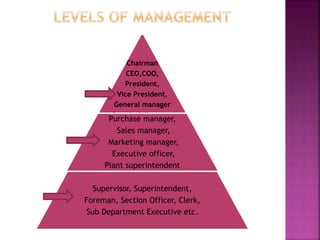
Chairman
CEO,COO,
President,
Vice President,
General manager
Board of directors
Purchase manager,
Sales manager,
Marketing manager,
Executive officer,
Plant superintendent
Supervisor, Superintendent,
Foreman, Section Officer, Clerk,
Sub Department Executive etc.
 Planning- It refers to ,deciding in advance what to do,
how to do and who is going to do it.
 Organizing- Identifying activities, Group activities,
Assigning Activities and Delegating authority
 Staffing- Manpower planning, Recruitment and
selection, Training and development, Appraisal
promotion and transfer and Employee remuneration.
 Directing-Supervision, Communication, Motivation
and leadership
 Controlling-Setting standards, Measuring performance,
Finding causes of deviations and taking corrective
action.
 In planning coordination is required between
Master/Main plan and organizational or Departmental
plan
 In organizing coordination is required between
different resources of an organization and also between
authority responsibility and accountability
 In staffing coordination is required between skill of a
person and job assigned to him between efficiency and
compensation etc.
 In directing function coordination is required between
superior and subordinates between orders, instructions,
gidelines and suggestions etc.
 In controlling function coordination is required
between standards and actual performance

Management nature and significance

  • 1.
    Nature and significanceof Management Geeta M.
  • 2.
     Management isa pervasive and universal concept. No business can work smoothly without management irrespective of its size, nature and functions.  Management is not constrain to business organization but even non-business organization needs to manage its functions.  Management is a process of planning, organizing, motivating and controlling the enterprise resources for the purpose of achieving the goals of the organization effectively and efficiently.
  • 3.
    Traditional concept-  ‘Managementis the art of getting things done through others’. Mary Parker Follett  ‘Management consists of getting things done through others’ .A manager is one who accomplishes organizational objectives by directing the efforts of others. C.S.George Modern concept-  ‘Management is establishing an effective environment for people operating in formal organizational group’. koontz and o’donnel  ‘Management is the co-ordination of all resources through the process of Planning, Organizing, Directing and Controlling in order to attain stated objectives’. F.w. Taylor
  • 4.
     Goal orientedprocess.  Pervasive.  Multidimensional.  Continuous process.  Group activity.  Dynamic function.  Intangible  Composite process.  Balancing effectiveness and efficiency
  • 5.
     Organizational objectives- Survival  Profit  Growth  Social objectives  supply of quality products at reasonable prices  Contribution towards desirable civic activities  Generation of economic wealth, creation of employment ,etc.  Personal objectives  Competitive salary  Personal growth and development  Peer recognition  Good working conditions
  • 6.
    Helps in achievinggroup goal. Improves efficiency. Creates a dynamic organization. Helps in achieving personal objectives. Bring harmony in work. Helps is developing of society.
  • 7.
     Management asa science-  systematic body of knowledge  scientific principles are derived on the basis of logical and scientific observation  universal validity  replication is possible  Management as an art-  systematic body of knowledge  personalized application  Based on practice and creativity  Management as profession-  well defined body of knowledge  restricted entry  service motive  code of conduct  presence of professional association
  • 8.
    Chairman CEO,COO, President, Vice President, General manager Boardof directors Purchase manager, Sales manager, Marketing manager, Executive officer, Plant superintendent Supervisor, Superintendent, Foreman, Section Officer, Clerk, Sub Department Executive etc.
  • 9.
     Planning- Itrefers to ,deciding in advance what to do, how to do and who is going to do it.  Organizing- Identifying activities, Group activities, Assigning Activities and Delegating authority  Staffing- Manpower planning, Recruitment and selection, Training and development, Appraisal promotion and transfer and Employee remuneration.  Directing-Supervision, Communication, Motivation and leadership  Controlling-Setting standards, Measuring performance, Finding causes of deviations and taking corrective action.
  • 10.
     In planningcoordination is required between Master/Main plan and organizational or Departmental plan  In organizing coordination is required between different resources of an organization and also between authority responsibility and accountability  In staffing coordination is required between skill of a person and job assigned to him between efficiency and compensation etc.  In directing function coordination is required between superior and subordinates between orders, instructions, gidelines and suggestions etc.  In controlling function coordination is required between standards and actual performance