ORGANISING   Its Nature and  Purpose
‘ Organising’  is the part of managing that involves establishing an intentional structure of roles for people to fill in an organization. It is intentional in the sense of making sure that all the tasks necessary to accomplish goals are assigned and, it is hoped, assigned to people who can execute them best.   Definition:  George Terry defines  Organising  as,” The establishing of effective authority relationships among selected work, persons and work places in order for the group to work together  effectively.” M E A N I N G of O R G A N I S I N G
  Organisation Structure ORGANISATION The term  ‘Organisation’  is derived from the word ‘Organism’   which means  a structure of body divided into parts that are held together by a fabric of relationship as one organic whole .  ‘ Organisation’  can be defined as a group of people working together to create a surplus. An organisation structure  is the design of positions, arrangement of positions and relationship of positions in an organisation.  In this sense, organisation structure refers to the network of relationships among individuals  and positions in an organisation.
Organisation Structure   Formal Organisation Structure Formal Organisation is a network of official authority – responsibility relationships. According to Chester Bernard,” An organisation is ‘formal’ when the activities of 2 or more persons are consciously coordinated towards a common objective.” Formal organisation structure has official status and recognition. Informal Organisation Structure According to Keith Davis, “Informal Organisation is a is a network of personal and social relations not established or required by the formal organisation but arising spontaneously as people associate with one another.” These are the relationships not appearing on an organisation chart and include the sixth floor group, the Friday evening bowling gang, the morning coffee regulars etc.
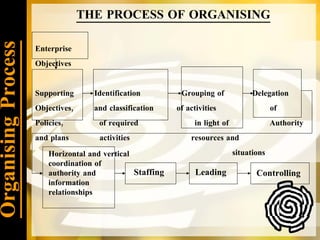
Organising Process THE PROCESS OF ORGANISING Enterprise Objectives Supporting  Identification  Grouping of  Delegation Objectives,  and classification  of activities  of  Policies,  of required  in light of  Authority and plans  activities  resources and situations  Horizontal and vertical coordination of authority and information relationships Staffing Leading Controlling
Span of control / management The term span of control / management refers to the number of subordinates who can be successfully supervised, directed and controlled by one supervisor or manager. The span of control suggests the appropriate number of subordinates a manager can manage effectively. TALL AND FLAT ORGANISATION STRUCTURE A]  Tall Organisation Structure  : If the span is narrow, ie limited to 4 or less subordinates, many managers would be required in every unit of organisation and there would be many managerial levels. Such an organisation structure is known as a ‘Tall organisation ’. Managing Director General Manager Manager  Manager  Manager Supervisors  Supervisors  Supervisors Workers  Workers  Workers
Span of control / management B]  Flat Organisation Structure  :  If the span of control is wide ie each manager directs relatively large number of subordinates (e.g. 6 or more) there would be fewer management levels.  Such organisation structure is known as a ‘Flat Organisation Structure’.  A wide span means fewer levels and flat/wide organisation. Managing Director General Manager Manager  Manager  Manager  Manager  Manager  Manager Workers  Workers  Workers  Workers  Workers  Workers
DEPARTMENTATION Departmentation is a process of dividing an organisation into convenient smaller units called departments. According to Pearce and Robinson, “Departmentation is the grouping of jobs, processes and resources into logical units to perform some organisational tasks.” BASES FOR DEPARTMENTATION / TYPES OF DEPARTMENTATION A] Departmentation by Functions B] Departmentation by  Process C] Departmentation by  Products D] Departmentation by Geographical Location E] Departmentation by  Customers
Delegation  / Decentralisation Delegation of Authority  Delegation of authority is the transfer of certain responsibilities to subordinates and giving them the necessary power or authority which is necessary in order to discharge the responsibility properly. According to F.C. Moore,” Delegation means assigning work to the others and giving them authority to do so.” Decentralisation of Authority Decentralisation of  authority  is the conscious/systematic effort to bring dispersal of decision-making power to lower levels of the organisation. According to Henry Fayol,” Everything that goes to increase the importance of the subordinate’s role is decentralisation, everything that goes to reduce it is centralisation.”
Organisation Structure A]  Line Organisation Structure  :  In the line organisation, the line of authority moves directly from the top level to the lowest level in a step-by-step manner. B]  Line and Staff Organisation Structure  : A combination of line and functional organisations is made in order to create a new/superior organisation structure called Line and Staff organisation. In line and staff organisation, line executives and staff are combined together. The line executives are ‘doers’ whereas staff refers to experts and act as ‘thinkers’.
Organisation Structure C]  Matrix Organisation  :  In matrix ,  two complementary organisation structures, i.e. the project organisation and functional organisation are merged together  in order to create a matrix structure. According to Koontz, O’Donnell and Weihrich, “The essence of matrix management, as one normally finds it , is combining of functional and project forms of departmentation in the  same organisation structure.”
THANK YOU!!

Organising

  • 1.
    ORGANISING Its Nature and Purpose
  • 2.
    ‘ Organising’ is the part of managing that involves establishing an intentional structure of roles for people to fill in an organization. It is intentional in the sense of making sure that all the tasks necessary to accomplish goals are assigned and, it is hoped, assigned to people who can execute them best. Definition: George Terry defines Organising as,” The establishing of effective authority relationships among selected work, persons and work places in order for the group to work together effectively.” M E A N I N G of O R G A N I S I N G
  • 3.
    OrganisationStructure ORGANISATION The term ‘Organisation’ is derived from the word ‘Organism’ which means a structure of body divided into parts that are held together by a fabric of relationship as one organic whole . ‘ Organisation’ can be defined as a group of people working together to create a surplus. An organisation structure is the design of positions, arrangement of positions and relationship of positions in an organisation. In this sense, organisation structure refers to the network of relationships among individuals and positions in an organisation.
  • 4.
    Organisation Structure Formal Organisation Structure Formal Organisation is a network of official authority – responsibility relationships. According to Chester Bernard,” An organisation is ‘formal’ when the activities of 2 or more persons are consciously coordinated towards a common objective.” Formal organisation structure has official status and recognition. Informal Organisation Structure According to Keith Davis, “Informal Organisation is a is a network of personal and social relations not established or required by the formal organisation but arising spontaneously as people associate with one another.” These are the relationships not appearing on an organisation chart and include the sixth floor group, the Friday evening bowling gang, the morning coffee regulars etc.
  • 5.
    Organising Process THEPROCESS OF ORGANISING Enterprise Objectives Supporting Identification Grouping of Delegation Objectives, and classification of activities of Policies, of required in light of Authority and plans activities resources and situations Horizontal and vertical coordination of authority and information relationships Staffing Leading Controlling
  • 6.
    Span of control/ management The term span of control / management refers to the number of subordinates who can be successfully supervised, directed and controlled by one supervisor or manager. The span of control suggests the appropriate number of subordinates a manager can manage effectively. TALL AND FLAT ORGANISATION STRUCTURE A] Tall Organisation Structure : If the span is narrow, ie limited to 4 or less subordinates, many managers would be required in every unit of organisation and there would be many managerial levels. Such an organisation structure is known as a ‘Tall organisation ’. Managing Director General Manager Manager Manager Manager Supervisors Supervisors Supervisors Workers Workers Workers
  • 7.
    Span of control/ management B] Flat Organisation Structure : If the span of control is wide ie each manager directs relatively large number of subordinates (e.g. 6 or more) there would be fewer management levels. Such organisation structure is known as a ‘Flat Organisation Structure’. A wide span means fewer levels and flat/wide organisation. Managing Director General Manager Manager Manager Manager Manager Manager Manager Workers Workers Workers Workers Workers Workers
  • 8.
    DEPARTMENTATION Departmentation isa process of dividing an organisation into convenient smaller units called departments. According to Pearce and Robinson, “Departmentation is the grouping of jobs, processes and resources into logical units to perform some organisational tasks.” BASES FOR DEPARTMENTATION / TYPES OF DEPARTMENTATION A] Departmentation by Functions B] Departmentation by Process C] Departmentation by Products D] Departmentation by Geographical Location E] Departmentation by Customers
  • 9.
    Delegation /Decentralisation Delegation of Authority Delegation of authority is the transfer of certain responsibilities to subordinates and giving them the necessary power or authority which is necessary in order to discharge the responsibility properly. According to F.C. Moore,” Delegation means assigning work to the others and giving them authority to do so.” Decentralisation of Authority Decentralisation of authority is the conscious/systematic effort to bring dispersal of decision-making power to lower levels of the organisation. According to Henry Fayol,” Everything that goes to increase the importance of the subordinate’s role is decentralisation, everything that goes to reduce it is centralisation.”
  • 10.
    Organisation Structure A] Line Organisation Structure : In the line organisation, the line of authority moves directly from the top level to the lowest level in a step-by-step manner. B] Line and Staff Organisation Structure : A combination of line and functional organisations is made in order to create a new/superior organisation structure called Line and Staff organisation. In line and staff organisation, line executives and staff are combined together. The line executives are ‘doers’ whereas staff refers to experts and act as ‘thinkers’.
  • 11.
    Organisation Structure C] Matrix Organisation : In matrix , two complementary organisation structures, i.e. the project organisation and functional organisation are merged together in order to create a matrix structure. According to Koontz, O’Donnell and Weihrich, “The essence of matrix management, as one normally finds it , is combining of functional and project forms of departmentation in the same organisation structure.”
  • 12.