MATLAB SIMULINK
30 Days Master Class
PMBLDC Motor Speed Control
DAY 15
TABLE OF CONTENTS
Introduction
DC Vs BLDC
Working Principle
Demo
Project Idea
Applications
01
02
03
04
05
06
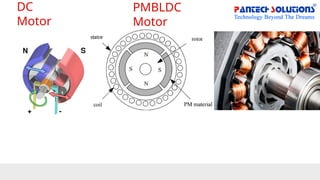
DC
Motor
PMBLDC
Motor
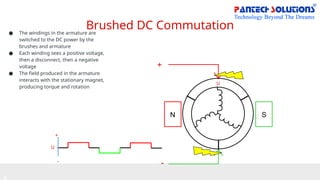
Brushed DC Commutation
● The windings in the armature are
switched to the DC power by the
brushes and armature
● Each winding sees a positive voltage,
then a disconnect, then a negative
voltage
● The field produced in the armature
interacts with the stationary magnet,
producing torque and rotation
+
-
N S
U
+
-
U
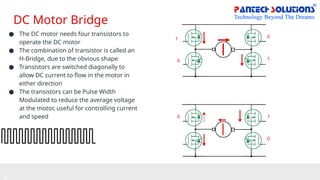
DC Motor Bridge
● The DC motor needs four transistors to
operate the DC motor
● The combination of transistor is called an
H-Bridge, due to the obvious shape
● Transistors are switched diagonally to
allow DC current to flow in the motor in
either direction
● The transistors can be Pulse Width
Modulated to reduce the average voltage
at the motor, useful for controlling current
and speed
0
1
1
1
0
0
0
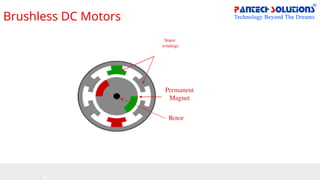
Brushless DC Motors
Permanent
Magnet
Rotor
Stator
windings
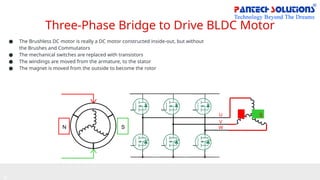
Three-Phase Bridge to Drive BLDC Motor
● The Brushless DC motor is really a DC motor constructed inside-out, but without
the Brushes and Commutators
● The mechanical switches are replaced with transistors
● The windings are moved from the armature, to the stator
● The magnet is moved from the outside to become the rotor
N S
N S
U
V
W
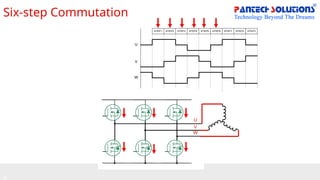
Six-step Commutation
STEP1 STEP2 STEP3 STEP4 STEP5 STEP6 STEP1 STEP2 STEP3
U
V
W
U
V
W
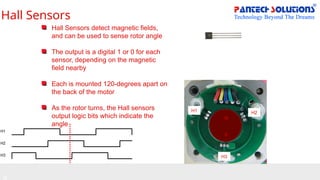
Hall Sensors
H1
H2
H3
Hall Sensors detect magnetic fields,
and can be used to sense rotor angle
The output is a digital 1 or 0 for each
sensor, depending on the magnetic
field nearby
Each is mounted 120-degrees apart on
the back of the motor
As the rotor turns, the Hall sensors
output logic bits which indicate the
angle
N
S
H1 H2
H3
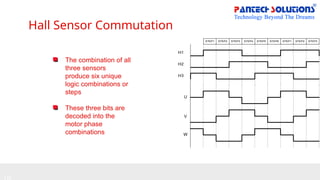
Hall Sensor Commutation
H1
H2
H3
STEP1 STEP2 STEP3 STEP4 STEP5 STEP6 STEP1 STEP2 STEP3
U
V
W
The combination of all
three sensors
produce six unique
logic combinations or
steps
These three bits are
decoded into the
motor phase
combinations
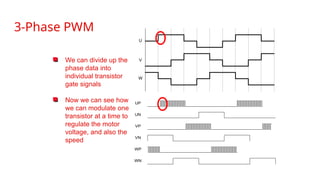
3-Phase PWM
U
V
W
We can divide up the
phase data into
individual transistor
gate signals
Now we can see how
we can modulate one
transistor at a time to
regulate the motor
voltage, and also the
speed
UP
UN
VP
VN
WP
WN
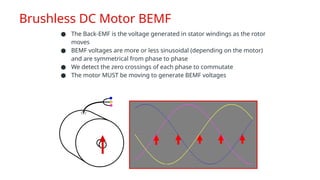
Brushless DC Motor BEMF
● The Back-EMF is the voltage generated in stator windings as the rotor
moves
● BEMF voltages are more or less sinusoidal (depending on the motor)
and are symmetrical from phase to phase
● We detect the zero crossings of each phase to commutate
● The motor MUST be moving to generate BEMF voltages
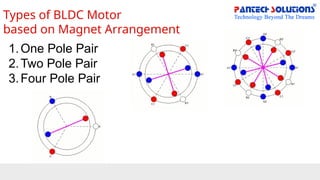
Types of BLDC Motor
based on Magnet Arrangement
1.One Pole Pair
2.Two Pole Pair
3.Four Pole Pair
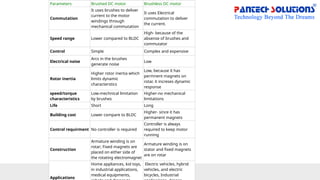
Parameters Brushed DC motor Brushless DC motor
Commutation
It uses brushes to deliver
current to the motor
windings through
mechanical commutation
It uses Electrical
commutation to deliver
the current.
Speed range Lower compared to BLDC
High- because of the
absense of brushes and
commutator
Control Simple Complex and expensive
Electrical noise
Arcs in the brushes
generate noise
Low
Rotor inertia
Higher rotor inertia which
limits dynamic
characterstics
Low, because it has
permnent magnets on
rotar. it increses dynamic
response
speed/torque
characteristics
Low-mechnical limitation
by brushes
Higher-no mechanical
limitations
Life Short Long
Building cost Lower compare to BLDC
Higher- since it has
permanent magnets
Control requirment No controller is required
Controller is always
required to keep motor
running
Construction
Armature winding is on
rotar; Fixed magnets are
placed on either side of
the rotating electromagnet
Armature winding is on
stator and fixed magnets
are on rotar
Applications
Home appliances, kid toys,
in industrial applications,
medical equipments,
Electric vehicles, hybrid
vehicles, and electric
bicycles, Industrial
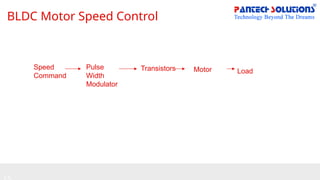
BLDC Motor Speed Control
Speed
Command
Pulse
Width
Modulator
Transistors Motor Load
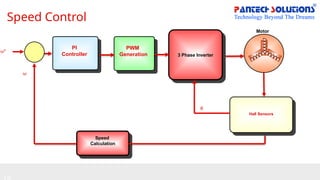
Speed Control
Hall Sensors
Speed
Calculation
Motor
PWM
Generation
PI
Controller
ω*
ω
θ
3 Phase Inverter
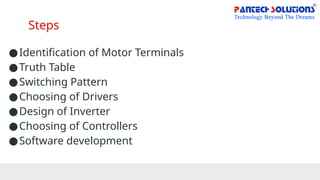
Steps
●Identification of Motor Terminals
●Truth Table
●Switching Pattern
●Choosing of Drivers
●Design of Inverter
●Choosing of Controllers
●Software development
Demo
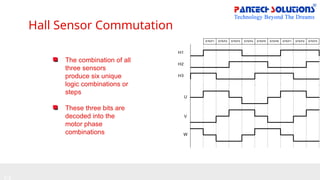
Hall Sensor Commutation
H1
H2
H3
STEP1 STEP2 STEP3 STEP4 STEP5 STEP6 STEP1 STEP2 STEP3
U
V
W
The combination of all
three sensors
produce six unique
logic combinations or
steps
These three bits are
decoded into the
motor phase
combinations
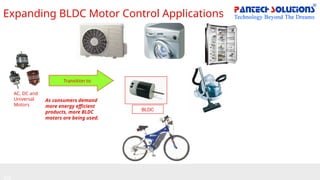
Expanding BLDC Motor Control Applications
AC, DC and
Universal
Motors
Transition to
BLDC
As consumers demand
more energy efficient
products, more BLDC
motors are being used.
Project Research
● Speed Control - Open Loop
● Speed Control - Closed Loop
● Speed Control - Closed Loop Sensorless
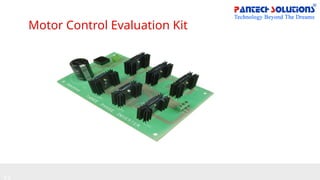
Motor Control Evaluation Kit
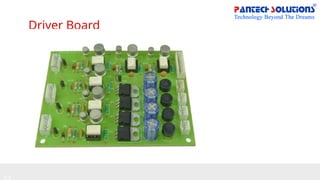
Driver Board
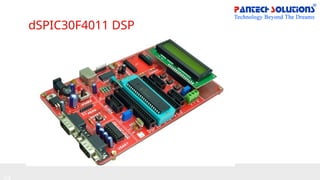
dSPIC30F4011 DSP
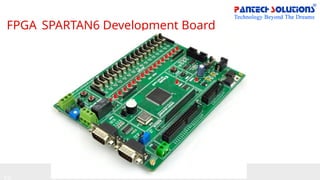
FPGA SPARTAN6 Development Board
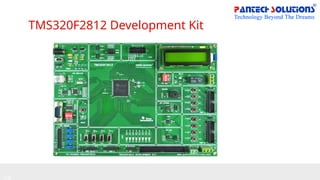
TMS320F2812 Development Kit
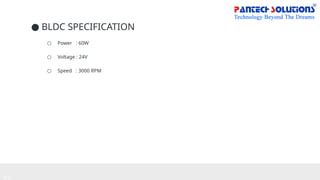
● BLDC SPECIFICATION
○ Power : 60W
○ Voltage : 24V
○ Speed : 3000 RPM
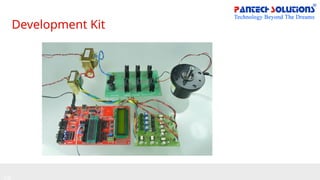
Development Kit
THANKS

Day15 BLDC Motor Control implemented on matlab simulation.pptx

  • 1.
    MATLAB SIMULINK 30 DaysMaster Class PMBLDC Motor Speed Control DAY 15
  • 2.
    TABLE OF CONTENTS Introduction DCVs BLDC Working Principle Demo Project Idea Applications 01 02 03 04 05 06
  • 3.
  • 4.
    Brushed DC Commutation ●The windings in the armature are switched to the DC power by the brushes and armature ● Each winding sees a positive voltage, then a disconnect, then a negative voltage ● The field produced in the armature interacts with the stationary magnet, producing torque and rotation + - N S U + - U
  • 5.
    DC Motor Bridge ●The DC motor needs four transistors to operate the DC motor ● The combination of transistor is called an H-Bridge, due to the obvious shape ● Transistors are switched diagonally to allow DC current to flow in the motor in either direction ● The transistors can be Pulse Width Modulated to reduce the average voltage at the motor, useful for controlling current and speed 0 1 1 1 0 0 0
  • 6.
  • 7.
    Three-Phase Bridge toDrive BLDC Motor ● The Brushless DC motor is really a DC motor constructed inside-out, but without the Brushes and Commutators ● The mechanical switches are replaced with transistors ● The windings are moved from the armature, to the stator ● The magnet is moved from the outside to become the rotor N S N S U V W
  • 8.
    Six-step Commutation STEP1 STEP2STEP3 STEP4 STEP5 STEP6 STEP1 STEP2 STEP3 U V W U V W
  • 9.
    Hall Sensors H1 H2 H3 Hall Sensorsdetect magnetic fields, and can be used to sense rotor angle The output is a digital 1 or 0 for each sensor, depending on the magnetic field nearby Each is mounted 120-degrees apart on the back of the motor As the rotor turns, the Hall sensors output logic bits which indicate the angle N S H1 H2 H3
  • 10.
    Hall Sensor Commutation H1 H2 H3 STEP1STEP2 STEP3 STEP4 STEP5 STEP6 STEP1 STEP2 STEP3 U V W The combination of all three sensors produce six unique logic combinations or steps These three bits are decoded into the motor phase combinations
  • 11.
    3-Phase PWM U V W We candivide up the phase data into individual transistor gate signals Now we can see how we can modulate one transistor at a time to regulate the motor voltage, and also the speed UP UN VP VN WP WN
  • 12.
    Brushless DC MotorBEMF ● The Back-EMF is the voltage generated in stator windings as the rotor moves ● BEMF voltages are more or less sinusoidal (depending on the motor) and are symmetrical from phase to phase ● We detect the zero crossings of each phase to commutate ● The motor MUST be moving to generate BEMF voltages
  • 13.
    Types of BLDCMotor based on Magnet Arrangement 1.One Pole Pair 2.Two Pole Pair 3.Four Pole Pair
  • 14.
    Parameters Brushed DCmotor Brushless DC motor Commutation It uses brushes to deliver current to the motor windings through mechanical commutation It uses Electrical commutation to deliver the current. Speed range Lower compared to BLDC High- because of the absense of brushes and commutator Control Simple Complex and expensive Electrical noise Arcs in the brushes generate noise Low Rotor inertia Higher rotor inertia which limits dynamic characterstics Low, because it has permnent magnets on rotar. it increses dynamic response speed/torque characteristics Low-mechnical limitation by brushes Higher-no mechanical limitations Life Short Long Building cost Lower compare to BLDC Higher- since it has permanent magnets Control requirment No controller is required Controller is always required to keep motor running Construction Armature winding is on rotar; Fixed magnets are placed on either side of the rotating electromagnet Armature winding is on stator and fixed magnets are on rotar Applications Home appliances, kid toys, in industrial applications, medical equipments, Electric vehicles, hybrid vehicles, and electric bicycles, Industrial
  • 15.
    BLDC Motor SpeedControl Speed Command Pulse Width Modulator Transistors Motor Load
  • 16.
  • 17.
    Steps ●Identification of MotorTerminals ●Truth Table ●Switching Pattern ●Choosing of Drivers ●Design of Inverter ●Choosing of Controllers ●Software development
  • 18.
  • 19.
    Hall Sensor Commutation H1 H2 H3 STEP1STEP2 STEP3 STEP4 STEP5 STEP6 STEP1 STEP2 STEP3 U V W The combination of all three sensors produce six unique logic combinations or steps These three bits are decoded into the motor phase combinations
  • 20.
    Expanding BLDC MotorControl Applications AC, DC and Universal Motors Transition to BLDC As consumers demand more energy efficient products, more BLDC motors are being used.
  • 21.
    Project Research ● SpeedControl - Open Loop ● Speed Control - Closed Loop ● Speed Control - Closed Loop Sensorless

  • 22.
  • 23.
  • 24.
  • 25.
  • 26.
  • 27.
    ● BLDC SPECIFICATION ○Power : 60W ○ Voltage : 24V ○ Speed : 3000 RPM
  • 28.
  • 29.