Engineering Materials
Background 
History 
Processing 
Uses 
Properties 
Copper
 part of the boron group in the periodic table 
 third most abundant element in the Earth’s 
crust 
 ability to resist corrosion due to passivation 
 capable of being a super conductor 
 almost never found in its elemental state 
 aluminum is found only in chemical 
compounds with other elements
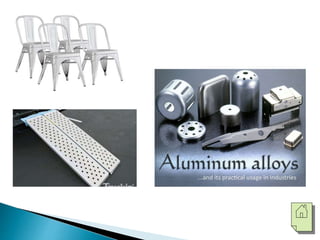
 lightweight, strong, nonmagnetic, and 
nontoxic 
 conducts heat and electricity and reflects heat 
and light 
 strong but easily workable 
 aluminum can easily and economically be 
recycled into new products 
 surface of aluminum quickly oxidizes to form 
an invisible barrier to corrosion
 potters made their strongest vessels from 
clay that contained aluminum oxide 
 aluminum compounds in fabric dyes, 
cosmetics, and medicines
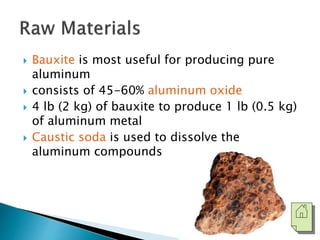
 Bauxite is most useful for producing pure 
aluminum 
 consists of 45-60% aluminum oxide 
 4 lb (2 kg) of bauxite to produce 1 lb (0.5 kg) 
of aluminum metal 
 Caustic soda is used to dissolve the 
aluminum compounds
 the Bayer process and Hall-Heroult process 
 Cryolite used as the electrolyte in smelting 
 Aluminum fluoride is added to lower the 
melting point of the electrolyte solution 
 Carbon electrodes transmit the electric 
current through the electrolyte 
 production of 2 lb (1 kg) of aluminum 
requires 15 kilowatt-hours (kWh) of energy
 refining the bauxite ore to obtain aluminum 
oxide 
1. The bauxite ore is mechanically crushed 
2. It is mixed with caustic soda and processed 
into a slurry 
3. The slurry is pumped into a digester 
4. It is passed through a series of flash tanks 
that reduce the pressure 
5. The slurry is pumped into a settling tank
6. The remaining liquid is pumped through 
cloth filters 
7. The filtered liquid is pumped through a 
series of precipitation tanks 
8. Seed crystals of alumina hydrate are added 
9. The crystals precipitate and are removed. 
10. After washing, they are transferred to a kiln 
for calcining. 
11. After leaving the kiln, the crystals pass 
through a cooler.
 process of smelting the aluminum oxide to 
release pure aluminum 
12. Smelting of alumina into metallic aluminum 
takes place in a steel vat called a reduction 
pot 
13. Within the reduction pot, alumina crystals 
are dissolved in molten cryolite at a 
temperature of 1,760-1,780° F (960-970° C)
14. A crucible is moved down the potline, 
collecting molten aluminum, which is 99.8% 
pure 
15. The metal is transferred to a holding 
furnace and then cast as ingots
 Alumina is used in laundry detergents, 
toothpaste, and fluorescent light bulbs 
 Also an important ingredient in ceramic 
materials 
 largest waste product generated in bauxite 
refining is the tailings (red mud) 
 Aluminum plants in the United States create 
significant amounts of greenhouse gases
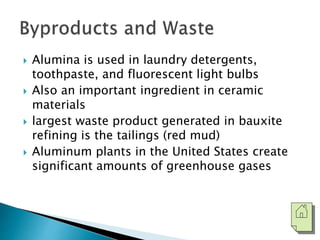
 Lightweight: a third of the weight of steel, 
brass, or copper of equal volume
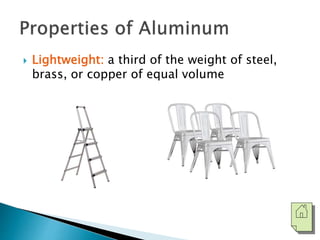
 Strength: can stand heavy pressures and 
loads
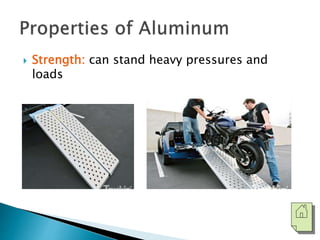
 Electrical Conductivity: conductivity is twice 
of copper
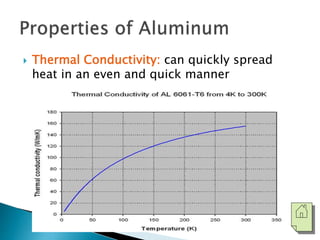
 Thermal Conductivity: can quickly spread 
heat in an even and quick manner
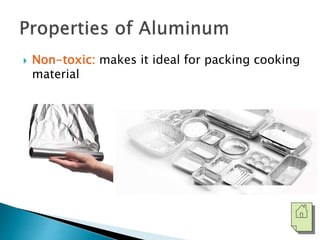
 Non-toxic: makes it ideal for packing cooking 
material
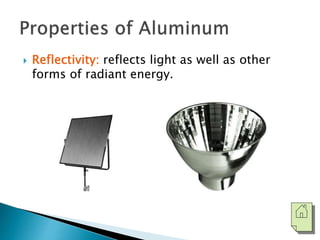
 Reflectivity: reflects light as well as other 
forms of radiant energy.
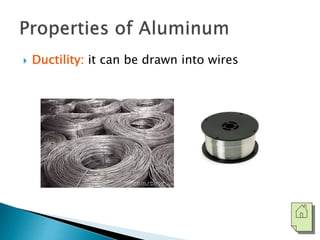
 Ductility: it can be drawn into wires
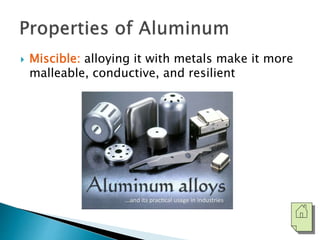
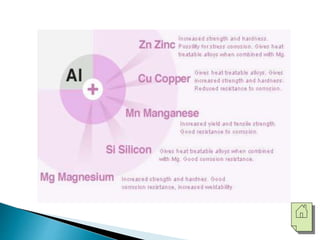
 Miscible: alloying it with metals make it more 
malleable, conductive, and resilient
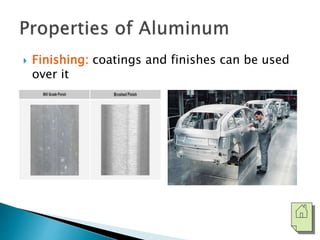
 Finishing: coatings and finishes can be used 
over it
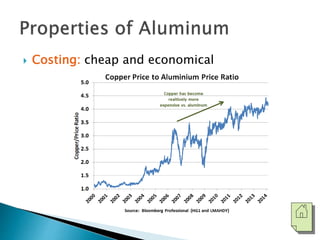
 Costing: cheap and economical
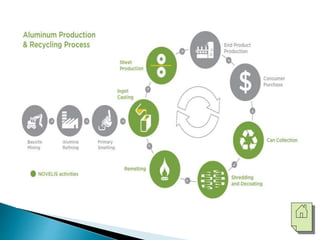
 Recyclable: cheaper than newly mined and 
processed aluminum
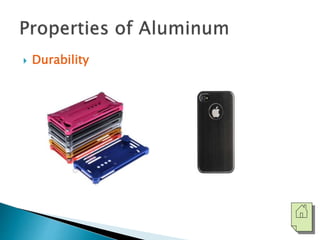
 Durability
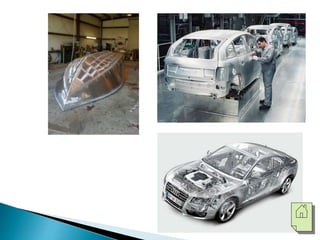
 Aerospace: percentage in aircraft frames is 
70% 
 Automotive: advantage of lightness, 
resistance and recyclability 
 Marine: lightening hulls by 40% to 50% over 
steel 
 Rail: lighter structures, resistance and 
durability
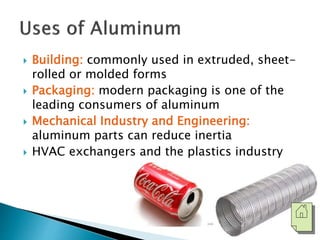
 Building: commonly used in extruded, sheet-rolled 
or molded forms 
 Packaging: modern packaging is one of the 
leading consumers of aluminum 
 Mechanical Industry and Engineering: 
aluminum parts can reduce inertia 
 HVAC exchangers and the plastics industry
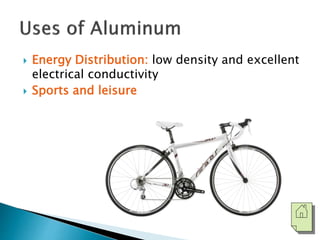
 Energy Distribution: low density and excellent 
electrical conductivity 
 Sports and leisure
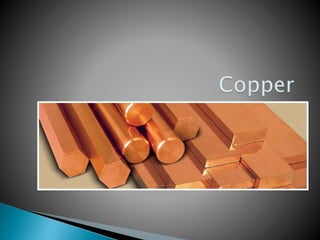
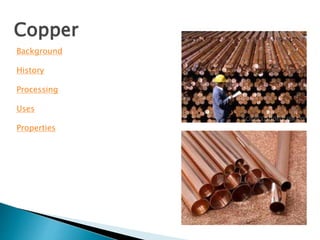
Copper 
Background 
History 
Processing 
Uses 
Properties
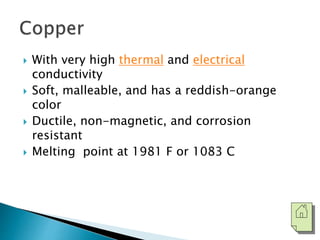
 With very high thermal and electrical 
conductivity 
 Soft, malleable, and has a reddish-orange 
color 
 Ductile, non-magnetic, and corrosion 
resistant 
 Melting point at 1981 F or 1083 C
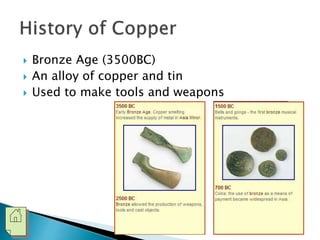
 Bronze Age (3500BC) 
 An alloy of copper and tin 
 Used to make tools and weapons
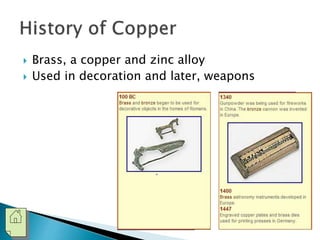
 Brass, a copper and zinc alloy 
 Used in decoration and later, weapons
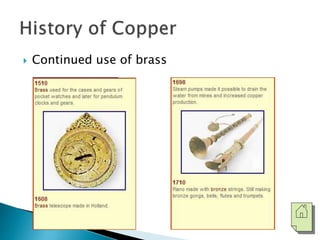
 Continued use of brass
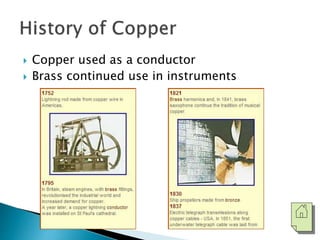
 Copper used as a conductor 
 Brass continued use in instruments
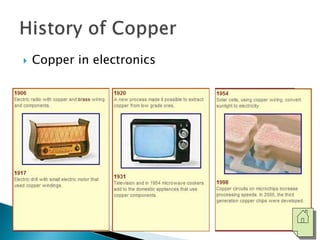
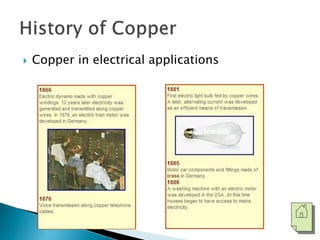
 Copper in electrical applications
 Copper in electronics
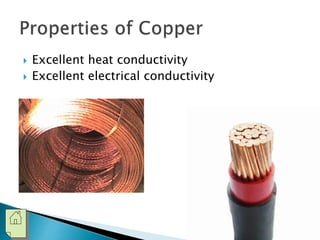
 Excellent heat conductivity 
 Excellent electrical conductivity
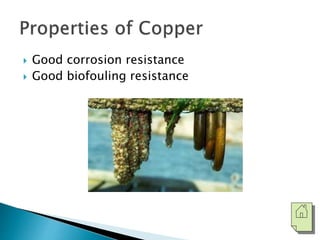
 Good corrosion resistance 
 Good biofouling resistance
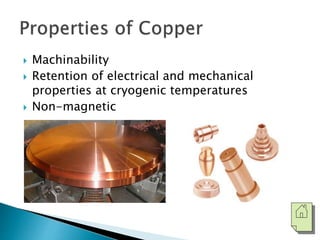
 Machinability 
 Retention of electrical and mechanical 
properties at cryogenic temperatures 
 Non-magnetic
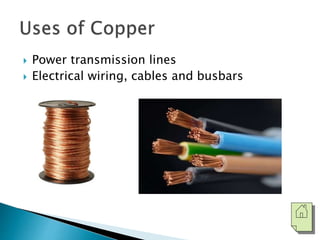
 Power transmission lines 
 Electrical wiring, cables and busbars
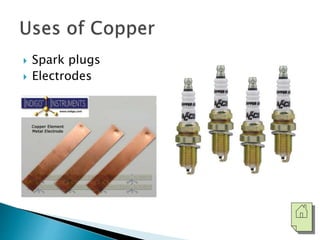
 Spark plugs 
 Electrodes
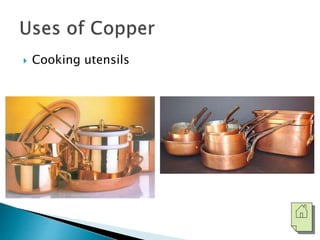
 Cooking utensils
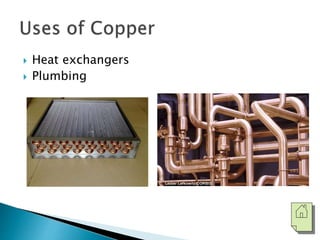
 Heat exchangers 
 Plumbing
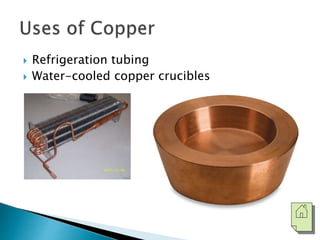
 Refrigeration tubing 
 Water-cooled copper crucibles
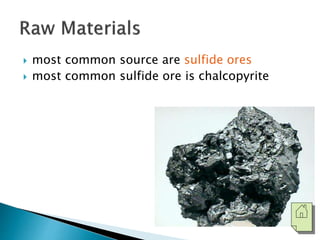
 most common source are sulfide ores 
 most common sulfide ore is chalcopyrite
 varies according to type of ore and desired 
purity 
 unwanted materials are physically or 
chemically removed 
 concentration of copper is progressively 
increased
1. sulfide ores are taken from huge open-pit 
mines 
2. material located above the ore is called 
overburden 
3. exposed ore is scooped up by large power 
shovels
1. ore is crushed in a series of cone crushers 
2. crushed ore is ground even smaller by mills 
3. mixed with water and placed in a rod mill 
4. mixture is further broken up in ball mills 
5. slurry mixed with various chemical reagents 
6. A liquid, called a frother, is also added 
7. mixture pumped into flotation cells 
8. copper particles cling to bubbles as they 
rise
1. concentrate is fed into a furnace along with 
a silica material, flux 
2. concentrate and flux melt and collect in the 
bottom 
3. iron chemically combines with flux to form 
slag 
4. sulfur combines with the oxygen to form 
sulfur dioxide
5. molten material in the bottom is called the 
matte 
6. molten matte is drawn and poured into a 
converter 
7. resulting molten material is called the 
blister
1. blister copper is heated in a refining furnace 
2. poured into molds to form electrical anodes 
3. copper anode is placed in an individual tank 
4. sheet of copper is placed on the opposite 
end 
5. tanks are filled with an acidic copper 
sulfate solution 
6. electrical current is passed through each 
tank
7. copper is stripped off the anode and 
deposits on the cathode 
8. After 9-15 days, the current is turned off 
9. Copper is cast into ingots, rolls, etc.
 sulfuric acid 
 Gold, silver, and other precious metals 
 overburden, tailings and slag
 http://www.madehow.com/Volume-4/Copper.html 
 http://www.azom.com/article.aspx?ArticleID=2856 
 http://www.chemistryexplained.com/elements/A-C/Aluminum.html 
 http://resources.schoolscience.co.uk/CDA/14- 
16/chemistry/copch0pg2.html 
 http://education.jlab.org/itselemental/ele029.html 
 http://www.madehow.com/Volume- 
5/Aluminum.html#ixzz398Y6sFuh 
 http://www.constellium.com/technology-center/aluminium-alloy-applications 
 http://www.buzzle.com/articles/aluminum-uses-of-aluminum.html

Copper and Aluminum

  • 1.
  • 2.
    Background History Processing Uses Properties Copper
  • 3.
     part ofthe boron group in the periodic table  third most abundant element in the Earth’s crust  ability to resist corrosion due to passivation  capable of being a super conductor  almost never found in its elemental state  aluminum is found only in chemical compounds with other elements
  • 4.
     lightweight, strong,nonmagnetic, and nontoxic  conducts heat and electricity and reflects heat and light  strong but easily workable  aluminum can easily and economically be recycled into new products  surface of aluminum quickly oxidizes to form an invisible barrier to corrosion
  • 6.
     potters madetheir strongest vessels from clay that contained aluminum oxide  aluminum compounds in fabric dyes, cosmetics, and medicines
  • 7.
     Bauxite ismost useful for producing pure aluminum  consists of 45-60% aluminum oxide  4 lb (2 kg) of bauxite to produce 1 lb (0.5 kg) of aluminum metal  Caustic soda is used to dissolve the aluminum compounds
  • 8.
     the Bayerprocess and Hall-Heroult process  Cryolite used as the electrolyte in smelting  Aluminum fluoride is added to lower the melting point of the electrolyte solution  Carbon electrodes transmit the electric current through the electrolyte  production of 2 lb (1 kg) of aluminum requires 15 kilowatt-hours (kWh) of energy
  • 9.
     refining thebauxite ore to obtain aluminum oxide 1. The bauxite ore is mechanically crushed 2. It is mixed with caustic soda and processed into a slurry 3. The slurry is pumped into a digester 4. It is passed through a series of flash tanks that reduce the pressure 5. The slurry is pumped into a settling tank
  • 10.
    6. The remainingliquid is pumped through cloth filters 7. The filtered liquid is pumped through a series of precipitation tanks 8. Seed crystals of alumina hydrate are added 9. The crystals precipitate and are removed. 10. After washing, they are transferred to a kiln for calcining. 11. After leaving the kiln, the crystals pass through a cooler.
  • 11.
     process ofsmelting the aluminum oxide to release pure aluminum 12. Smelting of alumina into metallic aluminum takes place in a steel vat called a reduction pot 13. Within the reduction pot, alumina crystals are dissolved in molten cryolite at a temperature of 1,760-1,780° F (960-970° C)
  • 12.
    14. A crucibleis moved down the potline, collecting molten aluminum, which is 99.8% pure 15. The metal is transferred to a holding furnace and then cast as ingots
  • 13.
     Alumina isused in laundry detergents, toothpaste, and fluorescent light bulbs  Also an important ingredient in ceramic materials  largest waste product generated in bauxite refining is the tailings (red mud)  Aluminum plants in the United States create significant amounts of greenhouse gases
  • 14.
     Lightweight: athird of the weight of steel, brass, or copper of equal volume
  • 15.
     Strength: canstand heavy pressures and loads
  • 16.
     Electrical Conductivity:conductivity is twice of copper
  • 17.
     Thermal Conductivity:can quickly spread heat in an even and quick manner
  • 18.
     Non-toxic: makesit ideal for packing cooking material
  • 19.
     Reflectivity: reflectslight as well as other forms of radiant energy.
  • 20.
     Ductility: itcan be drawn into wires
  • 21.
     Miscible: alloyingit with metals make it more malleable, conductive, and resilient
  • 23.
     Finishing: coatingsand finishes can be used over it
  • 24.
     Costing: cheapand economical
  • 25.
     Recyclable: cheaperthan newly mined and processed aluminum
  • 27.
  • 28.
     Aerospace: percentagein aircraft frames is 70%  Automotive: advantage of lightness, resistance and recyclability  Marine: lightening hulls by 40% to 50% over steel  Rail: lighter structures, resistance and durability
  • 30.
     Building: commonlyused in extruded, sheet-rolled or molded forms  Packaging: modern packaging is one of the leading consumers of aluminum  Mechanical Industry and Engineering: aluminum parts can reduce inertia  HVAC exchangers and the plastics industry
  • 31.
     Energy Distribution:low density and excellent electrical conductivity  Sports and leisure
  • 33.
    Copper Background History Processing Uses Properties
  • 34.
     With veryhigh thermal and electrical conductivity  Soft, malleable, and has a reddish-orange color  Ductile, non-magnetic, and corrosion resistant  Melting point at 1981 F or 1083 C
  • 35.
     Bronze Age(3500BC)  An alloy of copper and tin  Used to make tools and weapons
  • 36.
     Brass, acopper and zinc alloy  Used in decoration and later, weapons
  • 37.
  • 38.
     Copper usedas a conductor  Brass continued use in instruments
  • 39.
     Copper inelectrical applications
  • 40.
     Copper inelectronics
  • 41.
     Excellent heatconductivity  Excellent electrical conductivity
  • 42.
     Good corrosionresistance  Good biofouling resistance
  • 43.
     Machinability Retention of electrical and mechanical properties at cryogenic temperatures  Non-magnetic
  • 44.
     Power transmissionlines  Electrical wiring, cables and busbars
  • 45.
     Spark plugs  Electrodes
  • 46.
  • 47.
     Heat exchangers  Plumbing
  • 48.
     Refrigeration tubing  Water-cooled copper crucibles
  • 49.
     most commonsource are sulfide ores  most common sulfide ore is chalcopyrite
  • 50.
     varies accordingto type of ore and desired purity  unwanted materials are physically or chemically removed  concentration of copper is progressively increased
  • 51.
    1. sulfide oresare taken from huge open-pit mines 2. material located above the ore is called overburden 3. exposed ore is scooped up by large power shovels
  • 52.
    1. ore iscrushed in a series of cone crushers 2. crushed ore is ground even smaller by mills 3. mixed with water and placed in a rod mill 4. mixture is further broken up in ball mills 5. slurry mixed with various chemical reagents 6. A liquid, called a frother, is also added 7. mixture pumped into flotation cells 8. copper particles cling to bubbles as they rise
  • 53.
    1. concentrate isfed into a furnace along with a silica material, flux 2. concentrate and flux melt and collect in the bottom 3. iron chemically combines with flux to form slag 4. sulfur combines with the oxygen to form sulfur dioxide
  • 54.
    5. molten materialin the bottom is called the matte 6. molten matte is drawn and poured into a converter 7. resulting molten material is called the blister
  • 55.
    1. blister copperis heated in a refining furnace 2. poured into molds to form electrical anodes 3. copper anode is placed in an individual tank 4. sheet of copper is placed on the opposite end 5. tanks are filled with an acidic copper sulfate solution 6. electrical current is passed through each tank
  • 56.
    7. copper isstripped off the anode and deposits on the cathode 8. After 9-15 days, the current is turned off 9. Copper is cast into ingots, rolls, etc.
  • 57.
     sulfuric acid  Gold, silver, and other precious metals  overburden, tailings and slag
  • 58.
     http://www.madehow.com/Volume-4/Copper.html http://www.azom.com/article.aspx?ArticleID=2856  http://www.chemistryexplained.com/elements/A-C/Aluminum.html  http://resources.schoolscience.co.uk/CDA/14- 16/chemistry/copch0pg2.html  http://education.jlab.org/itselemental/ele029.html  http://www.madehow.com/Volume- 5/Aluminum.html#ixzz398Y6sFuh  http://www.constellium.com/technology-center/aluminium-alloy-applications  http://www.buzzle.com/articles/aluminum-uses-of-aluminum.html