
ALUMINUM
The ancient Greeks and Romans used alum in
medicine as an astringent, and in dyeing
processes. In 1761 de Morveau proposed
the name "alumine" for the base in alum. In
1807, Davy proposed the name alumium for
the metal, undiscovered at that time, and
later agreed to change it to aluminum.
What’s in NAME?
Shortly thereafter, the name aluminium was
adopted by IUPAC to conform with the
"ium" ending of most elements. Aluminium
is the IUPAC spelling and therefore the
international standard. Aluminium was also
the accepted spelling in the U.S.A. until
1925, at which time the American Chemical
Society decided to revert back to
aluminum, and to this day Americans still
refer to aluminium as "aluminum".
What’s in NAME?
What is Aluminum?
• Aluminum is the most abundant metallic
element in the Earth’s crust (about 8%) and is
the third most common element after oxygen
and silicon. Unlike copper or gold, aluminum
cannot be found in nature in the pure state
because of its high affinity with oxygen, being
so always combined with another element like
in alum (KAl(SO4)2∙12H2O) and in aluminum
oxide (Al2O3).
1787 – 1825 ; Scientists found unknown
metal in alum but they did not have way
how to extract it.
Hans Christian Oersted, a Danish
chemist, was the first to produce tiny
amounts of aluminum in 1825
History of Aluminum
 Two years later, Friedrich Wöhler, a
German chemist, developed a different way
to obtain aluminum.
 By 1845, he was able to produce
samples large enough to determine some of
aluminum's basic properties.
History of Aluminum
Wöhler's method was improved in 1854 by
Henri Étienne Sainte-Claire Deville, a
French chemist. Deville's process allowed
for the commercial production of aluminum.
As a result, the price of aluminum dropped
from around $1200 per kilogram in 1852 to
around $40 per kilogram in 1859.
Unfortunately, aluminum remained too
expensive to be widely used.
History of Aluminum
Two important developments in the
1880s greatly increased the availability
of aluminum.
History of Aluminum
The first was the invention of a new process
for obtaining aluminum from aluminum
oxide. Charles Martin Hall, an American
chemist, and Paul L. T. Héroult, a French
chemist, each invented this process
independently in 1886.
History of Aluminum
The second was the invention of a new
process that could cheaply obtain aluminum
oxide from bauxite.
History of Aluminum
Bauxite is an ore that contains a large amount
of aluminum hydroxide
(Al2O3·3H2O), along with other compounds.
History of Aluminum
Karl Joseph Bayer, an Austrian chemist,
developed this process in 1888. The Hall-
Héroult and Bayer processes are still used
today to produce nearly all of the world's
aluminum.
In 1888, Hall formed the Pittsburgh Reduction
Company, which is now known as the
Aluminum Company of America, or Alcoa.
When it opened, his company could
produce about 25 kilograms of aluminum a
day. By 1909, his company was producing
about 41,000 kilograms of aluminum a day.
As a result of this huge increase of
supply, the price of aluminum fell rapidly to
about $0.60 per kilogram.
Alcoa Inc. (from Aluminum Company of America) is the
world's third largest producer of aluminum.
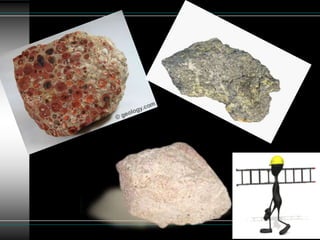
Bauxite, found in parts of the world
where high temperatures are
combined with heavy rainfall, is a
mixture, produced by weathering, of
chalk and rock containing aluminium
hydroxide. It has the highest
concentration of aluminium of the
easily accessible compounds found in
the Earth's crust, producing about one
ton of metal from every four ton of
ore.
Production of Aluminum
The complex Bayer process uses high
temperature and pressure to convert the
crushed bauxite to pure aluminium
hydroxide, which is then roasted to drive off
the water and convert it to aluminium oxide,
or calcined alumina, a white powder.
The next step is the electrolytic smelting
process, where the alumina is mixed with a
molten cryolite electrolyte in a pot lined
with pitch and coke which acts as a cathode.
A carbon anode is lowered to the surface of
the mixture from above, and a heavy direct
electrical current at 4-5 V is passed between
anode and cathode. The Aluminium
Smelting Process (Hall Heroult Process)
l. Lightness:
On a volume basis, aluminum is only about
one-third the weight of steel. Significant
weight savings can be made in almost every
type of mechanical application.
Properties of Aluminum
• 2. Durability
• Because aluminum quickly forms an
impervious oxide skin on exposed
surfaces, it is highly resistant to atmospheric
corrosion, even in marine conditions. So it
does not require painting for protection.
• 3. Conductivity
• The specific electrical conductivity of
aluminum makes it indispensable for
electronics and electrics. Aluminum cables
carry twice as much current as copper of the
same weight. High thermal conductivity
makes it very suitable for heating and
cooling applications.
• Workability
• Aluminium can be formed by all the
common metal-working techniques, more
easily than most. It is easy to cast, or die-
cast to precise and complex shapes. It can
be forged, rolled to a superfine foil, and
extruded into intricate sections, or pressed.
Superplastic alloys can be worked almost
like vacuum-formed plastics. Aluminium is
also one of the easiest and fastest materials
to machine.
• 5. Versatility
• Aluminium alloys can be stiff or supple,
especially strong or particularly corrosion-
resistant. It is easy to tailor the metal, by
alloying and heat treatment, to meet a wide
range of needs.
• 6. Attractiveness
• Aluminium is a "clean" material. It looks
good without further finishing, but takes
kindly to a wide range of applied coatings,
from paints to colored anodizing.
• 7. Recyclability
• Aluminium is easily reprocessed using 5%
of the energy needed for primary smelting:
almost one third of all the aluminium used
today is produced from scrap, either from
production processes or from recycled
products.
Presently, aluminum is the second largest
used metal in the world, mainly due to its
light weight, high strength and recyclability.
Uses of Aluminum
• Aluminum Markets
• Top markets for the industry are
transportation, beverage cans and other
packaging, and building/construction.
• In 1994, transportation first emerged as the
largest market for aluminum, at about one-
quarter of the market, with passenger cars
accounting for the vast majority of the
growth. Up until 2009, that trend has largely
continued.
• Transportation
• While transportation has typically
represented the largest market for aluminum
in North America over the past two
decades, 2009 marked the worst year for
auto sales since 1982 and, as
such, transportation applications accounted
for only 23.7 percent of all aluminum
shipments - 4.22 billion pounds in all.
• Packaging
• In 2009, containers and packaging regained
their position as the top market for
aluminum. The aluminum industry shipped
4.73 billion pounds for packaging
applications, or 26.5 percent of all
shipments. Aluminum is used in products
such as beverage cans and bottles, food
containers, and household and institutional
foil.
• Building and Construction
• Largely due to products in the residential,
industrial, commercial, farm, and highway
sectors, the 2009 building and construction
market accounted for 2.13 billion pounds of
net shipments, good for 11.9 percent of total
shipments and the third largest North
American market for aluminum.
• Electrical
• Aluminum has many advantages for
electrical applications. It is lightweight,
strong, corrosion resistant, and a highly
efficient conductor (aluminum has twice the
conductivity, per pound, of copper)—
rendering it the material of choice for
transmitting power from generating stations
to homes and businesses.
• Use in Households
• This metallic element is used for door
knobs, window frames and kitchen utensils.
The element is applied in kettles, saucepans,
toasters and refrigerators. It is also used in
indoor and outdoor furniture. Some sports
equipment like golf clubs and tennis balls
also use it.
Best thing about Aluminum
• Aluminum Recycling
• Aluminium's high scrap value
encourages recycling, with the result
that it is not a significant contributor
to waste disposal problems because it
can be collected before waste. One
third of all aluminum comes from
scrap, and as much as 70% of the
metal used in electrical
engineering, building and transport is
re-used, often again and again.
Aluminum

Aluminum

  • 1.
  • 2.
    The ancient Greeksand Romans used alum in medicine as an astringent, and in dyeing processes. In 1761 de Morveau proposed the name "alumine" for the base in alum. In 1807, Davy proposed the name alumium for the metal, undiscovered at that time, and later agreed to change it to aluminum. What’s in NAME?
  • 3.
    Shortly thereafter, thename aluminium was adopted by IUPAC to conform with the "ium" ending of most elements. Aluminium is the IUPAC spelling and therefore the international standard. Aluminium was also the accepted spelling in the U.S.A. until 1925, at which time the American Chemical Society decided to revert back to aluminum, and to this day Americans still refer to aluminium as "aluminum". What’s in NAME?
  • 4.
    What is Aluminum? •Aluminum is the most abundant metallic element in the Earth’s crust (about 8%) and is the third most common element after oxygen and silicon. Unlike copper or gold, aluminum cannot be found in nature in the pure state because of its high affinity with oxygen, being so always combined with another element like in alum (KAl(SO4)2∙12H2O) and in aluminum oxide (Al2O3).
  • 5.
    1787 – 1825; Scientists found unknown metal in alum but they did not have way how to extract it. Hans Christian Oersted, a Danish chemist, was the first to produce tiny amounts of aluminum in 1825 History of Aluminum
  • 6.
     Two yearslater, Friedrich Wöhler, a German chemist, developed a different way to obtain aluminum.  By 1845, he was able to produce samples large enough to determine some of aluminum's basic properties. History of Aluminum
  • 7.
    Wöhler's method wasimproved in 1854 by Henri Étienne Sainte-Claire Deville, a French chemist. Deville's process allowed for the commercial production of aluminum. As a result, the price of aluminum dropped from around $1200 per kilogram in 1852 to around $40 per kilogram in 1859. Unfortunately, aluminum remained too expensive to be widely used. History of Aluminum
  • 8.
    Two important developmentsin the 1880s greatly increased the availability of aluminum. History of Aluminum
  • 9.
    The first wasthe invention of a new process for obtaining aluminum from aluminum oxide. Charles Martin Hall, an American chemist, and Paul L. T. Héroult, a French chemist, each invented this process independently in 1886. History of Aluminum
  • 10.
    The second wasthe invention of a new process that could cheaply obtain aluminum oxide from bauxite. History of Aluminum
  • 11.
    Bauxite is anore that contains a large amount of aluminum hydroxide (Al2O3·3H2O), along with other compounds. History of Aluminum Karl Joseph Bayer, an Austrian chemist, developed this process in 1888. The Hall- Héroult and Bayer processes are still used today to produce nearly all of the world's aluminum.
  • 12.
    In 1888, Hallformed the Pittsburgh Reduction Company, which is now known as the Aluminum Company of America, or Alcoa. When it opened, his company could produce about 25 kilograms of aluminum a day. By 1909, his company was producing about 41,000 kilograms of aluminum a day. As a result of this huge increase of supply, the price of aluminum fell rapidly to about $0.60 per kilogram.
  • 13.
    Alcoa Inc. (fromAluminum Company of America) is the world's third largest producer of aluminum.
  • 14.
    Bauxite, found inparts of the world where high temperatures are combined with heavy rainfall, is a mixture, produced by weathering, of chalk and rock containing aluminium hydroxide. It has the highest concentration of aluminium of the easily accessible compounds found in the Earth's crust, producing about one ton of metal from every four ton of ore. Production of Aluminum
  • 17.
    The complex Bayerprocess uses high temperature and pressure to convert the crushed bauxite to pure aluminium hydroxide, which is then roasted to drive off the water and convert it to aluminium oxide, or calcined alumina, a white powder.
  • 18.
    The next stepis the electrolytic smelting process, where the alumina is mixed with a molten cryolite electrolyte in a pot lined with pitch and coke which acts as a cathode. A carbon anode is lowered to the surface of the mixture from above, and a heavy direct electrical current at 4-5 V is passed between anode and cathode. The Aluminium Smelting Process (Hall Heroult Process)
  • 20.
    l. Lightness: On avolume basis, aluminum is only about one-third the weight of steel. Significant weight savings can be made in almost every type of mechanical application. Properties of Aluminum
  • 21.
    • 2. Durability •Because aluminum quickly forms an impervious oxide skin on exposed surfaces, it is highly resistant to atmospheric corrosion, even in marine conditions. So it does not require painting for protection.
  • 22.
    • 3. Conductivity •The specific electrical conductivity of aluminum makes it indispensable for electronics and electrics. Aluminum cables carry twice as much current as copper of the same weight. High thermal conductivity makes it very suitable for heating and cooling applications.
  • 23.
    • Workability • Aluminiumcan be formed by all the common metal-working techniques, more easily than most. It is easy to cast, or die- cast to precise and complex shapes. It can be forged, rolled to a superfine foil, and extruded into intricate sections, or pressed. Superplastic alloys can be worked almost like vacuum-formed plastics. Aluminium is also one of the easiest and fastest materials to machine.
  • 24.
    • 5. Versatility •Aluminium alloys can be stiff or supple, especially strong or particularly corrosion- resistant. It is easy to tailor the metal, by alloying and heat treatment, to meet a wide range of needs.
  • 25.
    • 6. Attractiveness •Aluminium is a "clean" material. It looks good without further finishing, but takes kindly to a wide range of applied coatings, from paints to colored anodizing.
  • 26.
    • 7. Recyclability •Aluminium is easily reprocessed using 5% of the energy needed for primary smelting: almost one third of all the aluminium used today is produced from scrap, either from production processes or from recycled products.
  • 27.
    Presently, aluminum isthe second largest used metal in the world, mainly due to its light weight, high strength and recyclability. Uses of Aluminum
  • 28.
    • Aluminum Markets •Top markets for the industry are transportation, beverage cans and other packaging, and building/construction. • In 1994, transportation first emerged as the largest market for aluminum, at about one- quarter of the market, with passenger cars accounting for the vast majority of the growth. Up until 2009, that trend has largely continued.
  • 29.
    • Transportation • Whiletransportation has typically represented the largest market for aluminum in North America over the past two decades, 2009 marked the worst year for auto sales since 1982 and, as such, transportation applications accounted for only 23.7 percent of all aluminum shipments - 4.22 billion pounds in all.
  • 31.
    • Packaging • In2009, containers and packaging regained their position as the top market for aluminum. The aluminum industry shipped 4.73 billion pounds for packaging applications, or 26.5 percent of all shipments. Aluminum is used in products such as beverage cans and bottles, food containers, and household and institutional foil.
  • 32.
    • Building andConstruction • Largely due to products in the residential, industrial, commercial, farm, and highway sectors, the 2009 building and construction market accounted for 2.13 billion pounds of net shipments, good for 11.9 percent of total shipments and the third largest North American market for aluminum.
  • 33.
    • Electrical • Aluminumhas many advantages for electrical applications. It is lightweight, strong, corrosion resistant, and a highly efficient conductor (aluminum has twice the conductivity, per pound, of copper)— rendering it the material of choice for transmitting power from generating stations to homes and businesses.
  • 34.
    • Use inHouseholds • This metallic element is used for door knobs, window frames and kitchen utensils. The element is applied in kettles, saucepans, toasters and refrigerators. It is also used in indoor and outdoor furniture. Some sports equipment like golf clubs and tennis balls also use it.
  • 35.
    Best thing aboutAluminum • Aluminum Recycling • Aluminium's high scrap value encourages recycling, with the result that it is not a significant contributor to waste disposal problems because it can be collected before waste. One third of all aluminum comes from scrap, and as much as 70% of the metal used in electrical engineering, building and transport is re-used, often again and again.