H U N G A R Y
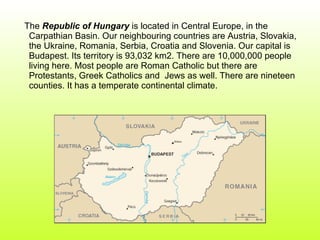
The  Republic of Hungary  is located in Central Europe, in the Carpathian Basin. Our neighbouring countries are Austria, Slovakia, the Ukraine, Romania, Serbia, Croatia and Slovenia. Our capital is Budapest. Its territory is 93,032 km2. There are 10,000,000 people living here. Most people are Roman Catholic but there are Protestants, Greek Catholics and  Jews as well. There are nineteen counties. It has a temperate continental climate.
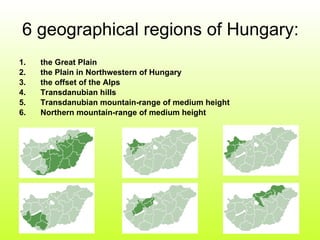
6 geographical regions of Hungary: the Great Plain the Plain in Northwestern of Hungary the offset of the Alps Transdanubian hills Transdanubian mountain-range of medium height Northern mountain-range of medium height
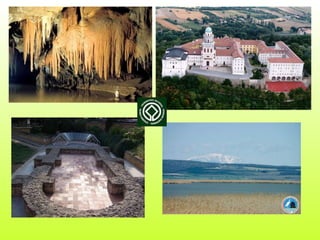
World Heritage Sites Danube riverside of Budapest, the Buda Castle district, Andrássy road and its historic surroundings (1987) Hollókő, an old village and its regional environment (1987) Stalagmite cave in Aggtelek (1995) The Thousand-year-old Benedict Abbey in Pannonhalma and its direct natural environment (1996) Hortobágy National Park – Puszta (1999) Ancient Christian tombs in Pécs (2000) Fertő culture region (2001) The Tokaj historical wine region (2002)
 
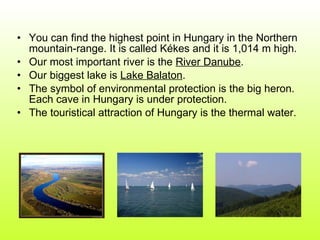
You can find the highest point in Hungary in the Northern mountain-range. It is called Kékes and it is 1,014 m high. Our most important river is the  River Danube . Our biggest lake is  Lake Balaton . The symbol of environmental protection is the big heron. Each cave in Hungary is under protection.  The touristical attraction of Hungary is the thermal water.
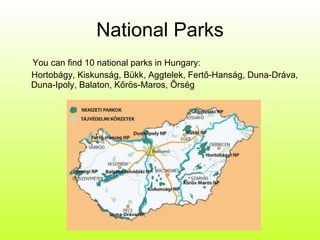
National Parks You can find 10 national parks in Hungary: Hortobágy, Kiskunság, Bükk, Aggtelek, Fertő-Hanság, Duna-Dráva, Duna-Ipoly, Balaton, Kőrös-Maros, Őrség
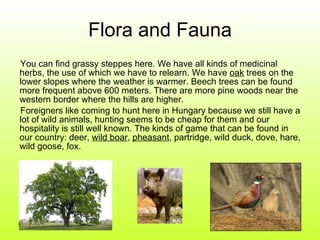
Flora and Fauna You can find grassy steppes here. We have all kinds of medicinal herbs, the use of which we have to relearn. We have  oak  trees on the lower slopes where the weather is warmer. Beech trees can be found more frequent above 600 meters. There are more pine woods near the western border where the hills are higher.  Foreigners like coming to hunt here in Hungary because we still have a lot of wild animals, hunting seems to be cheap for them and our hospitality is still well known. The kinds of game that can be found in our country: deer,  wild boar ,  pheasant , partridge, wild duck, dove, hare, wild goose, fox.
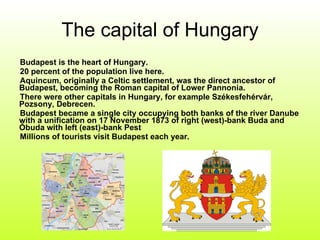
The capital of Hungary Budapest is the heart of Hungary. 20 percent of the population live here. Aquincum, originally a Celtic settlement, was the direct ancestor of Budapest, becoming the Roman capital of Lower Pannonia. There were other capitals in Hungary, for example Székesfehérvár, Pozsony, Debrecen. Budapest became a single city occupying both banks of the river Danube with a unification on 17 November 1873 of right (west)-bank Buda and Óbuda with left (east)-bank Pest Millions of tourists visit Budapest each year.
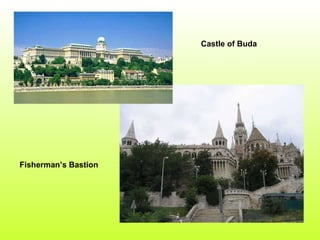
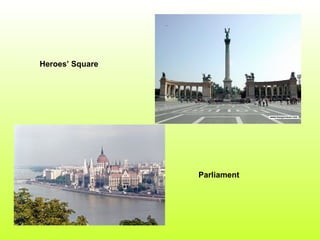
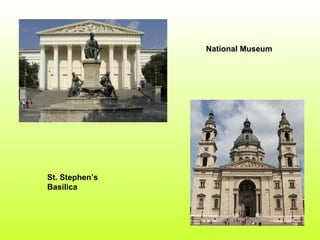
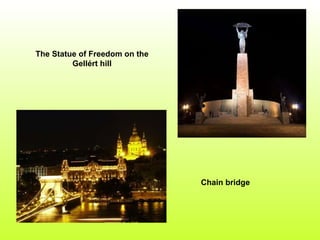
Sights in Budapest  Castle District with the Matthias Church, the Fisherman’s Bastion and Széchenyi National Library in the Royal Castle House of Parliament Heroes’ Square – statues of Árpád reigning prince and his six chief tains National Museum – here started the Revolution and War of Independence on 15th March, 1848 Opera House St Stephen’s Basilica Margaret island – perfect place of recreation Gellért hill, Szabadság hill Gellért spa bath, Széchenyi bath, Rudas bath Bridges: Chain Bridge with lions, Elizabeth Bridge, the first suspension bridge, Liberty Bridge, Margit bridge, Petőfi bridge
Castle of Buda Fisherman’s Bastion
Heroes’ Square Parliament
National Museum St. Stephen’s Basilica
The Statue of Freedom on the Gellért hill Chain bridge
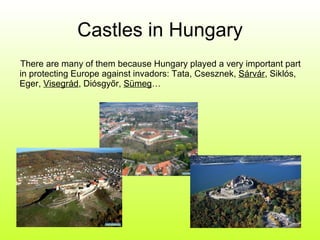
Castles in Hungary There are many of them because Hungary played a very important part in protecting Europe against invadors: Tata, Csesznek,  Sárvár , Siklós, Eger,  Visegrád , Diósgyőr,  Sümeg …
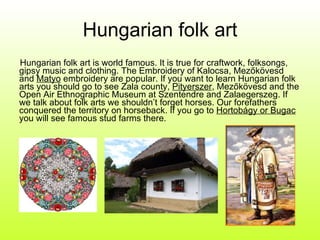
Hungarian folk art Hungarian folk art is world famous. It is true for craftwork, folksongs, gipsy music and clothing. The Embroidery of Kalocsa, Mezőkövesd and  Matyo  embroidery are popular. If you want to learn Hungarian folk arts you should go to see Zala county,  Pityerszer , Mezőkövesd and the Open Air Ethnographic Museum at Szentendre and Zalaegerszeg. If we talk about folk arts we shouldn’t forget horses. Our forefathers conquered the territory on horseback. If you go to  Hortobágy or Bugac  you will see famous stud farms there.
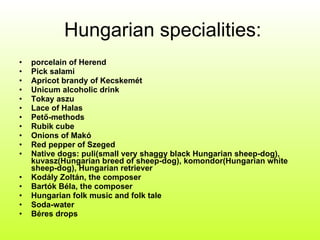
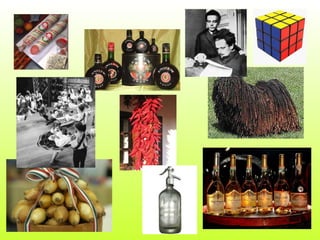
Hungarian specialities: porcelain of Herend Pick salami Apricot brandy of Kecskemét Unicum alcoholic drink Tokay aszu Lace of Halas Pető-methods Rubik cube Onions of Makó Red pepper of Szeged Native dogs: puli(small very shaggy black Hungarian sheep-dog), kuvasz(Hungarian breed of sheep-dog), komondor(Hungarian white sheep-dog), Hungarian retriever Kodály Zoltán, the composer Bartók Béla, the composer Hungarian folk music and folk tale Soda-water Béres drops
 
Presentation of the students of OAMK Simon Istvan Street Primary School Szombathely

Hungary

  • 1.
    H U NG A R Y
  • 2.
    The Republicof Hungary is located in Central Europe, in the Carpathian Basin. Our neighbouring countries are Austria, Slovakia, the Ukraine, Romania, Serbia, Croatia and Slovenia. Our capital is Budapest. Its territory is 93,032 km2. There are 10,000,000 people living here. Most people are Roman Catholic but there are Protestants, Greek Catholics and Jews as well. There are nineteen counties. It has a temperate continental climate.
  • 3.
    6 geographical regionsof Hungary: the Great Plain the Plain in Northwestern of Hungary the offset of the Alps Transdanubian hills Transdanubian mountain-range of medium height Northern mountain-range of medium height
  • 4.
    World Heritage SitesDanube riverside of Budapest, the Buda Castle district, Andrássy road and its historic surroundings (1987) Hollókő, an old village and its regional environment (1987) Stalagmite cave in Aggtelek (1995) The Thousand-year-old Benedict Abbey in Pannonhalma and its direct natural environment (1996) Hortobágy National Park – Puszta (1999) Ancient Christian tombs in Pécs (2000) Fertő culture region (2001) The Tokaj historical wine region (2002)
  • 5.
  • 6.
    You can findthe highest point in Hungary in the Northern mountain-range. It is called Kékes and it is 1,014 m high. Our most important river is the River Danube . Our biggest lake is Lake Balaton . The symbol of environmental protection is the big heron. Each cave in Hungary is under protection. The touristical attraction of Hungary is the thermal water.
  • 7.
    National Parks Youcan find 10 national parks in Hungary: Hortobágy, Kiskunság, Bükk, Aggtelek, Fertő-Hanság, Duna-Dráva, Duna-Ipoly, Balaton, Kőrös-Maros, Őrség
  • 8.
    Flora and FaunaYou can find grassy steppes here. We have all kinds of medicinal herbs, the use of which we have to relearn. We have oak trees on the lower slopes where the weather is warmer. Beech trees can be found more frequent above 600 meters. There are more pine woods near the western border where the hills are higher. Foreigners like coming to hunt here in Hungary because we still have a lot of wild animals, hunting seems to be cheap for them and our hospitality is still well known. The kinds of game that can be found in our country: deer, wild boar , pheasant , partridge, wild duck, dove, hare, wild goose, fox.
  • 9.
    The capital ofHungary Budapest is the heart of Hungary. 20 percent of the population live here. Aquincum, originally a Celtic settlement, was the direct ancestor of Budapest, becoming the Roman capital of Lower Pannonia. There were other capitals in Hungary, for example Székesfehérvár, Pozsony, Debrecen. Budapest became a single city occupying both banks of the river Danube with a unification on 17 November 1873 of right (west)-bank Buda and Óbuda with left (east)-bank Pest Millions of tourists visit Budapest each year.
  • 10.
    Sights in Budapest Castle District with the Matthias Church, the Fisherman’s Bastion and Széchenyi National Library in the Royal Castle House of Parliament Heroes’ Square – statues of Árpád reigning prince and his six chief tains National Museum – here started the Revolution and War of Independence on 15th March, 1848 Opera House St Stephen’s Basilica Margaret island – perfect place of recreation Gellért hill, Szabadság hill Gellért spa bath, Széchenyi bath, Rudas bath Bridges: Chain Bridge with lions, Elizabeth Bridge, the first suspension bridge, Liberty Bridge, Margit bridge, Petőfi bridge
  • 11.
    Castle of BudaFisherman’s Bastion
  • 12.
  • 13.
    National Museum St.Stephen’s Basilica
  • 14.
    The Statue ofFreedom on the Gellért hill Chain bridge
  • 15.
    Castles in HungaryThere are many of them because Hungary played a very important part in protecting Europe against invadors: Tata, Csesznek, Sárvár , Siklós, Eger, Visegrád , Diósgyőr, Sümeg …
  • 16.
    Hungarian folk artHungarian folk art is world famous. It is true for craftwork, folksongs, gipsy music and clothing. The Embroidery of Kalocsa, Mezőkövesd and Matyo embroidery are popular. If you want to learn Hungarian folk arts you should go to see Zala county, Pityerszer , Mezőkövesd and the Open Air Ethnographic Museum at Szentendre and Zalaegerszeg. If we talk about folk arts we shouldn’t forget horses. Our forefathers conquered the territory on horseback. If you go to Hortobágy or Bugac you will see famous stud farms there.
  • 17.
    Hungarian specialities: porcelainof Herend Pick salami Apricot brandy of Kecskemét Unicum alcoholic drink Tokay aszu Lace of Halas Pető-methods Rubik cube Onions of Makó Red pepper of Szeged Native dogs: puli(small very shaggy black Hungarian sheep-dog), kuvasz(Hungarian breed of sheep-dog), komondor(Hungarian white sheep-dog), Hungarian retriever Kodály Zoltán, the composer Bartók Béla, the composer Hungarian folk music and folk tale Soda-water Béres drops
  • 18.
  • 19.
    Presentation of thestudents of OAMK Simon Istvan Street Primary School Szombathely