Broaching machine
Machine Tools & Machining
Department of Mechanical Engineering
University of Engineering & Technology
Lahore
Presented By:
Ali Raza 2017-ME-516
Broaching Machine
Broaching is a machining operation in which a tool
usediscalled asbroach havingseriesof cutting teeth.
In this operation broach is either pulled or
pushed with the help of broaching with the
help of broaching machine on the
workpiece.
Parts that is produced by the broaching have good
surfacefinishand dimensionalaccuracy
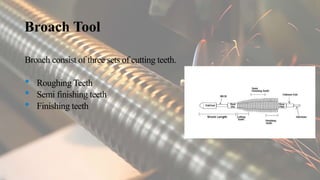
Broach Tool
Broach consist of three sets of cutting teeth.
• Roughing Teeth
• Semi finishing teeth
• Finishing teeth
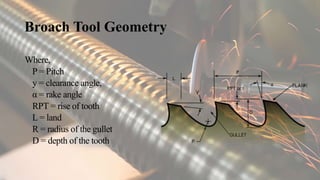
Broach Tool Geometry
Where,
P = Pitch
y = clearance angle,
α = rake angle
RPT = rise of tooth
L = land
R = radius of the gullet
D = depth of the tooth
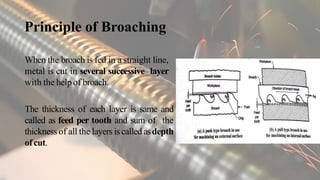
Principle of Broaching
When the broach is fed in a straight line,
metal is cut in several successive layer
with the helpof broach.
The thickness of each layer is same and
called as feed per tooth and sum of the
thickness of all the layers is called asdepth
ofcut.
Nomenclature of Broach
Pull End:
It is provided in pull broach to attach pulling mechanism.
Front pilot:
It guides broach in hole and also works as rough no-go gauge.
Rear pilot:
It determines size of finished hole.
Follower diameter:
It is held in automatic machine in order bring in original position.
Shank length:
It is length to pass from work piece and attach puller before
roughing teeth engage with work piece.
Use of Fixtures
• To located the work in correct positin
• To support and hold the work rigidly during
the operation.
• To guide the broach during the operation.
• To move the the work to correct position
before the start of operation and remove
it after the operation.
Specification of Broaching Machine
 Power of the motor and its speed
 Length of bed
 Length of slide stroke
 Rated pulling force
 Cutting stroke speed
 Number of speeds
 Return stroke speed
 Maximum size of cut
 Weight of machine
 Size and floor area
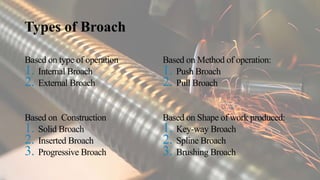
Types of Broach
Based on type of operation
1. Internal Broach
2. External Broach
Based on Construction
1. Solid Broach
2. Inserted Broach
3. Progressive Broach
Based on Method of operation:
1. Push Broach
2. Pull Broach
Based on Shape of work produced:
1. Key-way Broach
2. Spline Broach
3. Brushing Broach
Industrial Broaching Machines
Mainly broaching machines which areusedin
the industriesareof following types:-
 Horizontal BroachingMachine
 VerticalPullTypeBroachingMachine
 Continuous BroachingMachine
 RotaryTableBroachingMachine
 Surface BroachingMachine
 Keyway BroachingMachine
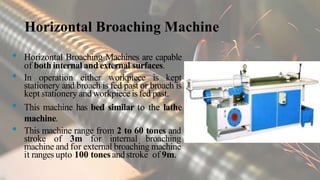
Horizontal Broaching Machine
• Horizontal Broaching Machines are capable
of both internal and external surfaces.
• In operation either workpiece is kept
stationery and broach is fed past or broach is
kept stationery and workpiece isfed past.
• This machine has bed similar to the lathe
machine.
• This machine range from 2 to 60 tones and
stroke of 3m for internal broaching
machine and for external broaching machine
it ranges upto 100 tones andstroke of 9m.
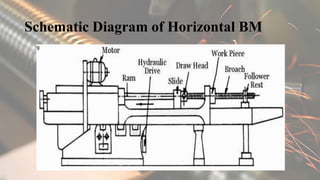
Schematic Diagram of Horizontal BM
9
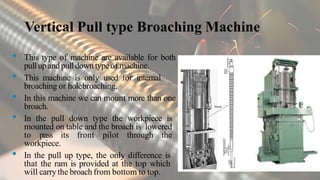
Vertical Pull type Broaching Machine
• This type of machine are available for both
pullupandpulldown typeof machine.
• This machine is only used for internal
broaching or holebroaching.
• In this machine we can mount more than one
broach.
• In the pull down type the workpiece is
mounted on table and the broach is lowered
to pass its front pilot through the
workpiece.
• In the pull up type, the only difference is
that the ram is provided at the top which
will carrythe broach from bottom to top.
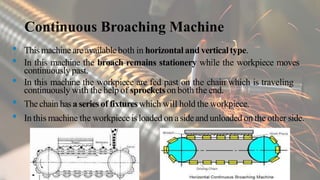
Continuous Broaching Machine
• This machine are availableboth in horizontal and verticaltype.
• In this machine the broach remains stationery while the workpiece moves
continuously past.
• In this machine the workpiece are fed past on the chain which is traveling
continuously with the help of sprocketson both the end.
• The chain hasa seriesof fixtureswhich will hold the workpiece.
• In this machine the workpiece is loaded on asideand unloaded on the other side.
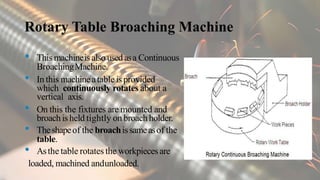
Rotary Table Broaching Machine
• This machineis also used asa Continuous
BroachingMachine.
• In this machineatable isprovided
which continuously rotates about a
vertical axis.
• On this the fixtures are mounted and
broachisheld tightly on broach holder.
• Theshapeof the broachissameasof the
table.
• Asthe table rotates the workpiecesare
loaded, machined andunloaded.
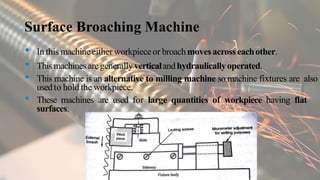
Surface Broaching Machine
• In this machineeither workpieceor broachmovesacrosseachother.
• Thismachinesaregenerallyverticalandhydraulicallyoperated.
• This machine is an alternative to milling machine so machine fixtures are also
usedto hold the workpiece.
• These machines are used for large quantities of workpiece having flat
surfaces.
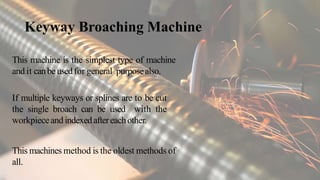
Keyway Broaching Machine
This machine is the simplest type of machine
andit canbeusedfor general purposealso.
If multiple keyways or splines are to be cut
the single broach can be used with the
workpieceandindexedaftereachother.
This machines method is the oldest methods of
all.
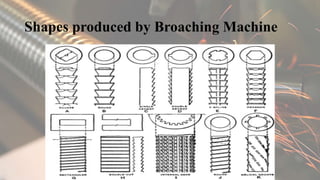
Shapes produced by Broaching Machine
Maximum load (F) on a Broach
For circular hole:-
F = π .d . T .t . p
Where,
d= diameter of machined hole
T= Total number of teeth cutting at a time
t= Rise per tooth
p= Force required to cut 1mm 2 of metal
at the given rise/tooth for square holes
For square holes:-
F=4l.T.t.P
l=Machined length of one side of the square hole
Advantages of Broaching
• Broachhasalongerlifethan other tools.
• Broach canperform roughing and finishing
operations.
• High skilled operator is notrequired.
• Interchangeable components can be
producedat faster rate.
Disadvantages of Broaching
• In this process,all jobs needafixture.
• Sharpening of broach is difficult and
expensive.
• With the help of broaching, it is difficult
to produce blindholes.
• Initial cost of broach and broaching
machineisveryhigh.
Applications of Broaching
•Theexamplesof components produced
by broaching areasfollows:
• Bearing caps
• Bearingbodies
• Cylinderblocks
• Connectingrods
• Gears andTurbine
• Keyways
• Splines
Broaching machine

Broaching machine

  • 1.
    Broaching machine Machine Tools& Machining Department of Mechanical Engineering University of Engineering & Technology Lahore
  • 2.
  • 3.
    Broaching Machine Broaching isa machining operation in which a tool usediscalled asbroach havingseriesof cutting teeth. In this operation broach is either pulled or pushed with the help of broaching with the help of broaching machine on the workpiece. Parts that is produced by the broaching have good surfacefinishand dimensionalaccuracy
  • 4.
    Broach Tool Broach consistof three sets of cutting teeth. • Roughing Teeth • Semi finishing teeth • Finishing teeth
  • 5.
    Broach Tool Geometry Where, P= Pitch y = clearance angle, α = rake angle RPT = rise of tooth L = land R = radius of the gullet D = depth of the tooth
  • 6.
    Principle of Broaching Whenthe broach is fed in a straight line, metal is cut in several successive layer with the helpof broach. The thickness of each layer is same and called as feed per tooth and sum of the thickness of all the layers is called asdepth ofcut.
  • 7.
    Nomenclature of Broach PullEnd: It is provided in pull broach to attach pulling mechanism. Front pilot: It guides broach in hole and also works as rough no-go gauge. Rear pilot: It determines size of finished hole. Follower diameter: It is held in automatic machine in order bring in original position. Shank length: It is length to pass from work piece and attach puller before roughing teeth engage with work piece.
  • 8.
    Use of Fixtures •To located the work in correct positin • To support and hold the work rigidly during the operation. • To guide the broach during the operation. • To move the the work to correct position before the start of operation and remove it after the operation.
  • 9.
    Specification of BroachingMachine  Power of the motor and its speed  Length of bed  Length of slide stroke  Rated pulling force  Cutting stroke speed  Number of speeds  Return stroke speed  Maximum size of cut  Weight of machine  Size and floor area
  • 10.
    Types of Broach Basedon type of operation 1. Internal Broach 2. External Broach Based on Construction 1. Solid Broach 2. Inserted Broach 3. Progressive Broach Based on Method of operation: 1. Push Broach 2. Pull Broach Based on Shape of work produced: 1. Key-way Broach 2. Spline Broach 3. Brushing Broach
  • 11.
    Industrial Broaching Machines Mainlybroaching machines which areusedin the industriesareof following types:-  Horizontal BroachingMachine  VerticalPullTypeBroachingMachine  Continuous BroachingMachine  RotaryTableBroachingMachine  Surface BroachingMachine  Keyway BroachingMachine
  • 12.
    Horizontal Broaching Machine •Horizontal Broaching Machines are capable of both internal and external surfaces. • In operation either workpiece is kept stationery and broach is fed past or broach is kept stationery and workpiece isfed past. • This machine has bed similar to the lathe machine. • This machine range from 2 to 60 tones and stroke of 3m for internal broaching machine and for external broaching machine it ranges upto 100 tones andstroke of 9m.
  • 13.
    Schematic Diagram ofHorizontal BM 9
  • 14.
    Vertical Pull typeBroaching Machine • This type of machine are available for both pullupandpulldown typeof machine. • This machine is only used for internal broaching or holebroaching. • In this machine we can mount more than one broach. • In the pull down type the workpiece is mounted on table and the broach is lowered to pass its front pilot through the workpiece. • In the pull up type, the only difference is that the ram is provided at the top which will carrythe broach from bottom to top.
  • 15.
    Continuous Broaching Machine •This machine are availableboth in horizontal and verticaltype. • In this machine the broach remains stationery while the workpiece moves continuously past. • In this machine the workpiece are fed past on the chain which is traveling continuously with the help of sprocketson both the end. • The chain hasa seriesof fixtureswhich will hold the workpiece. • In this machine the workpiece is loaded on asideand unloaded on the other side.
  • 16.
    Rotary Table BroachingMachine • This machineis also used asa Continuous BroachingMachine. • In this machineatable isprovided which continuously rotates about a vertical axis. • On this the fixtures are mounted and broachisheld tightly on broach holder. • Theshapeof the broachissameasof the table. • Asthe table rotates the workpiecesare loaded, machined andunloaded.
  • 17.
    Surface Broaching Machine •In this machineeither workpieceor broachmovesacrosseachother. • Thismachinesaregenerallyverticalandhydraulicallyoperated. • This machine is an alternative to milling machine so machine fixtures are also usedto hold the workpiece. • These machines are used for large quantities of workpiece having flat surfaces.
  • 18.
    Keyway Broaching Machine Thismachine is the simplest type of machine andit canbeusedfor general purposealso. If multiple keyways or splines are to be cut the single broach can be used with the workpieceandindexedaftereachother. This machines method is the oldest methods of all.
  • 19.
    Shapes produced byBroaching Machine
  • 20.
    Maximum load (F)on a Broach For circular hole:- F = π .d . T .t . p Where, d= diameter of machined hole T= Total number of teeth cutting at a time t= Rise per tooth p= Force required to cut 1mm 2 of metal at the given rise/tooth for square holes For square holes:- F=4l.T.t.P l=Machined length of one side of the square hole
  • 21.
    Advantages of Broaching •Broachhasalongerlifethan other tools. • Broach canperform roughing and finishing operations. • High skilled operator is notrequired. • Interchangeable components can be producedat faster rate.
  • 22.
    Disadvantages of Broaching •In this process,all jobs needafixture. • Sharpening of broach is difficult and expensive. • With the help of broaching, it is difficult to produce blindholes. • Initial cost of broach and broaching machineisveryhigh.
  • 23.
    Applications of Broaching •Theexamplesofcomponents produced by broaching areasfollows: • Bearing caps • Bearingbodies • Cylinderblocks • Connectingrods • Gears andTurbine • Keyways • Splines