Broaching:
Broaching is machining process for removal of a strip or layer of
material of desired section or width and depth usually in one stroke
by a slender rod or bar type cutter, called broach.
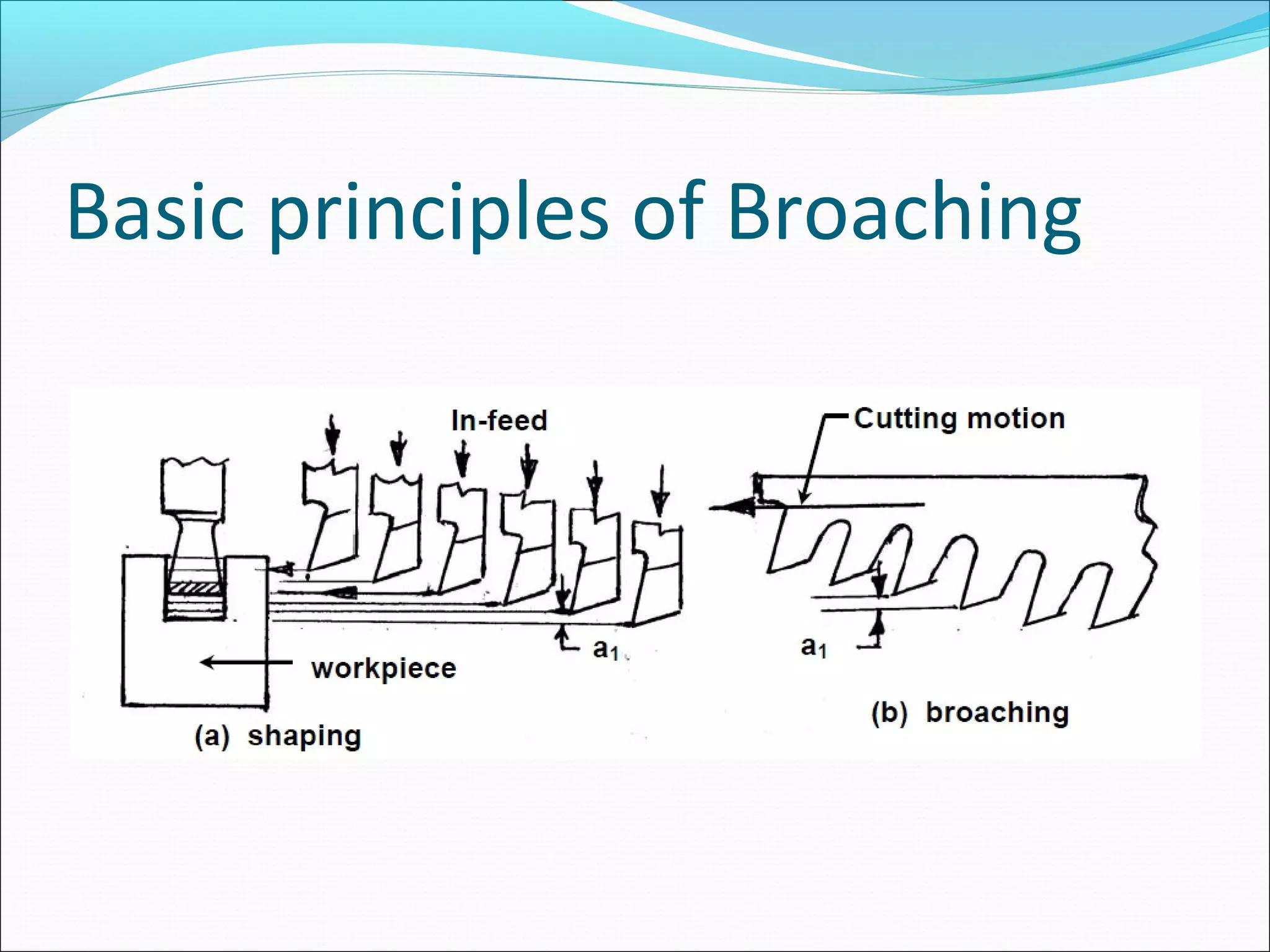
In shaping, attaining full depth requires a number of strokes to
remove the material in thin layers step-by-step by gradually infeeding
the single point tool.
Broaching , on the other hand, removes the entire material in one
stroke only by the gradually rising teeth of the broach.
The amount of tooth rise between the successive teeth of the broach
is equivalent to the infeed given in shaping.
Basic principles of Broaching
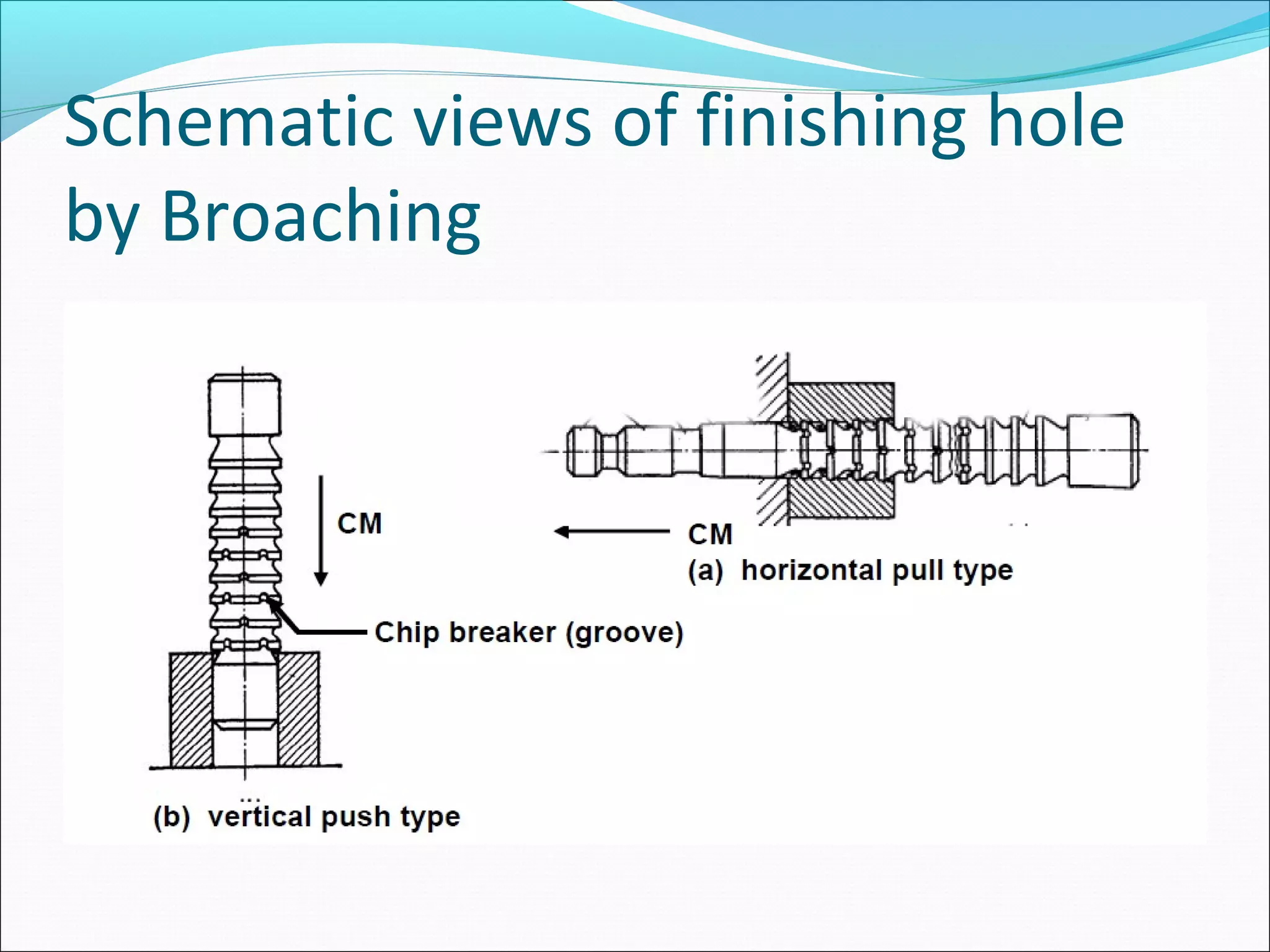
Schematic views of finishing hole
by Broaching
Configuration of Broaching tool
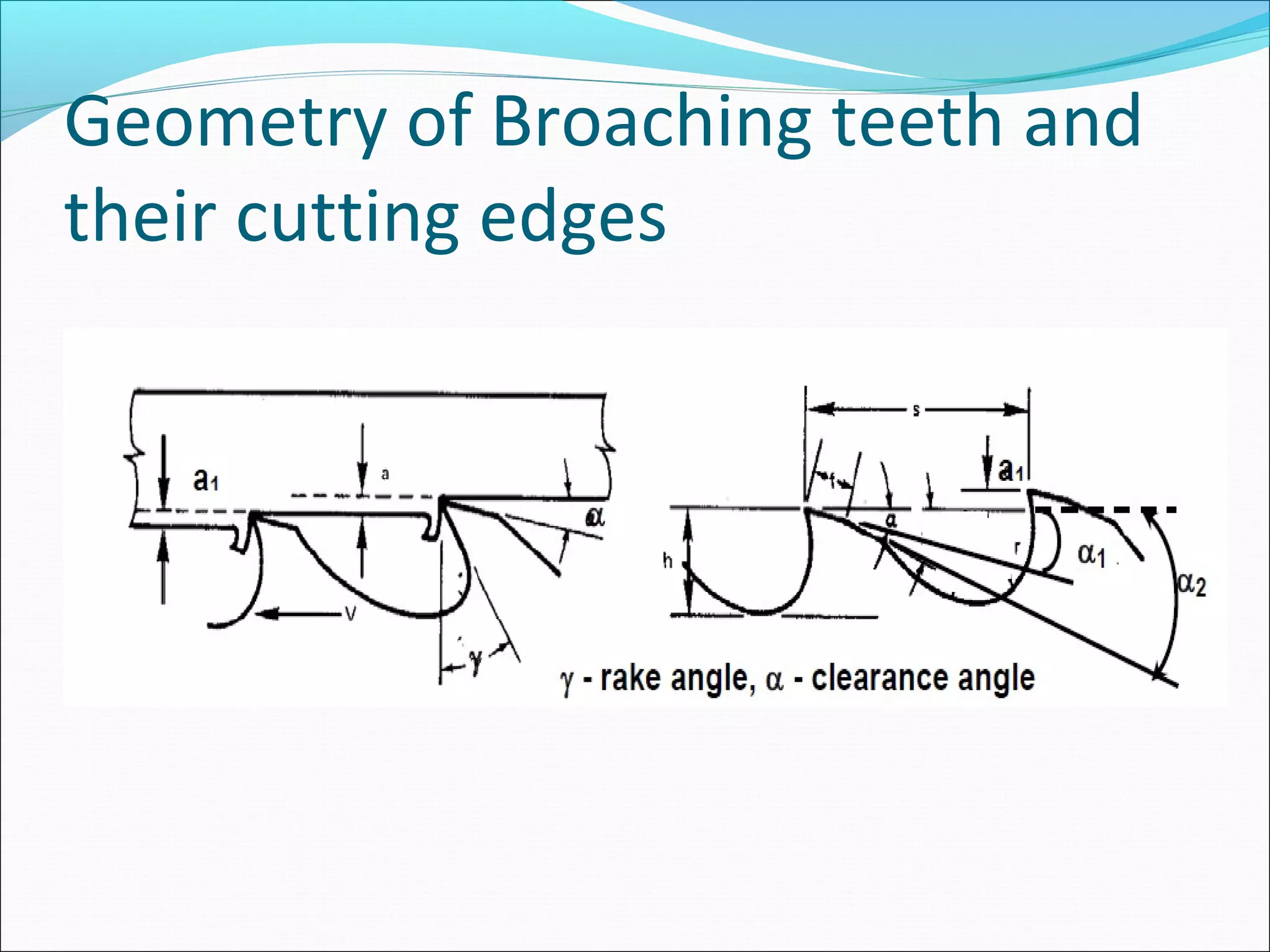
Geometry of Broaching teeth and
their cutting edges
Selection of Broach and Broaching
machine
There are various types of broaches available. The
appropriate one has to be selected based on –
type of the job; size, shape and material
 geometry and volume of work material to be
removed from the job
 desired length of stroke and the broach
 type of the broaching machines available or to be
used
Selection of Broach and Broaching
machine
Broaching machine has to be selected based on –
The type, size and method of clamping of the broach
to be used.
Size, shape and material of the workpiece.
Strength, power and rigidity required for the
broaching machine to provide the desired productivity
and process capability.
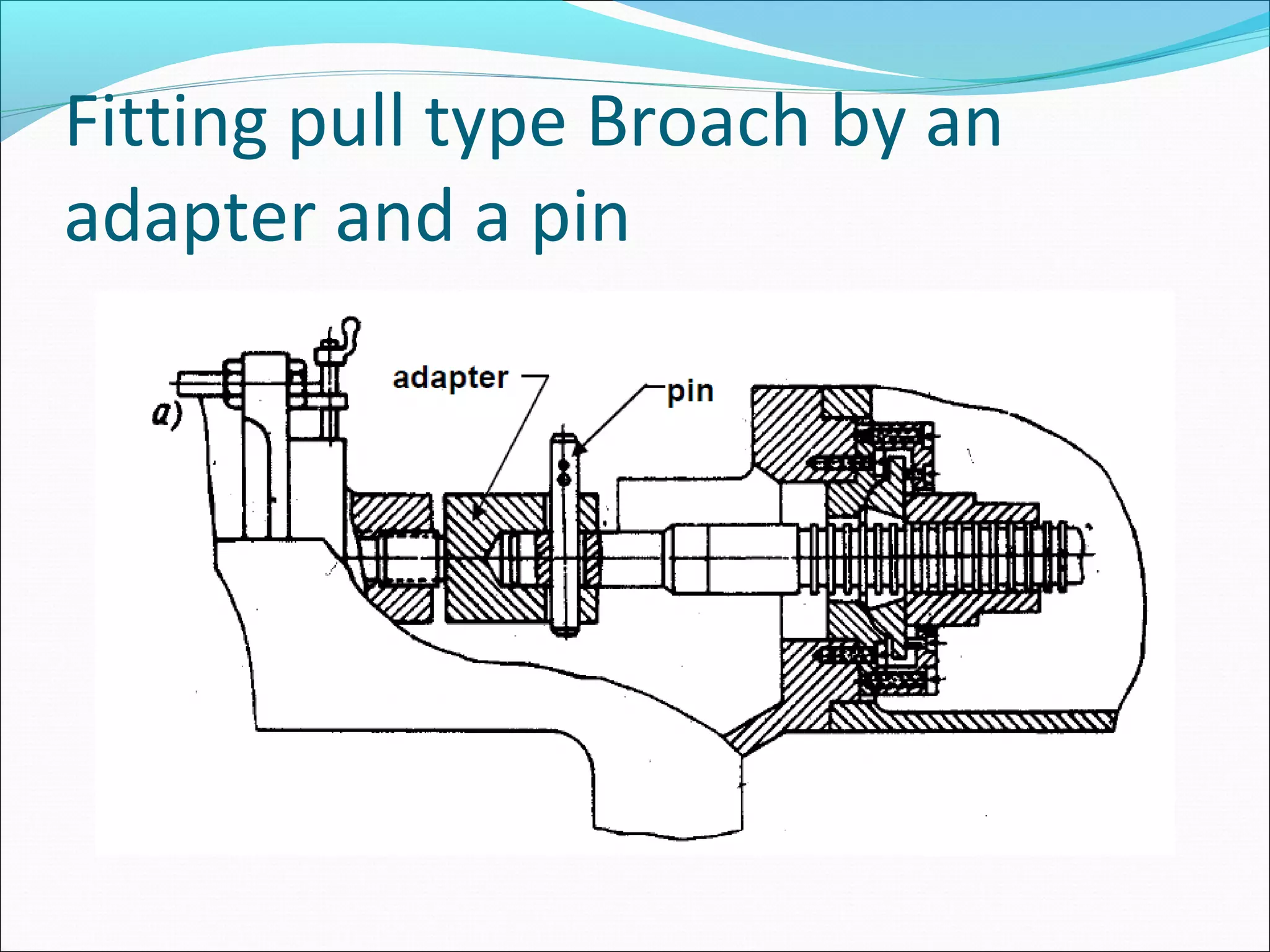
Mounting and Clamping – pull type
Broach
Fitting pull type Broach by an
adapter and a pin
Types of Broaches-
Internal broaching or External broaching
Pull type or Push type
Ordinary cut or Progressive type
Solid, Sectional or Modular type
Profile sharpened or form relieved type
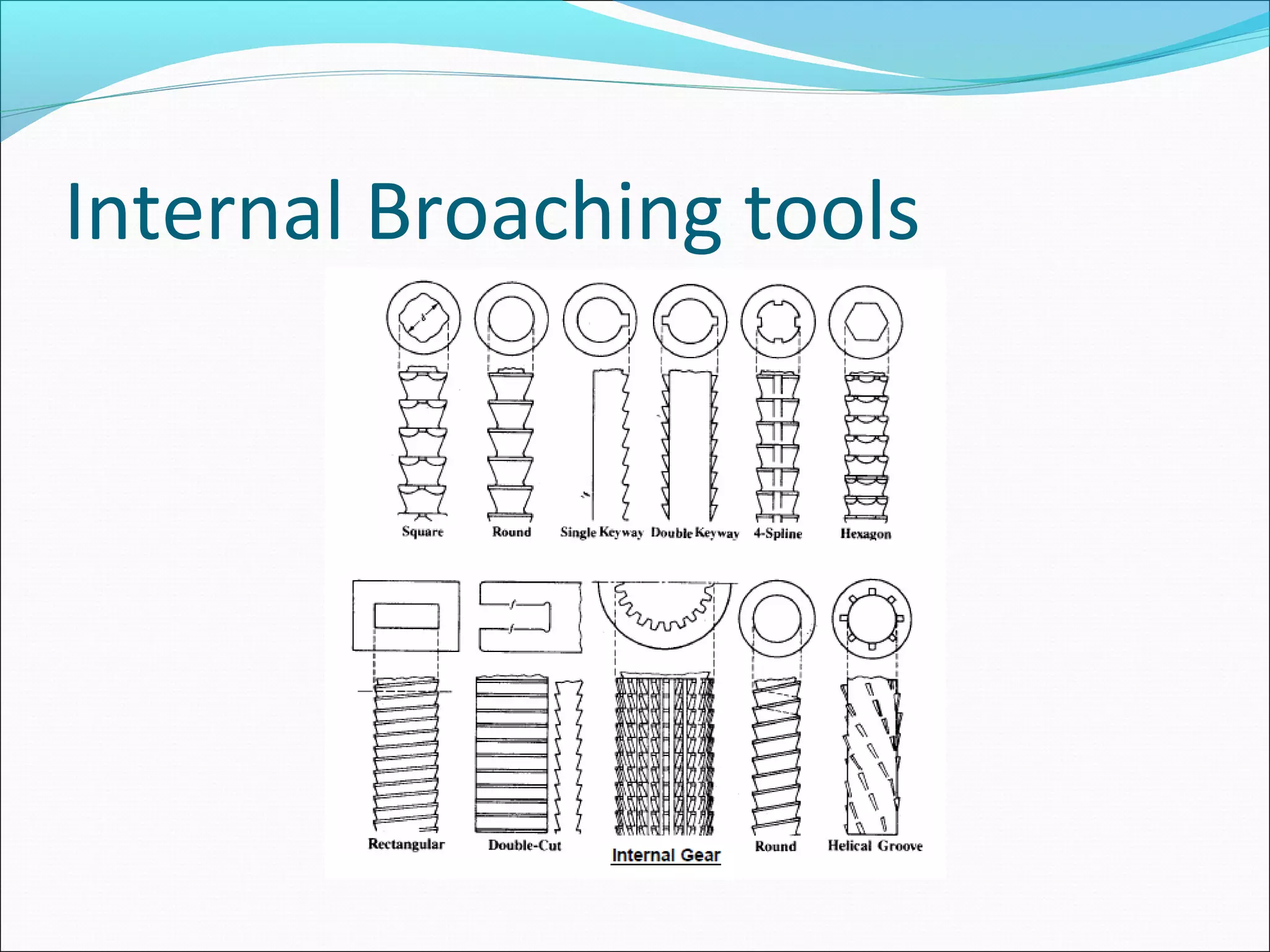
Internal Broaching tools
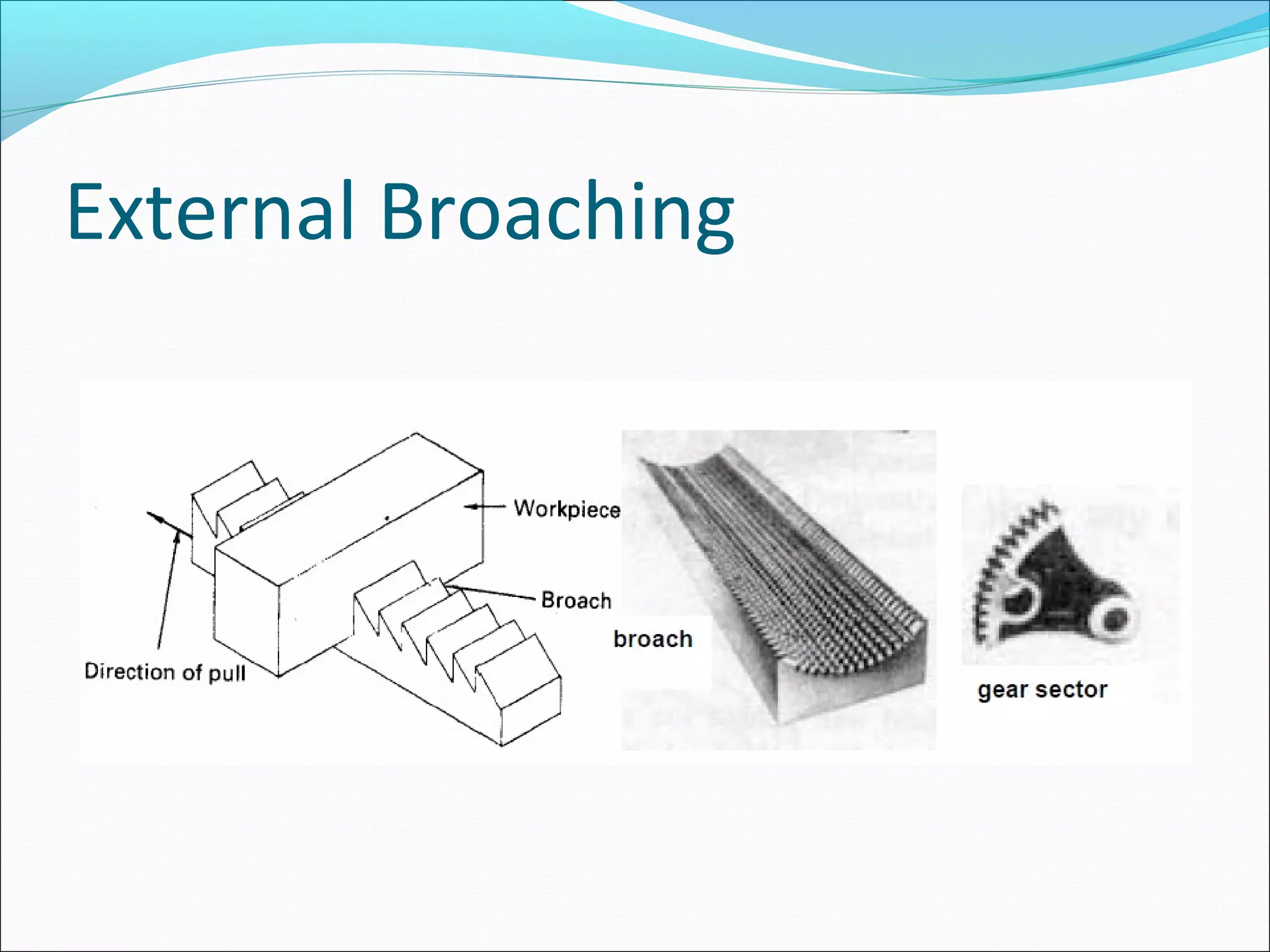
External Broaching
External surface broaching competes with milling, shaping
and planning and, wherever feasible, outperforms those
processes in respect of productivity and product quality.
External broaching tools may be both pull and push type.
Major applications of external broaching are :
un-obstructed outside surfacing; flat, peripheral and
contour surfaces .
 grooves, slots, keyways etc. on through outer surfaces of
objects.
teeth of external spur gears or gear sectors.
External Broaching
Pull type and Push type Broaches
During operation a pull type broach is subjected to
tensile force, which helps in maintaining alignment
and prevents buckling.
Pull type broaches are generally made as a long single
piece and are more widely used, for internal
broaching in particular.
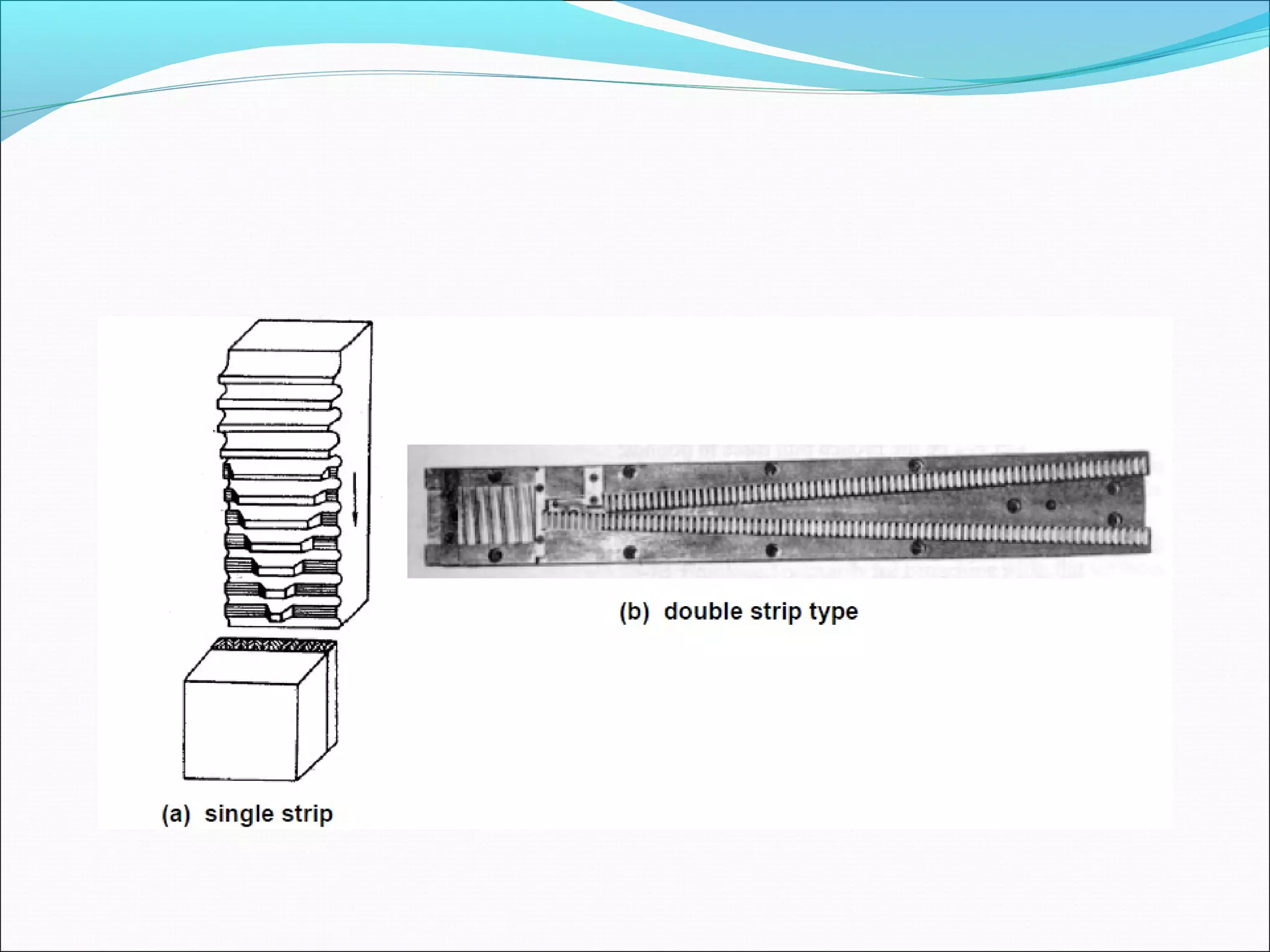
Push type broaches are essentially shorter in length
(to avoid buckling) and may be made in segments.
Push type broaches are generally used for external
broaching, preferably, requiring light cuts and small
depth of material removal.
Ordinary – Cut and Progressive type Broach
Most of the broaches fall under the category of
Ordinary – cut type where the teeth increase in height
or protrusion gradually from tooth to tooth along the
length of the broach. By such broaches, work material
is removed in thin layers over the complete form.
Whereas, Progressive – cut type broaches have their
teeth increasing in width instead of height.
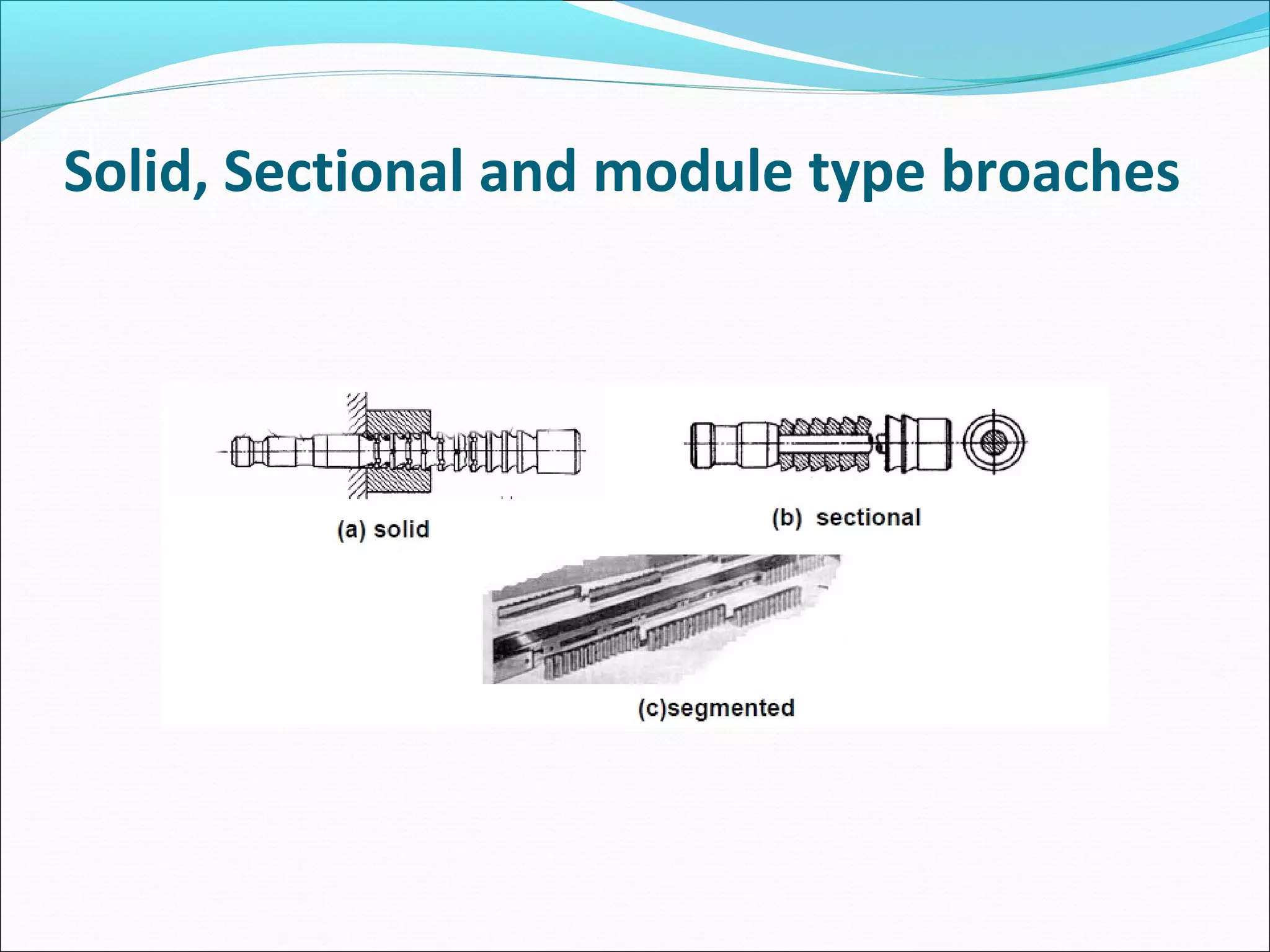
Solid, Sectional and module type broaches
Broaches are mostly made in single pieces specially
those used for pull type internal broaching. But some
broaches called sectional broaches, are made by
assemblying several sections or cutter-pieces in series
for convenience in manufacturing and resharpening
and also for having little flexibility required by
production in batches having interbatch slight job
variation. External broaches are often made by
combining a number of modules or segments for ease
of manufacturing and handling.
Solid, Sectional and module type broaches
Profile sharpened type Broaches
Such cutters have teeth of simple geometry with same
rake and clearance angles all over the cutting edge.
These broaches are generally designed and used for
machining flat surface(s) or circular holes.
Form relieved type broaches
These broaches, being used for non-uniform profiles
like gear teeth etc., have teeth where the cutting edge
geometry is more complex and varies point – to –
point along the cutting edges. Here the job profile
becomes the replica of the tool form. Such broaches
are sharpened and resharpened by grinding at their
rake faces unlike the profile sharpened broaches
which are ground at the flank surfaces.
Advantages of Broaching
Very high production rate (much higher than milling,
planing, boring etc.)
High dimensional and form accuracy and surface
finish of the product
Roughing and finishing in single stroke of the same
cutter
Needs only one motion (cutting), so design,
construction, operation and control are simpler
Extremely suitable and economic for mass production
Limitations of Broaching
Only through holes and surfaces can be machined.
Usable only for light cuts, i.e. low chip load and
unhard materials.
Cutting speed cannot be high.
Defects or damages in the broach (cutting edges)
severely affect product quality.
Design, manufacture and restoration of the broaches
are difficult and expensive.
Separate broach has to be procured and used
whenever size, shape and geometry of the job
changes.
Economic only when the production volume is large.

Broaching

  • 2.
    Broaching: Broaching is machiningprocess for removal of a strip or layer of material of desired section or width and depth usually in one stroke by a slender rod or bar type cutter, called broach. In shaping, attaining full depth requires a number of strokes to remove the material in thin layers step-by-step by gradually infeeding the single point tool. Broaching , on the other hand, removes the entire material in one stroke only by the gradually rising teeth of the broach. The amount of tooth rise between the successive teeth of the broach is equivalent to the infeed given in shaping.
  • 3.
  • 4.
    Schematic views offinishing hole by Broaching
  • 5.
  • 6.
    Geometry of Broachingteeth and their cutting edges
  • 7.
    Selection of Broachand Broaching machine There are various types of broaches available. The appropriate one has to be selected based on – type of the job; size, shape and material  geometry and volume of work material to be removed from the job  desired length of stroke and the broach  type of the broaching machines available or to be used
  • 8.
    Selection of Broachand Broaching machine Broaching machine has to be selected based on – The type, size and method of clamping of the broach to be used. Size, shape and material of the workpiece. Strength, power and rigidity required for the broaching machine to provide the desired productivity and process capability.
  • 9.
    Mounting and Clamping– pull type Broach
  • 10.
    Fitting pull typeBroach by an adapter and a pin
  • 11.
    Types of Broaches- Internalbroaching or External broaching Pull type or Push type Ordinary cut or Progressive type Solid, Sectional or Modular type Profile sharpened or form relieved type
  • 12.
  • 13.
    External Broaching External surfacebroaching competes with milling, shaping and planning and, wherever feasible, outperforms those processes in respect of productivity and product quality. External broaching tools may be both pull and push type. Major applications of external broaching are : un-obstructed outside surfacing; flat, peripheral and contour surfaces .  grooves, slots, keyways etc. on through outer surfaces of objects. teeth of external spur gears or gear sectors.
  • 14.
  • 15.
    Pull type andPush type Broaches During operation a pull type broach is subjected to tensile force, which helps in maintaining alignment and prevents buckling. Pull type broaches are generally made as a long single piece and are more widely used, for internal broaching in particular. Push type broaches are essentially shorter in length (to avoid buckling) and may be made in segments. Push type broaches are generally used for external broaching, preferably, requiring light cuts and small depth of material removal.
  • 16.
    Ordinary – Cutand Progressive type Broach Most of the broaches fall under the category of Ordinary – cut type where the teeth increase in height or protrusion gradually from tooth to tooth along the length of the broach. By such broaches, work material is removed in thin layers over the complete form. Whereas, Progressive – cut type broaches have their teeth increasing in width instead of height.
  • 18.
    Solid, Sectional andmodule type broaches Broaches are mostly made in single pieces specially those used for pull type internal broaching. But some broaches called sectional broaches, are made by assemblying several sections or cutter-pieces in series for convenience in manufacturing and resharpening and also for having little flexibility required by production in batches having interbatch slight job variation. External broaches are often made by combining a number of modules or segments for ease of manufacturing and handling.
  • 19.
    Solid, Sectional andmodule type broaches
  • 20.
    Profile sharpened typeBroaches Such cutters have teeth of simple geometry with same rake and clearance angles all over the cutting edge. These broaches are generally designed and used for machining flat surface(s) or circular holes.
  • 21.
    Form relieved typebroaches These broaches, being used for non-uniform profiles like gear teeth etc., have teeth where the cutting edge geometry is more complex and varies point – to – point along the cutting edges. Here the job profile becomes the replica of the tool form. Such broaches are sharpened and resharpened by grinding at their rake faces unlike the profile sharpened broaches which are ground at the flank surfaces.
  • 22.
    Advantages of Broaching Veryhigh production rate (much higher than milling, planing, boring etc.) High dimensional and form accuracy and surface finish of the product Roughing and finishing in single stroke of the same cutter Needs only one motion (cutting), so design, construction, operation and control are simpler Extremely suitable and economic for mass production
  • 23.
    Limitations of Broaching Onlythrough holes and surfaces can be machined. Usable only for light cuts, i.e. low chip load and unhard materials. Cutting speed cannot be high. Defects or damages in the broach (cutting edges) severely affect product quality. Design, manufacture and restoration of the broaches are difficult and expensive. Separate broach has to be procured and used whenever size, shape and geometry of the job changes. Economic only when the production volume is large.