The Colonial Era in India
8th class social science Exploring Society: India and BeyondBy:K Sandeep Swamy(M.Sc,B.Ed)
For Online Classes (IITJEE & NEET foundation and academics) contact : 9491878325
Subscribe Samyans Eduhub youtube channel
"Modern England has been made great by Indian wealth, wealth always taken by the might and skill of the stronger." — William Digby (1901)What is colonialism?
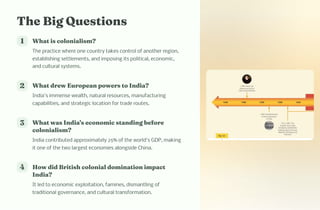
The practice where one country takes control of another region, establishing settlements, and imposing its political, economic, and cultural systems.
What drew European powers to India?
India's immense wealth, natural resources, manufacturing capabilities, and strategic location for trade routes.
What was India's economic standing before colonialism?
India contributed approximately 25% of the world's GDP, making it one of the two largest economies alongside China.
How did British colonial domination impact India?
It led to economic exploitation, famines, dismantling of traditional governance, and cultural transformation.The Age of Colonialism
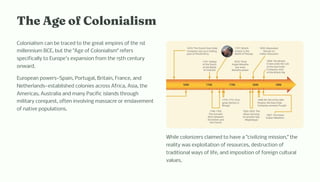
Colonialism can be traced to the great empires of the 1st millennium BCE, but the "Age of Colonialism" refers specifically to Europe's expansion from the 15th century onward.
European powers—Spain, Portugal, Britain, France, and Netherlands—established colonies across Africa, Asia, the Americas, Australia and many Pacific islands through military conquest, often involving massacre or enslavement of native populations.
While colonizers claimed to have a "civilizing mission," the reality was exploitation of resources, destruction of traditional ways of life, and imposition of foreign cultural values.Motivations for Colonial Expansion
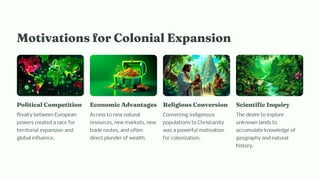
Political Competition
Rivalry between European powers created a race for territorial expansion and global influence.
Economic Advantages
Access to new natural resources, new markets, new trade routes, and often direct plunder of wealth.
Religious Conversion
Converting indigenous populations to Christianity was a powerful motivation for colonization.
Scientific Inquiry
The desire to explore unknown lands to accumulate knowledge of geography and natural history.
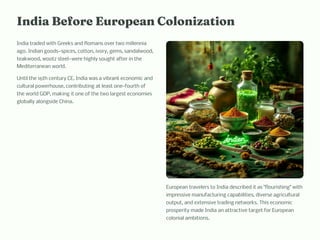
India Before European Colonization
India traded with Greeks and Romans over two millennia ago. Indian goods—spices, cotton, ivory, gems, sandalwood, teakwood, wootz steel—were highly sought after in the Mediterranean world.
Until the 16th century CE, India was a vibrant economic and cultural powerhouse, contributing at least one-fourth of the world GDP, making it one of the two largest economies globally alongside China.
European travelers to India described it as "flourishing" with impressive manufacturing capabilities, diverse agricultural output, and extensive trading networks. This economic prosperity made India an attractive target for European colonial ambitions.
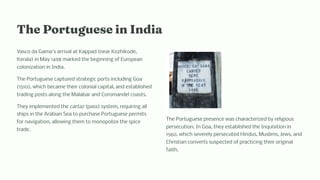
The Portuguese in India
Vasco da Gama's arrival at Kappad (near Kozhikode, Kerala) in May 1498 marked the beginning of European colonization
 Most read
 Most read

 Most read
![Tra for i g I dia Educatio
Diver e Traditio al Lear i g
Before British rule, India possessed rich
and varied educational traditions,
including pt #ha[hls, madrass,
vihras, and various forms of
apprenticeship learning. Even British
reports noted hundreds of thousands
of thriving village schools across the
subcontinent.
Macaulay' I po itio
A turning point came with Thomas
Macaulay's 1835 Minute on Indian
Education. He argued for imposing
British education to create Indians who
would be Indian in blood and colour,
but English in taste, in opinions, in
morals, and in intellect.
I have never found one among
them [Orientalists] who could deny
that a single shelf of a good
European library was worth the
whole native literature of India and
Arabia.
4 Thomas B. Macaulay, 1835
A Divided Society
This policy led to the swift decline of
traditional Indian schools, while English
became the language of prestige and
opportunity. This fostered lasting social
divisions between the newly emerging
English-educated elites and the broader
Indian masses.](https://image.slidesharecdn.com/4-250730004852-bac4c906/85/4-The-Colonial-Era-in-India-pdfppt-pdf-8th-class-social-science-Exploring-Society-India-and-Beyond-By-K-Sandeep-Swamy-M-Sc-B-Ed-17-320.jpg)