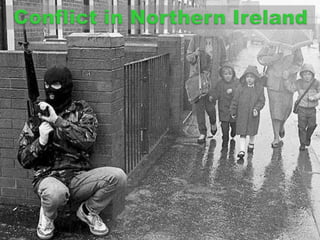
Conflict in Northern Ireland
1916-1999
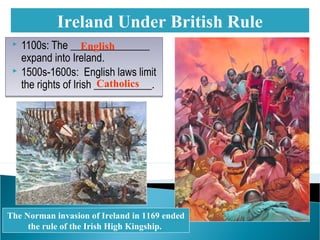
 1100s: The _______________
expand into Ireland.
 1500s-1600s: English laws limit
the rights of Irish ___________.
 1100s: The _______________
expand into Ireland.
 1500s-1600s: English laws limit
the rights of Irish ___________.
Ireland Under British Rule
The Norman invasion of Ireland in 1169 ended
the rule of the Irish High Kingship.
English
Catholics
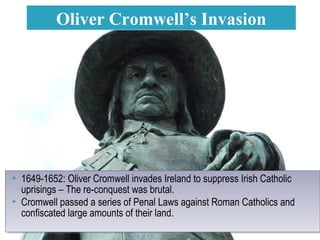
 1649-1652: Oliver Cromwell invades Ireland to suppress Irish Catholic
uprisings – The re-conquest was brutal.
 Cromwell passed a series of Penal Laws against Roman Catholics and
confiscated large amounts of their land.
 1649-1652: Oliver Cromwell invades Ireland to suppress Irish Catholic
uprisings – The re-conquest was brutal.
 Cromwell passed a series of Penal Laws against Roman Catholics and
confiscated large amounts of their land.
Oliver Cromwell’s Invasion
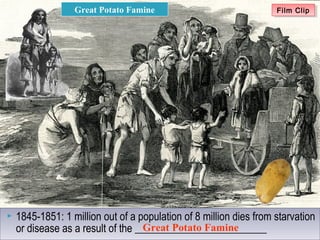
 1845-1851: 1 million out of a population of 8 million dies from starvation
or disease as a result of the _________________________
 1845-1851: 1 million out of a population of 8 million dies from starvation
or disease as a result of the _________________________
Great Potato Famine
Great Potato Famine
Film ClipFilm Clip
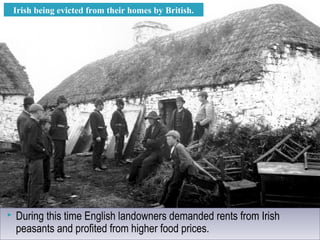
 During this time English landowners demanded rents from Irish
peasants and profited from higher food prices.
 During this time English landowners demanded rents from Irish
peasants and profited from higher food prices.
Irish being evicted from their homes by British.
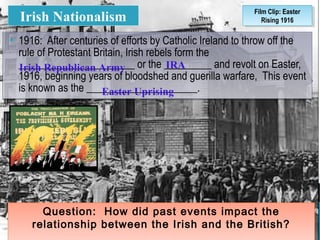
 1916: After centuries of efforts by Catholic Ireland to throw off the
rule of Protestant Britain, Irish rebels form the
______________________ or the _________ and revolt on Easter,
1916, beginning years of bloodshed and guerilla warfare, This event
is known as the _____________________.
 1916: After centuries of efforts by Catholic Ireland to throw off the
rule of Protestant Britain, Irish rebels form the
______________________ or the _________ and revolt on Easter,
1916, beginning years of bloodshed and guerilla warfare, This event
is known as the _____________________.
Irish Nationalism
Irish Republican Army IRA
Easter Uprising
Film Clip: Easter
Rising 1916
Film Clip: Easter
Rising 1916
Question: How did past events impact the
relationship between the Irish and the British?
Question: How did past events impact the
relationship between the Irish and the British?
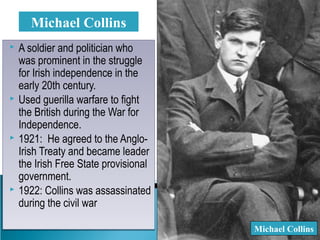
 A soldier and politician who
was prominent in the struggle
for Irish independence in the
early 20th century.
 Used guerilla warfare to fight
the British during the War for
Independence.
 1921: He agreed to the Anglo-
Irish Treaty and became leader
the Irish Free State provisional
government.
 1922: Collins was assassinated
during the civil war
 A soldier and politician who
was prominent in the struggle
for Irish independence in the
early 20th century.
 Used guerilla warfare to fight
the British during the War for
Independence.
 1921: He agreed to the Anglo-
Irish Treaty and became leader
the Irish Free State provisional
government.
 1922: Collins was assassinated
during the civil war
Michael Collins
Michael Collins
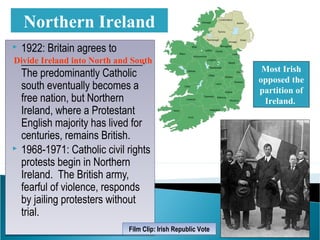
 1922: Britain agrees to
_______________________.
The predominantly Catholic
south eventually becomes a
free nation, but Northern
Ireland, where a Protestant
English majority has lived for
centuries, remains British.
 1968-1971: Catholic civil rights
protests begin in Northern
Ireland. The British army,
fearful of violence, responds
by jailing protesters without
trial.
 1922: Britain agrees to
_______________________.
The predominantly Catholic
south eventually becomes a
free nation, but Northern
Ireland, where a Protestant
English majority has lived for
centuries, remains British.
 1968-1971: Catholic civil rights
protests begin in Northern
Ireland. The British army,
fearful of violence, responds
by jailing protesters without
trial.
Northern Ireland
Most Irish
opposed the
partition of
Ireland.
Divide Ireland into North and South
Film Clip: Irish Republic VoteFilm Clip: Irish Republic Vote
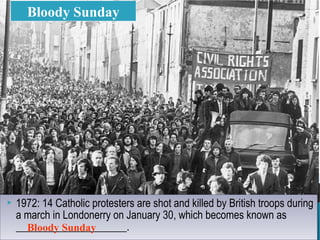
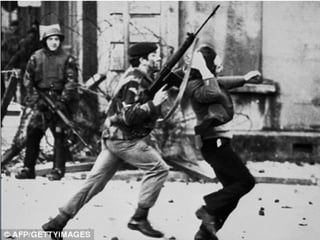
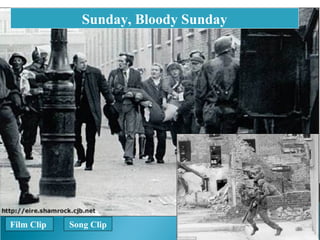
 1972: 14 Catholic protesters are shot and killed by British troops during
a march in Londonerry on January 30, which becomes known as
_____________________.
 1972: 14 Catholic protesters are shot and killed by British troops during
a march in Londonerry on January 30, which becomes known as
_____________________.
Bloody Sunday
Bloody Sunday
Sunday, Bloody Sunday
Film Clip Song Clip
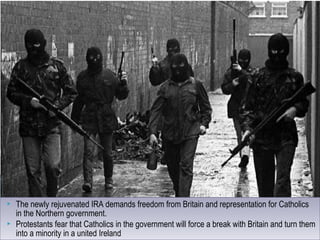
 The newly rejuvenated IRA demands freedom from Britain and representation for Catholics
in the Northern government.
 Protestants fear that Catholics in the government will force a break with Britain and turn them
into a minority in a united Ireland
 The newly rejuvenated IRA demands freedom from Britain and representation for Catholics
in the Northern government.
 Protestants fear that Catholics in the government will force a break with Britain and turn them
into a minority in a united Ireland
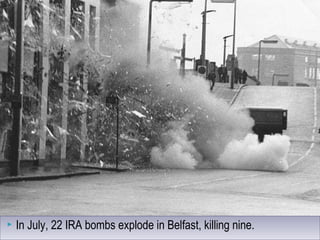
 In July, 22 IRA bombs explode in Belfast, killing nine. In July, 22 IRA bombs explode in Belfast, killing nine.
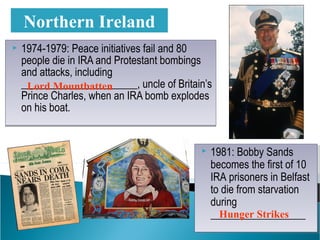
 1974-1979: Peace initiatives fail and 80
people die in IRA and Protestant bombings
and attacks, including
______________________, uncle of Britain’s
Prince Charles, when an IRA bomb explodes
on his boat.
 1974-1979: Peace initiatives fail and 80
people die in IRA and Protestant bombings
and attacks, including
______________________, uncle of Britain’s
Prince Charles, when an IRA bomb explodes
on his boat.
Northern Ireland
 1981: Bobby Sands
becomes the first of 10
IRA prisoners in Belfast
to die from starvation
during
__________________
 1981: Bobby Sands
becomes the first of 10
IRA prisoners in Belfast
to die from starvation
during
__________________
Lord Mountbatten
Hunger Strikes
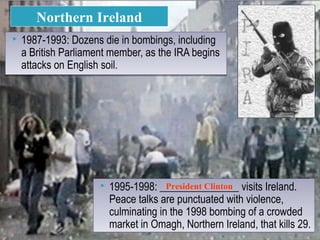
 1987-1993: Dozens die in bombings, including
a British Parliament member, as the IRA begins
attacks on English soil.
 1987-1993: Dozens die in bombings, including
a British Parliament member, as the IRA begins
attacks on English soil.
Northern Ireland
 1995-1998: _______________ visits Ireland.
Peace talks are punctuated with violence,
culminating in the 1998 bombing of a crowded
market in Omagh, Northern Ireland, that kills 29.
 1995-1998: _______________ visits Ireland.
Peace talks are punctuated with violence,
culminating in the 1998 bombing of a crowded
market in Omagh, Northern Ireland, that kills 29.
President Clinton
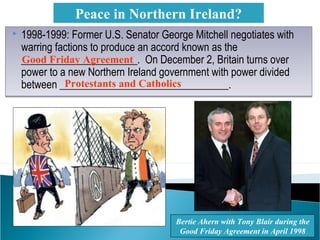
 1998-1999: Former U.S. Senator George Mitchell negotiates with
warring factions to produce an accord known as the
______________________. On December 2, Britain turns over
power to a new Northern Ireland government with power divided
between ________________________________.
 1998-1999: Former U.S. Senator George Mitchell negotiates with
warring factions to produce an accord known as the
______________________. On December 2, Britain turns over
power to a new Northern Ireland government with power divided
between ________________________________.
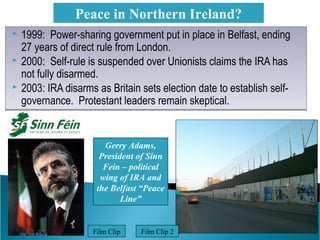
Peace in Northern Ireland?
Bertie Ahern with Tony Blair during the
Good Friday Agreement in April 1998
Good Friday Agreement
Protestants and Catholics
 1999: Power-sharing government put in place in Belfast, ending
27 years of direct rule from London.
 2000: Self-rule is suspended over Unionists claims the IRA has
not fully disarmed.
 2003: IRA disarms as Britain sets election date to establish self-
governance. Protestant leaders remain skeptical.
 1999: Power-sharing government put in place in Belfast, ending
27 years of direct rule from London.
 2000: Self-rule is suspended over Unionists claims the IRA has
not fully disarmed.
 2003: IRA disarms as Britain sets election date to establish self-
governance. Protestant leaders remain skeptical.
Peace in Northern Ireland?
Gerry Adams,
President of Sinn
Fein – political
wing of IRA and
the Belfast “Peace
Line”
Film Clip Film Clip 2

Ireland conflict

  • 2.
    Conflict in NorthernIreland 1916-1999
  • 3.
     1100s: The_______________ expand into Ireland.  1500s-1600s: English laws limit the rights of Irish ___________.  1100s: The _______________ expand into Ireland.  1500s-1600s: English laws limit the rights of Irish ___________. Ireland Under British Rule The Norman invasion of Ireland in 1169 ended the rule of the Irish High Kingship. English Catholics
  • 4.
     1649-1652: OliverCromwell invades Ireland to suppress Irish Catholic uprisings – The re-conquest was brutal.  Cromwell passed a series of Penal Laws against Roman Catholics and confiscated large amounts of their land.  1649-1652: Oliver Cromwell invades Ireland to suppress Irish Catholic uprisings – The re-conquest was brutal.  Cromwell passed a series of Penal Laws against Roman Catholics and confiscated large amounts of their land. Oliver Cromwell’s Invasion
  • 5.
     1845-1851: 1million out of a population of 8 million dies from starvation or disease as a result of the _________________________  1845-1851: 1 million out of a population of 8 million dies from starvation or disease as a result of the _________________________ Great Potato Famine Great Potato Famine Film ClipFilm Clip
  • 6.
     During thistime English landowners demanded rents from Irish peasants and profited from higher food prices.  During this time English landowners demanded rents from Irish peasants and profited from higher food prices. Irish being evicted from their homes by British.
  • 7.
     1916: Aftercenturies of efforts by Catholic Ireland to throw off the rule of Protestant Britain, Irish rebels form the ______________________ or the _________ and revolt on Easter, 1916, beginning years of bloodshed and guerilla warfare, This event is known as the _____________________.  1916: After centuries of efforts by Catholic Ireland to throw off the rule of Protestant Britain, Irish rebels form the ______________________ or the _________ and revolt on Easter, 1916, beginning years of bloodshed and guerilla warfare, This event is known as the _____________________. Irish Nationalism Irish Republican Army IRA Easter Uprising Film Clip: Easter Rising 1916 Film Clip: Easter Rising 1916 Question: How did past events impact the relationship between the Irish and the British? Question: How did past events impact the relationship between the Irish and the British?
  • 8.
     A soldierand politician who was prominent in the struggle for Irish independence in the early 20th century.  Used guerilla warfare to fight the British during the War for Independence.  1921: He agreed to the Anglo- Irish Treaty and became leader the Irish Free State provisional government.  1922: Collins was assassinated during the civil war  A soldier and politician who was prominent in the struggle for Irish independence in the early 20th century.  Used guerilla warfare to fight the British during the War for Independence.  1921: He agreed to the Anglo- Irish Treaty and became leader the Irish Free State provisional government.  1922: Collins was assassinated during the civil war Michael Collins Michael Collins
  • 9.
     1922: Britainagrees to _______________________. The predominantly Catholic south eventually becomes a free nation, but Northern Ireland, where a Protestant English majority has lived for centuries, remains British.  1968-1971: Catholic civil rights protests begin in Northern Ireland. The British army, fearful of violence, responds by jailing protesters without trial.  1922: Britain agrees to _______________________. The predominantly Catholic south eventually becomes a free nation, but Northern Ireland, where a Protestant English majority has lived for centuries, remains British.  1968-1971: Catholic civil rights protests begin in Northern Ireland. The British army, fearful of violence, responds by jailing protesters without trial. Northern Ireland Most Irish opposed the partition of Ireland. Divide Ireland into North and South Film Clip: Irish Republic VoteFilm Clip: Irish Republic Vote
  • 10.
     1972: 14Catholic protesters are shot and killed by British troops during a march in Londonerry on January 30, which becomes known as _____________________.  1972: 14 Catholic protesters are shot and killed by British troops during a march in Londonerry on January 30, which becomes known as _____________________. Bloody Sunday Bloody Sunday
  • 12.
  • 13.
     The newlyrejuvenated IRA demands freedom from Britain and representation for Catholics in the Northern government.  Protestants fear that Catholics in the government will force a break with Britain and turn them into a minority in a united Ireland  The newly rejuvenated IRA demands freedom from Britain and representation for Catholics in the Northern government.  Protestants fear that Catholics in the government will force a break with Britain and turn them into a minority in a united Ireland
  • 14.
     In July,22 IRA bombs explode in Belfast, killing nine. In July, 22 IRA bombs explode in Belfast, killing nine.
  • 15.
     1974-1979: Peaceinitiatives fail and 80 people die in IRA and Protestant bombings and attacks, including ______________________, uncle of Britain’s Prince Charles, when an IRA bomb explodes on his boat.  1974-1979: Peace initiatives fail and 80 people die in IRA and Protestant bombings and attacks, including ______________________, uncle of Britain’s Prince Charles, when an IRA bomb explodes on his boat. Northern Ireland  1981: Bobby Sands becomes the first of 10 IRA prisoners in Belfast to die from starvation during __________________  1981: Bobby Sands becomes the first of 10 IRA prisoners in Belfast to die from starvation during __________________ Lord Mountbatten Hunger Strikes
  • 16.
     1987-1993: Dozensdie in bombings, including a British Parliament member, as the IRA begins attacks on English soil.  1987-1993: Dozens die in bombings, including a British Parliament member, as the IRA begins attacks on English soil. Northern Ireland  1995-1998: _______________ visits Ireland. Peace talks are punctuated with violence, culminating in the 1998 bombing of a crowded market in Omagh, Northern Ireland, that kills 29.  1995-1998: _______________ visits Ireland. Peace talks are punctuated with violence, culminating in the 1998 bombing of a crowded market in Omagh, Northern Ireland, that kills 29. President Clinton
  • 17.
     1998-1999: FormerU.S. Senator George Mitchell negotiates with warring factions to produce an accord known as the ______________________. On December 2, Britain turns over power to a new Northern Ireland government with power divided between ________________________________.  1998-1999: Former U.S. Senator George Mitchell negotiates with warring factions to produce an accord known as the ______________________. On December 2, Britain turns over power to a new Northern Ireland government with power divided between ________________________________. Peace in Northern Ireland? Bertie Ahern with Tony Blair during the Good Friday Agreement in April 1998 Good Friday Agreement Protestants and Catholics
  • 18.
     1999: Power-sharinggovernment put in place in Belfast, ending 27 years of direct rule from London.  2000: Self-rule is suspended over Unionists claims the IRA has not fully disarmed.  2003: IRA disarms as Britain sets election date to establish self- governance. Protestant leaders remain skeptical.  1999: Power-sharing government put in place in Belfast, ending 27 years of direct rule from London.  2000: Self-rule is suspended over Unionists claims the IRA has not fully disarmed.  2003: IRA disarms as Britain sets election date to establish self- governance. Protestant leaders remain skeptical. Peace in Northern Ireland? Gerry Adams, President of Sinn Fein – political wing of IRA and the Belfast “Peace Line” Film Clip Film Clip 2

Editor's Notes

  • #4 Ireland became a laboratory for colonialism – British experiment with rule on Ireland and then export it to America, Caribbean and India
  • #5 Cromwell believed stories of Irish slaughtering of Protestants in 1641 Rebellion and sought revenge Oliver Cromwell left Ireland on May 26, 1650.  Only nine months in Ireland , Cromwell gave birth to death, exile, persecution, indentured slavery, and a form of 17th century ethnic cleansing.  His name is forever associated by the Irish people with fevered anti-Catholicism and a burning hatred for the Irish people.  Cromwell’s Settlement plan for Ireland can be fairly judged as being even more harmful to Ireland than his blood letting in 1649.