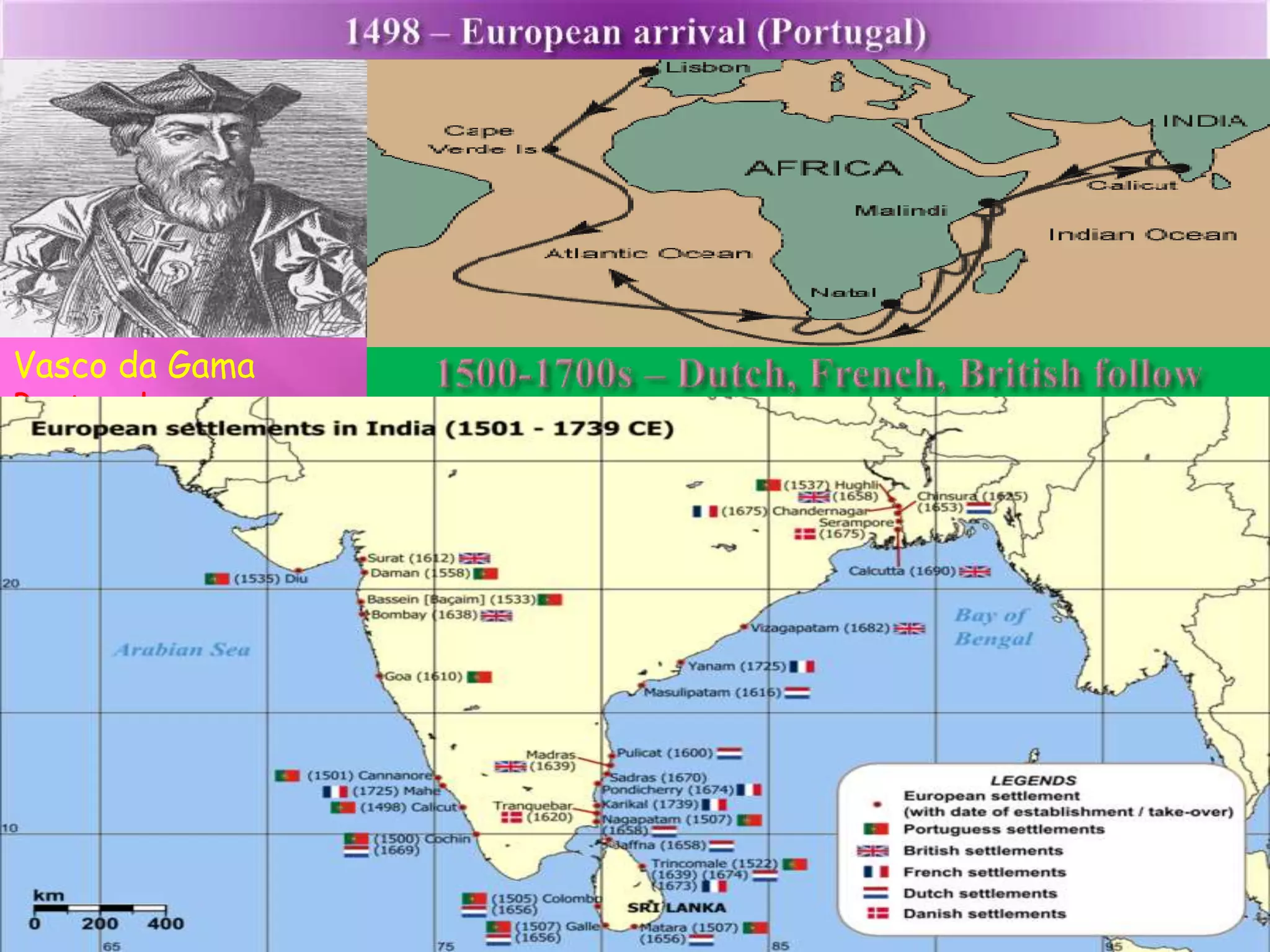
Vasco da Gama 
Portugal
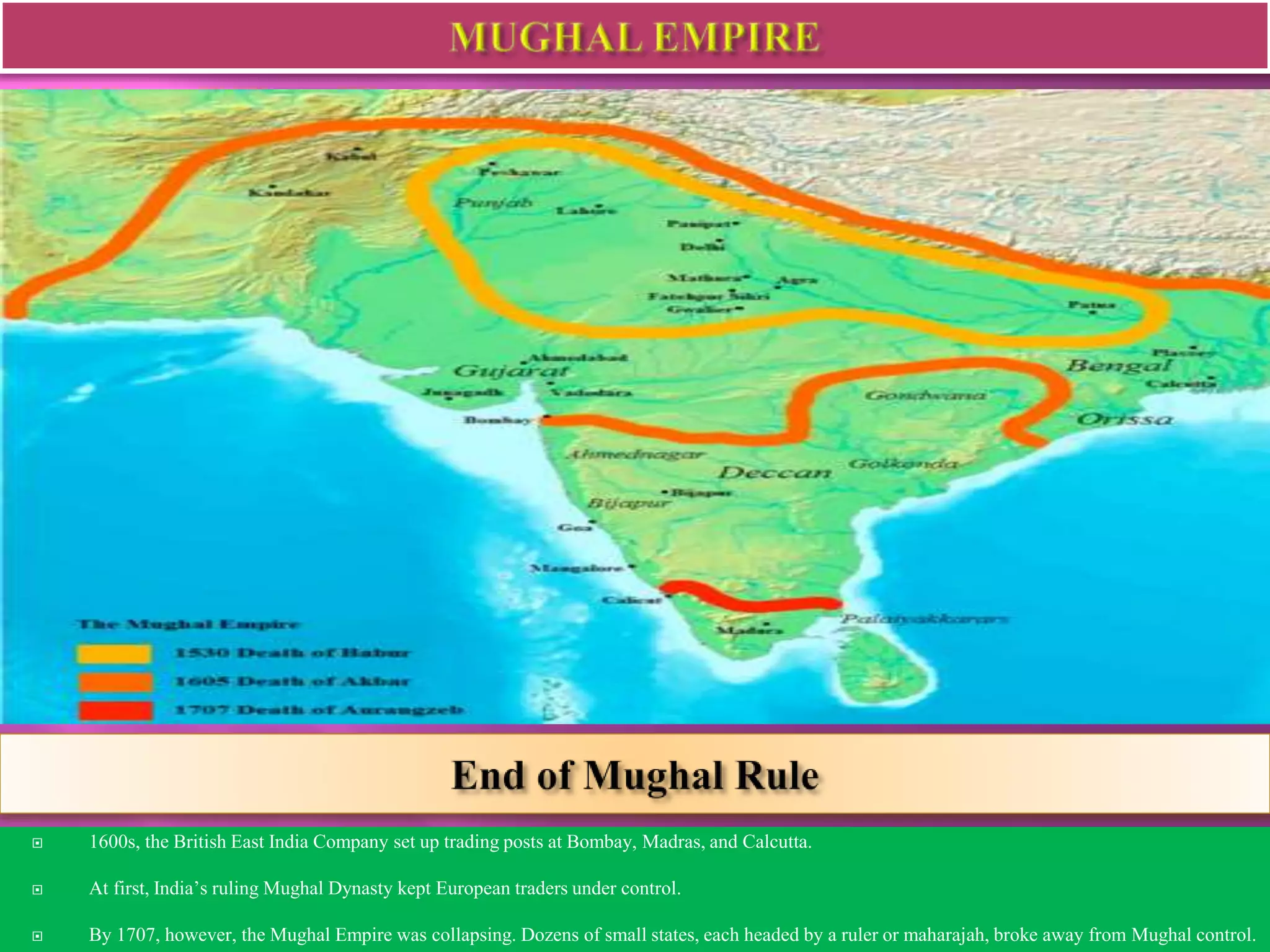
 1600s, the British East India Company set up trading posts at Bombay, Madras, and Calcutta. 
 At first, India’s ruling Mughal Dynasty kept European traders under control. 
 By 1707, however, the Mughal Empire was collapsing. Dozens of small states, each headed by a ruler or maharajah, broke away from Mughal control.
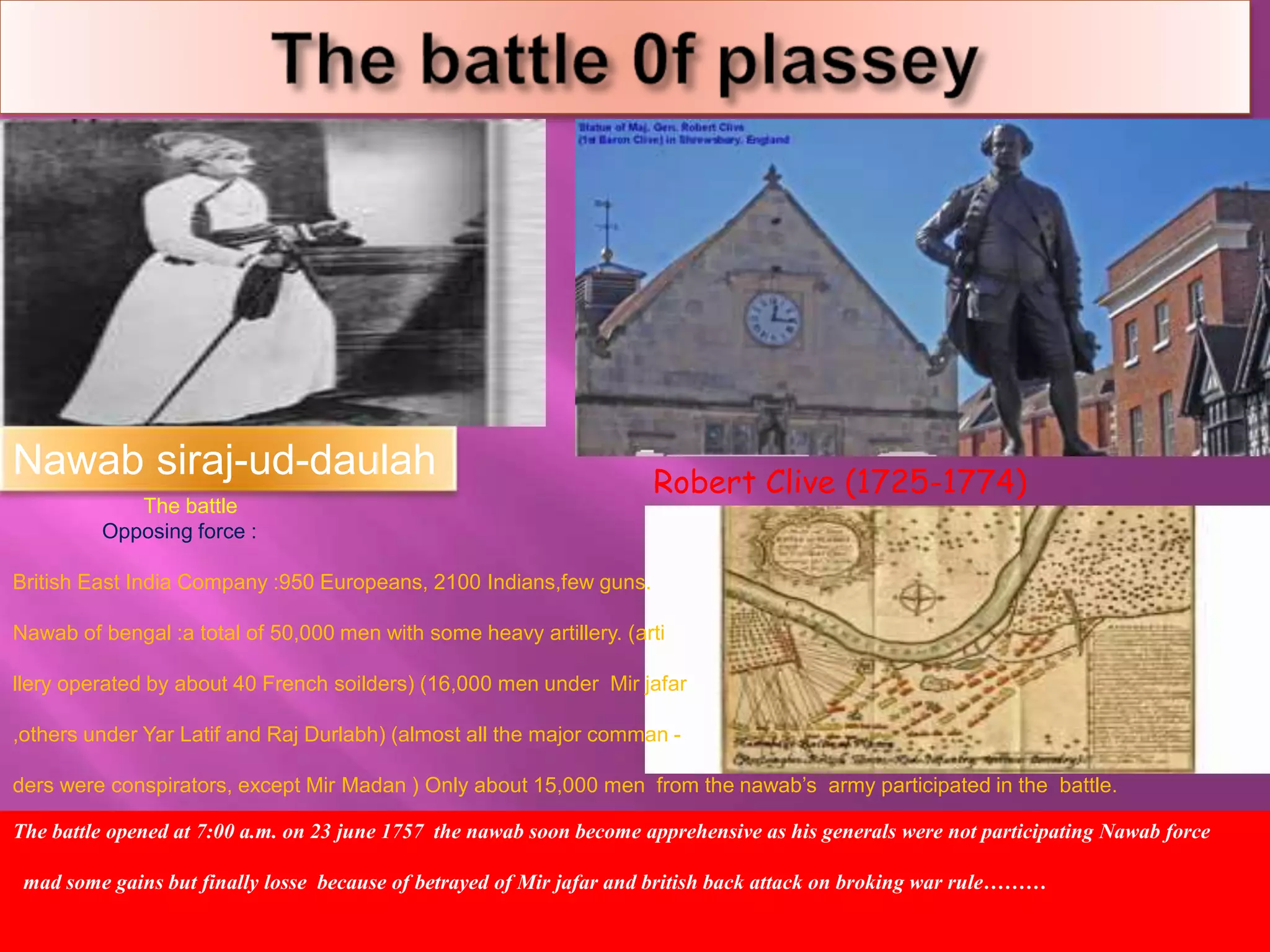
Nawab siraj-ud-daulah 
Robert Clive (1725-1774) 
The battle 
Opposing force : 
British East India Company :950 Europeans, 2100 Indians,few guns. 
Nawab of bengal :a total of 50,000 men with some heavy artillery. (arti 
llery operated by about 40 French soilders) (16,000 men under Mir jafar 
,others under Yar Latif and Raj Durlabh) (almost all the major comman - 
ders were conspirators, except Mir Madan ) Only about 15,000 men from the nawab’s army participated in the battle. 
The battle opened at 7:00 a.m. on 23 june 1757 the nawab soon become apprehensive as his generals were not participating Nawab force 
mad some gains but finally losse because of betrayed of Mir jafar and british back attack on broking war rule………
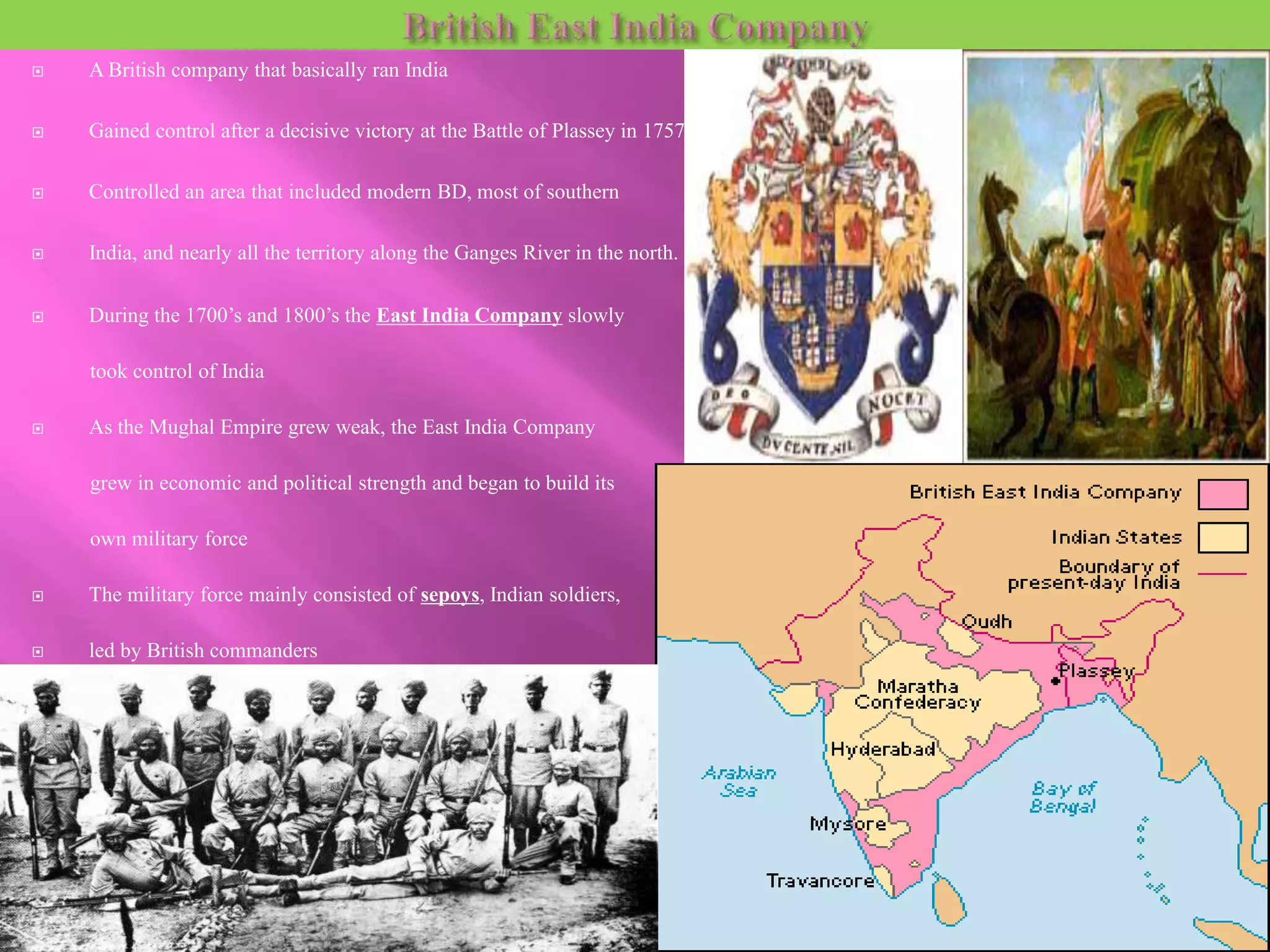
 A British company that basically ran India 
 Gained control after a decisive victory at the Battle of Plassey in 1757 
 Controlled an area that included modern BD, most of southern 
 India, and nearly all the territory along the Ganges River in the north. 
 During the 1700’s and 1800’s the East India Company slowly 
took control of India 
 As the Mughal Empire grew weak, the East India Company 
grew in economic and political strength and began to build its 
own military force 
 The military force mainly consisted of sepoys, Indian soldiers, 
 led by British commanders
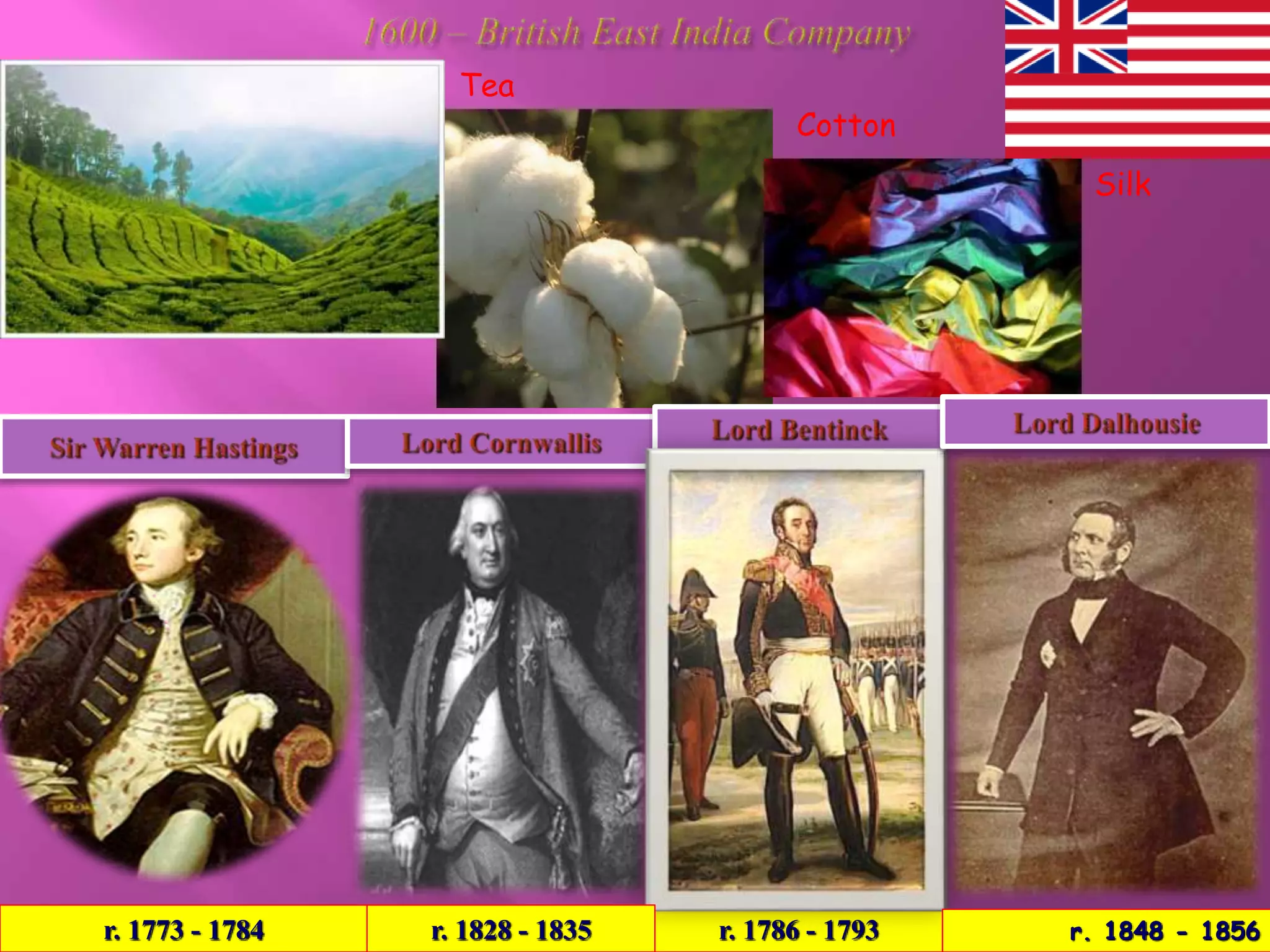
Cotton 
Silk 
Tea 
r. 1773 - 1784 r. 1828 - 1835 r. 1786 - 1793 r. 1848 - 1856
 Became like a foreign gov’t. 
 Took more land 
 Forced Indian rulers to sign treaties granting it power 
 Collected taxes from Indians 
 Est. law code & courts 
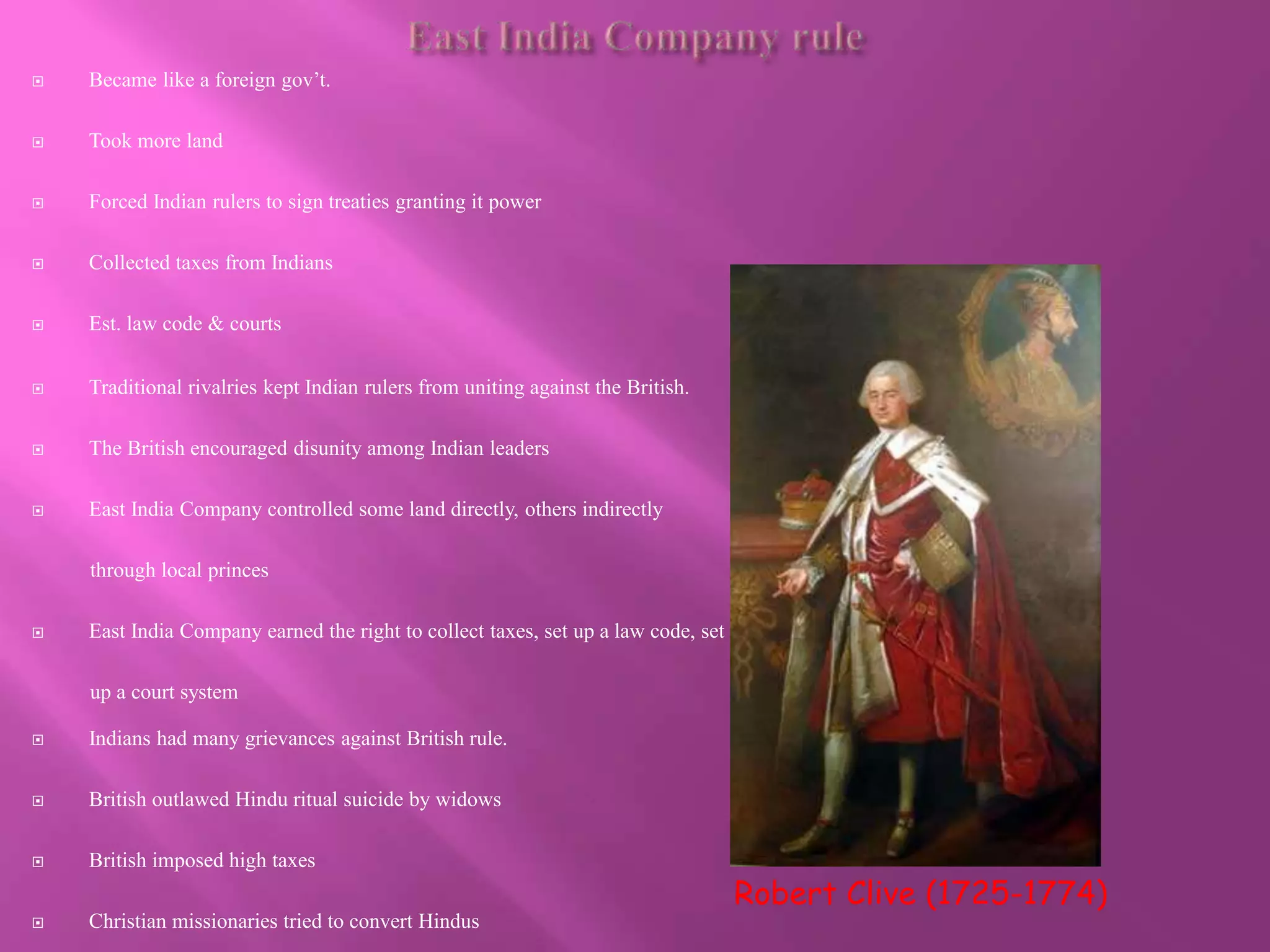
Robert Clive (1725-1774) 
 Traditional rivalries kept Indian rulers from uniting against the British. 
 The British encouraged disunity among Indian leaders 
 East India Company controlled some land directly, others indirectly 
through local princes 
 East India Company earned the right to collect taxes, set up a law code, set 
up a court system 
 Indians had many grievances against British rule. 
 British outlawed Hindu ritual suicide by widows 
 British imposed high taxes 
 Christian missionaries tried to convert Hindus
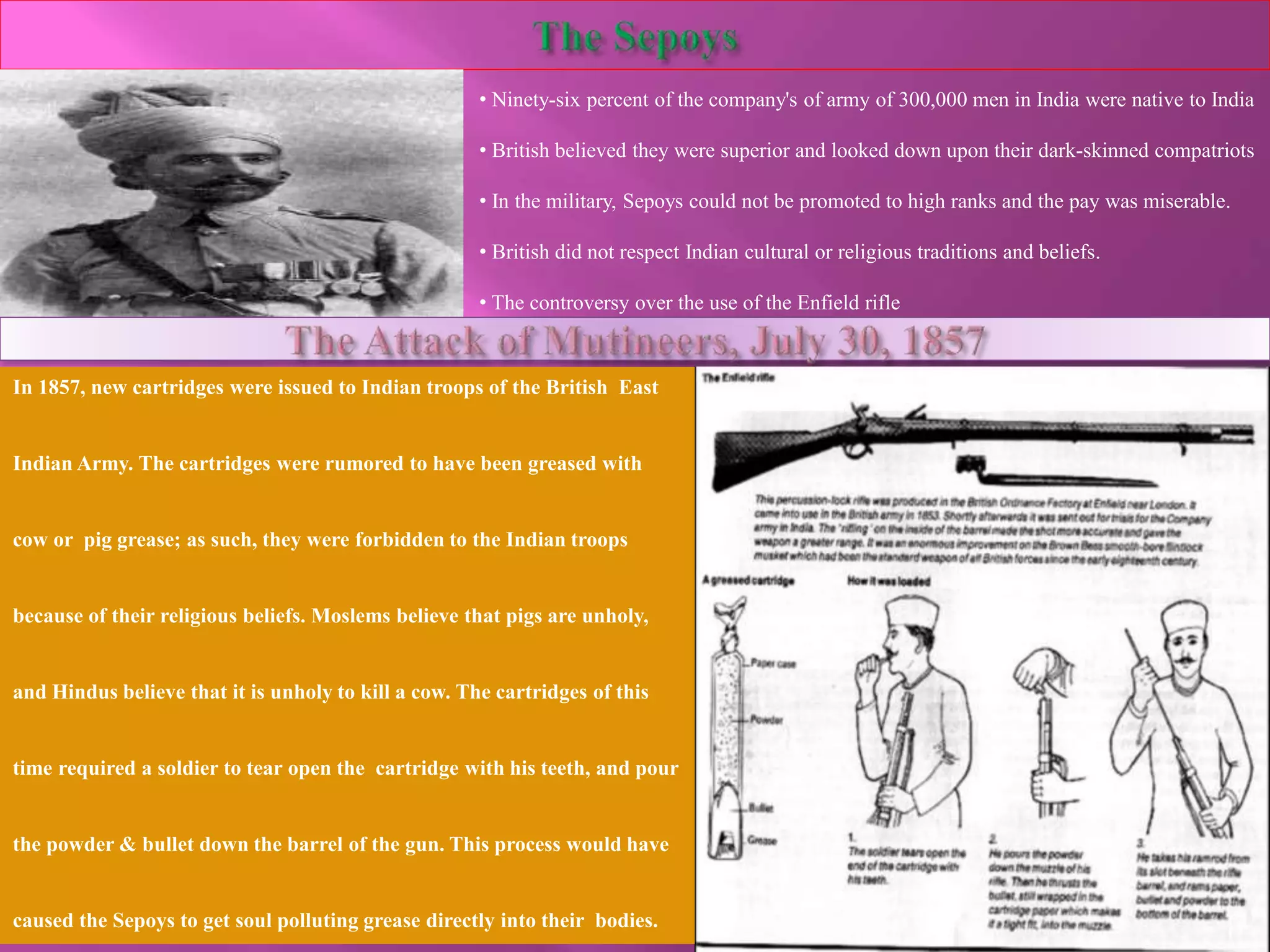
• Ninety-six percent of the company's of army of 300,000 men in India were native to India 
• British believed they were superior and looked down upon their dark-skinned compatriots 
• In the military, Sepoys could not be promoted to high ranks and the pay was miserable. 
• British did not respect Indian cultural or religious traditions and beliefs. 
• The controversy over the use of the Enfield rifle 
In 1857, new cartridges were issued to Indian troops of the British East 
Indian Army. The cartridges were rumored to have been greased with 
cow or pig grease; as such, they were forbidden to the Indian troops 
because of their religious beliefs. Moslems believe that pigs are unholy, 
and Hindus believe that it is unholy to kill a cow. The cartridges of this 
time required a soldier to tear open the cartridge with his teeth, and pour 
the powder & bullet down the barrel of the gun. This process would have 
caused the Sepoys to get soul polluting grease directly into their bodies.
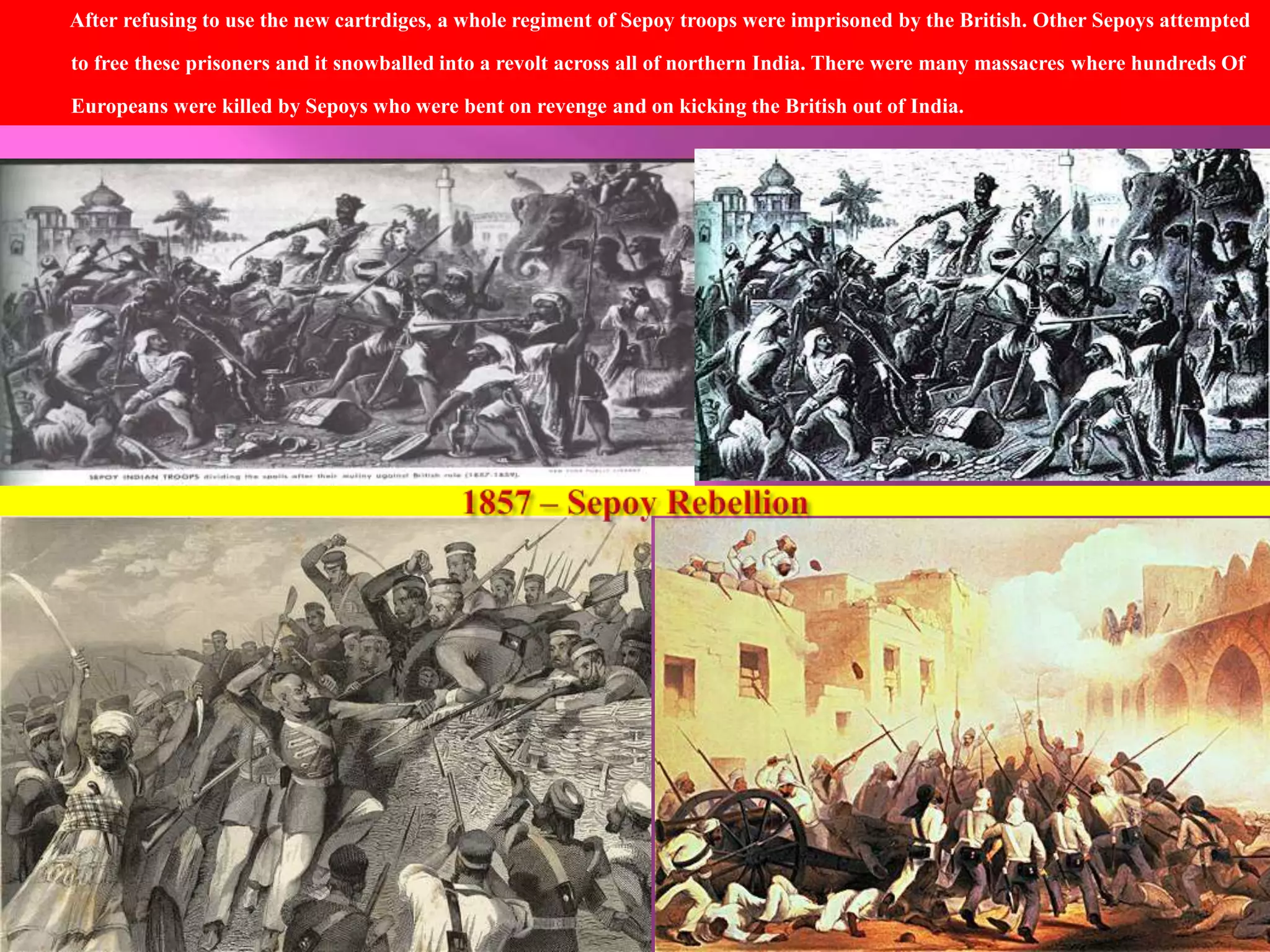
After refusing to use the new cartrdiges, a whole regiment of Sepoy troops were imprisoned by the British. Other Sepoys attempted 
to free these prisoners and it snowballed into a revolt across all of northern India. There were many massacres where hundreds Of 
Europeans were killed by Sepoys who were bent on revenge and on kicking the British out of India.
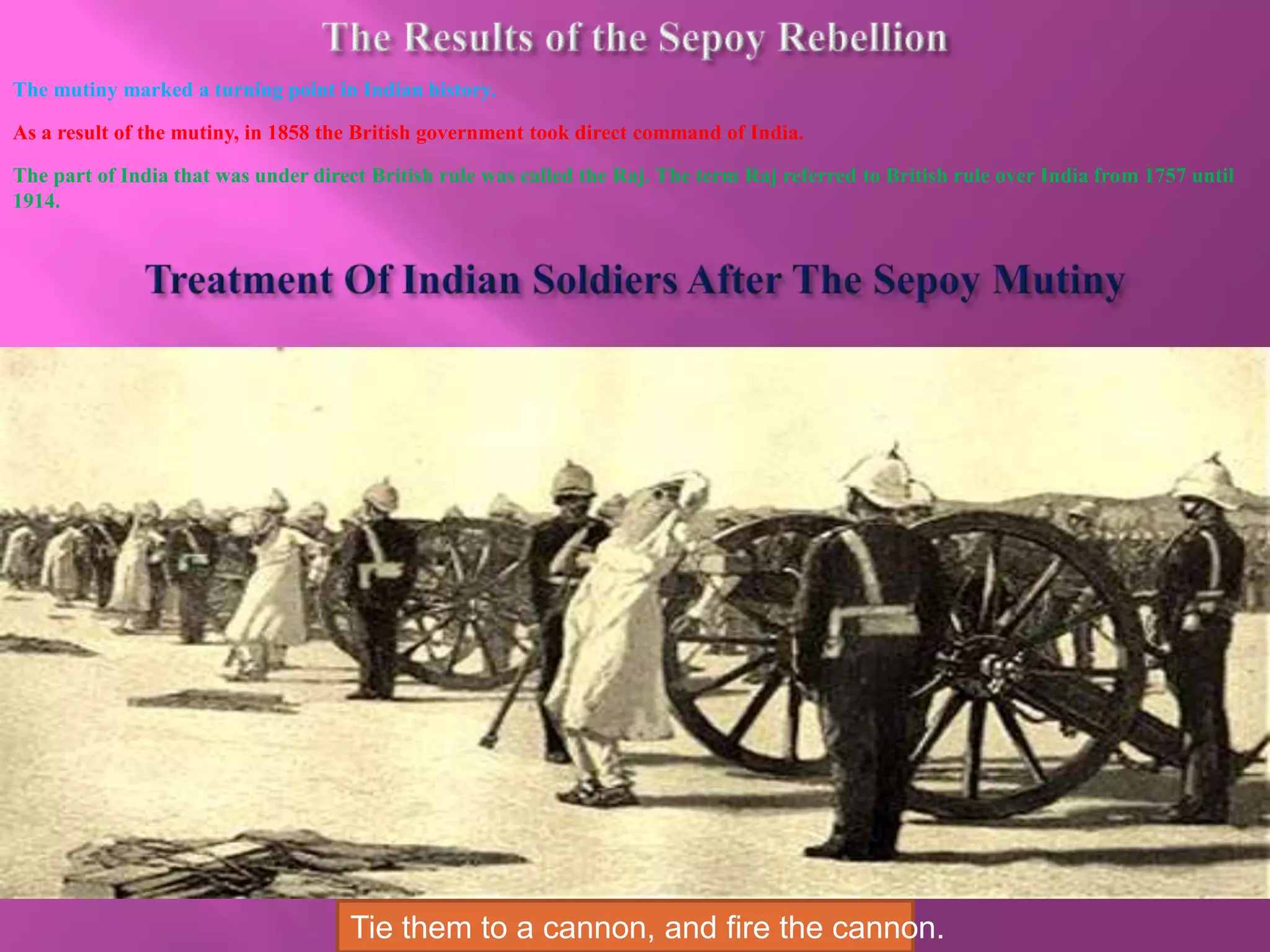
The mutiny marked a turning point in Indian history. 
As a result of the mutiny, in 1858 the British government took direct command of India. 
The part of India that was under direct British rule was called the Raj. The term Raj referred to British rule over India from 1757 until 
1914. 
Tie them to a cannon, and fire the cannon.
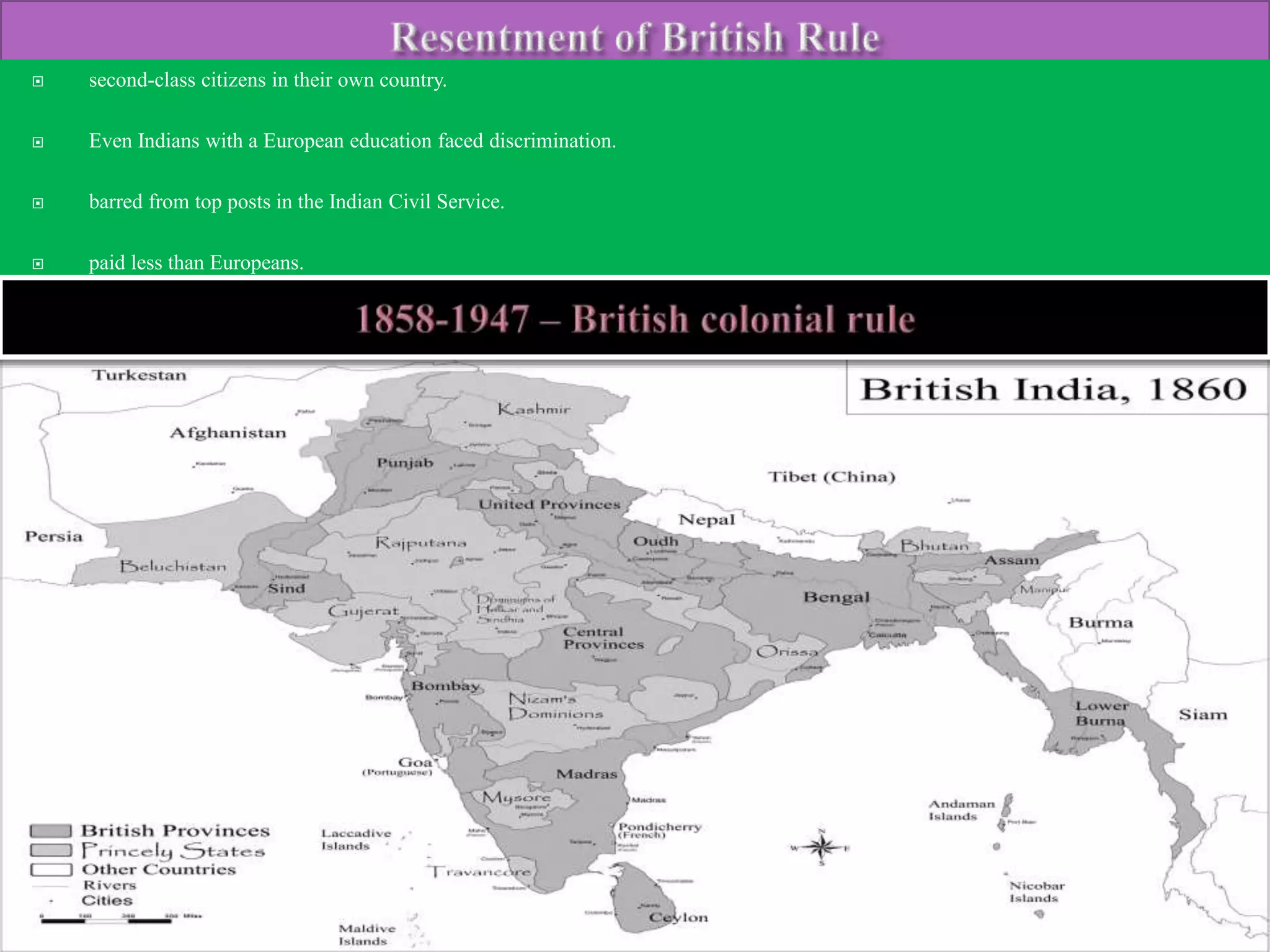
 second-class citizens in their own country. 
 Even Indians with a European education faced discrimination. 
 barred from top posts in the Indian Civil Service. 
 paid less than Europeans.
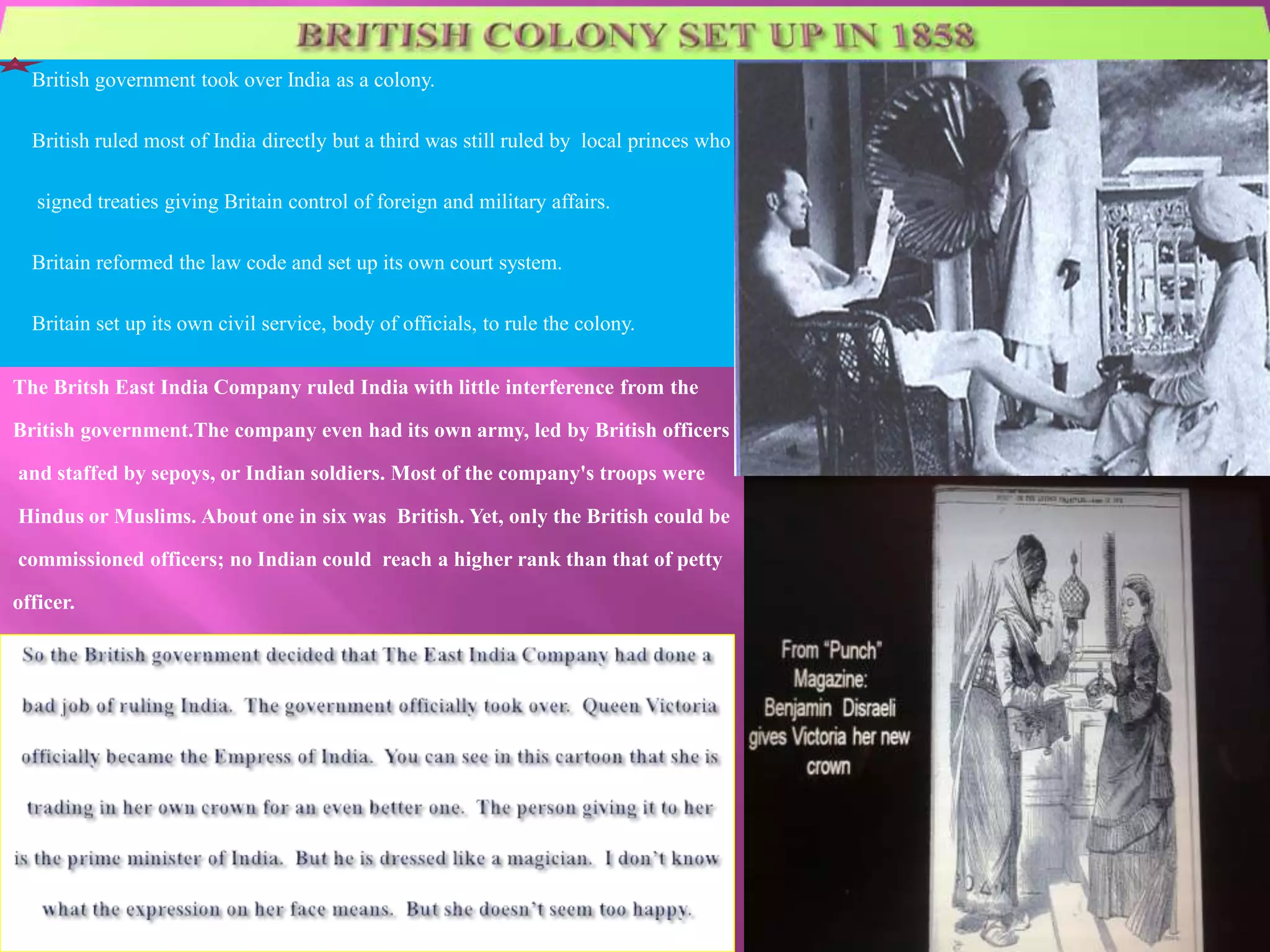
British government took over India as a colony. 
British ruled most of India directly but a third was still ruled by local princes who 
signed treaties giving Britain control of foreign and military affairs. 
Britain reformed the law code and set up its own court system. 
Britain set up its own civil service, body of officials, to rule the colony. 
The Britsh East India Company ruled India with little interference from the 
British government.The company even had its own army, led by British officers 
and staffed by sepoys, or Indian soldiers. Most of the company's troops were 
Hindus or Muslims. About one in six was British. Yet, only the British could be 
commissioned officers; no Indian could reach a higher rank than that of petty 
officer.
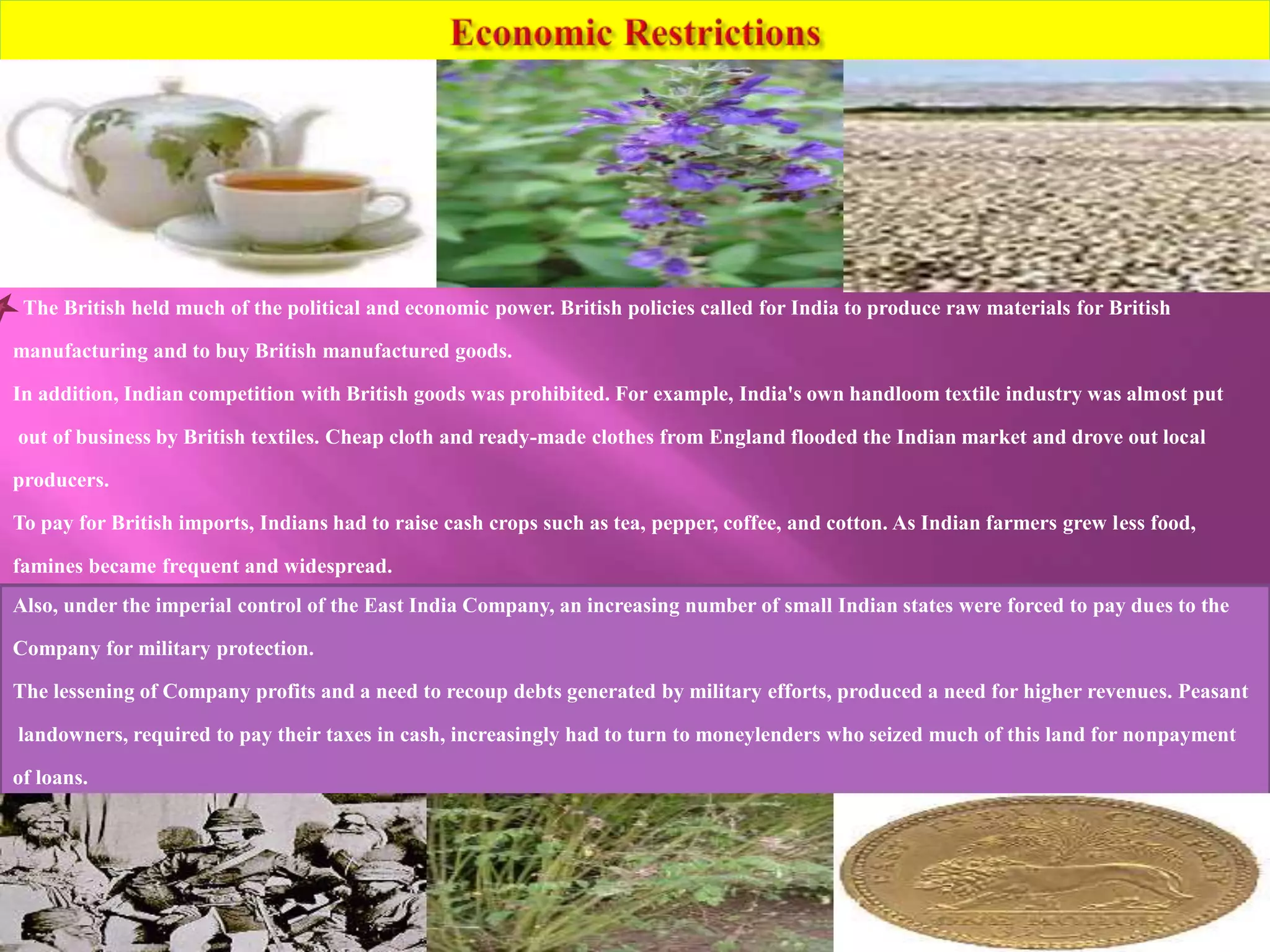
The British held much of the political and economic power. British policies called for India to produce raw materials for British 
manufacturing and to buy British manufactured goods. 
In addition, Indian competition with British goods was prohibited. For example, India's own handloom textile industry was almost put 
out of business by British textiles. Cheap cloth and ready-made clothes from England flooded the Indian market and drove out local 
producers. 
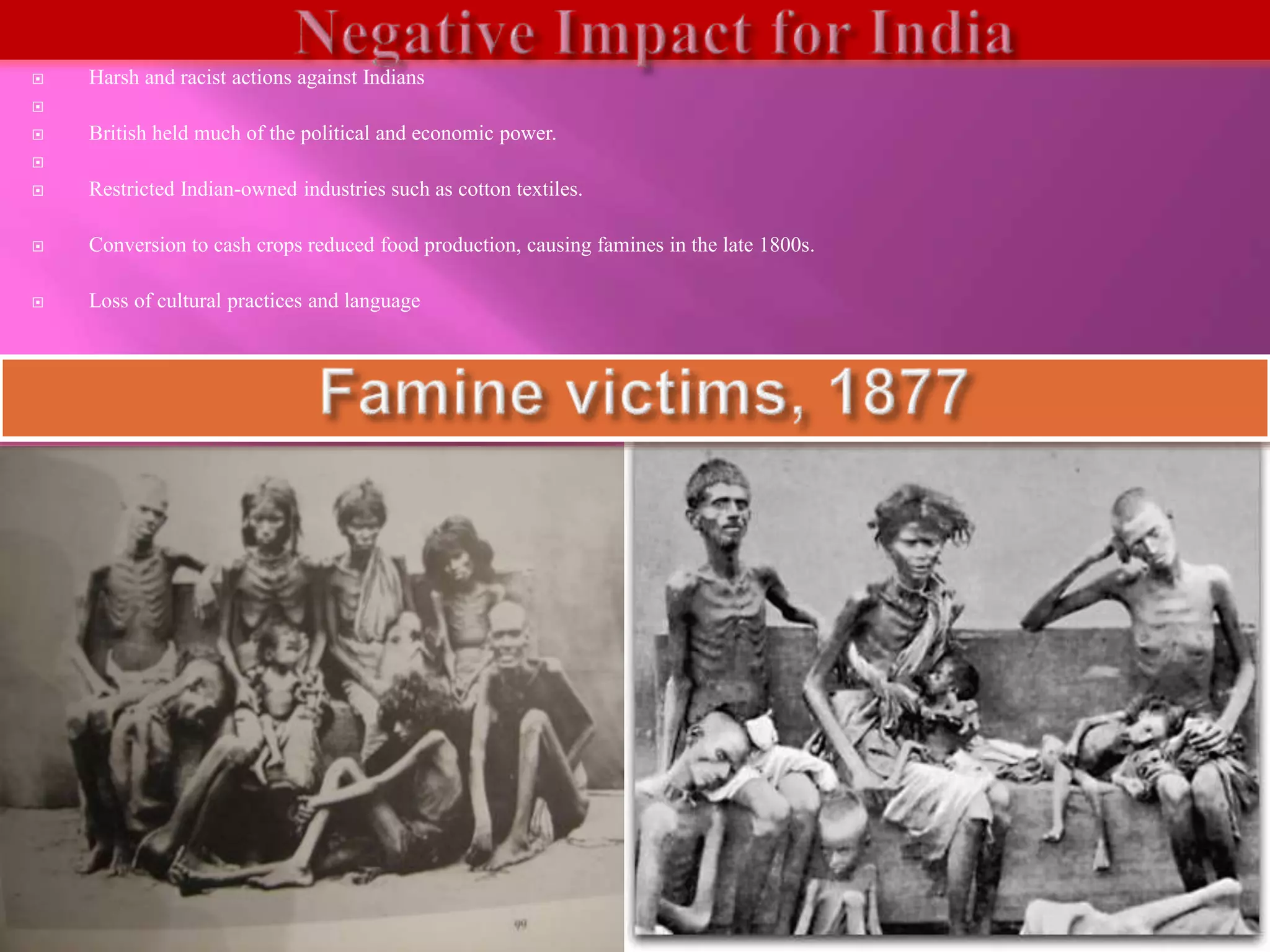
To pay for British imports, Indians had to raise cash crops such as tea, pepper, coffee, and cotton. As Indian farmers grew less food, 
famines became frequent and widespread. 
Also, under the imperial control of the East India Company, an increasing number of small Indian states were forced to pay dues to the 
Company for military protection. 
The lessening of Company profits and a need to recoup debts generated by military efforts, produced a need for higher revenues. Peasant 
landowners, required to pay their taxes in cash, increasingly had to turn to moneylenders who seized much of this land for nonpayment 
of loans.
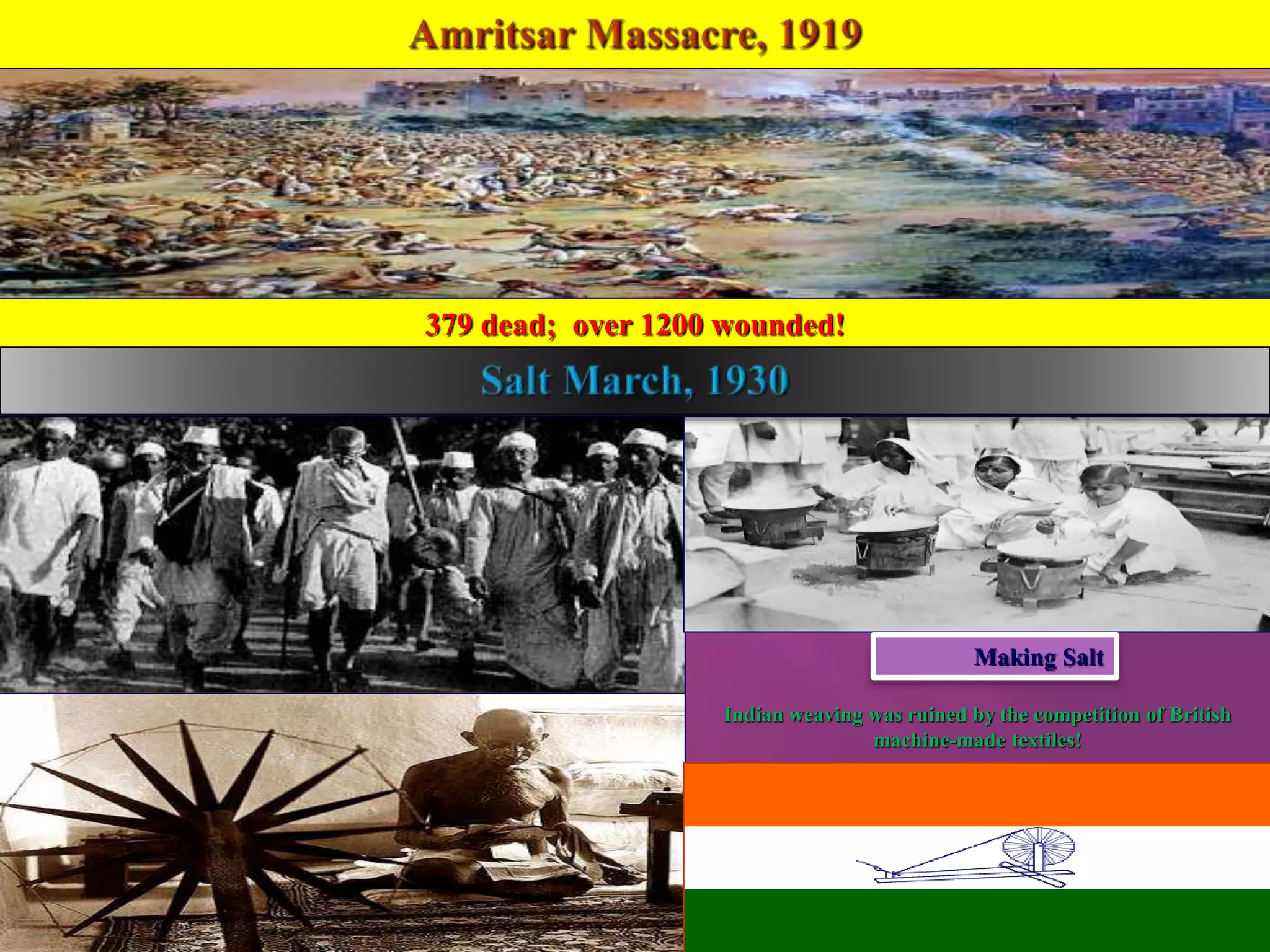
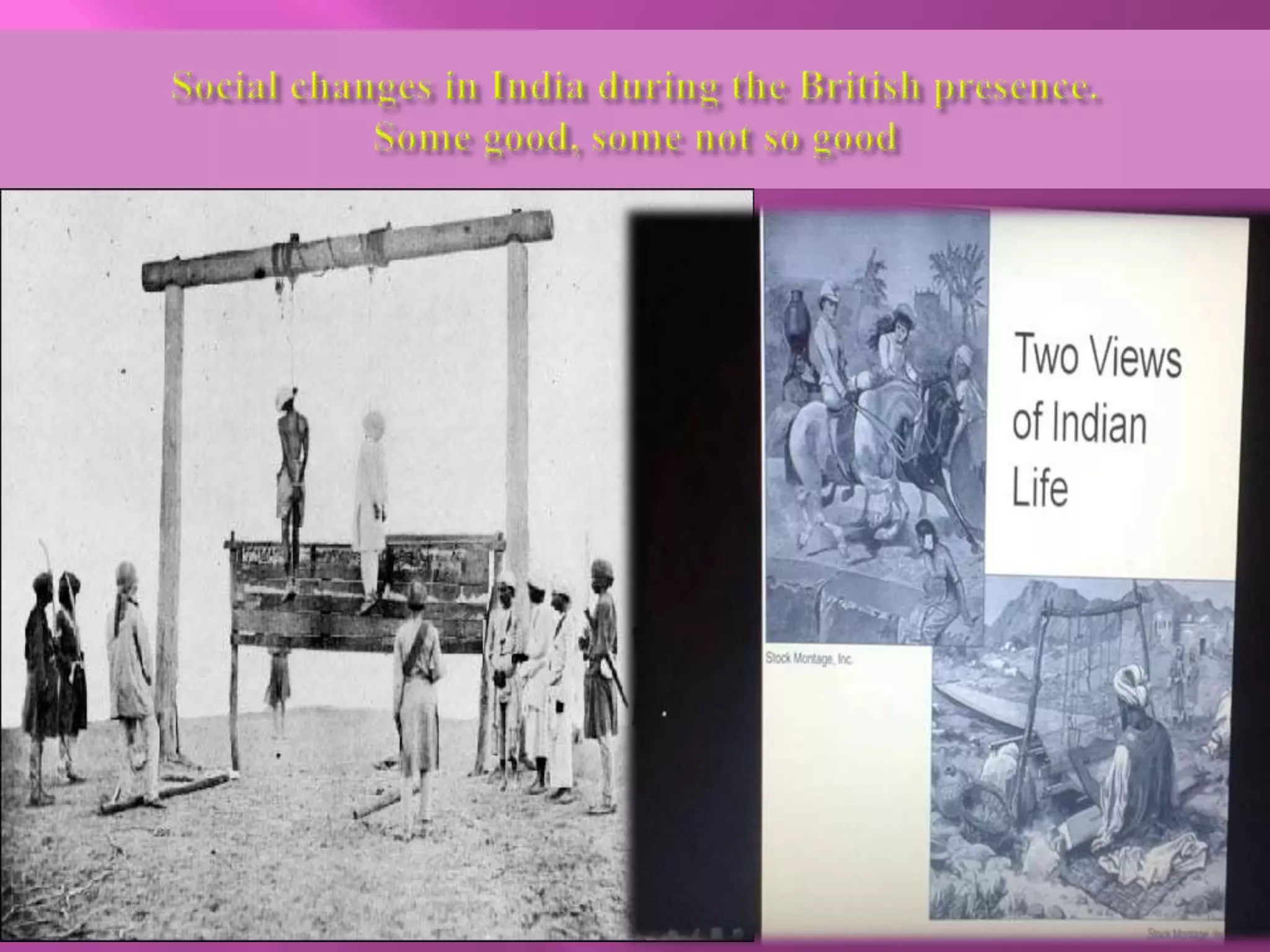
379 dead; over 1200 wounded! 
Making Salt 
Indian weaving was ruined by the competition of British 
machine-made textiles!
I’m going to play a clip from a popular 2000 Hindi film called Lagaan .In this scene the king of the area comes to the British captain who is in 
charge of the region. He asks the king to forgive the tax for the farmers, because it has not rained, and they cannot pay this year. The Captain 
agrees to forgive the tax, but on one condition. You will see what that condition is. Also notice the setting in which the discussion is taking 
place. They are basically having an english tea party. You remember that picture that I showed you from before, with the women riding the 
horses. The British tried to isolate themselves from everywhere else in India. Basically making a version of England in India. Which included 
dressing up in fancy clothes, which are completely inappropriate for the Indian heat, and having tea parties. A couple of things to watch for. 
Notice how the English captain talks about protecting the Indians with his army. He says that he is protecting the king from the neighboring 
king, who also happens to be his cousin. Pay attention to the way the Captain tries to destroy the honor of the Hindu king. And remember. 
The Hindu king rules in name only. He is allowed to stay because the British let him. The British are the ones who are in control.
 the world’s third largest railroad network was a major British achievement. 
 railroads enabled India to develop a modern economy and brought unity to the connected regions. 
 a modern road network, telephone and telegraph lines, dams, bridges, and irrigation canals 
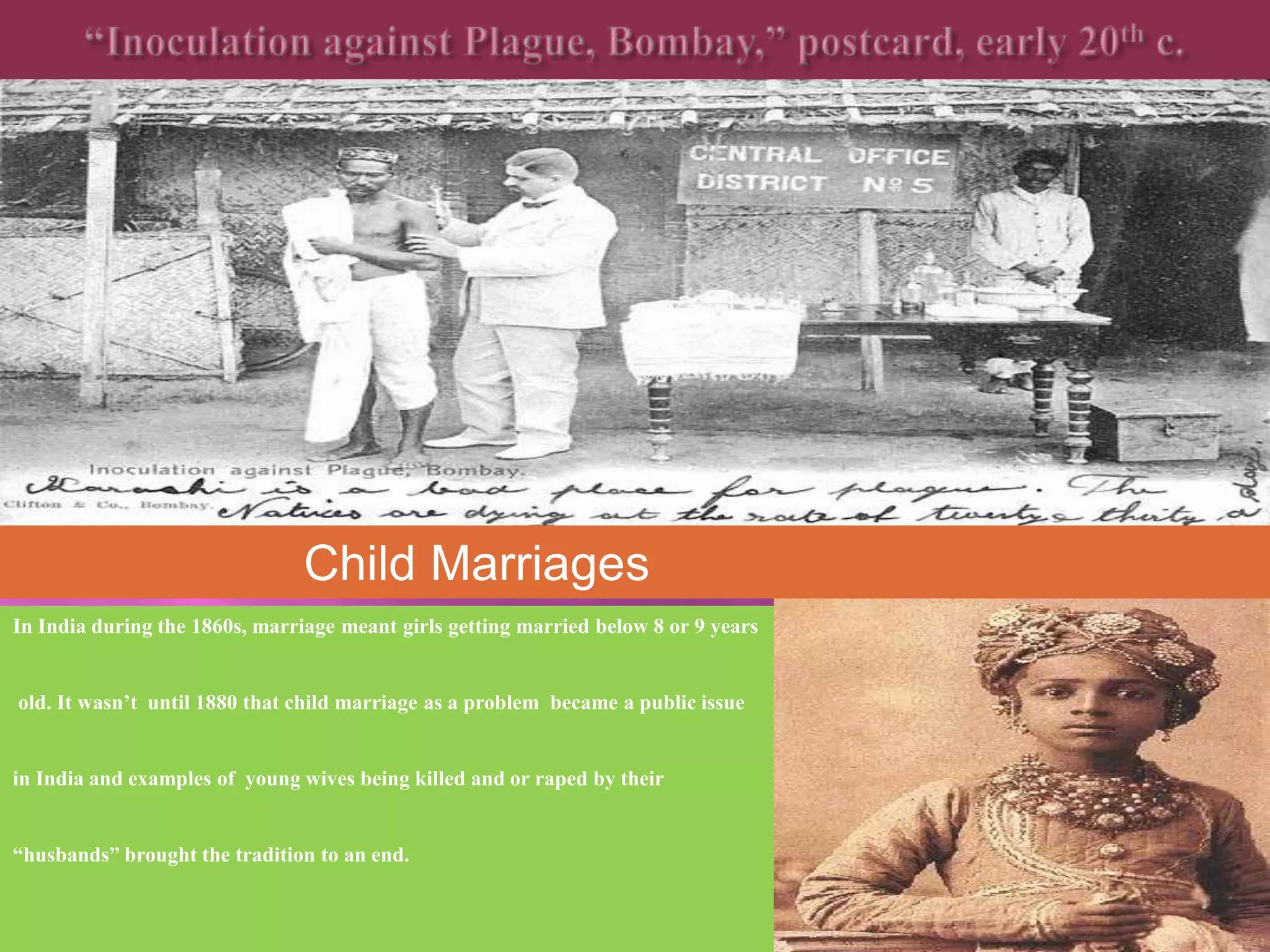
 Sanitation and public health improved. 
 Schools and colleges were founded, and literacy increased. 
 British troops cleared central India of bandits 
 End to local warfare among competing local rulers. 
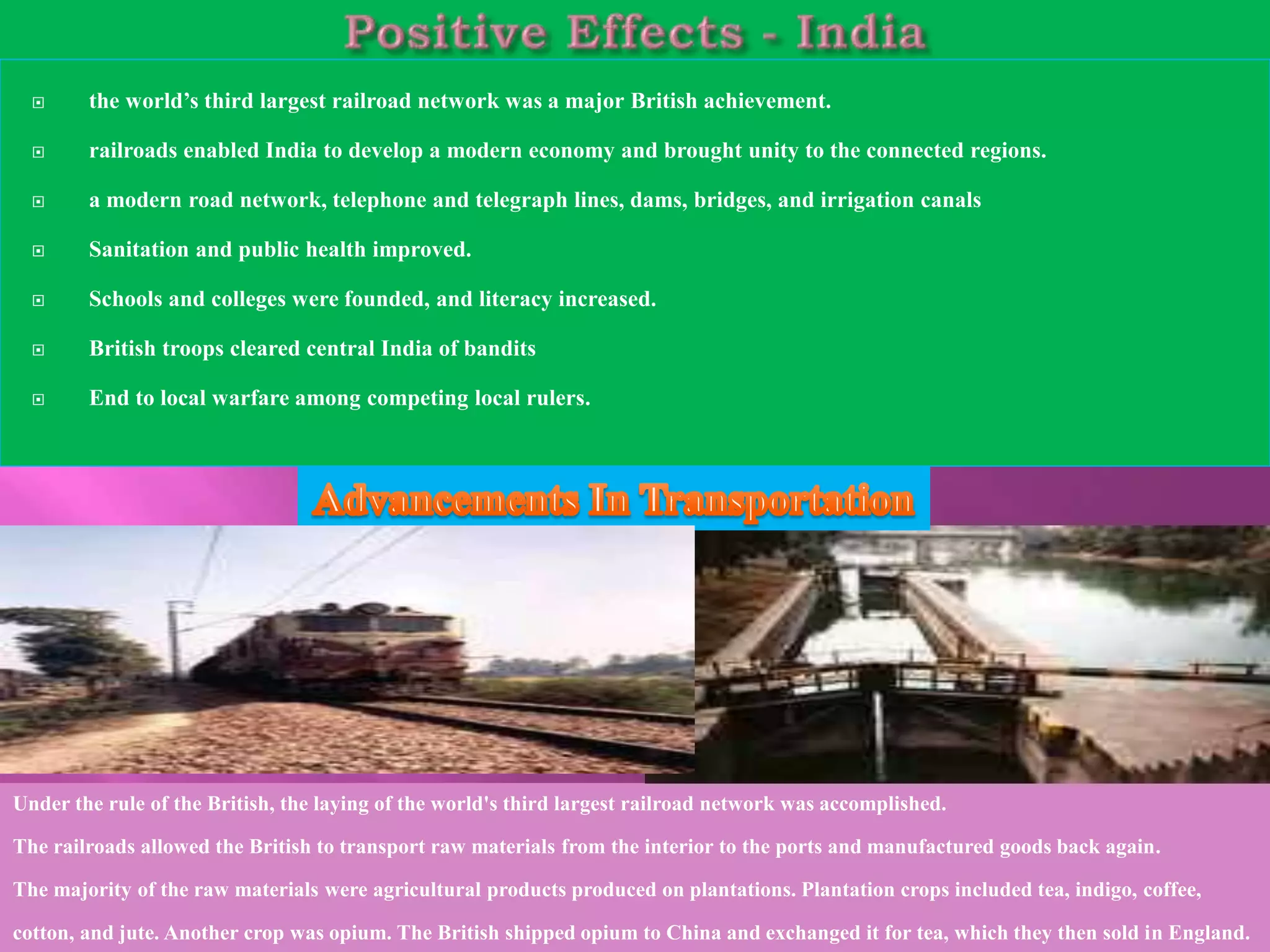
Under the rule of the British, the laying of the world's third largest railroad network was accomplished. 
The railroads allowed the British to transport raw materials from the interior to the ports and manufactured goods back again. 
The majority of the raw materials were agricultural products produced on plantations. Plantation crops included tea, indigo, coffee, 
cotton, and jute. Another crop was opium. The British shipped opium to China and exchanged it for tea, which they then sold in England.
British officer: “This Custom tho ' shocking to humanity we still allow in consequence of the revenue it brings in, which is of importance. I have 
also private reasons for not suppressing the burning system immediately.” 
British bishop: “Why my Lord, with a view to [O]economy under existing circumstances it might be imprudent to press the 
measure at present. Besides I think I feel also the private motives which actuates your Lordship.” 
Sati (Su-thi , a.k.a. suttee) is the traditional Hindu practice of a widow throwing herself on her husband's funeral pyre. 
Sati was prevalent among certain sects of the society in ancient India, who either took the vow or deemed it a great honor to die on the 
funeral pyres of their husbands.
Child Marriages 
In India during the 1860s, marriage meant girls getting married below 8 or 9 years 
old. It wasn’t until 1880 that child marriage as a problem became a public issue 
in India and examples of young wives being killed and or raped by their 
“husbands” brought the tradition to an end.
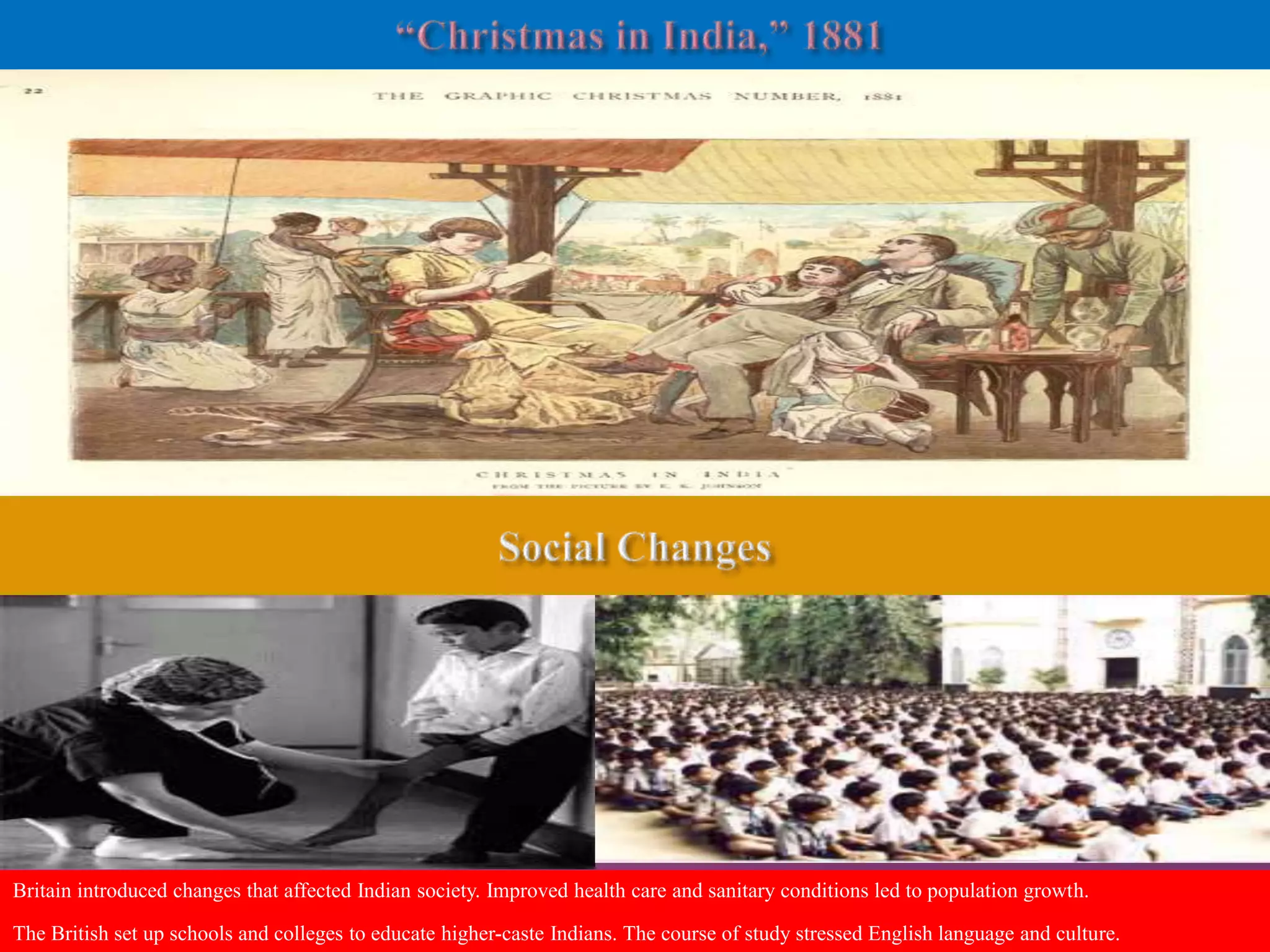
Britain introduced changes that affected Indian society. Improved health care and sanitary conditions led to population growth. 
The British set up schools and colleges to educate higher-caste Indians. The course of study stressed English language and culture.
 Harsh and racist actions against Indians 
 
 British held much of the political and economic power. 
 
 Restricted Indian-owned industries such as cotton textiles. 
 Conversion to cash crops reduced food production, causing famines in the late 1800s. 
 Loss of cultural practices and language
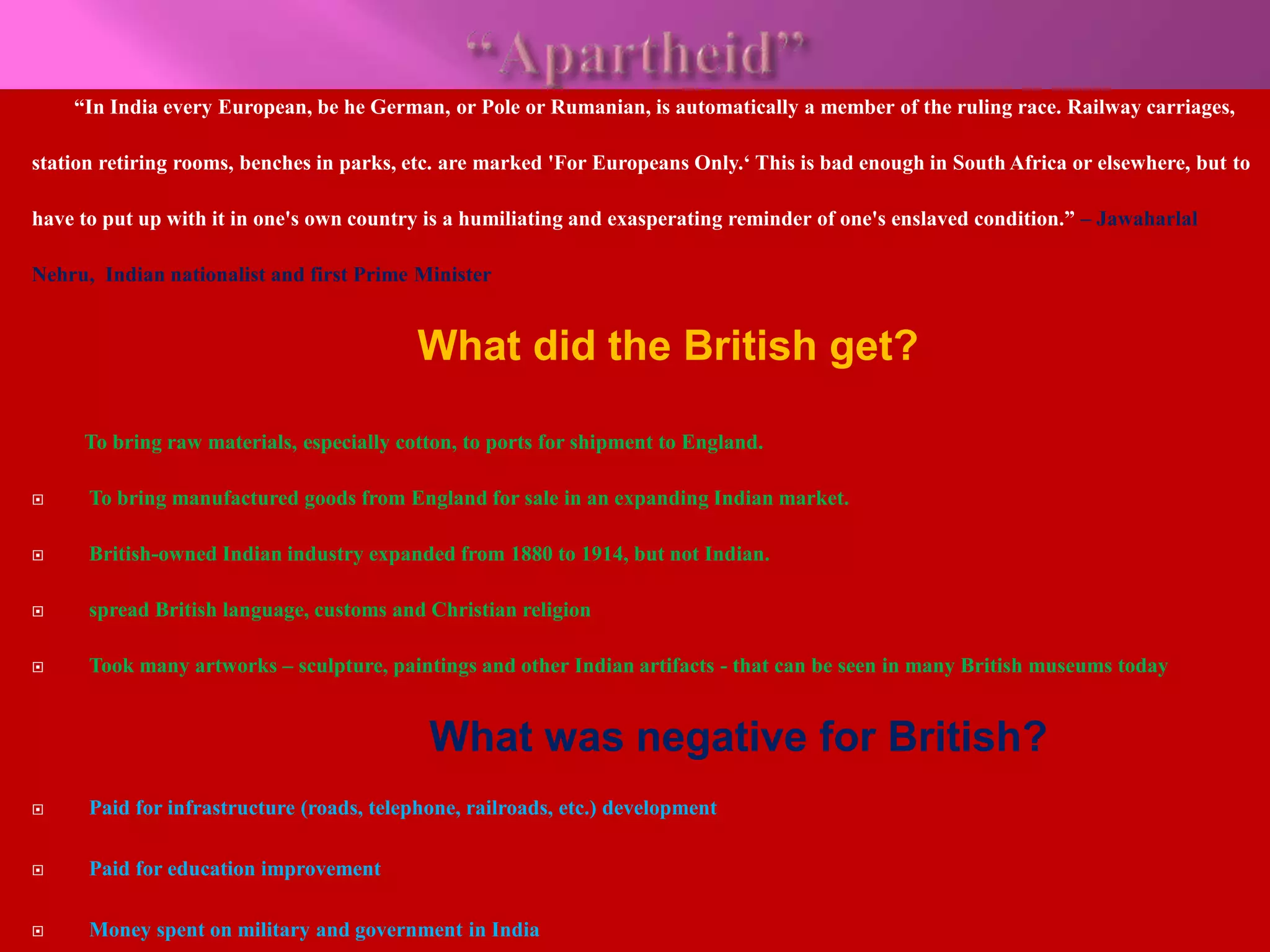
“In India every European, be he German, or Pole or Rumanian, is automatically a member of the ruling race. Railway carriages, 
station retiring rooms, benches in parks, etc. are marked 'For Europeans Only.‘ This is bad enough in South Africa or elsewhere, but to 
have to put up with it in one's own country is a humiliating and exasperating reminder of one's enslaved condition.” – Jawaharlal 
Nehru, Indian nationalist and first Prime Minister 
What did the British get? 
To bring raw materials, especially cotton, to ports for shipment to England. 
 To bring manufactured goods from England for sale in an expanding Indian market. 
 British-owned Indian industry expanded from 1880 to 1914, but not Indian. 
 spread British language, customs and Christian religion 
 Took many artworks – sculpture, paintings and other Indian artifacts - that can be seen in many British museums today 
What was negative for British? 
 Paid for infrastructure (roads, telephone, railroads, etc.) development 
 Paid for education improvement 
 Money spent on military and government in India
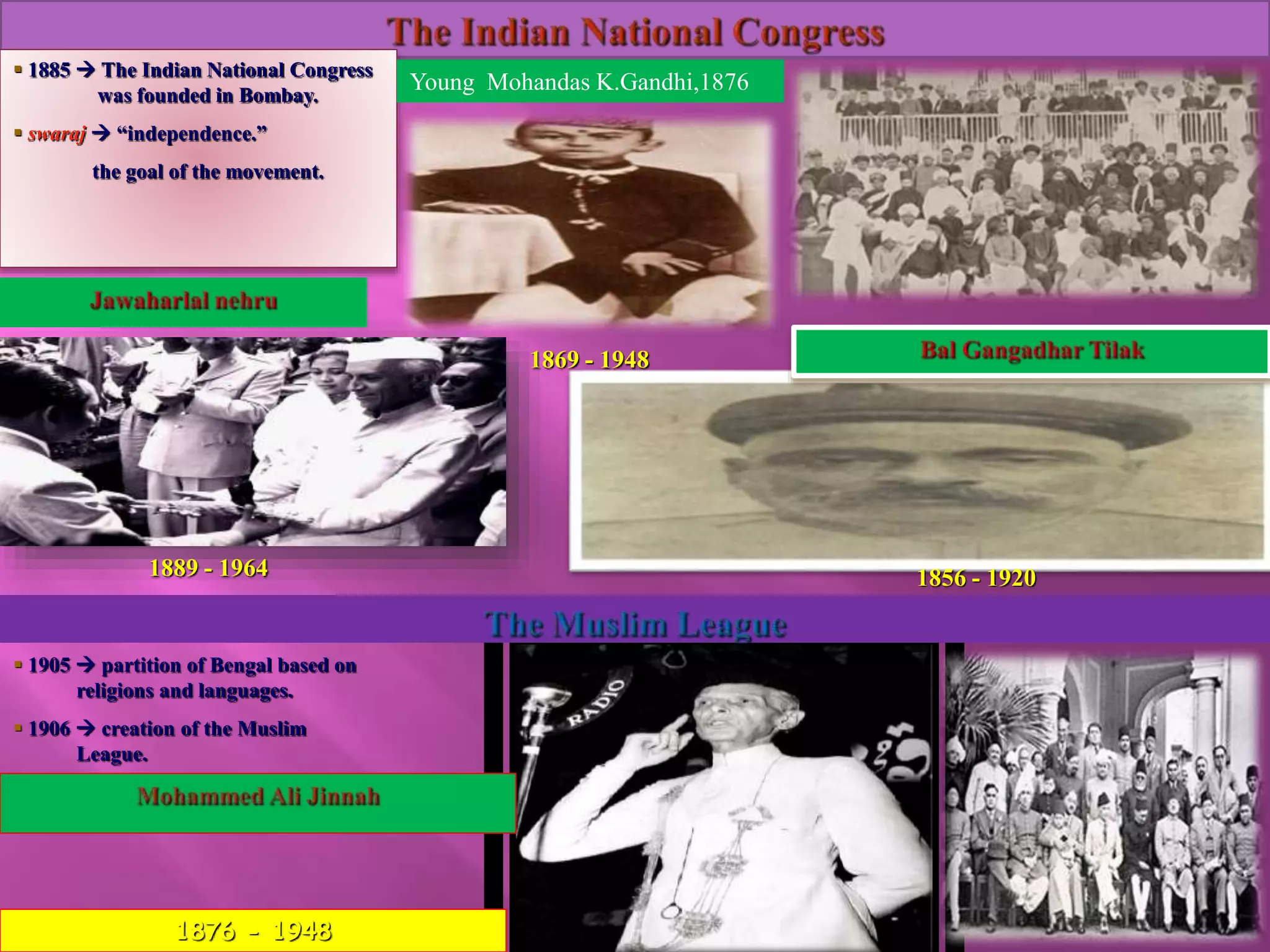
 1885  The Indian National Congress 
was founded in Bombay. 
 swaraj  “independence.” 
the goal of the movement. 
 1905  partition of Bengal based on 
religions and languages. 
 1906  creation of the Muslim 
League. 
1876 - 1948 
Young Mohandas K.Gandhi,1876 
1869 - 1948 
1889 - 1964 1856 - 1920
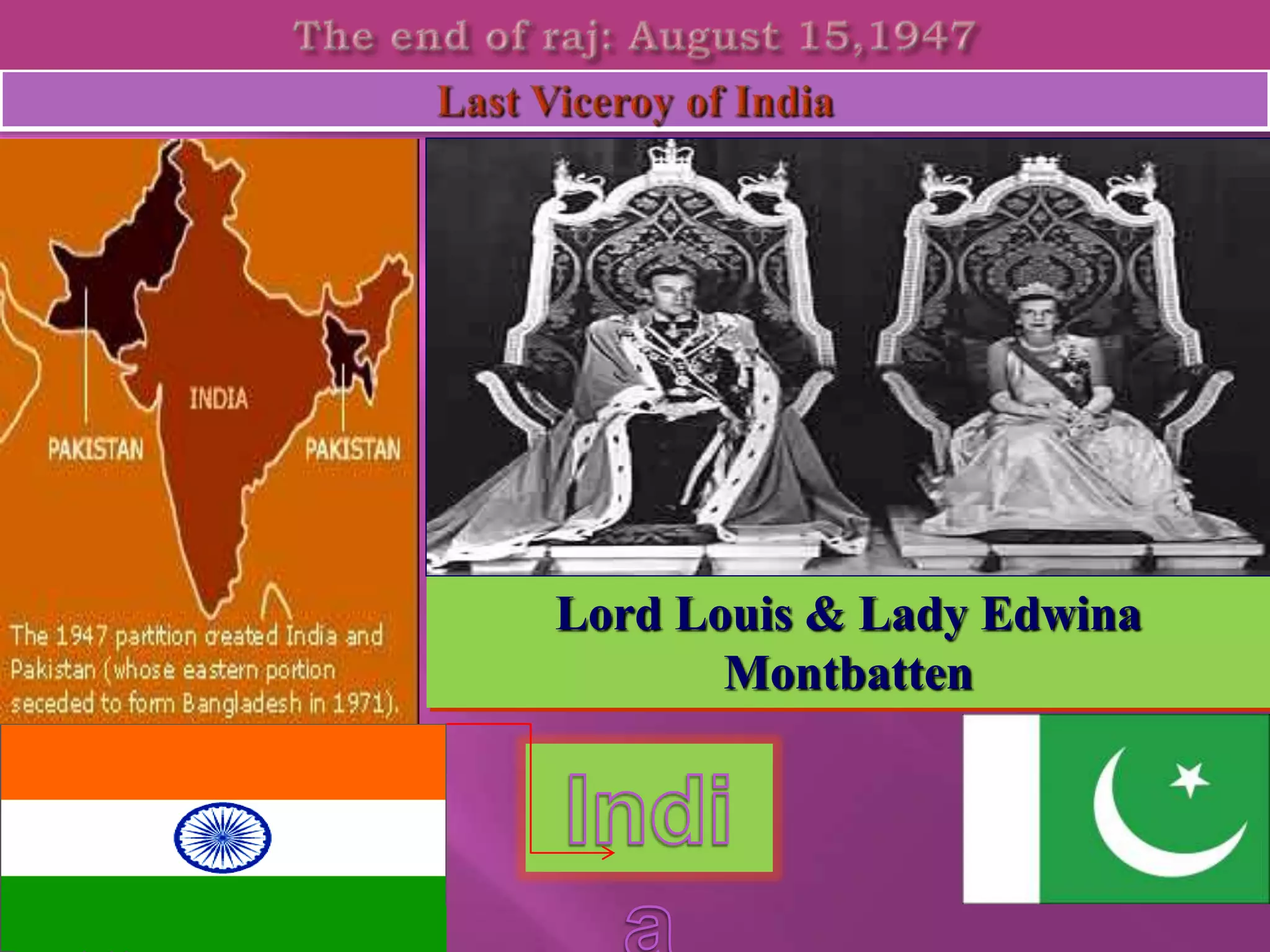
Lord Louis & Lady Edwina 
Montbatten
British rule

British rule

  • 5.
    Vasco da Gama Portugal
  • 6.
     1600s, theBritish East India Company set up trading posts at Bombay, Madras, and Calcutta.  At first, India’s ruling Mughal Dynasty kept European traders under control.  By 1707, however, the Mughal Empire was collapsing. Dozens of small states, each headed by a ruler or maharajah, broke away from Mughal control.
  • 7.
    Nawab siraj-ud-daulah RobertClive (1725-1774) The battle Opposing force : British East India Company :950 Europeans, 2100 Indians,few guns. Nawab of bengal :a total of 50,000 men with some heavy artillery. (arti llery operated by about 40 French soilders) (16,000 men under Mir jafar ,others under Yar Latif and Raj Durlabh) (almost all the major comman - ders were conspirators, except Mir Madan ) Only about 15,000 men from the nawab’s army participated in the battle. The battle opened at 7:00 a.m. on 23 june 1757 the nawab soon become apprehensive as his generals were not participating Nawab force mad some gains but finally losse because of betrayed of Mir jafar and british back attack on broking war rule………
  • 8.
     A Britishcompany that basically ran India  Gained control after a decisive victory at the Battle of Plassey in 1757  Controlled an area that included modern BD, most of southern  India, and nearly all the territory along the Ganges River in the north.  During the 1700’s and 1800’s the East India Company slowly took control of India  As the Mughal Empire grew weak, the East India Company grew in economic and political strength and began to build its own military force  The military force mainly consisted of sepoys, Indian soldiers,  led by British commanders
  • 9.
    Cotton Silk Tea r. 1773 - 1784 r. 1828 - 1835 r. 1786 - 1793 r. 1848 - 1856
  • 10.
     Became likea foreign gov’t.  Took more land  Forced Indian rulers to sign treaties granting it power  Collected taxes from Indians  Est. law code & courts Robert Clive (1725-1774)  Traditional rivalries kept Indian rulers from uniting against the British.  The British encouraged disunity among Indian leaders  East India Company controlled some land directly, others indirectly through local princes  East India Company earned the right to collect taxes, set up a law code, set up a court system  Indians had many grievances against British rule.  British outlawed Hindu ritual suicide by widows  British imposed high taxes  Christian missionaries tried to convert Hindus
  • 11.
    • Ninety-six percentof the company's of army of 300,000 men in India were native to India • British believed they were superior and looked down upon their dark-skinned compatriots • In the military, Sepoys could not be promoted to high ranks and the pay was miserable. • British did not respect Indian cultural or religious traditions and beliefs. • The controversy over the use of the Enfield rifle In 1857, new cartridges were issued to Indian troops of the British East Indian Army. The cartridges were rumored to have been greased with cow or pig grease; as such, they were forbidden to the Indian troops because of their religious beliefs. Moslems believe that pigs are unholy, and Hindus believe that it is unholy to kill a cow. The cartridges of this time required a soldier to tear open the cartridge with his teeth, and pour the powder & bullet down the barrel of the gun. This process would have caused the Sepoys to get soul polluting grease directly into their bodies.
  • 12.
    After refusing touse the new cartrdiges, a whole regiment of Sepoy troops were imprisoned by the British. Other Sepoys attempted to free these prisoners and it snowballed into a revolt across all of northern India. There were many massacres where hundreds Of Europeans were killed by Sepoys who were bent on revenge and on kicking the British out of India.
  • 13.
    The mutiny markeda turning point in Indian history. As a result of the mutiny, in 1858 the British government took direct command of India. The part of India that was under direct British rule was called the Raj. The term Raj referred to British rule over India from 1757 until 1914. Tie them to a cannon, and fire the cannon.
  • 14.
     second-class citizensin their own country.  Even Indians with a European education faced discrimination.  barred from top posts in the Indian Civil Service.  paid less than Europeans.
  • 15.
    British government tookover India as a colony. British ruled most of India directly but a third was still ruled by local princes who signed treaties giving Britain control of foreign and military affairs. Britain reformed the law code and set up its own court system. Britain set up its own civil service, body of officials, to rule the colony. The Britsh East India Company ruled India with little interference from the British government.The company even had its own army, led by British officers and staffed by sepoys, or Indian soldiers. Most of the company's troops were Hindus or Muslims. About one in six was British. Yet, only the British could be commissioned officers; no Indian could reach a higher rank than that of petty officer.
  • 16.
    The British heldmuch of the political and economic power. British policies called for India to produce raw materials for British manufacturing and to buy British manufactured goods. In addition, Indian competition with British goods was prohibited. For example, India's own handloom textile industry was almost put out of business by British textiles. Cheap cloth and ready-made clothes from England flooded the Indian market and drove out local producers. To pay for British imports, Indians had to raise cash crops such as tea, pepper, coffee, and cotton. As Indian farmers grew less food, famines became frequent and widespread. Also, under the imperial control of the East India Company, an increasing number of small Indian states were forced to pay dues to the Company for military protection. The lessening of Company profits and a need to recoup debts generated by military efforts, produced a need for higher revenues. Peasant landowners, required to pay their taxes in cash, increasingly had to turn to moneylenders who seized much of this land for nonpayment of loans.
  • 17.
    379 dead; over1200 wounded! Making Salt Indian weaving was ruined by the competition of British machine-made textiles!
  • 18.
    I’m going toplay a clip from a popular 2000 Hindi film called Lagaan .In this scene the king of the area comes to the British captain who is in charge of the region. He asks the king to forgive the tax for the farmers, because it has not rained, and they cannot pay this year. The Captain agrees to forgive the tax, but on one condition. You will see what that condition is. Also notice the setting in which the discussion is taking place. They are basically having an english tea party. You remember that picture that I showed you from before, with the women riding the horses. The British tried to isolate themselves from everywhere else in India. Basically making a version of England in India. Which included dressing up in fancy clothes, which are completely inappropriate for the Indian heat, and having tea parties. A couple of things to watch for. Notice how the English captain talks about protecting the Indians with his army. He says that he is protecting the king from the neighboring king, who also happens to be his cousin. Pay attention to the way the Captain tries to destroy the honor of the Hindu king. And remember. The Hindu king rules in name only. He is allowed to stay because the British let him. The British are the ones who are in control.
  • 19.
     the world’sthird largest railroad network was a major British achievement.  railroads enabled India to develop a modern economy and brought unity to the connected regions.  a modern road network, telephone and telegraph lines, dams, bridges, and irrigation canals  Sanitation and public health improved.  Schools and colleges were founded, and literacy increased.  British troops cleared central India of bandits  End to local warfare among competing local rulers. Under the rule of the British, the laying of the world's third largest railroad network was accomplished. The railroads allowed the British to transport raw materials from the interior to the ports and manufactured goods back again. The majority of the raw materials were agricultural products produced on plantations. Plantation crops included tea, indigo, coffee, cotton, and jute. Another crop was opium. The British shipped opium to China and exchanged it for tea, which they then sold in England.
  • 20.
    British officer: “ThisCustom tho ' shocking to humanity we still allow in consequence of the revenue it brings in, which is of importance. I have also private reasons for not suppressing the burning system immediately.” British bishop: “Why my Lord, with a view to [O]economy under existing circumstances it might be imprudent to press the measure at present. Besides I think I feel also the private motives which actuates your Lordship.” Sati (Su-thi , a.k.a. suttee) is the traditional Hindu practice of a widow throwing herself on her husband's funeral pyre. Sati was prevalent among certain sects of the society in ancient India, who either took the vow or deemed it a great honor to die on the funeral pyres of their husbands.
  • 21.
    Child Marriages InIndia during the 1860s, marriage meant girls getting married below 8 or 9 years old. It wasn’t until 1880 that child marriage as a problem became a public issue in India and examples of young wives being killed and or raped by their “husbands” brought the tradition to an end.
  • 22.
    Britain introduced changesthat affected Indian society. Improved health care and sanitary conditions led to population growth. The British set up schools and colleges to educate higher-caste Indians. The course of study stressed English language and culture.
  • 23.
     Harsh andracist actions against Indians   British held much of the political and economic power.   Restricted Indian-owned industries such as cotton textiles.  Conversion to cash crops reduced food production, causing famines in the late 1800s.  Loss of cultural practices and language
  • 25.
    “In India everyEuropean, be he German, or Pole or Rumanian, is automatically a member of the ruling race. Railway carriages, station retiring rooms, benches in parks, etc. are marked 'For Europeans Only.‘ This is bad enough in South Africa or elsewhere, but to have to put up with it in one's own country is a humiliating and exasperating reminder of one's enslaved condition.” – Jawaharlal Nehru, Indian nationalist and first Prime Minister What did the British get? To bring raw materials, especially cotton, to ports for shipment to England.  To bring manufactured goods from England for sale in an expanding Indian market.  British-owned Indian industry expanded from 1880 to 1914, but not Indian.  spread British language, customs and Christian religion  Took many artworks – sculpture, paintings and other Indian artifacts - that can be seen in many British museums today What was negative for British?  Paid for infrastructure (roads, telephone, railroads, etc.) development  Paid for education improvement  Money spent on military and government in India
  • 26.
     1885 The Indian National Congress was founded in Bombay.  swaraj  “independence.” the goal of the movement.  1905  partition of Bengal based on religions and languages.  1906  creation of the Muslim League. 1876 - 1948 Young Mohandas K.Gandhi,1876 1869 - 1948 1889 - 1964 1856 - 1920
  • 27.
    Lord Louis &Lady Edwina Montbatten