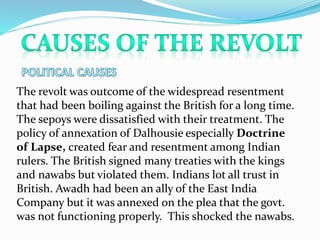
 The revolt of 1857 was the landmark in the history of
India’s struggle for freedom. It started on May 10 1857.
Delhi was a mute witness to a band of sepoys crossing
over the Yamuna and entering Red fort. They appealed
to the aged Mughal emperor Bahadur Shah, an
emperor without any authority, to take over the
leadership of the revolt. He was proclaimed the
shahenshah e hindustan. The sepoys captured the city
of Delhi, killed many englishmen and ransacked many
public offices.
 The event was called the Uprising, the Revolt of 1857 or
the Sepoy Mutiny by the British. But Indian historian
called it the first war of independence as it was the
first time that different sections of Indian society
united and fought as one nation to throw off the
shackles of foreign domination. Ever since Britishers
have set foot on our soil, the nation was losing its
wealth and independence. They sent foreign wealth
home back in England. Their motive was to exploit
the resources of our country. This angered the Indians
and finally in 1857 a number of Indians revolted.
The revolt was outcome of the widespread resentment
that had been boiling against the British for a long time.
The sepoys were dissatisfied with their treatment. The
policy of annexation of Dalhousie especially Doctrine
of Lapse, created fear and resentment among Indian
rulers. The British signed many treaties with the kings
and nawabs but violated them. Indians lot all trust in
British. Awadh had been an ally of the East India
Company but it was annexed on the plea that the govt.
was not functioning properly. This shocked the nawabs.
ECONOMIC CAUSES
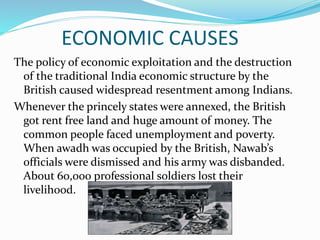
The policy of economic exploitation and the destruction
of the traditional India economic structure by the
British caused widespread resentment among Indians.
Whenever the princely states were annexed, the British
got rent free land and huge amount of money. The
common people faced unemployment and poverty.
When awadh was occupied by the British, Nawab’s
officials were dismissed and his army was disbanded.
About 60,000 professional soldiers lost their
livelihood.
SOCIAL AND RELIGIOUS CAUSES
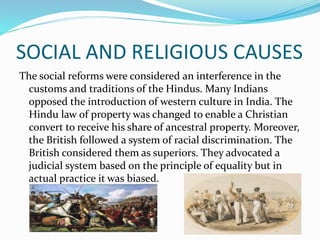
The social reforms were considered an interference in the
customs and traditions of the Hindus. Many Indians
opposed the introduction of western culture in India. The
Hindu law of property was changed to enable a Christian
convert to receive his share of ancestral property. Moreover,
the British followed a system of racial discrimination. The
British considered them as superiors. They advocated a
judicial system based on the principle of equality but in
actual practice it was biased.
MILITARY CAUSES
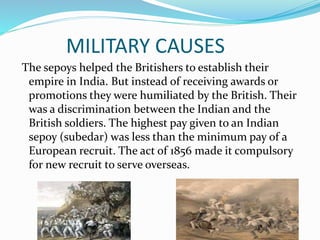
The sepoys helped the Britishers to establish their
empire in India. But instead of receiving awards or
promotions they were humiliated by the British. Their
was a discrimination between the Indian and the
British soldiers. The highest pay given to an Indian
sepoy (subedar) was less than the minimum pay of a
European recruit. The act of 1856 made it compulsory
for new recruit to serve overseas.
IMMIDIATE CAUSES
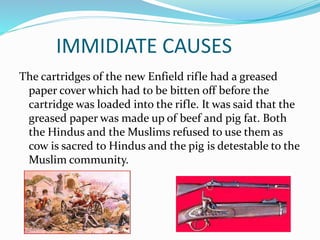
The cartridges of the new Enfield rifle had a greased
paper cover which had to be bitten off before the
cartridge was loaded into the rifle. It was said that the
greased paper was made up of beef and pig fat. Both
the Hindus and the Muslims refused to use them as
cow is sacred to Hindus and the pig is detestable to the
Muslim community.
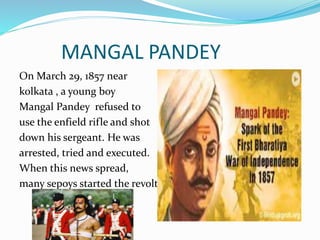
MANGAL PANDEY
On March 29, 1857 near
kolkata , a young boy
Mangal Pandey refused to
use the enfield rifle and shot
down his sergeant. He was
arrested, tried and executed.
When this news spread,
many sepoys started the revolt.
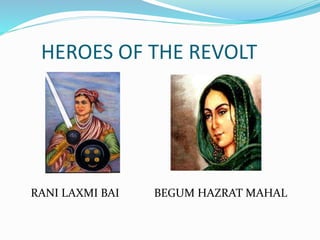
HEROES OF THE REVOLT
RANI LAXMI BAI BEGUM HAZRAT MAHAL
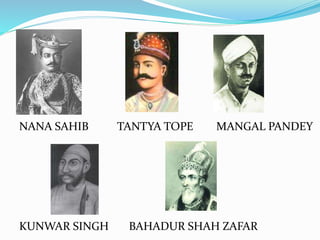
NANA SAHIB TANTYA TOPE MANGAL PANDEY
KUNWAR SINGH BAHADUR SHAH ZAFAR
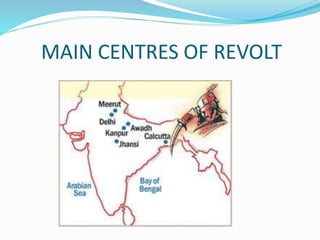
MAIN CENTRES OF REVOLT
SUPPRESION OF THE REVOLT
British army freed Delhi, the epicenter of the revolt.
Bahadur Shah Zafar was tried and sent to Rangoon.
His children were killed. The control of Delhi and
imprisonment of Bahadur shah Zafar broke the
backbone of the mutiny. Luknow was recaptured in
1858. Rani Lakshmi Bai was killed and Tantya Tope was
captured and hanged to death.
CAUSES OF FAILURE OF REVOLT
 The Uprising had been planned for months but it broke
before the due date. It was not widespread.
 There was no unity among the rebels. The ideas of
nationalism had not yet developed. There was no common
ideology.
 It was limited to north and central India . Gurkhas helped
the British to suppress the revolt.
 The rebels could not match the sophisticated weapons of
the British .
 The leadership was neither strong nor gave directions to
the rebels. Moreover the British got timely help from the
government of Britain.
RESULTS OF THE REVOLT
 The rule of East India Company ended with Queen
Victoria’s Proclamation of Nov. 1 1858. She assumed the
title of the Empress of India.
 A secretary of state for India Affairs was appointed to look
after the governance of India with the help of a council. He
was called Viceroy.
 The policy of ruthless conquests and annexations of Indian
territories was given up. The Indian princes were given the
assurance that their states would not be annexed and were
given the right to adoption.
 Full religious freedom was granted to the Indians. They
were also given assurance that high posts would be given to
them without any discrimination.
LETS NOT FORGET THAT GREAT FIRST WAR OF
INDEPENDENCE WHICH BECAME A TRUE
INSPIRATION FOR THE LATER FREEDOM
STRUGLES. JAI HIND!!!
Made by- ARNAV
Submitted to- MRS. KAVITA MAM

The revolt of 1857

  • 2.
     The revoltof 1857 was the landmark in the history of India’s struggle for freedom. It started on May 10 1857. Delhi was a mute witness to a band of sepoys crossing over the Yamuna and entering Red fort. They appealed to the aged Mughal emperor Bahadur Shah, an emperor without any authority, to take over the leadership of the revolt. He was proclaimed the shahenshah e hindustan. The sepoys captured the city of Delhi, killed many englishmen and ransacked many public offices.
  • 3.
     The eventwas called the Uprising, the Revolt of 1857 or the Sepoy Mutiny by the British. But Indian historian called it the first war of independence as it was the first time that different sections of Indian society united and fought as one nation to throw off the shackles of foreign domination. Ever since Britishers have set foot on our soil, the nation was losing its wealth and independence. They sent foreign wealth home back in England. Their motive was to exploit the resources of our country. This angered the Indians and finally in 1857 a number of Indians revolted.
  • 4.
    The revolt wasoutcome of the widespread resentment that had been boiling against the British for a long time. The sepoys were dissatisfied with their treatment. The policy of annexation of Dalhousie especially Doctrine of Lapse, created fear and resentment among Indian rulers. The British signed many treaties with the kings and nawabs but violated them. Indians lot all trust in British. Awadh had been an ally of the East India Company but it was annexed on the plea that the govt. was not functioning properly. This shocked the nawabs.
  • 5.
    ECONOMIC CAUSES The policyof economic exploitation and the destruction of the traditional India economic structure by the British caused widespread resentment among Indians. Whenever the princely states were annexed, the British got rent free land and huge amount of money. The common people faced unemployment and poverty. When awadh was occupied by the British, Nawab’s officials were dismissed and his army was disbanded. About 60,000 professional soldiers lost their livelihood.
  • 6.
    SOCIAL AND RELIGIOUSCAUSES The social reforms were considered an interference in the customs and traditions of the Hindus. Many Indians opposed the introduction of western culture in India. The Hindu law of property was changed to enable a Christian convert to receive his share of ancestral property. Moreover, the British followed a system of racial discrimination. The British considered them as superiors. They advocated a judicial system based on the principle of equality but in actual practice it was biased.
  • 7.
    MILITARY CAUSES The sepoyshelped the Britishers to establish their empire in India. But instead of receiving awards or promotions they were humiliated by the British. Their was a discrimination between the Indian and the British soldiers. The highest pay given to an Indian sepoy (subedar) was less than the minimum pay of a European recruit. The act of 1856 made it compulsory for new recruit to serve overseas.
  • 8.
    IMMIDIATE CAUSES The cartridgesof the new Enfield rifle had a greased paper cover which had to be bitten off before the cartridge was loaded into the rifle. It was said that the greased paper was made up of beef and pig fat. Both the Hindus and the Muslims refused to use them as cow is sacred to Hindus and the pig is detestable to the Muslim community.
  • 9.
    MANGAL PANDEY On March29, 1857 near kolkata , a young boy Mangal Pandey refused to use the enfield rifle and shot down his sergeant. He was arrested, tried and executed. When this news spread, many sepoys started the revolt.
  • 10.
    HEROES OF THEREVOLT RANI LAXMI BAI BEGUM HAZRAT MAHAL
  • 11.
    NANA SAHIB TANTYATOPE MANGAL PANDEY KUNWAR SINGH BAHADUR SHAH ZAFAR
  • 12.
  • 13.
    SUPPRESION OF THEREVOLT British army freed Delhi, the epicenter of the revolt. Bahadur Shah Zafar was tried and sent to Rangoon. His children were killed. The control of Delhi and imprisonment of Bahadur shah Zafar broke the backbone of the mutiny. Luknow was recaptured in 1858. Rani Lakshmi Bai was killed and Tantya Tope was captured and hanged to death.
  • 14.
    CAUSES OF FAILUREOF REVOLT  The Uprising had been planned for months but it broke before the due date. It was not widespread.  There was no unity among the rebels. The ideas of nationalism had not yet developed. There was no common ideology.  It was limited to north and central India . Gurkhas helped the British to suppress the revolt.  The rebels could not match the sophisticated weapons of the British .  The leadership was neither strong nor gave directions to the rebels. Moreover the British got timely help from the government of Britain.
  • 15.
    RESULTS OF THEREVOLT  The rule of East India Company ended with Queen Victoria’s Proclamation of Nov. 1 1858. She assumed the title of the Empress of India.  A secretary of state for India Affairs was appointed to look after the governance of India with the help of a council. He was called Viceroy.  The policy of ruthless conquests and annexations of Indian territories was given up. The Indian princes were given the assurance that their states would not be annexed and were given the right to adoption.  Full religious freedom was granted to the Indians. They were also given assurance that high posts would be given to them without any discrimination.
  • 16.
    LETS NOT FORGETTHAT GREAT FIRST WAR OF INDEPENDENCE WHICH BECAME A TRUE INSPIRATION FOR THE LATER FREEDOM STRUGLES. JAI HIND!!! Made by- ARNAV Submitted to- MRS. KAVITA MAM