
INTERPERSONAL
PSYCHOTHERAPY
By: Teo Qian Hua
Chen Xiu Wen
Teo Meijun
Gerald L. Klerman & Myrna M. Weissman
INTERPERSONAL PSYCHOTHERAPY
ü Time-limited therapy (12-20 sessions)
ü Especially designed for depression
ü ‘here-and-now’ framework

Focus on current interpersonal issues
ü Medical model
Depression as treatable
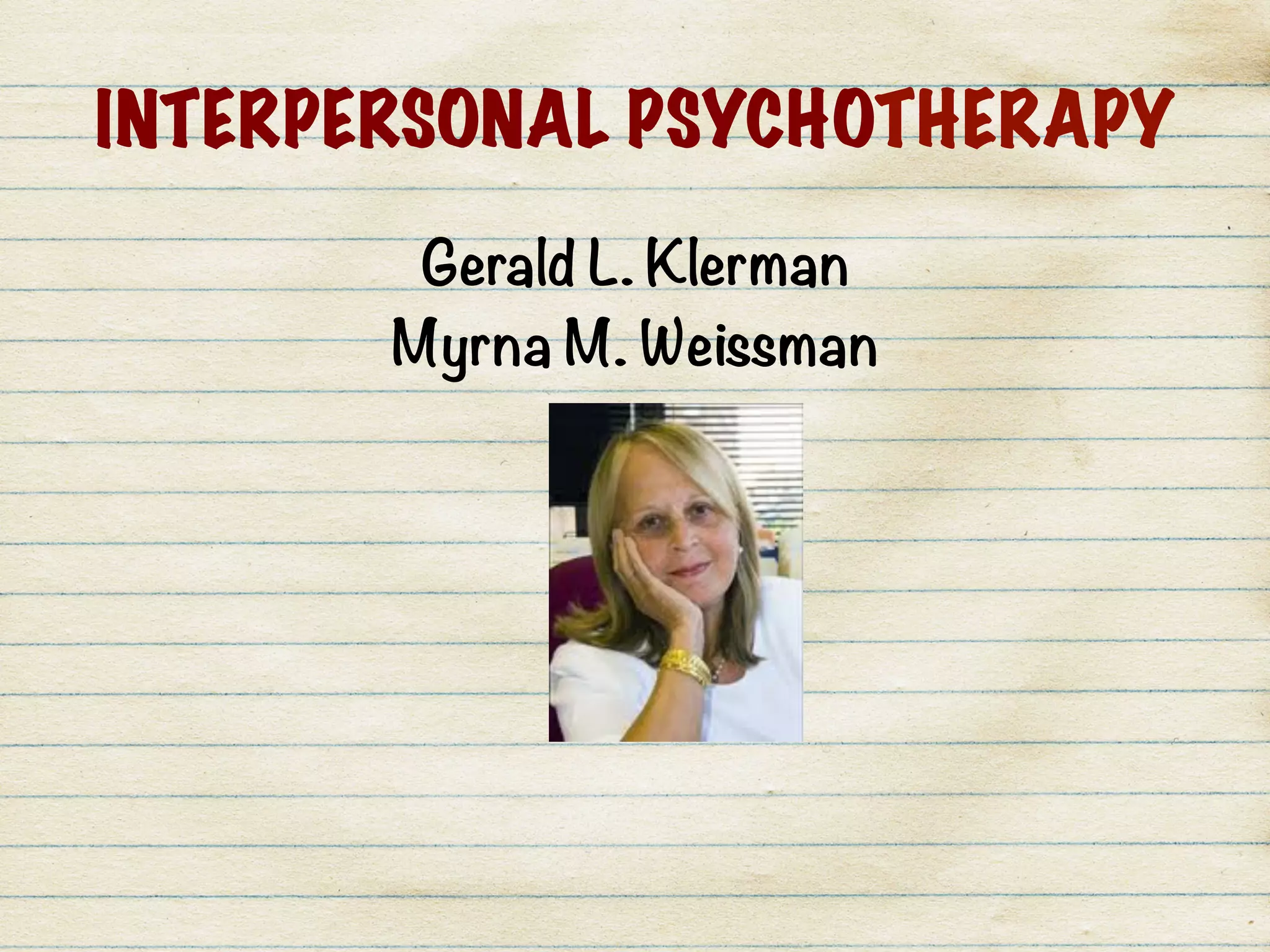
Gerald L. Klerman 
Myrna M. Weissman 
INTERPERSONAL PSYCHOTHERAPY
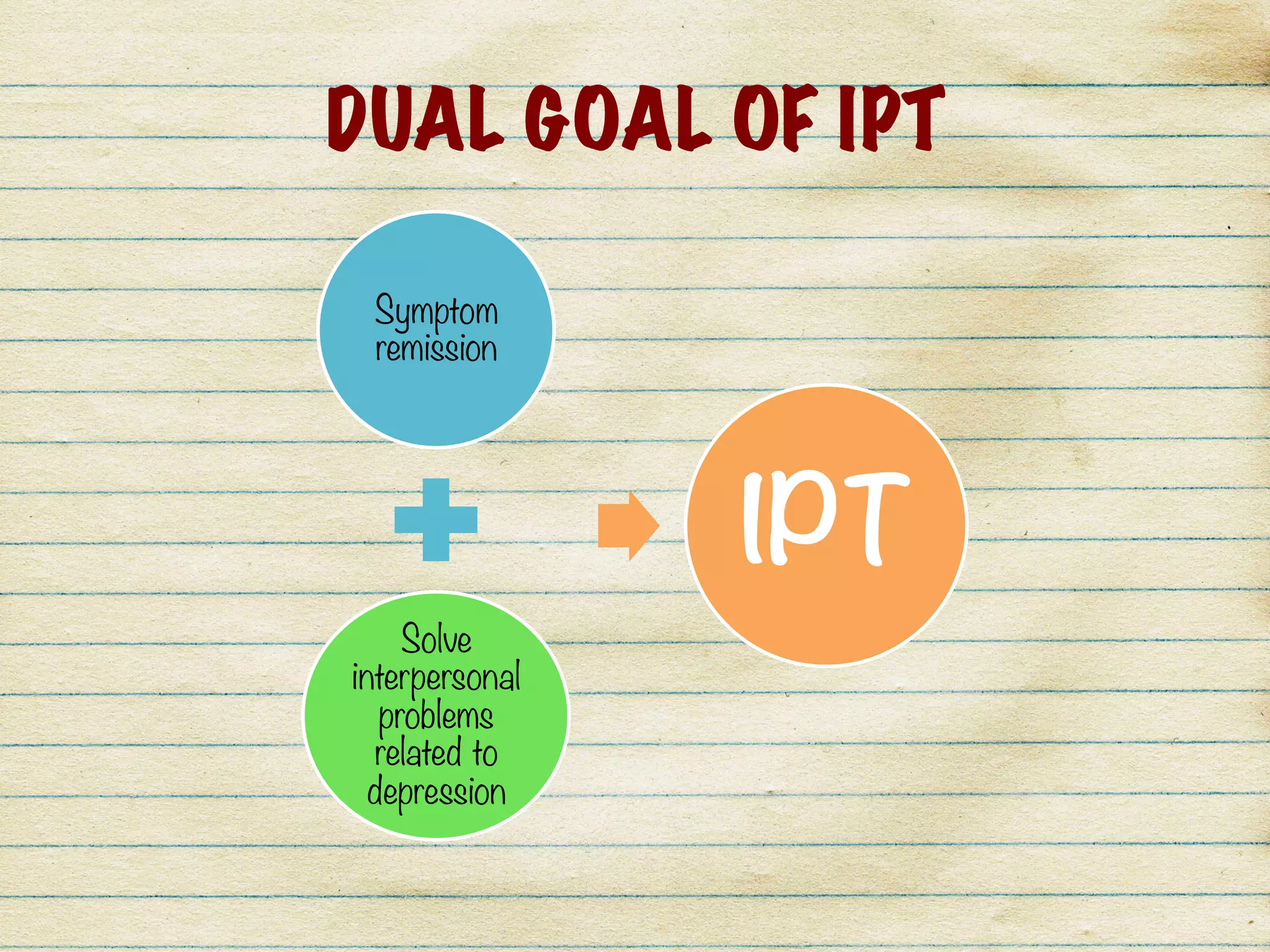
DUAL GOAL OF IPT
Symptom
remission
Solve
interpersonal
problems
related to
depression
IPT
THEORETICAL BASIS
ü Interpersonal theory 
ü Adolf Meyer & Harry Stack Sullivan
ü Focus on the importance of interpersonal
relationships in determining behavior
ü Psychological illness develops out of interpersonal
disruptions
ü Help patients to increase their
understanding of the interpersonal events
that triggered depression
THEORETICAL BASIS
ü Attachment theory
ü People have the fundamental need to form strong
bonds with others. 
ü When these bonds are disrupted, the individual will
experience emotional distress

ü IPT targets interpersonal relationships that may affect
patient’s attachment experiences
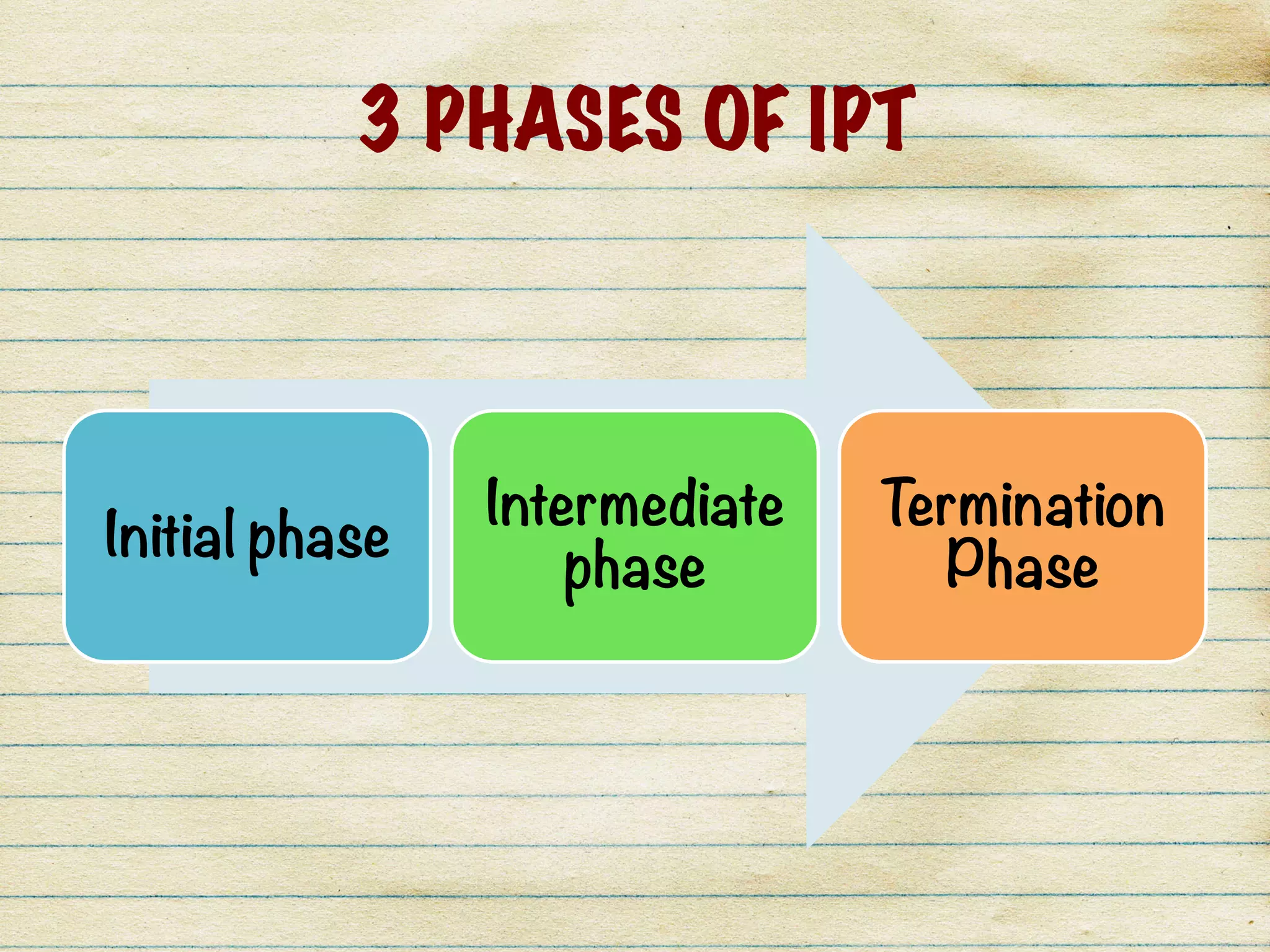
3 PHASES OF IPT
Initial phase
Intermediate
phase
Termination
Phase
Initial phase
ü Diagnosis

ü Psycho-education
•  Symptoms and behaviors
of depression
•  Assign ‘sick role’ to patient
ü Identify interpersonal
issues most related to
current depression
•  4 problem areas
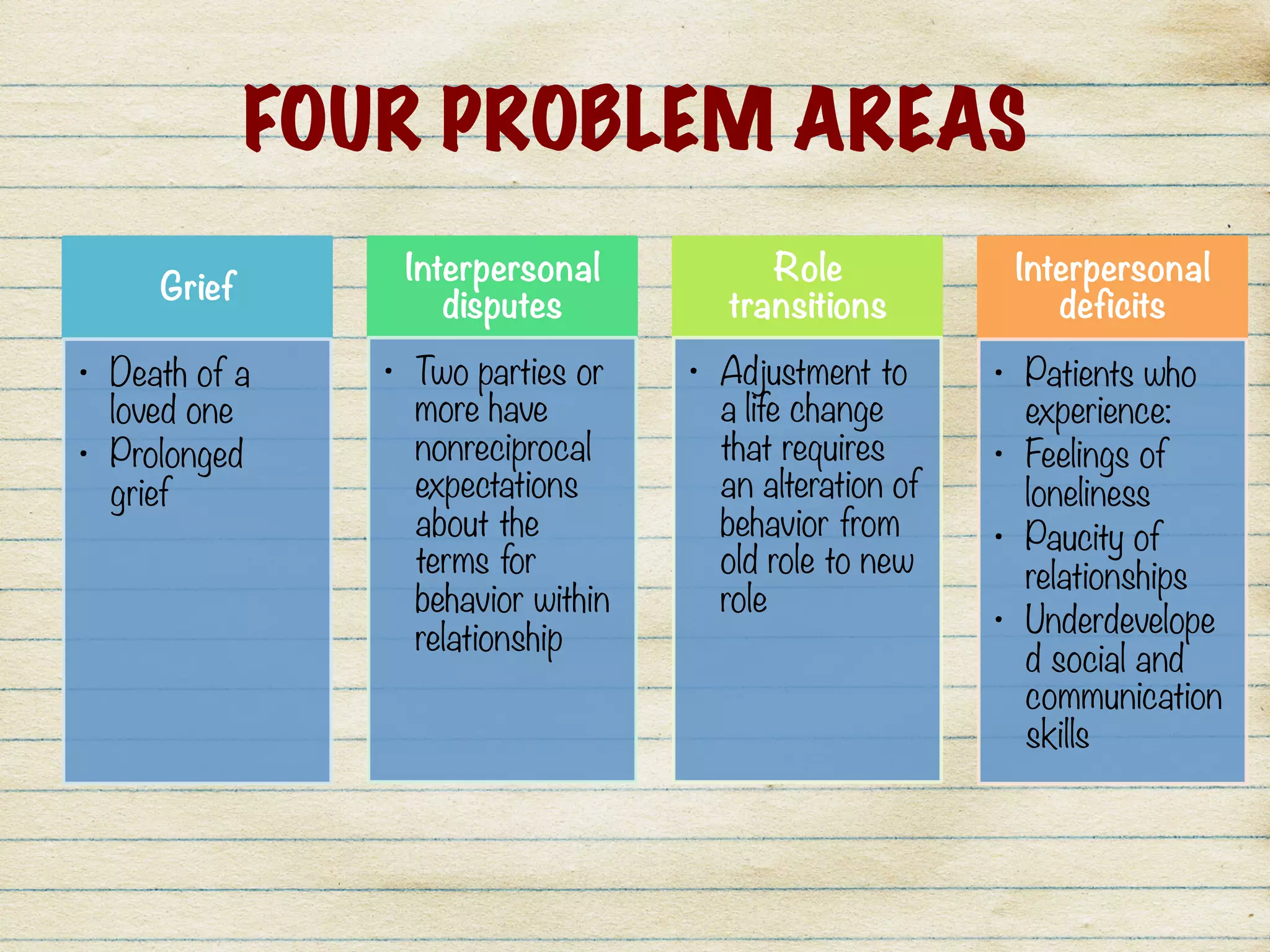
FOUR PROBLEM AREAS
Grief
•  Death of a
loved one
•  Prolonged
grief
Interpersonal
disputes
•  Two parties or
more have
nonreciprocal
expectations
about the
terms for
behavior within
relationship
Role
transitions
•  Adjustment to
a life change
that requires
an alteration of
behavior from
old role to new
role
Interpersonal
deficits
•  Patients who
experience: 
•  Feelings of
loneliness
•  Paucity of
relationships
•  Underdevelope
d social and
communication
skills
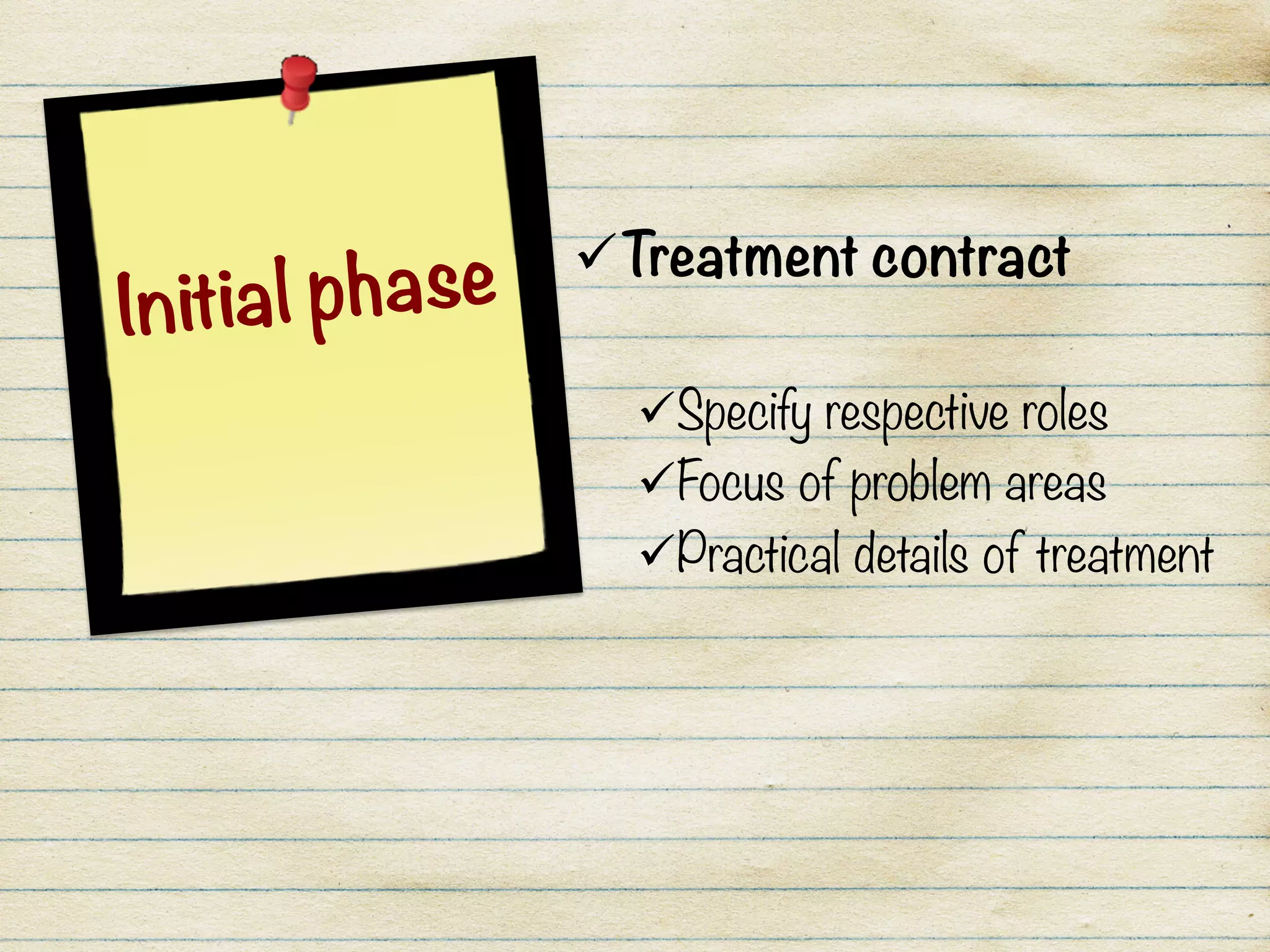
ü Treatment contract

ü Specify respective roles
ü Focus of problem areas
ü Practical details of treatment
Initial phase
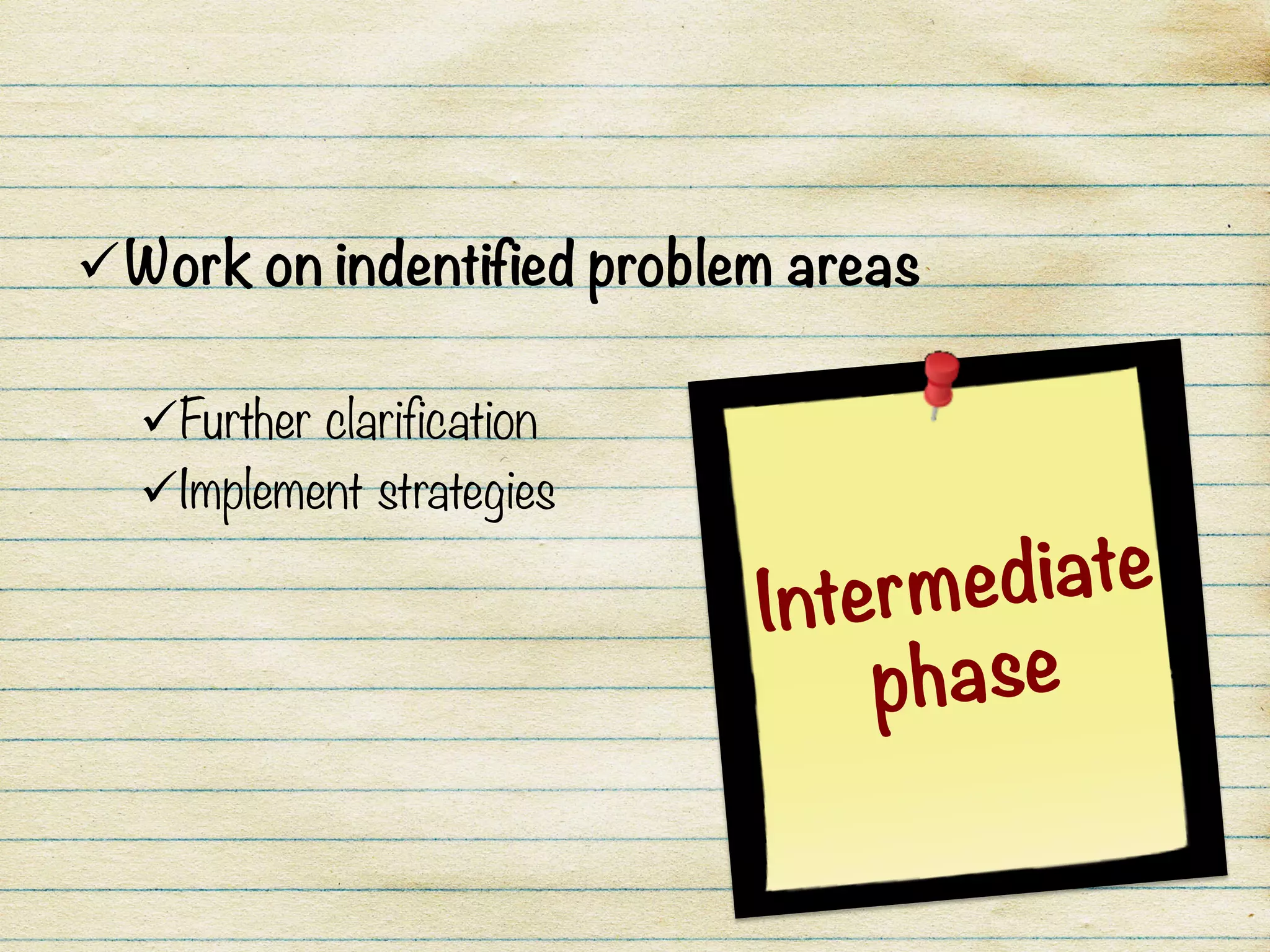
ü Work on indentified problem areas

ü Further clarification
ü Implement strategies
Intermediate
phase
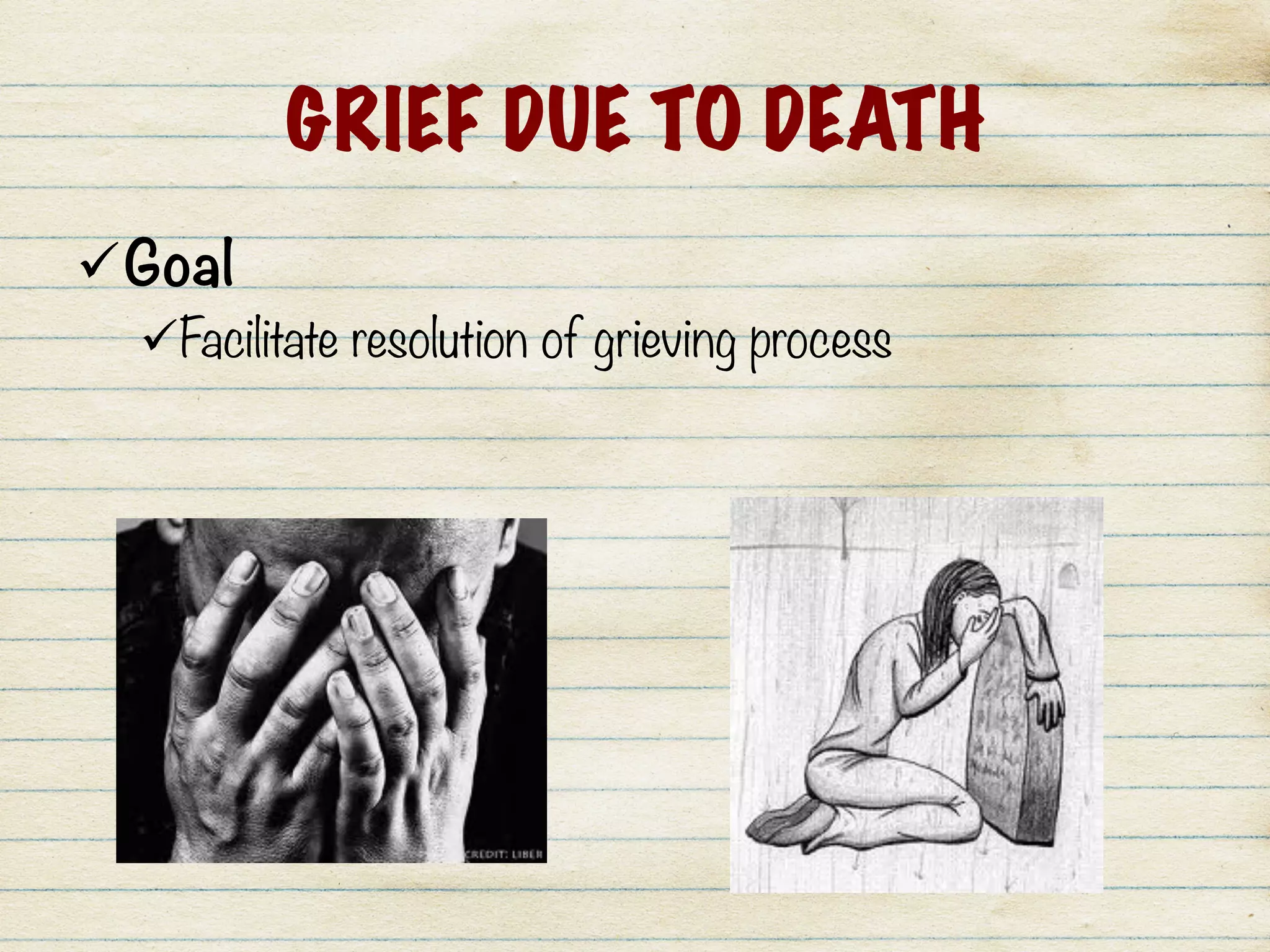
GRIEF DUE TO DEATH
ü Goal
ü Facilitate resolution of grieving process
GRIEF DUE TO DEATH
ü Strategies

ü Review +/- aspects of relationship with deceased
ü Encourage expression of emotions
ü Taught skills for communicating loss
ü Apply skills to other significant relationships
ü Establish new or furthering existing relationships
ROLE DISPUTES
ü 3 stages in a dispute
ü Renegotiation
ü Impasse
ü Dissolution
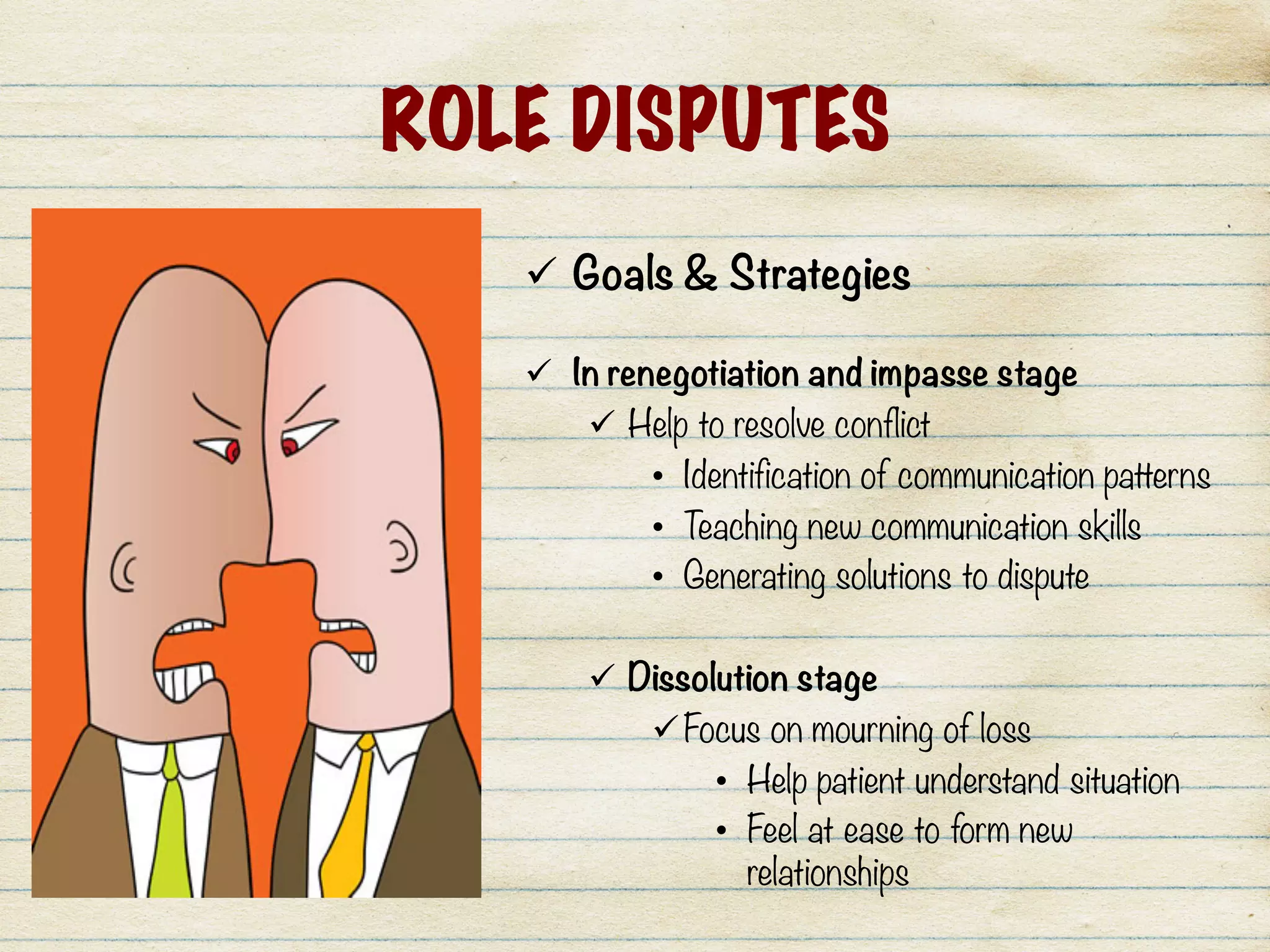
ROLE DISPUTES
ü  Goals & Strategies
ü  In renegotiation and impasse stage
ü  Help to resolve conflict
•  Identification of communication patterns
•  Teaching new communication skills
•  Generating solutions to dispute

ü  Dissolution stage
ü Focus on mourning of loss
•  Help patient understand situation
•  Feel at ease to form new
relationships
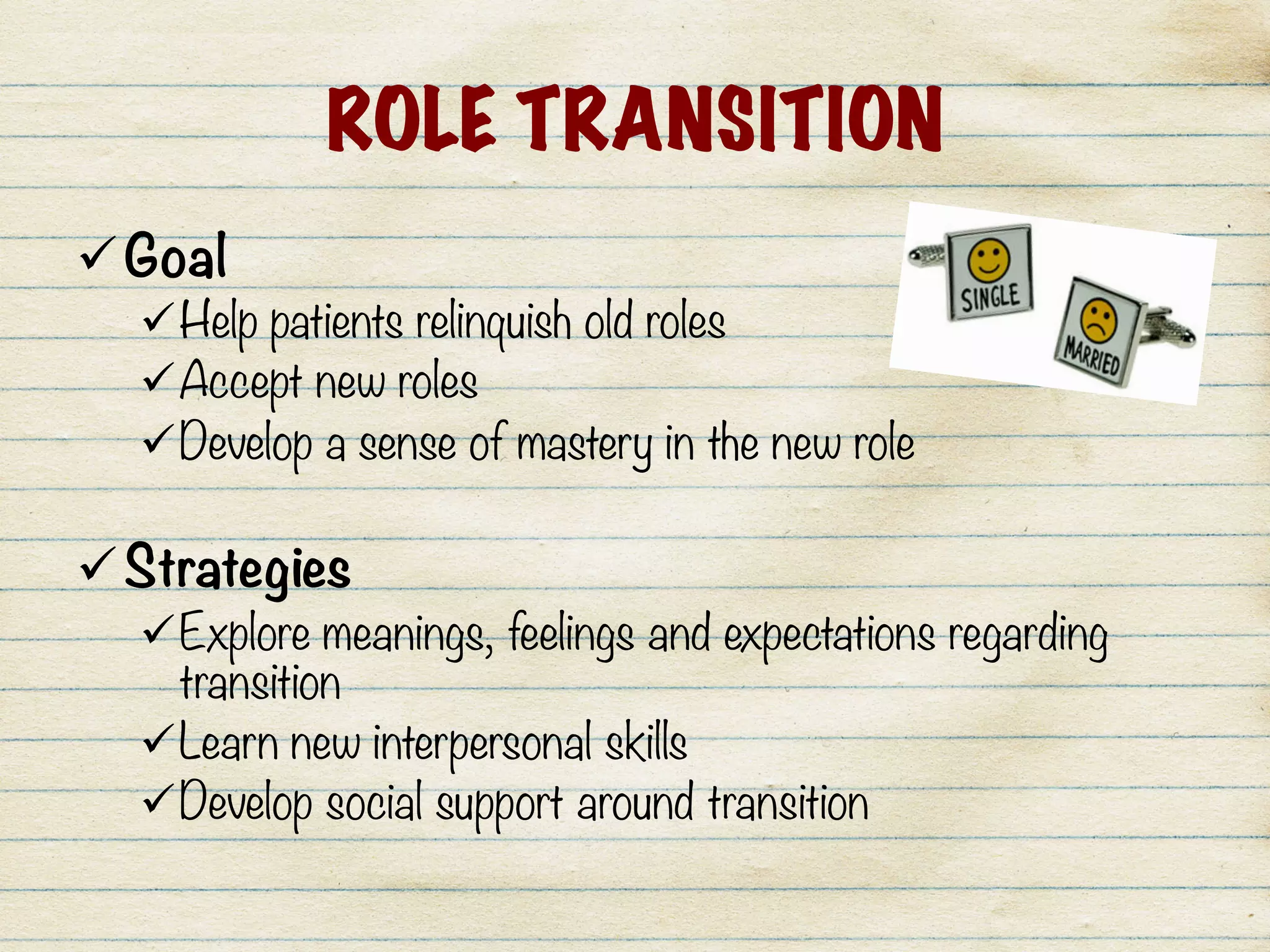
ROLE TRANSITION
ü Goal
ü Help patients relinquish old roles
ü Accept new roles
ü Develop a sense of mastery in the new role

ü Strategies
ü Explore meanings, feelings and expectations regarding
transition
ü Learn new interpersonal skills
ü Develop social support around transition
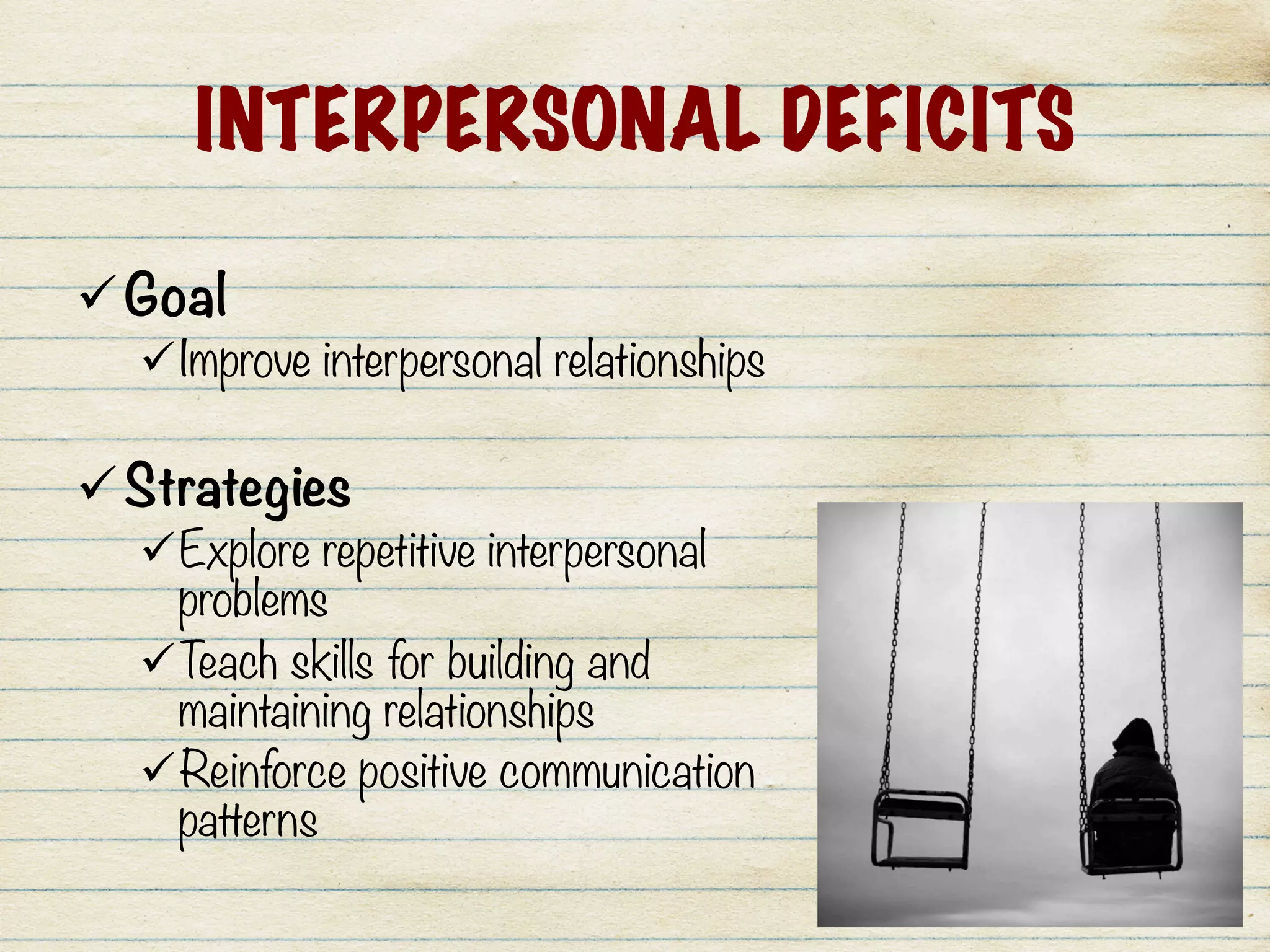
INTERPERSONAL DEFICITS
ü Goal
ü Improve interpersonal relationships

ü Strategies
ü Explore repetitive interpersonal
problems
ü Teach skills for building and
maintaining relationships
ü Reinforce positive communication
patterns
ü  Reviews the patient’s course of
depressive symptoms and how they have
changed

ü  Review changes in interpersonal
functioning

ü  Link these changes to the improvement in
the patient’s mood

ü  Highlight skills and strategies that were
particularly useful

ü  Discuss end of treatment

ü  Address possibility that depression might
recur
ü  Warn symptoms
ü  Teach strategies
Termination
phase
TECHNIQUES
ü Targeted at 
ü Providing patients with the
skills to change interpersonal
relationship
ü Improving their mood

ü Different combinations of
techniques used according to
their problem area(s)
THERAPEUTIC ALLIANCE
ü Essential in predicting therapeutic
change

ü Provide information about the
patient
ü Provide a safe environment to bring
about therapeutic change
ü Without therapeutic alliance, other
techniques may become ineffective
ENCOURAGEMENT OF AFFECT &
CONNECTION WITH
INTERPERSONAL EVENT
ü Help patients become aware of,
acknowledge and accept emotions about
relationships

ü Understand impact of affect on
relationships

ü Learn to negotiate interpersonal
experiences more effectively

ü Observe that –ve interpersonal events
are associated with decline in mood and
+ve changes are associated with
improvement in mood
Content and Process Affect

ü Content Affect: Affect reported
by patient

ü Process Affect: Affect
demonstrated by patient

ü Observing for INCONGRUITY
COMMUNICATION ANALYSIS
ü Understand patient’s
patterns of interactions

ü Recognize ineffective
communication skills

ü Acquire better
communication skills
DECISION ANALYSIS
ü Processes involved
ü Identify a problematic
interpersonal situation
ü Formulate a goal
ü Generate potential solution
ü Evaluate and choose a
strategy

ü Consider the different
actions one can take when
faced with interpersonal
difficulties
	
  
ROLE PLAYING
ü Discuss, model and practice the
skills they have gained through
therapy
ü More comfortable and
competent in transferring the skills
to real life situations

ü Allow therapist to observe and
correct skills deficits that arises
ü Not suitable for all patients
EFFICACY
AND
EFFECTIVENESS
of IPT as a treatment to Major Depression & Other psychiatric illness
TREATMENT FOR
MAJOR DEPRESSION
Acute
Treatment
ü  NIMH Treatment of Depression
Collaborative Research Program (Elkin et
al., 1989) 

ü  Treatment groups
•  Imipramine, IPT, CBT, Placebo

ü  Reduction in depressive symptoms &
improved functioning

ü  Severely depressed patients
•  IPT comparable to IMI and superior to
placebo

ü  Follow-up 
•  No significant differences in recovery 

 
(Shea et al., 1992) 
	
  
Maintenance
Treatment
ü  Maintenance Treatment 

•  First tested with 150 acutely
depressed female outpatients


 (Klerman et al. 1974) 
•  IPT improved social functioning

ü  Meta-analysis (Mello et al., 2005)

•  13 studies 
•  IPT superior to placebo
•  similar to medication 
•  more efficacious than CBT 
	
  
TREATMENT FOR
MAJOR DEPRESSION
TREATMENT FOR
MAJOR
DEPRESSION
Different population
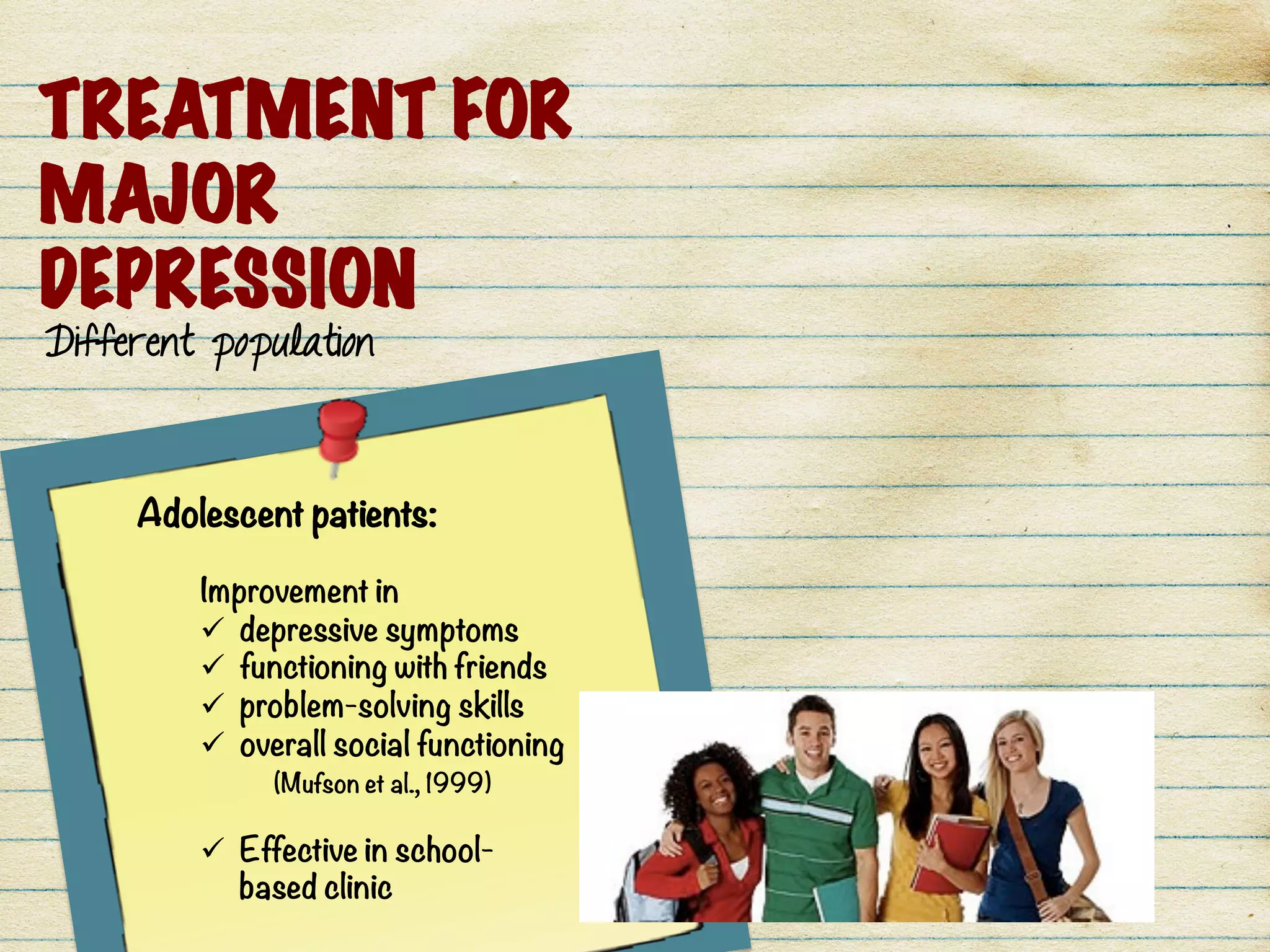
Adolescent patients: 

Improvement in 
ü  depressive symptoms
ü  functioning with friends
ü  problem-solving skills
ü  overall social functioning

 (Mufson et al., 1999) 

ü  Effective in school-
based clinic
TREATMENT FOR
MAJOR
DEPRESSION
Different population
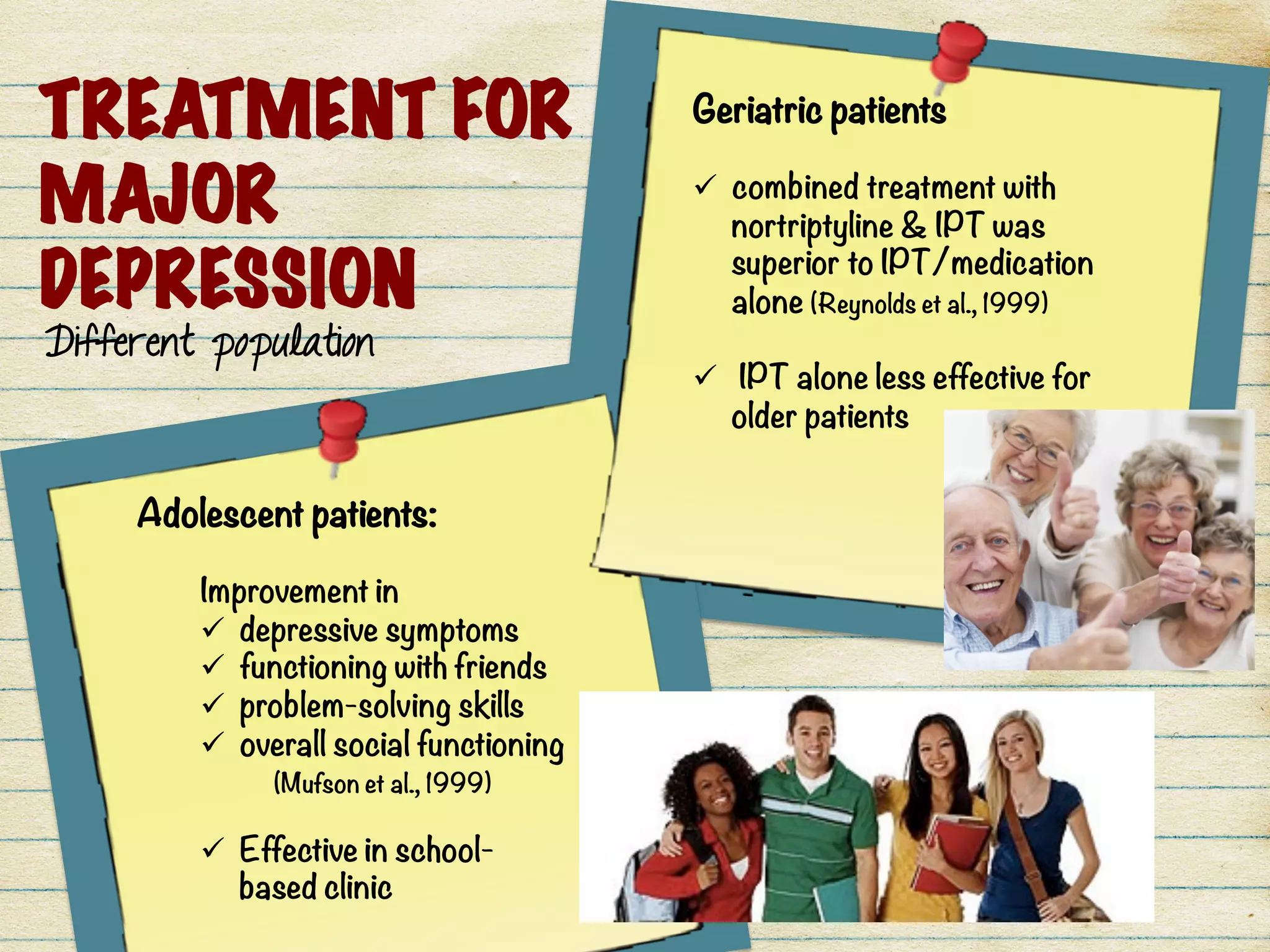
Geriatric patients

ü  combined treatment with
nortriptyline & IPT was
superior to IPT/medication
alone (Reynolds et al., 1999)

ü  IPT alone less effective for
older patients
Adolescent patients: 

Improvement in 
ü  depressive symptoms
ü  functioning with friends
ü  problem-solving skills
ü  overall social functioning

 (Mufson et al., 1999) 

ü  Effective in school-
based clinic
IPT AS A
TREATMENT
For Other Psychiatric Illnesses
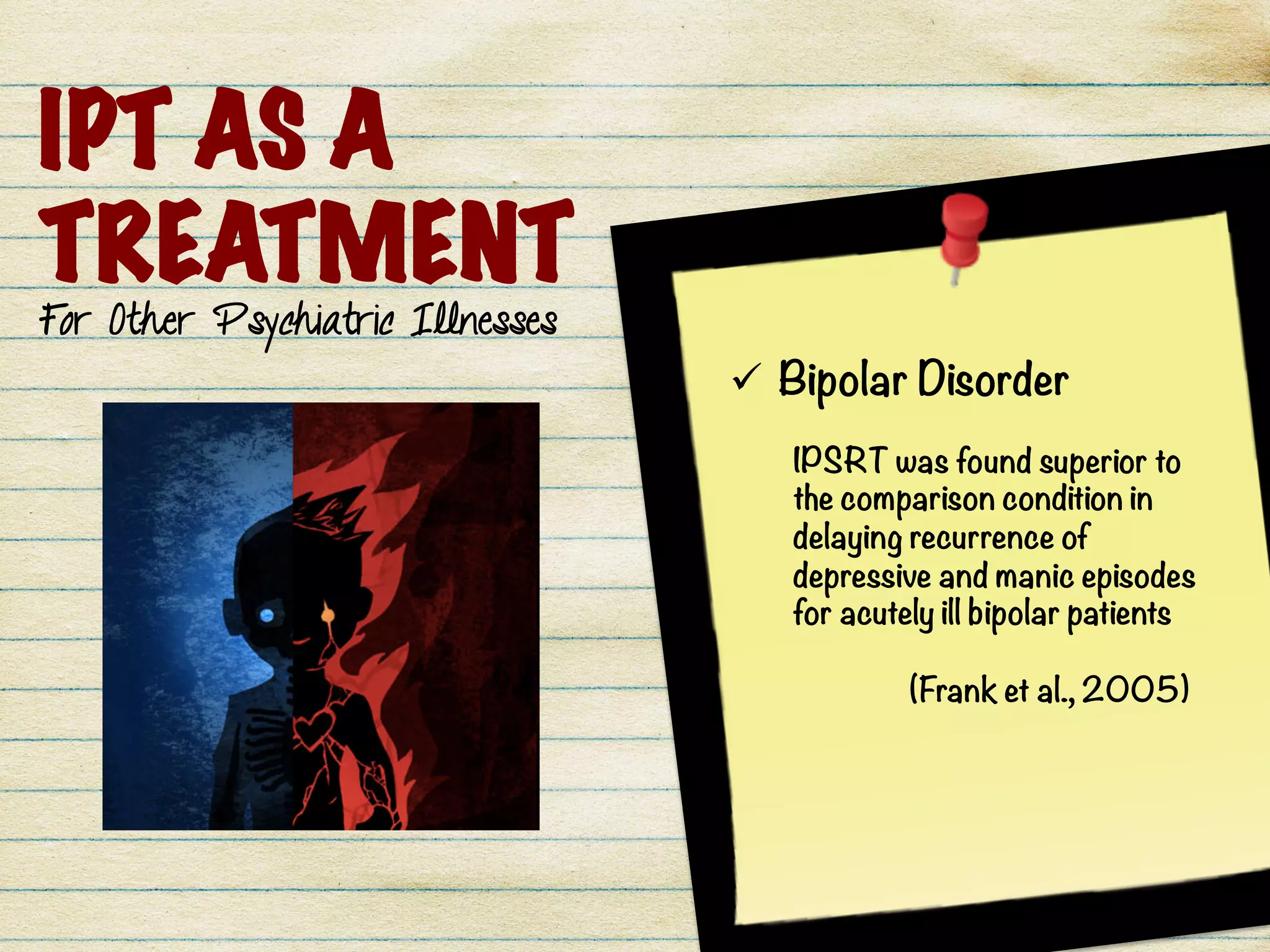
ü  Bipolar Disorder
IPSRT was found superior to
the comparison condition in
delaying recurrence of
depressive and manic episodes
for acutely ill bipolar patients

(Frank et al., 2005)
IPT AS A
TREATMENT
For Other Psychiatric Illnesses
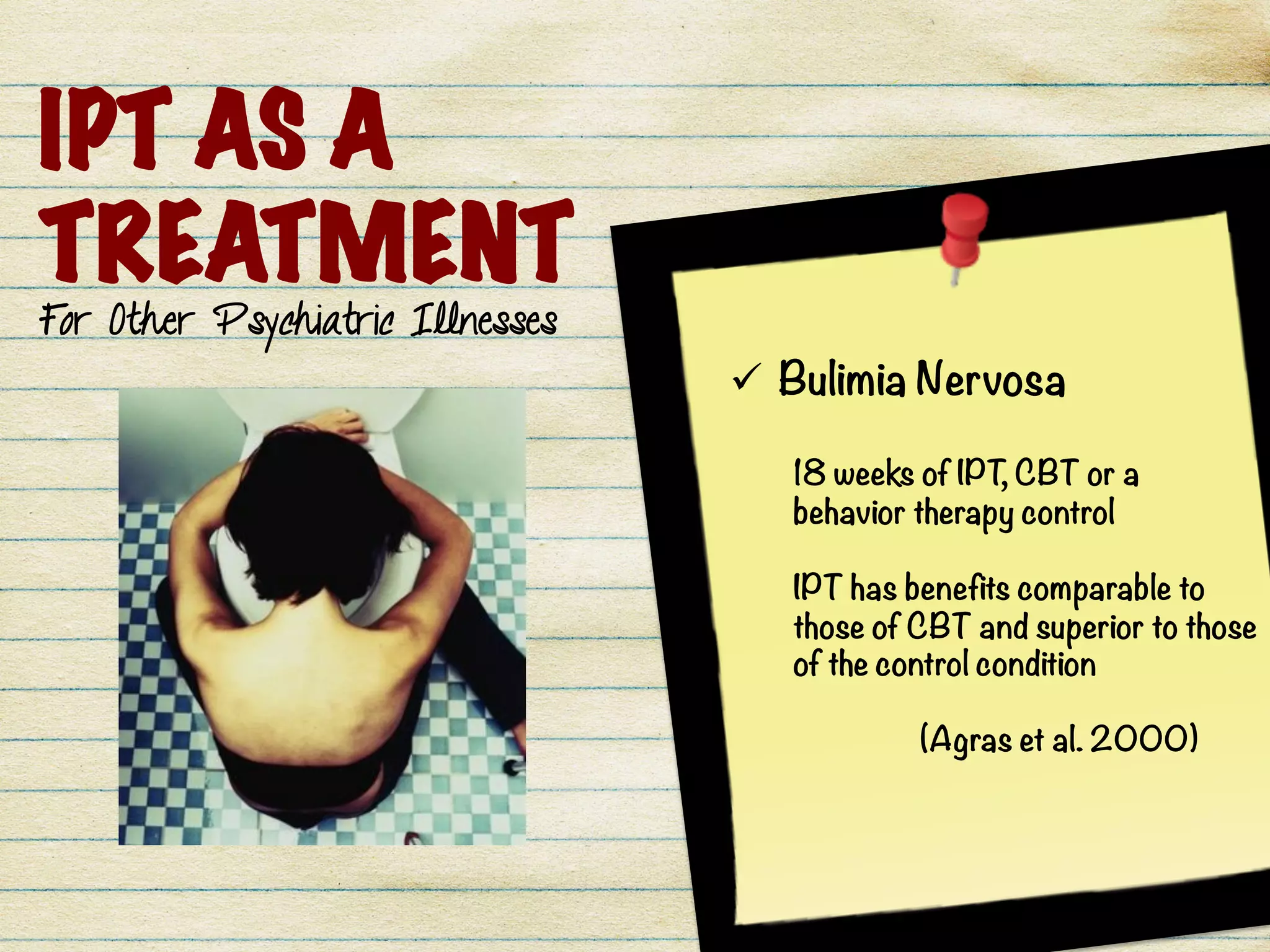
ü  Bulimia Nervosa

18 weeks of IPT, CBT or a
behavior therapy control

IPT has benefits comparable to
those of CBT and superior to those
of the control condition 


(Agras et al. 2000)
IPT AS A
TREATMENT
For Other Psychiatric Illnesses
ü  Substance Dependence

A study of 42 subjects with
cocaine abuse who were
attempting to achieve abstinence 

IPT was ineffective than a
behavioral control therapy 


(Carroll et al. 1991)
AN APPLICATION
OF
INTERPERSONAL
PSYCHOTHERAPY
A Case of an Adolescent Bully-Victim
AN APPLICATION OF
INTERPERSONAL
PSYCHOTHERAPY
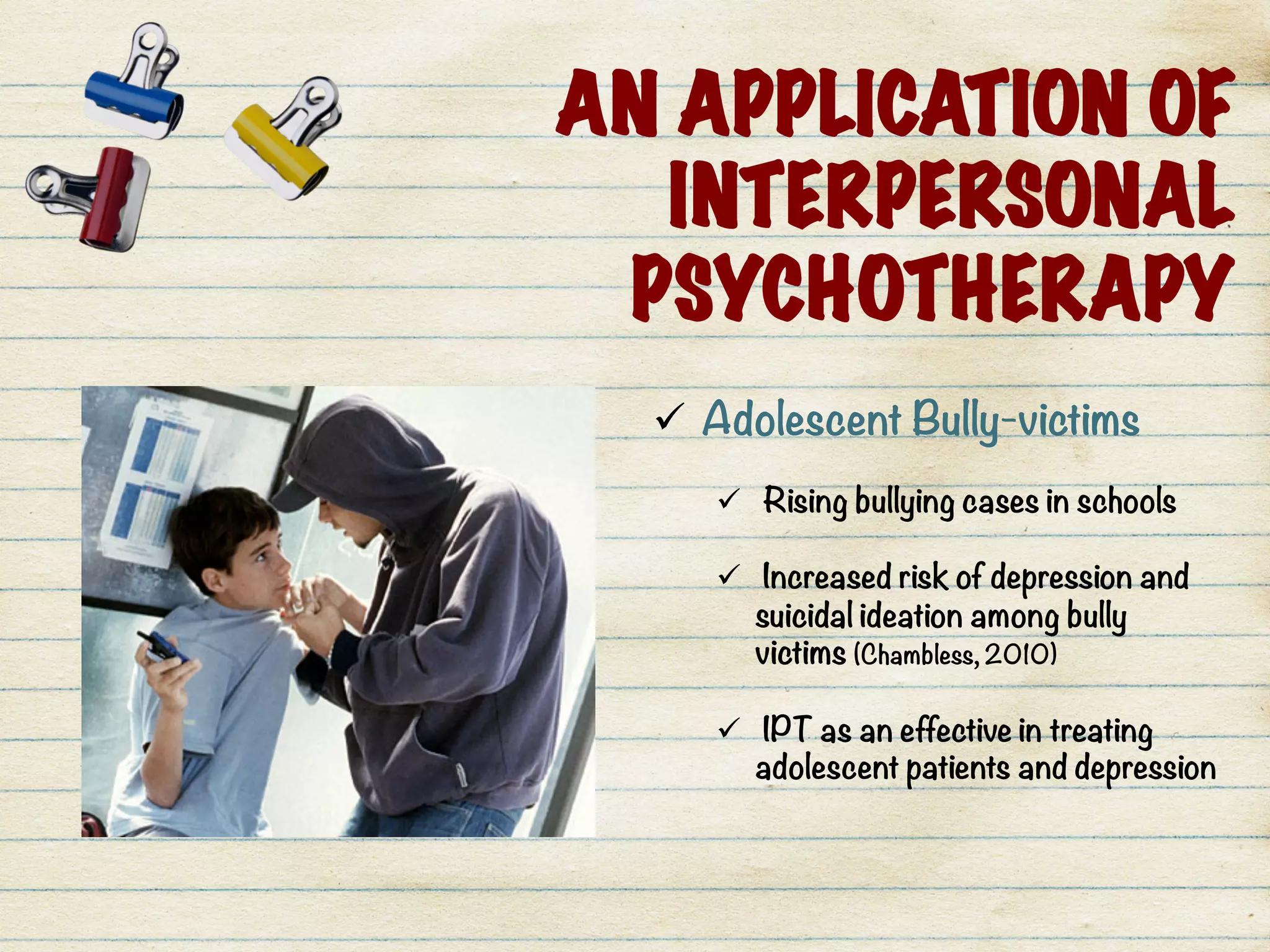
ü  Adolescent Bully-victims

ü  Rising bullying cases in schools

ü  Increased risk of depression and
suicidal ideation among bully
victims (Chambless, 2010)

ü  IPT as an effective in treating
adolescent patients and depression
AN APPLICATION OF
INTERPERSONAL
PSYCHOTHERAPY
A Case of an Adolescent Bully-Victim
Initial Intermediate Termination
ü  Assigning of “sick role”
Inform adolescent of depression 

ü  Restrictive Families
Adolescent boys are more likely to become
victims 

ü  Bully-victims have less teacher and peer
support 
ü  Focus on present circumstances 
Free them of self-criticism
A Case of an Adolescent Bully-Victim
Initial Intermediate Termination
AN APPLICATION OF
INTERPERSONAL
PSYCHOTHERAPY
ü  Disputes with parents 
•  That leads to maladaptive communication
patterns
ü  Goals: Self-assertion and communication 
•  Expressions of feelings and problems
ü  Role-playing 
•  Anticipate problems and rehearse
expression of emotions in disputes 
Problem Area 1:
Interpersonal
Dispute
A Case of an Adolescent Bully-Victim
Initial Intermediate Termination
AN APPLICATION OF
INTERPERSONAL
PSYCHOTHERAPY
ü  Past bully incidents 
•  negative preconceptions of people 
ü  Goal: reduce social isolation 
•  Explore the distorted feelings toward
people
•  New skills for building and maintaining
relationships
ü  Role-playing 
•  Practice the new skills 
Problem Area 2:
Interpersonal
Deficits
AN APPLICATION OF
INTERPERSONAL
PSYCHOTHERAPY
A Case of an Adolescent Bully-Victim
Initial Intermediate Termination
ü  Help adolescent recognize
gains in self-assertion
ü  Calling into attention patient’s
independent successes
ü  Discuss potential recurrent
symptoms and how to handle
them
THANK
YOU
VERY MUCH
Good-bye and Have a nice day!

Interpersonal psychotherapy final

  • 1.
    INTERPERSONAL PSYCHOTHERAPY By: Teo QianHua Chen Xiu Wen Teo Meijun Gerald L. Klerman & Myrna M. Weissman
  • 2.
    INTERPERSONAL PSYCHOTHERAPY ü Time-limited therapy(12-20 sessions) ü Especially designed for depression ü ‘here-and-now’ framework Focus on current interpersonal issues ü Medical model Depression as treatable
  • 3.
    Gerald L. Klerman Myrna M. Weissman INTERPERSONAL PSYCHOTHERAPY
  • 4.
    DUAL GOAL OFIPT Symptom remission Solve interpersonal problems related to depression IPT
  • 5.
    THEORETICAL BASIS ü Interpersonal theory ü Adolf Meyer & Harry Stack Sullivan ü Focus on the importance of interpersonal relationships in determining behavior ü Psychological illness develops out of interpersonal disruptions ü Help patients to increase their understanding of the interpersonal events that triggered depression
  • 6.
    THEORETICAL BASIS ü Attachment theory ü Peoplehave the fundamental need to form strong bonds with others. ü When these bonds are disrupted, the individual will experience emotional distress ü IPT targets interpersonal relationships that may affect patient’s attachment experiences
  • 7.
    3 PHASES OFIPT Initial phase Intermediate phase Termination Phase
  • 8.
    Initial phase ü Diagnosis ü Psycho-education •  Symptomsand behaviors of depression •  Assign ‘sick role’ to patient ü Identify interpersonal issues most related to current depression •  4 problem areas
  • 9.
    FOUR PROBLEM AREAS Grief • Death of a loved one •  Prolonged grief Interpersonal disputes •  Two parties or more have nonreciprocal expectations about the terms for behavior within relationship Role transitions •  Adjustment to a life change that requires an alteration of behavior from old role to new role Interpersonal deficits •  Patients who experience: •  Feelings of loneliness •  Paucity of relationships •  Underdevelope d social and communication skills
  • 10.
    ü Treatment contract ü Specify respectiveroles ü Focus of problem areas ü Practical details of treatment Initial phase
  • 11.
    ü Work on indentifiedproblem areas ü Further clarification ü Implement strategies Intermediate phase
  • 12.
    GRIEF DUE TODEATH ü Goal ü Facilitate resolution of grieving process
  • 13.
    GRIEF DUE TODEATH ü Strategies ü Review +/- aspects of relationship with deceased ü Encourage expression of emotions ü Taught skills for communicating loss ü Apply skills to other significant relationships ü Establish new or furthering existing relationships
  • 14.
    ROLE DISPUTES ü 3 stagesin a dispute ü Renegotiation ü Impasse ü Dissolution
  • 15.
    ROLE DISPUTES ü  Goals& Strategies ü  In renegotiation and impasse stage ü  Help to resolve conflict •  Identification of communication patterns •  Teaching new communication skills •  Generating solutions to dispute ü  Dissolution stage ü Focus on mourning of loss •  Help patient understand situation •  Feel at ease to form new relationships
  • 16.
    ROLE TRANSITION ü Goal ü Help patientsrelinquish old roles ü Accept new roles ü Develop a sense of mastery in the new role ü Strategies ü Explore meanings, feelings and expectations regarding transition ü Learn new interpersonal skills ü Develop social support around transition
  • 17.
    INTERPERSONAL DEFICITS ü Goal ü Improve interpersonalrelationships ü Strategies ü Explore repetitive interpersonal problems ü Teach skills for building and maintaining relationships ü Reinforce positive communication patterns
  • 18.
    ü  Reviews thepatient’s course of depressive symptoms and how they have changed ü  Review changes in interpersonal functioning ü  Link these changes to the improvement in the patient’s mood ü  Highlight skills and strategies that were particularly useful ü  Discuss end of treatment ü  Address possibility that depression might recur ü  Warn symptoms ü  Teach strategies Termination phase
  • 19.
  • 20.
    ü Targeted at ü Providingpatients with the skills to change interpersonal relationship ü Improving their mood ü Different combinations of techniques used according to their problem area(s)
  • 21.
    THERAPEUTIC ALLIANCE ü Essential inpredicting therapeutic change ü Provide information about the patient ü Provide a safe environment to bring about therapeutic change ü Without therapeutic alliance, other techniques may become ineffective
  • 22.
    ENCOURAGEMENT OF AFFECT& CONNECTION WITH INTERPERSONAL EVENT ü Help patients become aware of, acknowledge and accept emotions about relationships ü Understand impact of affect on relationships ü Learn to negotiate interpersonal experiences more effectively ü Observe that –ve interpersonal events are associated with decline in mood and +ve changes are associated with improvement in mood Content and Process Affect ü Content Affect: Affect reported by patient ü Process Affect: Affect demonstrated by patient ü Observing for INCONGRUITY
  • 23.
    COMMUNICATION ANALYSIS ü Understand patient’s patternsof interactions ü Recognize ineffective communication skills ü Acquire better communication skills
  • 24.
    DECISION ANALYSIS ü Processes involved ü Identifya problematic interpersonal situation ü Formulate a goal ü Generate potential solution ü Evaluate and choose a strategy ü Consider the different actions one can take when faced with interpersonal difficulties  
  • 25.
    ROLE PLAYING ü Discuss, modeland practice the skills they have gained through therapy ü More comfortable and competent in transferring the skills to real life situations ü Allow therapist to observe and correct skills deficits that arises ü Not suitable for all patients
  • 26.
    EFFICACY AND EFFECTIVENESS of IPT asa treatment to Major Depression & Other psychiatric illness
  • 27.
    TREATMENT FOR MAJOR DEPRESSION Acute Treatment ü NIMH Treatment of Depression Collaborative Research Program (Elkin et al., 1989) ü  Treatment groups •  Imipramine, IPT, CBT, Placebo ü  Reduction in depressive symptoms & improved functioning ü  Severely depressed patients •  IPT comparable to IMI and superior to placebo ü  Follow-up •  No significant differences in recovery (Shea et al., 1992)  
  • 28.
    Maintenance Treatment ü  Maintenance Treatment •  First tested with 150 acutely depressed female outpatients (Klerman et al. 1974) •  IPT improved social functioning ü  Meta-analysis (Mello et al., 2005) •  13 studies •  IPT superior to placebo •  similar to medication •  more efficacious than CBT   TREATMENT FOR MAJOR DEPRESSION
  • 29.
    TREATMENT FOR MAJOR DEPRESSION Different population Adolescentpatients: Improvement in ü  depressive symptoms ü  functioning with friends ü  problem-solving skills ü  overall social functioning (Mufson et al., 1999) ü  Effective in school- based clinic
  • 30.
    TREATMENT FOR MAJOR DEPRESSION Different population Geriatricpatients ü  combined treatment with nortriptyline & IPT was superior to IPT/medication alone (Reynolds et al., 1999) ü  IPT alone less effective for older patients Adolescent patients: Improvement in ü  depressive symptoms ü  functioning with friends ü  problem-solving skills ü  overall social functioning (Mufson et al., 1999) ü  Effective in school- based clinic
  • 31.
    IPT AS A TREATMENT ForOther Psychiatric Illnesses ü  Bipolar Disorder IPSRT was found superior to the comparison condition in delaying recurrence of depressive and manic episodes for acutely ill bipolar patients (Frank et al., 2005)
  • 32.
    IPT AS A TREATMENT ForOther Psychiatric Illnesses ü  Bulimia Nervosa 18 weeks of IPT, CBT or a behavior therapy control IPT has benefits comparable to those of CBT and superior to those of the control condition (Agras et al. 2000)
  • 33.
    IPT AS A TREATMENT ForOther Psychiatric Illnesses ü  Substance Dependence A study of 42 subjects with cocaine abuse who were attempting to achieve abstinence IPT was ineffective than a behavioral control therapy (Carroll et al. 1991)
  • 34.
  • 35.
    AN APPLICATION OF INTERPERSONAL PSYCHOTHERAPY ü Adolescent Bully-victims ü  Rising bullying cases in schools ü  Increased risk of depression and suicidal ideation among bully victims (Chambless, 2010) ü  IPT as an effective in treating adolescent patients and depression
  • 36.
    AN APPLICATION OF INTERPERSONAL PSYCHOTHERAPY ACase of an Adolescent Bully-Victim Initial Intermediate Termination ü  Assigning of “sick role” Inform adolescent of depression ü  Restrictive Families Adolescent boys are more likely to become victims ü  Bully-victims have less teacher and peer support ü  Focus on present circumstances Free them of self-criticism
  • 37.
    A Case ofan Adolescent Bully-Victim Initial Intermediate Termination AN APPLICATION OF INTERPERSONAL PSYCHOTHERAPY ü  Disputes with parents •  That leads to maladaptive communication patterns ü  Goals: Self-assertion and communication •  Expressions of feelings and problems ü  Role-playing •  Anticipate problems and rehearse expression of emotions in disputes Problem Area 1: Interpersonal Dispute
  • 38.
    A Case ofan Adolescent Bully-Victim Initial Intermediate Termination AN APPLICATION OF INTERPERSONAL PSYCHOTHERAPY ü  Past bully incidents •  negative preconceptions of people ü  Goal: reduce social isolation •  Explore the distorted feelings toward people •  New skills for building and maintaining relationships ü  Role-playing •  Practice the new skills Problem Area 2: Interpersonal Deficits
  • 39.
    AN APPLICATION OF INTERPERSONAL PSYCHOTHERAPY ACase of an Adolescent Bully-Victim Initial Intermediate Termination ü  Help adolescent recognize gains in self-assertion ü  Calling into attention patient’s independent successes ü  Discuss potential recurrent symptoms and how to handle them
  • 40.