Cognitive-Behavioral Applications in Primary Care   Scott S. Meit, PsyD, MBA, FAACP Vice Chair for Psychology Department of Psychiatry and Psychology The Cleveland Clinic
Learning Objectives To incorporate a fundamental model of CBT To gain skill in identifying common thought distortions To prep for basic application of CBT methodology & techniques in the primary care setting
What is “Talk Therapy” ? A generic term used by many docs making a referral for counseling  A non-descript term that irritates Scott a & b
So…  What is Cognitive-Behavioral Therapy? ( The Basics)
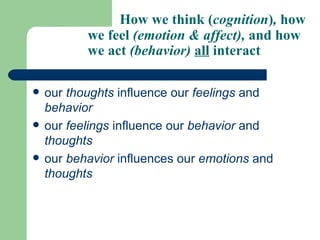
How we think ( cognition ) ,  how we feel  (emotion & affect),  and how we act  (behavior)   all  interact our  thoughts  influence our  feelings  and  behavior   our  feelings  influence our  behavior  and  thoughts   our  behavior  influences our  emotions  and  thoughts
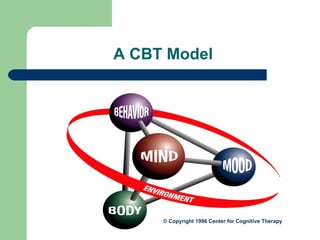
A CBT Model  © Copyright 1986 Center for Cognitive Therapy
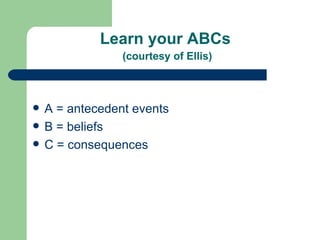
Learn your ABCs   (courtesy of Ellis) A = antecedent events B = beliefs C = consequences
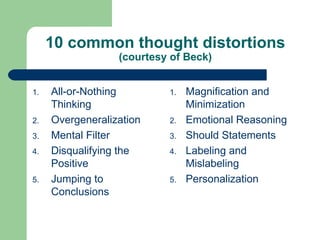
10 common thought distortions (courtesy of Beck) All-or-Nothing Thinking  Overgeneralization  Mental Filter  Disqualifying the Positive  Jumping to Conclusions  Magnification and Minimization  Emotional Reasoning  Should Statements  Labeling and Mislabeling  Personalization
  A little practice…  Donna just “cheated” on her diet.  I'm a fat, lazy pig , she thinks.  Labeling Reframe = “I slipped; what do I need to  do   differently?”
As Mary is driving home, a man waves her to go ahead of him (as she merges into traffic). Later in her trip,  another  driver cuts her off. She grumbles to herself, “there are nothing but rude and insensitive people in this town.” Mental Filter Re-calibrating question? “ Nothing  but rude & insensitive people in this town?!  If you had to, do you think you could  prove  that in a court of law – before a jury of your peers?”
Jean's son is doing poorly in school. She feels that she must be a bad mother. She feels that it's all  her  fault that he isn't studying   Personalization Problem-solving Questions = What are the “high probability” (rule-in) explanations for my son’s academic difficulties?  What are the “ingredients" of this unsavory broth?  How might the identified problems, suggest reasonable solutions?
Jumping to Conclusions A re-calibrating question = What are alternative high probability explanations (for her being late)? Chuck is waiting for his date at a restaurant. She's 20 minutes late. Chuck laments he must have done something wrong; she has stood him up!  Meanwhile, across town, his date is stuck in traffic.
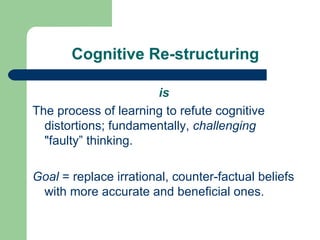
Cognitive Re-structuring is The process of learning to refute cognitive distortions; fundamentally,  challenging  "faulty” thinking. Goal  = replace irrational, counter-factual beliefs with more accurate and beneficial ones.
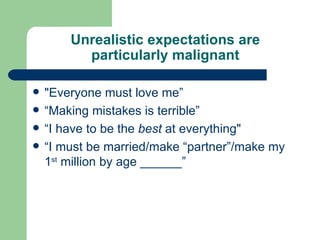
Unrealistic expectations are particularly malignant "Everyone must love me” “Making mistakes is terrible” “I have to be the  best  at everything"  “I must be married/make “partner”/make my 1 st  million by age ______”
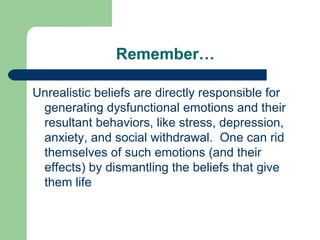
Remember… Unrealistic beliefs are directly responsible for generating dysfunctional emotions and their resultant behaviors, like stress, depression, anxiety, and social withdrawal.  One can rid themselves of such emotions (and their effects) by dismantling the beliefs that give them life
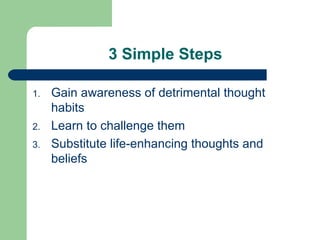
3 Simple Steps Gain awareness of detrimental thought habits  Learn to challenge them  Substitute life-enhancing thoughts and beliefs
Other CBT Techniques Thought Records Experiments
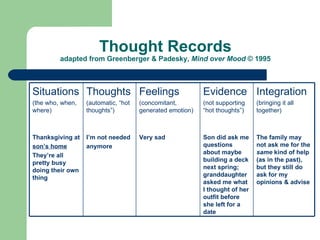
Thought Records adapted from Greenberger & Padesky,  Mind over Mood  © 1995 Integration (bringing it all together) The family may not ask me for the  same  kind of help (as in the past), but they still do ask for my opinions & advise Evidence (not supporting “hot thoughts”) Son did ask me questions about maybe building a deck next spring; granddaughter asked me what I thought of her outfit before she left for a date Feelings (concomitant, generated emotion) Very sad Thoughts (automatic, “hot thoughts”) I’m not needed anymore Situations (the who, when, where) Thanksgiving at son’s home   They’re all pretty busy doing their own thing
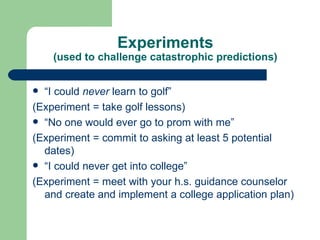
Experiments (used to challenge catastrophic predictions) “ I could  never  learn to golf” (Experiment = take golf lessons) “ No one would ever go to prom with me” (Experiment = commit to asking at least 5 potential dates) “ I could never get into college” (Experiment = meet with your h.s. guidance counselor and create and implement a college application plan)
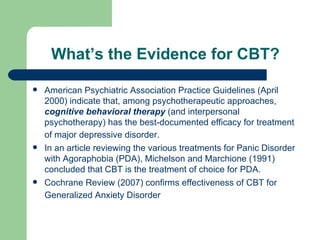
What’s the Evidence for CBT? American Psychiatric Association  Practice Guidelines (April 2000) indicate that, among psychotherapeutic approaches,  cognitive behavioral therapy  (and interpersonal psychotherapy) has the best-documented efficacy for treatment of major depressive disorder.   In an article reviewing the various treatments for Panic Disorder with Agoraphobia (PDA), Michelson and Marchione (1991) concluded that CBT is the treatment of choice for PDA.  Cochrane Review (2007) confirms effectiveness of CBT for Generalized Anxiety Disorder
Further Reading & Resources American Psychiatric Association (2000).  Treatment Recommendations for  Patients with Major  Depressive Disorder .   (Practice Guideline for the Treatment of Patients With Major Depressive Disorder,  Second Edition) .  http://www.psych.org/psych_pract/treatg/pg/MDD2e_05-15-06.pdf Retrieved on October 14, 2007. Beck, Aaron T (1975) .   Cognitive Therapy and the Emotional Disorders . International Universities Press Inc.,  ISBN 0-8236-0990-1   Ellis, Albert (2001).  Overcoming Destructive Beliefs, Feelings,  and Behaviors . Prometheus Books.  ISBN 978-1573928793 .   Greenberger, D. & Padesky, C. (1995).  Mind over Mood. The Guilford Press; 1st edition (March 15, 1995)   ISBN-10: 0898621283   Hunot V, Churchill R, Silva de Lima M, Teixeira V.  Psychological therapies for generalised anxiety disorder (Review).  Cochrane Database of Systematic  Rev; 2007,1.  Michelson, L.K. & Marchione, K. (1991).  Behavioral, Cognitive, and Pharmacological Treatments of PDA:  Critique and Synthesis.   Journal of Consulting and Clinical Psychology ,  59 , 100-114.

Cognitive Behavioral Applications

  • 1.
    Cognitive-Behavioral Applications inPrimary Care Scott S. Meit, PsyD, MBA, FAACP Vice Chair for Psychology Department of Psychiatry and Psychology The Cleveland Clinic
  • 2.
    Learning Objectives Toincorporate a fundamental model of CBT To gain skill in identifying common thought distortions To prep for basic application of CBT methodology & techniques in the primary care setting
  • 3.
    What is “TalkTherapy” ? A generic term used by many docs making a referral for counseling A non-descript term that irritates Scott a & b
  • 4.
    So… Whatis Cognitive-Behavioral Therapy? ( The Basics)
  • 5.
    How we think( cognition ) , how we feel (emotion & affect), and how we act (behavior) all interact our thoughts influence our feelings and behavior our feelings influence our behavior and thoughts our behavior influences our emotions and thoughts
  • 6.
    A CBT Model © Copyright 1986 Center for Cognitive Therapy
  • 7.
    Learn your ABCs (courtesy of Ellis) A = antecedent events B = beliefs C = consequences
  • 8.
    10 common thoughtdistortions (courtesy of Beck) All-or-Nothing Thinking Overgeneralization Mental Filter Disqualifying the Positive Jumping to Conclusions Magnification and Minimization Emotional Reasoning Should Statements Labeling and Mislabeling Personalization
  • 9.
    Alittle practice… Donna just “cheated” on her diet. I'm a fat, lazy pig , she thinks. Labeling Reframe = “I slipped; what do I need to do differently?”
  • 10.
    As Mary isdriving home, a man waves her to go ahead of him (as she merges into traffic). Later in her trip, another driver cuts her off. She grumbles to herself, “there are nothing but rude and insensitive people in this town.” Mental Filter Re-calibrating question? “ Nothing but rude & insensitive people in this town?! If you had to, do you think you could prove that in a court of law – before a jury of your peers?”
  • 11.
    Jean's son isdoing poorly in school. She feels that she must be a bad mother. She feels that it's all her fault that he isn't studying Personalization Problem-solving Questions = What are the “high probability” (rule-in) explanations for my son’s academic difficulties? What are the “ingredients" of this unsavory broth? How might the identified problems, suggest reasonable solutions?
  • 12.
    Jumping to ConclusionsA re-calibrating question = What are alternative high probability explanations (for her being late)? Chuck is waiting for his date at a restaurant. She's 20 minutes late. Chuck laments he must have done something wrong; she has stood him up! Meanwhile, across town, his date is stuck in traffic.
  • 13.
    Cognitive Re-structuring isThe process of learning to refute cognitive distortions; fundamentally, challenging "faulty” thinking. Goal = replace irrational, counter-factual beliefs with more accurate and beneficial ones.
  • 14.
    Unrealistic expectations areparticularly malignant "Everyone must love me” “Making mistakes is terrible” “I have to be the best at everything" “I must be married/make “partner”/make my 1 st million by age ______”
  • 15.
    Remember… Unrealistic beliefsare directly responsible for generating dysfunctional emotions and their resultant behaviors, like stress, depression, anxiety, and social withdrawal. One can rid themselves of such emotions (and their effects) by dismantling the beliefs that give them life
  • 16.
    3 Simple StepsGain awareness of detrimental thought habits Learn to challenge them Substitute life-enhancing thoughts and beliefs
  • 17.
    Other CBT TechniquesThought Records Experiments
  • 18.
    Thought Records adaptedfrom Greenberger & Padesky, Mind over Mood © 1995 Integration (bringing it all together) The family may not ask me for the same kind of help (as in the past), but they still do ask for my opinions & advise Evidence (not supporting “hot thoughts”) Son did ask me questions about maybe building a deck next spring; granddaughter asked me what I thought of her outfit before she left for a date Feelings (concomitant, generated emotion) Very sad Thoughts (automatic, “hot thoughts”) I’m not needed anymore Situations (the who, when, where) Thanksgiving at son’s home They’re all pretty busy doing their own thing
  • 19.
    Experiments (used tochallenge catastrophic predictions) “ I could never learn to golf” (Experiment = take golf lessons) “ No one would ever go to prom with me” (Experiment = commit to asking at least 5 potential dates) “ I could never get into college” (Experiment = meet with your h.s. guidance counselor and create and implement a college application plan)
  • 20.
    What’s the Evidencefor CBT? American Psychiatric Association Practice Guidelines (April 2000) indicate that, among psychotherapeutic approaches, cognitive behavioral therapy (and interpersonal psychotherapy) has the best-documented efficacy for treatment of major depressive disorder. In an article reviewing the various treatments for Panic Disorder with Agoraphobia (PDA), Michelson and Marchione (1991) concluded that CBT is the treatment of choice for PDA. Cochrane Review (2007) confirms effectiveness of CBT for Generalized Anxiety Disorder
  • 21.
    Further Reading &Resources American Psychiatric Association (2000). Treatment Recommendations for Patients with Major Depressive Disorder . (Practice Guideline for the Treatment of Patients With Major Depressive Disorder, Second Edition) . http://www.psych.org/psych_pract/treatg/pg/MDD2e_05-15-06.pdf Retrieved on October 14, 2007. Beck, Aaron T (1975) . Cognitive Therapy and the Emotional Disorders . International Universities Press Inc., ISBN 0-8236-0990-1 Ellis, Albert (2001). Overcoming Destructive Beliefs, Feelings, and Behaviors . Prometheus Books. ISBN 978-1573928793 .  Greenberger, D. & Padesky, C. (1995). Mind over Mood. The Guilford Press; 1st edition (March 15, 1995) ISBN-10: 0898621283 Hunot V, Churchill R, Silva de Lima M, Teixeira V. Psychological therapies for generalised anxiety disorder (Review). Cochrane Database of Systematic Rev; 2007,1. Michelson, L.K. & Marchione, K. (1991).  Behavioral, Cognitive, and Pharmacological Treatments of PDA: Critique and Synthesis.  Journal of Consulting and Clinical Psychology , 59 , 100-114.