General Survey of Cognitive-Behavioral Therapy Strategies The Model and The Techniques Kevin D. Arnold, Ph.D., ABPP Director, The Center for Cognitive and Behavioral Therapy of Greater Columbus 614.459.4490
Theory Behind CBT Barlow’s Theory of Emotional Disorders Barlow (1991) & Moses and Barlow (2006) Key Concepts Emotional Regulation Emotional Memory Antecedent Cognitive Appraisals Emotionally Driven Behaviors (EDBs) Avoidance
Theory Behind CBT Emotional Regulation: Key Strategies* Situational Control Situation Selection Predictive Model of Emotional Arousal Features and Likelihoods Costs and Benefits Assessment of Regulation vs. Experience Situation Modification Modification of the Physical, External Environment Attention Attention Deployment Distraction to Other Situational Features or Away Completely Concentration on Emotional Experience, Situational Factors, or Predictions Theory Behind CBT *Gross & Thompson, 2007
Emotional Regulation: Key Strategies* Appraisal Cognitive Appraisal Modification of Appraisal (e.g., threat value, label of event) Response Response Modulation Relaxation Strategies Expression of Emotion (Behavioral, Verbal) Adaptive Response Alternatives  Theory Behind CBT *Gross & Thompson, 2007
Theory Behind CBT
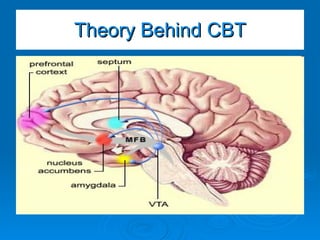
Emotional Memory* and Anxiety Disclaimer—Not a Neuropsychologist Role of Amygdala and Prefrontal Cortex in Anxiety Amygdala Stores Stress Arousal as Nondeclarative Memory In Contrast, Hippocampus Stores Declarative Memory PFC Necessary to Habituate to Anxiety Habituation is New Learning Allowing PFC to Modulate Amygdala Arousal and Enhance Declarative Recall Through Hippocampus  PFC can also “prevent the acquisition of fear conditioning” or “excite the amygdala and increase fear.” (pp. 36-37) Theory Behind CBT *Quirk, 2007
Emotional Memory* and Depression Disclaimer—Not a Neuropsychologist Role of Amygdala and Prefrontal Cortex in Depression PFC Activation Levels Needed to be Higher in Depressed Patients For Working Memory Performance Predisposition to Serotonin Based Abnormalities Associated with Increased Activity in Amygdala and with Abnormalities in Connection of Prefrontal Cortex and Amygdala.  Theory Behind CBT *Davidson, Fox & Kalin, 2007
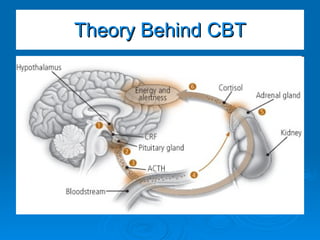
Impact on the HPA Axis The HPA Axis is the Hypothalamus-Pituitary-Adrenal Axis Changes in HPA Axis Functioning Have Been Found in Early Developmental Exposure to Trauma* Predisposes to later MDD and PTSD Vulnerability Early Trauma has been Shown to Reduce Hypothalamic Mass In utero Exposure to Stress Reveals Changes in Fetus and Infant Dysregulation of the HPA System Leading to Greater Degrees of Stress and Anxiety Theory Behind CBT *Shea, Walsh, MacMillan & Steiner (2006)
Theory Behind CBT
Antecedent Cognitive Appraisals Early Learning During Parenting Interactions or Traumas Regarding Self-Efficacy or Threats Appraisal of Likelihood of Negative Event Occurrence Appraisal of Catastrophic Outcome Appraisal of Incapacity to Effect Outcomes or Manage Outcomes Appraisal of Others as Harsh (Punitive Parenting) or Unsupportive (Dismissive Parenting) Overall Situational Appraisal & Development of Assumptive Schemas Theory Behind CBT
Emotionally Driven Behaviors (EDBs) Behavioral Response Probabilities Activation of Learned, Adaptive Responses to Over-generalized and Inappropriate Emotional Recall Reduce Emotional Arousal Negative Reinforcement When EDBs Lead to Unhealthy Outcomes Social Isolation, Avoidance of Adaptive Situations, Reduction in Relationship Connections Theory Behind CBT
Avoidance Escape is an EDB to Exit to Reduce Arousal Avoidance is to Prevent Arousal or Full Arousal Forms of Avoidance Subtle Behavioral Avoidance  Avoiding Eye Contact, Procrastination Cognitive Avoidance Distraction, Stonewalling, Mental Rituals, Thought Stopping Safety Signals Shaking Medicine Bottles, Keeping Positive Association Objects Handy, Good Luck Charms, Carrying Cleaners Theory Behind CBT
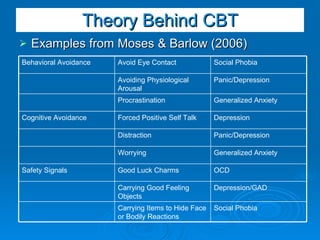
Theory Behind CBT Examples from Moses & Barlow (2006) Social Phobia Carrying Items to Hide Face or Bodily Reactions Depression/GAD Carrying Good Feeling Objects OCD Good Luck Charms Safety Signals Generalized Anxiety Worrying Panic/Depression Distraction Depression Forced Positive Self Talk Cognitive Avoidance Generalized Anxiety Procrastination Panic/Depression Avoiding Physiological Arousal Social Phobia Avoid Eye Contact Behavioral Avoidance
The Basic CBT Model Beck & Other’s Approach Psychopathology is bio-psycho-social Feelings can be managed through addressing cognitions and behaviors Psychopathology has deficits in behaviors and maladaptive or distorted cognitions Underlying assumptions have been learned in an “if-then” format Schemas create a construction that is maladaptive now, but not when first developed Theory Behind CBT
Cognitive Triad Cognitive Triad Distorted Thoughts are those that are mood congruent but not reflective of the evidence in life These are sometimes referred to as Automatic Thoughts The thoughts fit basically into three categories:  Self, Others/World, or Future Theory Behind CBT
Cognitive Blockade Cognitive Blockade Mood or other pathologic processes create a filtering of information that is state-dependent Information, both internal and external, is filtered so that only mood congruent information is a) perceived, or b) valued. Overcoming the impact of the blockade is a major goal of CBT Theory Behind CBT
Treatment Method: General IT IS AN APPROACH, NOT A MANUAL Cognitive Therapy is collaborative so that the patient and therapist are a team working on problems together Cognitive Therapy is active and engages the patient through a treatment relationship that encourages but respects the patient through empathy Cognitive Therapy uses the Socratic Method, using questions whenever possible
Socratic Method Questions are used in CBT to  Help the patient become aware of thoughts Examine thoughts to identify distortions Replace distortions with health and evidenced based ideas Plan to develop new thinking patterns Self-Awareness of EDBs Treatment Method: General
Collaborative Therapy is guided by a team approach to problems The treatment conceptualization is created collaboratively as a basis for the treatment methods The structure of the sessions is agreed upon as a way of keeping the collaborative work moving Both agree on structure and direction Treatment Method: General
Structure and Direction All sessions use the following template Setting an agenda Bridging back to the previous session Setting a target for the session Application of the CBT techniques to the target Summarization of the session Setting homework Feedback on the session Treatment Method: General
Problem Orientation Conceptualization:  Patients problems within a present, learning context Orientation to the Present/Here and Now Selection of strategies and techniques Assess the effectiveness of the CBT on the problem within its context Treatment Method: General
Common Strategies in CBT Simplify Do it now You can’t know unless you experiment If you are off track, do the opposite Persistence will produce change Break it down and take one thing at a time Do that which you don’t expect yourself to do Pull, don’t push/Flow Treatment Method: General
Educate CBT educates patients to be their own therapists Help the patient to learn how to learn It’s not resistance, it’s reluctance It’s not resistance, it’s slowness Patients learn inductively Beliefs are hypothesis Testing them can provide insight or new ways of thinking Treatment Method: General
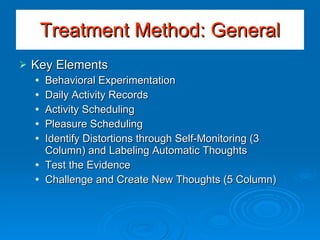
Key Elements Behavioral Experimentation Daily Activity Records Activity Scheduling Pleasure Scheduling Identify Distortions through Self-Monitoring (3 Column) and Labeling Automatic Thoughts Test the Evidence Challenge and Create New Thoughts (5 Column) Treatment Method: General
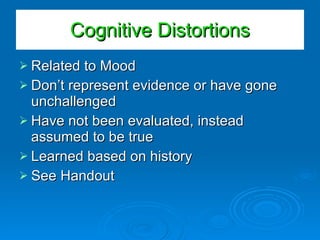
Cognitive Distortions Related to Mood Don’t represent evidence or have gone unchallenged Have not been evaluated, instead assumed to be true Learned based on history See Handout
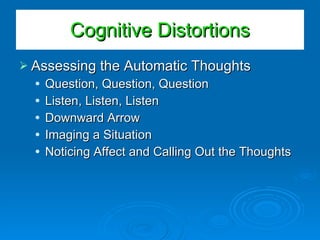
Assessing the Automatic Thoughts Question, Question, Question Listen, Listen, Listen Downward Arrow Imaging a Situation Noticing Affect and Calling Out the Thoughts Cognitive Distortions
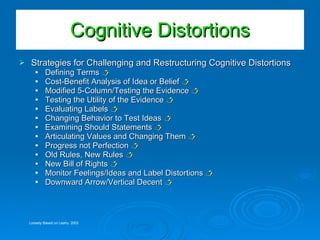
Strategies for Challenging and Restructuring Cognitive Distortions Defining Terms   Cost-Benefit Analysis of Idea or Belief   Modified 5-Column/Testing the Evidence   Testing the Utility of the Evidence   Evaluating Labels   Changing Behavior to Test Ideas   Examining Should Statements   Articulating Values and Changing Them   Progress not Perfection   Old Rules, New Rules   New Bill of Rights   Monitor Feelings/Ideas and Label Distortions   Downward Arrow/Vertical Decent   Cognitive Distortions Loosely Based on Leahy, 2003
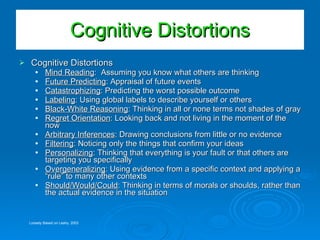
Cognitive Distortions Mind Reading :  Assuming you know what others are thinking Future Predicting : Appraisal of future events Catastrophizing : Predicting the worst possible outcome Labeling : Using global labels to describe yourself or others Black-White Reasoning : Thinking in all or none terms not shades of gray Regret Orientation : Looking back and not living in the moment of the now Arbitrary Inferences : Drawing conclusions from little or no evidence Filtering : Noticing only the things that confirm your ideas Personalizing : Thinking that everything is your fault or that others are targeting you specifically Overgeneralizing : Using evidence from a specific context and applying a “rule” to many other contexts Should/Would/Could : Thinking in terms of morals or shoulds, rather than the actual evidence in the situation Cognitive Distortions Loosely Based on Leahy, 2003
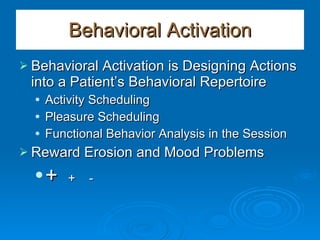
Behavioral Activation Behavioral Activation is Designing Actions into a Patient’s Behavioral Repertoire Activity Scheduling Pleasure Scheduling Functional Behavior Analysis in the Session Reward Erosion and Mood Problems +   +  -
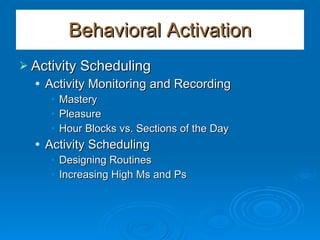
Behavioral Activation Activity Scheduling Activity Monitoring and Recording Mastery Pleasure Hour Blocks vs. Sections of the Day Activity Scheduling Designing Routines Increasing High Ms and Ps
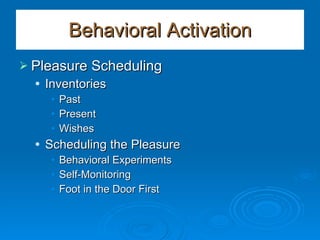
Behavioral Activation Pleasure Scheduling Inventories Past Present Wishes Scheduling the Pleasure Behavioral Experiments Self-Monitoring Foot in the Door First
Behavioral Activation Application of Functional Analysis Use of the Therapy Relationship to Differentially Deliver Reinforcement or Punishment Identification of Clinically Relevant Behaviors CRB1: Those to Decrease CRB2: Those to Increase Observe CRBs Elicit CRBs Develop Alternate Behaviors to CRB1s Differentially Apply Rewards Design Generalization invivo  Cuijpers, van Straten, and Warmerdam (2007) showed in meta-analysis that Behavioral Activation was Effective See Kanter, Manos, Busch, and Rusch, 2008
Behavioral Activation Self-Determination Development of Personal Goals Identification of Stimuli to Old Behaviors Modification of Stimuli Exposure Training New Behaviors to Stimuli (Self-Regulation of Natural Prompts)
Relaxation Therapy Controlled Breathing Concentration Rhythm Sensations Suggestive Relaxation 16 Muscle Group PMR Practice 2x per day
Relaxation Therapy Uses of Relaxation Therapy Cued Affect Management Counter-conditioning Management of Physiologic Stimuli
Overcoming “Resistance” Use of Socratic Methods How Likely to Do? Reasons Not To? How to Overcome Not To Framework of “No Choice” List Pros/Cons Application of Stages of Change
Overcoming “Resistance” Stages of Change Pre-Contemplative Educate Patient Contemplative Strategies such as Pros-Cons or Cross-Examiner Decision Decision to/Decision not to, Pros-Cons Action Graduated Exposure Strategy Foot in the Door Noticing Action and its Impact Anti-Contemplative A Different Day, A Different Time Push-Pull Strategy
Application to Anxiety Retraining the Brain: Habituation Habituation is the result of extended exposure to an anxiety provoking stimulus Anxiety typically elevates beyond typical levels due to defeat of avoidance or escape Anxiety begins to drop after extended exposure Anxiety usually flattens and persists at a reduced level for several minutes during the exposure Over repeated exposure activities, anxiety ceases to elevate clinically when the anxiety provoking stimulus is presented Habituation is seen in Systematic Desensitization using Graduated Exposure Exposure and Response Prevention (ExRP) Direct Exposure Narrative Story Telling Interventions Flooding
Application to Anxiety OCD OCD is conceptualized as an anxiety disorder driven by  mis-appraisal of the threat posed by intrusive, obsessive thoughts use of ritualized behaviors or cognitive patterns to escape the anxiety use of avoidance behaviors to end exposure to triggers associated with the obsessive thoughts
Application to Anxiety OCD Assessment in CBT is typically done with one of several instruments, although usually it is the Yale-Brown Obsessive Compulsive Scale (YBOCS) Identification of historical and current obsessions and compulsions Identification of target obsessions and compulsions, with SUDS ratings of each to create a hierarchy Identification of avoidance behaviors SUDS = Subjective Units of Distress Scale using 0 to 100 Must create behavioral anchors to ratings for patient
Application to Anxiety OCD Treatment with CBT is primarily Exposure and Response Prevention (ExRP) Therapy Exposure Patient collection of obsessive thoughts per theme Creation of Exposure Narrative—Often recorded Design of 90 minute exposure to be done daily Creation of SUDS tracking form throughout Exposure exercise Safety plan for atypical NSEs
Application to Anxiety OCD Treatment with CBT is primarily Exposure and Response Prevention (ExRP) Therapy Response Prevention Identification of Ritual Structure for each Obsession Identification of Avoidance Patterns Creation of Behavioral Plan to stop Rituals and Avoidance Creation of tracking form for ritual and avoidance performance Behavioral Description Situational Factors Emotional Experiences Outcome of Ritual or Avoidance Used to Create Better Response Prevention Plans
Application to Anxiety OCD Relapse Prevention and Fading Use of graphs to create evidence Cognitive Restructuring regarding beliefs about competency to manage OCD Cognitive Restructuring to differentiate self from OCD Fading the session length and frequency as habituation occurs Development of plan should obsessions become more controlling again Booster Sessions as a normative expectation
Application to Anxiety OCD Case Example Exposure Tape   SUDS data 
Application to Anxiety Generalized Anxiety Disorder Characterized by Uncontrollable Worrisome Thoughts that have several themes Anxiety Provocation is Based on the Appraisal of Risks in the Cognitions coupled with Estimates of Probability and Believability Anxiety is experienced as elevated but not panic-like, and occurs physically as well as subjectively
Application to Anxiety Generalized Anxiety Disorder Assessment Use of Scale like Beck Anxiety Scale or Zung Collect Diary of Worrisome Thoughts Develop SUDS for each Theme Identify Anxiety Components (e.g., subjective experience, physiologic arousal) Identify Safety Behaviors Self vs. Other Behaviors Identify Magic Cognitions (Worry Prevents Catastrophe)
Application to Anxiety Generalized Anxiety Disorder Treatment Components Relaxation Therapy to Manage Anxiety Arousal Use of Theme-based Scripts for Exposure Exercises Cognitive Restructuring to Modify Estimates of Likelihood and Believability Modification of Safety Behaviors (e.g., calling spouse to see if safe)
Application to PTSD Rape Trauma Direct Exposure Therapy Use of Cognitive Reprocessing Modification of View of Self Modification of Limited Event Recall Development of Realistic Risk Appraisal Development of Personal Safety Skills (Coping)
Application to PTSD Childhood Trauma  STAIR Affect Regulation Development of Language of Emotion Development of Emotional Self-Soothing Skills Cognitive Distraction Distress Tolerance & Behavioral Activation of Pleasurable Experiences Acceptance of Emotions and Reframing Emotions as Valued
Application to PTSD Childhood Trauma  STAIR Interpersonal Connection Identification of Interpersonal Schemas & Common Life Behaviors Self-Awareness of Conflict between Trauma Emotions vs. Goals for Interpersonal Relationships Modification of Self-Defeating Behaviors Through Role Playing Identification of Power and Control Issues in Role Playing Assertiveness Skills and Beliefs of Basic Rights Creation of Interpersonal Conflict Management Skills Fostering Flexibility Within Power-Differential Relationships
Application to PTSD Childhood Trauma  STAIR Narrative Story Telling as Exposure Creation of Memory Targets Assurance of Hope and Betterment of Life Skills Using Emotional Management Strategies at end of Exposure & Staying in the Present Identification of Negative Emotions During Narrative Identification of Negative Interpersonal Schemas in the Narrative Contrasting Present Interpersonal Reality and New Skills to Learned Schemas Applying Coping Skills to Real-Life Situations and Healthier Interpersonal Behaviors in Present Relationship
Application to Depression Self-Monitoring of Mood Orientation to Descriptions of Mood Mood Logs Three Column Strategy Behavioral Self-Monitoring Activity Log Cataloging Positive Experiences
Application to Depression Behavioral Activation Development of Three Lists Current Pleasure Past Pleasure Hopes/Dreams Planning Scheduling Daily Activities and Structure Scheduling Pleasure
Application to Depression Cognitive Restructuring Development of Evidence Testing Skills From Mood Logs and Activity Records Understanding of Automatic and Distorted Cognitions Labeling Distorted Cognitions Modifying Distortions and Mood Through 5-Column Using Pros/Cons and Other Cognitive Restructuring Strategies Stimulus Control Negative Mood Triggers and Management of Exposure Development of Coping Mechanisms for Mood Triggers Skills Enhancement (e.g., parenting skills, conflict management)
Applications to Other Disorders Mastery of Your ADHD Habit Reversal Therapy for Hair Pulling Anger Management Using Stimulus Control and Cognitive Restructuring Weight Loss Protocol Developed by Judith Beck Positive Parenting Program for ADHD and Modification of Parental Incompetence Distortions
What to Do Develop CBT competencies Identify Useful Texts Like Leahy’s books Take Training from one of the Centers Seek ABPP and/or ACT Certification
Questions

Opa basics of cognitive behavioral therapy

  • 1.
    General Survey ofCognitive-Behavioral Therapy Strategies The Model and The Techniques Kevin D. Arnold, Ph.D., ABPP Director, The Center for Cognitive and Behavioral Therapy of Greater Columbus 614.459.4490
  • 2.
    Theory Behind CBTBarlow’s Theory of Emotional Disorders Barlow (1991) & Moses and Barlow (2006) Key Concepts Emotional Regulation Emotional Memory Antecedent Cognitive Appraisals Emotionally Driven Behaviors (EDBs) Avoidance
  • 3.
    Theory Behind CBTEmotional Regulation: Key Strategies* Situational Control Situation Selection Predictive Model of Emotional Arousal Features and Likelihoods Costs and Benefits Assessment of Regulation vs. Experience Situation Modification Modification of the Physical, External Environment Attention Attention Deployment Distraction to Other Situational Features or Away Completely Concentration on Emotional Experience, Situational Factors, or Predictions Theory Behind CBT *Gross & Thompson, 2007
  • 4.
    Emotional Regulation: KeyStrategies* Appraisal Cognitive Appraisal Modification of Appraisal (e.g., threat value, label of event) Response Response Modulation Relaxation Strategies Expression of Emotion (Behavioral, Verbal) Adaptive Response Alternatives Theory Behind CBT *Gross & Thompson, 2007
  • 5.
  • 6.
    Emotional Memory* andAnxiety Disclaimer—Not a Neuropsychologist Role of Amygdala and Prefrontal Cortex in Anxiety Amygdala Stores Stress Arousal as Nondeclarative Memory In Contrast, Hippocampus Stores Declarative Memory PFC Necessary to Habituate to Anxiety Habituation is New Learning Allowing PFC to Modulate Amygdala Arousal and Enhance Declarative Recall Through Hippocampus PFC can also “prevent the acquisition of fear conditioning” or “excite the amygdala and increase fear.” (pp. 36-37) Theory Behind CBT *Quirk, 2007
  • 7.
    Emotional Memory* andDepression Disclaimer—Not a Neuropsychologist Role of Amygdala and Prefrontal Cortex in Depression PFC Activation Levels Needed to be Higher in Depressed Patients For Working Memory Performance Predisposition to Serotonin Based Abnormalities Associated with Increased Activity in Amygdala and with Abnormalities in Connection of Prefrontal Cortex and Amygdala. Theory Behind CBT *Davidson, Fox & Kalin, 2007
  • 8.
    Impact on theHPA Axis The HPA Axis is the Hypothalamus-Pituitary-Adrenal Axis Changes in HPA Axis Functioning Have Been Found in Early Developmental Exposure to Trauma* Predisposes to later MDD and PTSD Vulnerability Early Trauma has been Shown to Reduce Hypothalamic Mass In utero Exposure to Stress Reveals Changes in Fetus and Infant Dysregulation of the HPA System Leading to Greater Degrees of Stress and Anxiety Theory Behind CBT *Shea, Walsh, MacMillan & Steiner (2006)
  • 9.
  • 10.
    Antecedent Cognitive AppraisalsEarly Learning During Parenting Interactions or Traumas Regarding Self-Efficacy or Threats Appraisal of Likelihood of Negative Event Occurrence Appraisal of Catastrophic Outcome Appraisal of Incapacity to Effect Outcomes or Manage Outcomes Appraisal of Others as Harsh (Punitive Parenting) or Unsupportive (Dismissive Parenting) Overall Situational Appraisal & Development of Assumptive Schemas Theory Behind CBT
  • 11.
    Emotionally Driven Behaviors(EDBs) Behavioral Response Probabilities Activation of Learned, Adaptive Responses to Over-generalized and Inappropriate Emotional Recall Reduce Emotional Arousal Negative Reinforcement When EDBs Lead to Unhealthy Outcomes Social Isolation, Avoidance of Adaptive Situations, Reduction in Relationship Connections Theory Behind CBT
  • 12.
    Avoidance Escape isan EDB to Exit to Reduce Arousal Avoidance is to Prevent Arousal or Full Arousal Forms of Avoidance Subtle Behavioral Avoidance Avoiding Eye Contact, Procrastination Cognitive Avoidance Distraction, Stonewalling, Mental Rituals, Thought Stopping Safety Signals Shaking Medicine Bottles, Keeping Positive Association Objects Handy, Good Luck Charms, Carrying Cleaners Theory Behind CBT
  • 13.
    Theory Behind CBTExamples from Moses & Barlow (2006) Social Phobia Carrying Items to Hide Face or Bodily Reactions Depression/GAD Carrying Good Feeling Objects OCD Good Luck Charms Safety Signals Generalized Anxiety Worrying Panic/Depression Distraction Depression Forced Positive Self Talk Cognitive Avoidance Generalized Anxiety Procrastination Panic/Depression Avoiding Physiological Arousal Social Phobia Avoid Eye Contact Behavioral Avoidance
  • 14.
    The Basic CBTModel Beck & Other’s Approach Psychopathology is bio-psycho-social Feelings can be managed through addressing cognitions and behaviors Psychopathology has deficits in behaviors and maladaptive or distorted cognitions Underlying assumptions have been learned in an “if-then” format Schemas create a construction that is maladaptive now, but not when first developed Theory Behind CBT
  • 15.
    Cognitive Triad CognitiveTriad Distorted Thoughts are those that are mood congruent but not reflective of the evidence in life These are sometimes referred to as Automatic Thoughts The thoughts fit basically into three categories: Self, Others/World, or Future Theory Behind CBT
  • 16.
    Cognitive Blockade CognitiveBlockade Mood or other pathologic processes create a filtering of information that is state-dependent Information, both internal and external, is filtered so that only mood congruent information is a) perceived, or b) valued. Overcoming the impact of the blockade is a major goal of CBT Theory Behind CBT
  • 17.
    Treatment Method: GeneralIT IS AN APPROACH, NOT A MANUAL Cognitive Therapy is collaborative so that the patient and therapist are a team working on problems together Cognitive Therapy is active and engages the patient through a treatment relationship that encourages but respects the patient through empathy Cognitive Therapy uses the Socratic Method, using questions whenever possible
  • 18.
    Socratic Method Questionsare used in CBT to Help the patient become aware of thoughts Examine thoughts to identify distortions Replace distortions with health and evidenced based ideas Plan to develop new thinking patterns Self-Awareness of EDBs Treatment Method: General
  • 19.
    Collaborative Therapy isguided by a team approach to problems The treatment conceptualization is created collaboratively as a basis for the treatment methods The structure of the sessions is agreed upon as a way of keeping the collaborative work moving Both agree on structure and direction Treatment Method: General
  • 20.
    Structure and DirectionAll sessions use the following template Setting an agenda Bridging back to the previous session Setting a target for the session Application of the CBT techniques to the target Summarization of the session Setting homework Feedback on the session Treatment Method: General
  • 21.
    Problem Orientation Conceptualization: Patients problems within a present, learning context Orientation to the Present/Here and Now Selection of strategies and techniques Assess the effectiveness of the CBT on the problem within its context Treatment Method: General
  • 22.
    Common Strategies inCBT Simplify Do it now You can’t know unless you experiment If you are off track, do the opposite Persistence will produce change Break it down and take one thing at a time Do that which you don’t expect yourself to do Pull, don’t push/Flow Treatment Method: General
  • 23.
    Educate CBT educatespatients to be their own therapists Help the patient to learn how to learn It’s not resistance, it’s reluctance It’s not resistance, it’s slowness Patients learn inductively Beliefs are hypothesis Testing them can provide insight or new ways of thinking Treatment Method: General
  • 24.
    Key Elements BehavioralExperimentation Daily Activity Records Activity Scheduling Pleasure Scheduling Identify Distortions through Self-Monitoring (3 Column) and Labeling Automatic Thoughts Test the Evidence Challenge and Create New Thoughts (5 Column) Treatment Method: General
  • 25.
    Cognitive Distortions Relatedto Mood Don’t represent evidence or have gone unchallenged Have not been evaluated, instead assumed to be true Learned based on history See Handout
  • 26.
    Assessing the AutomaticThoughts Question, Question, Question Listen, Listen, Listen Downward Arrow Imaging a Situation Noticing Affect and Calling Out the Thoughts Cognitive Distortions
  • 27.
    Strategies for Challengingand Restructuring Cognitive Distortions Defining Terms  Cost-Benefit Analysis of Idea or Belief  Modified 5-Column/Testing the Evidence  Testing the Utility of the Evidence  Evaluating Labels  Changing Behavior to Test Ideas  Examining Should Statements  Articulating Values and Changing Them  Progress not Perfection  Old Rules, New Rules  New Bill of Rights  Monitor Feelings/Ideas and Label Distortions  Downward Arrow/Vertical Decent  Cognitive Distortions Loosely Based on Leahy, 2003
  • 28.
    Cognitive Distortions MindReading : Assuming you know what others are thinking Future Predicting : Appraisal of future events Catastrophizing : Predicting the worst possible outcome Labeling : Using global labels to describe yourself or others Black-White Reasoning : Thinking in all or none terms not shades of gray Regret Orientation : Looking back and not living in the moment of the now Arbitrary Inferences : Drawing conclusions from little or no evidence Filtering : Noticing only the things that confirm your ideas Personalizing : Thinking that everything is your fault or that others are targeting you specifically Overgeneralizing : Using evidence from a specific context and applying a “rule” to many other contexts Should/Would/Could : Thinking in terms of morals or shoulds, rather than the actual evidence in the situation Cognitive Distortions Loosely Based on Leahy, 2003
  • 29.
    Behavioral Activation BehavioralActivation is Designing Actions into a Patient’s Behavioral Repertoire Activity Scheduling Pleasure Scheduling Functional Behavior Analysis in the Session Reward Erosion and Mood Problems + + -
  • 30.
    Behavioral Activation ActivityScheduling Activity Monitoring and Recording Mastery Pleasure Hour Blocks vs. Sections of the Day Activity Scheduling Designing Routines Increasing High Ms and Ps
  • 31.
    Behavioral Activation PleasureScheduling Inventories Past Present Wishes Scheduling the Pleasure Behavioral Experiments Self-Monitoring Foot in the Door First
  • 32.
    Behavioral Activation Applicationof Functional Analysis Use of the Therapy Relationship to Differentially Deliver Reinforcement or Punishment Identification of Clinically Relevant Behaviors CRB1: Those to Decrease CRB2: Those to Increase Observe CRBs Elicit CRBs Develop Alternate Behaviors to CRB1s Differentially Apply Rewards Design Generalization invivo Cuijpers, van Straten, and Warmerdam (2007) showed in meta-analysis that Behavioral Activation was Effective See Kanter, Manos, Busch, and Rusch, 2008
  • 33.
    Behavioral Activation Self-DeterminationDevelopment of Personal Goals Identification of Stimuli to Old Behaviors Modification of Stimuli Exposure Training New Behaviors to Stimuli (Self-Regulation of Natural Prompts)
  • 34.
    Relaxation Therapy ControlledBreathing Concentration Rhythm Sensations Suggestive Relaxation 16 Muscle Group PMR Practice 2x per day
  • 35.
    Relaxation Therapy Usesof Relaxation Therapy Cued Affect Management Counter-conditioning Management of Physiologic Stimuli
  • 36.
    Overcoming “Resistance” Useof Socratic Methods How Likely to Do? Reasons Not To? How to Overcome Not To Framework of “No Choice” List Pros/Cons Application of Stages of Change
  • 37.
    Overcoming “Resistance” Stagesof Change Pre-Contemplative Educate Patient Contemplative Strategies such as Pros-Cons or Cross-Examiner Decision Decision to/Decision not to, Pros-Cons Action Graduated Exposure Strategy Foot in the Door Noticing Action and its Impact Anti-Contemplative A Different Day, A Different Time Push-Pull Strategy
  • 38.
    Application to AnxietyRetraining the Brain: Habituation Habituation is the result of extended exposure to an anxiety provoking stimulus Anxiety typically elevates beyond typical levels due to defeat of avoidance or escape Anxiety begins to drop after extended exposure Anxiety usually flattens and persists at a reduced level for several minutes during the exposure Over repeated exposure activities, anxiety ceases to elevate clinically when the anxiety provoking stimulus is presented Habituation is seen in Systematic Desensitization using Graduated Exposure Exposure and Response Prevention (ExRP) Direct Exposure Narrative Story Telling Interventions Flooding
  • 39.
    Application to AnxietyOCD OCD is conceptualized as an anxiety disorder driven by mis-appraisal of the threat posed by intrusive, obsessive thoughts use of ritualized behaviors or cognitive patterns to escape the anxiety use of avoidance behaviors to end exposure to triggers associated with the obsessive thoughts
  • 40.
    Application to AnxietyOCD Assessment in CBT is typically done with one of several instruments, although usually it is the Yale-Brown Obsessive Compulsive Scale (YBOCS) Identification of historical and current obsessions and compulsions Identification of target obsessions and compulsions, with SUDS ratings of each to create a hierarchy Identification of avoidance behaviors SUDS = Subjective Units of Distress Scale using 0 to 100 Must create behavioral anchors to ratings for patient
  • 41.
    Application to AnxietyOCD Treatment with CBT is primarily Exposure and Response Prevention (ExRP) Therapy Exposure Patient collection of obsessive thoughts per theme Creation of Exposure Narrative—Often recorded Design of 90 minute exposure to be done daily Creation of SUDS tracking form throughout Exposure exercise Safety plan for atypical NSEs
  • 42.
    Application to AnxietyOCD Treatment with CBT is primarily Exposure and Response Prevention (ExRP) Therapy Response Prevention Identification of Ritual Structure for each Obsession Identification of Avoidance Patterns Creation of Behavioral Plan to stop Rituals and Avoidance Creation of tracking form for ritual and avoidance performance Behavioral Description Situational Factors Emotional Experiences Outcome of Ritual or Avoidance Used to Create Better Response Prevention Plans
  • 43.
    Application to AnxietyOCD Relapse Prevention and Fading Use of graphs to create evidence Cognitive Restructuring regarding beliefs about competency to manage OCD Cognitive Restructuring to differentiate self from OCD Fading the session length and frequency as habituation occurs Development of plan should obsessions become more controlling again Booster Sessions as a normative expectation
  • 44.
    Application to AnxietyOCD Case Example Exposure Tape  SUDS data 
  • 45.
    Application to AnxietyGeneralized Anxiety Disorder Characterized by Uncontrollable Worrisome Thoughts that have several themes Anxiety Provocation is Based on the Appraisal of Risks in the Cognitions coupled with Estimates of Probability and Believability Anxiety is experienced as elevated but not panic-like, and occurs physically as well as subjectively
  • 46.
    Application to AnxietyGeneralized Anxiety Disorder Assessment Use of Scale like Beck Anxiety Scale or Zung Collect Diary of Worrisome Thoughts Develop SUDS for each Theme Identify Anxiety Components (e.g., subjective experience, physiologic arousal) Identify Safety Behaviors Self vs. Other Behaviors Identify Magic Cognitions (Worry Prevents Catastrophe)
  • 47.
    Application to AnxietyGeneralized Anxiety Disorder Treatment Components Relaxation Therapy to Manage Anxiety Arousal Use of Theme-based Scripts for Exposure Exercises Cognitive Restructuring to Modify Estimates of Likelihood and Believability Modification of Safety Behaviors (e.g., calling spouse to see if safe)
  • 48.
    Application to PTSDRape Trauma Direct Exposure Therapy Use of Cognitive Reprocessing Modification of View of Self Modification of Limited Event Recall Development of Realistic Risk Appraisal Development of Personal Safety Skills (Coping)
  • 49.
    Application to PTSDChildhood Trauma STAIR Affect Regulation Development of Language of Emotion Development of Emotional Self-Soothing Skills Cognitive Distraction Distress Tolerance & Behavioral Activation of Pleasurable Experiences Acceptance of Emotions and Reframing Emotions as Valued
  • 50.
    Application to PTSDChildhood Trauma STAIR Interpersonal Connection Identification of Interpersonal Schemas & Common Life Behaviors Self-Awareness of Conflict between Trauma Emotions vs. Goals for Interpersonal Relationships Modification of Self-Defeating Behaviors Through Role Playing Identification of Power and Control Issues in Role Playing Assertiveness Skills and Beliefs of Basic Rights Creation of Interpersonal Conflict Management Skills Fostering Flexibility Within Power-Differential Relationships
  • 51.
    Application to PTSDChildhood Trauma STAIR Narrative Story Telling as Exposure Creation of Memory Targets Assurance of Hope and Betterment of Life Skills Using Emotional Management Strategies at end of Exposure & Staying in the Present Identification of Negative Emotions During Narrative Identification of Negative Interpersonal Schemas in the Narrative Contrasting Present Interpersonal Reality and New Skills to Learned Schemas Applying Coping Skills to Real-Life Situations and Healthier Interpersonal Behaviors in Present Relationship
  • 52.
    Application to DepressionSelf-Monitoring of Mood Orientation to Descriptions of Mood Mood Logs Three Column Strategy Behavioral Self-Monitoring Activity Log Cataloging Positive Experiences
  • 53.
    Application to DepressionBehavioral Activation Development of Three Lists Current Pleasure Past Pleasure Hopes/Dreams Planning Scheduling Daily Activities and Structure Scheduling Pleasure
  • 54.
    Application to DepressionCognitive Restructuring Development of Evidence Testing Skills From Mood Logs and Activity Records Understanding of Automatic and Distorted Cognitions Labeling Distorted Cognitions Modifying Distortions and Mood Through 5-Column Using Pros/Cons and Other Cognitive Restructuring Strategies Stimulus Control Negative Mood Triggers and Management of Exposure Development of Coping Mechanisms for Mood Triggers Skills Enhancement (e.g., parenting skills, conflict management)
  • 55.
    Applications to OtherDisorders Mastery of Your ADHD Habit Reversal Therapy for Hair Pulling Anger Management Using Stimulus Control and Cognitive Restructuring Weight Loss Protocol Developed by Judith Beck Positive Parenting Program for ADHD and Modification of Parental Incompetence Distortions
  • 56.
    What to DoDevelop CBT competencies Identify Useful Texts Like Leahy’s books Take Training from one of the Centers Seek ABPP and/or ACT Certification
  • 57.