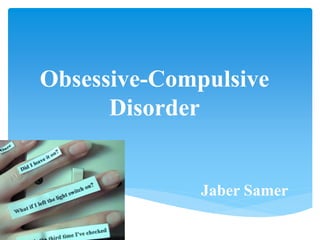
Obsessive-Compulsive
Disorder
Jaber Samer
Obsessive-Compulsive
Disorder
Obsessive-compulsive disorder (OCD) is
an type of anxiety disorder , represented by
a diverse group of symptoms that include
intrusive thoughts, rituals, preoccupations,
and compulsions.
Obsessive-Compulsive
Disorder
These recurrent obsessions or compulsions
cause severe distress to the person. The
obsessions or compulsions are time-consuming
and interfere significantly with the person's
normal routine , occupational functioning,
usual social activities, or relationships. A
patient with OCD may have an obsession, a
compulsion, or both.
Obsessive-Compulsive
Disorder
An obsession is a recurrent and intrusive thought, feeling, idea, or sensation.
In contrast to an obsession, which is a mental event, a compulsion is a
behavior.
Specifically, a compulsion is a conscious, standardized, recurrent behavior,
such as counting, checking, or avoiding.
A patient with OCD realizes the irrationality of the obsession
and experiences both the obsession and the compulsion as ego-dystonic.
Obsessive-Compulsive
Disorder
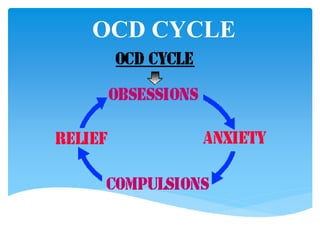
the compulsive act may be carried out in an attempt to reduce
the anxiety associated with the obsession, it does not always
succeed in doing so.
The completion of the compulsive act may not affect the
anxiety, and it may even increase the anxiety.
Anxiety is also increased when a person resists carrying out a
compulsion.
OCD CYCLE
EPIDEMIOLOGY
 a lifetime prevalence in the general population
estimated at 2 to 3 percent.
Some researchers have estimated that the disorder is
found in as many as 10 percent of outpatients in
psychiatric clinics.
OCD is the fourth most common psychiatric
diagnosis after phobias, substance-related disorders, and
major depressive disorder.
EPIDEMIOLOGY
 Among adults, men and women are equally likely to
be affected, but among adolescents, boys are more
commonly affected than girls.
 mean age of onset is about 20 y.o, although men
have a slightly earlier age of onset (mean about 19
years) than women (mean about 22 years).
 about two thirds of affected persons have an onset
before age 25, and the symptoms of fewer than 15
percent have an onset after age 35.
EPIDEMIOLOGY
 Single persons are more frequently affected with
OCD than are married persons, although this finding
probably reflects the difficulty that persons with the
disorder have maintaining a relationship .
 OCD occurs less often among blacks than among
whites.
COMORBIDITY
 Lifetime prevalence for major depressive
disorder in persons with OCD is about 67
percent and for social phobia, about 25 percent.
 The incidence of Tourette's disorder in
patients with OCD is 5 to 7 percent, and 20 to 30
percent of patients with OCD have a history of
tics.
COMORBIDITY
 Other common comorbid psychiatric
diagnoses in patients with OCD include alcohol
use disorders, generalized anxiety disorder,
specific phobia, panic disorder, eating disorders,
and personality disorders.
ETIOLOGY
Biological Factors
Serotonergic System
dysregulation of serotonin is involved in the symptom formation
of obsessions and compulsions in the disorder.
Data show that serotonergic drugs are more effective than drugs
that affect other neurotransmitter systems.
ETIOLOGY
Biological Factors
Serotonergic System
Clinical studies have assayed CSF concentrations of serotonin metabolites
(e.g., 5-hydroxyindoleacetic acid [5-HIAA]) and affinities and numbers of
platelet-binding sites of tritiated imipramine , which binds to serotonin
reuptake sites, and have reported variable findings of these measures in
patients with OCD. In one study, the CSF concentration of 5-HIAA decreased
after treatment with clomipramine , focusing attention on the serotonergic
system.
ETIOLOGY
Biological Factors
Noradrenergic System
Currently, less evidence exists for dysfunction in the
noradrenergic system in OCD. Anecdotal reports show some
improvement in OCD symptoms with use of oral clonidine, a
drug that lowers the amount of norepinephrine released from the
presynaptic nerve terminals.
ETIOLOGY
NEUROIMMUNOLOGY
Some interest exists in a positive link between
streptococcal infection and OCD. Group A β-
hemolytic streptococcal infection can cause
rheumatic fever, and approximately 10 to 30
percent of the patients develop Sydenham's
chorea and show obsessive-compulsive
symptoms.
ETIOLOGY
Brain-Imaging Studies
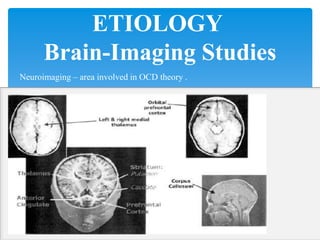
Neuroimaging in patients with OCD has produced converging data
implicating altered function in the neurocircuitry between orbitofrontal
cortex, caudate, and thalamus.
 PET SCANS shows - increased activity (e.g., metabolism and blood flow)
in the frontal lobes, the basal ganglia (especially the caudate), and the
cingulum of patients with OCD.
 Pharmacological and behavioral treatments reportedly reverse
these abnormalities.
ETIOLOGY
Brain-Imaging Studies
Neuroimaging – area involved in OCD theory .
ETIOLOGY
Brain-Imaging Studies
 In CT-Scans studies have found bilaterally smaller
caudates in patients with OCD.
 MRI study reported increased T1 relaxation times in
the frontal cortex, a finding consistent with the location
of abnormalities discovered in PET studies .
ETIOLOGY
Genetics
 Some studies demonstrate increased rates of a
variety of conditions among relatives of OCD probands,
including generalized anxiety disorder, tic disorders,
body dysmorphic disorder, hypochondriasis, eating
disorders, and habits such as nail-biting.
ETIOLOGY
Other Biological Data
A higher than usual incidence of nonspecific EEG abnormalities occurs
in patients with OCD.
 Sleep EEG studies have found abnormalities similar to those in
depressive disorders, such as decreased rapid eye movement latency.
 Neuroendocrine studies have also produced some analogies to
depressive disorders, such as non-suppression on the dexamethasone-
suppression test in about one third of patients and decreased growth hormone
secretion .
ETIOLOGY
Behavioral Factors
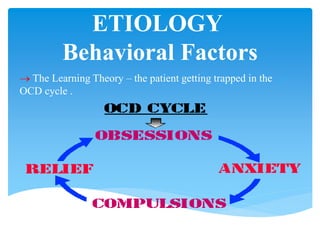
 The Learning Theory – the patient getting trapped in the
OCD cycle .
ETIOLOGY
Psycho-social Factors
Personality Factors
OCD differs from obsessive-compulsive personality disorder, which is
associated with an obsessive concern for details, perfectionism, and
other similar personality traits. Most persons with OCD do not have
premorbid compulsive symptoms, and such personality traits are
neither necessary nor sufficient for the development of OCD. Only
about 15 to 35 percent of patients with OCD have had premorbid
obsessional traits.
ETIOLOGY
Psycho-social Factors
Psychodynamic factors
Many patients refuse to cooperate with SSRI treatment and CBT , and become
invested in symptomatology due to secondary gain , child who want to obtain
attention from his mother .
And patient learn how there illness can effect others – mainly faced in families
with disrupted interpersonal relationship .
OCD patient engage in compulsion pattern in Away to relieve stressors of
daily life – environmental stressors , pregnancy , child care .
ETIOLOGY
Psycho-social Factors
Sigmund freud theory
Obsessive-Compulsive Neurosis considered a regression from the oedipal
phase to the anal psychosexual phase of development – OCD patient feels
threatened by the anxiety about unconsciousness impulses or loss of love
object which to an intensity ambivalence emotional stage with the anal phase ,
the coexistence of hatred and love toward same person leave patient paralyzed
with doubt and indecision .
Freud believed the need to be clean and not to be touched is related to anal
sexuality , and the disgust for the mother is the reaction against that fear .
The disturbances may lie between normal development and anal-sadistic
development .
ETIOLOGY
Psycho-social Factors
Magical Thinking
In magical thinking, regression uncovers early modes of thought rather
than impulses; that is, ego functions, as well as id functions, are
affected by regression. Inherent in magical thinking is omnipotence of
thought. Persons believe that merely by thinking about an event in the
external world they can cause the event to occur without intermediate
physical actions. This feeling causes them to fear having an aggressive
Thought.
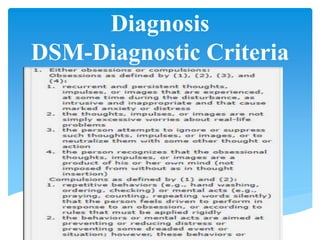
Diagnosis
DSM-Diagnostic Criteria
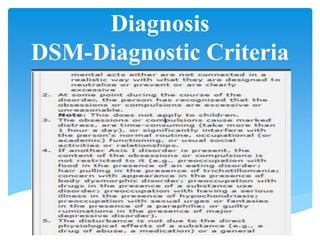
Diagnosis
DSM-Diagnostic Criteria
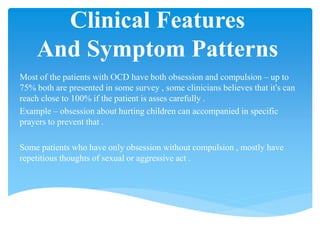
Clinical Features
And Symptom Patterns
Most of the patients with OCD have both obsession and compulsion – up to
75% both are presented in some survey , some clinicians believes that it’s can
reach close to 100% if the patient is asses carefully .
Example – obsession about hurting children can accompanied in specific
prayers to prevent that .
Some patients who have only obsession without compulsion , mostly have
repetitious thoughts of sexual or aggressive act .
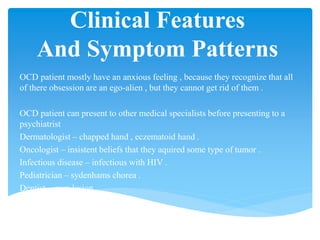
Clinical Features
And Symptom Patterns
OCD patient mostly have an anxious feeling , because they recognize that all
of there obsession are an ego-alien , but they cannot get rid of them .
OCD patient can present to other medical specialists before presenting to a
psychiatrist
Dermatologist – chapped hand , eczematoid hand .
Oncologist – insistent beliefs that they aquired some type of tumor .
Infectious disease – infectious with HIV .
Pediatrician – sydenhams chorea .
Dentist – gum lesion .
Clinical Features
And Symptom Patterns
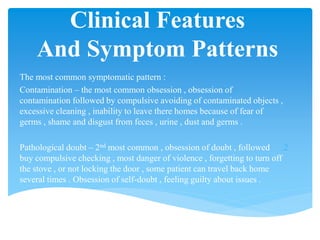
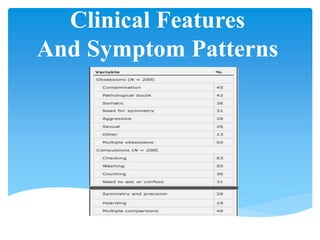
The most common symptomatic pattern :
.1Contamination – the most common obsession , obsession of
contamination followed by compulsive avoiding of contaminated objects ,
excessive cleaning , inability to leave there homes because of fear of
germs , shame and disgust from feces , urine , dust and germs .
.2Pathological doubt – 2nd most common , obsession of doubt , followed
buy compulsive checking , most danger of violence , forgetting to turn off
the stove , or not locking the door , some patient can travel back home
several times . Obsession of self-doubt , feeling guilty about issues .
Clinical Features
And Symptom Patterns
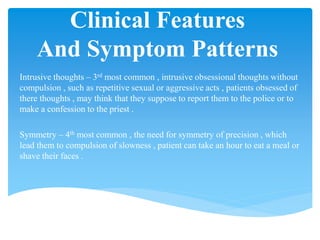
Intrusive thoughts – 3rd most common , intrusive obsessional thoughts without
compulsion , such as repetitive sexual or aggressive acts , patients obsessed of
there thoughts , may think that they suppose to report them to the police or to
make a confession to the priest .
Symmetry – 4th most common , the need for symmetry of precision , which
lead them to compulsion of slowness , patient can take an hour to eat a meal or
shave their faces .
Clinical Features
And Symptom Patterns
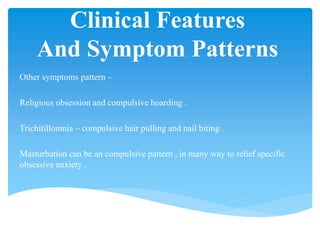
Other symptoms pattern –
Religious obsession and compulsive hoarding .
Trichitillomnia – compulsive hair pulling and nail biting .
Masturbation can be an compulsive pattern , in many way to relief specific
obsessive anxiety .
Clinical Features
And Symptom Patterns
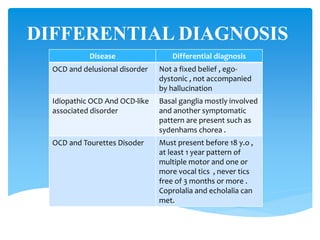
DIFFERENTIAL DIAGNOSIS
Differential diagnosisDisease
Not a fixed belief , ego-
dystonic , not accompanied
by hallucination
OCD and delusional disorder
Basal ganglia mostly involved
and another symptomatic
pattern are present such as
sydenhams chorea .
Idiopathic OCD And OCD-like
associated disorder
Must present before 18 y.o ,
at least 1 year pattern of
multiple motor and one or
more vocal tics , never tics
free of 3 months or more .
Coprolalia and echolalia can
met.
OCD and Tourettes Disoder
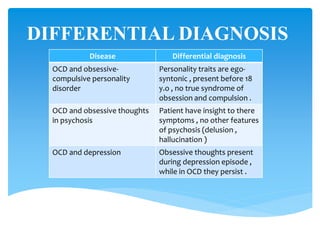
DIFFERENTIAL DIAGNOSIS
Differential diagnosisDisease
Personality traits are ego-
syntonic , present before 18
y.o , no true syndrome of
obsession and compulsion .
OCD and obsessive-
compulsive personality
disorder
Patient have insight to there
symptoms , no other features
of psychosis (delusion ,
hallucination )
OCD and obsessive thoughts
in psychosis
Obsessive thoughts present
during depression episode ,
while in OCD they persist .
OCD and depression
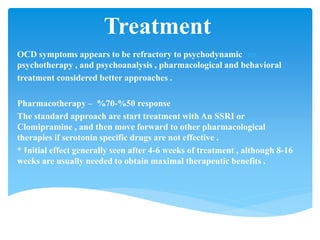
Treatment
OCD symptoms appears to be refractory to psychodynamic
psychotherapy , and psychoanalysis , pharmacological and behavioral
treatment considered better approaches .
response50%-70%Pharmacotherapy –
The standard approach are start treatment with An SSRI or
Clomipramine , and then move forward to other pharmacological
therapies if serotonin specific drugs are not effective .
* Initial effect generally seen after 4-6 weeks of treatment , although 8-16
weeks are usually needed to obtain maximal therapeutic benefits .
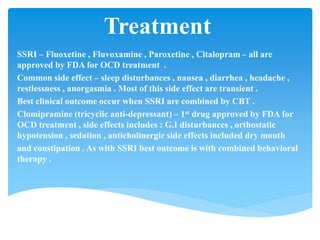
Treatment
SSRI – Fluoxetine , Fluvoxamine , Paroxetine , Citalopram – all are
approved by FDA for OCD treatment .
Common side effect – sleep disturbances , nausea , diarrhea , headache ,
restlessness , anorgasmia . Most of this side effect are transient .
Best clinical outcome occur when SSRI are combined by CBT .
Clomipramine (tricyclic anti-depressant) – 1st drug approved by FDA for
OCD treatment , side effects includes : G.I disturbances , orthostatic
hypotension , sedation , anticholinergic side effects included dry mouth
and constipation . As with SSRI best outcome is with combined behavioral
therapy .
Treatment
Other pharmacotherapy which used for first augmentation in case of
resistance cases –
Valporate
Lithium
Carbamazepine
Other drugs which could be tried – Venelafaxine , pindolol , MAOI
phenelzine , buspirone , 5-hydroxytryptamine , l-tryptophan , clonazepam
.
Atypical anti-psychotic such as Risperidol , helped in some cases .
Treatment
Behavior therapy
Pharmacotherapy and behavioral therapy has long lasting effect .
The principle of the therapy is –
Exposure and response prevention
Desensitization and thoughts stopping
Flooding
Aversive conditioning .
Psychotherapy with concentrating in Cognitive behavioral therapy , and
insight oriented therapy , also can be combined by supportive therapy .
Treatment – other
therapies
Family therapy – building alliance with the family members , and helping
reduce marital discord resulting from the disorder .
Group therapy – can be tried .
•For extreme cases that treatment resistant and chronically debilitating
– ELECTROCONVULSIVE THEAPT (ECT) and psychosurgery are
the consideration .
Treatment – other
therapies
•Psychosurgery
•Cingulotomy which is successfully treating 25-30 percent of
unresponsive cases .
•Subcaudate tractotmy (capsulotomy) also has been used for that
purpose .
Non ablative surgical techniques involving indwelling electrodes in
various basal ganglia (deep brain stimulation ) are under investigation
for
patient who is suffering from Tourettes disorder and OCD .
Seizures development due to Psychosurgery , mostly can be eliminated by
phenytoin .
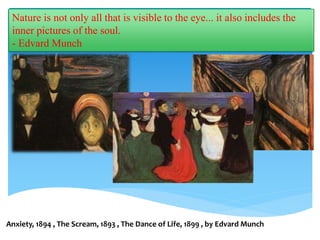
Nature is not only all that is visible to the eye... it also includes the
inner pictures of the soul.
- Edvard Munch
Anxiety, 1894 , The Scream, 1893 , The Dance of Life, 1899 , by Edvard Munch

Obsessive compulsive disorder

  • 1.
  • 2.
    Obsessive-Compulsive Disorder Obsessive-compulsive disorder (OCD)is an type of anxiety disorder , represented by a diverse group of symptoms that include intrusive thoughts, rituals, preoccupations, and compulsions.
  • 3.
    Obsessive-Compulsive Disorder These recurrent obsessionsor compulsions cause severe distress to the person. The obsessions or compulsions are time-consuming and interfere significantly with the person's normal routine , occupational functioning, usual social activities, or relationships. A patient with OCD may have an obsession, a compulsion, or both.
  • 4.
    Obsessive-Compulsive Disorder An obsession isa recurrent and intrusive thought, feeling, idea, or sensation. In contrast to an obsession, which is a mental event, a compulsion is a behavior. Specifically, a compulsion is a conscious, standardized, recurrent behavior, such as counting, checking, or avoiding. A patient with OCD realizes the irrationality of the obsession and experiences both the obsession and the compulsion as ego-dystonic.
  • 5.
    Obsessive-Compulsive Disorder the compulsive actmay be carried out in an attempt to reduce the anxiety associated with the obsession, it does not always succeed in doing so. The completion of the compulsive act may not affect the anxiety, and it may even increase the anxiety. Anxiety is also increased when a person resists carrying out a compulsion.
  • 6.
  • 7.
    EPIDEMIOLOGY  a lifetimeprevalence in the general population estimated at 2 to 3 percent. Some researchers have estimated that the disorder is found in as many as 10 percent of outpatients in psychiatric clinics. OCD is the fourth most common psychiatric diagnosis after phobias, substance-related disorders, and major depressive disorder.
  • 8.
    EPIDEMIOLOGY  Among adults,men and women are equally likely to be affected, but among adolescents, boys are more commonly affected than girls.  mean age of onset is about 20 y.o, although men have a slightly earlier age of onset (mean about 19 years) than women (mean about 22 years).  about two thirds of affected persons have an onset before age 25, and the symptoms of fewer than 15 percent have an onset after age 35.
  • 9.
    EPIDEMIOLOGY  Single personsare more frequently affected with OCD than are married persons, although this finding probably reflects the difficulty that persons with the disorder have maintaining a relationship .  OCD occurs less often among blacks than among whites.
  • 10.
    COMORBIDITY  Lifetime prevalencefor major depressive disorder in persons with OCD is about 67 percent and for social phobia, about 25 percent.  The incidence of Tourette's disorder in patients with OCD is 5 to 7 percent, and 20 to 30 percent of patients with OCD have a history of tics.
  • 11.
    COMORBIDITY  Other commoncomorbid psychiatric diagnoses in patients with OCD include alcohol use disorders, generalized anxiety disorder, specific phobia, panic disorder, eating disorders, and personality disorders.
  • 12.
    ETIOLOGY Biological Factors Serotonergic System dysregulationof serotonin is involved in the symptom formation of obsessions and compulsions in the disorder. Data show that serotonergic drugs are more effective than drugs that affect other neurotransmitter systems.
  • 13.
    ETIOLOGY Biological Factors Serotonergic System Clinicalstudies have assayed CSF concentrations of serotonin metabolites (e.g., 5-hydroxyindoleacetic acid [5-HIAA]) and affinities and numbers of platelet-binding sites of tritiated imipramine , which binds to serotonin reuptake sites, and have reported variable findings of these measures in patients with OCD. In one study, the CSF concentration of 5-HIAA decreased after treatment with clomipramine , focusing attention on the serotonergic system.
  • 14.
    ETIOLOGY Biological Factors Noradrenergic System Currently,less evidence exists for dysfunction in the noradrenergic system in OCD. Anecdotal reports show some improvement in OCD symptoms with use of oral clonidine, a drug that lowers the amount of norepinephrine released from the presynaptic nerve terminals.
  • 15.
    ETIOLOGY NEUROIMMUNOLOGY Some interest existsin a positive link between streptococcal infection and OCD. Group A β- hemolytic streptococcal infection can cause rheumatic fever, and approximately 10 to 30 percent of the patients develop Sydenham's chorea and show obsessive-compulsive symptoms.
  • 16.
    ETIOLOGY Brain-Imaging Studies Neuroimaging inpatients with OCD has produced converging data implicating altered function in the neurocircuitry between orbitofrontal cortex, caudate, and thalamus.  PET SCANS shows - increased activity (e.g., metabolism and blood flow) in the frontal lobes, the basal ganglia (especially the caudate), and the cingulum of patients with OCD.  Pharmacological and behavioral treatments reportedly reverse these abnormalities.
  • 17.
  • 18.
    ETIOLOGY Brain-Imaging Studies  InCT-Scans studies have found bilaterally smaller caudates in patients with OCD.  MRI study reported increased T1 relaxation times in the frontal cortex, a finding consistent with the location of abnormalities discovered in PET studies .
  • 19.
    ETIOLOGY Genetics  Some studiesdemonstrate increased rates of a variety of conditions among relatives of OCD probands, including generalized anxiety disorder, tic disorders, body dysmorphic disorder, hypochondriasis, eating disorders, and habits such as nail-biting.
  • 20.
    ETIOLOGY Other Biological Data Ahigher than usual incidence of nonspecific EEG abnormalities occurs in patients with OCD.  Sleep EEG studies have found abnormalities similar to those in depressive disorders, such as decreased rapid eye movement latency.  Neuroendocrine studies have also produced some analogies to depressive disorders, such as non-suppression on the dexamethasone- suppression test in about one third of patients and decreased growth hormone secretion .
  • 21.
    ETIOLOGY Behavioral Factors  TheLearning Theory – the patient getting trapped in the OCD cycle .
  • 22.
    ETIOLOGY Psycho-social Factors Personality Factors OCDdiffers from obsessive-compulsive personality disorder, which is associated with an obsessive concern for details, perfectionism, and other similar personality traits. Most persons with OCD do not have premorbid compulsive symptoms, and such personality traits are neither necessary nor sufficient for the development of OCD. Only about 15 to 35 percent of patients with OCD have had premorbid obsessional traits.
  • 23.
    ETIOLOGY Psycho-social Factors Psychodynamic factors Manypatients refuse to cooperate with SSRI treatment and CBT , and become invested in symptomatology due to secondary gain , child who want to obtain attention from his mother . And patient learn how there illness can effect others – mainly faced in families with disrupted interpersonal relationship . OCD patient engage in compulsion pattern in Away to relieve stressors of daily life – environmental stressors , pregnancy , child care .
  • 24.
    ETIOLOGY Psycho-social Factors Sigmund freudtheory Obsessive-Compulsive Neurosis considered a regression from the oedipal phase to the anal psychosexual phase of development – OCD patient feels threatened by the anxiety about unconsciousness impulses or loss of love object which to an intensity ambivalence emotional stage with the anal phase , the coexistence of hatred and love toward same person leave patient paralyzed with doubt and indecision . Freud believed the need to be clean and not to be touched is related to anal sexuality , and the disgust for the mother is the reaction against that fear . The disturbances may lie between normal development and anal-sadistic development .
  • 25.
    ETIOLOGY Psycho-social Factors Magical Thinking Inmagical thinking, regression uncovers early modes of thought rather than impulses; that is, ego functions, as well as id functions, are affected by regression. Inherent in magical thinking is omnipotence of thought. Persons believe that merely by thinking about an event in the external world they can cause the event to occur without intermediate physical actions. This feeling causes them to fear having an aggressive Thought.
  • 26.
  • 27.
  • 28.
    Clinical Features And SymptomPatterns Most of the patients with OCD have both obsession and compulsion – up to 75% both are presented in some survey , some clinicians believes that it’s can reach close to 100% if the patient is asses carefully . Example – obsession about hurting children can accompanied in specific prayers to prevent that . Some patients who have only obsession without compulsion , mostly have repetitious thoughts of sexual or aggressive act .
  • 29.
    Clinical Features And SymptomPatterns OCD patient mostly have an anxious feeling , because they recognize that all of there obsession are an ego-alien , but they cannot get rid of them . OCD patient can present to other medical specialists before presenting to a psychiatrist Dermatologist – chapped hand , eczematoid hand . Oncologist – insistent beliefs that they aquired some type of tumor . Infectious disease – infectious with HIV . Pediatrician – sydenhams chorea . Dentist – gum lesion .
  • 30.
    Clinical Features And SymptomPatterns The most common symptomatic pattern : .1Contamination – the most common obsession , obsession of contamination followed by compulsive avoiding of contaminated objects , excessive cleaning , inability to leave there homes because of fear of germs , shame and disgust from feces , urine , dust and germs . .2Pathological doubt – 2nd most common , obsession of doubt , followed buy compulsive checking , most danger of violence , forgetting to turn off the stove , or not locking the door , some patient can travel back home several times . Obsession of self-doubt , feeling guilty about issues .
  • 31.
    Clinical Features And SymptomPatterns Intrusive thoughts – 3rd most common , intrusive obsessional thoughts without compulsion , such as repetitive sexual or aggressive acts , patients obsessed of there thoughts , may think that they suppose to report them to the police or to make a confession to the priest . Symmetry – 4th most common , the need for symmetry of precision , which lead them to compulsion of slowness , patient can take an hour to eat a meal or shave their faces .
  • 32.
    Clinical Features And SymptomPatterns Other symptoms pattern – Religious obsession and compulsive hoarding . Trichitillomnia – compulsive hair pulling and nail biting . Masturbation can be an compulsive pattern , in many way to relief specific obsessive anxiety .
  • 33.
  • 34.
    DIFFERENTIAL DIAGNOSIS Differential diagnosisDisease Nota fixed belief , ego- dystonic , not accompanied by hallucination OCD and delusional disorder Basal ganglia mostly involved and another symptomatic pattern are present such as sydenhams chorea . Idiopathic OCD And OCD-like associated disorder Must present before 18 y.o , at least 1 year pattern of multiple motor and one or more vocal tics , never tics free of 3 months or more . Coprolalia and echolalia can met. OCD and Tourettes Disoder
  • 35.
    DIFFERENTIAL DIAGNOSIS Differential diagnosisDisease Personalitytraits are ego- syntonic , present before 18 y.o , no true syndrome of obsession and compulsion . OCD and obsessive- compulsive personality disorder Patient have insight to there symptoms , no other features of psychosis (delusion , hallucination ) OCD and obsessive thoughts in psychosis Obsessive thoughts present during depression episode , while in OCD they persist . OCD and depression
  • 36.
    Treatment OCD symptoms appearsto be refractory to psychodynamic psychotherapy , and psychoanalysis , pharmacological and behavioral treatment considered better approaches . response50%-70%Pharmacotherapy – The standard approach are start treatment with An SSRI or Clomipramine , and then move forward to other pharmacological therapies if serotonin specific drugs are not effective . * Initial effect generally seen after 4-6 weeks of treatment , although 8-16 weeks are usually needed to obtain maximal therapeutic benefits .
  • 37.
    Treatment SSRI – Fluoxetine, Fluvoxamine , Paroxetine , Citalopram – all are approved by FDA for OCD treatment . Common side effect – sleep disturbances , nausea , diarrhea , headache , restlessness , anorgasmia . Most of this side effect are transient . Best clinical outcome occur when SSRI are combined by CBT . Clomipramine (tricyclic anti-depressant) – 1st drug approved by FDA for OCD treatment , side effects includes : G.I disturbances , orthostatic hypotension , sedation , anticholinergic side effects included dry mouth and constipation . As with SSRI best outcome is with combined behavioral therapy .
  • 38.
    Treatment Other pharmacotherapy whichused for first augmentation in case of resistance cases – Valporate Lithium Carbamazepine Other drugs which could be tried – Venelafaxine , pindolol , MAOI phenelzine , buspirone , 5-hydroxytryptamine , l-tryptophan , clonazepam . Atypical anti-psychotic such as Risperidol , helped in some cases .
  • 39.
    Treatment Behavior therapy Pharmacotherapy andbehavioral therapy has long lasting effect . The principle of the therapy is – Exposure and response prevention Desensitization and thoughts stopping Flooding Aversive conditioning . Psychotherapy with concentrating in Cognitive behavioral therapy , and insight oriented therapy , also can be combined by supportive therapy .
  • 40.
    Treatment – other therapies Familytherapy – building alliance with the family members , and helping reduce marital discord resulting from the disorder . Group therapy – can be tried . •For extreme cases that treatment resistant and chronically debilitating – ELECTROCONVULSIVE THEAPT (ECT) and psychosurgery are the consideration .
  • 41.
    Treatment – other therapies •Psychosurgery •Cingulotomywhich is successfully treating 25-30 percent of unresponsive cases . •Subcaudate tractotmy (capsulotomy) also has been used for that purpose . Non ablative surgical techniques involving indwelling electrodes in various basal ganglia (deep brain stimulation ) are under investigation for patient who is suffering from Tourettes disorder and OCD . Seizures development due to Psychosurgery , mostly can be eliminated by phenytoin .
  • 42.
    Nature is notonly all that is visible to the eye... it also includes the inner pictures of the soul. - Edvard Munch Anxiety, 1894 , The Scream, 1893 , The Dance of Life, 1899 , by Edvard Munch