Building Construction
Technology
Lecture # 4
What is a
bond?
Bond
The arrangement of bricks or stones in each layer
so as to avoid continuity of vertical joints in any
adjacent course both on the face and inside of a
masonry structure is called bond.
This is done by overlapping bricks or stones in the
successive courses longitudinally as well as
transversely.
Necessity Of Providing Bond
A bond is provided to achieve the following
objects:
1.The primary object of providing a bond is to
break the vertical continuity of the joints in the
successive courses both in the length and
thickness of a masonry structure.
2.To ensure the longitudinal and lateral strength
of the structure.
3.To enable the structure to act as a
bounded mass and to distribute the load
uniformly to its foundation.
4.To provide pleasing appearance by
placing bricks or stones symmetrically.
5.To do masonry work quickly by engaging
more masons on the job at a time.
Bonding in Brickwork
The process of arranging bricks in different courses in
order to tie them together in unified mass of brickwork is
called bonding in brickwork.
Bonding in brickwork is done to ensure that vertical joints
do not come over one another because a brickwork
having continuous vertical joints will not act as a unified
mass but will consist of small portions which act as
columns. In such a construction, the load on wall shall
not be uniform distributed but there are chances of
settlement of the load .
Bonding in Brickwork
However, if a wall is properly bounded so that there are
no continuous vertical joints the load will get distributed.
Thus, the purpose of bonding in brickwork is to develop
longitudinal and transverse interlocking for individual
bricks so as to achieve a unified mass of the structure.
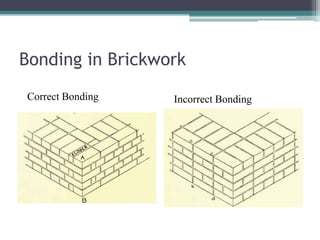
Bonding in Brickwork
Correct Bonding Incorrect Bonding
Types Of Bonds In Brickwork and Their
Suitability:
The following are the different types of
bonds used in brickwork:
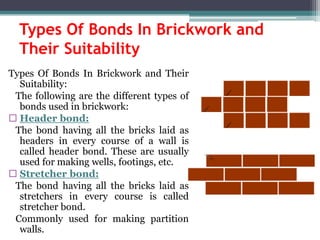
 Header bond:
The bond having all the bricks laid as
headers in every course of a wall is
called header bond. These are usually
used for making wells, footings, etc.
 Stretcher bond:
The bond having all the bricks laid as
stretchers in every course is called
stretcher bond.
Commonly used for making partition
walls.
Types Of Bonds In Brickwork and
Their Suitability
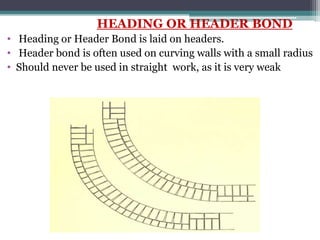
HEADING OR HEADER BOND
• Heading or Header Bond is laid on headers.
• Header bond is often used on curving walls with a small radius
• Should never be used in straight work, as it is very weak
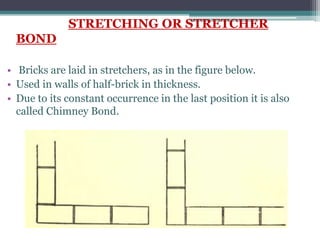
STRETCHING OR STRETCHER
BOND
• Bricks are laid in stretchers, as in the figure below.
• Used in walls of half-brick in thickness.
• Due to its constant occurrence in the last position it is also
called Chimney Bond.
Types Of Bonds In Brickwork and
Their Suitability
The following are the different types of bonds used
in brickwork:
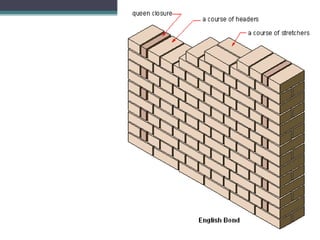
1.English Bond: The bond having headers and
stretchers laid in alternate courses is called
English bond.
In this bond, a queen a queen closer is placed after
every quoin header in the header course to break
the continuity of vertical Joints.
Bonding in Brickwork
This bond is considered as the strongest bond and does not
require any special alternation in its formation.
Salient Features of English Bond Are Given Below:
i. Headers and stretchers are laid in alternate courses.
ii. A queen closer is placed after every quoin header in the
heading course when the thickness of wall is 9” or
above.
iii. Continuous vertical joints do not occur on the face as
well as on inside of the structure.
iv. Each alternate header in the heading course lies
centrally over every stretcher of the underlying
stretching course.
Suitability: English bond is commonly adopted for
brickwork of buildings where strength is of prime
importance.
DISADVANTAGE:
• Penetration of damp through transverse joints.
• Appearance not as good as Flemish bond.
Flemish bond
The bond having headers and stretchers laid
alternately in the same course is called flemish
bond. In this bond a queen closer is provided
after every quoin header n the alternate courses
to break the continuity of vertical joints. Brick
bats are to be used for forming this bond when
the thickness of wall is equal to an odd mutiple
of half brick.
Salient Features of Flemish Bond:
I. Header and stretcher are laid aternately in the
same coruse.
II. Queen closer is placed after every quoin header
in the alternate course when the thickness of
the wall is 9” or above.
III. Every header in each course lies centrally over
each stretcher of he underlying course.
Flemish Bond is of two types:
1. Double Flemish Bond
2. Single Flemish Bond
Duoble Flemish Bond: The bond having header and
stretchers laid alternatively in each course both in
the face and back of the structure is called double
flemish bond. This type of bond provides good
appearance but it is weaker in strength than english
bond for walls having thickness more than 9”.
Suitability: It is used in buildings where appearance is
of prime importance.
Comparison Between English Bond and
Flemish Bond
English Bond
1. Construction:
This bond consists of
headers and stretchers
laid in alternate courses.
2. Strength
It is the strongest of all the
bonds.
Flemish Bond
This bond consists of
headers and stretchers
laid alternatively in each
courses.
It is less strong.
Comparison Between English Bond and
Flemish Bond
English Bond
3. Appearance
It provides rough
appearance especially for
one brick thick walls.
4.Continuity of Vertical
Joints
There are no continuous
vertical joints in the
structure built in this
bond.
Flemish Bond
It provides good
appearance for all
thickness of walls.
There are partly continuous
vertical joints in the
structure built in this
bond.
Comparison Between English Bond and
Flemish Bond
English Bond
5. Care in providing the
Bond
Special Care is not required
in providing this bond.
6. Progress Of Work:
Progress of work is more.
7. Cost
It is costly because use of
brick bats is not allowed.
Flemish Bond
Special Care is required in
providing this bond.
Progress of work is less.
It is economical because
brick bats are to be used
for forming this bond.
• The most important factors affecting the
thickness of a wall in brick masonry are:
1. The Total load to be carried by the wall
2. Overall Height of the Wall
3. Height between floors
4. Strength of materials-Strength of brick and
mortar
Factors Affecting The Thickness Of
Walls In Brick Masonry:
lecture-4 (brick bonding).ppt

lecture-4 (brick bonding).ppt

  • 1.
  • 2.
  • 3.
    Bond The arrangement ofbricks or stones in each layer so as to avoid continuity of vertical joints in any adjacent course both on the face and inside of a masonry structure is called bond. This is done by overlapping bricks or stones in the successive courses longitudinally as well as transversely.
  • 4.
    Necessity Of ProvidingBond A bond is provided to achieve the following objects: 1.The primary object of providing a bond is to break the vertical continuity of the joints in the successive courses both in the length and thickness of a masonry structure. 2.To ensure the longitudinal and lateral strength of the structure.
  • 5.
    3.To enable thestructure to act as a bounded mass and to distribute the load uniformly to its foundation. 4.To provide pleasing appearance by placing bricks or stones symmetrically. 5.To do masonry work quickly by engaging more masons on the job at a time.
  • 6.
    Bonding in Brickwork Theprocess of arranging bricks in different courses in order to tie them together in unified mass of brickwork is called bonding in brickwork. Bonding in brickwork is done to ensure that vertical joints do not come over one another because a brickwork having continuous vertical joints will not act as a unified mass but will consist of small portions which act as columns. In such a construction, the load on wall shall not be uniform distributed but there are chances of settlement of the load .
  • 7.
    Bonding in Brickwork However,if a wall is properly bounded so that there are no continuous vertical joints the load will get distributed. Thus, the purpose of bonding in brickwork is to develop longitudinal and transverse interlocking for individual bricks so as to achieve a unified mass of the structure.
  • 8.
    Bonding in Brickwork CorrectBonding Incorrect Bonding
  • 9.
    Types Of BondsIn Brickwork and Their Suitability: The following are the different types of bonds used in brickwork:  Header bond: The bond having all the bricks laid as headers in every course of a wall is called header bond. These are usually used for making wells, footings, etc.  Stretcher bond: The bond having all the bricks laid as stretchers in every course is called stretcher bond. Commonly used for making partition walls. Types Of Bonds In Brickwork and Their Suitability
  • 10.
    HEADING OR HEADERBOND • Heading or Header Bond is laid on headers. • Header bond is often used on curving walls with a small radius • Should never be used in straight work, as it is very weak
  • 11.
    STRETCHING OR STRETCHER BOND •Bricks are laid in stretchers, as in the figure below. • Used in walls of half-brick in thickness. • Due to its constant occurrence in the last position it is also called Chimney Bond.
  • 12.
    Types Of BondsIn Brickwork and Their Suitability The following are the different types of bonds used in brickwork: 1.English Bond: The bond having headers and stretchers laid in alternate courses is called English bond. In this bond, a queen a queen closer is placed after every quoin header in the header course to break the continuity of vertical Joints.
  • 13.
    Bonding in Brickwork Thisbond is considered as the strongest bond and does not require any special alternation in its formation. Salient Features of English Bond Are Given Below: i. Headers and stretchers are laid in alternate courses. ii. A queen closer is placed after every quoin header in the heading course when the thickness of wall is 9” or above. iii. Continuous vertical joints do not occur on the face as well as on inside of the structure. iv. Each alternate header in the heading course lies centrally over every stretcher of the underlying stretching course.
  • 14.
    Suitability: English bondis commonly adopted for brickwork of buildings where strength is of prime importance. DISADVANTAGE: • Penetration of damp through transverse joints. • Appearance not as good as Flemish bond.
  • 16.
    Flemish bond The bondhaving headers and stretchers laid alternately in the same course is called flemish bond. In this bond a queen closer is provided after every quoin header n the alternate courses to break the continuity of vertical joints. Brick bats are to be used for forming this bond when the thickness of wall is equal to an odd mutiple of half brick.
  • 17.
    Salient Features ofFlemish Bond: I. Header and stretcher are laid aternately in the same coruse. II. Queen closer is placed after every quoin header in the alternate course when the thickness of the wall is 9” or above. III. Every header in each course lies centrally over each stretcher of he underlying course.
  • 19.
    Flemish Bond isof two types: 1. Double Flemish Bond 2. Single Flemish Bond Duoble Flemish Bond: The bond having header and stretchers laid alternatively in each course both in the face and back of the structure is called double flemish bond. This type of bond provides good appearance but it is weaker in strength than english bond for walls having thickness more than 9”. Suitability: It is used in buildings where appearance is of prime importance.
  • 20.
    Comparison Between EnglishBond and Flemish Bond English Bond 1. Construction: This bond consists of headers and stretchers laid in alternate courses. 2. Strength It is the strongest of all the bonds. Flemish Bond This bond consists of headers and stretchers laid alternatively in each courses. It is less strong.
  • 21.
    Comparison Between EnglishBond and Flemish Bond English Bond 3. Appearance It provides rough appearance especially for one brick thick walls. 4.Continuity of Vertical Joints There are no continuous vertical joints in the structure built in this bond. Flemish Bond It provides good appearance for all thickness of walls. There are partly continuous vertical joints in the structure built in this bond.
  • 22.
    Comparison Between EnglishBond and Flemish Bond English Bond 5. Care in providing the Bond Special Care is not required in providing this bond. 6. Progress Of Work: Progress of work is more. 7. Cost It is costly because use of brick bats is not allowed. Flemish Bond Special Care is required in providing this bond. Progress of work is less. It is economical because brick bats are to be used for forming this bond.
  • 23.
    • The mostimportant factors affecting the thickness of a wall in brick masonry are: 1. The Total load to be carried by the wall 2. Overall Height of the Wall 3. Height between floors 4. Strength of materials-Strength of brick and mortar Factors Affecting The Thickness Of Walls In Brick Masonry: