

Anatomy, Physiology & Benign
Pathology of the
Breast
Victor H. Barnica M.D.
Surgery
Development
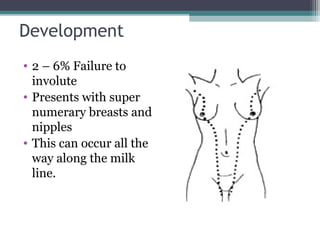
• The milk line as the
  primitive structure
• Around 6th week of
  gestational age
• 9th week involutes
  sparing the chest area
Development


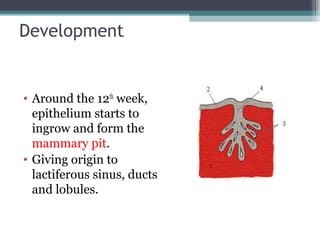
• Around the 12th week,
  epithelium starts to
  ingrow and form the
  mammary pit.
• Giving origin to
  lactiferous sinus, ducts
  and lobules.
Development
• 2 – 6% Failure to
  involute
• Presents with super
  numerary breasts and
  nipples
• This can occur all the
  way along the milk
  line.
Development


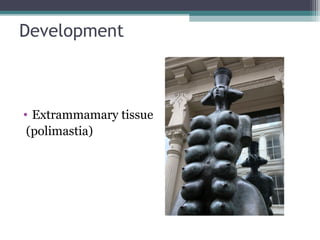
• Extrammamary tissue
 (polimastia)
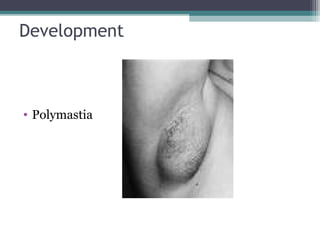
Development


• Polymastia
Development


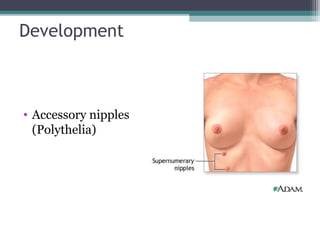
• Accessory nipples
  (Polythelia)
Anatomy
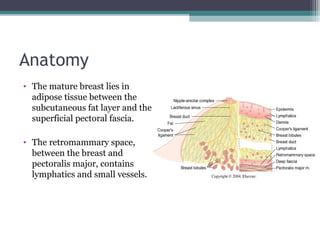
• The mature breast lies in
  adipose tissue between the
  subcutaneous fat layer and the
  superficial pectoral fascia.

• The retromammary space,
  between the breast and
  pectoralis major, contains
  lymphatics and small vessels.
Anatomy
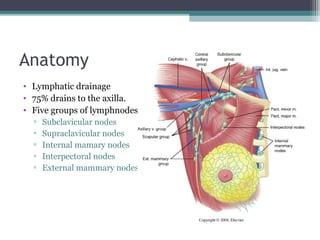
• Lymphatic drainage
• 75% drains to the axilla.
• Five groups of lymphnodes.
  ▫ Subclavicular nodes
  ▫ Supraclavicular nodes
  ▫ Internal mamary nodes
  ▫ Interpectoral nodes
  ▫ External mammary nodes
Anatomy
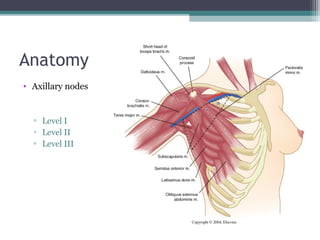
• Axillary nodes


  ▫ Level I
  ▫ Level II
  ▫ Level III
Anatomy
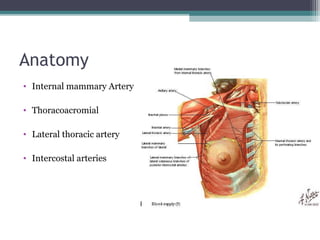
• Internal mammary Artery

• Thoracoacromial

• Lateral thoracic artery

• Intercostal arteries
Anatomy
• Close to the chest wall on the
  medial side of the axilla is the
  long thoracic nerve.

• Provides innervation to the
  anterior serratus muscle.

• Division of this results in
  winged scapula
Anatomy
• The second major nerve trunk is the
  thoracodorsal nerve.
• Runs at the lateral border of the axilla
• Innervates the latissimus dorsi muscle
• The medial pectoralis nerves innervate the
  pectoralis major muscle and are part of the
  neurovasvular bundle, best landmark for the
  axillary vein.
Anatomy
• Microscopic anatomy
• A mature breast is composed of 3 principal
  tissue types:
 ▫ Glandular epithelium
 ▫ Fibrous stroma and supporting structures
 ▫ Fat
• Epithelium and stroma being replaced by fat in
  postmenopausal women.
Anatomy
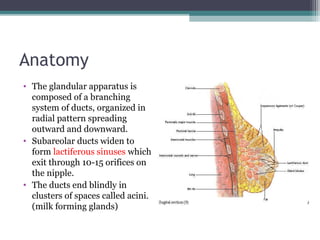
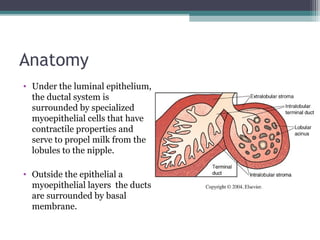
• The glandular apparatus is
  composed of a branching
  system of ducts, organized in
  radial pattern spreading
  outward and downward.
• Subareolar ducts widen to
  form lactiferous sinuses which
  exit through 10-15 orifices on
  the nipple.
• The ducts end blindly in
  clusters of spaces called acini.
  (milk forming glands)
Anatomy
• Under the luminal epithelium,
  the ductal system is
  surrounded by specialized
  myoepithelial cells that have
  contractile properties and
  serve to propel milk from the
  lobules to the nipple.

• Outside the epithelial a
  myoepithelial layers the ducts
  are surrounded by basal
  membrane.
Development and physiology
• During prepuberty the breast is composed
  primarily of dense fibrous stroma and scattered
  ducts lined with epithelium.
• Raised serum stradiol concentrations promote
  fat deposition, formation of new ducts by
  branching and elongation.
• Trophic effects of Insulin and thyroid hormones.
Development and physiology
• Postpubertal mature or resting breast contains
  fat, stroma, lactiferous ducts and lobular units.
• The epithelium and stroma undergo cyclic
  stimulation.
• Hypertrophy and morphology alteration rather
  than hyperplasia.
Development and physiology
• During pregnancy


 ▫ Diminution of fibrous stroma
                                        Adenosis of
 ▫ Formation of new acini or lobules    Pregnancy


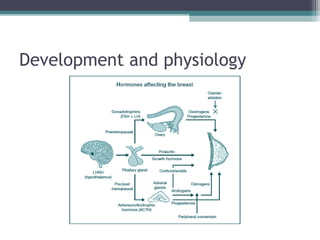
• Changes promoted by influence of progesterone,
  estrogen, placental lactogen, prolactin and
  chorionic gonadotropin.
Development and physiology
• Placental lactogen and sex hormones maintain
  the mammary epithelium in a presecretory
  phase by antagonizing the effects of prolactin.
• The abrupt withdrawal upon delivery leaves the
  breast under the influence of prolactin.
• In the presence of GH, Insulin and Cortisol,
  prolactin converts the epithelial cells to a
  secretory phase, resulting in the production of
  milk by alveolar cells.
Development and physiology
• Colostrum

• Milk production starts by day 4 or 5

• Prolacting is maintained and stimulated by
  suckling.
Development and physiology
• Oxytocin, released from the posterior pituitary in
  response to nipple/areolar stimulation, causes
  the ductal myoepithelial cells to contract and
  eject milk.
• Postlactational involution occurs typically 3
  months after weaning.
• Menopause results in involution, decrease
  epithelial elements of resting breast, increased
  fat deposition, diminished connective tissue and
  disappearance of lobular units.
Benign Clinical Conditions
• Mastalgia
• 70% present pain, only 3% seek treatment.
• Commonly cyclic and premenstrual.
• Detail H&P, location, relation with mestrual period,
  duration, association w/masses or skin changes.
• Commonly FCC, cysts and infection.
• Older than 35 get mammogram as part of the W/U.
• Treatment no caffeine, minimize salt, NSAIDs,
  Vitamins E and B6.
Benign Clinical Conditions
•   Nipple Discharge
•   Relatively common 5% of referrals
•   95% has a benign cause
•   Likelihood of malignacy increases w/age
    ▫ Younger than 40 3%
    ▫ Ages 40-60 10%
    ▫ Older than 60 32%
• All get mammogram
Benign Clinical Conditions
• Nipple discharge cont…
• Determine if physiologic or pathologic
• Physiologic
 ▫ Non spontaneous, bilateral and multiple ducts.
 ▫ Colorwhite, yellow, green, brown or black-
   bluish.
 ▫ Galactorrhea is b/l, copious, white color, non
   pregnant.  medications or prolactinoma.
 ▫ Most common benign causes of bloody d/c are
   intraductal papiloma, periductal mastitis and duct
   ectasia.
Benign Clinical Conditions
• Pathological discharge

  ▫ Spontaneous
  ▫ Unilateral
  ▫ Single duct

• If associated with a mass, excision or biopsy is
  indicated.
Benign Clinical Conditions
• Breas abscess/mastitis
• Mastitis is cellulitis of the breast, commonly
  during lactation.
  ▫ Staph Aureus
  ▫ Strep
  ▫ Treat with heat/ice pads, Abx (1st gen ceph. Or
    PCN)
  ▫ Breast pump if patient lactating.
• If abscess is present I&D + IV Abx.
Benign Clinical Conditions
•   Simple breast Cysts
•   Epithelial-lined cavities that contain fluid
•   7% of women
•   Can have cyclic fluctuation
•   Firm and mobile and well demarcated
•   Aspiration
    ▫ If bloody
                            Excisional biopsy is
    ▫ Recurrence            warranted
    ▫ Persistence
Benign Clinical Conditions
• Fibroadenoma
• Most common cause of breast masses in younger
  than 25yo.
• Pseudo encapsulated and mobile, smooth or
  slightly lobulated.
• Epithelial and stromal elements.
• Solitary and painless masses.
• Older than 30 get biopsied.
• Definitive diagnosis by FNA, core needle or
  excision.
Benign Clinical Conditions
• Hamartomas

• Well-defined masses on exam and mammogram.

• Composed of combination of fibrous stroma,
  ducts, lobules, adipose tissue and occasional
  smooth muscle.
Benign Clinical Conditions
• Fat necrosis
• Can mimic carcinoma, clinically and
  mammographycally
• Round, firm tumor that may have cavitations 2ry
  to liquefactive necrosis.
• Micro Early lesions have cystic space w/lipid
  laden macrophages .
• Later lesions have fibroplastic proliferation w/
  deposition of collagen.
Benign Clinical Conditions
• Fibrocystic changes
• Spectrum of mammographic and histologic
  findings
• Forth and fifth decades of life
• Exagerated response of breast stroma and
  epithelium to circulating and locally produced
  hormones
• Breast pain, tenderness and nodularity
• Premenstrual cyclic mastalgia
Benign Clinical Conditions
• Mammographycally apears as diffuse of focal
  radiologically dense tissue.
• Palpable cysts or multiple small cysts are typical
• Depending on the presence of epithelial
  hyperplasia is classified:
  ▫ Non proliferative
  ▫ Proliferative w/o atypia
  ▫ Proliferative w/atypia
• Risk of cancer when presence of ADH or ALH.
Benign Clinical Conditions
• Gynecomastia
• Hypertrophy of breast tissue in man
• No identifiable cause
  ▫ Pubertal  13yo and early adulthood
  ▫ Senescent older than 50
• Meds: digoxin, thiazides, estrogens, phenothiazines
  and theophyline.
• May be a systemic manifestation of cirrhosis, renal
  failure and malnutrition.
• Just provide reassurance unless cosmetically
  unacceptable.
Benign Clinical Conditions
• Galactocele
• Milk-filled cysts that are round, well
  circunscribed and easily movable.
• Up to 6-10 months after breast-feeding has
  stopped.
• Unknown pathogenesis, thouth to be due to
  inspissated milk within ducts.
• Centrally located under the nipple.
• Can be aspirated and surgery reserved for those
  that become infected.
anatomy,physiology of breast

anatomy,physiology of breast

  • 1.
    Anatomy, Physiology &Benign Pathology of the Breast Victor H. Barnica M.D. Surgery
  • 2.
    Development • The milkline as the primitive structure • Around 6th week of gestational age • 9th week involutes sparing the chest area
  • 3.
    Development • Around the12th week, epithelium starts to ingrow and form the mammary pit. • Giving origin to lactiferous sinus, ducts and lobules.
  • 4.
    Development • 2 –6% Failure to involute • Presents with super numerary breasts and nipples • This can occur all the way along the milk line.
  • 5.
  • 6.
  • 7.
  • 8.
    Anatomy • The maturebreast lies in adipose tissue between the subcutaneous fat layer and the superficial pectoral fascia. • The retromammary space, between the breast and pectoralis major, contains lymphatics and small vessels.
  • 9.
    Anatomy • Lymphatic drainage •75% drains to the axilla. • Five groups of lymphnodes. ▫ Subclavicular nodes ▫ Supraclavicular nodes ▫ Internal mamary nodes ▫ Interpectoral nodes ▫ External mammary nodes
  • 10.
    Anatomy • Axillary nodes ▫ Level I ▫ Level II ▫ Level III
  • 11.
    Anatomy • Internal mammaryArtery • Thoracoacromial • Lateral thoracic artery • Intercostal arteries
  • 12.
    Anatomy • Close tothe chest wall on the medial side of the axilla is the long thoracic nerve. • Provides innervation to the anterior serratus muscle. • Division of this results in winged scapula
  • 13.
    Anatomy • The secondmajor nerve trunk is the thoracodorsal nerve. • Runs at the lateral border of the axilla • Innervates the latissimus dorsi muscle • The medial pectoralis nerves innervate the pectoralis major muscle and are part of the neurovasvular bundle, best landmark for the axillary vein.
  • 14.
    Anatomy • Microscopic anatomy •A mature breast is composed of 3 principal tissue types: ▫ Glandular epithelium ▫ Fibrous stroma and supporting structures ▫ Fat • Epithelium and stroma being replaced by fat in postmenopausal women.
  • 15.
    Anatomy • The glandularapparatus is composed of a branching system of ducts, organized in radial pattern spreading outward and downward. • Subareolar ducts widen to form lactiferous sinuses which exit through 10-15 orifices on the nipple. • The ducts end blindly in clusters of spaces called acini. (milk forming glands)
  • 16.
    Anatomy • Under theluminal epithelium, the ductal system is surrounded by specialized myoepithelial cells that have contractile properties and serve to propel milk from the lobules to the nipple. • Outside the epithelial a myoepithelial layers the ducts are surrounded by basal membrane.
  • 17.
    Development and physiology •During prepuberty the breast is composed primarily of dense fibrous stroma and scattered ducts lined with epithelium. • Raised serum stradiol concentrations promote fat deposition, formation of new ducts by branching and elongation. • Trophic effects of Insulin and thyroid hormones.
  • 18.
    Development and physiology •Postpubertal mature or resting breast contains fat, stroma, lactiferous ducts and lobular units. • The epithelium and stroma undergo cyclic stimulation. • Hypertrophy and morphology alteration rather than hyperplasia.
  • 19.
  • 20.
    Development and physiology •During pregnancy ▫ Diminution of fibrous stroma Adenosis of ▫ Formation of new acini or lobules Pregnancy • Changes promoted by influence of progesterone, estrogen, placental lactogen, prolactin and chorionic gonadotropin.
  • 21.
    Development and physiology •Placental lactogen and sex hormones maintain the mammary epithelium in a presecretory phase by antagonizing the effects of prolactin. • The abrupt withdrawal upon delivery leaves the breast under the influence of prolactin. • In the presence of GH, Insulin and Cortisol, prolactin converts the epithelial cells to a secretory phase, resulting in the production of milk by alveolar cells.
  • 22.
    Development and physiology •Colostrum • Milk production starts by day 4 or 5 • Prolacting is maintained and stimulated by suckling.
  • 23.
    Development and physiology •Oxytocin, released from the posterior pituitary in response to nipple/areolar stimulation, causes the ductal myoepithelial cells to contract and eject milk. • Postlactational involution occurs typically 3 months after weaning. • Menopause results in involution, decrease epithelial elements of resting breast, increased fat deposition, diminished connective tissue and disappearance of lobular units.
  • 24.
    Benign Clinical Conditions •Mastalgia • 70% present pain, only 3% seek treatment. • Commonly cyclic and premenstrual. • Detail H&P, location, relation with mestrual period, duration, association w/masses or skin changes. • Commonly FCC, cysts and infection. • Older than 35 get mammogram as part of the W/U. • Treatment no caffeine, minimize salt, NSAIDs, Vitamins E and B6.
  • 25.
    Benign Clinical Conditions • Nipple Discharge • Relatively common 5% of referrals • 95% has a benign cause • Likelihood of malignacy increases w/age ▫ Younger than 40 3% ▫ Ages 40-60 10% ▫ Older than 60 32% • All get mammogram
  • 26.
    Benign Clinical Conditions •Nipple discharge cont… • Determine if physiologic or pathologic • Physiologic ▫ Non spontaneous, bilateral and multiple ducts. ▫ Colorwhite, yellow, green, brown or black- bluish. ▫ Galactorrhea is b/l, copious, white color, non pregnant.  medications or prolactinoma. ▫ Most common benign causes of bloody d/c are intraductal papiloma, periductal mastitis and duct ectasia.
  • 27.
    Benign Clinical Conditions •Pathological discharge ▫ Spontaneous ▫ Unilateral ▫ Single duct • If associated with a mass, excision or biopsy is indicated.
  • 28.
    Benign Clinical Conditions •Breas abscess/mastitis • Mastitis is cellulitis of the breast, commonly during lactation. ▫ Staph Aureus ▫ Strep ▫ Treat with heat/ice pads, Abx (1st gen ceph. Or PCN) ▫ Breast pump if patient lactating. • If abscess is present I&D + IV Abx.
  • 29.
    Benign Clinical Conditions • Simple breast Cysts • Epithelial-lined cavities that contain fluid • 7% of women • Can have cyclic fluctuation • Firm and mobile and well demarcated • Aspiration ▫ If bloody Excisional biopsy is ▫ Recurrence warranted ▫ Persistence
  • 30.
    Benign Clinical Conditions •Fibroadenoma • Most common cause of breast masses in younger than 25yo. • Pseudo encapsulated and mobile, smooth or slightly lobulated. • Epithelial and stromal elements. • Solitary and painless masses. • Older than 30 get biopsied. • Definitive diagnosis by FNA, core needle or excision.
  • 31.
    Benign Clinical Conditions •Hamartomas • Well-defined masses on exam and mammogram. • Composed of combination of fibrous stroma, ducts, lobules, adipose tissue and occasional smooth muscle.
  • 32.
    Benign Clinical Conditions •Fat necrosis • Can mimic carcinoma, clinically and mammographycally • Round, firm tumor that may have cavitations 2ry to liquefactive necrosis. • Micro Early lesions have cystic space w/lipid laden macrophages . • Later lesions have fibroplastic proliferation w/ deposition of collagen.
  • 33.
    Benign Clinical Conditions •Fibrocystic changes • Spectrum of mammographic and histologic findings • Forth and fifth decades of life • Exagerated response of breast stroma and epithelium to circulating and locally produced hormones • Breast pain, tenderness and nodularity • Premenstrual cyclic mastalgia
  • 34.
    Benign Clinical Conditions •Mammographycally apears as diffuse of focal radiologically dense tissue. • Palpable cysts or multiple small cysts are typical • Depending on the presence of epithelial hyperplasia is classified: ▫ Non proliferative ▫ Proliferative w/o atypia ▫ Proliferative w/atypia • Risk of cancer when presence of ADH or ALH.
  • 35.
    Benign Clinical Conditions •Gynecomastia • Hypertrophy of breast tissue in man • No identifiable cause ▫ Pubertal  13yo and early adulthood ▫ Senescent older than 50 • Meds: digoxin, thiazides, estrogens, phenothiazines and theophyline. • May be a systemic manifestation of cirrhosis, renal failure and malnutrition. • Just provide reassurance unless cosmetically unacceptable.
  • 36.
    Benign Clinical Conditions •Galactocele • Milk-filled cysts that are round, well circunscribed and easily movable. • Up to 6-10 months after breast-feeding has stopped. • Unknown pathogenesis, thouth to be due to inspissated milk within ducts. • Centrally located under the nipple. • Can be aspirated and surgery reserved for those that become infected.