



Olive R. Orpilla
COED
 Brain Development in
a.Infancy
b. Early Childhood
c. Middle Childhood
d. Adolescence
 Environmental Influences on
Development of the Brain
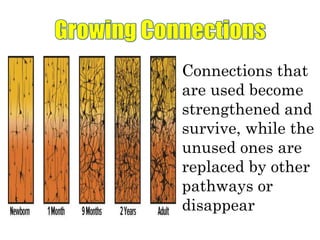
Connections that
are used become
strengthened and
survive, while the
unused ones are
replaced by other
pathways or
disappear
 Connections that are not used are removed
 After the first birthday, pruning occurs more
quickly.
 A 3 year old child has twice as many
connections as an adult.
 By 10 years, a child has nearly 500 trillion
synapses, which is the same as the average
adult
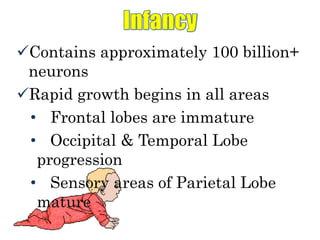
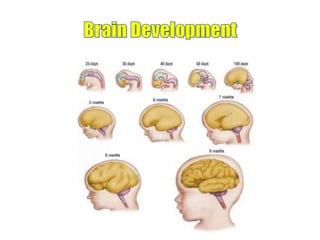
Contains approximately 100 billion+
neurons
Rapid growth begins in all areas
• Frontal lobes are immature
• Occipital & Temporal Lobe
progression
• Sensory areas of Parietal Lobe
mature
Connections are made permanent from early
infancy to early childhood
As we mature, the brain physically changes
due to outside experiences.
The first three years see the most rapid
changes due to the bombardment of
experience.
At this time, the brain is most flexible and
prepared to learn.
 A brain doubles in weight after 6
months.
Brain development proceeds at an
uneven pace occurring between 3 and
10 months and between 15 and 24
months.
There are 100 billion neurons present at
birth which conduct nerve impulses.
The neurons are nourished by glial cells.
Glial cells outnumber
neurons but are smaller
than neurons.
Production of myelin.
a fatty substance that form the
covering of the axon of the neuron.
It is myelin substance that conducts
impulses at higher speeds
Myelination of nerve fibers grows at
different parts of the brain.
The first to be myelinated is the
peripheral nervous system connecting
the sensory perception, brain
muscles, spinal chords and the
internal organs and glands.
The number of neuron is constant following
birth.
Ages between 6 and 8 the development of
frontal lobes of the cerebral cortex and the
sensory and motor areas are the primary sites
of brain growth.
Selective attention allows children to focus
cognitive ability on the elements of a problem
or situation.
 95% of brain growth is reached by time a
child reaches the age of 9.
• Growth is characterized by interrelated
process namely: Cell proliferation and
cell pruning
 Is the ability to identify and act a relationship
between objects in space.
 Lateralization of spatial perception.
The over production
of neurons
interconnections
Is a continuous
process in the
childhood phase
There are two major brain growth spurts
one occurring between ages 13 to 15;
• The first spurt , the cerebral cortex
becomes thicker and neuronal
pathways become more efficient.
• The second birth growth spurt has the
frontal lobes of the cerebral cortex as
focus of development.
Frontal Lobes, responsible for reasoning
and problem solving, develop.
Synaptic growth spurts most in temporal
and parietal lobes.
Synaptic pruning occurs mostly in frontal
lobes and adolescent losses 3 percent
matter in frontal lobes
Life’s experiences whether better or
worse have lasting effects on the
capacity of the central Nervous
System to learn and store
information
The midbrain are the most fully
developed at birth.
The last developed part of the brain
at birth is the cortex
 95% of brain functions
are laterized through a
pattern called left-brain
dominance. The pattern
called left-dominance.
The remaining small
portion of the functions
that account for
remaining small portion
of the functions that
account for 5% are
reversed.

Brain development

  • 1.
  • 2.
     Brain Developmentin a.Infancy b. Early Childhood c. Middle Childhood d. Adolescence  Environmental Influences on Development of the Brain
  • 3.
    Connections that are usedbecome strengthened and survive, while the unused ones are replaced by other pathways or disappear
  • 4.
     Connections thatare not used are removed  After the first birthday, pruning occurs more quickly.  A 3 year old child has twice as many connections as an adult.  By 10 years, a child has nearly 500 trillion synapses, which is the same as the average adult
  • 5.
    Contains approximately 100billion+ neurons Rapid growth begins in all areas • Frontal lobes are immature • Occipital & Temporal Lobe progression • Sensory areas of Parietal Lobe mature
  • 7.
    Connections are madepermanent from early infancy to early childhood As we mature, the brain physically changes due to outside experiences. The first three years see the most rapid changes due to the bombardment of experience. At this time, the brain is most flexible and prepared to learn.
  • 8.
     A braindoubles in weight after 6 months. Brain development proceeds at an uneven pace occurring between 3 and 10 months and between 15 and 24 months. There are 100 billion neurons present at birth which conduct nerve impulses. The neurons are nourished by glial cells. Glial cells outnumber neurons but are smaller than neurons. Production of myelin.
  • 9.
    a fatty substancethat form the covering of the axon of the neuron. It is myelin substance that conducts impulses at higher speeds Myelination of nerve fibers grows at different parts of the brain. The first to be myelinated is the peripheral nervous system connecting the sensory perception, brain muscles, spinal chords and the internal organs and glands.
  • 10.
    The number ofneuron is constant following birth. Ages between 6 and 8 the development of frontal lobes of the cerebral cortex and the sensory and motor areas are the primary sites of brain growth. Selective attention allows children to focus cognitive ability on the elements of a problem or situation.
  • 11.
     95% ofbrain growth is reached by time a child reaches the age of 9. • Growth is characterized by interrelated process namely: Cell proliferation and cell pruning  Is the ability to identify and act a relationship between objects in space.  Lateralization of spatial perception. The over production of neurons interconnections Is a continuous process in the childhood phase
  • 12.
    There are twomajor brain growth spurts one occurring between ages 13 to 15; • The first spurt , the cerebral cortex becomes thicker and neuronal pathways become more efficient. • The second birth growth spurt has the frontal lobes of the cerebral cortex as focus of development.
  • 13.
    Frontal Lobes, responsiblefor reasoning and problem solving, develop. Synaptic growth spurts most in temporal and parietal lobes. Synaptic pruning occurs mostly in frontal lobes and adolescent losses 3 percent matter in frontal lobes
  • 14.
    Life’s experiences whetherbetter or worse have lasting effects on the capacity of the central Nervous System to learn and store information The midbrain are the most fully developed at birth. The last developed part of the brain at birth is the cortex
  • 15.
     95% ofbrain functions are laterized through a pattern called left-brain dominance. The pattern called left-dominance. The remaining small portion of the functions that account for remaining small portion of the functions that account for 5% are reversed.