SEMINAR
  ON


       SUBMITTED BY:-
                        TYPE YOUR NAME
                        REG.
  21/3/2007             BRANCH     1
POINTS TO BE DISCUSSED
   INTRODUCTION
   OPERATIONAL MODES
   XYBERNAUT
   NETWORKING AND OPERATING SYSTEM
   COMPONENT PIECES
   OUTLOOK
   AGENTS
   RECOGNISING EFFECT
   APPLICATIONS
   FUTURE RESEARCH
   CONCLUSION


                     21/3/2007        2
INTRODUCTION
   A wearable computer is a small portable computer that is designed to be
    worn on the body during use.

   Wearable computers are usually either integrated into the user's clothing
    or can be attached to the body through some other means , like a
    wristband.

   The computer evolution has moved from mainframes, to the desktop, and
    now the computing power is moving onto the person.

   The user actually "wearing" the computer, s/he can utilize the power and
    functionality virtually anywhere in their environment.

   This technology is developing and changing rapidly primarily due to vast
    changes in computer speed, wireless technology and miniaturization of
    components.


                                   21/3/2007                             3
Operational Modes of Wearable Computer

   Constancy


   Augmentation


   Mediation


                   21/3/2007             4
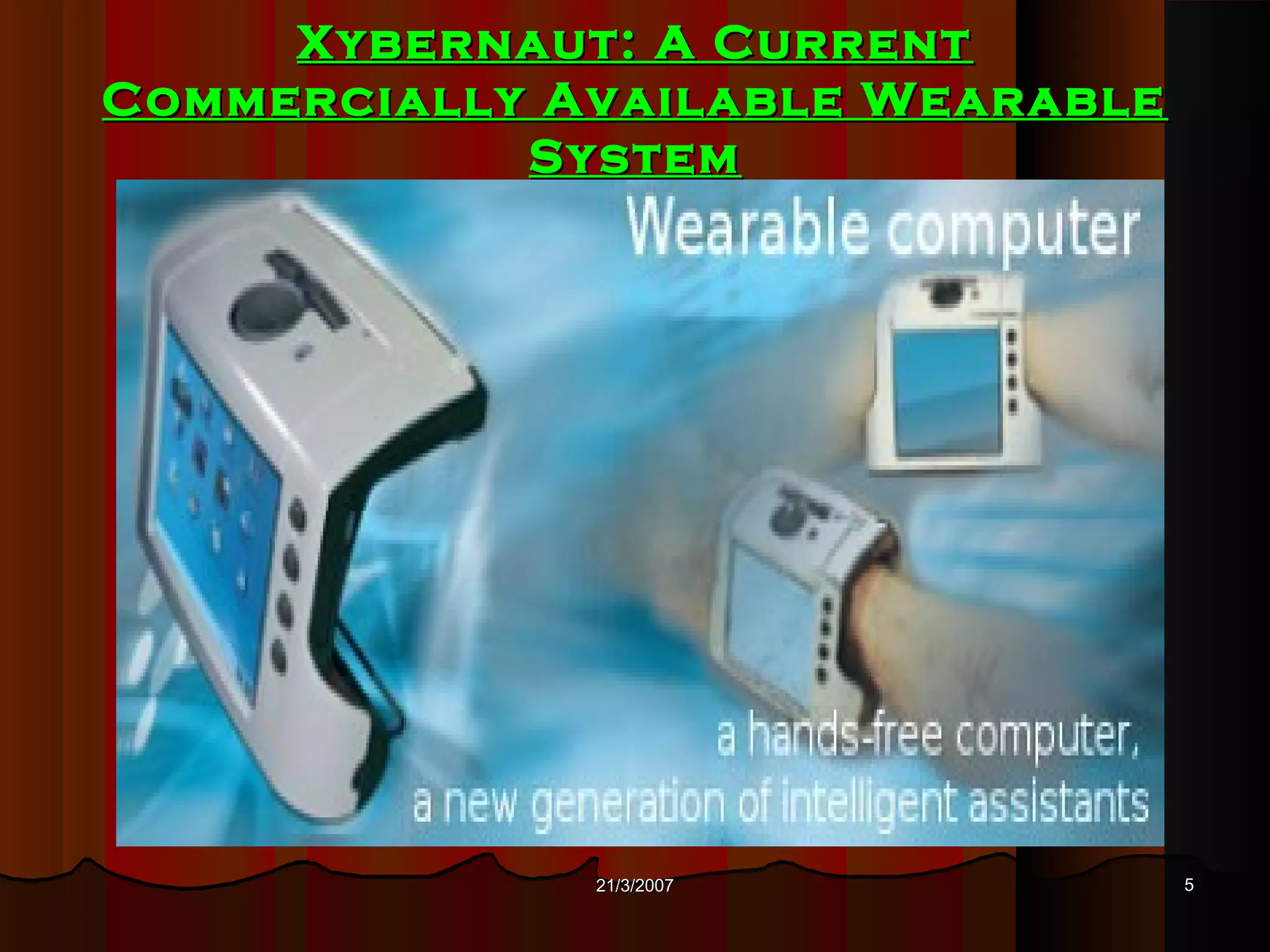
Xybernaut: A Current
Commercially Available Wearable
            System


              21/3/2007           5
Networking and Operating
           System
 The goal   of wearable/interactive computers is
  to network all components through one
  operating system.
 There are two competing operating systems,
  Sun Microsystems Jini and Microsoft
  Windows CE ("Compact Edition").
 Sun      apparently     sees    all
  appliances /components networked through
    Java/Jini interface, while MS seems to be
  taking the more traditional personal computer
   interface approach in connecting
  appliances to the network.
                      21/3/2007               6
 Far Field and Near field Communication.
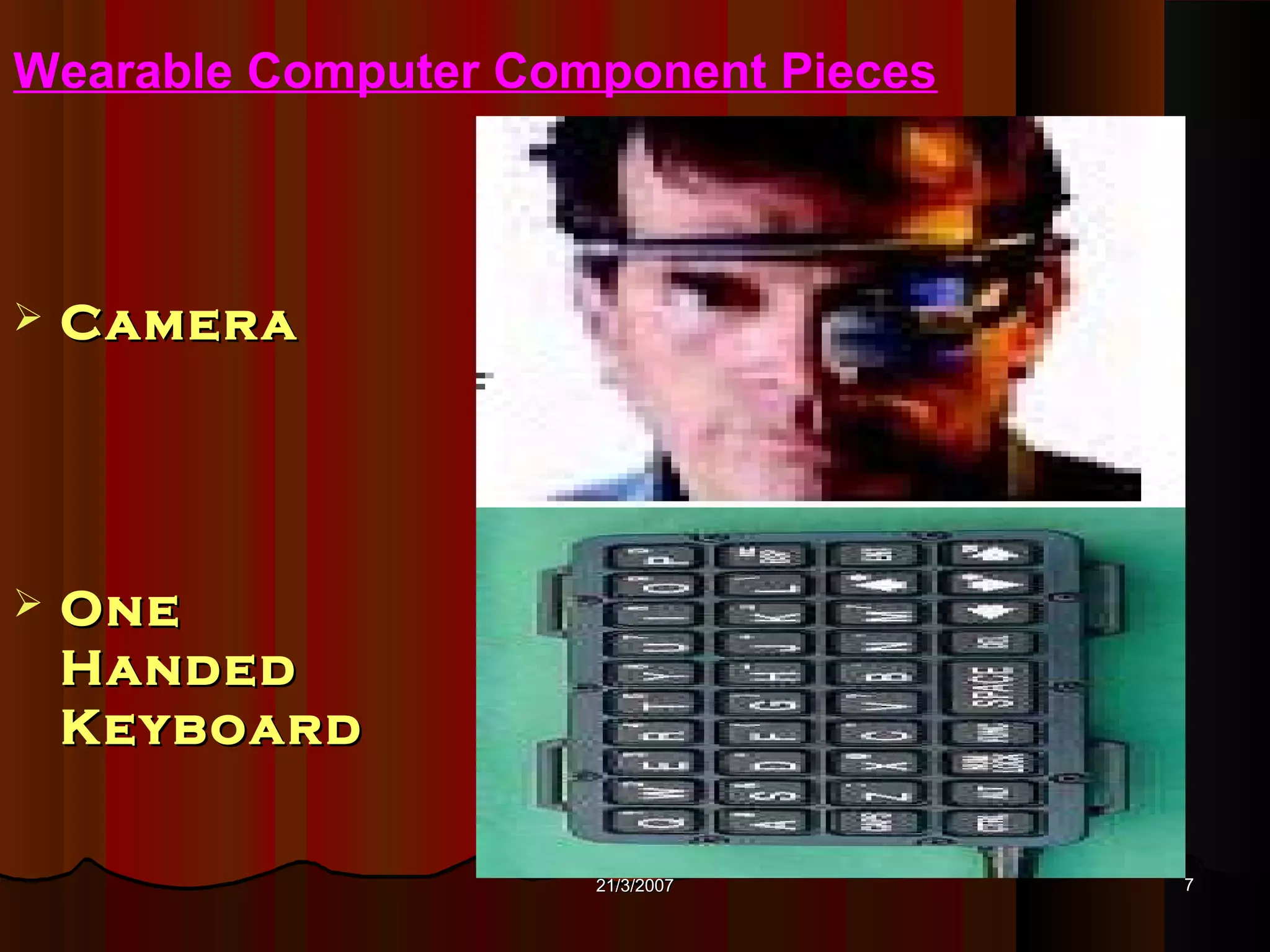
Wearable Computer Component Pieces


   Camera


   One
    Handed
    Keyboard


                     21/3/2007       7
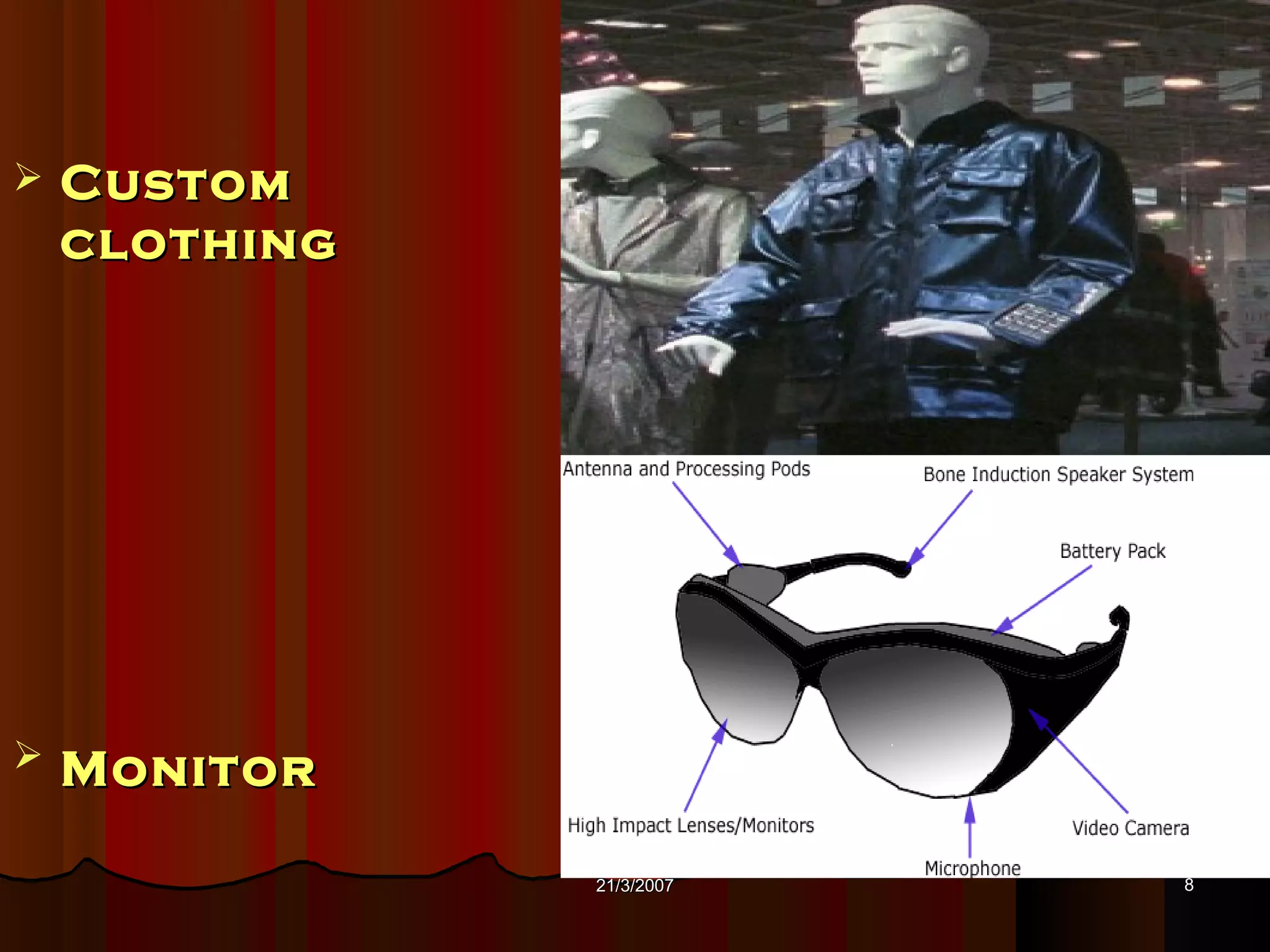
   Custom
    clothing


   Monitor

               21/3/2007   8
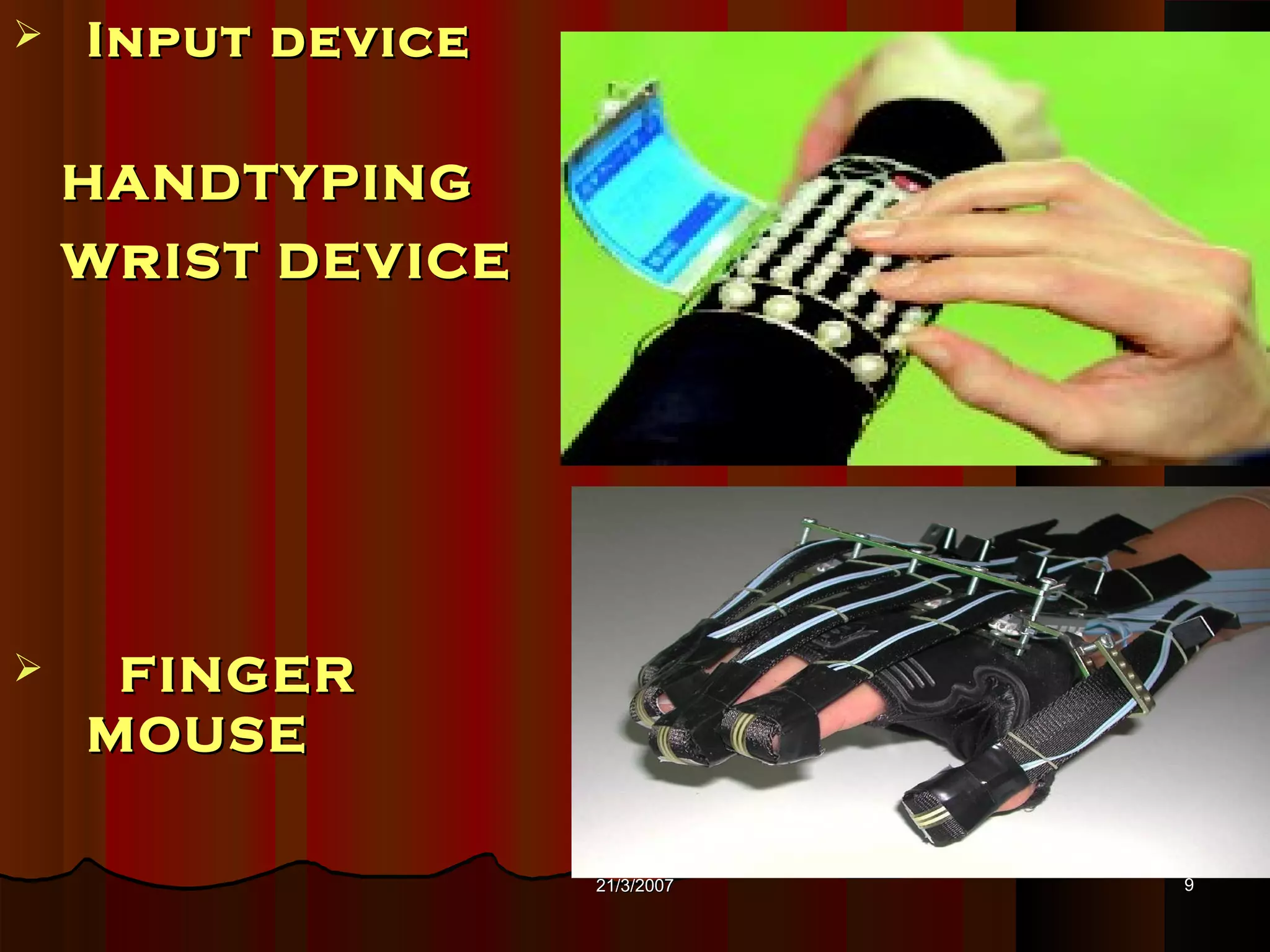
   Input device

    HANDTYPING
    W r IST DEVICE


    FINGER
    MOUSE

                     21/3/2007   9
   Positioning System

   Battery Power

   PC-104 based 50 MHz 486 computer,16M
    RAM,1G hard disk.

   Bio-Sensors

   Sound board and Video board

   CRT or LCD display

   Extra disk capacity
                      21/3/2007        10
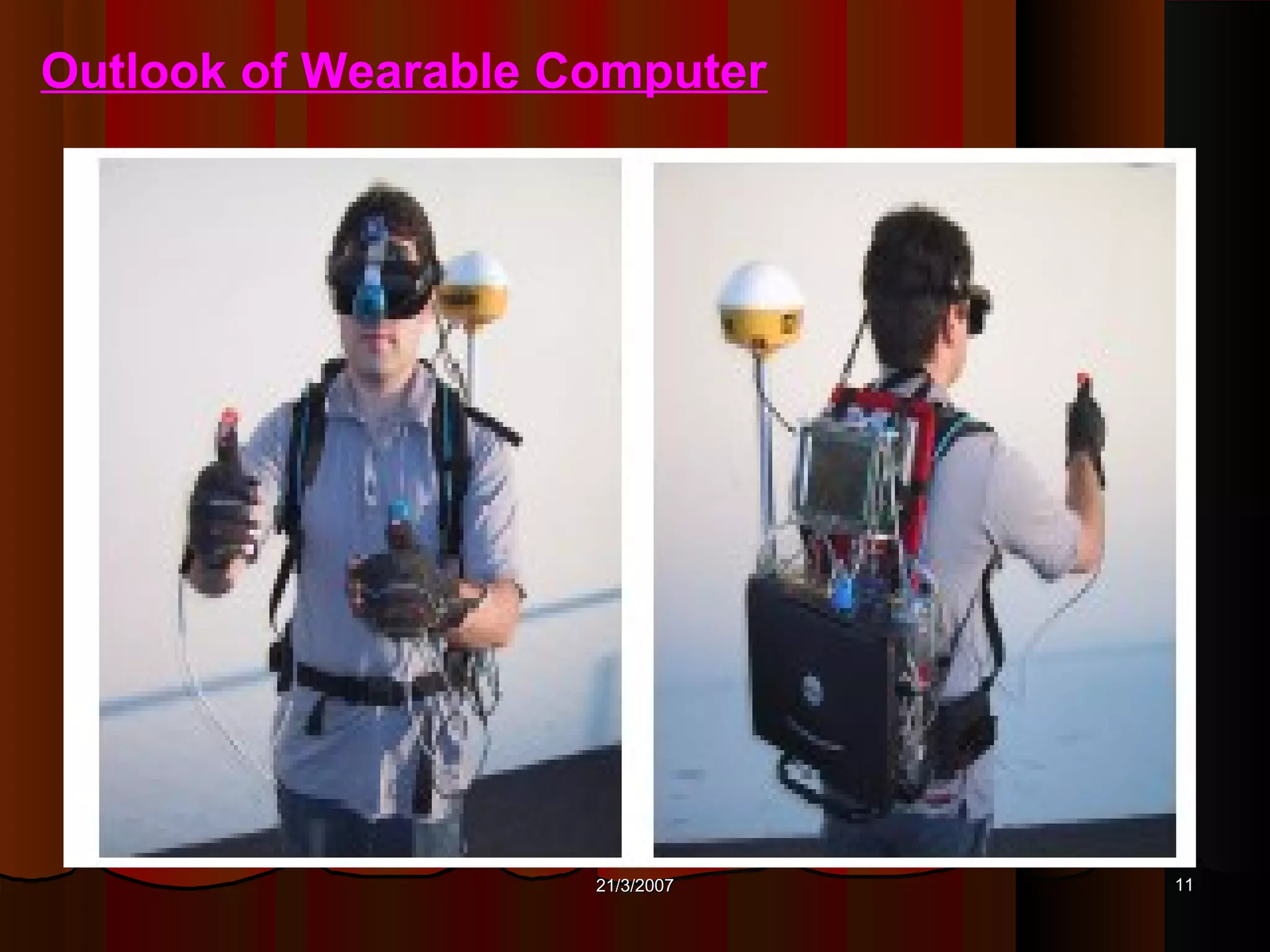
Outlook of Wearable Computer


                     21/3/2007   11
Agents
   A premise of a wearable computer is that the computer can learn and
    become customized to the user's needs, based upon the task the user is
    involved with. If the user is viewing a document, the Wearable Computer
    may suggest an associated email, showing minimal information such as the
    subject, sender, date, or what ever information the user would want to view
    to get a sense as to decide whether the entire email should be retrieved.

   Humans are poor at data retrieval, and a complex hierarchical directory
    quickly breaks down when the human user loses the thread of where the
    item being searched for resides. A computer remembrance agent can take
    cues from this environment to assist in locating appropriate files from
    memory, picking up on cues like where the user is, is the user alone or with
    someone , what is the user doing at that time, etc., all can be used to
    search and locate appropriate files that may be relevant to the user at
    that time. In this manner the computer is a continual presence, always
    'looking over the shoulder' of the user. For example, at a staff meeting the
    Wearable Computer can assist in remembering names of attendees, who
    was at the meeting prior, what they said at that time, what was on the
    agenda, and also to suggest topics which might be of relevance to what was
    going. The computer is always active in searching the user's own personal
    data base for information which might prove useful within the context of the
    current task the user is performing.
                                      21/3/2007                            12
Recognizing Affect
 Our emotions play a significant role in our every day life, and up to now, this
  had been unrepresented within human computer interfaces. Human vital
   signs such as blood pressure , temperature, galvanic skin response,
  foot pressure and electromyograms can be tracked and monitored through
  the use of body sensors connected into the wearable computer. In this
  manner, the computer becomes physically connected to the user and can
  learn to recognize physiological states . By this monitoring of body vital
  signs and learning how the user reacts when in different feeling and
  mood states, the computer can take action accordingly. For
  example, if the user likes to hear a certain type of music at one time and
  another during a different mood state, the computer can plan on providing
  this to the user at the appropriate times.
 The affective sensors could also be of assistance in medical monitoring
  where important health data might be tracked and reported directly to the
  user’s physician. They list four bio-sensors used in a current prototype
  affective wearable system: measuring respiration , skin conductivity, blood
  volume pressure and electromyogram, all of which the sensors can
  monitor painlessly from the surface of the skin. These four sensors are
  monitored via a Linux operating system, and can be sampled up to 20
  times per second. Affective computing employs its own intelligent agent
  which can make decisions based upon analysis of the incoming
  environmental and physiological sense data.
                                      21/3/2007                            13
Applications

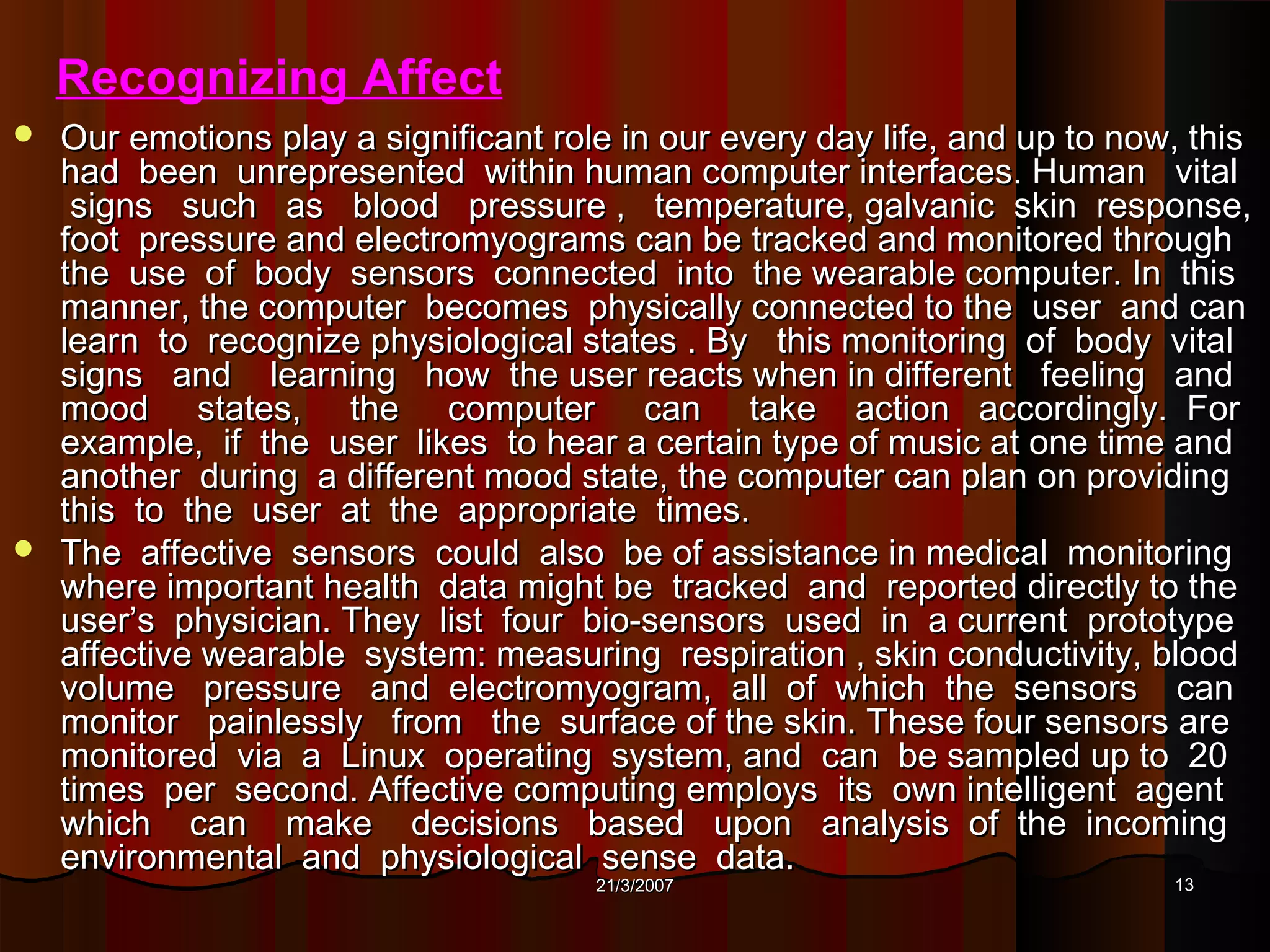
 Smart   Wallet


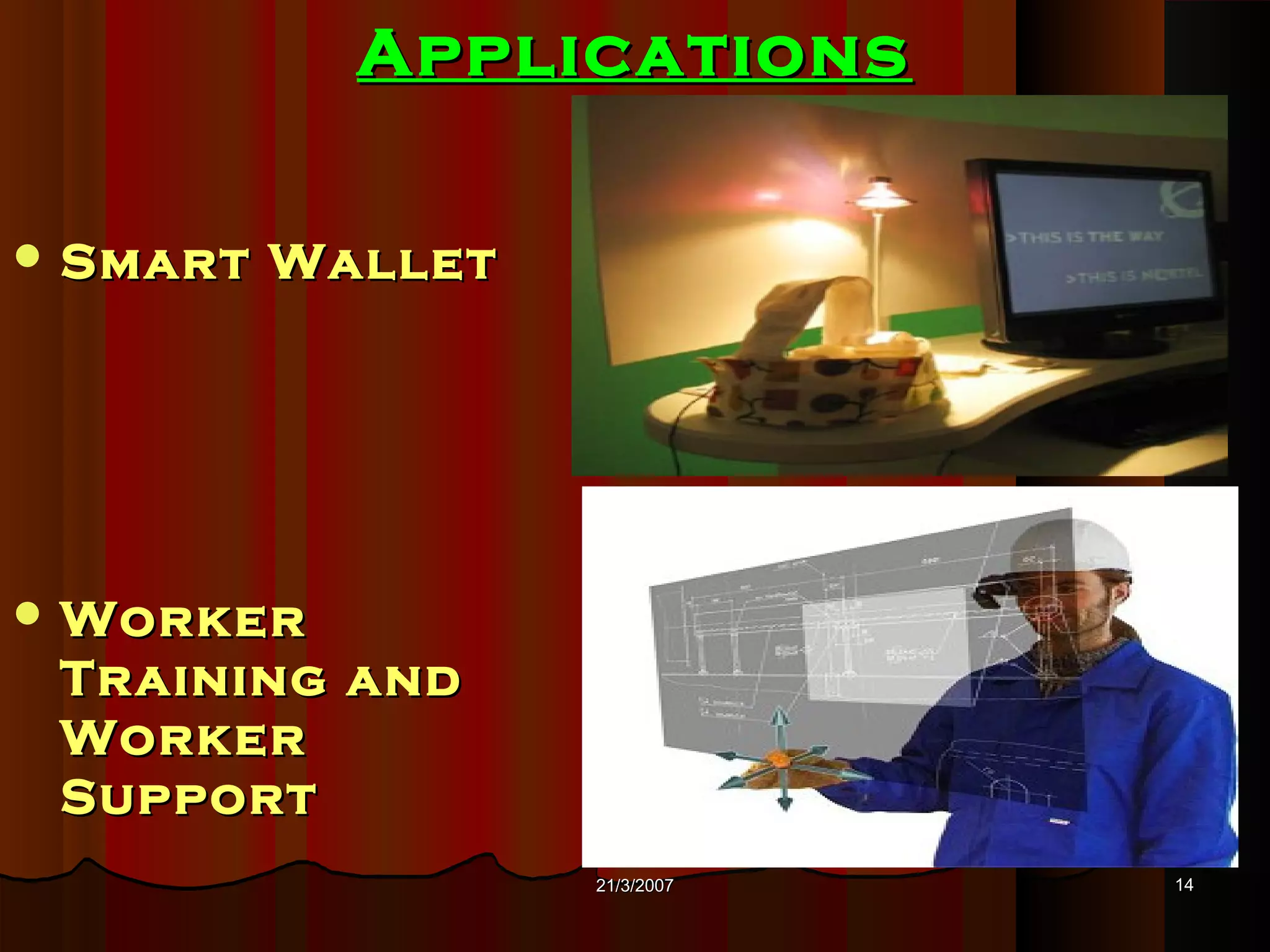
 Worker
 Training and
 Worker
 Support
                   21/3/2007   14
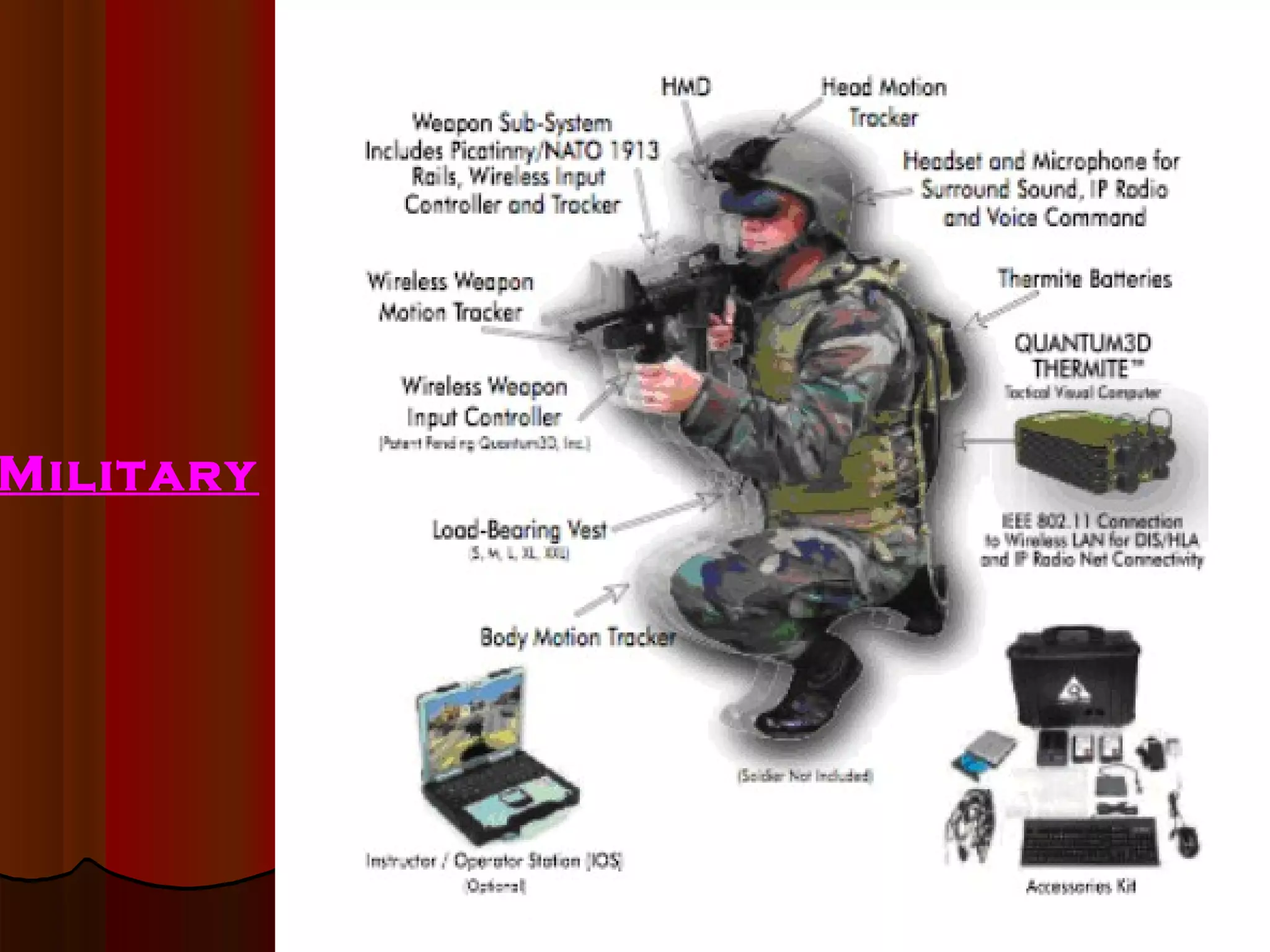
Military


           21/3/2007   15
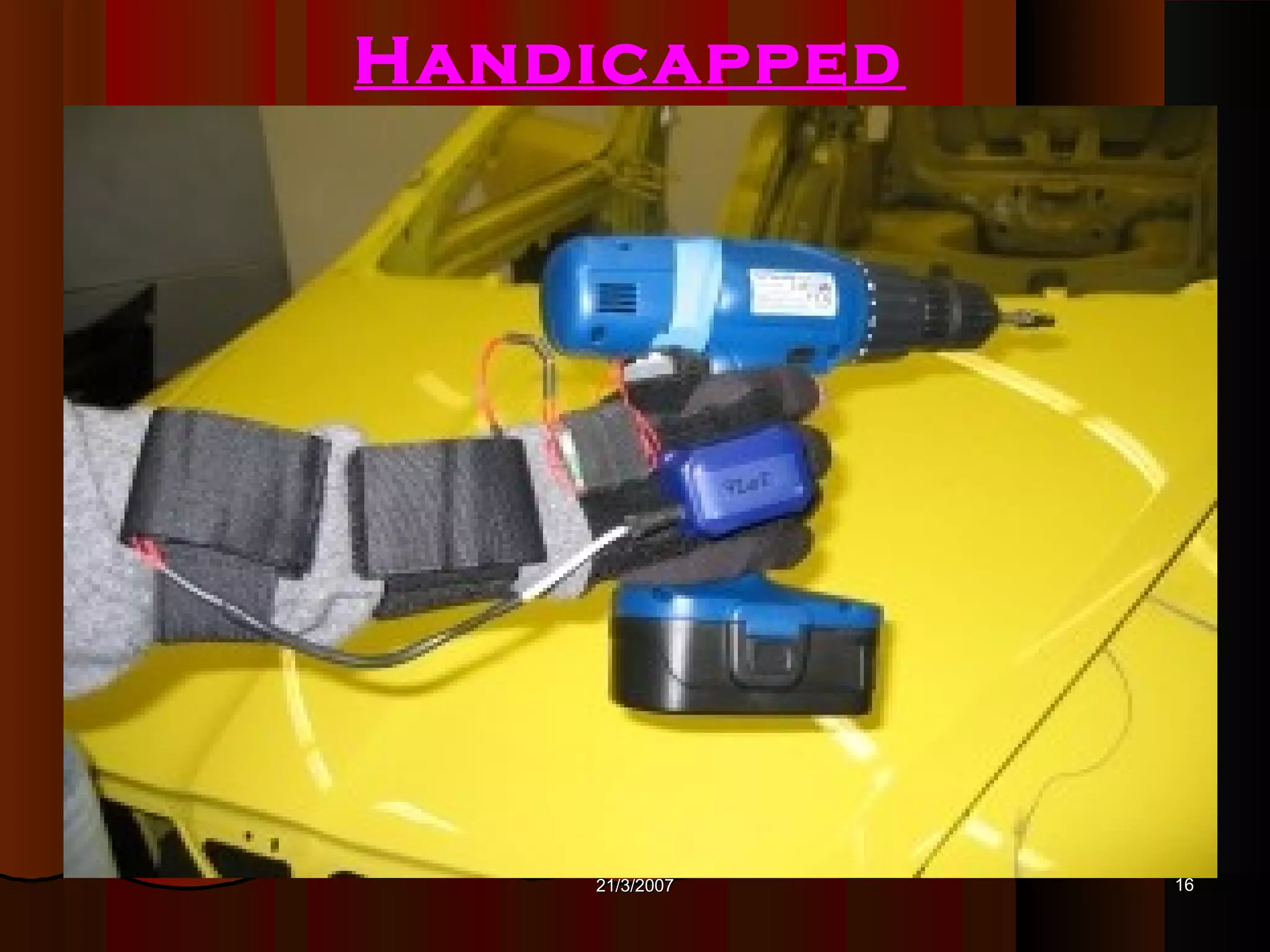
Handicapped


    21/3/2007   16
Future Research
Future research and development issues include the following:

   Ergonomic research - best method to utilize components, e.g. -
    the head set such that it is comfortable and is helping and not
    distracting the user from the task. There needs to be more light
    weight efficient and easily powered computer apparatus which
    is comfortable to wear.

   In terms of Network using the body as the networks medium, to
    increase the speed at which they can run also to increase to
    bps speed of data transfer .


                                 21/3/2007                      17
Conclusion
Lot of research and experiments for practical & tactical
use of Wearable Computer are going on around the world.
Several types of Wearable Computer’s are indeed
commercially available, but as of now most of them are
tailor made for specific applications. It is only a matter of
time before the consumer community accepts the idea. The
shift that the Wearable Computer’s will bring;computer working
along with you instead of you working at the computer.Though
the wearable has not seen the widespread acceptance given
to the desktop, work continues in this field to meet the
challenges that inhibit its growth. Processors and sensors need
to be effectively integrated into textiles; and displays, whether
head or body mounted, need to effective under a wide range
of lighting conditions - all of these must be comfortable to wear
                             21/3/2007                       18
21/3/2007   19

Wearable computer

  • 1.
    SEMINAR ON SUBMITTED BY:- TYPE YOUR NAME REG. 21/3/2007 BRANCH 1
  • 2.
    POINTS TO BEDISCUSSED  INTRODUCTION  OPERATIONAL MODES  XYBERNAUT  NETWORKING AND OPERATING SYSTEM  COMPONENT PIECES  OUTLOOK  AGENTS  RECOGNISING EFFECT  APPLICATIONS  FUTURE RESEARCH  CONCLUSION 21/3/2007 2
  • 3.
    INTRODUCTION  A wearable computer is a small portable computer that is designed to be worn on the body during use.  Wearable computers are usually either integrated into the user's clothing or can be attached to the body through some other means , like a wristband.  The computer evolution has moved from mainframes, to the desktop, and now the computing power is moving onto the person.  The user actually "wearing" the computer, s/he can utilize the power and functionality virtually anywhere in their environment.  This technology is developing and changing rapidly primarily due to vast changes in computer speed, wireless technology and miniaturization of components. 21/3/2007 3
  • 4.
    Operational Modes ofWearable Computer  Constancy  Augmentation  Mediation 21/3/2007 4
  • 5.
    Xybernaut: A Current CommerciallyAvailable Wearable System 21/3/2007 5
  • 6.
    Networking and Operating System  The goal of wearable/interactive computers is to network all components through one operating system.  There are two competing operating systems, Sun Microsystems Jini and Microsoft Windows CE ("Compact Edition").  Sun apparently sees all appliances /components networked through Java/Jini interface, while MS seems to be taking the more traditional personal computer interface approach in connecting appliances to the network. 21/3/2007 6  Far Field and Near field Communication.
  • 7.
    Wearable Computer ComponentPieces  Camera  One Handed Keyboard 21/3/2007 7
  • 8.
    Custom clothing  Monitor 21/3/2007 8
  • 9.
    Input device HANDTYPING W r IST DEVICE  FINGER MOUSE 21/3/2007 9
  • 10.
    Positioning System  Battery Power  PC-104 based 50 MHz 486 computer,16M RAM,1G hard disk.  Bio-Sensors  Sound board and Video board  CRT or LCD display  Extra disk capacity 21/3/2007 10
  • 11.
    Outlook of WearableComputer 21/3/2007 11
  • 12.
    Agents  A premise of a wearable computer is that the computer can learn and become customized to the user's needs, based upon the task the user is involved with. If the user is viewing a document, the Wearable Computer may suggest an associated email, showing minimal information such as the subject, sender, date, or what ever information the user would want to view to get a sense as to decide whether the entire email should be retrieved.  Humans are poor at data retrieval, and a complex hierarchical directory quickly breaks down when the human user loses the thread of where the item being searched for resides. A computer remembrance agent can take cues from this environment to assist in locating appropriate files from memory, picking up on cues like where the user is, is the user alone or with someone , what is the user doing at that time, etc., all can be used to search and locate appropriate files that may be relevant to the user at that time. In this manner the computer is a continual presence, always 'looking over the shoulder' of the user. For example, at a staff meeting the Wearable Computer can assist in remembering names of attendees, who was at the meeting prior, what they said at that time, what was on the agenda, and also to suggest topics which might be of relevance to what was going. The computer is always active in searching the user's own personal data base for information which might prove useful within the context of the current task the user is performing. 21/3/2007 12
  • 13.
    Recognizing Affect  Ouremotions play a significant role in our every day life, and up to now, this had been unrepresented within human computer interfaces. Human vital signs such as blood pressure , temperature, galvanic skin response, foot pressure and electromyograms can be tracked and monitored through the use of body sensors connected into the wearable computer. In this manner, the computer becomes physically connected to the user and can learn to recognize physiological states . By this monitoring of body vital signs and learning how the user reacts when in different feeling and mood states, the computer can take action accordingly. For example, if the user likes to hear a certain type of music at one time and another during a different mood state, the computer can plan on providing this to the user at the appropriate times.  The affective sensors could also be of assistance in medical monitoring where important health data might be tracked and reported directly to the user’s physician. They list four bio-sensors used in a current prototype affective wearable system: measuring respiration , skin conductivity, blood volume pressure and electromyogram, all of which the sensors can monitor painlessly from the surface of the skin. These four sensors are monitored via a Linux operating system, and can be sampled up to 20 times per second. Affective computing employs its own intelligent agent which can make decisions based upon analysis of the incoming environmental and physiological sense data. 21/3/2007 13
  • 14.
    Applications  Smart Wallet  Worker Training and Worker Support 21/3/2007 14
  • 15.
    Military 21/3/2007 15
  • 16.
    Handicapped 21/3/2007 16
  • 17.
    Future Research Future researchand development issues include the following:  Ergonomic research - best method to utilize components, e.g. - the head set such that it is comfortable and is helping and not distracting the user from the task. There needs to be more light weight efficient and easily powered computer apparatus which is comfortable to wear.  In terms of Network using the body as the networks medium, to increase the speed at which they can run also to increase to bps speed of data transfer . 21/3/2007 17
  • 18.
    Conclusion Lot of researchand experiments for practical & tactical use of Wearable Computer are going on around the world. Several types of Wearable Computer’s are indeed commercially available, but as of now most of them are tailor made for specific applications. It is only a matter of time before the consumer community accepts the idea. The shift that the Wearable Computer’s will bring;computer working along with you instead of you working at the computer.Though the wearable has not seen the widespread acceptance given to the desktop, work continues in this field to meet the challenges that inhibit its growth. Processors and sensors need to be effectively integrated into textiles; and displays, whether head or body mounted, need to effective under a wide range of lighting conditions - all of these must be comfortable to wear 21/3/2007 18
  • 19.