

Free
   Space Optics

       Under The Esteemed Guidance of
              Mr.G.Venugopal
            Associate Professor
Department Of Computer Science and Engineering
Sri Satya Narayana Engineering College, Ongole

                  By
         R.Mouli sai (07X91A0528)
OVERVIEW

INTRODUCTION
HOW FSO WORKS
ADVANTAGES
CHALLENGES
SECURITY
CONCLUSION
INTRODUCTION………

Advanced Communication Technology

Uses Infrared beams for transmission

Also called Free Space Photonics (FSP)

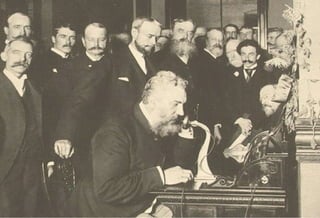
Introduced by Alexander Graham Bell
The transmission of information using
light is actually not a new idea.


In the late nineteenth century, Alexander
Bell expanded his "phone-phone"
communication which modulated by
sunlight.
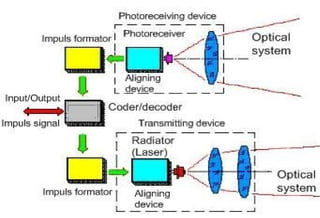
HOW FSO WORKS………….?

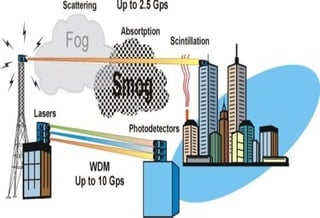
  Consists of two Telescopes

Transmits invisible light beams b/w Telescopes

Offer capacities in range of 100Mbps to 2.5Gbps

Can function over distances of several Kms
ADVANTAGES……………….

Flexible Networking Solution
Low Cost
Unlimited Bandwidth
Possible to mount FSO inside even Buildings
Only requirement is Line of Sight b/w to ends
of the link
CHALLENGES…………..

Atmosphere Factors
Physical Obstructions
Change in pointing stability
Scintillation
Solar Interfernce
SECURITY………
Laser beams can’t detected with spectrum
analyzers or RF meters
Line of sight cannot be intercepted easily
Beams are harder to find and crack
Data can be transmitted over an encrypted
connection
CONCLUSION………….
Provides low cost, rapidly deployable method
of gaining access to fiber optic backbone

FSO complement legacy network investments

FSO eliminates the need to obtain costly
spectrum licences
REFERENCES………….
http://www.freespaceoptics.org

http://www.networkmagazin.com

Heinz A. Willerbrand, Baksheesh S. Ghuman
“Fiber Optics Without Fiber”
ANY
   QUERIS
T ANK
 H
 Q

Free space optics