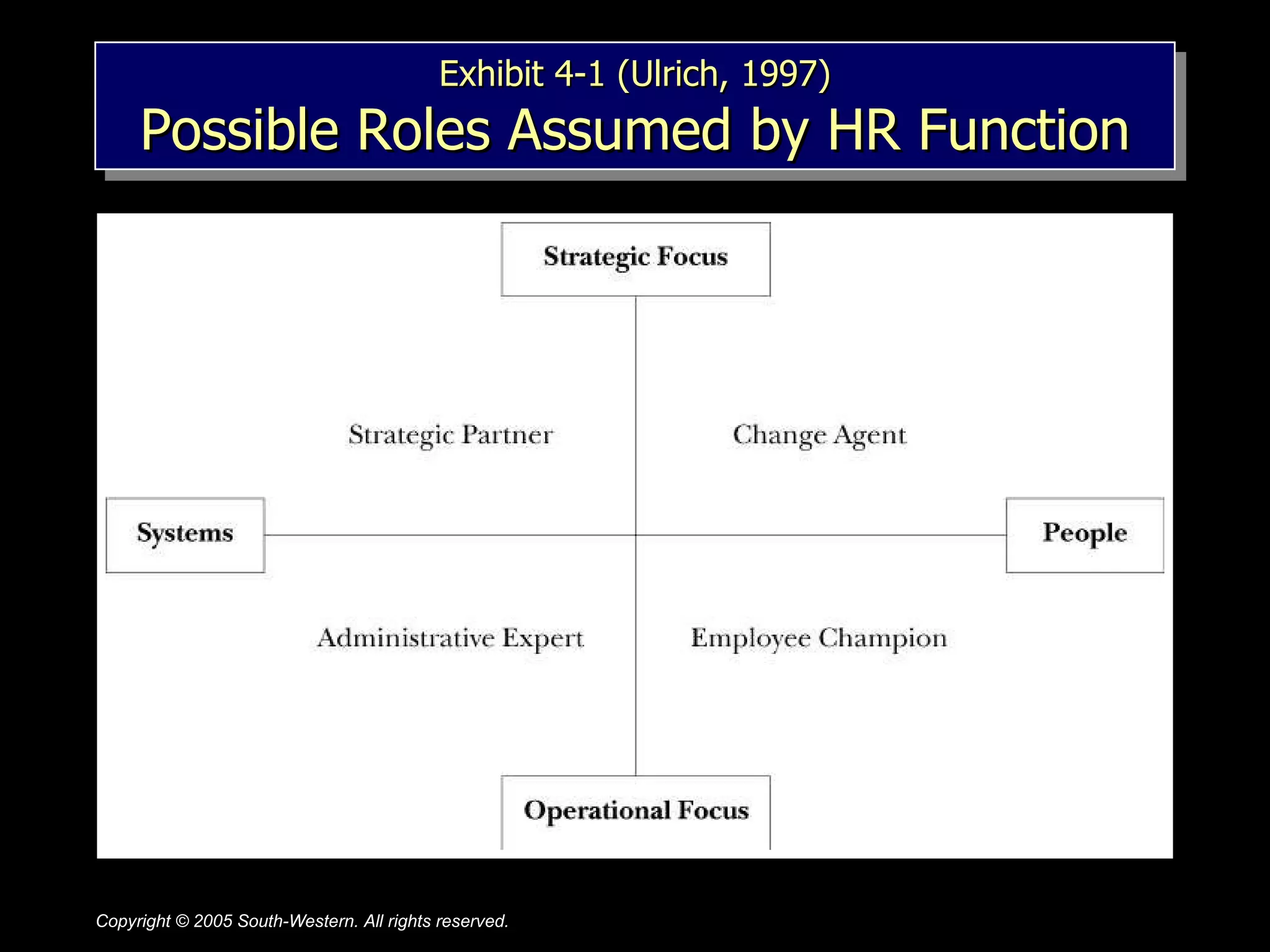
The document discusses the evolving strategic role of human resource management. It explains that strategic HR involves aligning practices and policies to achieve organizational objectives and integrate HR programs within the larger business strategy. It also outlines various roles HR can assume, such as being a knowledge facilitator and relationship builder. Key competencies for HR to act as a true strategic partner are discussed as well.
In this document
Powered by AI
Discusses SHRM's role in aligning HR practices with strategic objectives and integrating HR programs.
Explores HR roles as human capital stewards and relationship builders to foster collaboration and adaptability.
Identifies five key competencies essential for HR to be a strategic business partner in organizations.
Addresses common barriers like short-term focus and underappreciation of HR's strategic contributions.
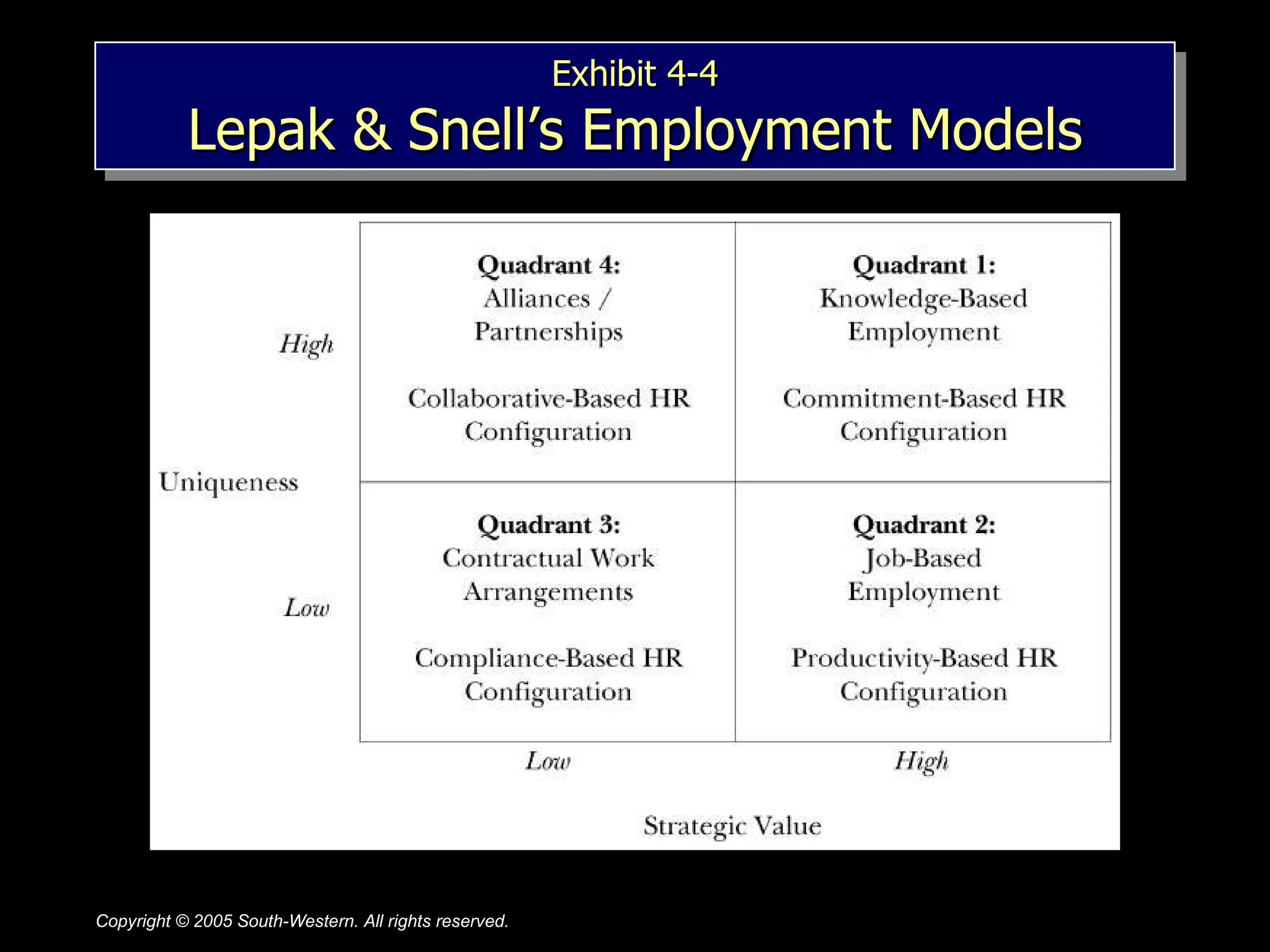
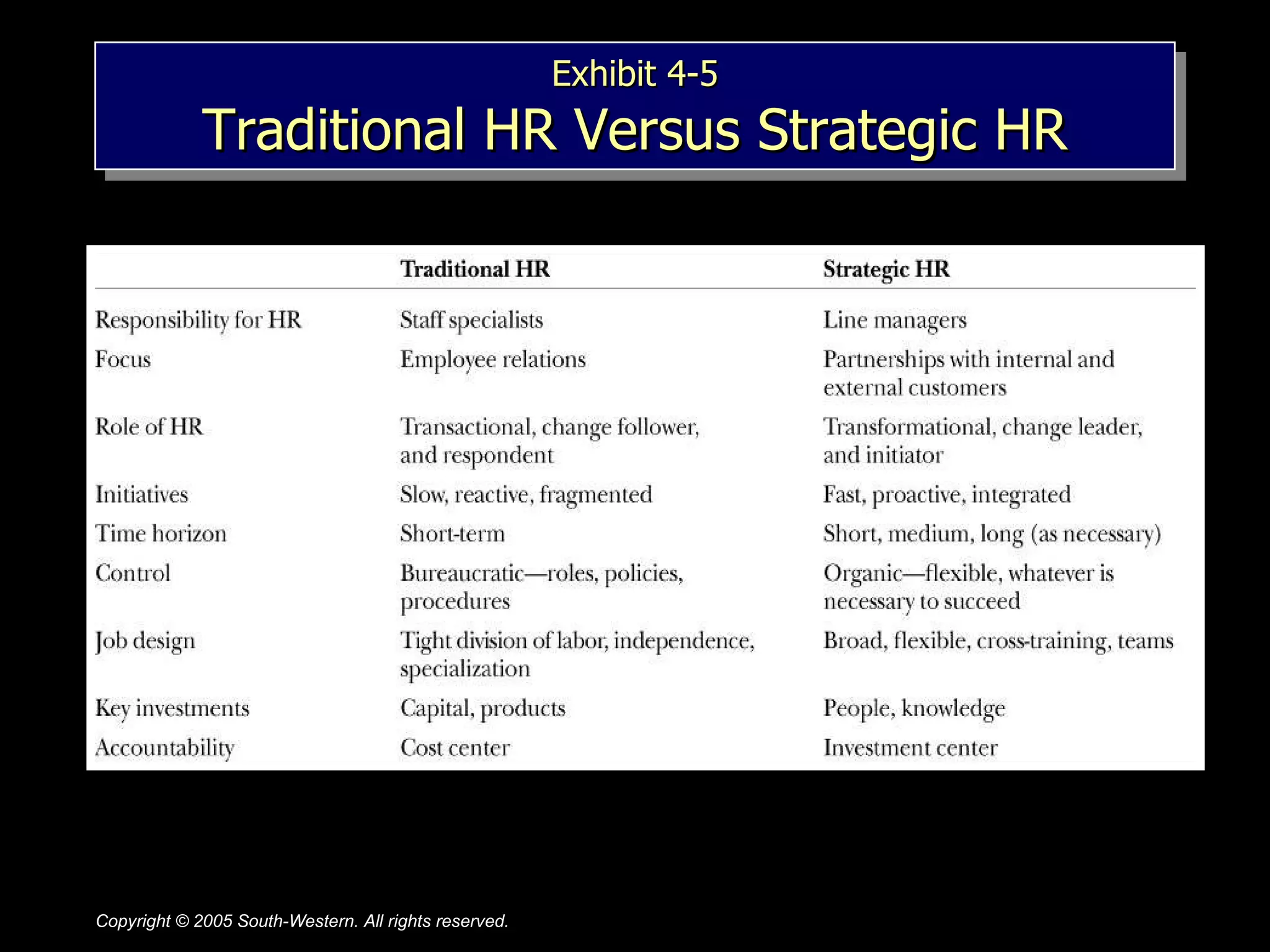
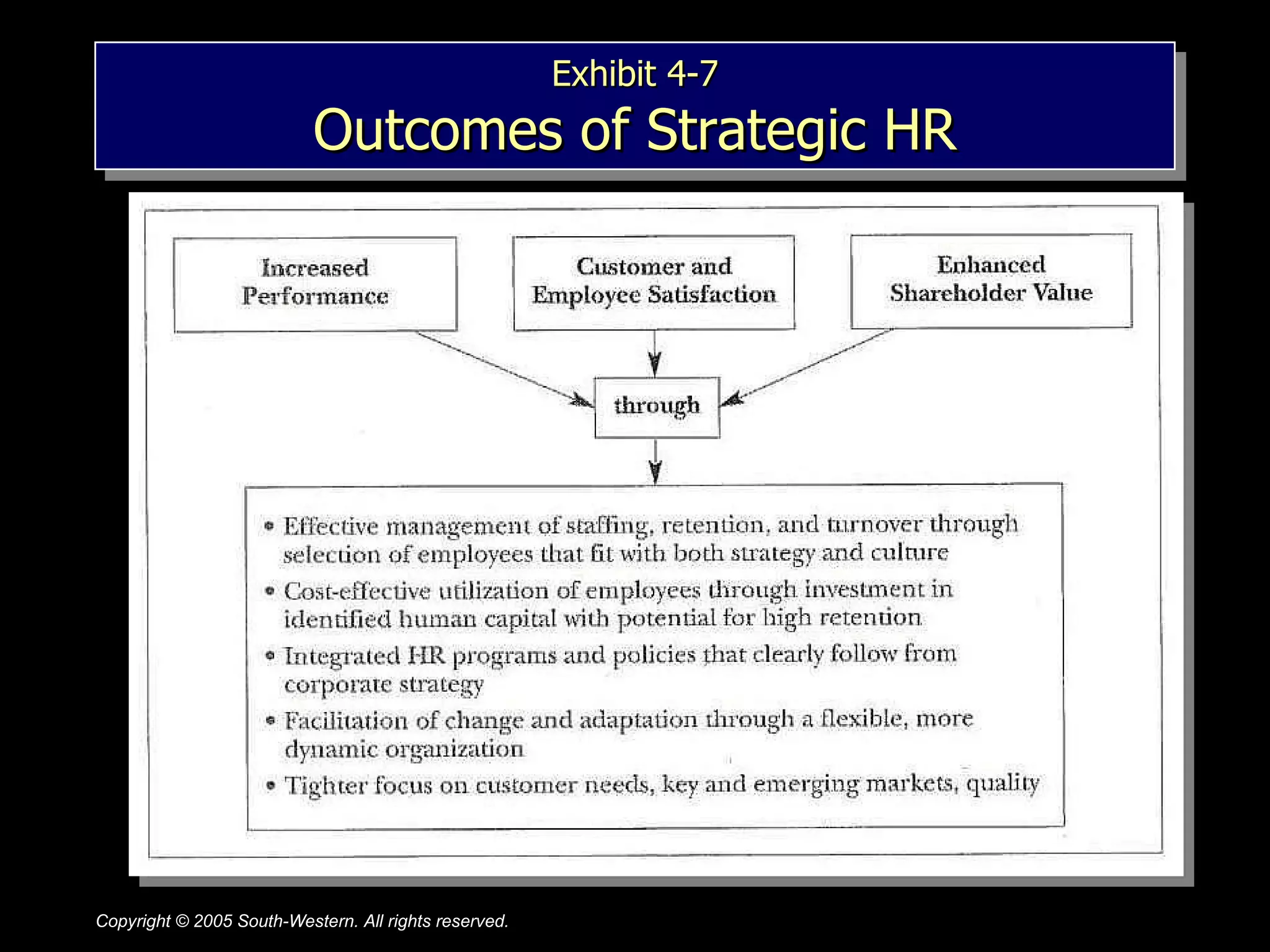
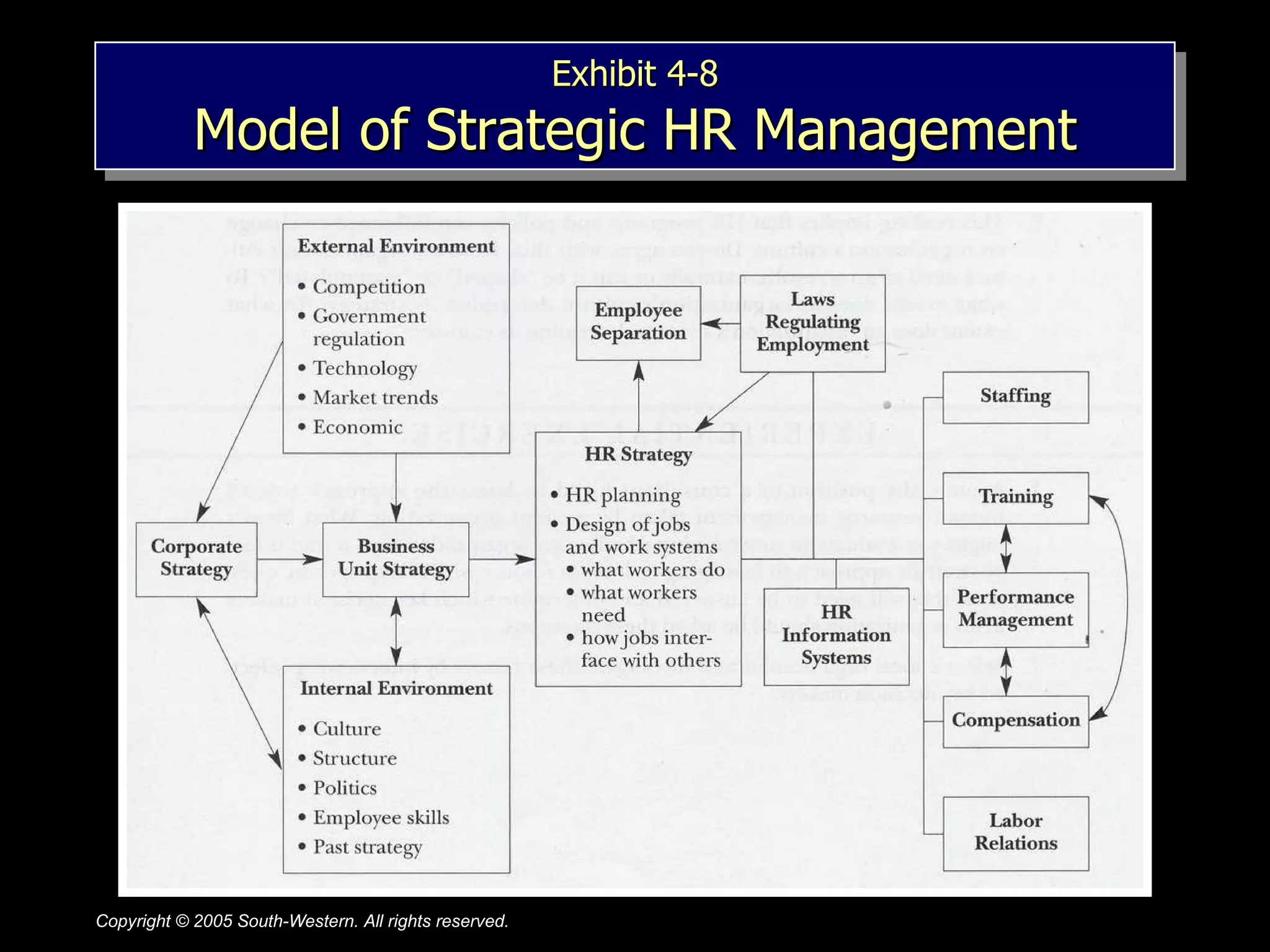
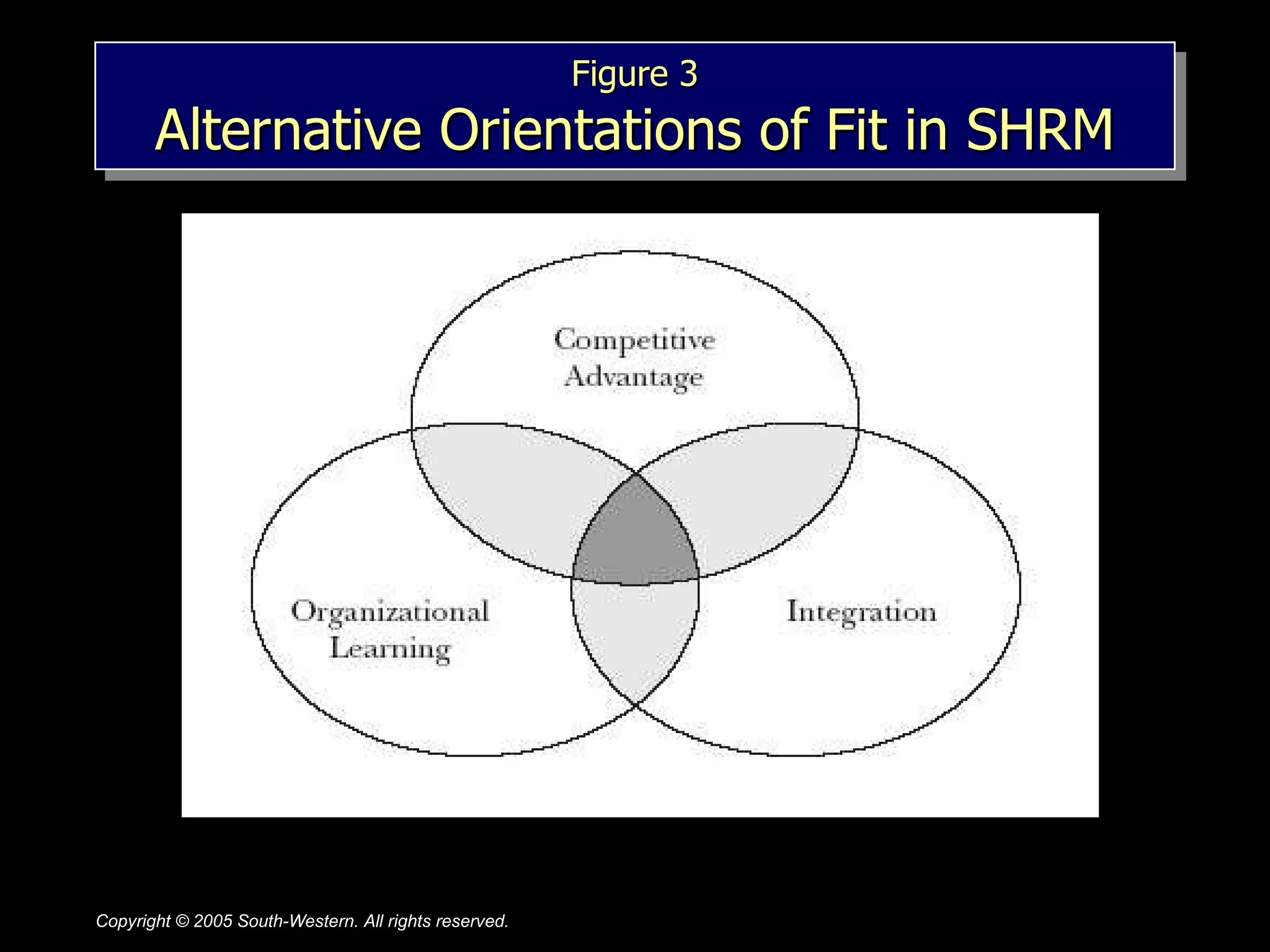
Visual representations of the outcomes and models that define effective strategic HR management.
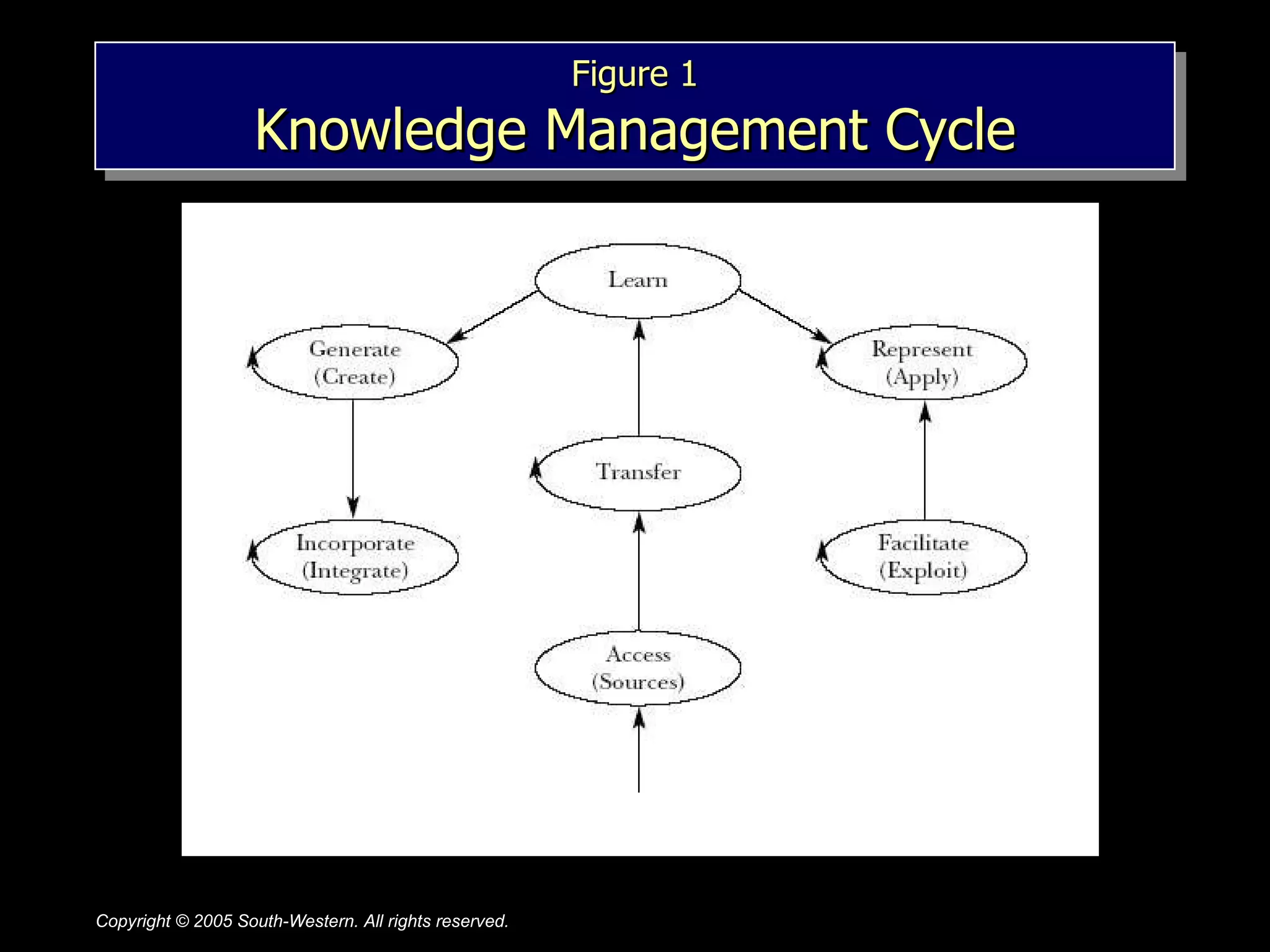
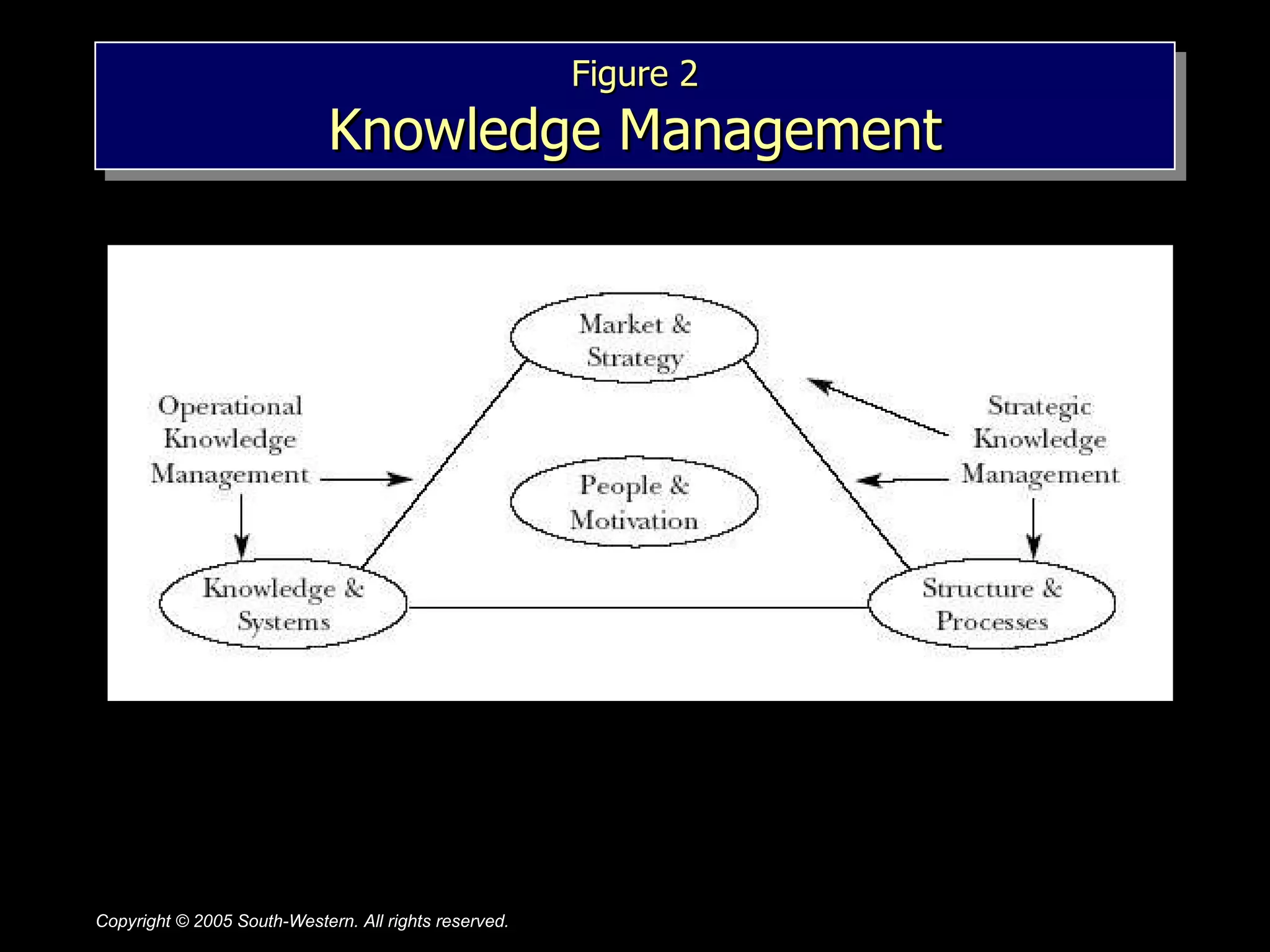
Details stages of knowledge management and how HR can facilitate organizational learning and knowledge transfer.
Investigates the relationship between HRM systems and organizational performance, emphasizing effective processes.
Discusses the importance of understanding organizational culture and aligning HR strategies to foster effective change.
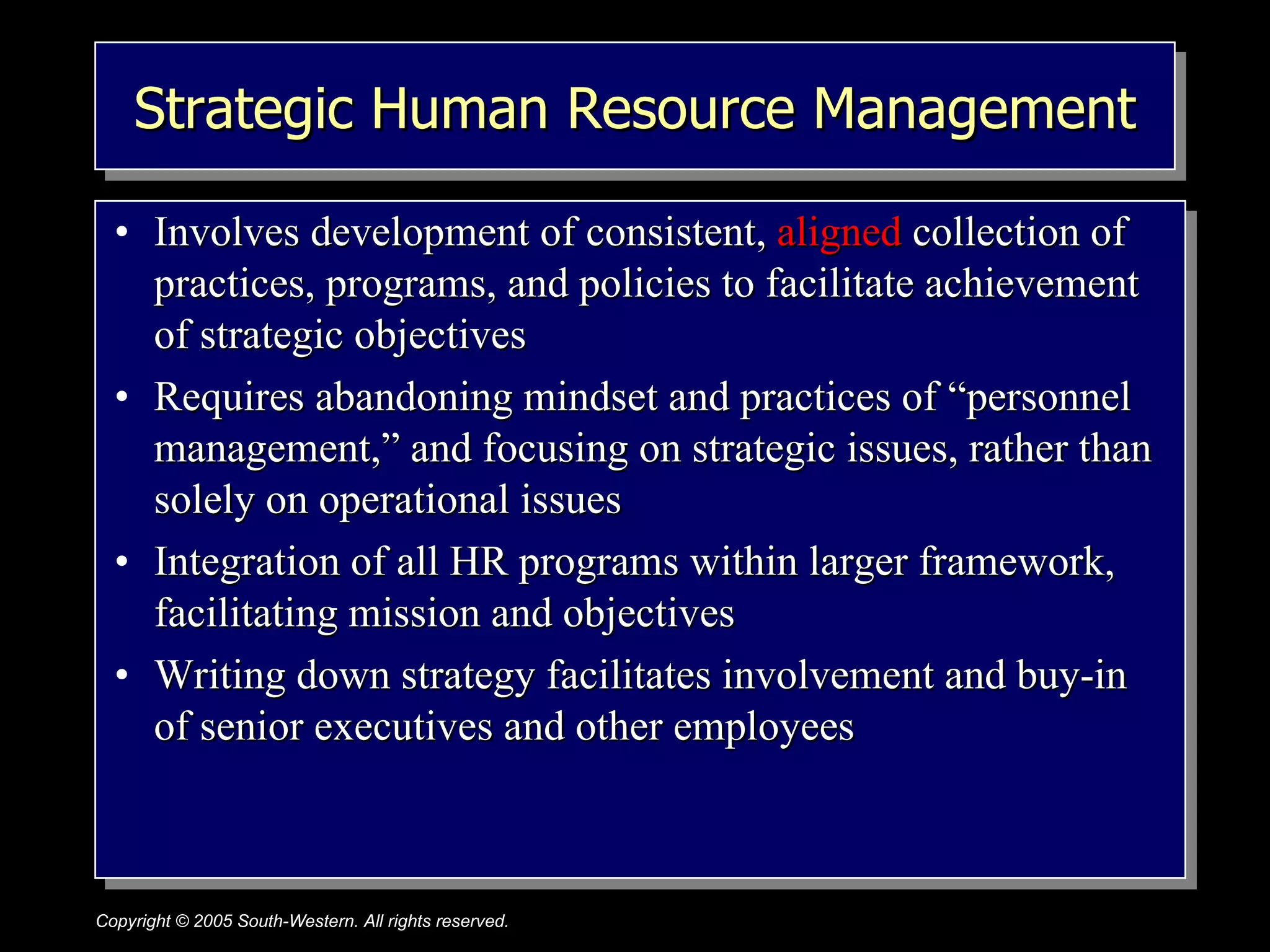
Strategic Human ResourceManagement Involves development of consistent, aligned collection of practices, programs, and policies to facilitate achievement of strategic objectives Requires abandoning mindset and practices of “personnel management,” and focusing on strategic issues, rather than solely on operational issues Integration of all HR programs within larger framework, facilitating mission and objectives Writing down strategy facilitates involvement and buy-in of senior executives and other employees
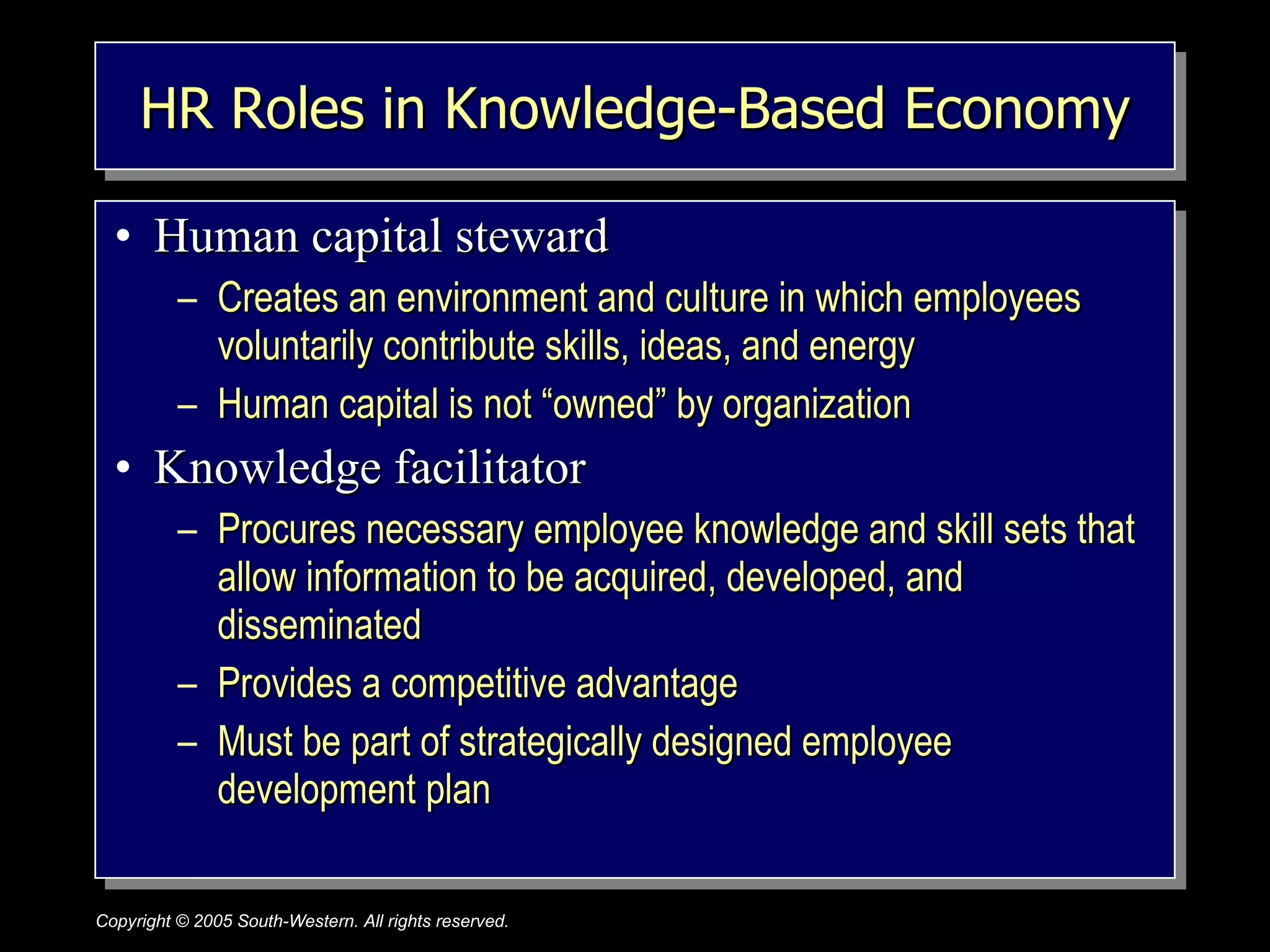
HR Roles inKnowledge-Based Economy Human capital steward Creates an environment and culture in which employees voluntarily contribute skills, ideas, and energy Human capital is not “owned” by organization Knowledge facilitator Procures necessary employee knowledge and skill sets that allow information to be acquired, developed, and disseminated Provides a competitive advantage Must be part of strategically designed employee development plan
5.
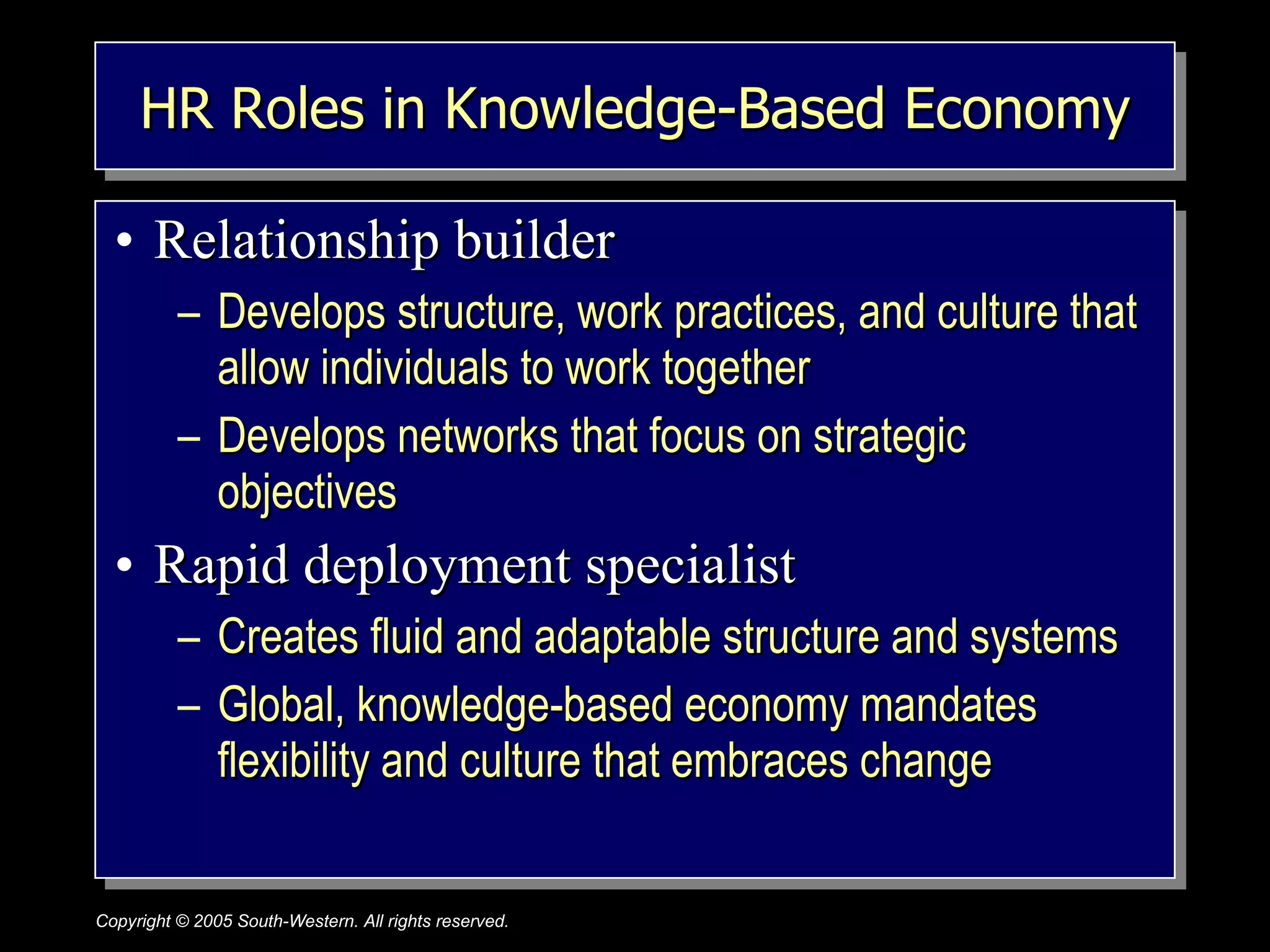
HR Roles inKnowledge-Based Economy Relationship builder Develops structure, work practices, and culture that allow individuals to work together Develops networks that focus on strategic objectives Rapid deployment specialist Creates fluid and adaptable structure and systems Global, knowledge-based economy mandates flexibility and culture that embraces change
6.
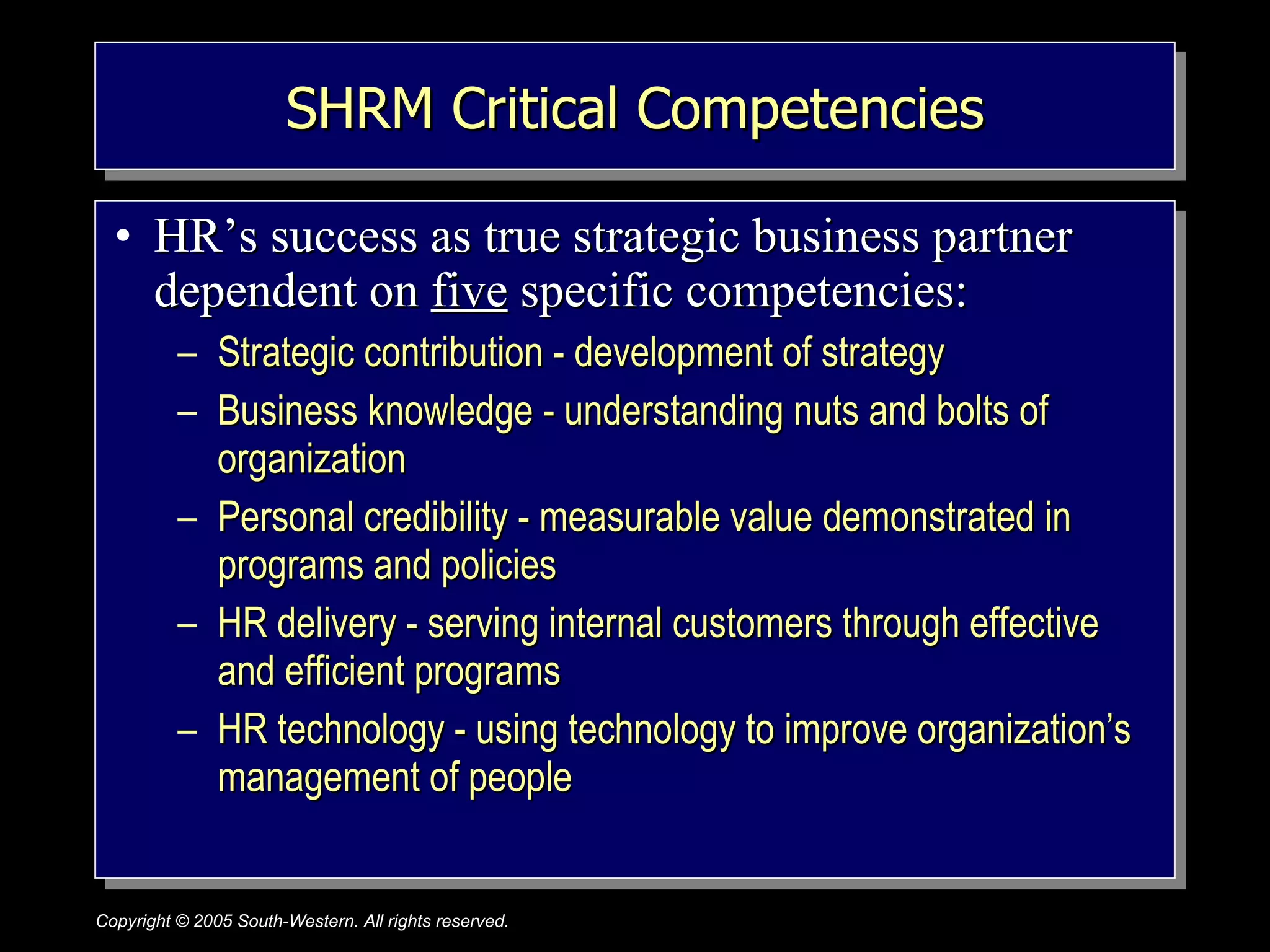
SHRM Critical CompetenciesHR’s success as true strategic business partner dependent on five specific competencies: Strategic contribution - development of strategy Business knowledge - understanding nuts and bolts of organization Personal credibility - measurable value demonstrated in programs and policies HR delivery - serving internal customers through effective and efficient programs HR technology - using technology to improve organization’s management of people
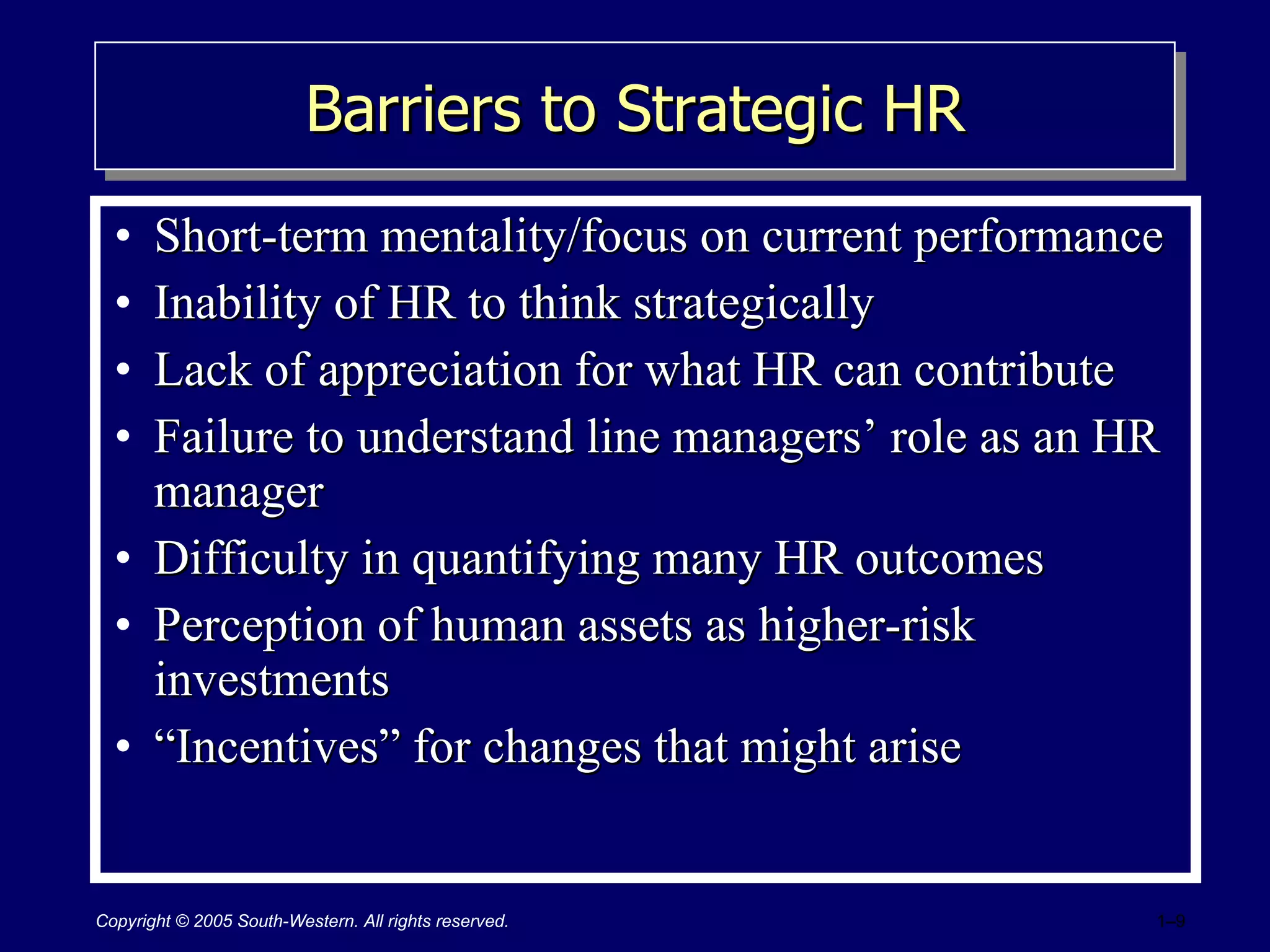
Barriers to StrategicHR Short-term mentality/focus on current performance Inability of HR to think strategically Lack of appreciation for what HR can contribute Failure to understand line managers’ role as an HR manager Difficulty in quantifying many HR outcomes Perception of human assets as higher-risk investments “ Incentives” for changes that might arise
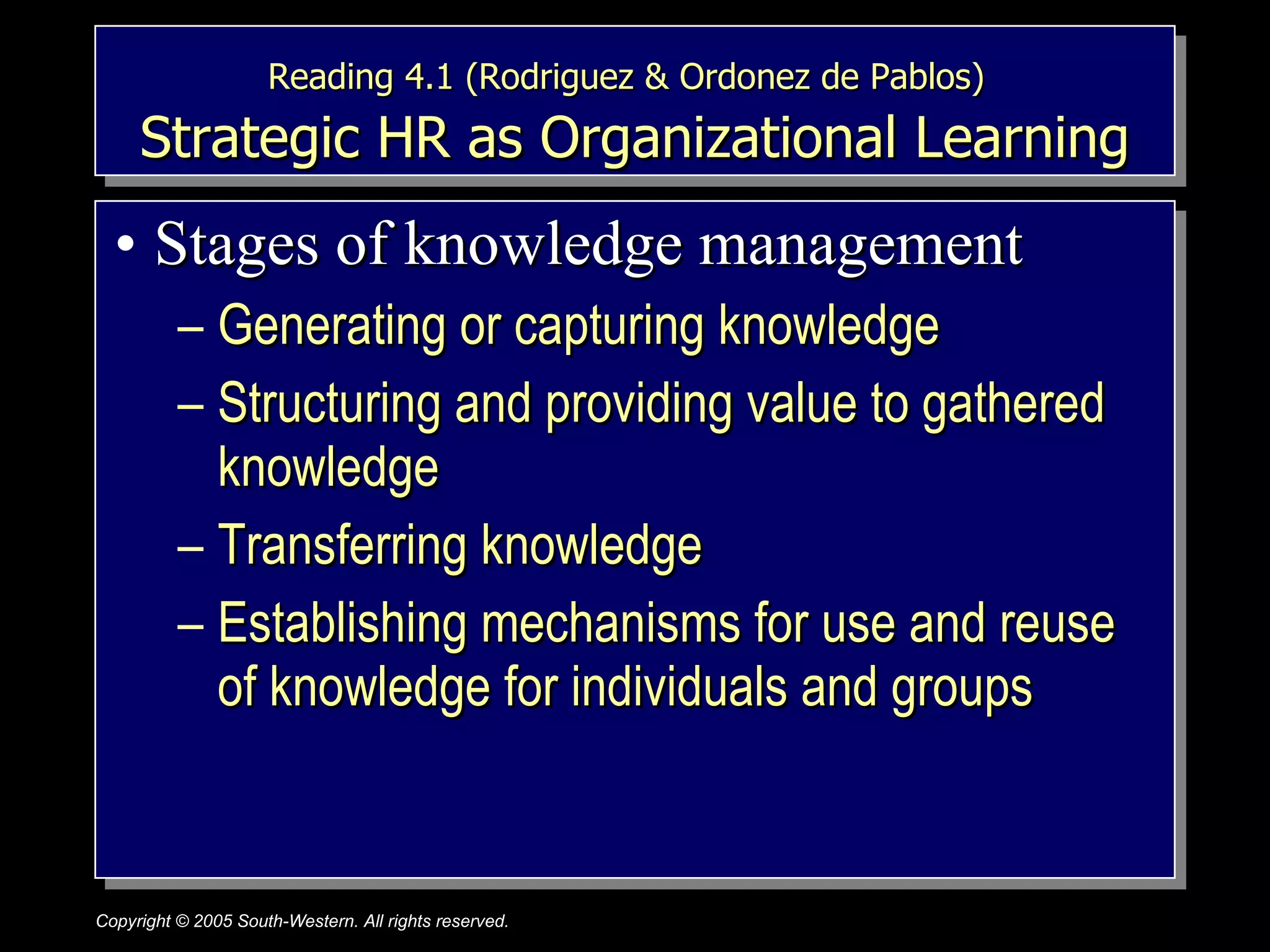
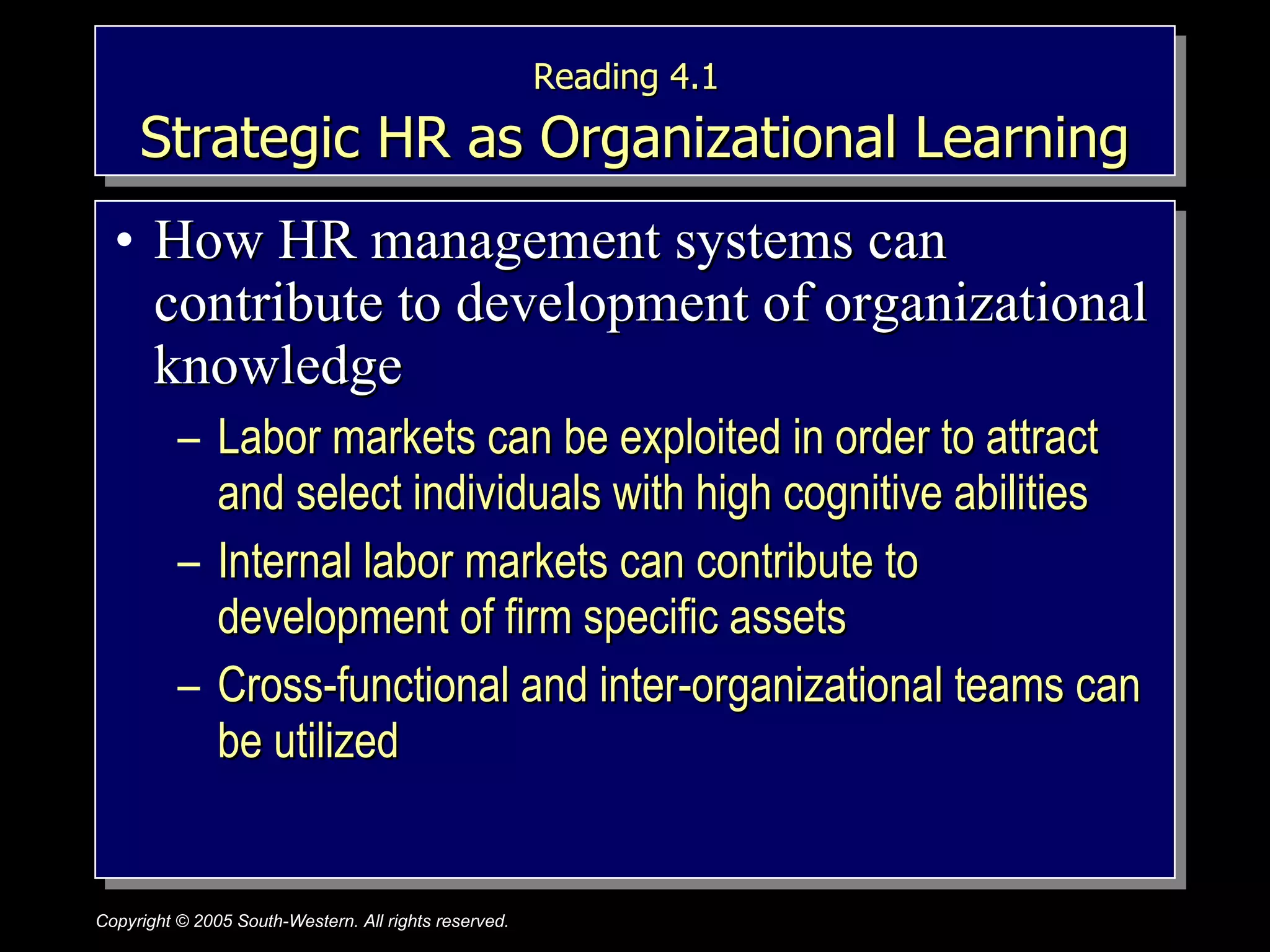
Reading 4.1 (Rodriguez& Ordonez de Pablos) Strategic HR as Organizational Learning Stages of knowledge management Generating or capturing knowledge Structuring and providing value to gathered knowledge Transferring knowledge Establishing mechanisms for use and reuse of knowledge for individuals and groups
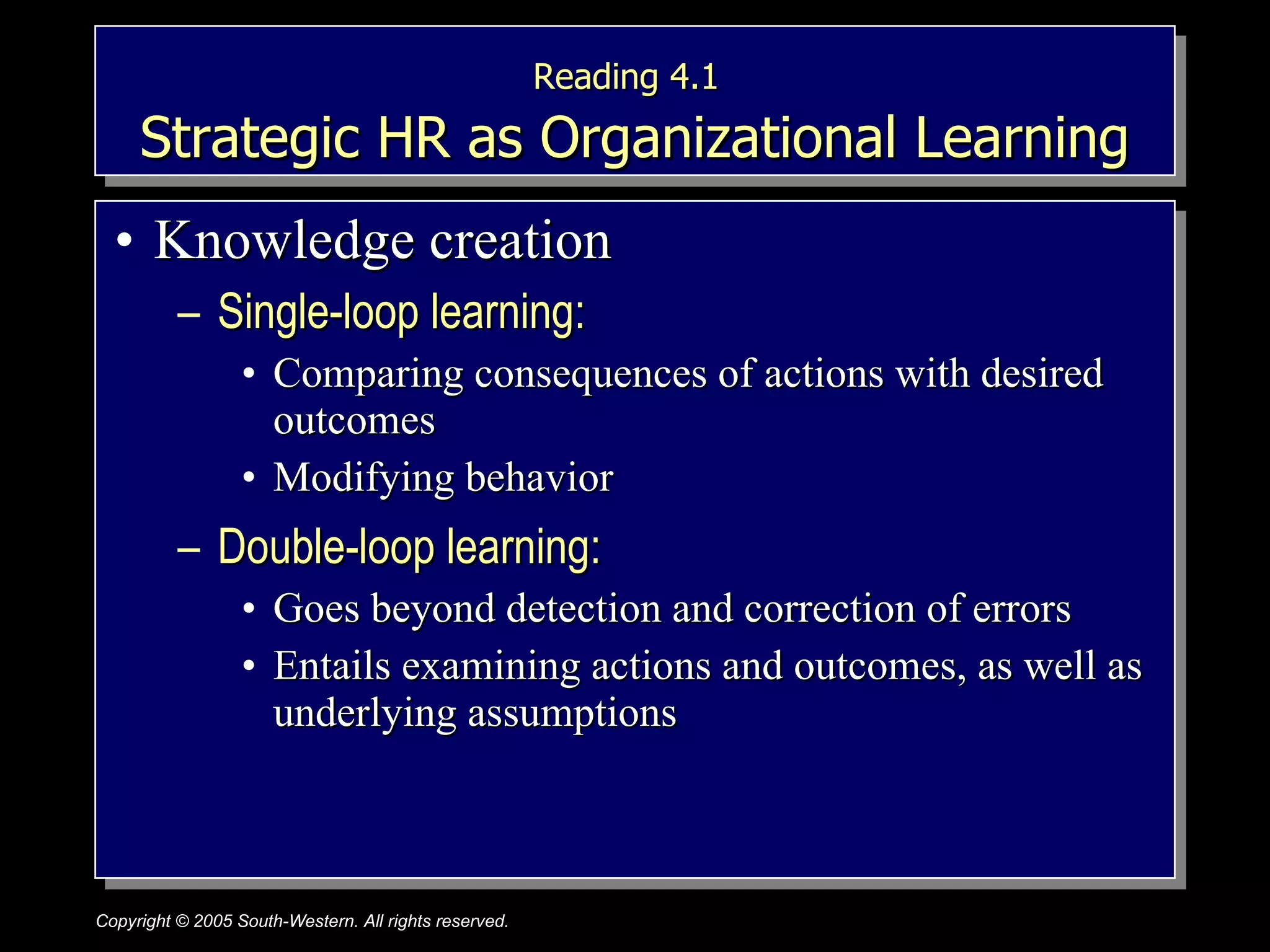
Reading 4.1 Strategic HR as Organizational Learning Knowledge creation Single-loop learning: Comparing consequences of actions with desired outcomes Modifying behavior Double-loop learning: Goes beyond detection and correction of errors Entails examining actions and outcomes, as well as underlying assumptions
16.
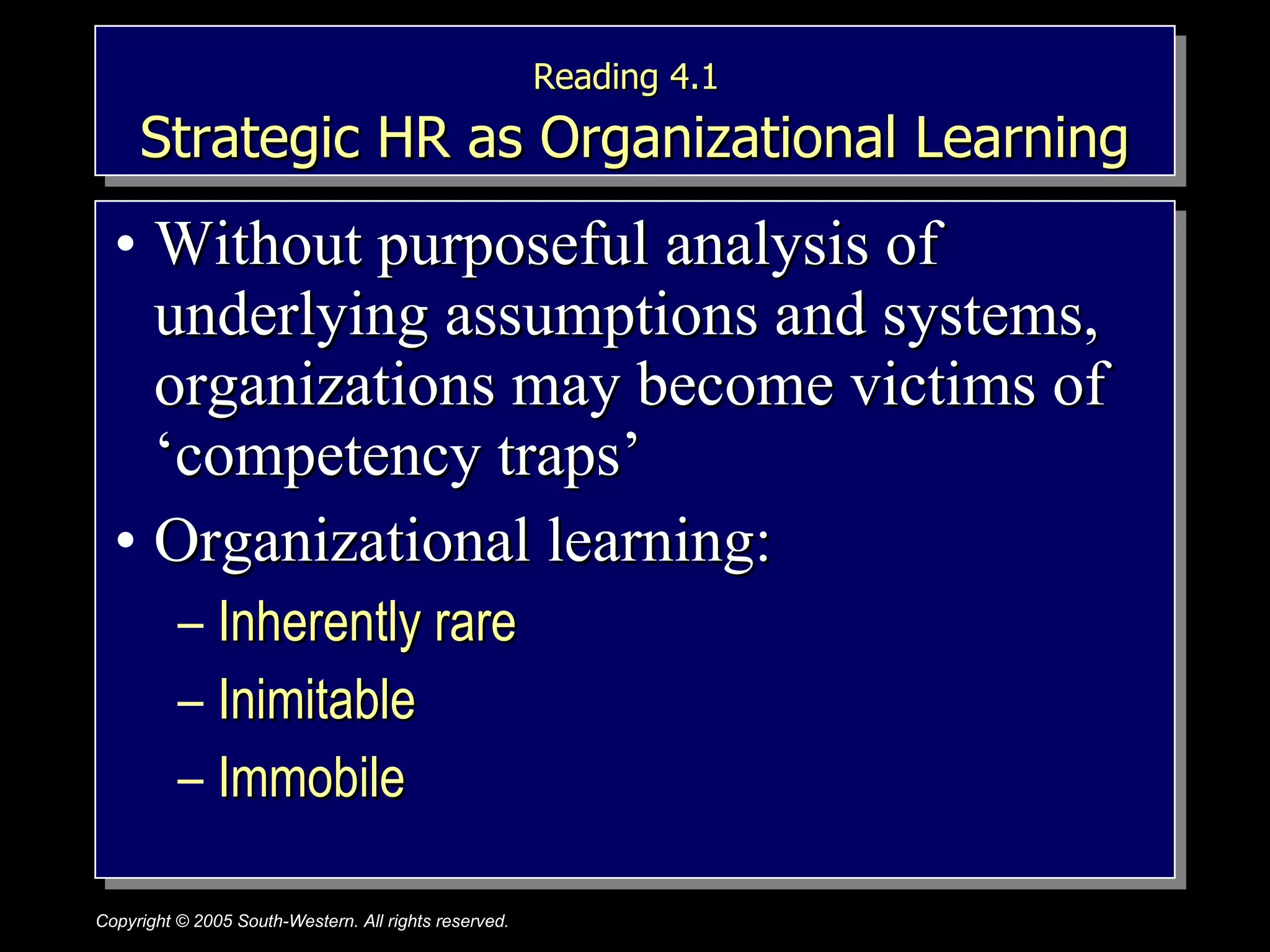
Reading 4.1 Strategic HR as Organizational Learning Without purposeful analysis of underlying assumptions and systems, organizations may become victims of ‘competency traps’ Organizational learning: Inherently rare Inimitable Immobile
17.
Reading 4.1 Strategic HR as Organizational Learning How HR management systems can contribute to development of organizational knowledge Labor markets can be exploited in order to attract and select individuals with high cognitive abilities Internal labor markets can contribute to development of firm specific assets Cross-functional and inter-organizational teams can be utilized
18.
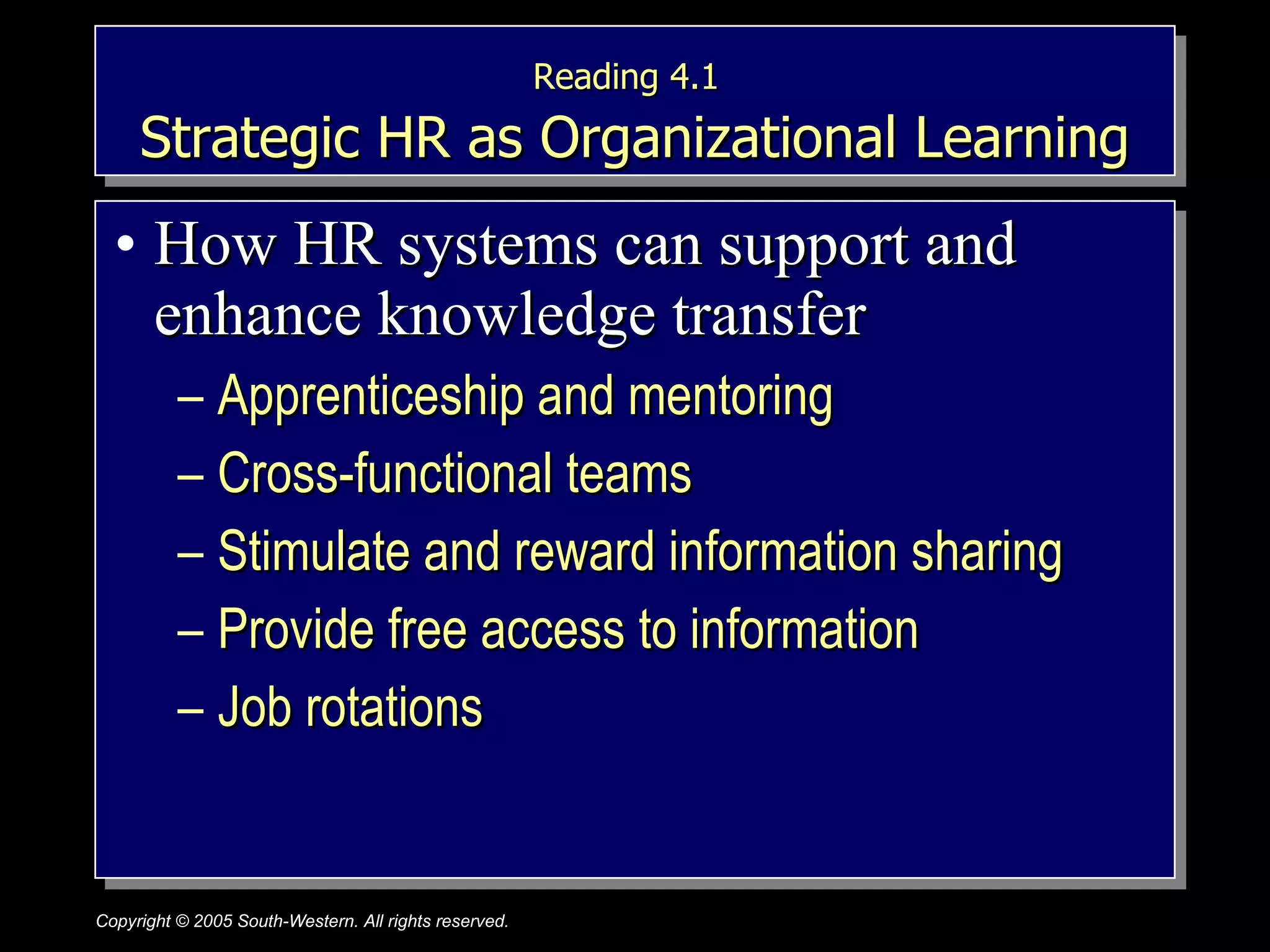
Reading 4.1 Strategic HR as Organizational Learning How HR systems can support and enhance knowledge transfer Apprenticeship and mentoring Cross-functional teams Stimulate and reward information sharing Provide free access to information Job rotations
19.
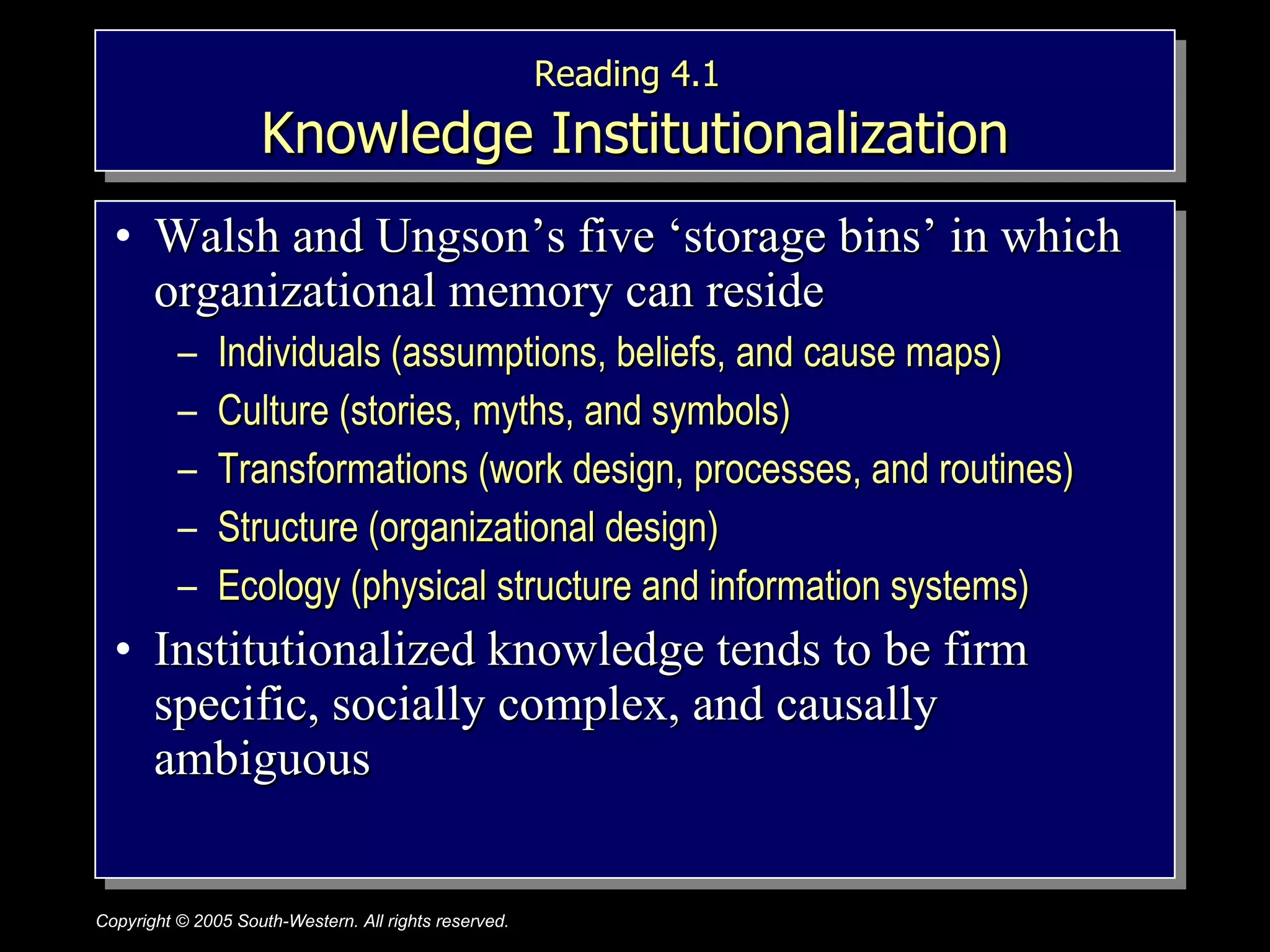
Reading 4.1 Knowledge Institutionalization Walsh and Ungson’s five ‘storage bins’ in which organizational memory can reside Individuals (assumptions, beliefs, and cause maps) Culture (stories, myths, and symbols) Transformations (work design, processes, and routines) Structure (organizational design) Ecology (physical structure and information systems) Institutionalized knowledge tends to be firm specific, socially complex, and causally ambiguous
Reading 4.2 (Bowen& Ostroff) Understanding HRM-Performance Linkages Scholars have often assumed two perspectives Systems view considers overall configuration or aggregation of HRM practices Strategic perspective examines “fit” between various HRM practices and organization’s competitive strategy Overall set of HRM practices generally associated with firm performance and competitive advantage
22.
Reading 4.2 Understanding HRM-Performance Linkages Psychological climate: Experiential-based perception of what people “see” and report happening to them as they make sense of their environment Climate: Critical mediating construct in exploring multilevel relationships between HRM and organizational performance
23.
Reading 4.2 Understanding HRM-Performance Linkages Two interrelated features of HRM system: Content Process Must be integrated effectively
24.
Reading 4.2 Understanding HRM-Performance Linkages Content Set of practices adopted Ideally driven by strategic goals and values No single most appropriate set of practices for particular strategic objective Different sets of practices may be equally effective so long as they allow particular type of climate around some strategic objective to develop Process How HRM system can be designed and administered effectively by defining meta-features of overall HRM system
25.
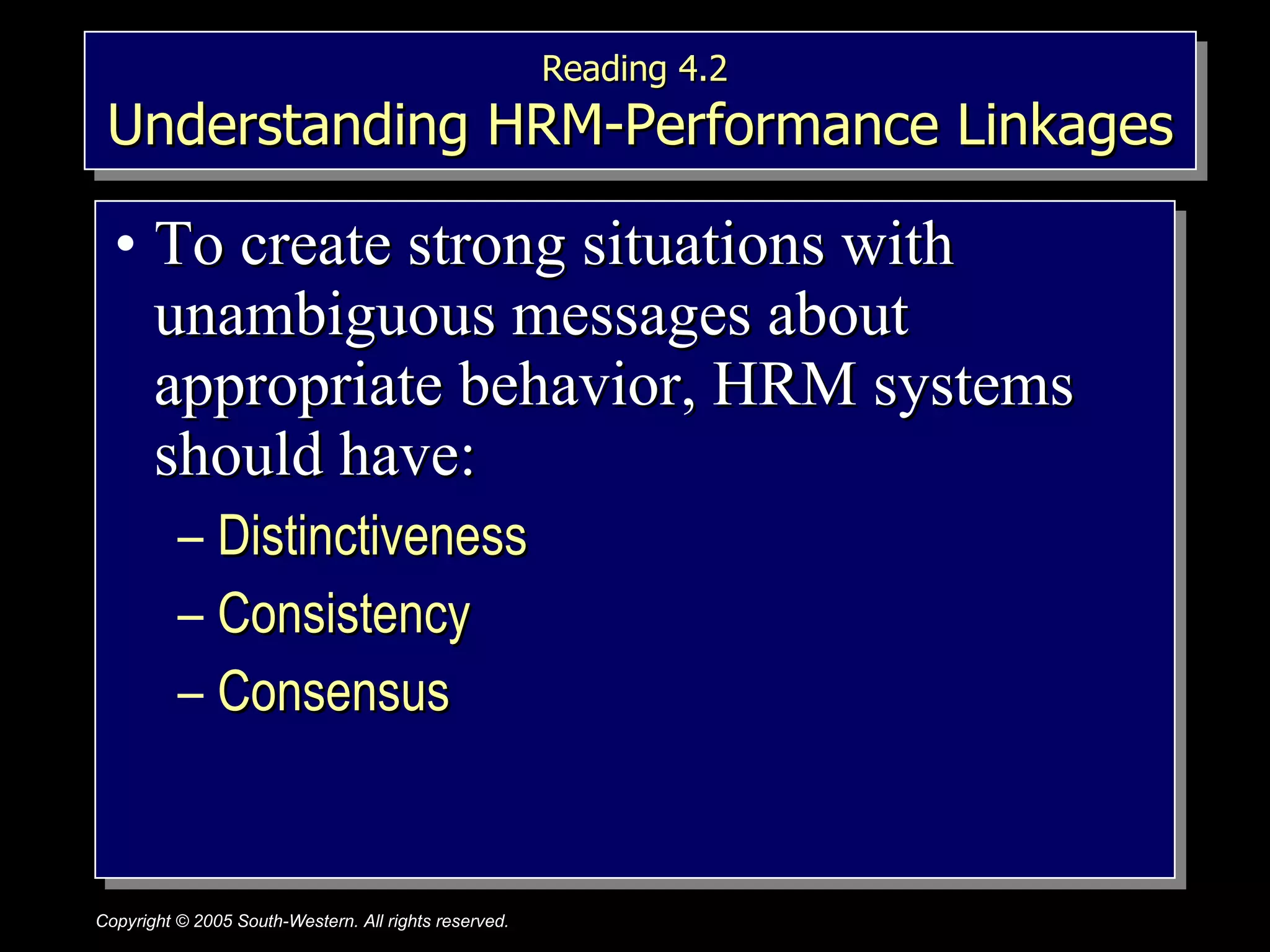
To create strongsituations with unambiguous messages about appropriate behavior, HRM systems should have: Distinctiveness Consistency Consensus Reading 4.2 Understanding HRM-Performance Linkages
26.
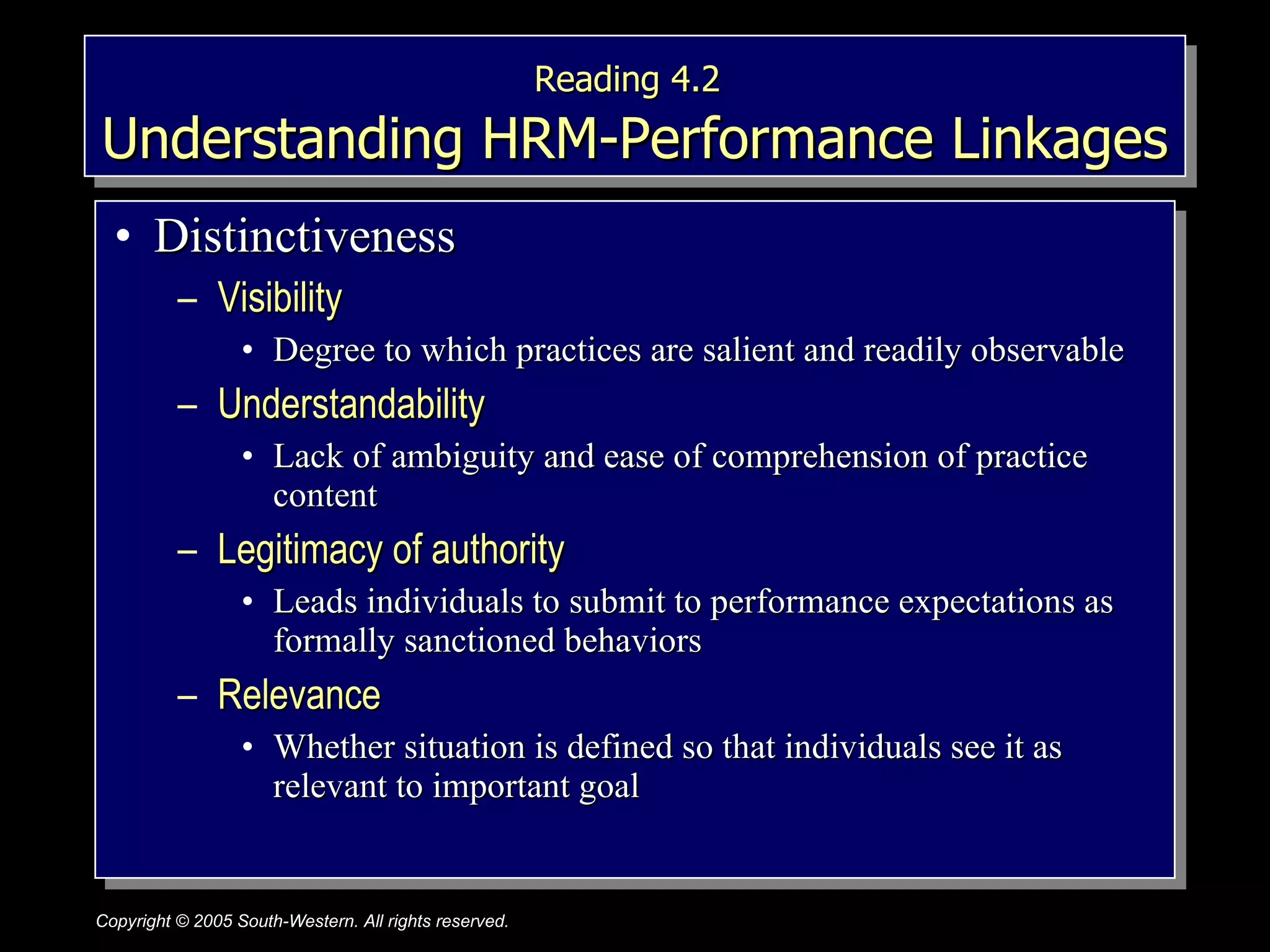
Reading 4.2 Understanding HRM-Performance Linkages Distinctiveness Visibility Degree to which practices are salient and readily observable Understandability Lack of ambiguity and ease of comprehension of practice content Legitimacy of authority Leads individuals to submit to performance expectations as formally sanctioned behaviors Relevance Whether situation is defined so that individuals see it as relevant to important goal
27.
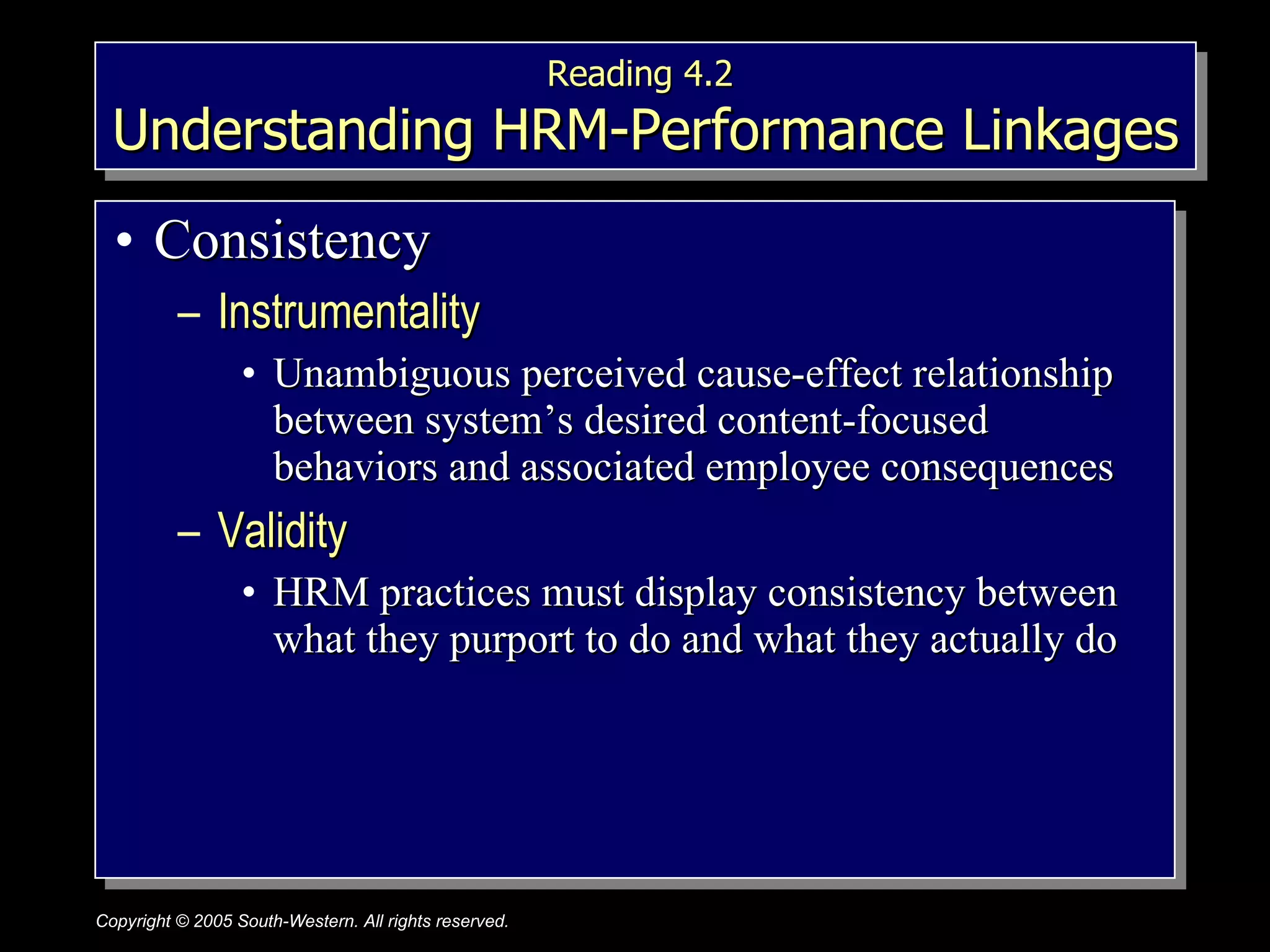
Reading 4.2 Understanding HRM-Performance Linkages Consistency Instrumentality Unambiguous perceived cause-effect relationship between system’s desired content-focused behaviors and associated employee consequences Validity HRM practices must display consistency between what they purport to do and what they actually do
28.
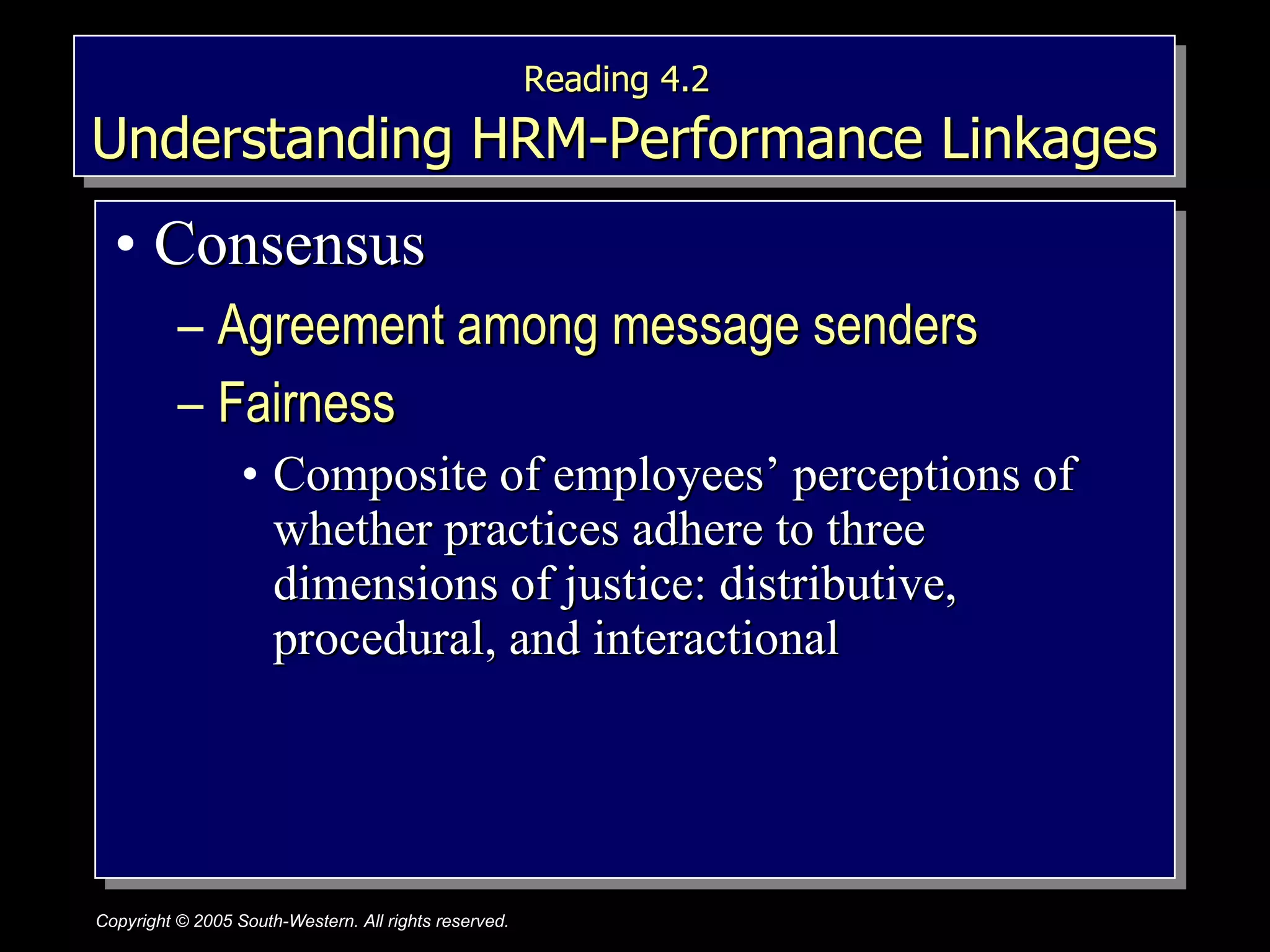
Reading 4.2 Understanding HRM-Performance Linkages Consensus Agreement among message senders Fairness Composite of employees’ perceptions of whether practices adhere to three dimensions of justice: distributive, procedural, and interactional
29.
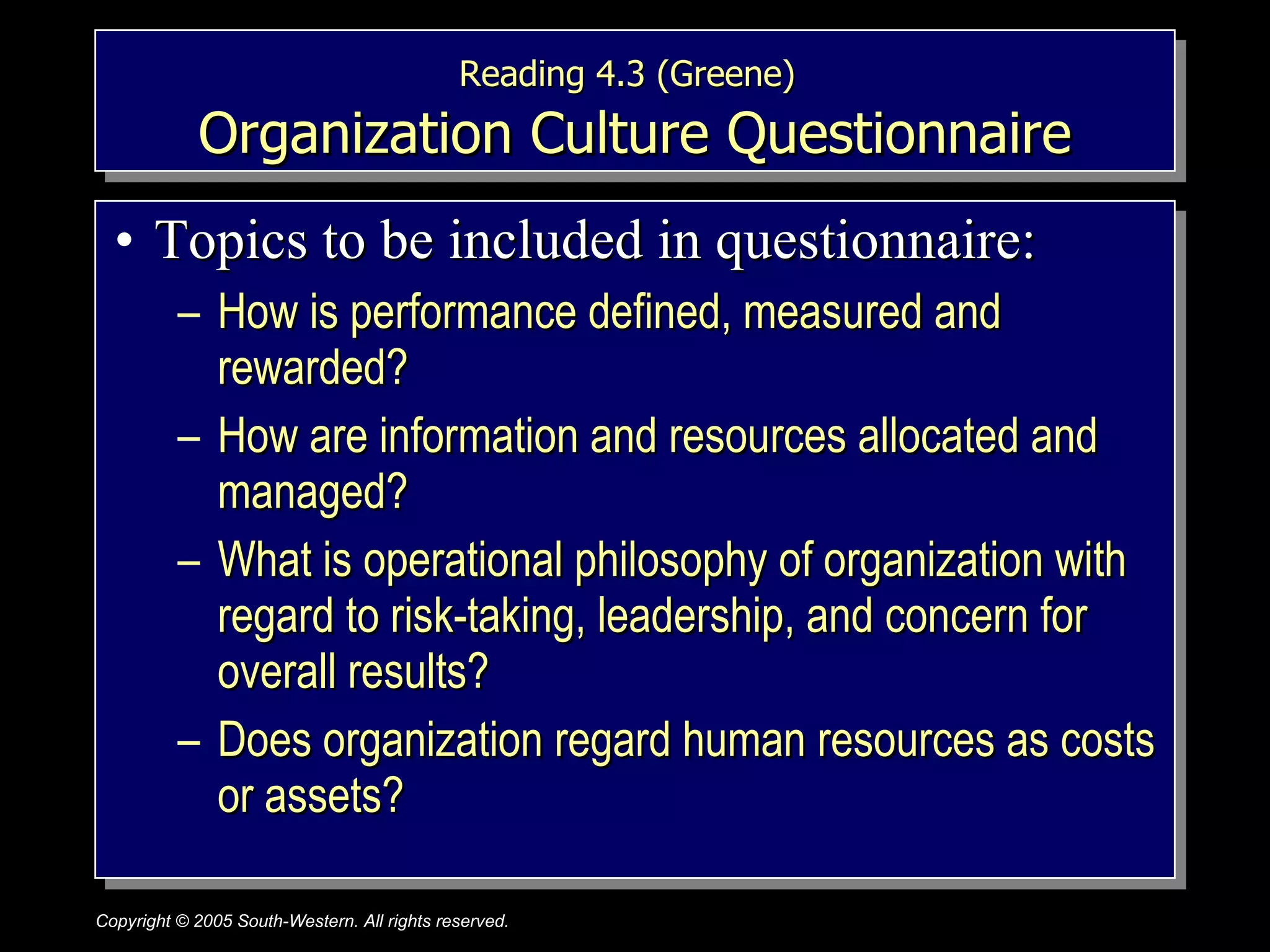
Reading 4.3 (Greene) Organization Culture Questionnaire Topics to be included in questionnaire: How is performance defined, measured and rewarded? How are information and resources allocated and managed? What is operational philosophy of organization with regard to risk-taking, leadership, and concern for overall results? Does organization regard human resources as costs or assets?
30.
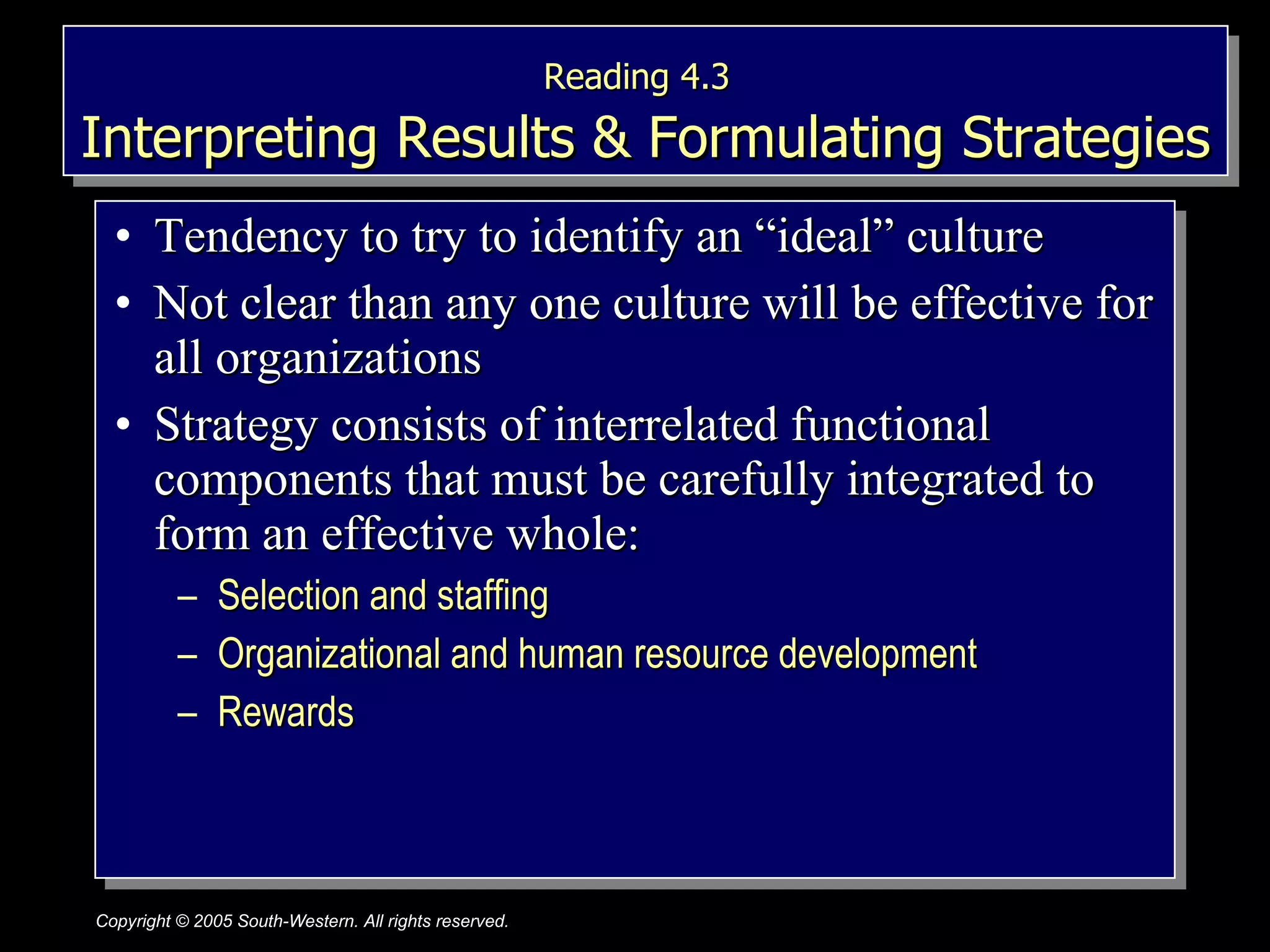
Reading 4.3 Interpreting Results & Formulating Strategies Tendency to try to identify an “ideal” culture Not clear than any one culture will be effective for all organizations Strategy consists of interrelated functional components that must be carefully integrated to form an effective whole: Selection and staffing Organizational and human resource development Rewards
31.
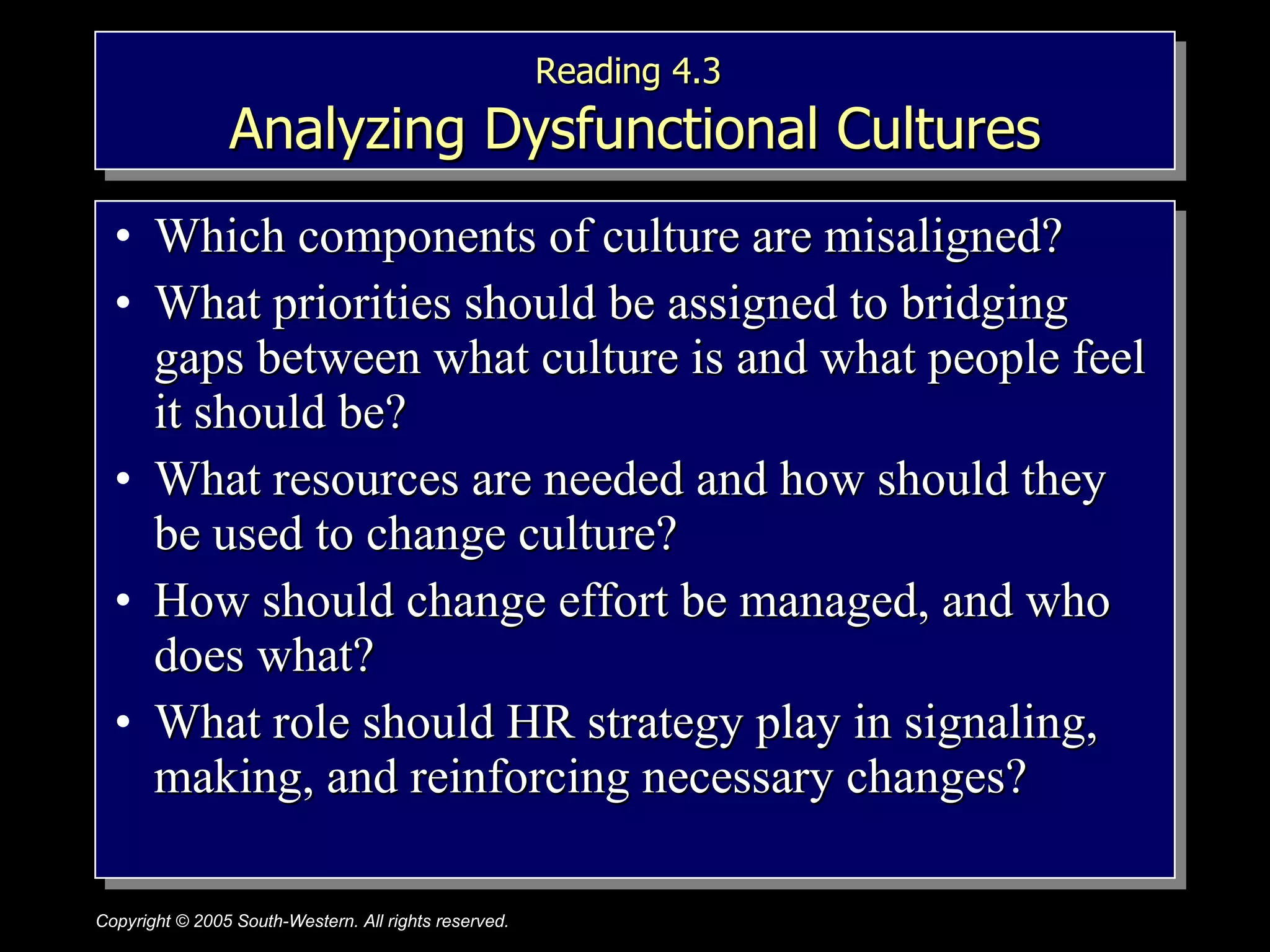
Reading 4.3 Analyzing Dysfunctional Cultures Which components of culture are misaligned? What priorities should be assigned to bridging gaps between what culture is and what people feel it should be? What resources are needed and how should they be used to change culture? How should change effort be managed, and who does what? What role should HR strategy play in signaling, making, and reinforcing necessary changes?