Kodak Case Presentation Managerial Accounting Mary Jane J. Mollenido SPCBA Graduate School
8
7
6
5
4
3
 
 
Eastman Kodak  Company A multinational corporation & a diversified manufacturer of photographic imaging equipment and supplies, chemicals, health-care products, and information systems. Widely recognized as a tightly managed company with superior international marketing.
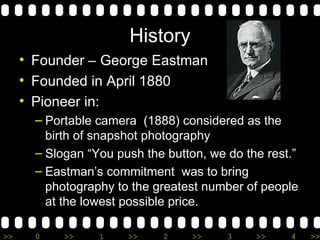
History Founder – George Eastman Founded in April 1880 Pioneer in: Portable camera  (1888) considered as the birth of snapshot photography Slogan “You push the button, we do the rest.” Eastman’s commitment  was to bring photography to the greatest number of people at the lowest possible price.
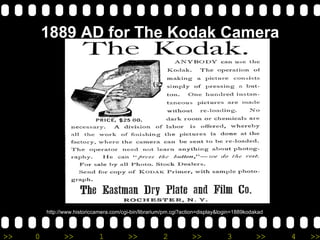
1889 AD for The Kodak Camera http://www.historiccamera.com/cgi-bin/librarium/pm.cgi?action=display&login=1889kodakad
Evolution 1902-  brought to market a new  developing machine that allowed  film processing without benefit of  a darkroom 1912-  introduced the 16-millimeter  Kodacolor motion picture film, the  16-millimeter Cine-Kodak motion  picture camera, and the  Kodascope projector
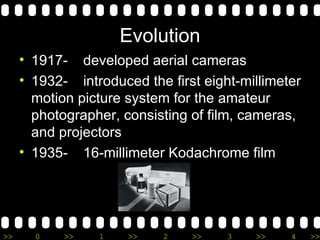
Evolution 1917-  developed aerial cameras 1932-  introduced the first eight-millimeter motion picture system for the amateur photographer, consisting of film, cameras, and projectors 1935- 16-millimeter Kodachrome film
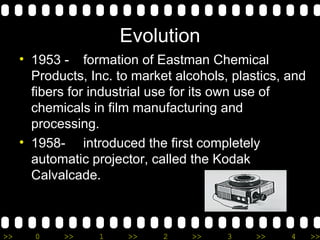
Evolution 1953 - formation of Eastman Chemical Products, Inc. to market alcohols, plastics, and fibers for industrial use for its own use of chemicals in film manufacturing and processing. 1958- introduced the first completely automatic projector, called the Kodak Calvalcade.
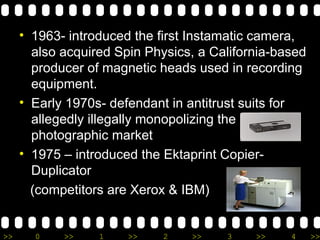
1963- introduced the first Instamatic camera, also acquired Spin Physics, a California-based producer of magnetic heads used in recording equipment.  Early 1970s- defendant in antitrust suits for allegedly illegally monopolizing the photographic market 1975 – introduced the Ektaprint Copier-Duplicator  (competitors are Xerox & IBM)
1980- introduced the Ektachem 400 blood analyzer 1980’s- faced intensifying Japanese competition in photography and a continuing decline in product demand as Fuji and 3M Company challenged Kodak’s dominance in photographic paper market
Management Strategy Since the company’s founding, Kodak had maintained a policy of treating its employees fairly and with respect, earning the nickname of the  “Great Yellow Father.”  George Eastman believe that an organization’s prosperity was not necessarily due to its technological achievements, but more to its workers’ goodwill and loyalty. As a result, company benefits were well above average, morale had always remained high, and employees never felt the need to unionize.
1983 - the company was forced to reduce its work force by 5 percent to cut costs. Competitive pressures from the Japanese and domestic and international economic problems had slowed product demand.  1984- introduced complete lines of videotape cassettes for all video formats and floppy discs for use in personal computers.
1985-purchase of Verbatim Corporation, a floppy disc manufacturer but was later on sold after 5 years of disappointing sales 1986- instituted a 10% workforce reduction due to class action lawsuit and an order by the federal court to leave the instant camera business, as a result of Polaroid’s patent infringement case
1986- introduction of alkaline battery under Supralife brand 1988-acquired Sterling Drug Co. manufacturer of prescription drugs , to make the company more competitive in the pharmaceutical industry
1990- Kodak admitted to have violated New York’s environmental regulations and was fined $1 million. It also agreed to clean up the site of its Kodak Park manufacturing facility and reduce chemical emissions from the plant. Environmental Concerns
Human Resource 1990-Kodak embarked on a path of restructuring and cost cutting, and as an incentive, management devised an Early retirement plan to trim  approx. 5,800 employees. 1991- the plan backfired when 6,600 availed of the early retirement plan, forcing the company to hire & train 1,600 new workers
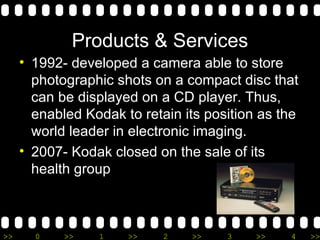
Products & Services 1992- developed a camera able to store photographic shots on a compact disc that can be displayed on a CD player. Thus, enabled Kodak to retain its position as the world leader in electronic imaging.  2007- Kodak closed on the sale of its health group
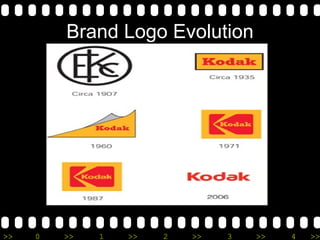
Brand Logo Evolution
The Company’s key goals for 2010 are: Improve segment earnings Accelerate digital revenue growth Continue to invest in new markets in need of transformation Exploit benefits of operating leverage Drive positive cash flow before restructuring
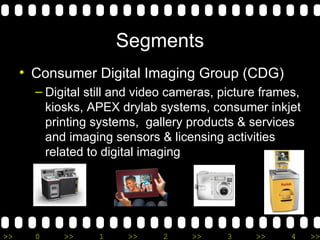
Segments Consumer Digital Imaging Group (CDG) Digital still and video cameras, picture frames, kiosks, APEX drylab systems, consumer inkjet printing systems,  gallery products & services and imaging sensors & licensing activities related to digital imaging
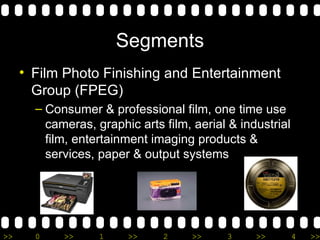
Segments Film Photo Finishing and Entertainment Group (FPEG) Consumer & professional film, one time use cameras, graphic arts film, aerial & industrial film, entertainment imaging products & services, paper & output systems
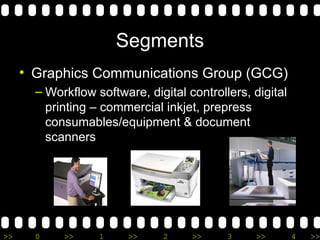
Segments Graphics Communications Group (GCG) Workflow software, digital controllers, digital printing – commercial inkjet, prepress consumables/equipment & document scanners
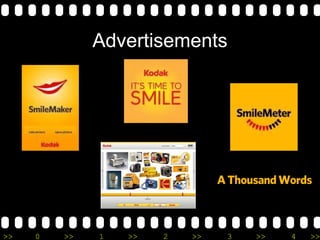
Advertisements
Kodak’s Popularity  Kodak Moments (urbandictionary.com) 1. a nice image for a picture  2. a horribly twisted event (sarcastically) 3. a rare, one time, moment that is captured by a picture, or should have been captured by a picture. 4. Said when something funny happens that would have made a good picture.
Classic-camera.com
Kodak’s Popularity  (Filipino Culture) Inclusion of Kodak in Tagalog ‘lingo’ i “kodak” mo ako “ kodakan” tayo  Magpapa”kodak” ka? Filipino’s are by nature Social people & emotional with strong attachments to relatives & occasions
Key Success Factors A strong brand name A strong management team Leader in distributed photo print outputs Existence of several kiosks nationwide Booming independent film making industry in the country Existence of several Holidays in the country
Measures of Success Factors Market share Company’s long standing career Advertisement recall (surveys) Psychology of “Smile” campaign Business Sustainability Number of franchise/kiosks Profitability
Company Structure 13 Board of Directors Board Committees Audit Committee Corporate Responsibility & Governance Committee Executive Compensation & Dev’t Committee Finance Committee  Executive Committee


Assessment on Planning System Cost Restructuring Supplier Diversity thru outsourcing Expansion specifically on Asia Recovery of loss in the U.S. Market due to economic slowdown Introduction of e-voting (Kodak’s partnership with Phils. Thru provision of 5 Kodak printer that finished printing of 50,850,940 ballots 2 days before deadline (April 25-deadline)
"Sustainability is about being viable into the future. We create memories. We preserve culture. We preserve history. It’s important that what we do everyday makes a difference to consumers, to businesses — to capture and preserve the essence of life." (Brad Kruchten, Film, Photofinishing and Entertainment Group)
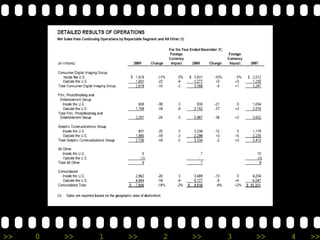
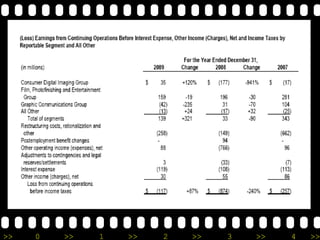
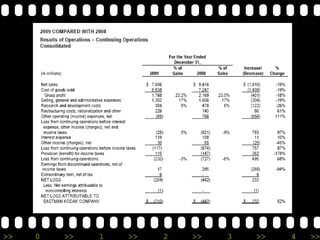
Extent of Reliance on Financial Reporting and Control to achieve objectives A multinational company like Kodak should equally rely on accurate financial systems reporting data and experience. Its multiple operations in different countries, wide array of products and services, research and development efforts in the three business segments have made the company reliant on figures (Statement of Operations & Cash Flow) to plan for its market strategies –whether expansion or cost cutting, product diversification or sale of an asset like its health group in 2007.  Accurate and on-time consolidation of reports is the basis of sound management policies.
Recommended Changes On Kodak’s  planning system Map out its strategic development plan for its products and services in Asia in order to be competitive amidst the dynamic imaging industry.  Weigh the long term valuation of re-establishing its Philippine office against market demand and viability of sales because it would mean investments on long term assets.
On other management systems With Techtrends as Kodak’s sole distributor for two years in the country, Kodak should give Techtrends time to adjust to Kodak’s plans so they could realign their objectives with Kodak’s plans. It is important to establish relationship and professionalism among distributors and consumers.  Also, Kodak should adapt to market changes e.g. buying power, needs/demands of consumers.
On i mprovement of management processes Human resource hiring and training should be one of Kodak’s utmost priorities, they must return to their original concept of  treating their employees fairly and with respect.  During the last three worldwide cost cutting issues, Kodak has always resorted to workforce reduction which is in contradiction to George Eastman’s  belief that an organization’s prosperity was not necessarily due to its technological achievements, but more to its workers’ goodwill and loyalty.
THANK YOU!!!

Kodak case presentation

  • 1.
    Kodak Case PresentationManagerial Accounting Mary Jane J. Mollenido SPCBA Graduate School
  • 2.
  • 3.
  • 4.
  • 5.
  • 6.
  • 7.
  • 8.
  • 9.
  • 10.
    Eastman Kodak Company A multinational corporation & a diversified manufacturer of photographic imaging equipment and supplies, chemicals, health-care products, and information systems. Widely recognized as a tightly managed company with superior international marketing.
  • 11.
    History Founder –George Eastman Founded in April 1880 Pioneer in: Portable camera (1888) considered as the birth of snapshot photography Slogan “You push the button, we do the rest.” Eastman’s commitment was to bring photography to the greatest number of people at the lowest possible price.
  • 12.
    1889 AD forThe Kodak Camera http://www.historiccamera.com/cgi-bin/librarium/pm.cgi?action=display&login=1889kodakad
  • 13.
    Evolution 1902- brought to market a new developing machine that allowed film processing without benefit of a darkroom 1912- introduced the 16-millimeter Kodacolor motion picture film, the 16-millimeter Cine-Kodak motion picture camera, and the Kodascope projector
  • 14.
    Evolution 1917- developed aerial cameras 1932- introduced the first eight-millimeter motion picture system for the amateur photographer, consisting of film, cameras, and projectors 1935- 16-millimeter Kodachrome film
  • 15.
    Evolution 1953 -formation of Eastman Chemical Products, Inc. to market alcohols, plastics, and fibers for industrial use for its own use of chemicals in film manufacturing and processing. 1958- introduced the first completely automatic projector, called the Kodak Calvalcade.
  • 16.
    1963- introduced thefirst Instamatic camera, also acquired Spin Physics, a California-based producer of magnetic heads used in recording equipment. Early 1970s- defendant in antitrust suits for allegedly illegally monopolizing the photographic market 1975 – introduced the Ektaprint Copier-Duplicator (competitors are Xerox & IBM)
  • 17.
    1980- introduced theEktachem 400 blood analyzer 1980’s- faced intensifying Japanese competition in photography and a continuing decline in product demand as Fuji and 3M Company challenged Kodak’s dominance in photographic paper market
  • 18.
    Management Strategy Sincethe company’s founding, Kodak had maintained a policy of treating its employees fairly and with respect, earning the nickname of the “Great Yellow Father.” George Eastman believe that an organization’s prosperity was not necessarily due to its technological achievements, but more to its workers’ goodwill and loyalty. As a result, company benefits were well above average, morale had always remained high, and employees never felt the need to unionize.
  • 19.
    1983 - thecompany was forced to reduce its work force by 5 percent to cut costs. Competitive pressures from the Japanese and domestic and international economic problems had slowed product demand. 1984- introduced complete lines of videotape cassettes for all video formats and floppy discs for use in personal computers.
  • 20.
    1985-purchase of VerbatimCorporation, a floppy disc manufacturer but was later on sold after 5 years of disappointing sales 1986- instituted a 10% workforce reduction due to class action lawsuit and an order by the federal court to leave the instant camera business, as a result of Polaroid’s patent infringement case
  • 21.
    1986- introduction ofalkaline battery under Supralife brand 1988-acquired Sterling Drug Co. manufacturer of prescription drugs , to make the company more competitive in the pharmaceutical industry
  • 22.
    1990- Kodak admittedto have violated New York’s environmental regulations and was fined $1 million. It also agreed to clean up the site of its Kodak Park manufacturing facility and reduce chemical emissions from the plant. Environmental Concerns
  • 23.
    Human Resource 1990-Kodakembarked on a path of restructuring and cost cutting, and as an incentive, management devised an Early retirement plan to trim approx. 5,800 employees. 1991- the plan backfired when 6,600 availed of the early retirement plan, forcing the company to hire & train 1,600 new workers
  • 24.
    Products & Services1992- developed a camera able to store photographic shots on a compact disc that can be displayed on a CD player. Thus, enabled Kodak to retain its position as the world leader in electronic imaging. 2007- Kodak closed on the sale of its health group
  • 25.
  • 26.
    The Company’s keygoals for 2010 are: Improve segment earnings Accelerate digital revenue growth Continue to invest in new markets in need of transformation Exploit benefits of operating leverage Drive positive cash flow before restructuring
  • 27.
    Segments Consumer DigitalImaging Group (CDG) Digital still and video cameras, picture frames, kiosks, APEX drylab systems, consumer inkjet printing systems, gallery products & services and imaging sensors & licensing activities related to digital imaging
  • 28.
    Segments Film PhotoFinishing and Entertainment Group (FPEG) Consumer & professional film, one time use cameras, graphic arts film, aerial & industrial film, entertainment imaging products & services, paper & output systems
  • 29.
    Segments Graphics CommunicationsGroup (GCG) Workflow software, digital controllers, digital printing – commercial inkjet, prepress consumables/equipment & document scanners
  • 30.
  • 31.
    Kodak’s Popularity Kodak Moments (urbandictionary.com) 1. a nice image for a picture 2. a horribly twisted event (sarcastically) 3. a rare, one time, moment that is captured by a picture, or should have been captured by a picture. 4. Said when something funny happens that would have made a good picture.
  • 32.
  • 33.
    Kodak’s Popularity (Filipino Culture) Inclusion of Kodak in Tagalog ‘lingo’ i “kodak” mo ako “ kodakan” tayo Magpapa”kodak” ka? Filipino’s are by nature Social people & emotional with strong attachments to relatives & occasions
  • 34.
    Key Success FactorsA strong brand name A strong management team Leader in distributed photo print outputs Existence of several kiosks nationwide Booming independent film making industry in the country Existence of several Holidays in the country
  • 35.
    Measures of SuccessFactors Market share Company’s long standing career Advertisement recall (surveys) Psychology of “Smile” campaign Business Sustainability Number of franchise/kiosks Profitability
  • 36.
    Company Structure 13Board of Directors Board Committees Audit Committee Corporate Responsibility & Governance Committee Executive Compensation & Dev’t Committee Finance Committee Executive Committee
  • 37.
  • 38.
  • 39.
  • 40.
  • 41.
    Assessment on PlanningSystem Cost Restructuring Supplier Diversity thru outsourcing Expansion specifically on Asia Recovery of loss in the U.S. Market due to economic slowdown Introduction of e-voting (Kodak’s partnership with Phils. Thru provision of 5 Kodak printer that finished printing of 50,850,940 ballots 2 days before deadline (April 25-deadline)
  • 42.
    "Sustainability is aboutbeing viable into the future. We create memories. We preserve culture. We preserve history. It’s important that what we do everyday makes a difference to consumers, to businesses — to capture and preserve the essence of life." (Brad Kruchten, Film, Photofinishing and Entertainment Group)
  • 43.
    Extent of Relianceon Financial Reporting and Control to achieve objectives A multinational company like Kodak should equally rely on accurate financial systems reporting data and experience. Its multiple operations in different countries, wide array of products and services, research and development efforts in the three business segments have made the company reliant on figures (Statement of Operations & Cash Flow) to plan for its market strategies –whether expansion or cost cutting, product diversification or sale of an asset like its health group in 2007. Accurate and on-time consolidation of reports is the basis of sound management policies.
  • 44.
    Recommended Changes OnKodak’s planning system Map out its strategic development plan for its products and services in Asia in order to be competitive amidst the dynamic imaging industry. Weigh the long term valuation of re-establishing its Philippine office against market demand and viability of sales because it would mean investments on long term assets.
  • 45.
    On other managementsystems With Techtrends as Kodak’s sole distributor for two years in the country, Kodak should give Techtrends time to adjust to Kodak’s plans so they could realign their objectives with Kodak’s plans. It is important to establish relationship and professionalism among distributors and consumers. Also, Kodak should adapt to market changes e.g. buying power, needs/demands of consumers.
  • 46.
    On i mprovementof management processes Human resource hiring and training should be one of Kodak’s utmost priorities, they must return to their original concept of treating their employees fairly and with respect. During the last three worldwide cost cutting issues, Kodak has always resorted to workforce reduction which is in contradiction to George Eastman’s belief that an organization’s prosperity was not necessarily due to its technological achievements, but more to its workers’ goodwill and loyalty.
  • 47.

Editor's Notes

  • #12 Supposed to be enjoying his vacation but instead spent 3 years developing the camera. Lower prices were introduced with the introduction of Brownie camera
  • #15 1932 – suicide of George Eastman at age 77 with note saying “To my friends. My work is done. Why wait? G.E.”
  • #16 Here it showed that Kodak has become very independent producing goods and services that its camera & film processing will need
  • #17 Kodak also faced patent infringement cases filed by Polaroid
  • #18 Reinforced its stong presence in the Xray industry as the film supplier
  • #20 Competition with Fuki
  • #22 Purchase of Sterling Drug Co was viewed unfavorably by the company’s shareholders, which proved to be correct later on
  • #23 Environmental violation caused the company to suffer financial damages
  • #24 Environmental violation caused the company to suffer financial damages
  • #25 Environmental violation caused the company to suffer financial damages
  • #27 3 segments CDG, FPEG & GCG, acceleration of digital revenue thur products offerings that are competitive in price and with ease of use like Kodak easy share, mobile phone industry investments with cameras
  • #34 In such a way that when you say Kodak, Filipinos immediately associate it with the camera or the film and it is a necessary part that pictures be taken on special occasions
  • #35 Last part can be a success factor because with a lot of Filipinos buying cellular phones with cameras they have the tendency to let images of this pictures in print thus a positive sales outlook for Kodak’s paper & printing business