Career Management
And
Development
Guided By: Prepared By:
Ami Ma’am Jay Raval
Submitted TO:
Department of Business Administration
Concept
Stages
Model
Process
Roles or responsibility
issues
2
Concept
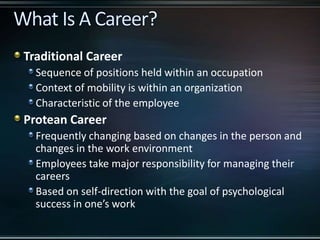
Traditional Career
Sequence of positions held within an occupation
Context of mobility is within an organization
Characteristic of the employee
Protean Career
Frequently changing based on changes in the person and
changes in the work environment
Employees take major responsibility for managing their
careers
Based on self-direction with the goal of psychological
success in one’s work
Career management is the process through
which employees:
Become aware of their own interests, values,
strengths, and weaknesses
Obtain information about job opportunities within
the company
Identify career goals
Establish action plans to achieve career goals
From the company’s perspective, the failure to
motivate employees to plan their careers can
result in:
a shortage of employees to fill open positions
lower employee commitment
inappropriate use of monies allocated for training
and development programs
From the employees’ perspective, lack of career
management can result in:
frustration
feelings of not being valued by the company
being unable to find suitable employment should a
job change be necessary due to mergers,
acquisitions, restructuring, or downsizing
A formal approach used by the firms to ensure
that people with proper qualifications and
experience are available when needed.
Career development benefits both employees
as well as organizations.
Organization needs to have career development
programme and integrate the function with HR
activities.
8
Career development is important for companies to
create and sustain a continuous learning
environment
The biggest challenge companies face is how to
balance advancing current employees’ careers with
simultaneously attracting and acquiring employees
with new skills
Changes in the concept of career affect:
Employees’ motivation to attend training programs
The outcomes they expect to gain from attendance
Their choice of programs
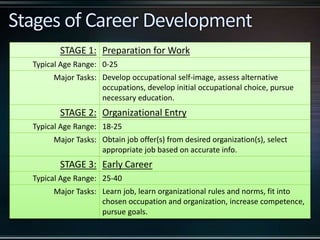
Stages
STAGE 1: Preparation for Work
Typical Age Range: 0-25
Major Tasks: Develop occupational self-image, assess alternative
occupations, develop initial occupational choice, pursue
necessary education.
STAGE 2: Organizational Entry
Typical Age Range: 18-25
Major Tasks: Obtain job offer(s) from desired organization(s), select
appropriate job based on accurate info.
STAGE 3: Early Career
Typical Age Range: 25-40
Major Tasks: Learn job, learn organizational rules and norms, fit into
chosen occupation and organization, increase competence,
pursue goals.
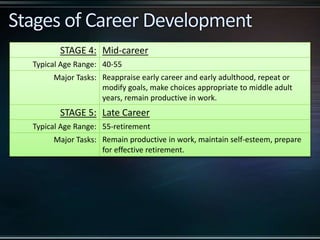
STAGE 4: Mid-career
Typical Age Range: 40-55
Major Tasks: Reappraise early career and early adulthood, repeat or
modify goals, make choices appropriate to middle adult
years, remain productive in work.
STAGE 5: Late Career
Typical Age Range: 55-retirement
Major Tasks: Remain productive in work, maintain self-esteem, prepare
for effective retirement.
Model
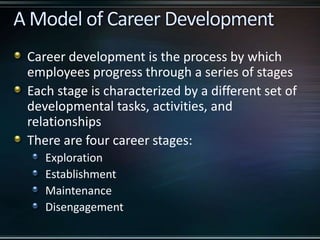
Career development is the process by which
employees progress through a series of stages
Each stage is characterized by a different set of
developmental tasks, activities, and
relationships
There are four career stages:
Exploration
Establishment
Maintenance
Disengagement
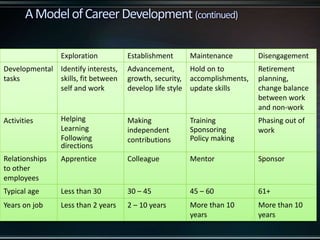
Exploration Establishment Maintenance Disengagement
Developmental
tasks
Identify interests,
skills, fit between
self and work
Advancement,
growth, security,
develop life style
Hold on to
accomplishments,
update skills
Retirement
planning,
change balance
between work
and non-work
Activities Helping
Learning
Following
directions
Making
independent
contributions
Training
Sponsoring
Policy making
Phasing out of
work
Relationships
to other
employees
Apprentice Colleague Mentor Sponsor
Typical age Less than 30 30 – 45 45 – 60 61+
Years on job Less than 2 years 2 – 10 years More than 10
years
More than 10
years
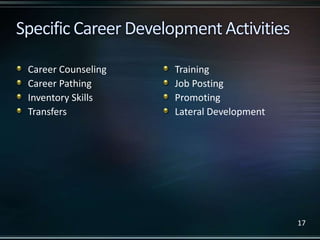
Career Counseling
Career Pathing
Inventory Skills
Transfers
Training
Job Posting
Promoting
Lateral Development
17
Process
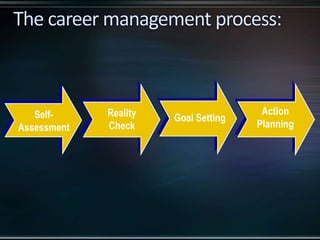
Self-
Assessment
Reality
Check
Goal Setting
Action
Planning
Roles
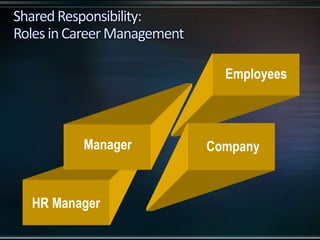
Manager
Employees
Company
HR Manager
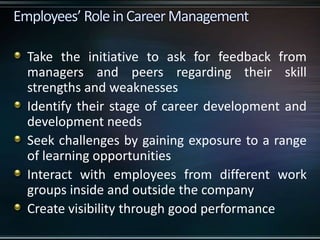
Take the initiative to ask for feedback from
managers and peers regarding their skill
strengths and weaknesses
Identify their stage of career development and
development needs
Seek challenges by gaining exposure to a range
of learning opportunities
Interact with employees from different work
groups inside and outside the company
Create visibility through good performance
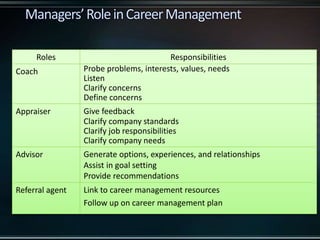
Roles Responsibilities
Coach Probe problems, interests, values, needs
Listen
Clarify concerns
Define concerns
Appraiser Give feedback
Clarify company standards
Clarify job responsibilities
Clarify company needs
Advisor Generate options, experiences, and relationships
Assist in goal setting
Provide recommendations
Referral agent Link to career management resources
Follow up on career management plan
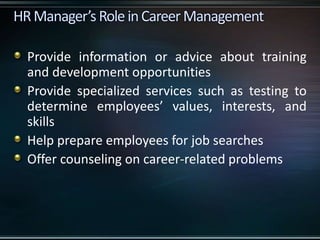
Provide information or advice about training
and development opportunities
Provide specialized services such as testing to
determine employees’ values, interests, and
skills
Help prepare employees for job searches
Offer counseling on career-related problems
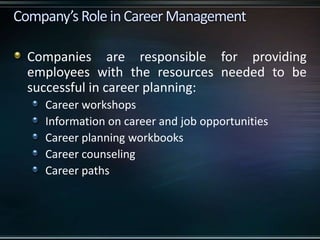
Companies are responsible for providing
employees with the resources needed to be
successful in career planning:
Career workshops
Information on career and job opportunities
Career planning workbooks
Career counseling
Career paths
1. Job change
2. Work overload
3. Pay cut post appraisal
4. Pushy peers
5. Suffering in a mis-sold job
Thank
You

Career management & Development

  • 1.
    Career Management And Development Guided By:Prepared By: Ami Ma’am Jay Raval Submitted TO: Department of Business Administration
  • 2.
  • 3.
  • 4.
    Traditional Career Sequence ofpositions held within an occupation Context of mobility is within an organization Characteristic of the employee Protean Career Frequently changing based on changes in the person and changes in the work environment Employees take major responsibility for managing their careers Based on self-direction with the goal of psychological success in one’s work
  • 5.
    Career management isthe process through which employees: Become aware of their own interests, values, strengths, and weaknesses Obtain information about job opportunities within the company Identify career goals Establish action plans to achieve career goals
  • 6.
    From the company’sperspective, the failure to motivate employees to plan their careers can result in: a shortage of employees to fill open positions lower employee commitment inappropriate use of monies allocated for training and development programs
  • 7.
    From the employees’perspective, lack of career management can result in: frustration feelings of not being valued by the company being unable to find suitable employment should a job change be necessary due to mergers, acquisitions, restructuring, or downsizing
  • 8.
    A formal approachused by the firms to ensure that people with proper qualifications and experience are available when needed. Career development benefits both employees as well as organizations. Organization needs to have career development programme and integrate the function with HR activities. 8
  • 9.
    Career development isimportant for companies to create and sustain a continuous learning environment The biggest challenge companies face is how to balance advancing current employees’ careers with simultaneously attracting and acquiring employees with new skills
  • 10.
    Changes in theconcept of career affect: Employees’ motivation to attend training programs The outcomes they expect to gain from attendance Their choice of programs
  • 11.
  • 12.
    STAGE 1: Preparationfor Work Typical Age Range: 0-25 Major Tasks: Develop occupational self-image, assess alternative occupations, develop initial occupational choice, pursue necessary education. STAGE 2: Organizational Entry Typical Age Range: 18-25 Major Tasks: Obtain job offer(s) from desired organization(s), select appropriate job based on accurate info. STAGE 3: Early Career Typical Age Range: 25-40 Major Tasks: Learn job, learn organizational rules and norms, fit into chosen occupation and organization, increase competence, pursue goals.
  • 13.
    STAGE 4: Mid-career TypicalAge Range: 40-55 Major Tasks: Reappraise early career and early adulthood, repeat or modify goals, make choices appropriate to middle adult years, remain productive in work. STAGE 5: Late Career Typical Age Range: 55-retirement Major Tasks: Remain productive in work, maintain self-esteem, prepare for effective retirement.
  • 14.
  • 15.
    Career development isthe process by which employees progress through a series of stages Each stage is characterized by a different set of developmental tasks, activities, and relationships There are four career stages: Exploration Establishment Maintenance Disengagement
  • 16.
    Exploration Establishment MaintenanceDisengagement Developmental tasks Identify interests, skills, fit between self and work Advancement, growth, security, develop life style Hold on to accomplishments, update skills Retirement planning, change balance between work and non-work Activities Helping Learning Following directions Making independent contributions Training Sponsoring Policy making Phasing out of work Relationships to other employees Apprentice Colleague Mentor Sponsor Typical age Less than 30 30 – 45 45 – 60 61+ Years on job Less than 2 years 2 – 10 years More than 10 years More than 10 years
  • 17.
    Career Counseling Career Pathing InventorySkills Transfers Training Job Posting Promoting Lateral Development 17
  • 18.
  • 19.
  • 20.
  • 21.
  • 22.
    Take the initiativeto ask for feedback from managers and peers regarding their skill strengths and weaknesses Identify their stage of career development and development needs Seek challenges by gaining exposure to a range of learning opportunities Interact with employees from different work groups inside and outside the company Create visibility through good performance
  • 23.
    Roles Responsibilities Coach Probeproblems, interests, values, needs Listen Clarify concerns Define concerns Appraiser Give feedback Clarify company standards Clarify job responsibilities Clarify company needs Advisor Generate options, experiences, and relationships Assist in goal setting Provide recommendations Referral agent Link to career management resources Follow up on career management plan
  • 24.
    Provide information oradvice about training and development opportunities Provide specialized services such as testing to determine employees’ values, interests, and skills Help prepare employees for job searches Offer counseling on career-related problems
  • 25.
    Companies are responsiblefor providing employees with the resources needed to be successful in career planning: Career workshops Information on career and job opportunities Career planning workbooks Career counseling Career paths
  • 27.
    1. Job change 2.Work overload 3. Pay cut post appraisal 4. Pushy peers 5. Suffering in a mis-sold job
  • 28.

Editor's Notes

  • #5 Career describes an individuals' journey through learning, work and other aspects of life.  Career paths have historically focused on upward mobility within a particular occupation.  For traditional career The protean career is a process which the person, not the organization, is managing. It consists of all of the person's varied experiences in education, training, work in several organizations, changes in occupational field, etc.  "Hall first noted the emergence of the protean career in 1976,
  • #9 2.as properly developed employees are better equipped to add value to themselves and to the company. 3.Integrating career development with other HR programs creates synergies in which all aspects of HR reinforce one another.
  • #18 Career counseling, career guidance and career coaching are similar in nature to other types of counseling or coaching, e.g. marriage or psychological counseling.  Career pathing involves understanding what knowledge, skills, personal characteristics, and experience are required for an employee to progress his or her career laterally, or through access to promotions and / or departmentaltransfers. Lateral growth means exposing ourselves to new ideas. Lateral growth means increasing consciousness itself.
  • #20 Self-Assessment Use of information by employees to determine their career interests, values, aptitudes, and behavioral tendencies Often involves psychological tests Reality Check Information employees receive about how the company evaluates their skills and knowledge and where they fit into company plans Goal Setting The process of employees developing short- and long-term career objectives Usually discussed with the manager and written into a development plan Action Planning Employees determining how they will achieve their short- and long-term career goals
  • #28 1. 3 It is always advisable to have a clear-cut reason for switching jobs. For example, quitting a job on the grounds of discord with colleagues or for the lack of job satisfaction are not the best of reasons. If you feel that your issues can be resolved with some counselling, then you can put your decisions to quit on hold.  2. It is important for a professional, particularly in a leadership role, to suitably delegate work. Overload can be avoided to a great extent with effective time management. The ability to decide which task is important immediately and what can be done later is crucial in managing work overload.  3. If it's a role mismatch you may like to sit with the manager and HR to rectify and realign the job responsibilities and work out a future course 4. If your over-ambitious colleague is constantly stepping on your toes and getting away with it, try and have a one-on-one conversation stating your discomfort. If they continue, discuss the issue with your boss or the HR department. 5. However, if you were deliberately misled, you should explore your legal options. It is best to always discuss job responsibility, job title, salary and growth path with the reporting manager and the HR and when you get the offer, check that they match the job description.