THE EFQM EXCELLENCE MODEL
Ahmed Al Dahab
https://www.youtube.com/watch?v=KCprz8NAZ9MIntroducing EFQM
THE EFQM EXCELLENCE MODEL
 Whilst there are numerous management tools and techniques
commonly used, The EFQM Model provides an holistic view of
the organization and it can be used to determine how these
different methods fit together and complement each other.
 The EFQM can therefore be used in conjunction with any
number of these tools, based on the needs and function of the
organization, as an overarching framework for developing
sustainable excellence.
 Excellent organizations achieve and sustain outstanding levels
of performance that meet or exceed the expectations of all
their stakeholders.
THE EFQM EXCELLENCE MODEL
There is a set of three integrated components
which comprise the EFQM Excellence Model:
 The Fundamental Concepts of Excellence
 The Model Criteria
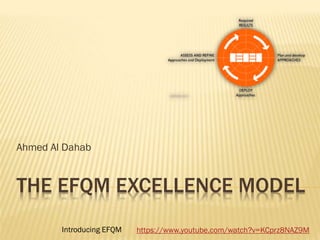
 The RADAR Logic
WHAT IS EXCELLENCE
 We often talk about it, and in general we feel
we're doing an excellent job, but what
is Excellence? Excellence is more than just
doing well, or being good.
 Excellence is when people strive to be the best
they can be and this applies to organisations as
well.
THE NEED FOR MODEL
 Who does the organisation work for? The traditional
view is the shareholders. But from an internal
perspective, this means optimizing profitability and
balancing the short-term demands for dividends against
the long-term sustainability of the business model.
 To ensure sustainable financial growth, we need to keep
our customers satisfied. To do this, we need to develop
and deliver products & services that add value to them.
We also need to deliver excellent service to maximize
retention, loyalty and our reputation.
FUNDAMENTAL CONCEPTS
 HOW DO YOU DEFINE EXCELLENCE? Excellent Organisations
achieve and sustain outstanding levels of performance that meet or exceed the expectations of all their
stakeholders.
 Fundamentals Concepts:
MODEL CRITERIA
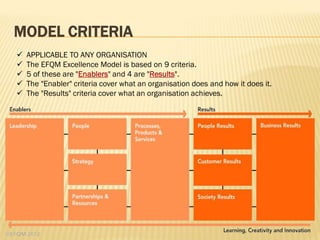
 APPLICABLE TO ANY ORGANISATION
 The EFQM Excellence Model is based on 9 criteria.
 5 of these are "Enablers" and 4 are "Results".
 The "Enabler" criteria cover what an organisation does and how it does it.
 The "Results" criteria cover what an organisation achieves.
ENABLERS
 WHAT AN ORGANISATION DOES AND HOW IT DOES IT
 LEADERSHIP
Excellent organisations have leaders who shape the future and make it happen, acting as role models for
its values and ethics and inspiring trust at all times. They are flexible, enabling the organisation to
anticipate and reach in a timely manner to ensure the on-going success of the organisation.
 STRATEGY
Excellent organisations implement their Mission and Vision by developing a stakeholder focused
strategy. Policies, plans, objectives and processes are developed and deployed to deliver the strategy.
 PEOPLE
Excellent organisations value their people and create a culture that allows the mutually beneficial
achievement of organisational and personal goals. They develop the capabilities of their people and
promote fairness and equality. They care for, communicate, reward and recognise, in a way that motivates
people, builds commitment and enables them to use their skills and knowledge for the benefit of the
organisation.
 PARTNERSHIPS & RESOURCES
Excellent organisations plan and manage external partnerships, suppliers and internal resources in order
to support their strategy, policies and the effective operation of processes. They ensure that they
effectively manage their environmental and societal impact.
 PROCESSES, PRODUCTS & SERVICES
Excellent organisations design, manage and improve processes, products and services to generate
increasing value for customers and other stakeholders.
RESULTS
 WHAT AN ORGANISATION ACHIEVES
There are 4 Results areas, shown on the right-hand side of the Model. These are the results an
organisation achieves, in line with their strategic goals.
In all 4 results areas, we find that excellent organisations:
 Develop a set of key performance indicators and related outcomes to determine the successful
deployment of their strategy, based on the needs and expectations of the relevant stakeholder
groups
 Set clear targets for key results, based on the needs and expectations of their business
stakeholders, in line with their chosen strategy
 Segment results to understand the performance of specific areas of the organisation and the
experience, needs and expectations of their stakeholders
 Demonstrate positive or sustained good business results over at least 3 years
 Clearly understand the underlying reasons and drivers of observed trends and the impact these
results will have on other performance indicators and related outcomes
 Have confidence in their future performance and results based on their understanding of the
cause and effect relationships established
 Understand how their key results compare to similar organisations and use this data, where
relevant, for target setting
RESULTS
 CUSTOMER RESULTS
Excellent organisations achieve and sustain outstanding results that
meet or exceed the need and expectations of their customers.
 PEOPLE RESULTS
Excellent organisations achieve and sustain outstanding results that
meet or exceed the need and expectations of their people.
 SOCIETY RESULTS
Excellent organisations achieve and sustain outstanding results that
meet or exceed the need and expectations of relevant stakeholders
within society.
 BUSINESS RESULTS
Excellent organisations achieve and sustain outstanding results that
meet or exceed the need and expectations of their business
stakeholders.
STRUCTURED APPROACH TO QUESTIONING THE
PERFORMANCE OF AN ORGANISATION
RADAR is a simple but powerful management tool that can be applied in different ways to help drive continuous
improvement:
Assessing the maturity of the approaches you have implemented
Assessing the excellence of the results achieved
Helping to structure improvement projects
ASSESSING ENABLERS
 When assessing Enablers, we look at the
approaches adopted, how they have been
deployed and how the organisation assesses
and refines their efficiency & effectiveness
over time.
ASSESSING RESULTS
 When assessing Results, we first
look at their Relevance to the
organisation's strategy and how
useful they are in reviewing
progress against these key
objectives.
 When then look at
the performance of the results
themselves.

The efqm excellence model

  • 1.
    THE EFQM EXCELLENCEMODEL Ahmed Al Dahab https://www.youtube.com/watch?v=KCprz8NAZ9MIntroducing EFQM
  • 2.
    THE EFQM EXCELLENCEMODEL  Whilst there are numerous management tools and techniques commonly used, The EFQM Model provides an holistic view of the organization and it can be used to determine how these different methods fit together and complement each other.  The EFQM can therefore be used in conjunction with any number of these tools, based on the needs and function of the organization, as an overarching framework for developing sustainable excellence.  Excellent organizations achieve and sustain outstanding levels of performance that meet or exceed the expectations of all their stakeholders.
  • 3.
    THE EFQM EXCELLENCEMODEL There is a set of three integrated components which comprise the EFQM Excellence Model:  The Fundamental Concepts of Excellence  The Model Criteria  The RADAR Logic
  • 4.
    WHAT IS EXCELLENCE We often talk about it, and in general we feel we're doing an excellent job, but what is Excellence? Excellence is more than just doing well, or being good.  Excellence is when people strive to be the best they can be and this applies to organisations as well.
  • 5.
    THE NEED FORMODEL  Who does the organisation work for? The traditional view is the shareholders. But from an internal perspective, this means optimizing profitability and balancing the short-term demands for dividends against the long-term sustainability of the business model.  To ensure sustainable financial growth, we need to keep our customers satisfied. To do this, we need to develop and deliver products & services that add value to them. We also need to deliver excellent service to maximize retention, loyalty and our reputation.
  • 6.
    FUNDAMENTAL CONCEPTS  HOWDO YOU DEFINE EXCELLENCE? Excellent Organisations achieve and sustain outstanding levels of performance that meet or exceed the expectations of all their stakeholders.  Fundamentals Concepts:
  • 7.
    MODEL CRITERIA  APPLICABLETO ANY ORGANISATION  The EFQM Excellence Model is based on 9 criteria.  5 of these are "Enablers" and 4 are "Results".  The "Enabler" criteria cover what an organisation does and how it does it.  The "Results" criteria cover what an organisation achieves.
  • 8.
    ENABLERS  WHAT ANORGANISATION DOES AND HOW IT DOES IT  LEADERSHIP Excellent organisations have leaders who shape the future and make it happen, acting as role models for its values and ethics and inspiring trust at all times. They are flexible, enabling the organisation to anticipate and reach in a timely manner to ensure the on-going success of the organisation.  STRATEGY Excellent organisations implement their Mission and Vision by developing a stakeholder focused strategy. Policies, plans, objectives and processes are developed and deployed to deliver the strategy.  PEOPLE Excellent organisations value their people and create a culture that allows the mutually beneficial achievement of organisational and personal goals. They develop the capabilities of their people and promote fairness and equality. They care for, communicate, reward and recognise, in a way that motivates people, builds commitment and enables them to use their skills and knowledge for the benefit of the organisation.  PARTNERSHIPS & RESOURCES Excellent organisations plan and manage external partnerships, suppliers and internal resources in order to support their strategy, policies and the effective operation of processes. They ensure that they effectively manage their environmental and societal impact.  PROCESSES, PRODUCTS & SERVICES Excellent organisations design, manage and improve processes, products and services to generate increasing value for customers and other stakeholders.
  • 9.
    RESULTS  WHAT ANORGANISATION ACHIEVES There are 4 Results areas, shown on the right-hand side of the Model. These are the results an organisation achieves, in line with their strategic goals. In all 4 results areas, we find that excellent organisations:  Develop a set of key performance indicators and related outcomes to determine the successful deployment of their strategy, based on the needs and expectations of the relevant stakeholder groups  Set clear targets for key results, based on the needs and expectations of their business stakeholders, in line with their chosen strategy  Segment results to understand the performance of specific areas of the organisation and the experience, needs and expectations of their stakeholders  Demonstrate positive or sustained good business results over at least 3 years  Clearly understand the underlying reasons and drivers of observed trends and the impact these results will have on other performance indicators and related outcomes  Have confidence in their future performance and results based on their understanding of the cause and effect relationships established  Understand how their key results compare to similar organisations and use this data, where relevant, for target setting
  • 10.
    RESULTS  CUSTOMER RESULTS Excellentorganisations achieve and sustain outstanding results that meet or exceed the need and expectations of their customers.  PEOPLE RESULTS Excellent organisations achieve and sustain outstanding results that meet or exceed the need and expectations of their people.  SOCIETY RESULTS Excellent organisations achieve and sustain outstanding results that meet or exceed the need and expectations of relevant stakeholders within society.  BUSINESS RESULTS Excellent organisations achieve and sustain outstanding results that meet or exceed the need and expectations of their business stakeholders.
  • 11.
    STRUCTURED APPROACH TOQUESTIONING THE PERFORMANCE OF AN ORGANISATION RADAR is a simple but powerful management tool that can be applied in different ways to help drive continuous improvement: Assessing the maturity of the approaches you have implemented Assessing the excellence of the results achieved Helping to structure improvement projects
  • 12.
    ASSESSING ENABLERS  Whenassessing Enablers, we look at the approaches adopted, how they have been deployed and how the organisation assesses and refines their efficiency & effectiveness over time.
  • 13.
    ASSESSING RESULTS  Whenassessing Results, we first look at their Relevance to the organisation's strategy and how useful they are in reviewing progress against these key objectives.  When then look at the performance of the results themselves.