DEGENERATIVE
DISC
DISEASES
D R . Q U R AT U L A I N M U G H A L
B ATC H I V
I I R S
1
CONTENTS
• ANATOMY
• DEGENERATIVE DISC DISEASES
• DIAGNOSIS
• MANAGEMENT
• REFERENCE
2
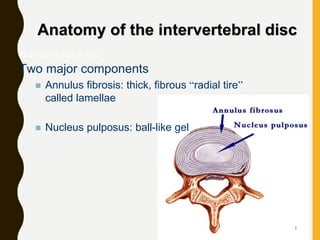
Anatomy of the intervertebral disc
The Intervertebral Disc
Two major components
 Annulus fibrosis: thick, fibrous “radial tire”
called lamellae
 Nucleus pulposus: ball-like gel
3
DEGENERATIVE DISC
DISEASE (DDD)
DEFINITION
“Describes the natural breakdown of an intervertebral disc of
the spine.”
4
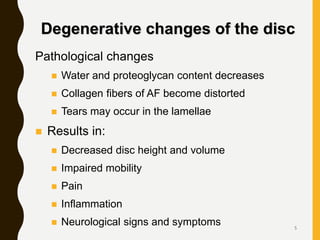
Degenerative changes of the disc
Pathological changes
 Water and proteoglycan content decreases
 Collagen fibers of AF become distorted
 Tears may occur in the lamellae
 Results in:
 Decreased disc height and volume
 Impaired mobility
 Pain
 Inflammation
 Neurological signs and symptoms 5
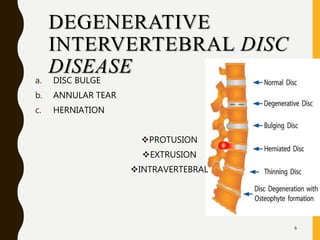
DEGENERATIVE
INTERVERTEBRAL DISC
DISEASE
a. DISC BULGE
b. ANNULAR TEAR
c. HERNIATION
PROTUSION
EXTRUSION
INTRAVERTEBRAL
6
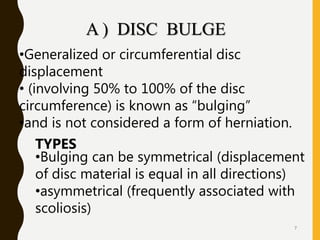
A ) DISC BULGE
•Generalized or circumferential disc
displacement
• (involving 50% to 100% of the disc
circumference) is known as “bulging”
•and is not considered a form of herniation.
TYPES
•Bulging can be symmetrical (displacement
of disc material is equal in all directions)
•asymmetrical (frequently associated with
scoliosis)
7
8
9
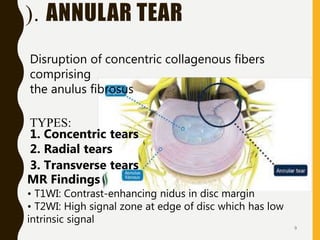
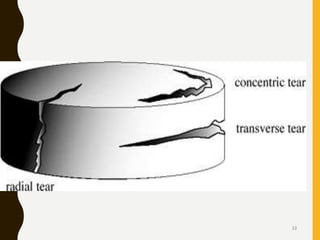
B ). ANNULAR TEAR
Disruption of concentric collagenous fibers
comprising
the anulus fibrosus
TYPES:
1. Concentric tears
2. Radial tears
3. Transverse tears
MR Findings
• T1WI: Contrast-enhancing nidus in disc margin
• T2WI: High signal zone at edge of disc which has low
intrinsic signal
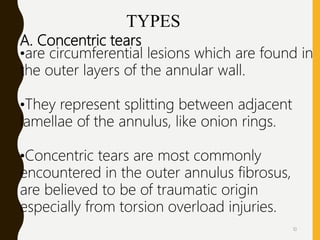
A. Concentric tears
•are circumferential lesions which are found in
the outer layers of the annular wall.
•They represent splitting between adjacent
lamellae of the annulus, like onion rings.
•Concentric tears are most commonly
encountered in the outer annulus fibrosus,
are believed to be of traumatic origin
especially from torsion overload injuries.
TYPES
10
B. RADIAL TEARS
• are characterized by an annular tear
• permeates from the deep central part of the disc (nucleus
pulposus)
• extends outward toward the annulus
• either a transverse or cranial-caudal plane.
11
C. TRANSVERSE TEARS
• also known as “peripheral tears” or “rim lesions”
• are horizontal ruptures of fibers, near the insertion in the bony
ring apophyses.
• Their clinical significance remains unclear.
• Transverse tears are believed to be traumatically induced and
are often associated with small osteophytes
12
13
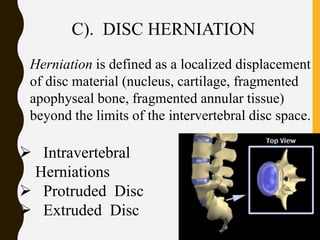
C). DISC HERNIATION
Herniation is defined as a localized displacement
of disc material (nucleus, cartilage, fragmented
apophyseal bone, fragmented annular tissue)
beyond the limits of the intervertebral disc space.
 Intravertebral
Herniations
 Protruded Disc
 Extruded Disc
14
•Are protrusions of
the nucleus pulposus of
the intervertebral
disc through
the vertebral
body endplate and into
the adjacent vertebra.
•(also known as
Schmorl’s nodes).
•They are often
surrounded by reactive
bone marrow changes.
INTRAVERTEBRAL HERNIATIONS
15
16
• The terminology “protruded disc” is used
when the base of the disc is broader than
any other diameter of the displaced
material.
•Based on a two-dimensional assessment
of the disc contour in the transverse plane,
a protruded disc can be:
•focal (involving <25% of the disc
circumference)
•broad-based (involving 25%–50% of the
“PROTRUDED DISC
17
The terminology “extruded
disc” is used for a focal disc extension
of which the base against the parent
disc is narrower than the diameter of
the extruded disc material, measured
in the same plane.
EXTRUDED DISC HERNIATIONS
Extrusion: the base of the herniation is
narrower than the apex (toothpaste
sign) 18
•Extrusion is also used when
there is no continuity between
the herniated disc material
beyond the disc space and that
within the disc space
•If the displaced disc material
has no connection with the
parent disc, it is called a
“sequestrated fragment”.
•This is synonymous with a “free
fragment”. 19
20
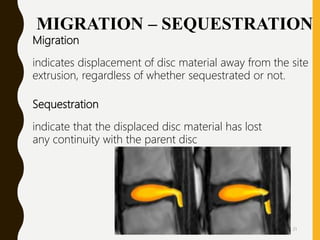
MIGRATION – SEQUESTRATION
Migration
indicates displacement of disc material away from the site
extrusion, regardless of whether sequestrated or not.
Sequestration
indicate that the displaced disc material has lost
any continuity with the parent disc
21
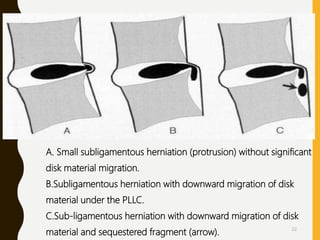
A. Small subligamentous herniation (protrusion) without significant
disk material migration.
B.Subligamentous herniation with downward migration of disk
material under the PLLC.
C.Sub-ligamentous herniation with downward migration of disk
material and sequestered fragment (arrow). 22
• X-ray: show spinal degenerative changes but
not a herniated disc; rule out obvious
underlying problems
• CT: relatively less used
• MRI: The best
DIAGNOSIS
23
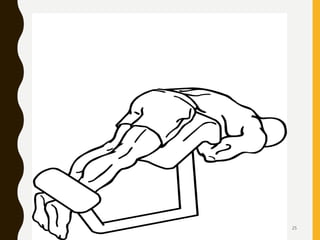
MANAGEMENT FOR DDD
24
25
REFERENCE
• THERAPEUTIC EXERCISE: KISNER & COLBY
• MEDICINE: DAVIDSONS
KUMAR AND CLARK
26
27

Degenerative disc disease (DDD)

  • 1.
    DEGENERATIVE DISC DISEASES D R .Q U R AT U L A I N M U G H A L B ATC H I V I I R S 1
  • 2.
    CONTENTS • ANATOMY • DEGENERATIVEDISC DISEASES • DIAGNOSIS • MANAGEMENT • REFERENCE 2
  • 3.
    Anatomy of theintervertebral disc The Intervertebral Disc Two major components  Annulus fibrosis: thick, fibrous “radial tire” called lamellae  Nucleus pulposus: ball-like gel 3
  • 4.
    DEGENERATIVE DISC DISEASE (DDD) DEFINITION “Describesthe natural breakdown of an intervertebral disc of the spine.” 4
  • 5.
    Degenerative changes ofthe disc Pathological changes  Water and proteoglycan content decreases  Collagen fibers of AF become distorted  Tears may occur in the lamellae  Results in:  Decreased disc height and volume  Impaired mobility  Pain  Inflammation  Neurological signs and symptoms 5
  • 6.
    DEGENERATIVE INTERVERTEBRAL DISC DISEASE a. DISCBULGE b. ANNULAR TEAR c. HERNIATION PROTUSION EXTRUSION INTRAVERTEBRAL 6
  • 7.
    A ) DISCBULGE •Generalized or circumferential disc displacement • (involving 50% to 100% of the disc circumference) is known as “bulging” •and is not considered a form of herniation. TYPES •Bulging can be symmetrical (displacement of disc material is equal in all directions) •asymmetrical (frequently associated with scoliosis) 7
  • 8.
  • 9.
    9 B ). ANNULARTEAR Disruption of concentric collagenous fibers comprising the anulus fibrosus TYPES: 1. Concentric tears 2. Radial tears 3. Transverse tears MR Findings • T1WI: Contrast-enhancing nidus in disc margin • T2WI: High signal zone at edge of disc which has low intrinsic signal
  • 10.
    A. Concentric tears •arecircumferential lesions which are found in the outer layers of the annular wall. •They represent splitting between adjacent lamellae of the annulus, like onion rings. •Concentric tears are most commonly encountered in the outer annulus fibrosus, are believed to be of traumatic origin especially from torsion overload injuries. TYPES 10
  • 11.
    B. RADIAL TEARS •are characterized by an annular tear • permeates from the deep central part of the disc (nucleus pulposus) • extends outward toward the annulus • either a transverse or cranial-caudal plane. 11
  • 12.
    C. TRANSVERSE TEARS •also known as “peripheral tears” or “rim lesions” • are horizontal ruptures of fibers, near the insertion in the bony ring apophyses. • Their clinical significance remains unclear. • Transverse tears are believed to be traumatically induced and are often associated with small osteophytes 12
  • 13.
  • 14.
    C). DISC HERNIATION Herniationis defined as a localized displacement of disc material (nucleus, cartilage, fragmented apophyseal bone, fragmented annular tissue) beyond the limits of the intervertebral disc space.  Intravertebral Herniations  Protruded Disc  Extruded Disc 14
  • 15.
    •Are protrusions of thenucleus pulposus of the intervertebral disc through the vertebral body endplate and into the adjacent vertebra. •(also known as Schmorl’s nodes). •They are often surrounded by reactive bone marrow changes. INTRAVERTEBRAL HERNIATIONS 15
  • 16.
  • 17.
    • The terminology“protruded disc” is used when the base of the disc is broader than any other diameter of the displaced material. •Based on a two-dimensional assessment of the disc contour in the transverse plane, a protruded disc can be: •focal (involving <25% of the disc circumference) •broad-based (involving 25%–50% of the “PROTRUDED DISC 17
  • 18.
    The terminology “extruded disc”is used for a focal disc extension of which the base against the parent disc is narrower than the diameter of the extruded disc material, measured in the same plane. EXTRUDED DISC HERNIATIONS Extrusion: the base of the herniation is narrower than the apex (toothpaste sign) 18
  • 19.
    •Extrusion is alsoused when there is no continuity between the herniated disc material beyond the disc space and that within the disc space •If the displaced disc material has no connection with the parent disc, it is called a “sequestrated fragment”. •This is synonymous with a “free fragment”. 19
  • 20.
  • 21.
    MIGRATION – SEQUESTRATION Migration indicatesdisplacement of disc material away from the site extrusion, regardless of whether sequestrated or not. Sequestration indicate that the displaced disc material has lost any continuity with the parent disc 21
  • 22.
    A. Small subligamentousherniation (protrusion) without significant disk material migration. B.Subligamentous herniation with downward migration of disk material under the PLLC. C.Sub-ligamentous herniation with downward migration of disk material and sequestered fragment (arrow). 22
  • 23.
    • X-ray: showspinal degenerative changes but not a herniated disc; rule out obvious underlying problems • CT: relatively less used • MRI: The best DIAGNOSIS 23
  • 24.
  • 25.
  • 26.
    REFERENCE • THERAPEUTIC EXERCISE:KISNER & COLBY • MEDICINE: DAVIDSONS KUMAR AND CLARK 26
  • 27.