RASHIDUL ISLAM
20121107007
Department of Applied Chemistry and
Chemical Engineering.
BSMRSTU
FISCHER-TROPSCH
SYNTHESIS
Production of Liquid fuels from Synthesis gas
Course Title: Fuels and Petrochemicals
Course No: ACCE 420
Fischer-Tropsch synthesis
• Fischer-Tropsch synthesis is a set of chemical reaction that can be
used to produce fuels and chemicals from synthesis gas.
• synthesis gas is a mixture of CO and H2, which can be derived
from natural gas, coal, or biomass.
• CH4 + H2O → 3H2 + CO
• C + H2O → H2 + CO
Invention
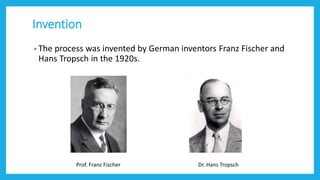
• The process was invented by German inventors Franz Fischer and
Hans Tropsch in the 1920s.
Prof. Franz Fischer Dr. Hans Tropsch
Reaction of the Process
• In the process, carbon monoxide (CO) and hydrogen (H2) in the
syngas are converted into hydrocarbons of various molecular
weights according to the following reaction.
• (2n+1) H2 + n CO → Cn H(2n+2) + n H2O
• There are other side reactions taking place in the process, among
which the water-gas-shift reaction is important.
• CO + H2O → H2 + CO2
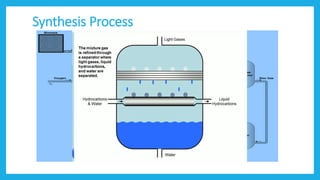
Synthesis Process
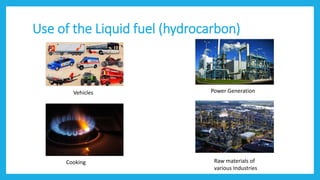
Use of the Liquid fuel (hydrocarbon)
Vehicles Power Generation
Cooking Raw materials of
various Industries
Have Any Questions……..

Fischer-Tropsch Synthesis

  • 2.
    RASHIDUL ISLAM 20121107007 Department ofApplied Chemistry and Chemical Engineering. BSMRSTU
  • 3.
    FISCHER-TROPSCH SYNTHESIS Production of Liquidfuels from Synthesis gas Course Title: Fuels and Petrochemicals Course No: ACCE 420
  • 4.
    Fischer-Tropsch synthesis • Fischer-Tropschsynthesis is a set of chemical reaction that can be used to produce fuels and chemicals from synthesis gas. • synthesis gas is a mixture of CO and H2, which can be derived from natural gas, coal, or biomass. • CH4 + H2O → 3H2 + CO • C + H2O → H2 + CO
  • 5.
    Invention • The processwas invented by German inventors Franz Fischer and Hans Tropsch in the 1920s. Prof. Franz Fischer Dr. Hans Tropsch
  • 6.
    Reaction of theProcess • In the process, carbon monoxide (CO) and hydrogen (H2) in the syngas are converted into hydrocarbons of various molecular weights according to the following reaction. • (2n+1) H2 + n CO → Cn H(2n+2) + n H2O • There are other side reactions taking place in the process, among which the water-gas-shift reaction is important. • CO + H2O → H2 + CO2
  • 7.
  • 8.
    Use of theLiquid fuel (hydrocarbon) Vehicles Power Generation Cooking Raw materials of various Industries
  • 9.