Quality Education For All
CLASS 12
CHAPTER 1-SOLID STATE
RECAP
✓ Imperfections in Solids
• Stoichiometric Defects
• Impurity Defects
• Non-Stoichiometric Defects
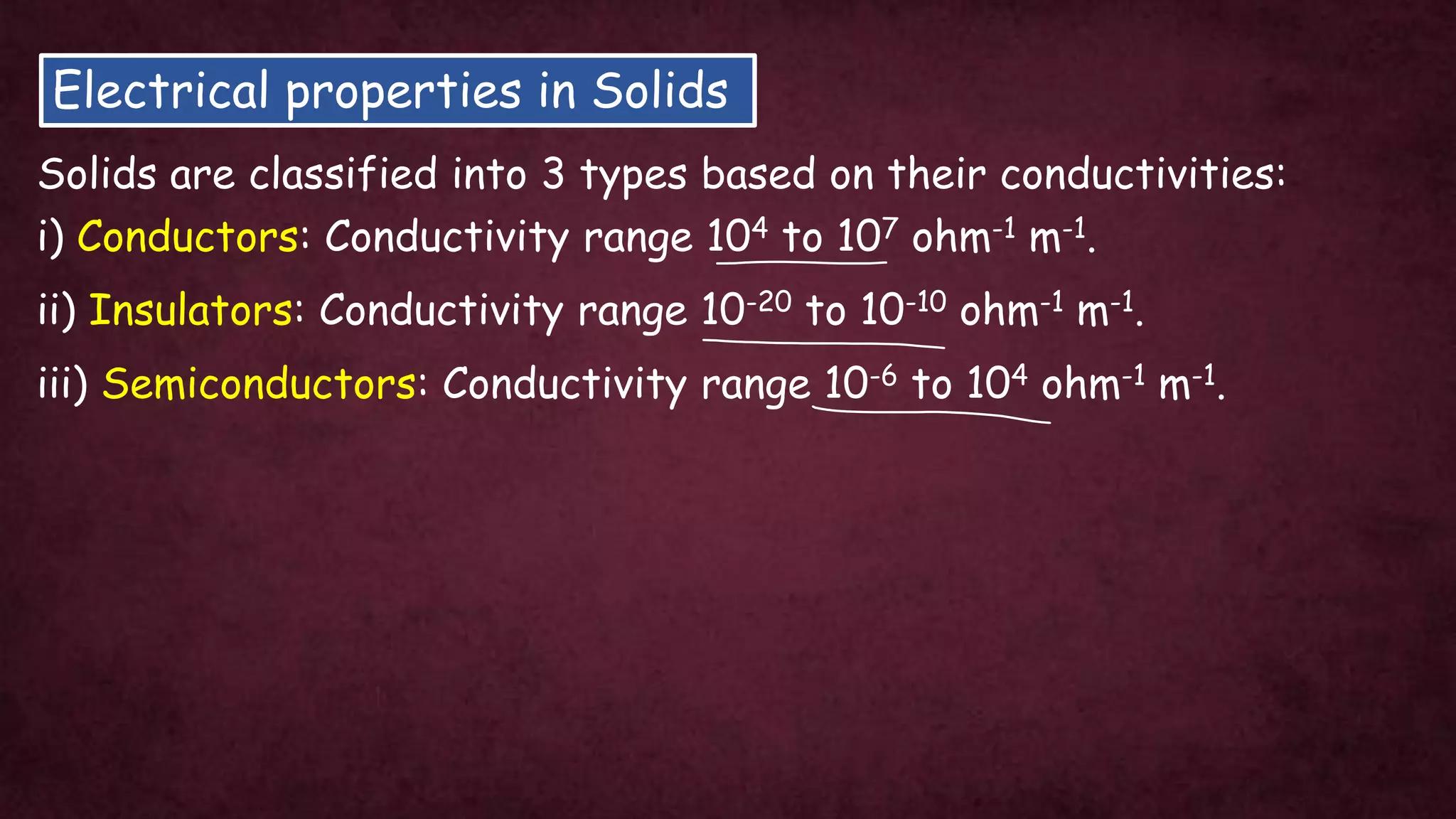
Electrical properties in Solids
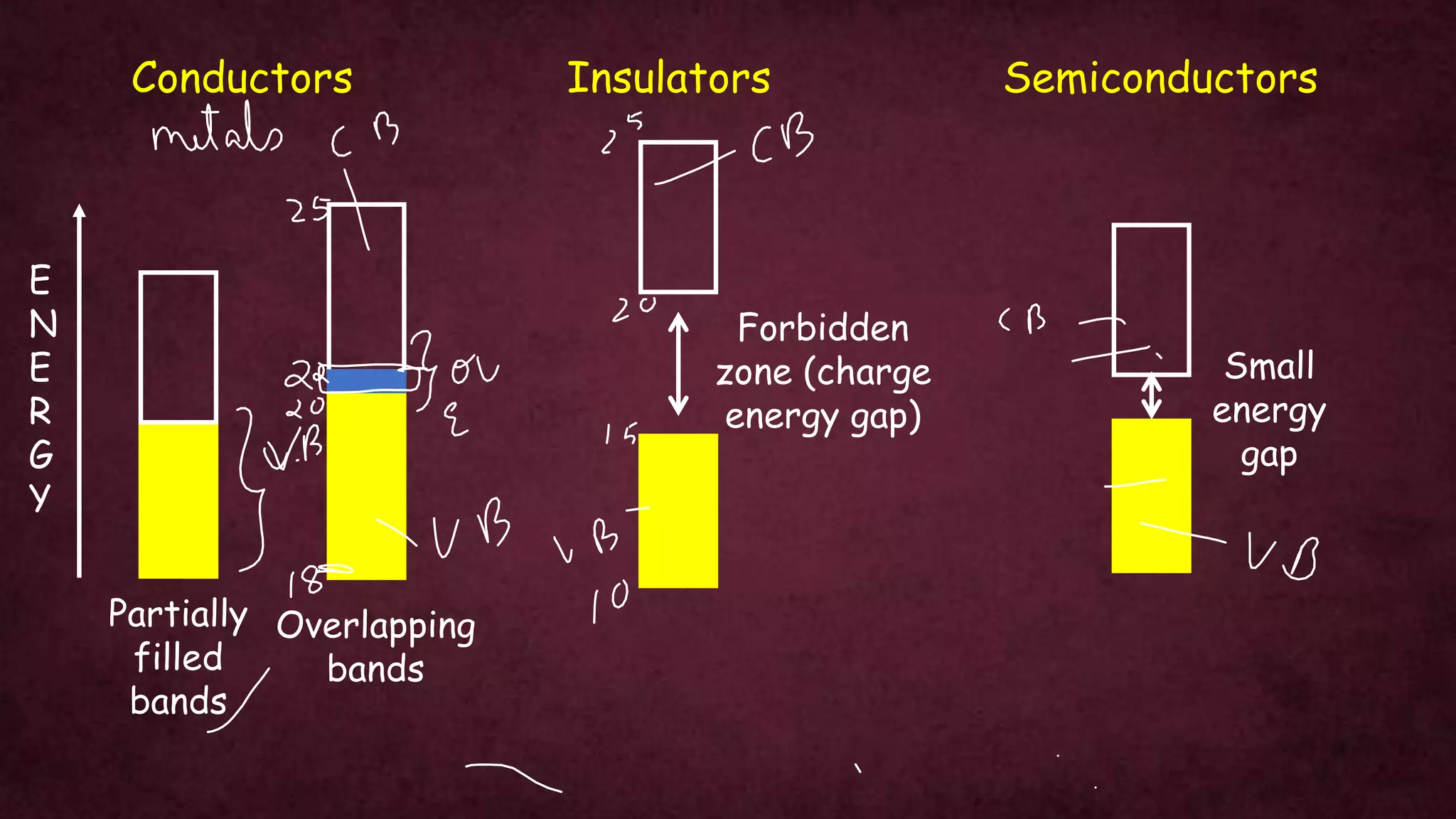
Solids are classified into 3 types based on their conductivities:
i) Conductors: Conductivity range 104 to 107 ohm-1 m-1.
ii) Insulators: Conductivity range 10-20 to 10-10 ohm-1 m-1.
iii) Semiconductors: Conductivity range 10-6 to 104 ohm-1 m-1.
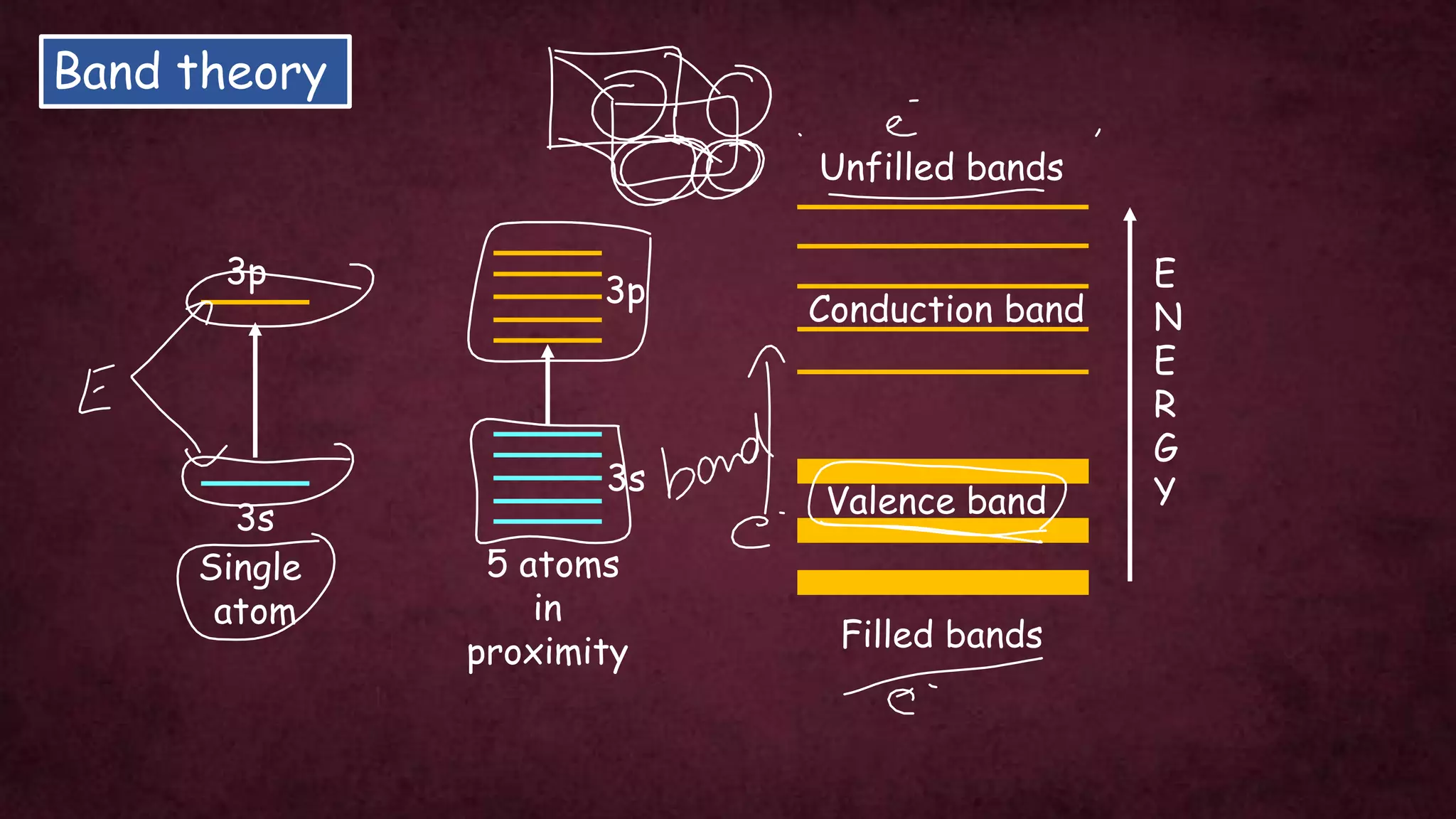
Band theory
E
N
E
R
G
Y
Unfilled bands
Filled bands
3s
3p
3s
3p
Single
atom
5 atoms
in
proximity
Conduction band
Valence band
Conductors
E
N
E
R
G
Y
Partially
filled
bands
Overlapping
bands
Insulators
Forbidden
zone (charge
energy gap)
Semiconductors
Small
energy
gap
Doping
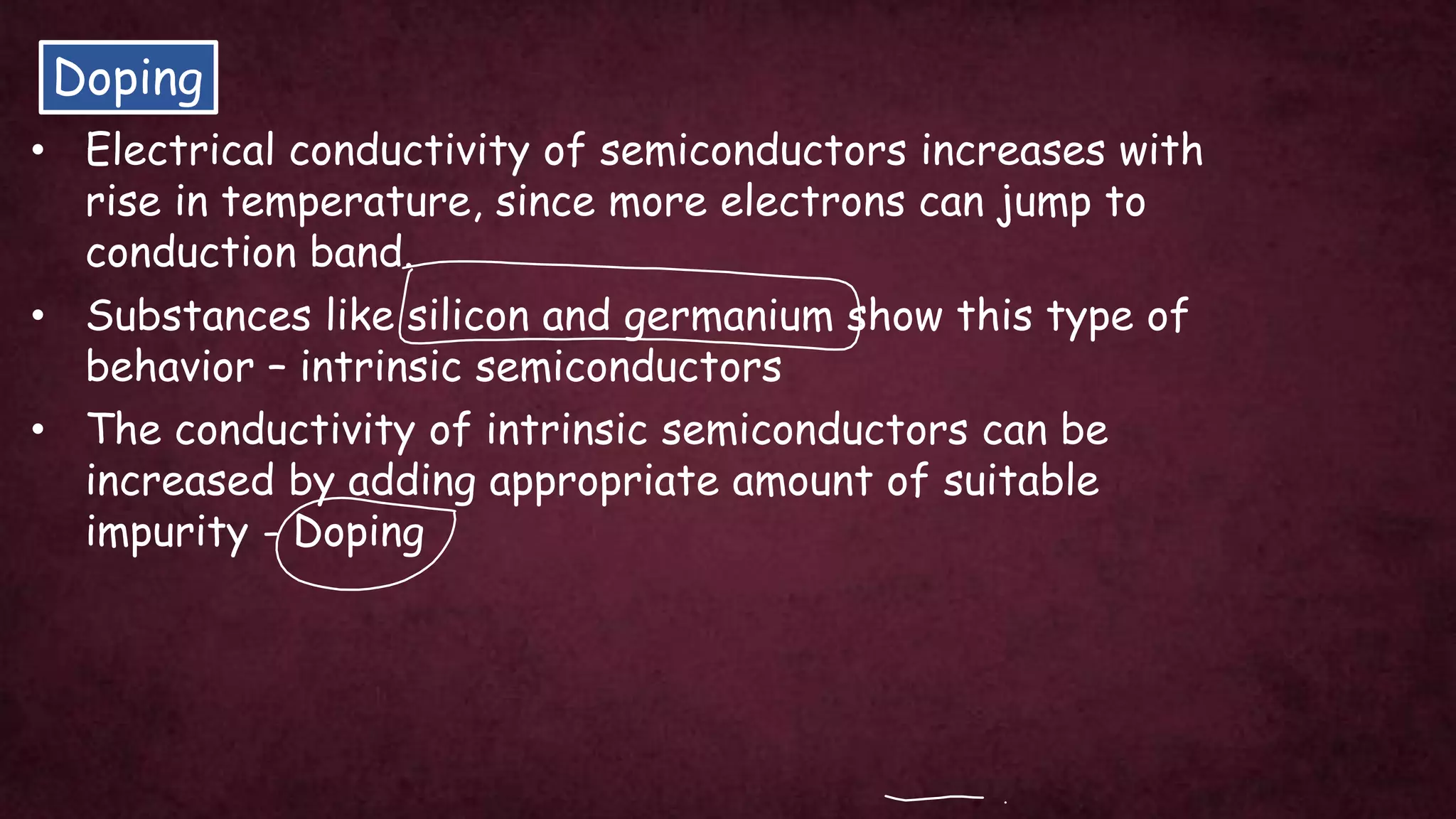
• The conductivity of intrinsic semiconductors can be
increased by adding appropriate amount of suitable
impurity - Doping
• Electrical conductivity of semiconductors increases with
rise in temperature, since more electrons can jump to
conduction band.
• Substances like silicon and germanium show this type of
behavior – intrinsic semiconductors
Doping
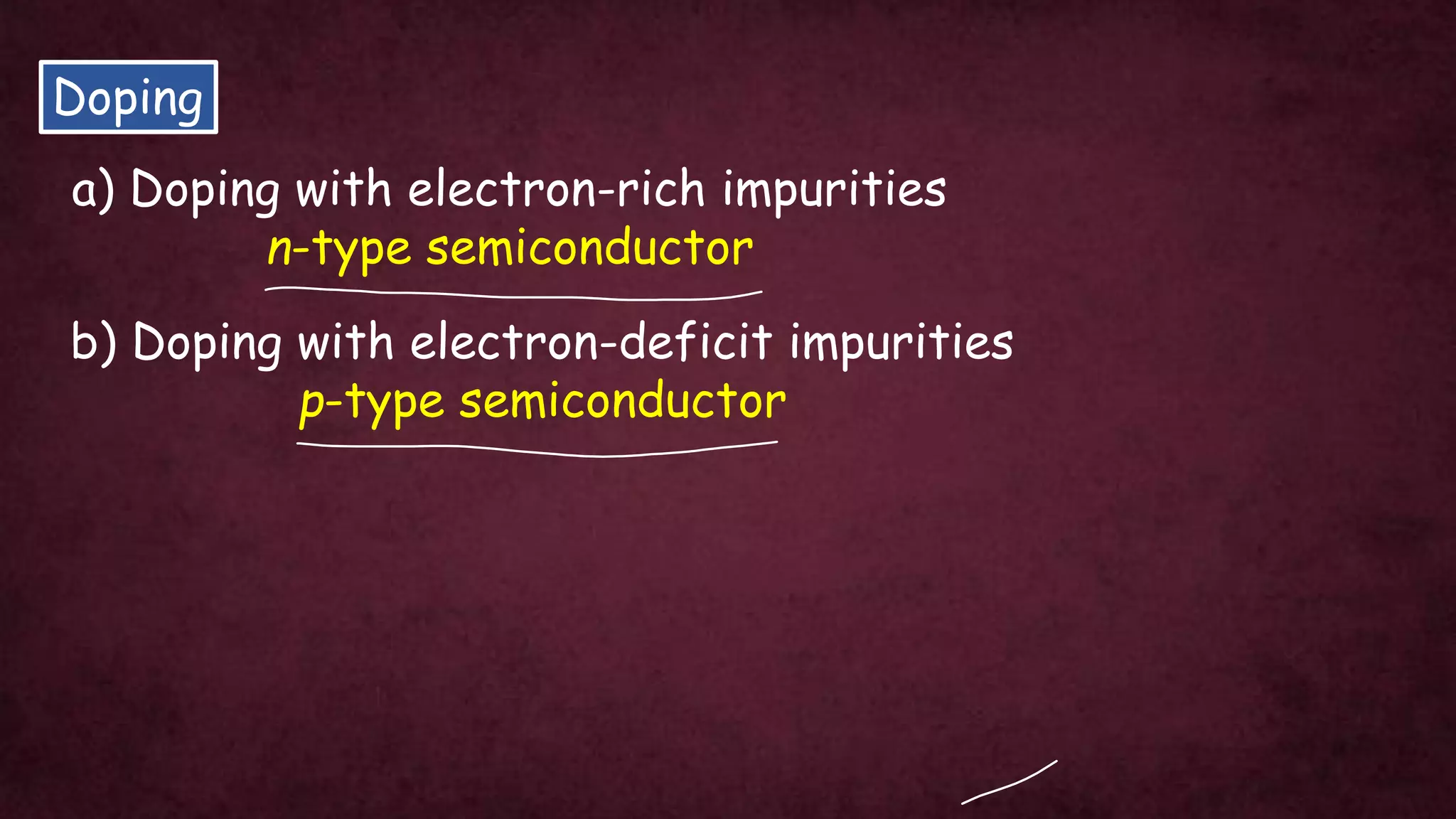
a) Doping with electron-rich impurities
n-type semiconductor
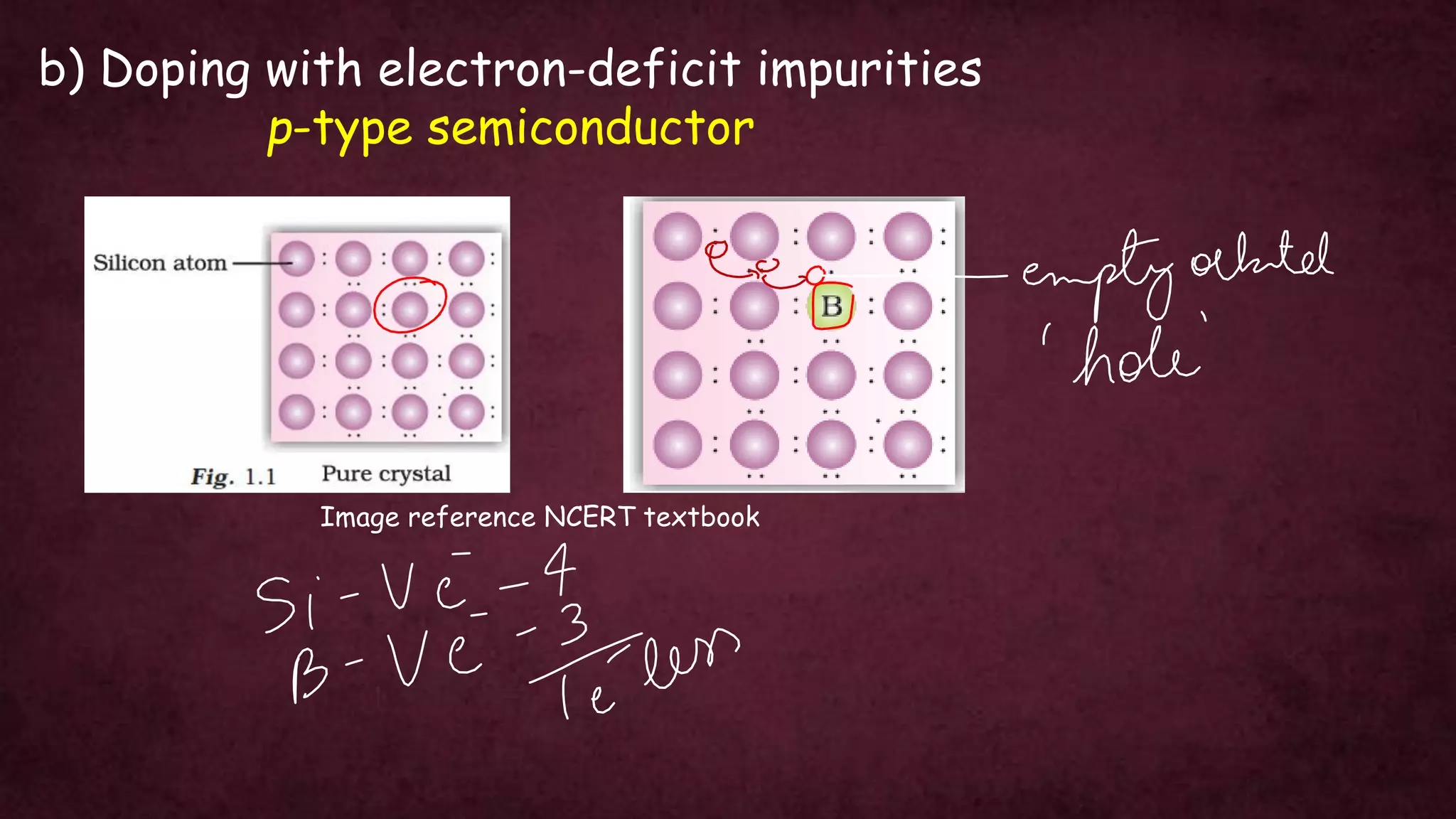
b) Doping with electron-deficit impurities
p-type semiconductor
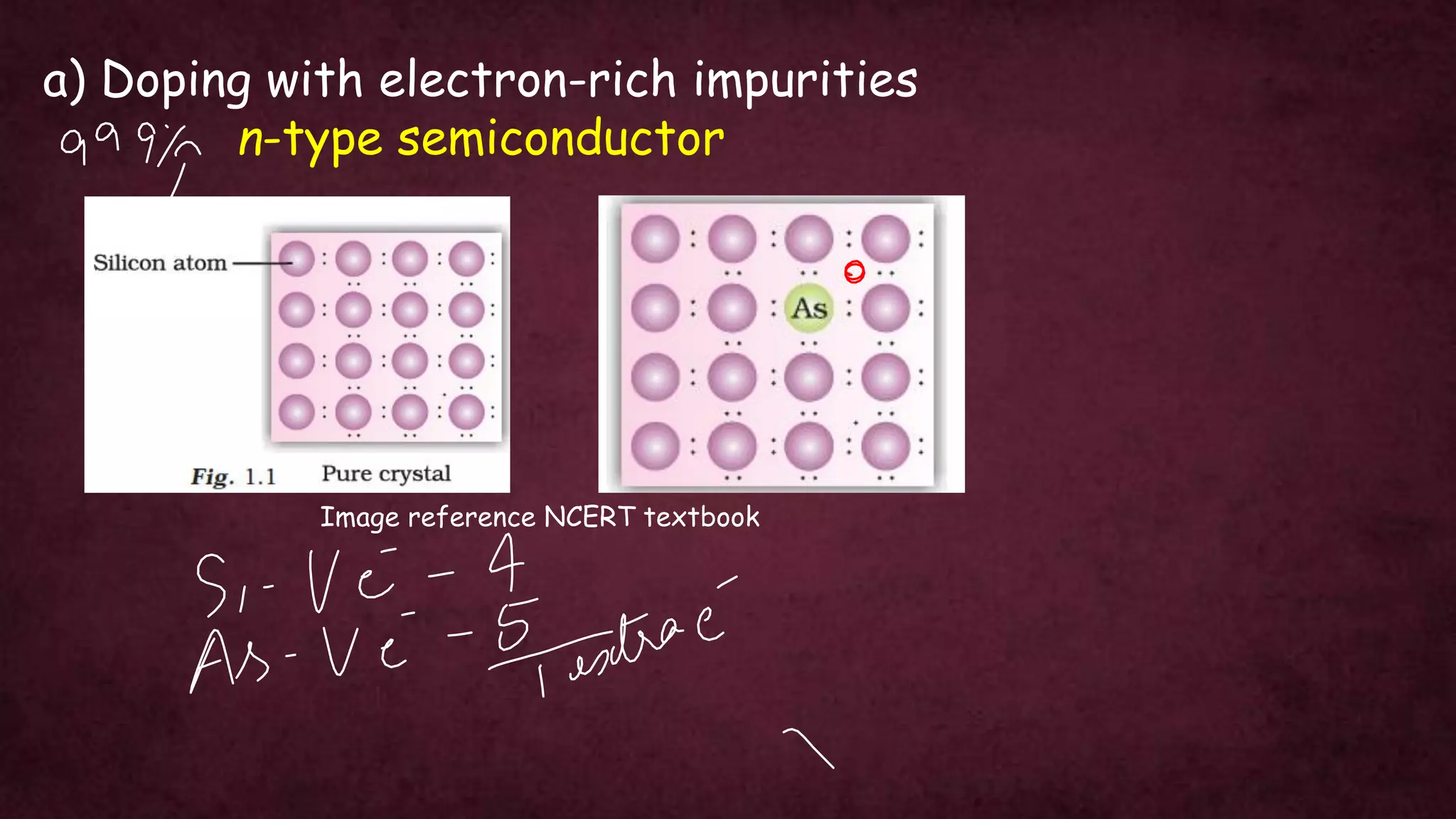
a) Doping with electron-rich impurities
n-type semiconductor
Image reference NCERT textbook
b) Doping with electron-deficit impurities
p-type semiconductor
Image reference NCERT textbook
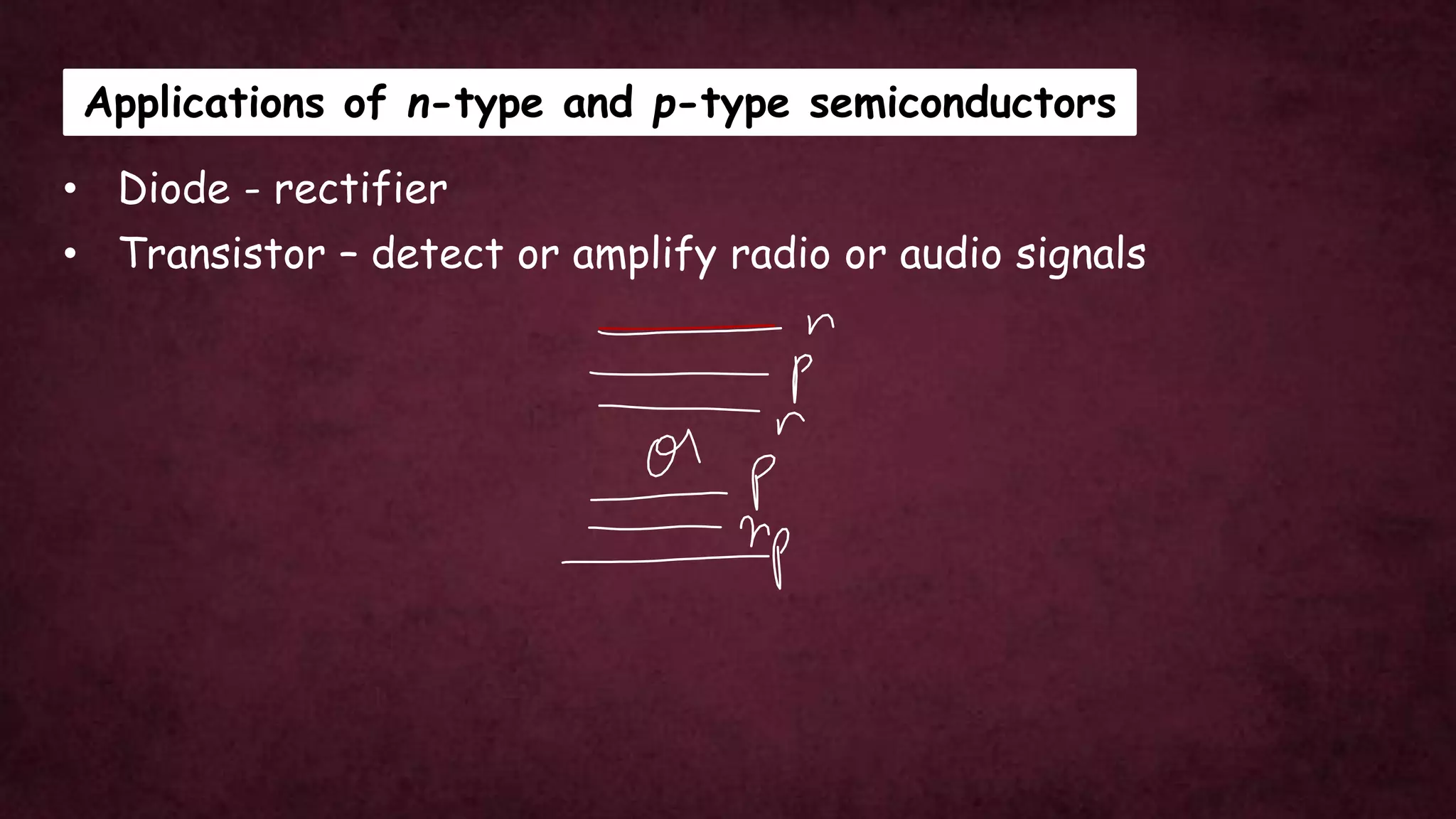
Applications of n-type and p-type semiconductors
• Diode - rectifier
• Transistor – detect or amplify radio or audio signals
Magnetic properties in Solids
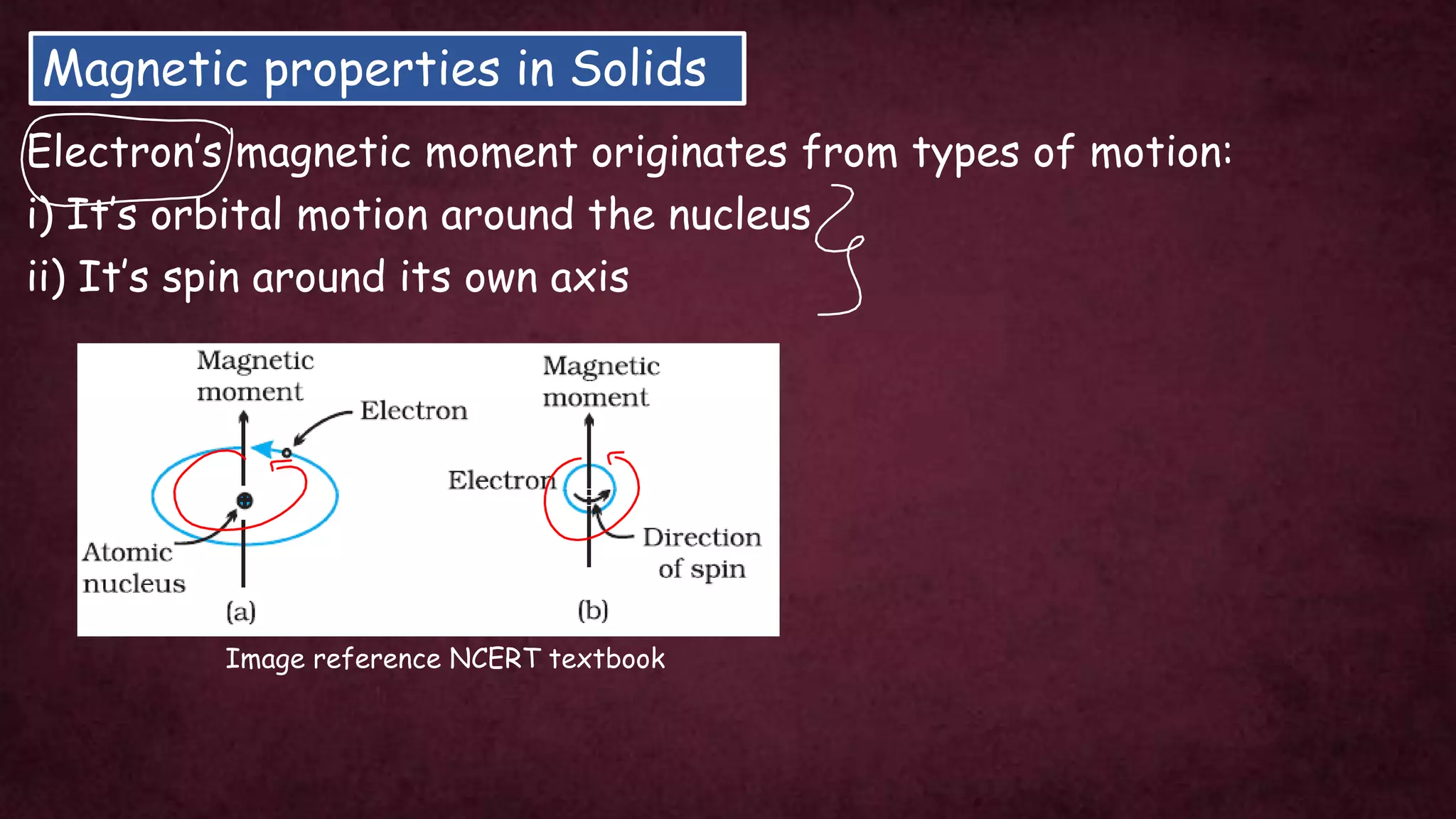
Electron’s magnetic moment originates from types of motion:
i) It’s orbital motion around the nucleus
ii) It’s spin around its own axis
Image reference NCERT textbook
Magnetic properties in Solids
• Magnitude of this magnetic moment is measured in the unit
called Bhor magneton μB. It is equal to 9.27 × 10⁻²⁴Am2.
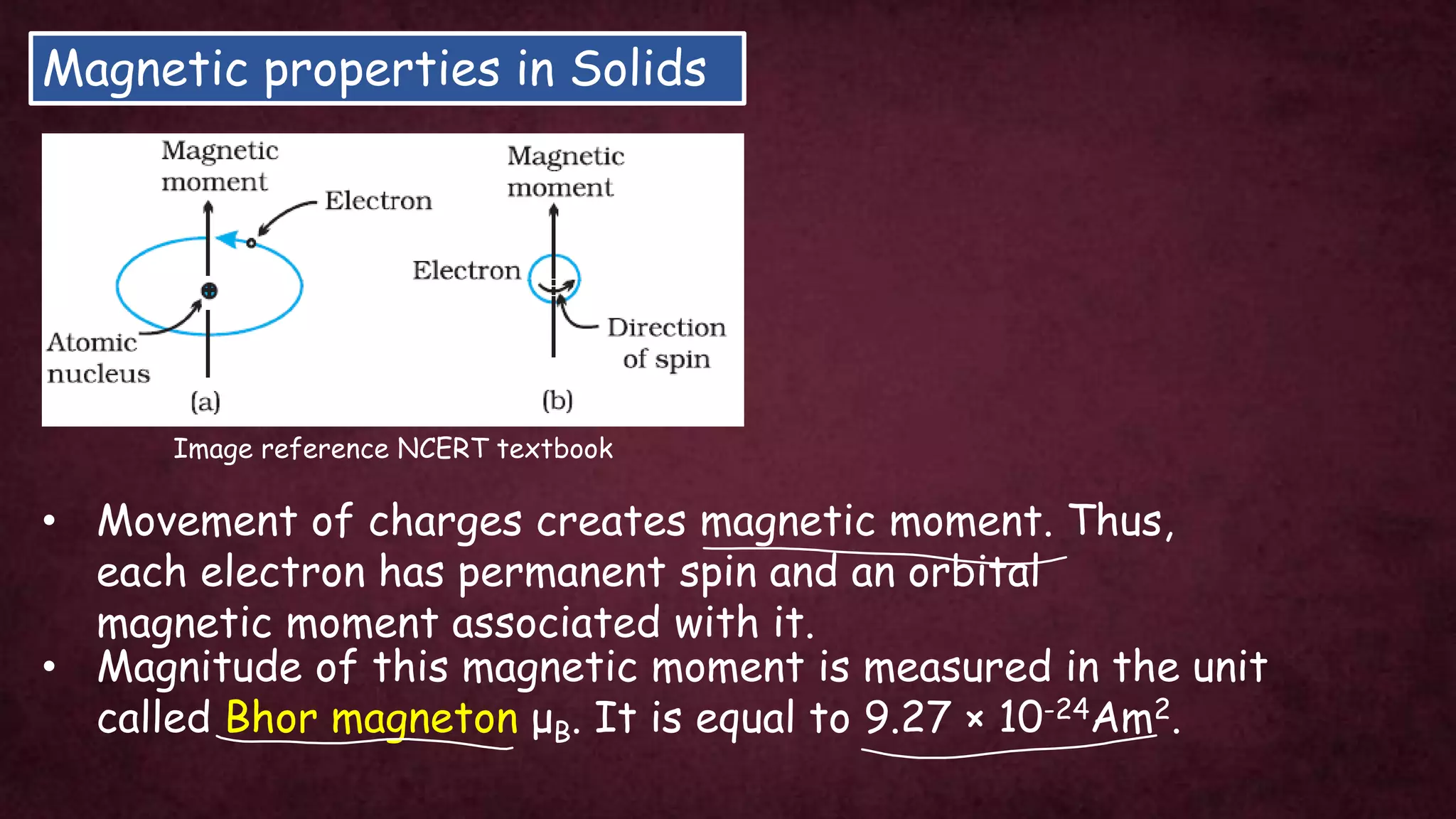
• Movement of charges creates magnetic moment. Thus,
each electron has permanent spin and an orbital
magnetic moment associated with it.
Image reference NCERT textbook
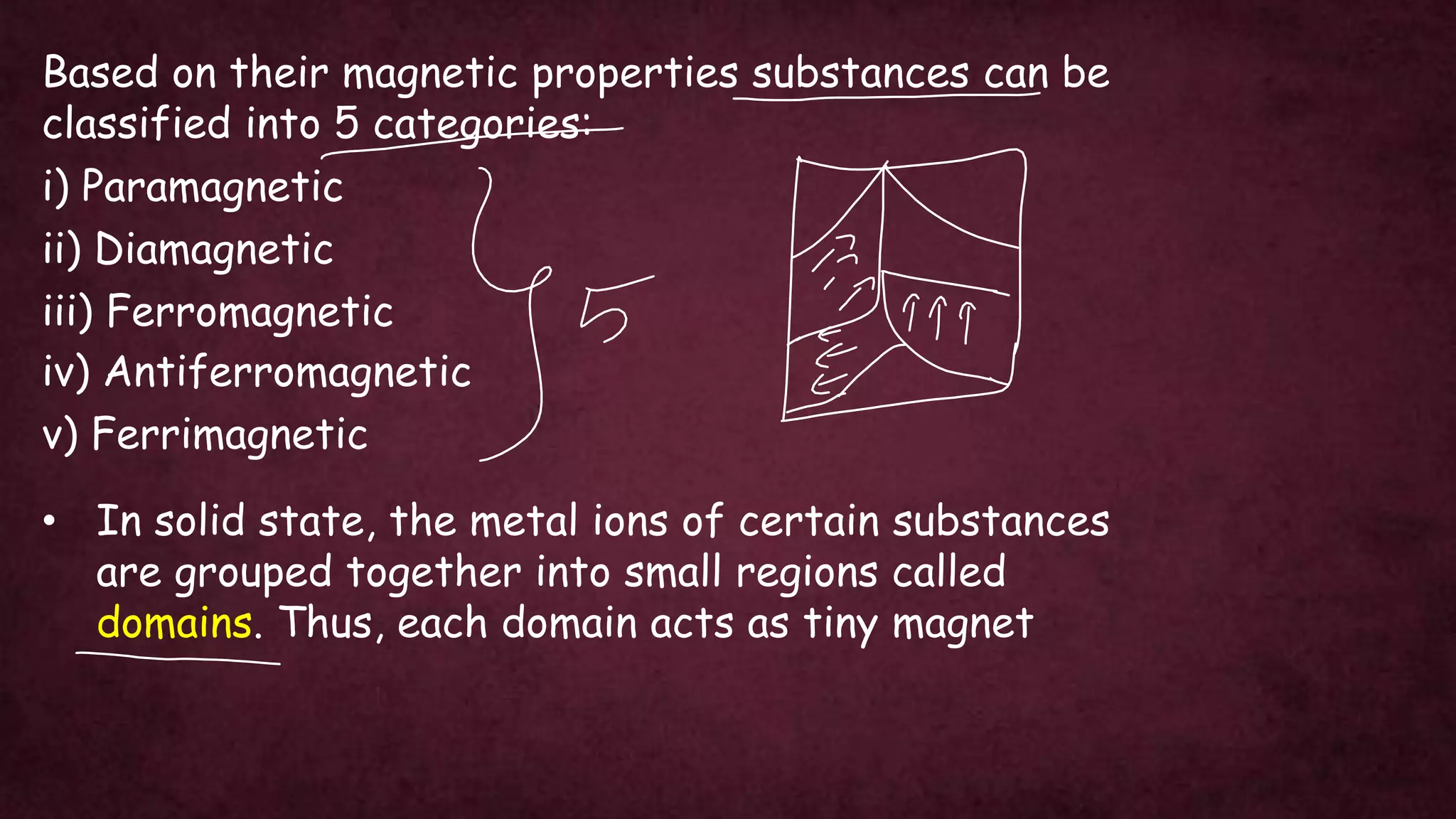
Based on their magnetic properties substances can be
classified into 5 categories:
i) Paramagnetic
ii) Diamagnetic
iii) Ferromagnetic
iv) Antiferromagnetic
v) Ferrimagnetic
• In solid state, the metal ions of certain substances
are grouped together into small regions called
domains. Thus, each domain acts as tiny magnet
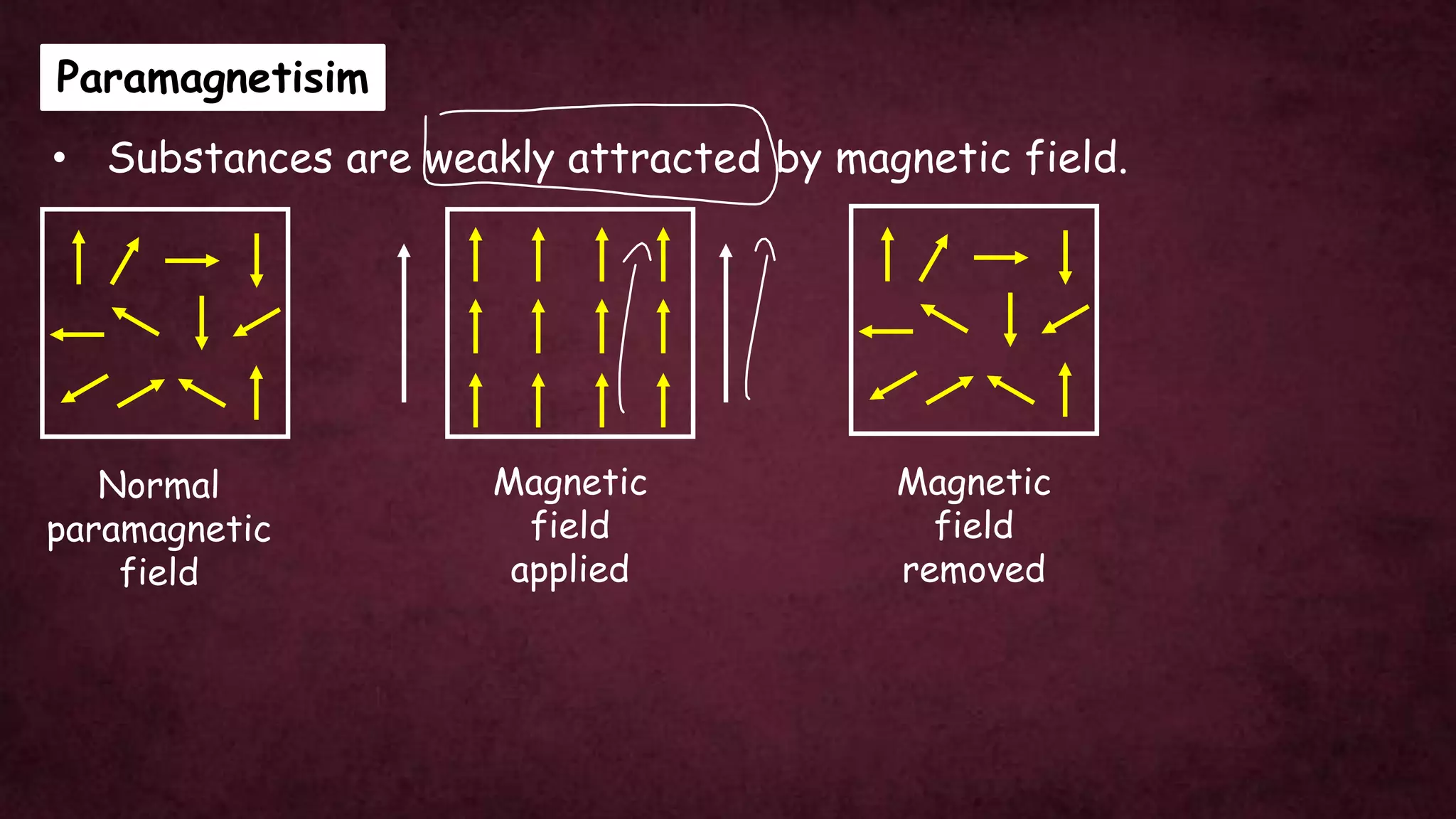
Paramagnetisim
• Substances are weakly attracted by magnetic field.
Normal
paramagnetic
field
Magnetic
field
applied
Magnetic
field
removed
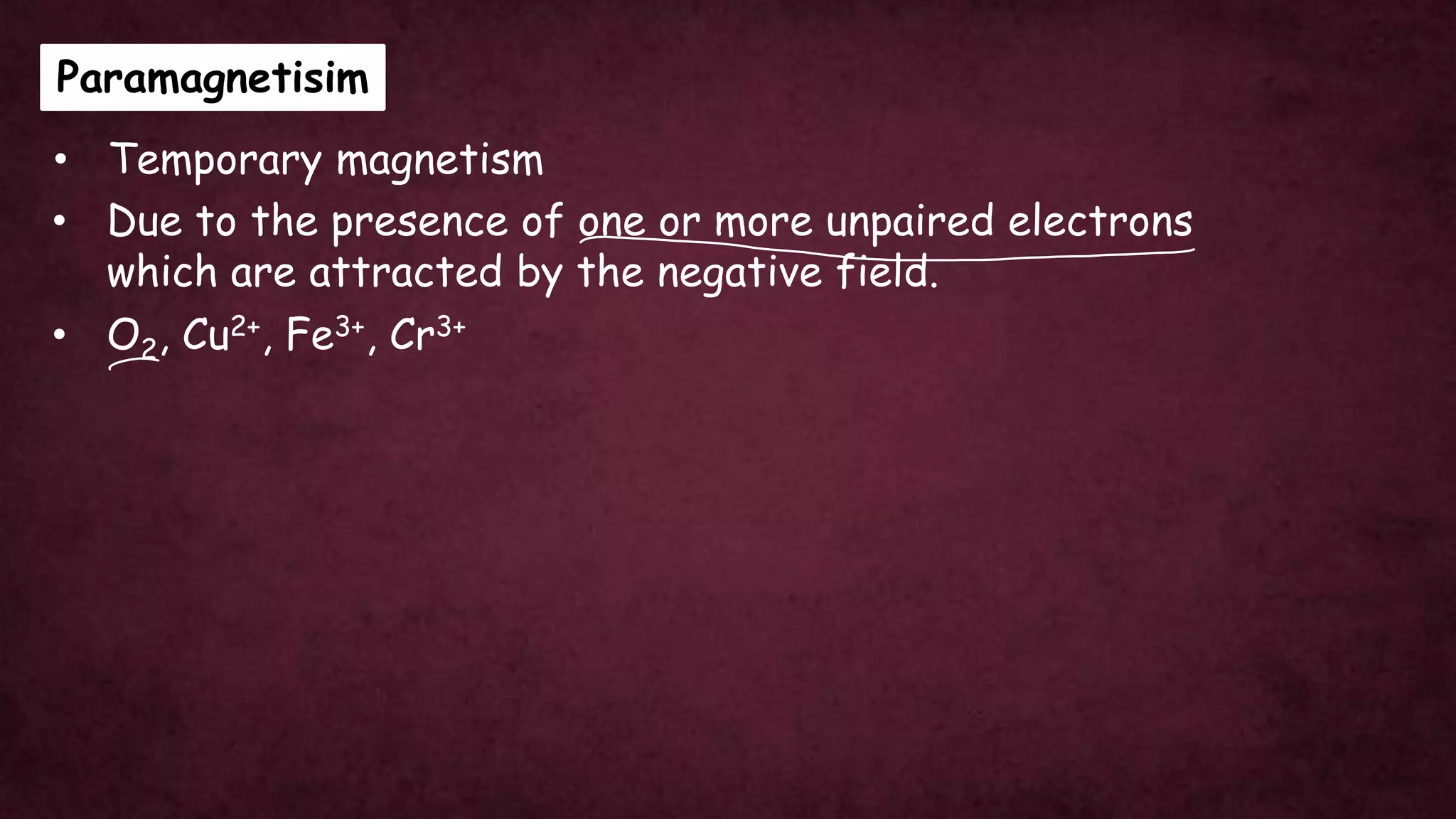
Paramagnetisim
• Temporary magnetism
• Due to the presence of one or more unpaired electrons
which are attracted by the negative field.
• O2, Cu2+, Fe3+, Cr3+
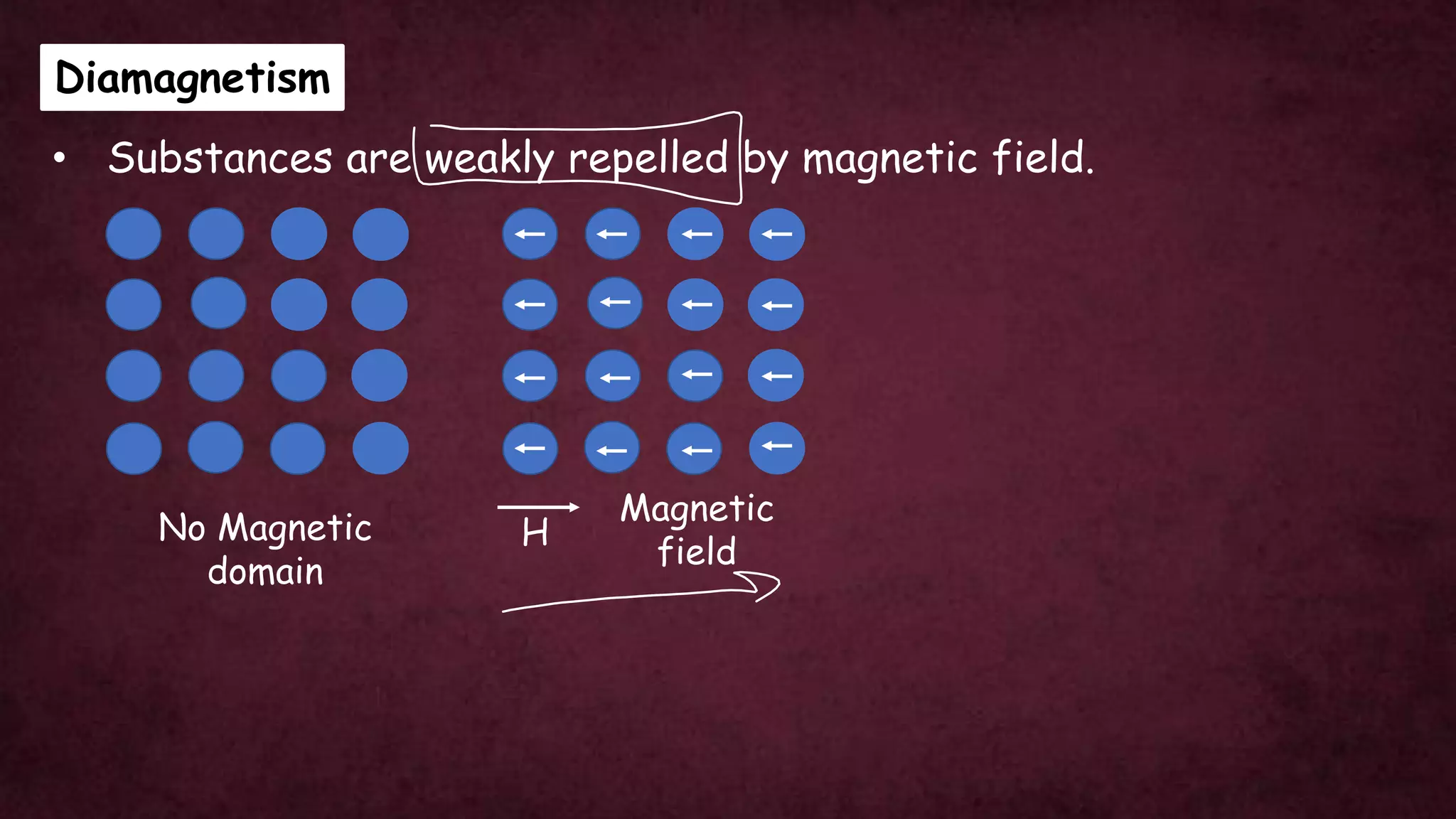
Diamagnetism
• Substances are weakly repelled by magnetic field.
No Magnetic
domain
H
Magnetic
field
Diamagnetism
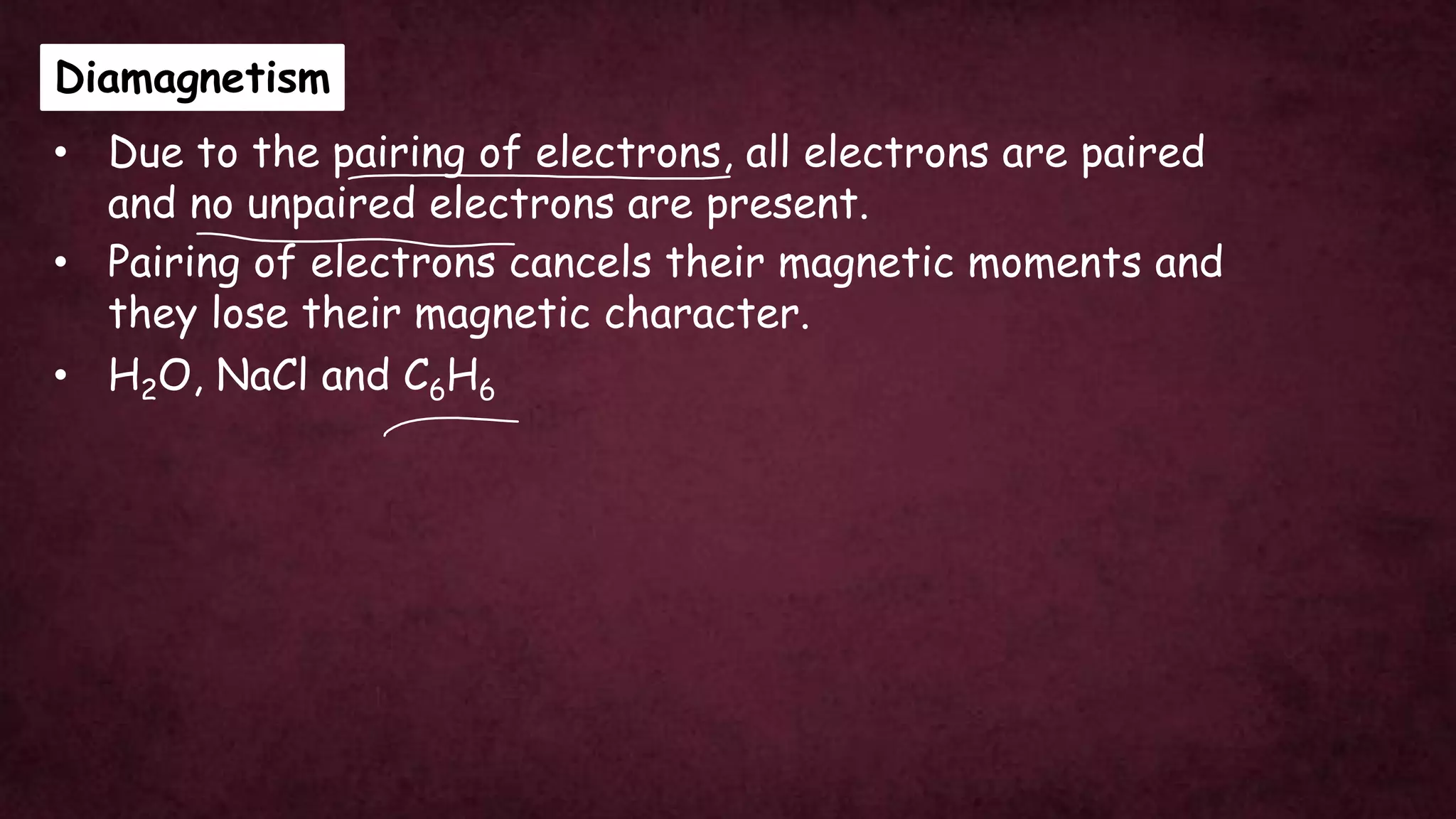
• H2O, NaCl and C6H6
• Pairing of electrons cancels their magnetic moments and
they lose their magnetic character.
• Due to the pairing of electrons, all electrons are paired
and no unpaired electrons are present.
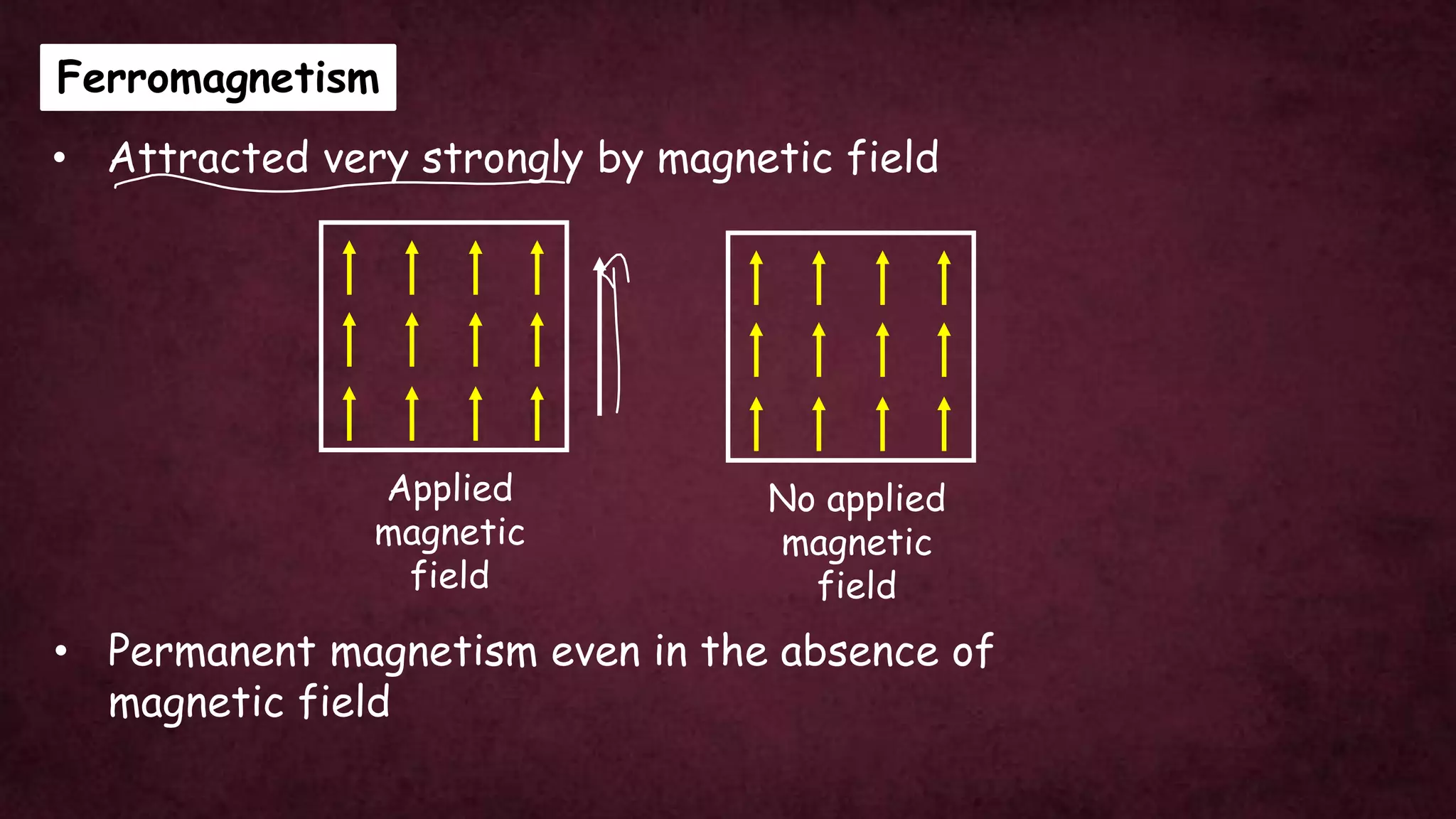
Ferromagnetism
• Attracted very strongly by magnetic field
Applied
magnetic
field
• Permanent magnetism even in the absence of
magnetic field
No applied
magnetic
field
Ferromagnetism
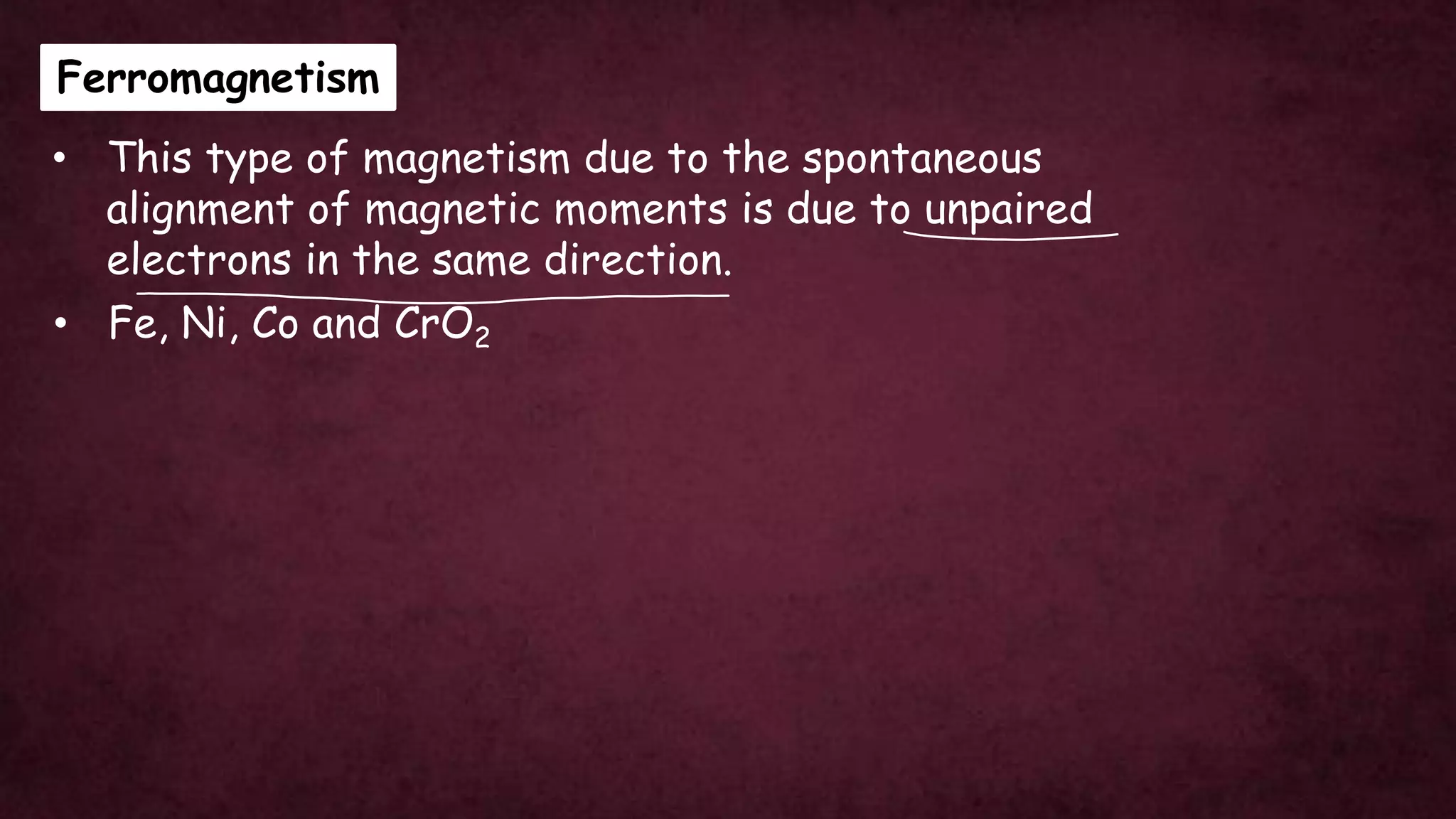
• This type of magnetism due to the spontaneous
alignment of magnetic moments is due to unpaired
electrons in the same direction.
• Fe, Ni, Co and CrO2
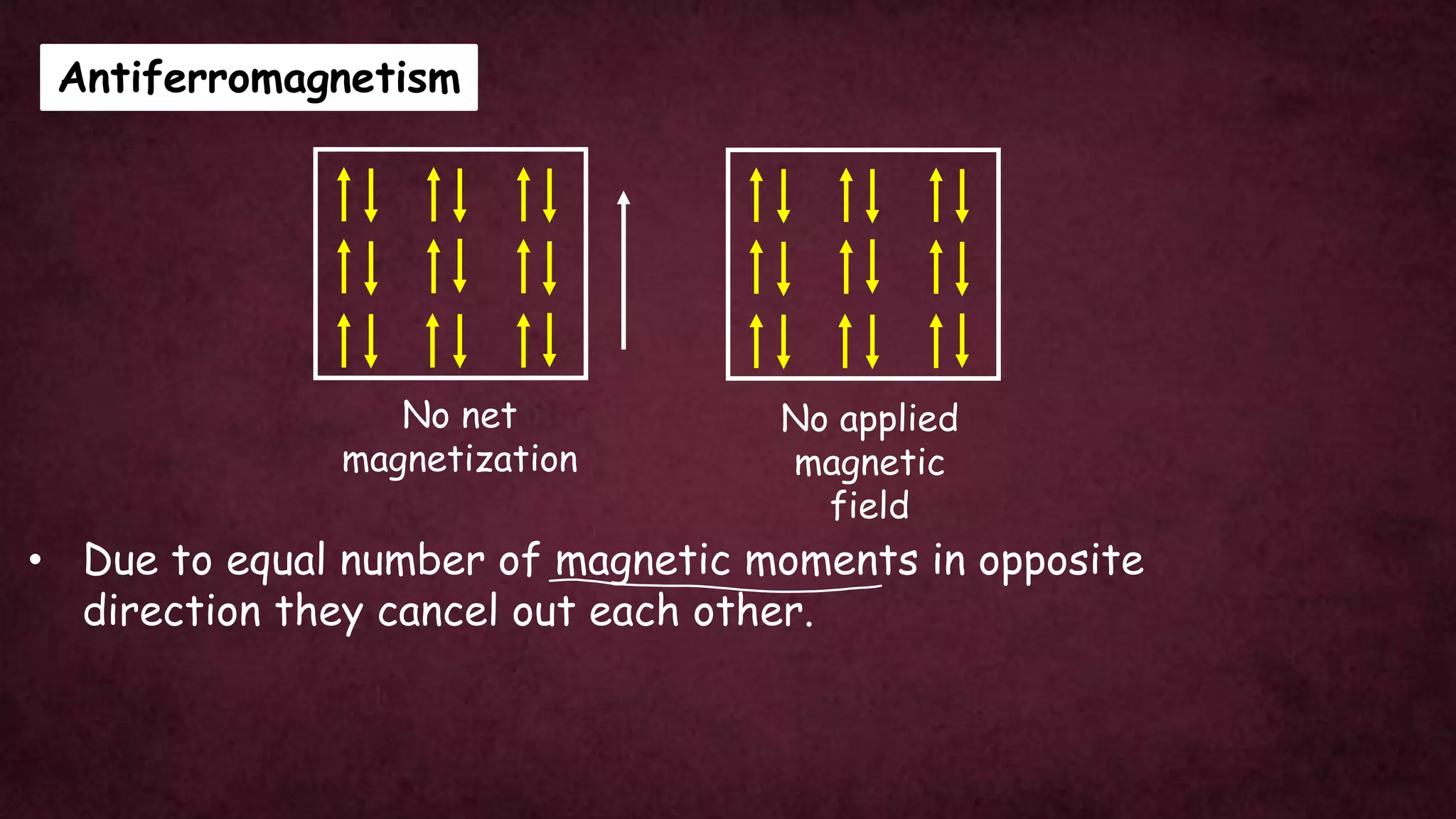
Antiferromagnetism
No net
magnetization
No applied
magnetic
field
• Due to equal number of magnetic moments in opposite
direction they cancel out each other.
Antiferromagnetism
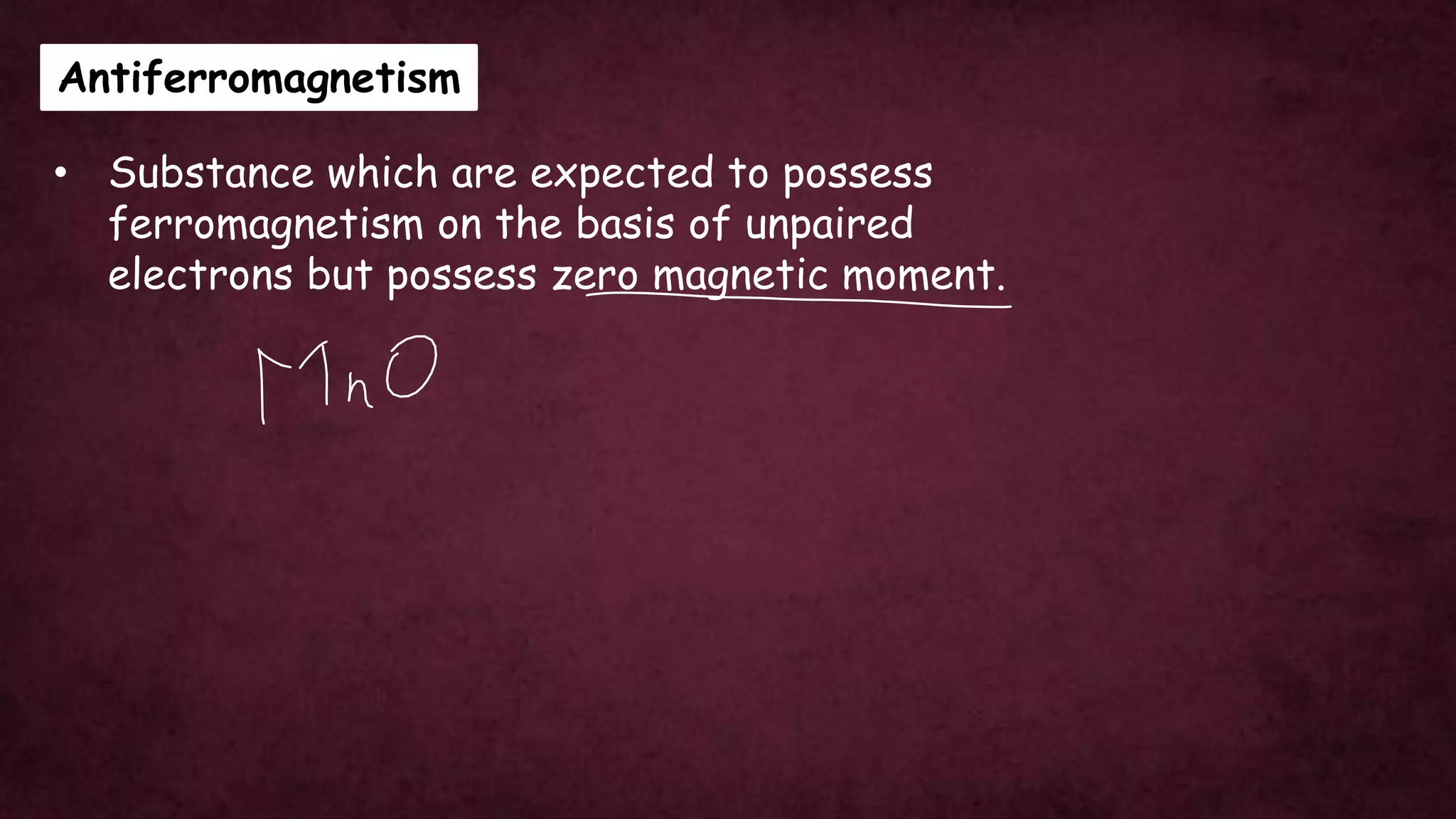
• Substance which are expected to possess
ferromagnetism on the basis of unpaired
electrons but possess zero magnetic moment.
Ferrimagnetism
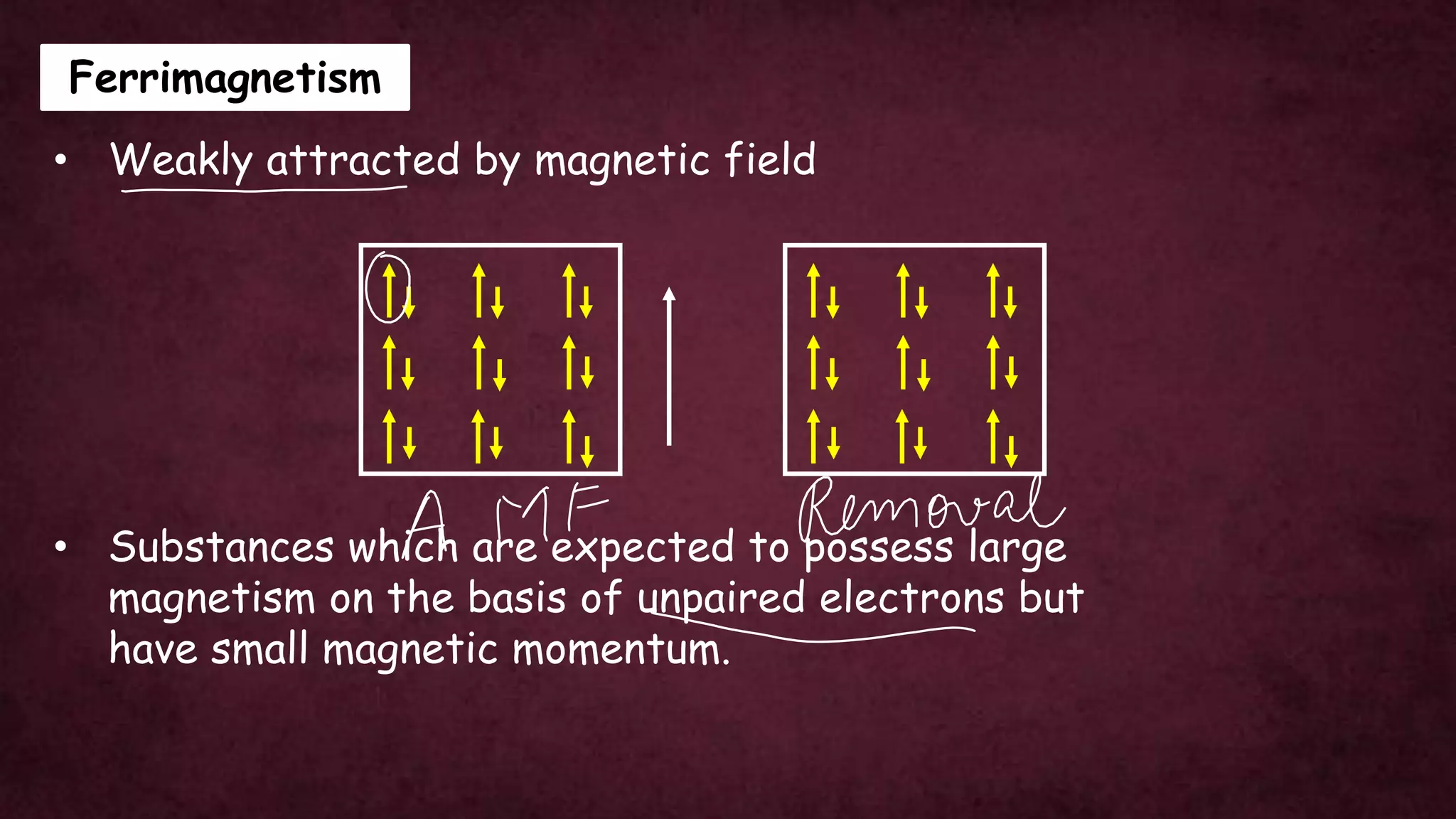
• Weakly attracted by magnetic field
• Substances which are expected to possess large
magnetism on the basis of unpaired electrons but
have small magnetic momentum.
Ferrimagnetism
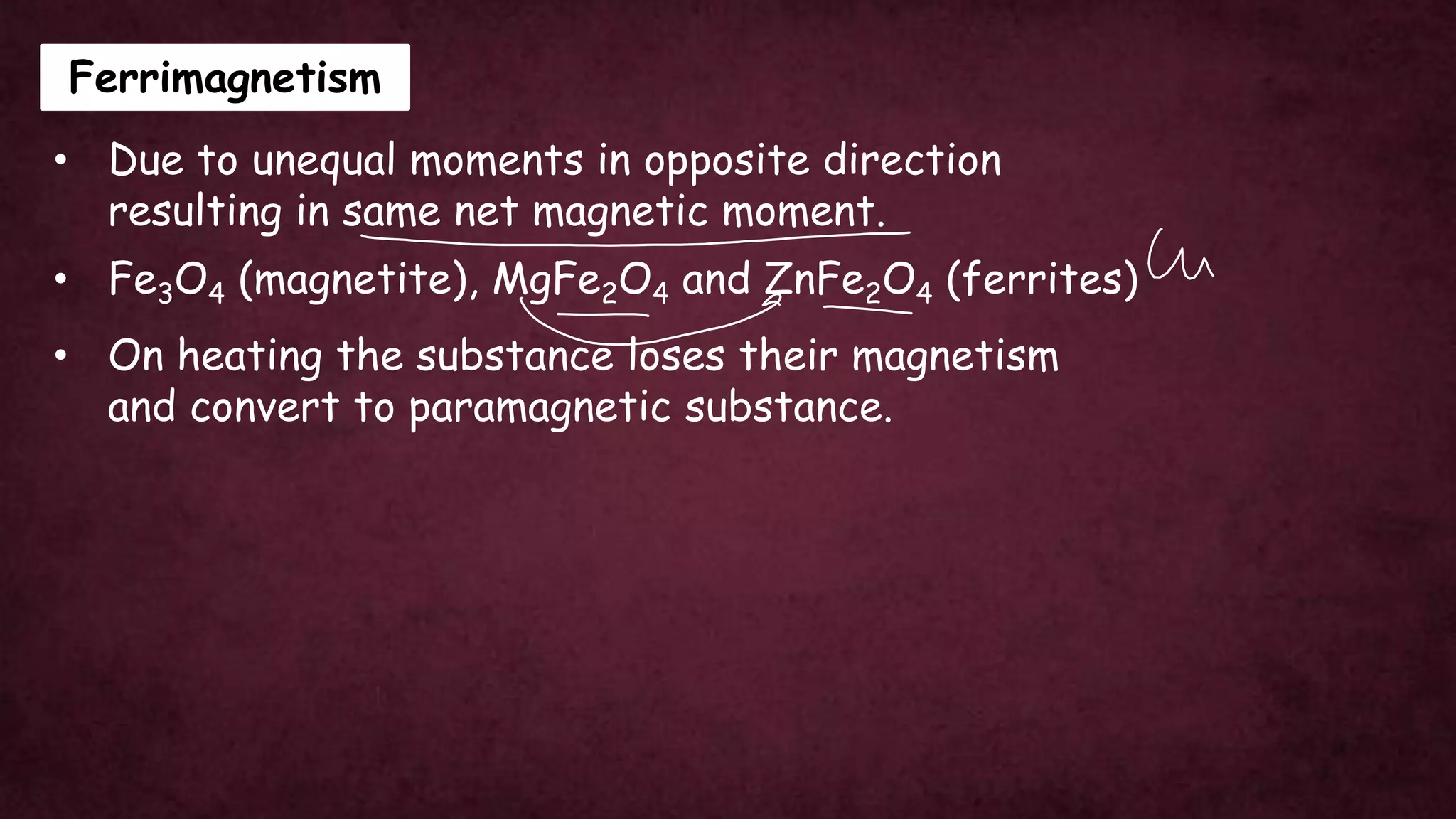
• Due to unequal moments in opposite direction
resulting in same net magnetic moment.
• On heating the substance loses their magnetism
and convert to paramagnetic substance.
• Fe3O4 (magnetite), MgFe2O4 and ZnFe2O4 (ferrites)
Class 12, subject chemistry chapter name   solid state, topic name - electrical and magnetic properties of solids

Class 12, subject chemistry chapter name solid state, topic name - electrical and magnetic properties of solids

  • 1.
  • 2.
  • 3.
    RECAP ✓ Imperfections inSolids • Stoichiometric Defects • Impurity Defects • Non-Stoichiometric Defects
  • 4.
    Electrical properties inSolids Solids are classified into 3 types based on their conductivities: i) Conductors: Conductivity range 104 to 107 ohm-1 m-1. ii) Insulators: Conductivity range 10-20 to 10-10 ohm-1 m-1. iii) Semiconductors: Conductivity range 10-6 to 104 ohm-1 m-1.
  • 5.
    Band theory E N E R G Y Unfilled bands Filledbands 3s 3p 3s 3p Single atom 5 atoms in proximity Conduction band Valence band
  • 6.
  • 7.
    Doping • The conductivityof intrinsic semiconductors can be increased by adding appropriate amount of suitable impurity - Doping • Electrical conductivity of semiconductors increases with rise in temperature, since more electrons can jump to conduction band. • Substances like silicon and germanium show this type of behavior – intrinsic semiconductors
  • 8.
    Doping a) Doping withelectron-rich impurities n-type semiconductor b) Doping with electron-deficit impurities p-type semiconductor
  • 9.
    a) Doping withelectron-rich impurities n-type semiconductor Image reference NCERT textbook
  • 10.
    b) Doping withelectron-deficit impurities p-type semiconductor Image reference NCERT textbook
  • 11.
    Applications of n-typeand p-type semiconductors • Diode - rectifier • Transistor – detect or amplify radio or audio signals
  • 12.
    Magnetic properties inSolids Electron’s magnetic moment originates from types of motion: i) It’s orbital motion around the nucleus ii) It’s spin around its own axis Image reference NCERT textbook
  • 13.
    Magnetic properties inSolids • Magnitude of this magnetic moment is measured in the unit called Bhor magneton μB. It is equal to 9.27 × 10⁻²⁴Am2. • Movement of charges creates magnetic moment. Thus, each electron has permanent spin and an orbital magnetic moment associated with it. Image reference NCERT textbook
  • 14.
    Based on theirmagnetic properties substances can be classified into 5 categories: i) Paramagnetic ii) Diamagnetic iii) Ferromagnetic iv) Antiferromagnetic v) Ferrimagnetic • In solid state, the metal ions of certain substances are grouped together into small regions called domains. Thus, each domain acts as tiny magnet
  • 15.
    Paramagnetisim • Substances areweakly attracted by magnetic field. Normal paramagnetic field Magnetic field applied Magnetic field removed
  • 16.
    Paramagnetisim • Temporary magnetism •Due to the presence of one or more unpaired electrons which are attracted by the negative field. • O2, Cu2+, Fe3+, Cr3+
  • 17.
    Diamagnetism • Substances areweakly repelled by magnetic field. No Magnetic domain H Magnetic field
  • 18.
    Diamagnetism • H2O, NaCland C6H6 • Pairing of electrons cancels their magnetic moments and they lose their magnetic character. • Due to the pairing of electrons, all electrons are paired and no unpaired electrons are present.
  • 19.
    Ferromagnetism • Attracted verystrongly by magnetic field Applied magnetic field • Permanent magnetism even in the absence of magnetic field No applied magnetic field
  • 20.
    Ferromagnetism • This typeof magnetism due to the spontaneous alignment of magnetic moments is due to unpaired electrons in the same direction. • Fe, Ni, Co and CrO2
  • 21.
    Antiferromagnetism No net magnetization No applied magnetic field •Due to equal number of magnetic moments in opposite direction they cancel out each other.
  • 22.
    Antiferromagnetism • Substance whichare expected to possess ferromagnetism on the basis of unpaired electrons but possess zero magnetic moment.
  • 23.
    Ferrimagnetism • Weakly attractedby magnetic field • Substances which are expected to possess large magnetism on the basis of unpaired electrons but have small magnetic momentum.
  • 24.
    Ferrimagnetism • Due tounequal moments in opposite direction resulting in same net magnetic moment. • On heating the substance loses their magnetism and convert to paramagnetic substance. • Fe3O4 (magnetite), MgFe2O4 and ZnFe2O4 (ferrites)