Muhammad Ehsan
(2013652616)

Date: 2013-12-05

Bionano Chemistry Lab
Types of Bonding

Ionic Bonds
Covalent Bonds
Coordinate Bonds
Dipole Interactions
Van der Walls forces
Pi-Pi Stacking
Introduction
Covalent Organic Frameworks (COFs)

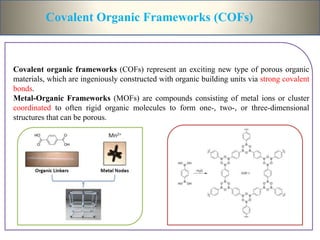
Covalent organic frameworks (COFs) represent an exciting new type of porous organic
materials, which are ingeniously constructed with organic building units via strong covalent
bonds.
Metal-Organic Frameworks (MOFs) are compounds consisting of metal ions or cluster
coordinated to often rigid organic molecules to form one-, two-, or three-dimensional
structures that can be porous.
Why to Synthesize COFs

Driving Force for the Synthesis of COFs:
Bringing
i) Covalent linkage
ii) Porosity and
iii) Crystallinity
within the same material
COFs posses
i) Low density
ii) Large surface area
iii) Tuneable pore size
iv) Facilely tailored functionality
v) Versatile covalent combination
Basic Concern
Covalent Bond Formation
Building Units
Classification of COFs

Depending on the building block dimensions, COFs can be categorized into
two-dimensional (2D)
three-dimensional (3D) COFs.

In 2D COFs, the covalently bound framework
is restricted to 2D sheets.
three-dimensional (3D) COFs.
In contrast, 3D COFs, which extend this framework three dimensionally
through a building block containing an sp3 carbon or silane atom,
characteristically possess high specific surface areas
Design and synthesis

Structure of building blocks
To obtain a crystalline and ordered COF, the structure of the building blocks
must meet two requirements:
 the formation reaction of the COF should be a reversible reaction.
Contain reactive groups,
monomers, oligomers, and polymers

 the geometry of the building blocks should be well preserved in the COF.
building blocks should be conformationally rigid,
and the bond formation direction must be discrete.
Synthetic Methods

Solvothermal synthesis

Microwave synthesis
Solvothermal synthesis

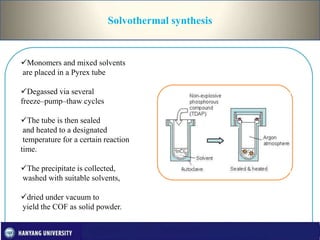
Monomers and mixed solvents
are placed in a Pyrex tube
Degassed via several
freeze–pump–thaw cycles
The tube is then sealed
and heated to a designated
temperature for a certain reaction
time.
The precipitate is collected,
washed with suitable solvents,
dried under vacuum to
yield the COF as solid powder.
Factors Affecting the Solvothermal Synthesis

Solvent combinations and ratios are important factors in balancing between framework
formation and crystallization when synthesizing highly crystalline COFs.
A suitable temperature is important to ensure the reversibility of the reaction. (85–120 0C)
Microwave Synthesis

Microwave synthesis provided several advantages over solvothermal
methods.

Produces COFs rapidly. Thus, large-scale synthesis is possible.
A sealed vessel is not required for the microwave synthesis.
Other Synthetic Methods

 Synthesis of monolayers on metal surfaces.
 Synthesis of monolayers on a (highly ordered pyrolytic graphite)
HOPG surface
 Synthesis of oriented thin films on graphene surfaces.
 Ionothermal synthesis
 Room-temperature synthesis
Structural Studies of COFs

 XRD, crystalline structure
 Infrared spectroscopy

 Solid-state NMR spectroscopy
 Elemental analysis
 X-ray photoelectron spectroscopy
are all useful for evaluating the linkages, terminal
groups, and compositions of the COFs.
Some Examples of COFs

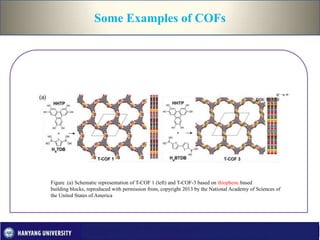
Figure .(a) Schematic representation of T-COF 1 (left) and T-COF-3 based on thiophene based
building blocks, reproduced with permission from, copyright 2013 by the National Academy of Sciences of
the United States of America
Some Examples of COFs

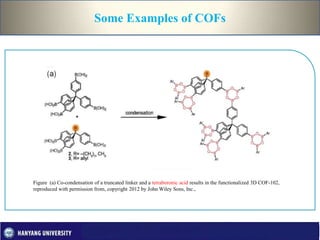
Figure (a) Co-condensation of a truncated linker and a tetraboronic acid results in the functionalized 3D COF-102,
reproduced with permission from, copyright 2012 by John Wiley Sons, Inc.,
Some Examples of COFs

Fig. Co-condensation of monomers 11 and 21 to synthesize 2D HHTP-DPB COF and the proposed crystalline structure.
(Adapted with permission from Copyright 2011 American Chemical Society.)
Applications of COFs

The function of a COF arises from its porosity and molecular
skeletons
1.
•
•
•
•

Gas adsorption and storage
Hydrogen
Methane
Carbon dioxide
Ammonia

2.

Heterogeneous catalysis

3.

Semiconduction

4.

Photoconduction
To be continue…….

Covalant Organic Frameworks

  • 1.
  • 2.
    Types of Bonding IonicBonds Covalent Bonds Coordinate Bonds Dipole Interactions Van der Walls forces Pi-Pi Stacking
  • 3.
  • 4.
    Covalent Organic Frameworks(COFs) Covalent organic frameworks (COFs) represent an exciting new type of porous organic materials, which are ingeniously constructed with organic building units via strong covalent bonds. Metal-Organic Frameworks (MOFs) are compounds consisting of metal ions or cluster coordinated to often rigid organic molecules to form one-, two-, or three-dimensional structures that can be porous.
  • 5.
    Why to SynthesizeCOFs Driving Force for the Synthesis of COFs: Bringing i) Covalent linkage ii) Porosity and iii) Crystallinity within the same material COFs posses i) Low density ii) Large surface area iii) Tuneable pore size iv) Facilely tailored functionality v) Versatile covalent combination
  • 6.
  • 7.
  • 8.
    Classification of COFs Dependingon the building block dimensions, COFs can be categorized into two-dimensional (2D) three-dimensional (3D) COFs. In 2D COFs, the covalently bound framework is restricted to 2D sheets.
  • 9.
    three-dimensional (3D) COFs. Incontrast, 3D COFs, which extend this framework three dimensionally through a building block containing an sp3 carbon or silane atom, characteristically possess high specific surface areas
  • 10.
    Design and synthesis Structureof building blocks To obtain a crystalline and ordered COF, the structure of the building blocks must meet two requirements:  the formation reaction of the COF should be a reversible reaction. Contain reactive groups, monomers, oligomers, and polymers  the geometry of the building blocks should be well preserved in the COF. building blocks should be conformationally rigid, and the bond formation direction must be discrete.
  • 11.
  • 12.
    Solvothermal synthesis Monomers andmixed solvents are placed in a Pyrex tube Degassed via several freeze–pump–thaw cycles The tube is then sealed and heated to a designated temperature for a certain reaction time. The precipitate is collected, washed with suitable solvents, dried under vacuum to yield the COF as solid powder.
  • 13.
    Factors Affecting theSolvothermal Synthesis Solvent combinations and ratios are important factors in balancing between framework formation and crystallization when synthesizing highly crystalline COFs. A suitable temperature is important to ensure the reversibility of the reaction. (85–120 0C)
  • 14.
    Microwave Synthesis Microwave synthesisprovided several advantages over solvothermal methods. Produces COFs rapidly. Thus, large-scale synthesis is possible. A sealed vessel is not required for the microwave synthesis.
  • 15.
    Other Synthetic Methods Synthesis of monolayers on metal surfaces.  Synthesis of monolayers on a (highly ordered pyrolytic graphite) HOPG surface  Synthesis of oriented thin films on graphene surfaces.  Ionothermal synthesis  Room-temperature synthesis
  • 16.
    Structural Studies ofCOFs  XRD, crystalline structure  Infrared spectroscopy  Solid-state NMR spectroscopy  Elemental analysis  X-ray photoelectron spectroscopy are all useful for evaluating the linkages, terminal groups, and compositions of the COFs.
  • 17.
    Some Examples ofCOFs Figure .(a) Schematic representation of T-COF 1 (left) and T-COF-3 based on thiophene based building blocks, reproduced with permission from, copyright 2013 by the National Academy of Sciences of the United States of America
  • 18.
    Some Examples ofCOFs Figure (a) Co-condensation of a truncated linker and a tetraboronic acid results in the functionalized 3D COF-102, reproduced with permission from, copyright 2012 by John Wiley Sons, Inc.,
  • 19.
    Some Examples ofCOFs Fig. Co-condensation of monomers 11 and 21 to synthesize 2D HHTP-DPB COF and the proposed crystalline structure. (Adapted with permission from Copyright 2011 American Chemical Society.)
  • 20.
    Applications of COFs Thefunction of a COF arises from its porosity and molecular skeletons 1. • • • • Gas adsorption and storage Hydrogen Methane Carbon dioxide Ammonia 2. Heterogeneous catalysis 3. Semiconduction 4. Photoconduction
  • 21.