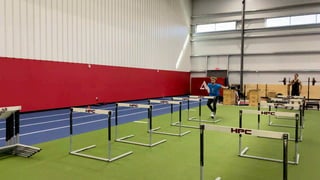
SCIENCE & PRACTICE OF
ELITE SPEED DEVELOPMENT
Mike Young, PhD
@mikeyoungphd
@mikeyoung
DETERMINANTS
OF SPEED
[Muscular Factors]
ACT CONTRACT
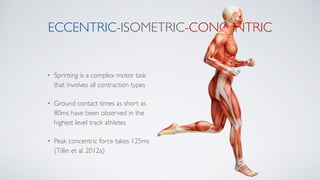
ECCENTRIC-ISOMETRIC-CONCENTRIC
• Sprinting is a complex motor task
that involves all contraction types
• Ground contact times as short as
80ms have been observed in the
highest level track athletes
• Peak concentric force takes 125ms
(Tillin et al. 2012a)
Van Hooren & Bosch, 2017
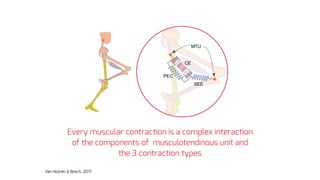
Every muscular contraction is a complex interaction
of the components of musculotendinous unit and
the 3 contraction types
Van Hooren & Bosch, 2017
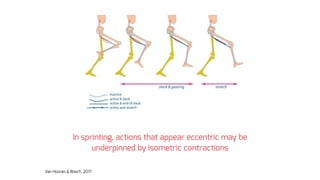
In sprinting, actions that appear eccentric may be
underpinned by isometric contractions
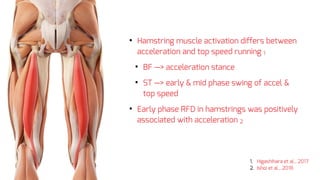
• Hamstring muscle activation differs between
acceleration and top speed running 1
• BF —> acceleration stance
• ST —> early & mid phase swing of accel &
top speed
• Early phase RFD in hamstrings was positively
associated with acceleration 2
1. Higashihara et al., 2017
2. Ishoi et al., 2018
•Hip extensors play critical role for force production
•Eccentric force generating capacity is vitally important
[Mechanical Factors]
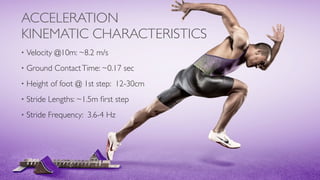
ACCELERATION
KINEMATIC CHARACTERISTICS
• Velocity @10m: ~8.2 m/s
• Ground ContactTime: ~0.17 sec
• Height of foot @ 1st step: 12-30cm
• Stride Lengths: ~1.5m first step
• Stride Frequency: 3.6-4 Hz
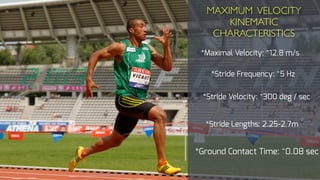
*Maximal Velocity: ~12.8 m/s
*Stride Frequency: ~5 Hz
MAXIMUM VELOCITY
KINEMATIC
CHARACTERISTICS
*Ground Contact Time: ~0.08 sec
*Stride Velocity: ~300 deg / sec
*Stride Lengths: 2.25-2.7m
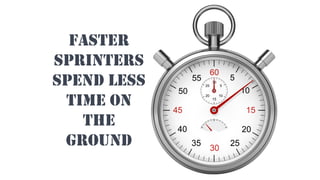
FASTER
SPRINTERS
SPEND LESS
TIME ON
THE
GROUND
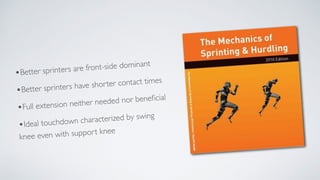
•Better sprinters are front-side dominant
•Better sprinters have shorter contact times
•Full extension neither needed nor beneficial
•Ideal touchdown characterized by swing
knee even with support knee
Physics Don’t Care
www.companyname.com
© 2016 Jetfabrik Multipurpose Theme. All Rights Reserved.
[Kinetic Factors]
KINETIC
CHARACTERISTICS
• Ground reaction forces
approaching 5x
bodyweight
• Muscle forces in excess of
7x bodyweight
NEWTONIAN
MECHANICS APPLY
F=MA
F
=
M
A
F
=
M
A F
APPLY MORE FORCE YOU DO.
SPRINT FASTER YOU WILL!
M
=
A F
M
=
A F
M
F
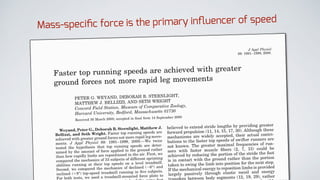
Mass-specific force is the primary influencer of speed
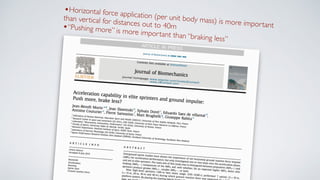
•Horizontal force application (per unit body mass) is more important
than vertical for distances out to 40m
•“Pushing more” is more important than “braking less”
BUTT….
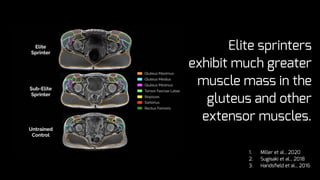
Elite sprinters
exhibit much greater
muscle mass in the
gluteus and other
extensor muscles.
1. Miller et al., 2020
2. Sugisaki et al., 2018
3. Handsfield et al., 2016
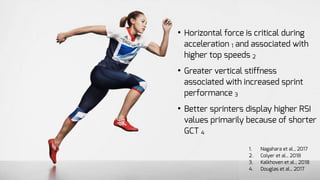
• Horizontal force is critical during
acceleration 1 and associated with
higher top speeds 2
• Greater vertical stiffness
associated with increased sprint
performance 3
• Better sprinters display higher RSI
values primarily because of shorter
GCT 4
1. Nagahara et al., 2017
2. Colyer et al., 2018
3. Kalkhoven et al., 2018
4. Douglas et al., 2017
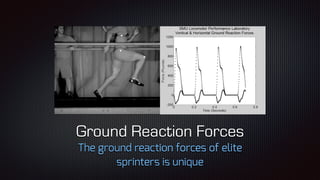
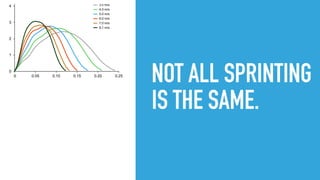
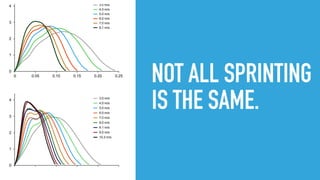
Ground Reaction Forces
The ground reaction forces of elite
sprinters is unique
NOT ALL SPRINTING
IS THE SAME.
NOT ALL SPRINTING
IS THE SAME.
NOT ALL SPRINTING
IS THE SAME.
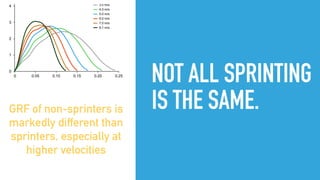
GRF of non-sprinters is
markedly different than
sprinters, especially at
higher velocities
NOT ALL SPRINTING
IS THE SAME.
GRF of non-sprinters is
markedly different than
sprinters, especially at
higher velocities
To run faster there is only ONE solution
Apply More Mass
Specific Force to
the Ground!
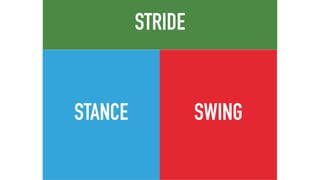
STANCE SWING
STRIDE
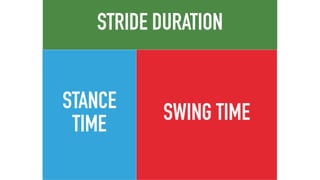
STANCE
TIME SWING TIME
STRIDE DURATION
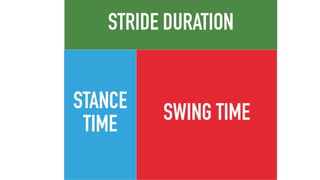
STANCE
TIME SWING TIME
STRIDE DURATION
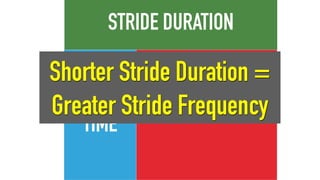
STANCE
TIME SWING TIME
STRIDE DURATION
Shorter Stride Duration =
Greater Stride Frequency
✅ Optimized Mass
" Big Force
⬇ Right Direction
⏱ Minimal Time
%&Run Fast
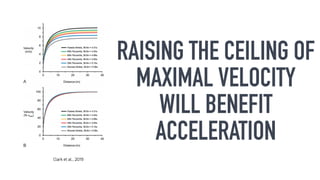
[Acceleration:Max Velocity]
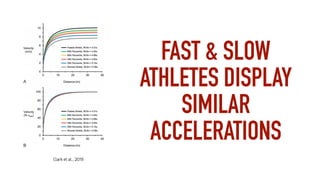
Clark et al., 2019
FAST & SLOW
ATHLETES DISPLAY
SIMILAR
ACCELERATIONS
Clark et al., 2019
RAISING THE CEILING OF
MAXIMAL VELOCITY
WILL BENEFIT
ACCELERATION
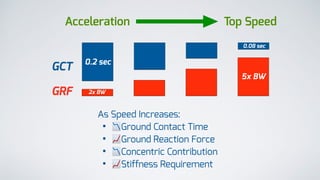
GCT
GRF
0.2 sec
0.08 sec
2x BW
5x BW
Acceleration Top Speed
As Speed Increases:
• 'Ground Contact Time
• "Ground Reaction Force
• 'Concentric Contribution
• "Stiffness Requirement
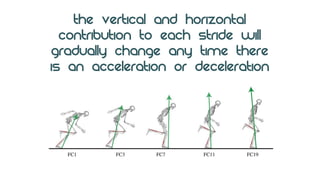
The vertical and horizontal
contribution to each stride will
gradually change any time there
is an acceleration or deceleration
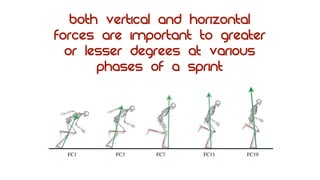
Both vertical and horizontal
forces are important to greater
or lesser degrees at various
phases of a sprint
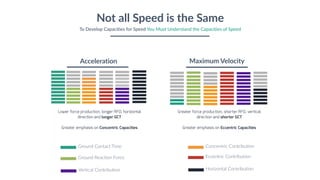
Lower force production, longer RFD, horizontal
direction and longer GCT
Greater emphasis on Concentric Capacities
Acceleration Maximum Velocity
Not all Speed is the Same
To Develop Capacities for Speed You Must Understand the Capacities of Speed
Eccentric Contribution
Concentric Contribution
Ground Reaction Force
Ground Contact Time
Greater force production, shorter RFD, vertical
direction and shorter GCT
Greater emphasis on Eccentric Capacities
Horizontal Contribution
Vertical Contribution
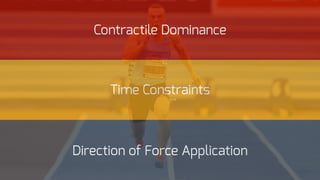
Contractile Dominance
Time Constraints
Direction of Force Application
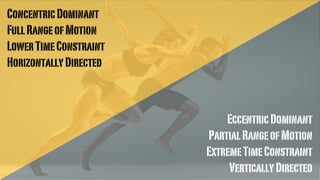
ConcentricDominant
FullRangeofMotion
LowerTimeConstraint
HorizontallyDirected
EccentricDominant
PartialRangeofMotion
ExtremeTimeConstraint
VerticallyDirected
IMPLICATIONS FOR
TRAINING
[Neuromuscular]
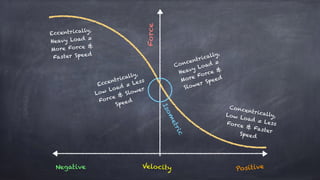
For optimal Speed-Power Development you must
train across the Force-Velocity Continuum
Negative Velocity
Force
I
s
o
m
e
t
r
i
c
Positive
Eccentrically,
Heavy Load =
More Force &
Faster Speed
Eccentrically,
Low Load = Less
Force & Slower
Speed
Concentrically,
Heavy Load =
More Force &
Slower Speed
Concentrically,
Low Load = Less
Force & Faster
Speed
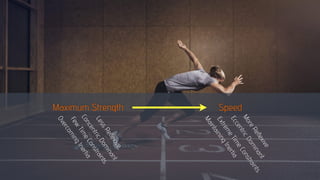
Surf the Wave
Maximum Strength
F
e
w
T
i
m
e
C
o
n
s
t
r
a
i
n
t
s
C
o
n
c
e
n
t
r
i
c
D
o
m
i
n
a
n
t
L
e
s
s
R
e
fl
e
x
i
v
e
O
v
e
r
c
o
m
i
n
g
I
n
e
r
t
i
a
Maximum Strength Speed
F
e
w
T
i
m
e
C
o
n
s
t
r
a
i
n
t
s
C
o
n
c
e
n
t
r
i
c
D
o
m
i
n
a
n
t
E
x
t
r
e
m
e
T
i
m
e
C
o
n
s
t
r
a
i
n
t
s
E
c
c
e
n
t
r
i
c
D
o
m
i
n
a
n
t
L
e
s
s
R
e
fl
e
x
i
v
e
M
o
r
e
R
e
fl
e
x
i
v
e
O
v
e
r
c
o
m
i
n
g
I
n
e
r
t
i
a
M
a
i
n
t
a
i
n
i
n
g
I
n
e
r
t
i
a
[Mechanical]
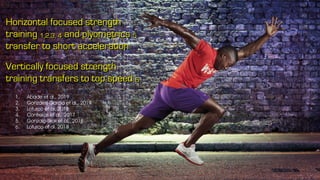
Horizontal focused strength
training 1,2,3, 4 and plyometrics 5
transfer to short acceleration
Vertically focused strength
training transfers to top speed 6
1. Abade et al., 2019
2. Gonzáles-García et al., 2019
3. Loturco et al. 2018
4. Contreras et al., 2017
5. Gonzalo-Skok et al., 2018
6. Loturco et al. 2018
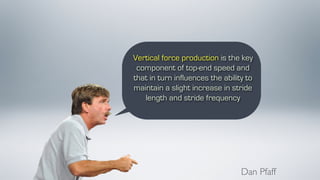
Vertical force production is the key
component of top-end speed and
that in turn influences the ability to
maintain a slight increase in stride
length and stride frequency
Dan Pfaff
INTENT
&
OUTCOME
ARE SELDOM COINCIDENT
With regards to what is
relevant to the coach &
athlete, horizontal & vertical
forces are quite similar [1/2]
Horizontal force is just
vertical force turned on
its side [2/2]
Horizontal force is just
vertical force turned on
its side [2/2]
BEST PRACTICES FOR
AUXILARY CAPACITIES
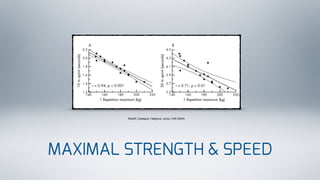
MAXIMAL STRENGTH & SPEED
Wisløff, Castagna, Helgerud, Jones, Hoff (2004)
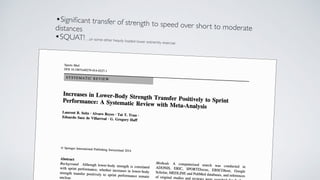
•Significant transfer of strength to speed over short to moderate
distances
•SQUAT!….or some other heavily loaded lower extremity exercise
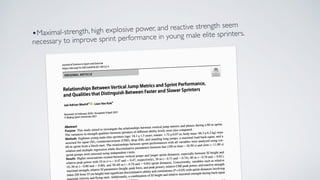
•Maximal-strength, high explosive power, and reactive strength seem
necessary to improve sprint performance in young male elite sprinters.
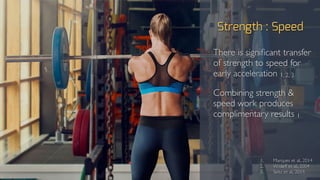
• There is significant transfer
of strength to speed for
early acceleration 1, 2, 3
• Combining strength &
speed work produces
complimentary results 1
Strength : Speed
1. Marques et al., 2014
2. Wisløff et al., 2004
3. Seitz et al., 2014
STRENGTH
IS SPECIFIC
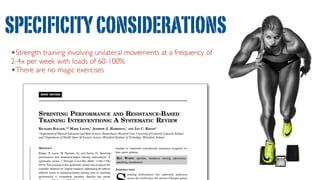
SPECIFICITYCONSIDERATIONS
•Strength training involving unilateral movements at a frequency of
2-4x per week with loads of 60-100%
•There are no magic exercises
SPECIFICITYCONSIDERATIONS
Target the underlying physiological
stimulus that drives adaptation and not
exercise selection based on movement
specificity of the target performance
(Applebee et al., 2019)
SPECIFICITYCONSIDERATIONS
Consistent use of partial range of motion
movements (squat) may transfer better
to maximum velocity
(Rhea et al., 2016)
SPECIFICITYCONSIDERATIONS
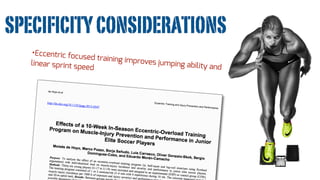
•Eccentric focused training improves jumping ability and
linear sprint speed
SPECIFICITYCONSIDERATIONS
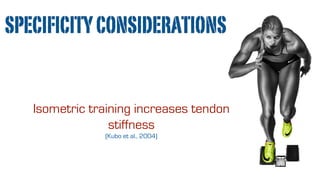
Isometric training increases tendon
stiffness
(Kubo et al., 2004)
• Improve lower extremity
max strength
• Include bilateral &
unilateral exercises
• Incorporate isometric and
eccentric focused
elements
Implications
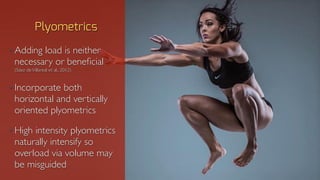
• Adding load is neither
necessary or beneficial
(Sáez deVillareal et al., 2012)
• Incorporate both
horizontal and vertically
oriented plyometrics
• High intensity plyometrics
naturally intensify so
overload via volume may
be misguided
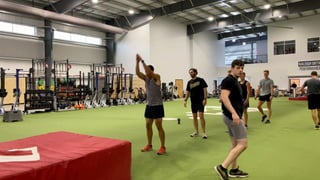
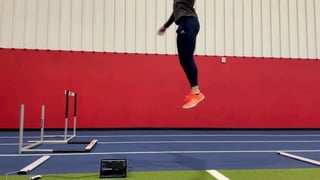
Plyometrics
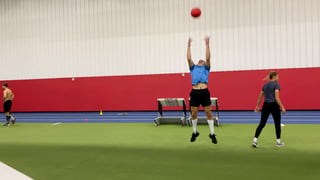
Full Body
Throws
BEST PRACTICES FOR
SPEED DEVELOPMENT
[General Speed Training
Guidelines]
Specific and general
training can improve
sprint performance but
actually sprinting
produces the best
results (Rumpf et al., 2015)
To Sprint Faster....
Sprint!
INTENSITY
NOT SPRINTING IS NOT SPRINTING
•Sprinting at less than 90% of maximal speed
DOES NOT improve performance
DECREMENT REGULATED TRAINING
Effects of velocity loss during resistance training on a
performance, strength gains and muscle adaptations
F. Pareja-Blanco1
, D. Rodr!
ıguez-Rosell1
, L. S!
anchez-Medina2
, J. Sanchis-Moysi3,4
, C. Dorado3,
J. M. Y!
a~
nez-Garc!
ıa1
, D. Morales-Alamo3,4
, I. P!
erez-Su!
arez3,4
, J. A. L. Calbet3,4
, J. J. Gonz!
ale
1
Physical Performance & Sports Research Center, Pablo de Olavide University, Seville, Spain, 2
Studies, R
Medicine Center, Government of Navarre, Pamplona, Spain, 3
Department of Physical Education, Las Pal
University, Las Palmas de Gran Canaria, Spain, 4
Research Institute of Biomedical and Health Sciences (I
Gran Canaria University, Las Palmas de Gran Canaria, Spain
Corresponding author: Fernando Pareja-Blanco, Centro de Investigaci!
on en Rendimiento F!
ısico y Deportiv
Olavide, Ctra. de Utrera km 1, 41013 Seville, Spain. Tel.: +34 653121522; Fax: +34 954 348 659; E-ma
Accepted for publication 23 February 2016
We compared the effects of two resistance training (RT)
programs only differing in the repetition velocity loss
allowed in each set: 20% (VL20) vs 40% (VL40) on
muscle structural and functional adaptations. Twenty-two
young males were randomly assigned to a VL20 (n = 12)
or VL40 (n = 10) group. Subjects followed an 8-week
velocity-based RT program using the squat exercise while
monitoring repetition velocity. Pre- and post-training
assessments included: magnetic resonance imaging, vastus
lateralis biopsies for muscle cross-sectional area (CSA)
and fiber type analyses, one-repetitio
and
squat strength gains than VL40 and
in CMJ (9.5% vs 3.5%, P < 0
performing 40% fewer repetitions. A
increased mean fiber CSA and whol
volume, VL40 training elicited a gre
vastus lateralis and intermedius th
resulted in a reduction of myosin
percentage in VL40, whereas it was pr
conclusion, the progressive accumulati
as indic
Scand J Med Sci Sports 2016: !!: !!–!!
doi: 10.1111/sms.12678
ª
Publ
•Adding volume when
intensity is
compromised HURTS
performance
DECREMENT REGULATED TRAINING
Effects of velocity loss during resistance training on a
performance, strength gains and muscle adaptations
F. Pareja-Blanco1
, D. Rodr!
ıguez-Rosell1
, L. S!
anchez-Medina2
, J. Sanchis-Moysi3,4
, C. Dorado3,
J. M. Y!
a~
nez-Garc!
ıa1
, D. Morales-Alamo3,4
, I. P!
erez-Su!
arez3,4
, J. A. L. Calbet3,4
, J. J. Gonz!
ale
1
Physical Performance & Sports Research Center, Pablo de Olavide University, Seville, Spain, 2
Studies, R
Medicine Center, Government of Navarre, Pamplona, Spain, 3
Department of Physical Education, Las Pal
University, Las Palmas de Gran Canaria, Spain, 4
Research Institute of Biomedical and Health Sciences (I
Gran Canaria University, Las Palmas de Gran Canaria, Spain
Corresponding author: Fernando Pareja-Blanco, Centro de Investigaci!
on en Rendimiento F!
ısico y Deportiv
Olavide, Ctra. de Utrera km 1, 41013 Seville, Spain. Tel.: +34 653121522; Fax: +34 954 348 659; E-ma
Accepted for publication 23 February 2016
We compared the effects of two resistance training (RT)
programs only differing in the repetition velocity loss
allowed in each set: 20% (VL20) vs 40% (VL40) on
muscle structural and functional adaptations. Twenty-two
young males were randomly assigned to a VL20 (n = 12)
or VL40 (n = 10) group. Subjects followed an 8-week
velocity-based RT program using the squat exercise while
monitoring repetition velocity. Pre- and post-training
assessments included: magnetic resonance imaging, vastus
lateralis biopsies for muscle cross-sectional area (CSA)
and fiber type analyses, one-repetitio
and
squat strength gains than VL40 and
in CMJ (9.5% vs 3.5%, P < 0
performing 40% fewer repetitions. A
increased mean fiber CSA and whol
volume, VL40 training elicited a gre
vastus lateralis and intermedius th
resulted in a reduction of myosin
percentage in VL40, whereas it was pr
conclusion, the progressive accumulati
as indic
Scand J Med Sci Sports 2016: !!: !!–!!
doi: 10.1111/sms.12678
ª
Publ
•Adding volume when
intensity is
compromised HURTS
performance
•Less may be more
VELOCITY
IS LOAD
[Hill Sprinting]
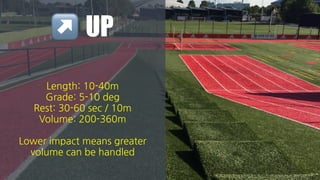
↗ UP
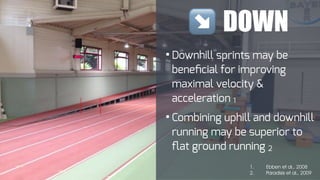
↘ DOWN
•Downhill sprints may be
beneficial for improving
maximal velocity &
acceleration 1
•Combining uphill and downhill
running may be superior to
flat ground running 2
1. Ebben et al., 2008
2. Paradisis et al., 2009
[Resisted Sprinting]
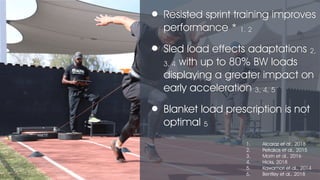
• Resisted sprint training improves
performance * 1, 2
• Sled load effects adaptations 2,
3, 4 with up to 80% BW loads
displaying a greater impact on
early acceleration 3, 4, 5
• Blanket load prescription is not
optimal 5
1. Alcaraz et al., 2018
2. Petrakos et al., 2015
3. Morin et al., 2016
4. Hicks, 2018
5. Kawamori et al., 2014
6. Bentley et al., 2018
[Acceleration
Development]
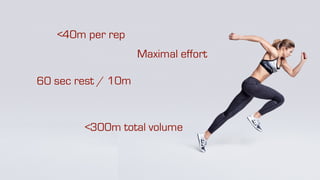
<40m per rep
60 sec rest / 10m
<300m total volume
Maximal effort
[Top Speed Development]
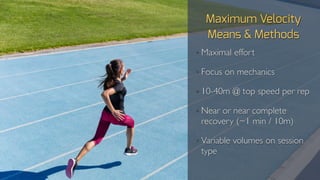
Maximum Velocity
Means & Methods
• Maximal effort
• Focus on mechanics
• 10-40m @ top speed per rep
• Near or near complete
recovery (~1 min / 10m)
• Variable volumes on session
type
IMPLEMENTING THE
FRAMEWORK
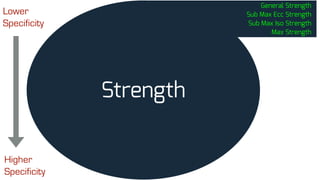
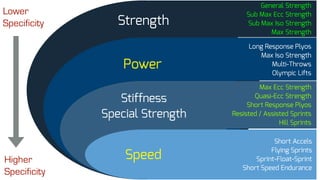
Strength
Lower
Specificity
Higher
Specificity
General Strength
Sub Max Ecc Strength
Sub Max Iso Strength
Max Strength
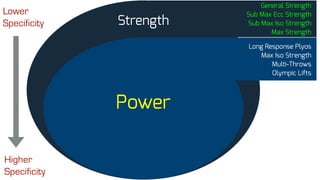
Strength
Power
Lower
Specificity
Higher
Specificity
General Strength
Sub Max Ecc Strength
Sub Max Iso Strength
Max Strength
Long Response Plyos
Max Iso Strength
Multi-Throws
Olympic Lifts
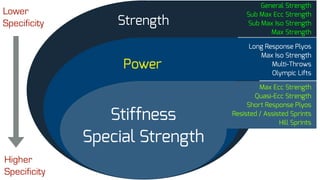
Strength
Power
Stiffness
Special Strength
Lower
Specificity
Higher
Specificity
General Strength
Sub Max Ecc Strength
Sub Max Iso Strength
Max Strength
Long Response Plyos
Max Iso Strength
Multi-Throws
Olympic Lifts
Max Ecc Strength
Quasi-Ecc Strength
Short Response Plyos
Resisted / Assisted Sprints
Hill Sprints
Speed
Strength
Power
Stiffness
Special Strength
Lower
Specificity
Higher
Specificity
General Strength
Sub Max Ecc Strength
Sub Max Iso Strength
Max Strength
Long Response Plyos
Max Iso Strength
Multi-Throws
Olympic Lifts
Max Ecc Strength
Quasi-Ecc Strength
Short Response Plyos
Resisted / Assisted Sprints
Hill Sprints
Short Accels
Flying Sprints
Sprint-Float-Sprint
Short Speed Endurance
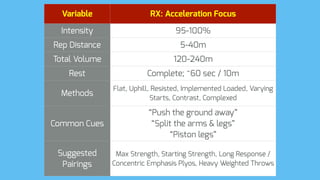
Variable RX: Acceleration Focus
Intensity 95-100%
Rep Distance 5-40m
Total Volume 120-240m
Rest Complete; ~60 sec / 10m
Methods
Flat, Uphill, Resisted, Implemented Loaded, Varying
Starts, Contrast, Complexed
Common Cues
“Push the ground away”
“Split the arms & legs”
“Piston legs”
Suggested
Pairings
Max Strength, Starting Strength, Long Response /
Concentric Emphasis Plyos, Heavy Weighted Throws
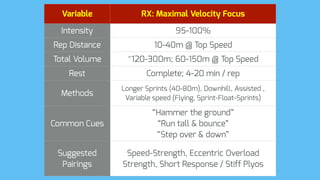
Variable RX: Maximal Velocity Focus
Intensity 95-100%
Rep Distance 10-40m @ Top Speed
Total Volume ~120-300m; 60-150m @ Top Speed
Rest Complete; 4-20 min / rep
Methods
Longer Sprints (40-80m), Downhill, Assisted ,
Variable speed (Flying, Sprint-Float-Sprints)
Common Cues
“Hammer the ground”
“Run tall & bounce”
“Step over & down”
Suggested
Pairings
Speed-Strength, Eccentric Overload
Strength, Short Response / Stiff Plyos
SURF THE WAVE
SPECIFICITY OF TRAINING
SCIENCE TO PRACTICE
UNDERSTAND THE ROOTS OF SPEED
SPRINT
ATHLETICLAB.COM
PROFORMANCE.PRO
FITFORFUTBOL.COM
ELITETRACK.COM
THANKS.
Mike Young, PhD
@mikeyoungphd
@mikeyoung

Science & Practice of Elite Speed Development