PREPARED BY: PRIYANKA
plyometrics
Plyometrics, or "plyos" for short, are a type of exercise
designed to produce fast and powerful movements. They
are generally used by athletes to improve performance in
sports, especially those that involve speed, quickness and
power.
In addition, it is possible to find plyometrics used in the
fitness field, but to a much lesser degree
 Thus, plyometric exercises use explosive, fast-acting
movements to develop muscular power and to improve
overall speed. In other words, it's exercise that allows
muscles to exert maximum force in the shortest amount of
time possible.
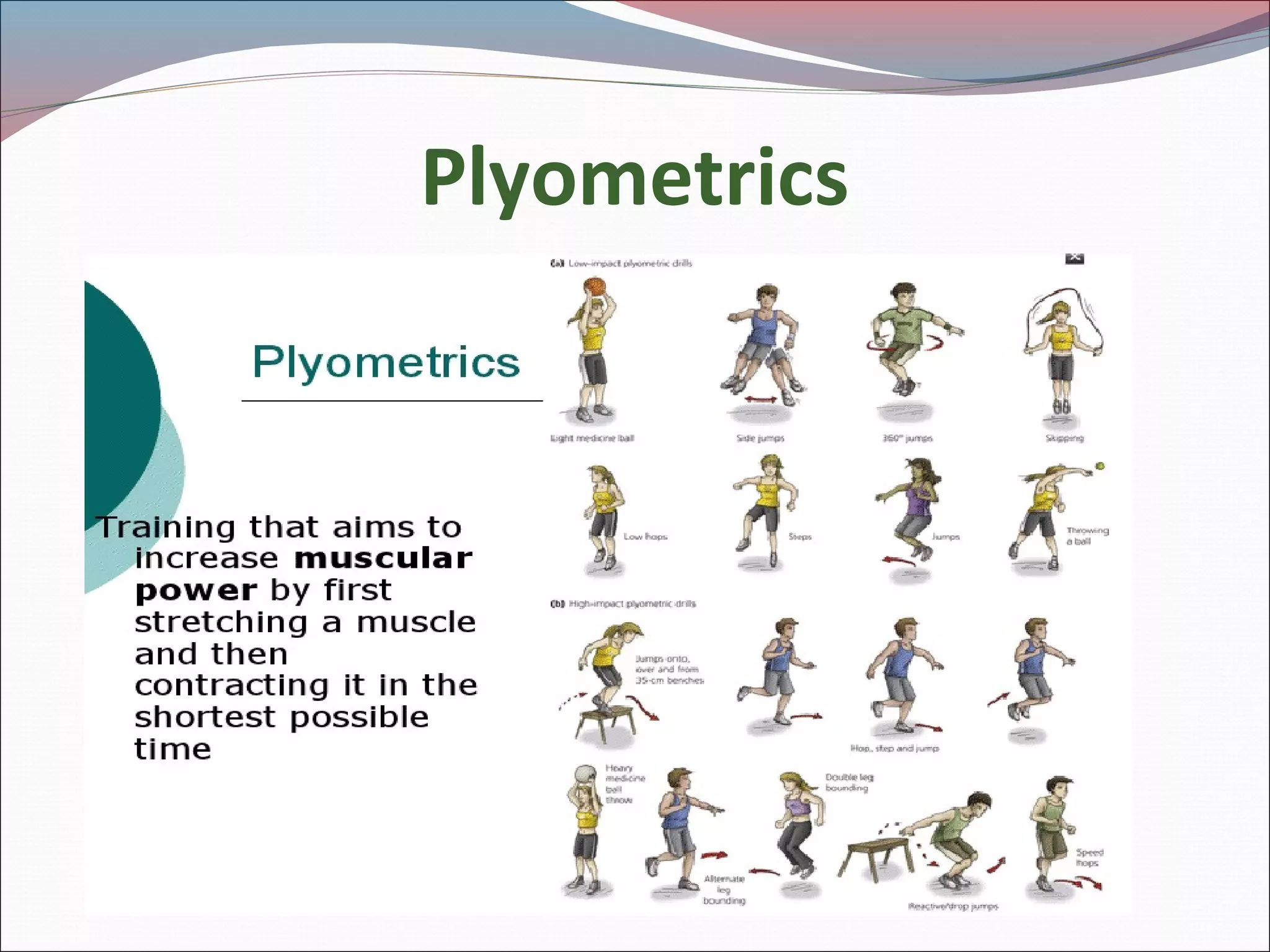
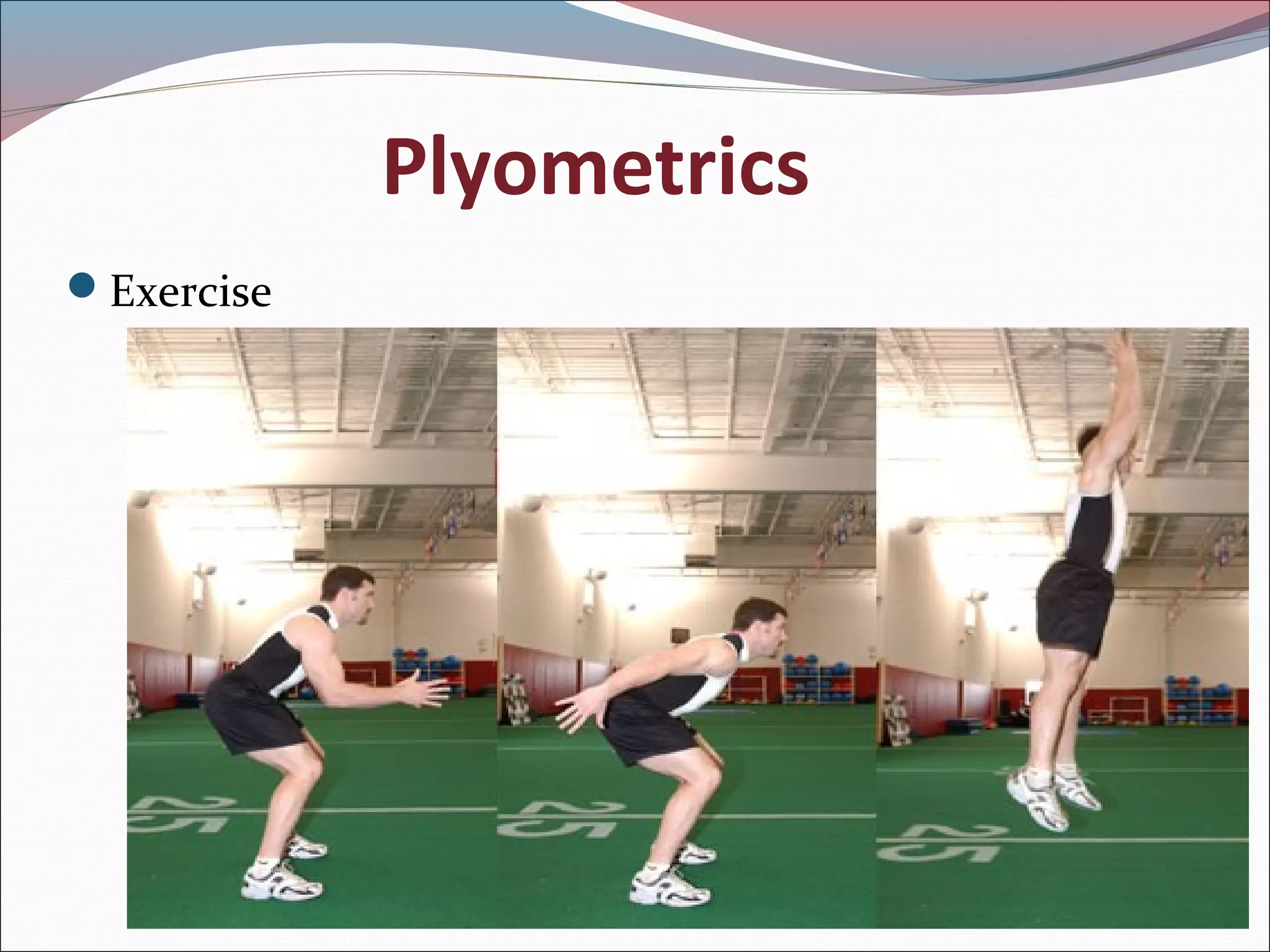
Plyometrics
Goals of Plyometrics
Decrease amount of time required
between the eccentric m. contraction &
the initiation of the overcoming
concentric contraction
Normal physiological movement rarely
begins from a static starting position, but
is usually preceded by an eccentric pre-
stretch
Plyometric exercises
are specialised, high intensity training techniques
used to develop athletic power (strength and speed).
Plyometric training involves high-intensity, explosive
muscular contractions that invoke the stretch reflex
(stretching the muscle before it contracts so that it
contracts with greater force).
The most common plyometric exercises include hops,
jumps and bounding movements.
One popular plyometric exercise is jumping off a box
and rebounding off the floor and onto another, higher
box. These exercises typically increase speed and
strength and build power.
(and any impact exercise) can increase the risk of
injury if you don’t follow certain safety precaution.
Plyometrics
Exercise
Plyometric Effectiveness
Important factors in ↑ strength & power output
Development of neuromuscular responses to stresses applied
 GTOs thresholds are raised to permit more stretch
↑ neuromuscular coordination
 As speed ↑ & activity is performed more accurately, the strength to
perform is improved. Energy & movement are not wasted on
ineffective activity. Better coordination permits greater power
production
When speed & coordination of activity is improved, greater
power can be produced
RATE of stretch is more important than AMOUNT of stretch
Program Design
Consider age, body weight, competitive level, surface, footwear, proper
technique, progression, & goals when developing a program
Direction of Body Movement
 Horizontal body movement is less stressful than vertical movement
 Dependent upon weight of athlete & technical proficiency
demonstrated during jumps
Weight of Athlete
 The heavier the athlete, the greater the training demand placed on the
athlete
Speed of Execution of Exercise
 ↑ speed of execution on exercises raises the training demand on the
individual
External Load
 Adding an external load can significantly ↑ the training demand
 Do not raise the load to a level that will significantly slow the speed of
movement
Program DesignIntensity
 Amount of effort exerted
 Progress from simple to complex activities
 Adding external weight or raising box height increases intensity
Volume
 Amount of work performed during one session
 Total # of foot contacts in one session
 Beginners – 75-100 foot contacts/session
 Advanced – 200-250 foot contacts/session
Frequency
 Optimum frequency is suggested that 48-72 hours of rest are necessary
for full recovery.
 RECOVERY
 Rest time between exercise sets.
 Power training-work rest ratio 1:3 to 1:4
 Endurance training 1:1 or 1:2 ratio
Classification of Individuals
Beginner
Intermediate
Advanced
Now you can begin to develop and initiate a program
EQUIPMENTS
Cones
Boxes
Hurdles
Medicines balls
Tubing
Success of a Program
Depends on how well the training variables are:
Controlled – be flexible & listen to body
Modified
Manipulated
In general, as intensity of exercise increases, volume is
decreased (& vice versa)
Should follow a periodization period
4 phases of year-round periodization
 Competitive season, Postseason training, Preparation phase,
Transitional phase
Plyometrics should be performed in latter stages of
preparation phase & during transitional phase for optimal
results 7 safety
Safety Tips
Plyometrics are recommended only for well-
conditioned athletes
You should have high levels of leg strength prior to
performing plyometrics
Warm up thoroughly before starting plyometrics
Start slowly with small jumps and gradually build up
Land softly to absorb shock
Allow plenty of rest between plyometric workouts
Stop immediately if you feel any pain in your joints
Use footwear with plenty of cushioning
Perform plyometrics on soft or cushioned surfaces
only
Benefits of a Plyometric Training
Individual should
Be well conditioned with sufficient strength &
endurance
Exhibit athletic abilities
Exhibit coordination & proprioceptive abilities
Free of pain from any injury or condition
Plyometrics are not designed to be an exclusive
training program
Guidelines for Plyometric
Training
Activities should be progressive in nature
Volume & intensity can be modified by:
Increase # of exercises, increase # of reps & set, decrease rest
period between sets
Sessions should be conducted no more than 3 times weekly
in the preseason phase of training (volume should prevail).
During competitive season, frequency should be reduced to
twice weekly with intensity more important
Test dynamically to provide progression & motivational
feedback
The KEY element in execution of proper technique is the
eccentric or landing phase
Plyometrics in Rehabilitation
Clinical plyometrics can be categorized according to
the loads applied to the healing tissue
Medial/lateral loading
Rotational loading
Shock absorption/deceleration loading
Plyometrics can be further categorized into
In-place activities
Dynamic distance drills
Depth jumping
 Simple jumping drills (bilateral) → hopping drills (unilateral)
PERIODISATION
Periodisation is the systematic
formulation of sports training for
achieving top form in a
competition at a definite time.
OBJECTIVES OF PERIODISATION
•to prepare the athlete for achievement of an optimal
improvement in performance
•to prepare the athlete for a definite climax to the
competition season
•to prepare the athlete for the main competitions
associated with that climax.
• to aid recovery from injury, illness or a particularly
stressful training year.
Continue……..
TYPES OF PERIODISATION
Single periodisation
When there is only one macro-cycle in one year it is
called single periodisation.
Multiple periodisation
In case there is more than one micro-cycle in a
training year , it is called multiple periodisation. Most
common types of multiple periodisation are double
periodisation and triple periodisation.
BENEFITS OF
PERIODISATION
•Good practice in less time.
•Well managed training.
•Less of work load.Good and satisfactory
results.
•Improve the skill and state of trainee.
Plyometrics and types of Periodisation)

Plyometrics and types of Periodisation)

  • 1.
  • 2.
    plyometrics Plyometrics, or "plyos"for short, are a type of exercise designed to produce fast and powerful movements. They are generally used by athletes to improve performance in sports, especially those that involve speed, quickness and power. In addition, it is possible to find plyometrics used in the fitness field, but to a much lesser degree  Thus, plyometric exercises use explosive, fast-acting movements to develop muscular power and to improve overall speed. In other words, it's exercise that allows muscles to exert maximum force in the shortest amount of time possible.
  • 3.
  • 4.
    Goals of Plyometrics Decreaseamount of time required between the eccentric m. contraction & the initiation of the overcoming concentric contraction Normal physiological movement rarely begins from a static starting position, but is usually preceded by an eccentric pre- stretch
  • 5.
    Plyometric exercises are specialised,high intensity training techniques used to develop athletic power (strength and speed). Plyometric training involves high-intensity, explosive muscular contractions that invoke the stretch reflex (stretching the muscle before it contracts so that it contracts with greater force). The most common plyometric exercises include hops, jumps and bounding movements. One popular plyometric exercise is jumping off a box and rebounding off the floor and onto another, higher box. These exercises typically increase speed and strength and build power. (and any impact exercise) can increase the risk of injury if you don’t follow certain safety precaution.
  • 6.
  • 7.
    Plyometric Effectiveness Important factorsin ↑ strength & power output Development of neuromuscular responses to stresses applied  GTOs thresholds are raised to permit more stretch ↑ neuromuscular coordination  As speed ↑ & activity is performed more accurately, the strength to perform is improved. Energy & movement are not wasted on ineffective activity. Better coordination permits greater power production When speed & coordination of activity is improved, greater power can be produced RATE of stretch is more important than AMOUNT of stretch
  • 8.
    Program Design Consider age,body weight, competitive level, surface, footwear, proper technique, progression, & goals when developing a program Direction of Body Movement  Horizontal body movement is less stressful than vertical movement  Dependent upon weight of athlete & technical proficiency demonstrated during jumps Weight of Athlete  The heavier the athlete, the greater the training demand placed on the athlete Speed of Execution of Exercise  ↑ speed of execution on exercises raises the training demand on the individual External Load  Adding an external load can significantly ↑ the training demand  Do not raise the load to a level that will significantly slow the speed of movement
  • 9.
    Program DesignIntensity  Amountof effort exerted  Progress from simple to complex activities  Adding external weight or raising box height increases intensity Volume  Amount of work performed during one session  Total # of foot contacts in one session  Beginners – 75-100 foot contacts/session  Advanced – 200-250 foot contacts/session Frequency  Optimum frequency is suggested that 48-72 hours of rest are necessary for full recovery.  RECOVERY  Rest time between exercise sets.  Power training-work rest ratio 1:3 to 1:4  Endurance training 1:1 or 1:2 ratio
  • 10.
    Classification of Individuals Beginner Intermediate Advanced Nowyou can begin to develop and initiate a program EQUIPMENTS Cones Boxes Hurdles Medicines balls Tubing
  • 11.
    Success of aProgram Depends on how well the training variables are: Controlled – be flexible & listen to body Modified Manipulated In general, as intensity of exercise increases, volume is decreased (& vice versa) Should follow a periodization period 4 phases of year-round periodization  Competitive season, Postseason training, Preparation phase, Transitional phase Plyometrics should be performed in latter stages of preparation phase & during transitional phase for optimal results 7 safety
  • 12.
    Safety Tips Plyometrics arerecommended only for well- conditioned athletes You should have high levels of leg strength prior to performing plyometrics Warm up thoroughly before starting plyometrics Start slowly with small jumps and gradually build up Land softly to absorb shock Allow plenty of rest between plyometric workouts Stop immediately if you feel any pain in your joints Use footwear with plenty of cushioning Perform plyometrics on soft or cushioned surfaces only
  • 13.
    Benefits of aPlyometric Training Individual should Be well conditioned with sufficient strength & endurance Exhibit athletic abilities Exhibit coordination & proprioceptive abilities Free of pain from any injury or condition Plyometrics are not designed to be an exclusive training program
  • 14.
    Guidelines for Plyometric Training Activitiesshould be progressive in nature Volume & intensity can be modified by: Increase # of exercises, increase # of reps & set, decrease rest period between sets Sessions should be conducted no more than 3 times weekly in the preseason phase of training (volume should prevail). During competitive season, frequency should be reduced to twice weekly with intensity more important Test dynamically to provide progression & motivational feedback The KEY element in execution of proper technique is the eccentric or landing phase
  • 15.
    Plyometrics in Rehabilitation Clinicalplyometrics can be categorized according to the loads applied to the healing tissue Medial/lateral loading Rotational loading Shock absorption/deceleration loading Plyometrics can be further categorized into In-place activities Dynamic distance drills Depth jumping  Simple jumping drills (bilateral) → hopping drills (unilateral)
  • 16.
    PERIODISATION Periodisation is thesystematic formulation of sports training for achieving top form in a competition at a definite time.
  • 17.
    OBJECTIVES OF PERIODISATION •toprepare the athlete for achievement of an optimal improvement in performance •to prepare the athlete for a definite climax to the competition season •to prepare the athlete for the main competitions associated with that climax. • to aid recovery from injury, illness or a particularly stressful training year. Continue……..
  • 18.
    TYPES OF PERIODISATION Singleperiodisation When there is only one macro-cycle in one year it is called single periodisation. Multiple periodisation In case there is more than one micro-cycle in a training year , it is called multiple periodisation. Most common types of multiple periodisation are double periodisation and triple periodisation.
  • 19.
    BENEFITS OF PERIODISATION •Good practicein less time. •Well managed training. •Less of work load.Good and satisfactory results. •Improve the skill and state of trainee.