Periodisation
BY JILL COSTLEY
Overview
 Periodisation: defined
 Principles of training: ASPORT
 The Homeostasis of Stress: the theories
General Adaptation Syndrome (GAS)
Stimulus-fatigue-recovery theory (SFRA)
Fitness-fatigue Theory (Fit-Fat)
 Main types of periodisation:
Traditional Periodisation
Undulatory Periodisation
Block Periodisation
 Periodisation for sprinting: the research
 *Athlete 1* case study
The annual plan: objectives (SWOT), key
variables, monitoring/ testing, external factors etc.
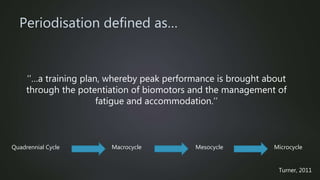
Periodisation defined as…
Turner, 2011
‘’…a training plan, whereby peak performance is brought about
through the potentiation of biomotors and the management of
fatigue and accommodation.’’
MicrocycleMesocycleMacrocycleQuadrennial Cycle
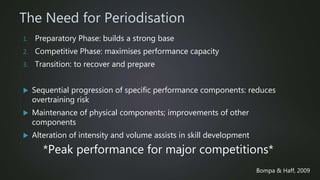
The Need for Periodisation
1. Preparatory Phase: builds a strong base
2. Competitive Phase: maximises performance capacity
3. Transition: to recover and prepare
 Sequential progression of specific performance components: reduces
overtraining risk
 Maintenance of physical components; improvements of other
components
 Alteration of intensity and volume assists in skill development
*Peak performance for major competitions*
Bompa & Haff, 2009
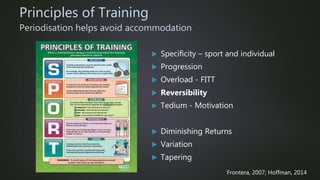
Principles of Training
Periodisation helps avoid accommodation
 Specificity – sport and individual
 Progression
 Overload - FITT
 Reversibility
 Tedium - Motivation
 Diminishing Returns
 Variation
 Tapering
Frontera, 2007; Hoffman, 2014
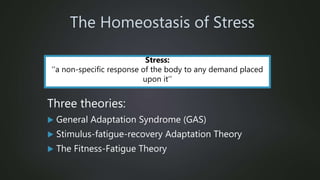
The Homeostasis of Stress
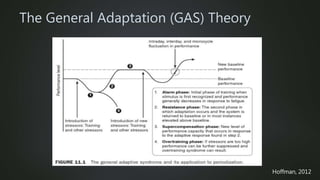
 General Adaptation Syndrome (GAS)
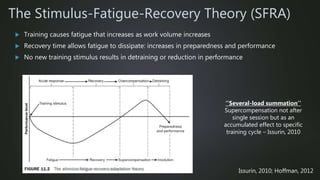
 Stimulus-fatigue-recovery Adaptation Theory
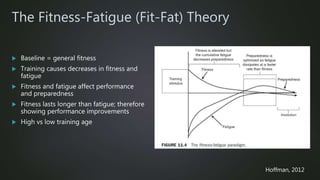
 The Fitness-Fatigue Theory
Three theories:
Stress:
‘’a non-specific response of the body to any demand placed
upon it’’
The General Adaptation (GAS) Theory
Hoffman, 2012
The Stimulus-Fatigue-Recovery Theory (SFRA)
 Training causes fatigue that increases as work volume increases
 Recovery time allows fatigue to dissipate: increases in preparedness and performance
 No new training stimulus results in detraining or reduction in performance
Issurin, 2010; Hoffman, 2012
‘’Several-load summation’’
Supercompensation not after
single session but as an
accumulated effect to specific
training cycle – Issurin, 2010
The Fitness-Fatigue (Fit-Fat) Theory
 Baseline = general fitness
 Training causes decreases in fitness and
fatigue
 Fitness and fatigue affect performance
and preparedness
 Fitness lasts longer than fatigue; therefore
showing performance improvements
 High vs low training age
Hoffman, 2012
Examples of Periodisation Models -
Explained
 Traditional
Matveyev’s ‘’Linear’’ Periodisation Model
 Non-traditional/ Undulating
Undulating Periodisation Model
Multi-Targeted Block Periodisation Model
Verkhoshanksky’s Concentrated Unidirectional Model
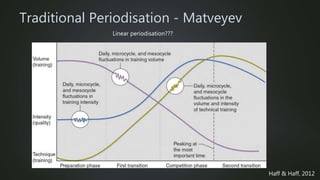
Traditional Periodisation - Matveyev
Haff & Haff, 2012
Linear periodisation???
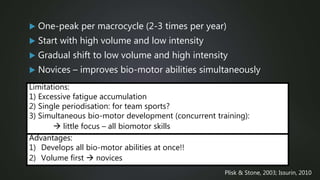
 One-peak per macrocycle (2-3 times per year)
 Start with high volume and low intensity
 Gradual shift to low volume and high intensity
 Novices – improves bio-motor abilities simultaneously
Plisk & Stone, 2003; Issurin, 2010
Limitations:
1) Excessive fatigue accumulation
2) Single periodisation: for team sports?
3) Simultaneous bio-motor development (concurrent training):
 little focus – all biomotor skills
Advantages:
1) Develops all bio-motor abilities at once!!
2) Volume first  novices
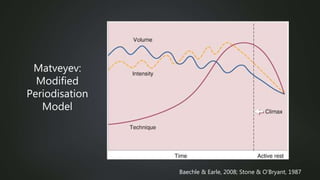
Matveyev:
Modified
Periodisation
Model
Baechle & Earle, 2008; Stone & O’Bryant, 1987
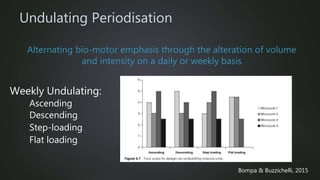
Undulating Periodisation
Alternating bio-motor emphasis through the alteration of volume
and intensity on a daily or weekly basis
Bompa & Buzzichelli, 2015
Ascending
Descending
Step-loading
Flat loading
Weekly Undulating:
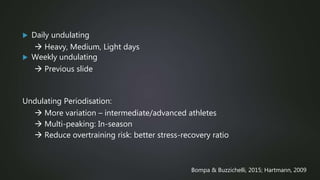
 Daily undulating
 Heavy, Medium, Light days
 Weekly undulating
 Previous slide
Undulating Periodisation:
 More variation – intermediate/advanced athletes
 Multi-peaking: In-season
 Reduce overtraining risk: better stress-recovery ratio
Bompa & Buzzichelli, 2015; Hartmann, 2009
Block Periodisation
1) Concentrated Unidirectional Periodisation Model (CU)
- Verkhoshansky:
‘’ A high concentration of specialised workloads for more pronounced
training simulation’’.
2) Multi-Targeted Training Model:
‘’The development of many targeted abilities within sequenced block
mesocycles containing mammal number of compatible training
modalities’’.
Issurin, 2016
Concentrated Unidirectional Block Periodisation
 Uni-directional: intense emphasis of one (upkeep of others?)
 Based on long-term speed-strength training studies
 Specifically jumping
 Concentrated workload causes an initial decline in performance
 postponed gains
 Concentrated workload: how to distinguish fatigue from accumulation or fatigue due
to overtraining
De Weese et al. 2015, Issurin, 2016
CU Objective:
Planned Overreaching - promoting the ‘’long-term lagging training effect’’ (LLTE)
Detraining?
X – no consideration for the residual training effect - X
Different articles by same authors
recommend different guidelines!
Issurin, 2016
Power/Strength  More sport-specific  Event Specific
‘’The Big Adaptation’’ Cycle
2-3 months 2 months 3-5 weeks
CU:
 Increased training stimulation
 Small number of training components required e.g. jumping performance
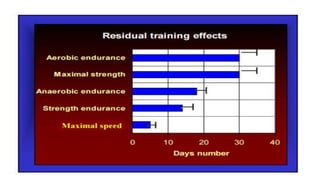
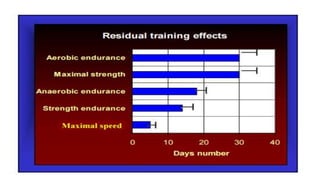
 Long blocks: residual training effect (not taken into account by Verkhoshansky)
 Double periodisation style (2 peaks)
 Studies do not show impact upon sports; only upon strength programme
22-26 weeks in total
Issurin, 2016
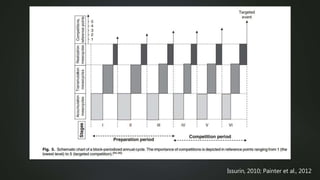
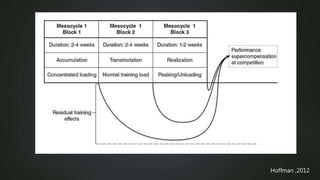
- Accumulation: developing basic abilities and general technique/ movement
- High volume; relatively lower intensity
- Balance, muscular strength, aerobic endurance
- 2-6 weeks
- Transformation: more sport-specific and event-technique
- Strength endurance and ‘’proper’’ technique and tactics
- 2-4 weeks (more intense)
- Realisation: Pre-competition phase – max speed and taper
- Race specific drills and technique work
- Active recovery
- 8-15 days
**Training stage lasts 5-10 weeks; 4-7 stages in annual plan’’
***Critical to consider the residual training effects of each bio-motor component***
Multi-Targeted Training Models
Issurin, 2016
Focuses on improving more than one aspect!
Issurin, 2010; Painter et al., 2012
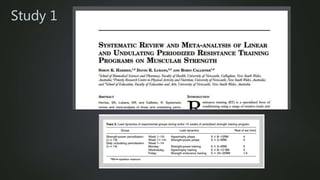
Study 1
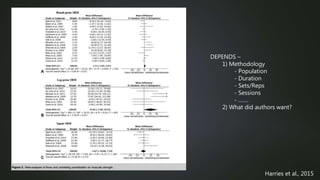
Harries et al., 2015
DEPENDS –
1) Methodology
- Population
- Duration
- Sets/Reps
- Sessions
- …….
2) What did authors want?
Team Sports
Off-season, in-season and pre-season instead of preparatory, competitive and transition phases
Issurin, 2016
Track and Field Periodisation
 Often double periodisation – indoor and outdoor seasons
 Winkelman (2009) – undulating/ conjugate
 Athletics NI – moving away from periodisation?
 Be 4-5 weeks away from competition at any time
Less accumulated fatigue in block phase? Painter et al., 2012
Athlete Case Study
NOT
AVAILABLE
References
Provided via Email/ JaFar
Thanks for
Listening!!!
Hoffman ,2012

Strength and Conditioning - Periodisation

  • 1.
  • 2.
    Overview  Periodisation: defined Principles of training: ASPORT  The Homeostasis of Stress: the theories General Adaptation Syndrome (GAS) Stimulus-fatigue-recovery theory (SFRA) Fitness-fatigue Theory (Fit-Fat)  Main types of periodisation: Traditional Periodisation Undulatory Periodisation Block Periodisation  Periodisation for sprinting: the research  *Athlete 1* case study The annual plan: objectives (SWOT), key variables, monitoring/ testing, external factors etc.
  • 3.
    Periodisation defined as… Turner,2011 ‘’…a training plan, whereby peak performance is brought about through the potentiation of biomotors and the management of fatigue and accommodation.’’ MicrocycleMesocycleMacrocycleQuadrennial Cycle
  • 4.
    The Need forPeriodisation 1. Preparatory Phase: builds a strong base 2. Competitive Phase: maximises performance capacity 3. Transition: to recover and prepare  Sequential progression of specific performance components: reduces overtraining risk  Maintenance of physical components; improvements of other components  Alteration of intensity and volume assists in skill development *Peak performance for major competitions* Bompa & Haff, 2009
  • 5.
    Principles of Training Periodisationhelps avoid accommodation  Specificity – sport and individual  Progression  Overload - FITT  Reversibility  Tedium - Motivation  Diminishing Returns  Variation  Tapering Frontera, 2007; Hoffman, 2014
  • 6.
    The Homeostasis ofStress  General Adaptation Syndrome (GAS)  Stimulus-fatigue-recovery Adaptation Theory  The Fitness-Fatigue Theory Three theories: Stress: ‘’a non-specific response of the body to any demand placed upon it’’
  • 7.
    The General Adaptation(GAS) Theory Hoffman, 2012
  • 8.
    The Stimulus-Fatigue-Recovery Theory(SFRA)  Training causes fatigue that increases as work volume increases  Recovery time allows fatigue to dissipate: increases in preparedness and performance  No new training stimulus results in detraining or reduction in performance Issurin, 2010; Hoffman, 2012 ‘’Several-load summation’’ Supercompensation not after single session but as an accumulated effect to specific training cycle – Issurin, 2010
  • 9.
    The Fitness-Fatigue (Fit-Fat)Theory  Baseline = general fitness  Training causes decreases in fitness and fatigue  Fitness and fatigue affect performance and preparedness  Fitness lasts longer than fatigue; therefore showing performance improvements  High vs low training age Hoffman, 2012
  • 10.
    Examples of PeriodisationModels - Explained  Traditional Matveyev’s ‘’Linear’’ Periodisation Model  Non-traditional/ Undulating Undulating Periodisation Model Multi-Targeted Block Periodisation Model Verkhoshanksky’s Concentrated Unidirectional Model
  • 11.
    Traditional Periodisation -Matveyev Haff & Haff, 2012 Linear periodisation???
  • 12.
     One-peak permacrocycle (2-3 times per year)  Start with high volume and low intensity  Gradual shift to low volume and high intensity  Novices – improves bio-motor abilities simultaneously Plisk & Stone, 2003; Issurin, 2010 Limitations: 1) Excessive fatigue accumulation 2) Single periodisation: for team sports? 3) Simultaneous bio-motor development (concurrent training):  little focus – all biomotor skills Advantages: 1) Develops all bio-motor abilities at once!! 2) Volume first  novices
  • 13.
  • 14.
    Undulating Periodisation Alternating bio-motoremphasis through the alteration of volume and intensity on a daily or weekly basis Bompa & Buzzichelli, 2015 Ascending Descending Step-loading Flat loading Weekly Undulating:
  • 15.
     Daily undulating Heavy, Medium, Light days  Weekly undulating  Previous slide Undulating Periodisation:  More variation – intermediate/advanced athletes  Multi-peaking: In-season  Reduce overtraining risk: better stress-recovery ratio Bompa & Buzzichelli, 2015; Hartmann, 2009
  • 16.
    Block Periodisation 1) ConcentratedUnidirectional Periodisation Model (CU) - Verkhoshansky: ‘’ A high concentration of specialised workloads for more pronounced training simulation’’. 2) Multi-Targeted Training Model: ‘’The development of many targeted abilities within sequenced block mesocycles containing mammal number of compatible training modalities’’. Issurin, 2016
  • 17.
    Concentrated Unidirectional BlockPeriodisation  Uni-directional: intense emphasis of one (upkeep of others?)  Based on long-term speed-strength training studies  Specifically jumping  Concentrated workload causes an initial decline in performance  postponed gains  Concentrated workload: how to distinguish fatigue from accumulation or fatigue due to overtraining De Weese et al. 2015, Issurin, 2016
  • 18.
    CU Objective: Planned Overreaching- promoting the ‘’long-term lagging training effect’’ (LLTE) Detraining? X – no consideration for the residual training effect - X Different articles by same authors recommend different guidelines! Issurin, 2016
  • 20.
    Power/Strength  Moresport-specific  Event Specific ‘’The Big Adaptation’’ Cycle 2-3 months 2 months 3-5 weeks CU:  Increased training stimulation  Small number of training components required e.g. jumping performance  Long blocks: residual training effect (not taken into account by Verkhoshansky)  Double periodisation style (2 peaks)  Studies do not show impact upon sports; only upon strength programme 22-26 weeks in total Issurin, 2016
  • 21.
    - Accumulation: developingbasic abilities and general technique/ movement - High volume; relatively lower intensity - Balance, muscular strength, aerobic endurance - 2-6 weeks - Transformation: more sport-specific and event-technique - Strength endurance and ‘’proper’’ technique and tactics - 2-4 weeks (more intense) - Realisation: Pre-competition phase – max speed and taper - Race specific drills and technique work - Active recovery - 8-15 days **Training stage lasts 5-10 weeks; 4-7 stages in annual plan’’ ***Critical to consider the residual training effects of each bio-motor component*** Multi-Targeted Training Models Issurin, 2016 Focuses on improving more than one aspect!
  • 22.
  • 24.
  • 25.
    Harries et al.,2015 DEPENDS – 1) Methodology - Population - Duration - Sets/Reps - Sessions - ……. 2) What did authors want?
  • 26.
    Team Sports Off-season, in-seasonand pre-season instead of preparatory, competitive and transition phases Issurin, 2016
  • 27.
    Track and FieldPeriodisation  Often double periodisation – indoor and outdoor seasons  Winkelman (2009) – undulating/ conjugate  Athletics NI – moving away from periodisation?  Be 4-5 weeks away from competition at any time Less accumulated fatigue in block phase? Painter et al., 2012
  • 28.
  • 29.
  • 30.
  • 31.

Editor's Notes

  • #4 Careful manipulation of load and intensity (these factors share an inverse relationship) CHECK BIOMOTORS -
  • #7 Competition and intense training create a large amount of physiological stress and cumulative fatigue. If this stress is applied for too long, overtraining can occur and performance capacity will decrease. Therefore stressful training or competition phases should be alternated with periods of recovbery and regeneration. These types of phases are transition phases that will decrease fatigue and allow the athlete to prepares for the next phase of training.
  • #8  Alarm Phase - Stress hormones released into bloodstream  interferes with rate of body’s processes Resistance Phase – Ability to tolerate specific stress is enhanced but body is susceptible to other stresses i.e. psychosomatic disorders Exhaustion Phase – Continued stress = depleted stress hormones  drains body Emotional, behaviour, physical Coon & Mitterer, 2013 Pscyhosomatic disorders – delayed effect  shows itself in exhaustion phase The GAS paradigm describes the body’s physiological response to stress, which, according to Selye (66), is the same despite the stressor. The GAS assumes 3 distinct phases during stress, which, for the following example, will be an exercise training session. The alarm phase (phase 1) represents the recognition and initial response to the session. This may be in the form of fatigue, stiffness, or delayed onset of muscle soreness for example. The resistance phase (phase 2) is then initiated in which the body is returned to either its pre-exercise session homeostasis or its new adapted higher state (i.e., supercompensation occurs). Finally, and assuming that the accumulation of stress is too great (e.g., the absence of an unloading week), the exhaustion phase (phase 3) occurs, and this may be considered synonymous with overtraining (74). The GAS is depicted in Figure 5.
  • #9 The SFRA concept (80,81,83) suggests that fatigue accumulates in proportion to the strength and duration of a stimulus. Then, after the stimulus, for example, an exercise session, the body is rested, enabling fatigue to dissipate and adaptations (often referred to as supercompensation) to occur. This concept also suggests that if the stress is not applied with sufficient frequency (also known as density), detraining (also known as involution) will occur. Moreover, involution time is influenced by the length of the preparation period (74), with the greater the duration of a training program, the greater the residual effects (Figure 3) (87). In addition, and by virtue of this, the subsequent preparation phases inherent to bi- and tricycles can progressively decrease. The significance of preparation has been previously discussed within this article. The SFRA concept is illustrated in Figure 6. The SFRA concept is also used to describe the supercompensation observed after periods of planned overreaching (81,83). For example, the accumulation of fatigue from the sequential execution of similar training sessions (i.e., a concentrated primarily unidirectional loading of strength/ power training) is superimposed on one another (Figure 7). This, therefore, leads to excessive fatigue and acutely (almost equal to 4 weeks) diminished strength and power capabilities. However, after the return to normal training (and by virtue of a delayed training effect phenomenon), they then rebound beyond their initial values (20,69). This strategy, however, is reserved for elite level athletes, whose window for adaptation is small, and therefore requires more intense interventions to bring about a supercompensation response (5). Planned overreaching strategies are briefly discussed later in this article.
  • #10 Winkleman (2009) suggests that the fitness-fatigue model (FFM) provides a good understanding of training effects. This model describes effects upon the baseline of general fitness as either positive (fitness) and negative (fatigue). The FFM emphasises the importance of a deload week, or taper towards an important event, especially as the effects of fitness last longer than that of fatigue as stated by this model. Therefore, performance becomes positive, even as training load and fitness decrease, due to a more rapid decline in fatigue level (Stone et al., 2007). The aim is to limit the risk of overtraining while providing an optimal stimulus for performance improvements (Spineti et al., 2013). Furthermore, Stone et al. (2007) stipulates that heavy loaded strength exercises (e.g. 90% 1RM back squat for 3 reps) may enhance the power output of a subsequent power movement; this concept is known as postactivation potentiation. The strength movement should not produce fatigue greater than the provided fitness effect however. Winkleman (2009) also suggests that strength training for the elite should follow the undulating model (UM) whereby focus is oscillated between three week blocks of intensity and volume. Currently, this is the most prevailing theory of training and adaptation (7,64,74) and is considered the basic Table 1 The principle phases and subphases of periodization Training phase Preparatory phase GPT SSPT Competitive phase Phase objective [ aerobic and anaerobic capacity; [ neuromuscular functioning Develop and perfect sport-specific biomotors Maintain biomotor conditioning Information attained from Bompa and Haff (5). GPT = general physical training; SSPT = sport-specific physical training; [ = increase. Figure 3. A 3:1 loading paradigm (information attained from Bompa and Haff (5) and Stone et al. (74)) VL = volume load. 36 VOLUME 33 | NUMBER 1 | FEBRUARY 2011 Science and Practice of Periodization tenet of a taper (discussed later in this article) (56). According to this paradigm, athlete preparedness may be evaluated based on the principle aftereffects of training: fitness and fatigue (87). Unlike the GAS and SFRA concepts, which assume that fitness and fatigue share a cause and effect relationship, the Fit-Fat model suggests that they demonstrate an inverse relationship. This, therefore, implies that strategies that maximize fitness and minimize fatigue will have the greatest potential to optimize athlete preparedness (74). The Fit-Fat concept is illustrated in Figure 8. An additional key difference between the Fit-Fat concept and the aforementioned models is that it differentiates between the actions of various stressors, such as neuromuscular and metabolic stress (7) and therefore implies that the aftereffects of fitness and fatigue are exercise specific (74,87). This suggests that if the athlete is too tired to repeat the same exercise with an acceptable quality (as measured by power output or form for example), they may still be able to perform another exercise to satisfaction (Figure 9). This, for example, provides the basic tenet to hypertrophy programs incorporating 3- to 5-day splits and concurrent training involving both aerobic and resistance workouts.
  • #13 How to distinguish between a long mesocycles or a short microcycle? How you break it down probably? It would be great if bio-motor abilities did not affect or influence others – no periodisaiton required! Novices or those unaccustomed to high intensities – slow changes 5 biomotor abilities of strength, fleixibilty, speed, endurance and coordintation/balance
  • #19 A – accumulation B – intensification
  • #22 Accumulation – improving training capacity Transformation –enhancing athletic performance Issurin – stages at start of phase last 3 months and at end last 25 days General biomotor abilities have larger residual effect than specifc Routine testing battery and performance monitored for effects  future transmutation phase being lengthened or shortened from feedback of previous phase  then use best response for the major competition
  • #25 No significant difference between linear and DUP – CONSIDER THE STRENGTH ENDURANCE DAY IN DUP THOUGH!! WOULD THIS HAVE BEEN DIFFERENT IF THERE WAS ANOTHER STRENGTH DAY IN?
  • #26 ALL DEPENDS – DIFFERENT STUDIES SHOWING DIFFERENT THINGS REMEMBER ALL ATHLETES MAY RESPOND DIFFERENTLY!
  • #27 Don’t use linear periodisation Off-season (general prep) Pre-season (specific prep) In-season (comp) Post-season {Trans) Off-season – conditioning and recovery Transistion – recovery Pre-season – sport specific technique, speed work In-season – maintenance and tactics
  • #28 Block is better than dup – in paper…states that research is conflicting
  • #29 Mixture – Conjugated -> the line graph with biomotor skills Multi-targeted Figure – training intensity is inversely correlated with the time a performance peak can be maintained and the height of that performance peak (Stone et al., 74) (P = performance; T = time)
  • #30 Coon, D., & Mitterer, J. O. (2013). Psychology: A journey. Cengage Learning. Frontera, W. R. (2007). Clinical sports medicine: medical management and rehabilitation. Elsevier Health Sciences. Hoffman, J. (2014). Physiological aspects of sport training and performance. Human Kinetics. Hoffman, J., & Conditioning Association. (2012). NSCA's Guide to Program Design. Human Kinetics. Harries, S. K., Lubans, D. R., & Callister, R. (2015). Systematic review and meta-analysis of linear and undulating periodized resistance training programs on muscular strength. The Journal of Strength & Conditioning Research, 29(4), 1113-1125. Issurin, V. B. (2016). Benefits and limitations of block periodized training approaches to athletes’ preparation: a review. Sports Medicine, 46(3), 329-338
  • #32 Modified Verkhoshansky – ask for his two papers so that I can read to check which is right