Strength Exercise
Techniques
Now we’re getting somewhere!
General Strength Exercises
 Back Squat
 Front Squat
 Deadlift
 Bench Press
 Barbell Row
 Shoulder Press
Back Squat
 The Barbell Back Squat has been
referred to as “the king of lifts”.
 It should be found in some form or
another in almost any resistance training
program for a given sport
Back Squat
 Muscles involved:
◦ Quadriceps
◦ Glutes
◦ Hamstrings
◦ Above are the main 3 according to NSCA, but
also heavily involved are spinal erectors and
core musculature
◦ The deeper the squat, the more emphasis on
the glute muscles and hamstrings. Shallow
squats are mostly working “anti-gravity”
muscles…quads and lower back.
Back Squat Types
 Many variations of squatting are out there.
The main three are:
◦ Olympic Squat
 Narrow stance, bar high on cervical vertebrae, rock
bottom depth (or at least close)
◦ Powerlifting Squat
 Wide stance, bar low on cervical vertebrae, and depth
to just parallel
◦ “Athletic Squat”
 Shoulder width or slightly wider stance, bar medium on
cervical vertebrae, parallel or slightly below parallel
depth
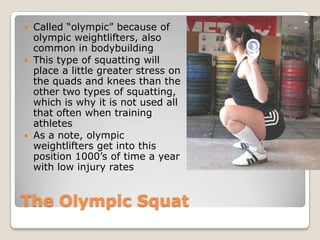
The Olympic Squat
 Called “olympic” because of
olympic weightlifters, also
common in bodybuilding
 This type of squatting will
place a little greater stress on
the quads and knees than the
other two types of squatting,
which is why it is not used all
that often when training
athletes
 As a note, olympic
weightlifters get into this
position 1000’s of time a year
with low injury rates
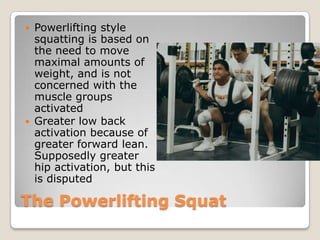
The Powerlifting Squat
 Powerlifting style
squatting is based on
the need to move
maximal amounts of
weight, and is not
concerned with the
muscle groups
activated
 Greater low back
activation because of
greater forward lean.
Supposedly greater
hip activation, but this
is disputed
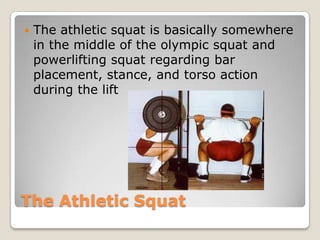
The Athletic Squat
 The athletic squat is basically somewhere
in the middle of the olympic squat and
powerlifting squat regarding bar
placement, stance, and torso action
during the lift
Athletic Squat Form
 Stance from: shoulder width to feet about
24” maximum
 Grip bar wider than shoulder width with
elbows pointing down and scapula retracted
and elevated (not too wide!)
 Toes are pointed slightly outward (up to 30
degrees) to prevent the knees from coming
together and to keep the focus on leg
strength
 Knees point the same direction as toes
during descent and ascent
Athletic Squat Form
 A breath is taken before descent (exhale on
the way down and up)
 The lift is initiated by flexing and pushing
back the hips
 The athlete lowers themselves until they
reach a position where the thighs are parallel
or slightly below parallel with the ground
 The chest should be elevated (big chest!)and
torso kept tight during the movement
 The torso leans forward as the hips go back,
this will not come naturally to many
beginners
Athletic Squat Form
 In the concentric phase the bar is lifted the
same path as the eccentric phase.
 The weight should be felt on the back 2/3 of
the foot during the lift (heels).
 The squat is considered complete when the
knees are almost completely, but not quite
extended (NSCA specific point)
 Although the above is true from a safety
standpoint, if maximal acceleration is being
applied to the bar, the knees will always
completely extend
Common Squat Faults
 Knees coming together
◦ Caused by weak legs (and stronger hips)
◦ This should ESPECIALLY be avoided in female athletes
because of the Q-angle and tendency for knees to come
together in dynamic movement
 Not enough depth
◦ Usually comes from not knowing how to “sit back”. The
movement is a backward squat, not a forward knee
bend. Can also be due to lack of flexibility in ankles.
 Rounded back
◦ If the athlete holds the bar too wide, or doesn’t keep a
“big chest”, or doesn’t keep their focus straight ahead or
slightly up, this can happen
Common Squat Variations
 Front Squat
 Split Squats
 1 and ¼ squats or 3 step squats
 Box Squats
 Partial Squats
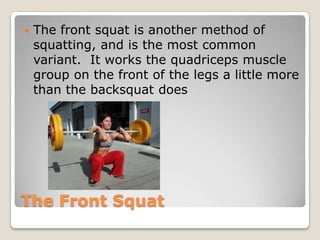
The Front Squat
 The front squat is another method of
squatting, and is the most common
variant. It works the quadriceps muscle
group on the front of the legs a little more
than the backsquat does
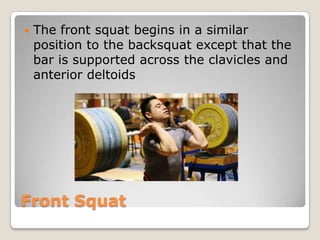
Front Squat
 The front squat begins in a similar
position to the backsquat except that the
bar is supported across the clavicles and
anterior deltoids
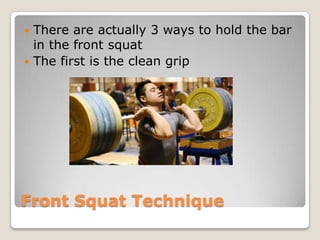
Front Squat Technique
 There are actually 3 ways to hold the bar
in the front squat
 The first is the clean grip
Front Squat Technique
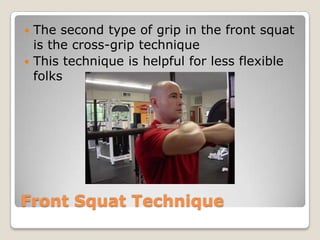
 The second type of grip in the front squat
is the cross-grip technique
 This technique is helpful for less flexible
folks
Front Squat Technique
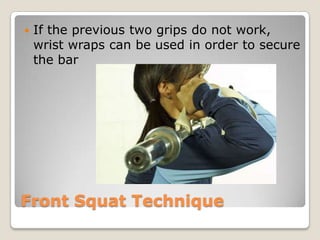
 If the previous two grips do not work,
wrist wraps can be used in order to secure
the bar
Front Squat Technique
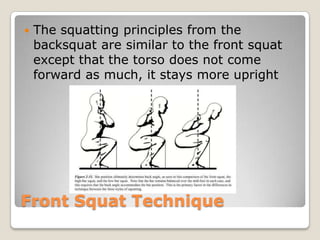
 The squatting principles from the
backsquat are similar to the front squat
except that the torso does not come
forward as much, it stays more upright
1 and ¼ Squat
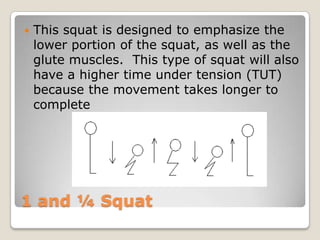
 This squat is designed to emphasize the
lower portion of the squat, as well as the
glute muscles. This type of squat will also
have a higher time under tension (TUT)
because the movement takes longer to
complete
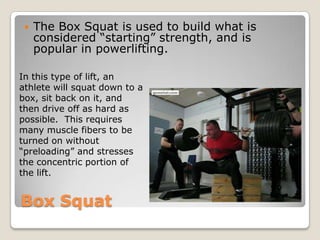
Box Squat
 The Box Squat is used to build what is
considered “starting” strength, and is
popular in powerlifting.
In this type of lift, an
athlete will squat down to a
box, sit back on it, and
then drive off as hard as
possible. This requires
many muscle fibers to be
turned on without
“preloading” and stresses
the concentric portion of
the lift.
Split Squats and Single Leg
Variants
 Unilateral (single side) strength is important
when it comes to many sporting events
 Although SL strength is important, SL squats will
have a supporting role (as opposed to the
primary exercise)in many training programs,
mostly because of two reasons
◦ Single leg squats require a balance element, which can
make it difficult to achieve maximal muscle tension
◦ Most athletes have a “bilateral strength deficit”. This
means that the strength of the two separately single legs
added together can be more than the total effort the two
legs can produce working together
◦ Single leg work will play a greater role in programs that
are shooting for special and specific strength
development
Split Squats
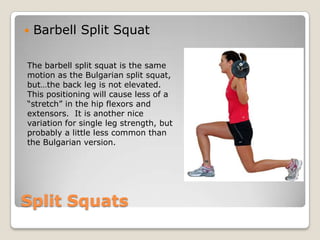
 Barbell Split Squat
The barbell split squat is the same
motion as the Bulgarian split squat,
but…the back leg is not elevated.
This positioning will cause less of a
“stretch” in the hip flexors and
extensors. It is another nice
variation for single leg strength, but
probably a little less common than
the Bulgarian version.
Split Squats
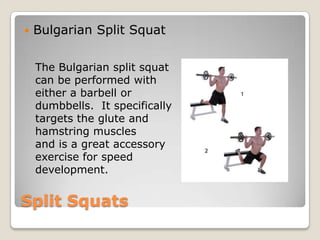
 Bulgarian Split Squat
The Bulgarian split squat
can be performed with
either a barbell or
dumbbells. It specifically
targets the glute and
hamstring muscles
and is a great accessory
exercise for speed
development.
Split Squats
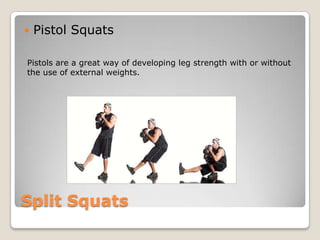
 Pistol Squats
Pistols are a great way of developing leg strength with or without
the use of external weights.
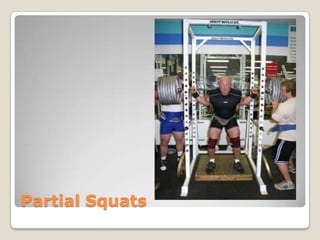
Partial Squats
Partial Squats
 Doing any squat short of parallel will
guarantee backlash from “strength experts”.
 Typically, semi-squats will come closer to the
joint angles found in most sports, and can
thus, overload that specific joint angle.
 They can and should be used, but probably
shouldn’t be used exclusively (see page 123
of the text). They place higher force on the
lumbar spine.
 Partial squats are useful “in season”, due to
the fact that they are a little less draining
than full squats.

Strength exercise techniques

  • 1.
  • 2.
    General Strength Exercises Back Squat  Front Squat  Deadlift  Bench Press  Barbell Row  Shoulder Press
  • 3.
    Back Squat  TheBarbell Back Squat has been referred to as “the king of lifts”.  It should be found in some form or another in almost any resistance training program for a given sport
  • 4.
    Back Squat  Musclesinvolved: ◦ Quadriceps ◦ Glutes ◦ Hamstrings ◦ Above are the main 3 according to NSCA, but also heavily involved are spinal erectors and core musculature ◦ The deeper the squat, the more emphasis on the glute muscles and hamstrings. Shallow squats are mostly working “anti-gravity” muscles…quads and lower back.
  • 5.
    Back Squat Types Many variations of squatting are out there. The main three are: ◦ Olympic Squat  Narrow stance, bar high on cervical vertebrae, rock bottom depth (or at least close) ◦ Powerlifting Squat  Wide stance, bar low on cervical vertebrae, and depth to just parallel ◦ “Athletic Squat”  Shoulder width or slightly wider stance, bar medium on cervical vertebrae, parallel or slightly below parallel depth
  • 6.
    The Olympic Squat Called “olympic” because of olympic weightlifters, also common in bodybuilding  This type of squatting will place a little greater stress on the quads and knees than the other two types of squatting, which is why it is not used all that often when training athletes  As a note, olympic weightlifters get into this position 1000’s of time a year with low injury rates
  • 7.
    The Powerlifting Squat Powerlifting style squatting is based on the need to move maximal amounts of weight, and is not concerned with the muscle groups activated  Greater low back activation because of greater forward lean. Supposedly greater hip activation, but this is disputed
  • 8.
    The Athletic Squat The athletic squat is basically somewhere in the middle of the olympic squat and powerlifting squat regarding bar placement, stance, and torso action during the lift
  • 9.
    Athletic Squat Form Stance from: shoulder width to feet about 24” maximum  Grip bar wider than shoulder width with elbows pointing down and scapula retracted and elevated (not too wide!)  Toes are pointed slightly outward (up to 30 degrees) to prevent the knees from coming together and to keep the focus on leg strength  Knees point the same direction as toes during descent and ascent
  • 10.
    Athletic Squat Form A breath is taken before descent (exhale on the way down and up)  The lift is initiated by flexing and pushing back the hips  The athlete lowers themselves until they reach a position where the thighs are parallel or slightly below parallel with the ground  The chest should be elevated (big chest!)and torso kept tight during the movement  The torso leans forward as the hips go back, this will not come naturally to many beginners
  • 11.
    Athletic Squat Form In the concentric phase the bar is lifted the same path as the eccentric phase.  The weight should be felt on the back 2/3 of the foot during the lift (heels).  The squat is considered complete when the knees are almost completely, but not quite extended (NSCA specific point)  Although the above is true from a safety standpoint, if maximal acceleration is being applied to the bar, the knees will always completely extend
  • 12.
    Common Squat Faults Knees coming together ◦ Caused by weak legs (and stronger hips) ◦ This should ESPECIALLY be avoided in female athletes because of the Q-angle and tendency for knees to come together in dynamic movement  Not enough depth ◦ Usually comes from not knowing how to “sit back”. The movement is a backward squat, not a forward knee bend. Can also be due to lack of flexibility in ankles.  Rounded back ◦ If the athlete holds the bar too wide, or doesn’t keep a “big chest”, or doesn’t keep their focus straight ahead or slightly up, this can happen
  • 13.
    Common Squat Variations Front Squat  Split Squats  1 and ¼ squats or 3 step squats  Box Squats  Partial Squats
  • 14.
    The Front Squat The front squat is another method of squatting, and is the most common variant. It works the quadriceps muscle group on the front of the legs a little more than the backsquat does
  • 15.
    Front Squat  Thefront squat begins in a similar position to the backsquat except that the bar is supported across the clavicles and anterior deltoids
  • 16.
    Front Squat Technique There are actually 3 ways to hold the bar in the front squat  The first is the clean grip
  • 17.
    Front Squat Technique The second type of grip in the front squat is the cross-grip technique  This technique is helpful for less flexible folks
  • 18.
    Front Squat Technique If the previous two grips do not work, wrist wraps can be used in order to secure the bar
  • 19.
    Front Squat Technique The squatting principles from the backsquat are similar to the front squat except that the torso does not come forward as much, it stays more upright
  • 20.
    1 and ¼Squat  This squat is designed to emphasize the lower portion of the squat, as well as the glute muscles. This type of squat will also have a higher time under tension (TUT) because the movement takes longer to complete
  • 21.
    Box Squat  TheBox Squat is used to build what is considered “starting” strength, and is popular in powerlifting. In this type of lift, an athlete will squat down to a box, sit back on it, and then drive off as hard as possible. This requires many muscle fibers to be turned on without “preloading” and stresses the concentric portion of the lift.
  • 22.
    Split Squats andSingle Leg Variants  Unilateral (single side) strength is important when it comes to many sporting events  Although SL strength is important, SL squats will have a supporting role (as opposed to the primary exercise)in many training programs, mostly because of two reasons ◦ Single leg squats require a balance element, which can make it difficult to achieve maximal muscle tension ◦ Most athletes have a “bilateral strength deficit”. This means that the strength of the two separately single legs added together can be more than the total effort the two legs can produce working together ◦ Single leg work will play a greater role in programs that are shooting for special and specific strength development
  • 23.
    Split Squats  BarbellSplit Squat The barbell split squat is the same motion as the Bulgarian split squat, but…the back leg is not elevated. This positioning will cause less of a “stretch” in the hip flexors and extensors. It is another nice variation for single leg strength, but probably a little less common than the Bulgarian version.
  • 24.
    Split Squats  BulgarianSplit Squat The Bulgarian split squat can be performed with either a barbell or dumbbells. It specifically targets the glute and hamstring muscles and is a great accessory exercise for speed development.
  • 25.
    Split Squats  PistolSquats Pistols are a great way of developing leg strength with or without the use of external weights.
  • 26.
  • 27.
    Partial Squats  Doingany squat short of parallel will guarantee backlash from “strength experts”.  Typically, semi-squats will come closer to the joint angles found in most sports, and can thus, overload that specific joint angle.  They can and should be used, but probably shouldn’t be used exclusively (see page 123 of the text). They place higher force on the lumbar spine.  Partial squats are useful “in season”, due to the fact that they are a little less draining than full squats.