

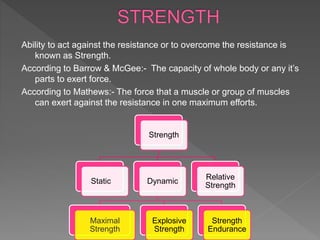

Ability to act against the resistance or to overcome the resistance is
known as Strength.
According to Barrow & McGee:- The capacity of whole body or any it’s
parts to exert force.
According to Mathews:- The force that a muscle or group of muscles
can exert against the resistance in one maximum efforts.
Strength
Static Dynamic
Maximal
Strength
Explosive
Strength
Strength
Endurance
Relative
Strength
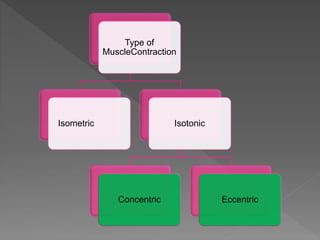
Type of
MuscleContraction
Isometric Isotonic
Concentric Eccentric
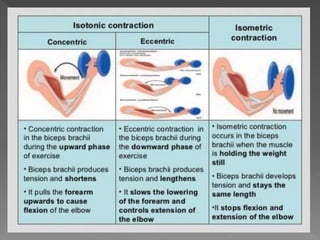
 Isometric is the combination of two words:-
Iso + metric where Iso means “Same” &
Metric means “measurement”.
 So during muscle contraction the length of
the muscles remains constant.
 Isometric is a form of exercise involving the
static contraction of a muscle without any
visible movement in the angle of joint.
 It is also the combination of 2 words:
Iso+Tonic where Iso means “Same” & Tonic
means “Tension/movement/motion”.
 During muscle contraction the length of the
muscles will be change & angle of joint also.
It is divided into 2 parts:-
1. Eccentric contraction
2. Concentric Contraction
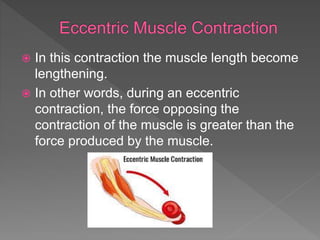
 In this contraction the muscle length become
lengthening.
 In other words, during an eccentric
contraction, the force opposing the
contraction of the muscle is greater than the
force produced by the muscle.
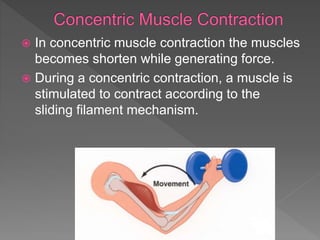
 In concentric muscle contraction the muscles
becomes shorten while generating force.
 During a concentric contraction, a muscle is
stimulated to contract according to the
sliding filament mechanism.
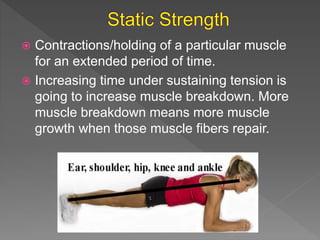
 Contractions/holding of a particular muscle
for an extended period of time.
 Increasing time under sustaining tension is
going to increase muscle breakdown. More
muscle breakdown means more muscle
growth when those muscle fibers repair.
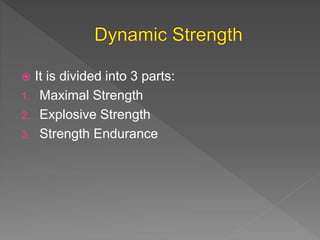
 It is divided into 3 parts:
1. Maximal Strength
2. Explosive Strength
3. Strength Endurance
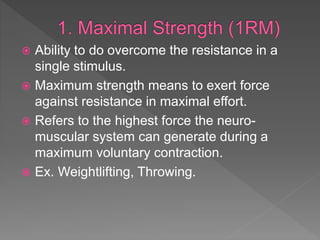
 Ability to do overcome the resistance in a
single stimulus.
 Maximum strength means to exert force
against resistance in maximal effort.
 Refers to the highest force the neuro-
muscular system can generate during a
maximum voluntary contraction.
 Ex. Weightlifting, Throwing.
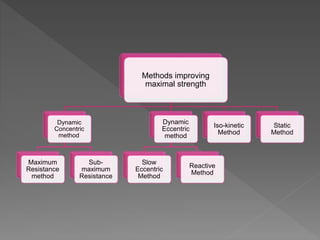
Methods improving
maximal strength
Dynamic
Concentric
method
Maximum
Resistance
method
Sub-
maximum
Resistance
Dynamic
Eccentric
method
Slow
Eccentric
Method
Reactive
Method
Iso-kinetic
Method
Static
Method
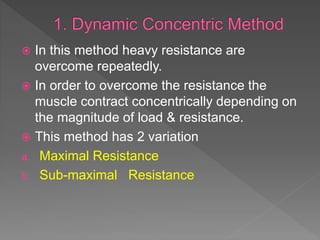
 In this method heavy resistance are
overcome repeatedly.
 In order to overcome the resistance the
muscle contract concentrically depending on
the magnitude of load & resistance.
 This method has 2 variation
a. Maximal Resistance
b. Sub-maximal Resistance
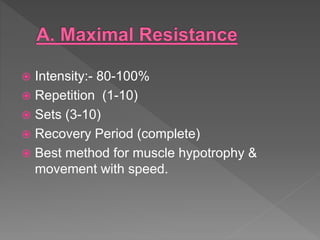
 Intensity:- 80-100%
 Repetition (1-10)
 Sets (3-10)
 Recovery Period (complete)
 Best method for muscle hypotrophy &
movement with speed.
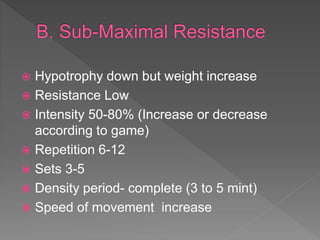
 Hypotrophy down but weight increase
 Resistance Low
 Intensity 50-80% (Increase or decrease
according to game)
 Repetition 6-12
 Sets 3-5
 Density period- complete (3 to 5 mint)
 Speed of movement increase
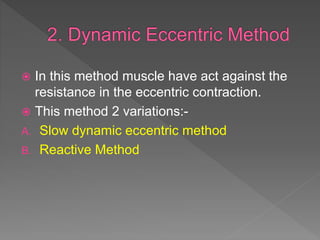
 In this method muscle have act against the
resistance in the eccentric contraction.
 This method 2 variations:-
A. Slow dynamic eccentric method
B. Reactive Method
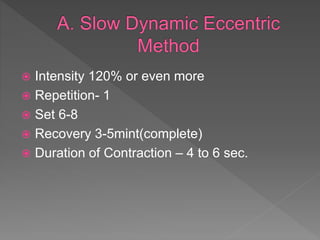
 Intensity 120% or even more
 Repetition- 1
 Set 6-8
 Recovery 3-5mint(complete)
 Duration of Contraction – 4 to 6 sec.
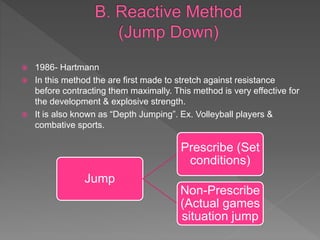
 1986- Hartmann
 In this method the are first made to stretch against resistance
before contracting them maximally. This method is very effective for
the development & explosive strength.
 It is also known as “Depth Jumping”. Ex. Volleyball players &
combative sports.
Jump
Prescribe (Set
conditions)
Non-Prescribe
(Actual games
situation jump
 Height of Box:- 40-120cm
 Repetition:- 6-8
 Recovery:- 5-8(complete)
 Total no. of jump in training session should
not be more than 50 jumps.
 It is used basic of leg muscles
 Landing when body angle 120-140degree &
upright:- 90-100 degree(knee) & optimum
range :- 30-50degree.
 This method was first introduced by J.J.
Perrine in 1968.
 This method involves a special type of
muscles contraction with the help of machine
called Iso-kinetic contraction.
 In Iso-kinetic contraction the muscles applies
maximal force only at a particular angle of
it’s range of movement.
 Ability to do overcome the resistance as fast
as possible. It is the combination of speed &
strength and sometime referred as “Power”.
 This special type of strength is of great
importance to the "explosive" events in
running, jumping and throwing.
 Further this is divided into
1. Start Strength
2. Strength Speed (Power)
3. Speed Strength
 Start Strength:- ability to develop maximal
muscles force during the starting phase of
the movement; sprint start
 Strength Speed:- ability to overcome heavy
resistance with high speed. Throws, jump
 Speed Strength:- It is the ability to overcome
lower resistance with high speed. Team
game., combat sports
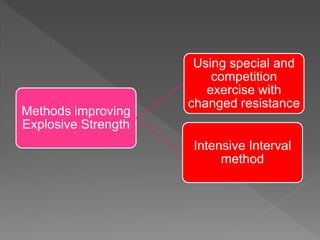
Methods improving
Explosive Strength
Using special and
competition
exercise with
changed resistance
Intensive Interval
method
 Resistance taken in increment (In this
variation the stress is on improving strength
element)
 Resistance become low (In this variation the
stress is on speed element)
 Examples: Various type of jumps with
additional resistance
 Short Sprint on slop.
 Given by Scholish (1988)
 Intensity:- 70-80%
 Repetition :- 8-12
 Recovery:- 90sec to 180sec
 Speed of movement:- Explosive
 Sets:- 3-5
 This method is very-very popular in world for combative
sports.
 In this method 3 types of resistance are used:
a) Opponent
b) Dummy
c) Passive Resistance (Mechanical Part)
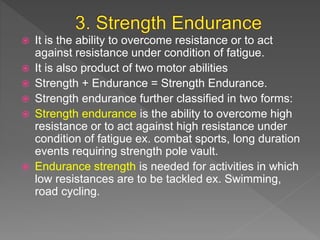
 It is the ability to overcome resistance or to act
against resistance under condition of fatigue.
 It is also product of two motor abilities
 Strength + Endurance = Strength Endurance.
 Strength endurance further classified in two forms:
 Strength endurance is the ability to overcome high
resistance or to act against high resistance under
condition of fatigue ex. combat sports, long duration
events requiring strength pole vault.
 Endurance strength is needed for activities in which
low resistances are to be tackled ex. Swimming,
road cycling.
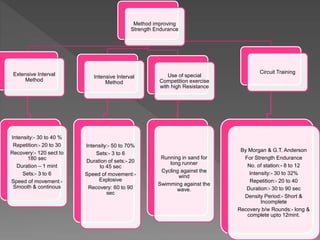
Method improving
Strength Endurance
Extensive Interval
Method
Intensity:- 30 to 40 %
Repetition:- 20 to 30
Recovery:- 120 sect to
180 sec
Duration – 1 mint
Sets:- 3 to 6
Speed of movement:-
Smooth & continous
Intensive Interval
Method
Intensity:- 50 to 70%
Sets:- 3 to 6
Duration of sets:- 20
to 45 sec
Speed of movement:-
Explosive
Recovery: 60 to 90
sec
Use of special
Competition exercise
with high Resistance
Running in sand for
long runner
Cycling against the
wind
Swimming against the
wave.
Circuit Training
By Morgan & G.T. Anderson
For Strength Endurance
No. of station:- 8 to 12
Intensity:- 30 to 32%
Repetition:- 20 to 40
Duration:- 30 to 90 sec
Density Period:- Short &
Incomplete
Recovery b/w Rounds:- long &
complete upto 12mint.
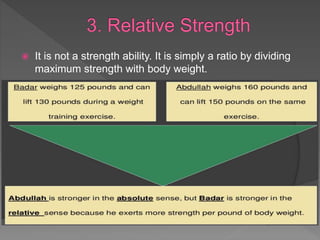
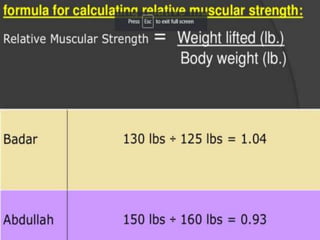
 It is not a strength ability. It is simply a ratio by dividing
maximum strength with body weight.
 Handgrip Test Procedure
 I-Repetition maximum or Bench Press test
 Upper body strength
 Isokinetic Testing

Strength & It's Method

  • 2.
    Ability to actagainst the resistance or to overcome the resistance is known as Strength. According to Barrow & McGee:- The capacity of whole body or any it’s parts to exert force. According to Mathews:- The force that a muscle or group of muscles can exert against the resistance in one maximum efforts. Strength Static Dynamic Maximal Strength Explosive Strength Strength Endurance Relative Strength
  • 3.
  • 4.
     Isometric isthe combination of two words:- Iso + metric where Iso means “Same” & Metric means “measurement”.  So during muscle contraction the length of the muscles remains constant.  Isometric is a form of exercise involving the static contraction of a muscle without any visible movement in the angle of joint.
  • 5.
     It isalso the combination of 2 words: Iso+Tonic where Iso means “Same” & Tonic means “Tension/movement/motion”.  During muscle contraction the length of the muscles will be change & angle of joint also. It is divided into 2 parts:- 1. Eccentric contraction 2. Concentric Contraction
  • 6.
     In thiscontraction the muscle length become lengthening.  In other words, during an eccentric contraction, the force opposing the contraction of the muscle is greater than the force produced by the muscle.
  • 7.
     In concentricmuscle contraction the muscles becomes shorten while generating force.  During a concentric contraction, a muscle is stimulated to contract according to the sliding filament mechanism.
  • 9.
     Contractions/holding ofa particular muscle for an extended period of time.  Increasing time under sustaining tension is going to increase muscle breakdown. More muscle breakdown means more muscle growth when those muscle fibers repair.
  • 10.
     It isdivided into 3 parts: 1. Maximal Strength 2. Explosive Strength 3. Strength Endurance
  • 11.
     Ability todo overcome the resistance in a single stimulus.  Maximum strength means to exert force against resistance in maximal effort.  Refers to the highest force the neuro- muscular system can generate during a maximum voluntary contraction.  Ex. Weightlifting, Throwing.
  • 12.
  • 13.
     In thismethod heavy resistance are overcome repeatedly.  In order to overcome the resistance the muscle contract concentrically depending on the magnitude of load & resistance.  This method has 2 variation a. Maximal Resistance b. Sub-maximal Resistance
  • 14.
     Intensity:- 80-100% Repetition (1-10)  Sets (3-10)  Recovery Period (complete)  Best method for muscle hypotrophy & movement with speed.
  • 15.
     Hypotrophy downbut weight increase  Resistance Low  Intensity 50-80% (Increase or decrease according to game)  Repetition 6-12  Sets 3-5  Density period- complete (3 to 5 mint)  Speed of movement increase
  • 16.
     In thismethod muscle have act against the resistance in the eccentric contraction.  This method 2 variations:- A. Slow dynamic eccentric method B. Reactive Method
  • 17.
     Intensity 120%or even more  Repetition- 1  Set 6-8  Recovery 3-5mint(complete)  Duration of Contraction – 4 to 6 sec.
  • 18.
     1986- Hartmann In this method the are first made to stretch against resistance before contracting them maximally. This method is very effective for the development & explosive strength.  It is also known as “Depth Jumping”. Ex. Volleyball players & combative sports. Jump Prescribe (Set conditions) Non-Prescribe (Actual games situation jump
  • 19.
     Height ofBox:- 40-120cm  Repetition:- 6-8  Recovery:- 5-8(complete)  Total no. of jump in training session should not be more than 50 jumps.  It is used basic of leg muscles  Landing when body angle 120-140degree & upright:- 90-100 degree(knee) & optimum range :- 30-50degree.
  • 20.
     This methodwas first introduced by J.J. Perrine in 1968.  This method involves a special type of muscles contraction with the help of machine called Iso-kinetic contraction.  In Iso-kinetic contraction the muscles applies maximal force only at a particular angle of it’s range of movement.
  • 21.
     Ability todo overcome the resistance as fast as possible. It is the combination of speed & strength and sometime referred as “Power”.  This special type of strength is of great importance to the "explosive" events in running, jumping and throwing.  Further this is divided into 1. Start Strength 2. Strength Speed (Power) 3. Speed Strength
  • 22.
     Start Strength:-ability to develop maximal muscles force during the starting phase of the movement; sprint start  Strength Speed:- ability to overcome heavy resistance with high speed. Throws, jump  Speed Strength:- It is the ability to overcome lower resistance with high speed. Team game., combat sports
  • 23.
    Methods improving Explosive Strength Usingspecial and competition exercise with changed resistance Intensive Interval method
  • 24.
     Resistance takenin increment (In this variation the stress is on improving strength element)  Resistance become low (In this variation the stress is on speed element)  Examples: Various type of jumps with additional resistance  Short Sprint on slop.
  • 25.
     Given byScholish (1988)  Intensity:- 70-80%  Repetition :- 8-12  Recovery:- 90sec to 180sec  Speed of movement:- Explosive  Sets:- 3-5  This method is very-very popular in world for combative sports.  In this method 3 types of resistance are used: a) Opponent b) Dummy c) Passive Resistance (Mechanical Part)
  • 26.
     It isthe ability to overcome resistance or to act against resistance under condition of fatigue.  It is also product of two motor abilities  Strength + Endurance = Strength Endurance.  Strength endurance further classified in two forms:  Strength endurance is the ability to overcome high resistance or to act against high resistance under condition of fatigue ex. combat sports, long duration events requiring strength pole vault.  Endurance strength is needed for activities in which low resistances are to be tackled ex. Swimming, road cycling.
  • 27.
    Method improving Strength Endurance ExtensiveInterval Method Intensity:- 30 to 40 % Repetition:- 20 to 30 Recovery:- 120 sect to 180 sec Duration – 1 mint Sets:- 3 to 6 Speed of movement:- Smooth & continous Intensive Interval Method Intensity:- 50 to 70% Sets:- 3 to 6 Duration of sets:- 20 to 45 sec Speed of movement:- Explosive Recovery: 60 to 90 sec Use of special Competition exercise with high Resistance Running in sand for long runner Cycling against the wind Swimming against the wave. Circuit Training By Morgan & G.T. Anderson For Strength Endurance No. of station:- 8 to 12 Intensity:- 30 to 32% Repetition:- 20 to 40 Duration:- 30 to 90 sec Density Period:- Short & Incomplete Recovery b/w Rounds:- long & complete upto 12mint.
  • 28.
     It isnot a strength ability. It is simply a ratio by dividing maximum strength with body weight.
  • 31.
     Handgrip TestProcedure  I-Repetition maximum or Bench Press test  Upper body strength  Isokinetic Testing