Physiology of Temperature Regulation
Introduction
• The normal body temperature range is 97°F (36°C) to 99°F (37.4°C) i.e. on an
average 98.8°F (37°C) when measured orally by a thermometer (0.5-1°F higher
if measured rectally).
• This body temperature is actually the core temperature which remains
constant except for when the person is suffering from febrile illness.
• There is also the skin temperature which in contrast to the core rises and falls
with the temperature of the surroundings.
• The temperature of the scrotum is as carefully regulated at 32°C.
Why is temperature regulation necessary?
• As we are warm blooded animals, the body temperature remains
within a limited constant value 37°C (±1°C).
• The internal temperature is independent of the environmental
temperature.
• Body maintains this temperature because-
• Speed of reactions in our body varies with temperature
• Enzymes in our body have a narrow range for optimum
functioning.
The body (core) temperature homeostasis is
controlled by balancing heat gain and the heat loss.
Heat Gain
Heat can be gained from the surrounding by radiation and conduction.
It can also be produced as a by-product of metabolism.
Main factors for production are -
• BMR of all the cells of the body.
• Hormonal effect, mainly by Thyroxin (to lesser extent by GH and testosterone).
• extra rate of metabolism due to muscle activity and work.
• extra rate of metabolism for food digestion, absorption and storage.
• sympathetic stimulation by the effect of epinephrine and norepinephrine.
Heat Loss
• Heat is primarily lost from the exposed body surface.
• Body heat is lost by-
• Radiation ~ 70%
• Vaporization of sweat ~27%
• Respiration ~2%
• Urination and defecation ~1%
Role Of Hypothalamus
• The temperature of the body is regulated almost entirely by nervous
feedback mechanisms.
• The anterior hypothalamic-preoptic area contains large numbers of
heat-sensitive neurons, as well as about one-third as many cold-
sensitive neurons.
• The heat-sensitive neurons increase their firing rate 2 to 10 fold in
response to a 10°C increase in body temperature.
• When the preoptic area is heated, the skin all over the body sweats
profusely, whereas the skin blood vessels become greatly dilated.
• Any excess heat production is also inhibited.
• Additional peripheral temperature receptors are present in the skin and in a
few specific deep tissues (the spinal cord, abdominal viscera, and in or around
the great veins) of the body.
• Deep receptors function differently from the skin receptors because they are
exposed to the body core temperature rather than the body surface
temperature. Yet, both temperature receptors, detect mainly cold rather than
warmth.
• It is probable that peripheral receptors are concerned primarily with preventing
hypothermia.
• The temperature sensory signals from the central and the peripheral receptors
are transmitted into posterior hypothalamus for integration and regulation.
Temperature-Decreasing Mechanisms When the Body Is Too Hot
• Vasodilation
• Sweating
• Decrease in thermogenesis
Temperature-Increasing Mechanisms When the Body Is Too Cold
• Vasoconstriction
• Piloerection
• Increased in thermogenesis
• Increased secretion of Epinephrine
Thermogenesis
• Heat production by the body to increase the temperature.
• By following means-
1. Shivering thermogenesis
2. Chemical or Nonshivering thermogenesis
a) Brown fat
b) Thyroxin (Long term)
Brown Fat
• Also known as brown adipose tissue (BAT).
• It produces heat to help maintain the body temperature in cold
conditions.
• It contains special mitochondria where uncoupled oxidation occurs.
• It is richly supplied with sympathetic nerves that release
norepinephrine, which causes expression of mitochondrial
uncoupling protein 1 (UCP1, also called thermogenin) and increases
thermogenesis.
• Most abundant in infants and decreases with age.
Thyroxine
• Cooling the anterior hypothalamic-preoptic area also increases
production of thyrotropin-releasing hormone by the hypothalamus.
• This stimulates anterior pituitary to produce TSH, which acts on Thyroid
to produce Thyroxine.
• This increased amount of thyroxine activates uncoupling protein and
causes thermogenesis.
• This increase in metabolism does not occur immediately but requires
long term (weeks) exposure to cold to make the thyroid gland
hypertrophy and reach its new level of thyroxine secretion.
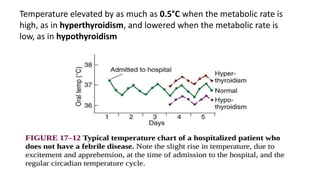
Temperature elevated by as much as 0.5°C when the metabolic rate is
high, as in hyperthyroidism, and lowered when the metabolic rate is
low, as in hypothyroidism
Set Point for temperature control
• The critical body core temperature i.e. 37°C (98.8°F) is called the “set
point”.
• All the temperature control mechanisms continually attempt to bring
the body temperature back to this set point level.
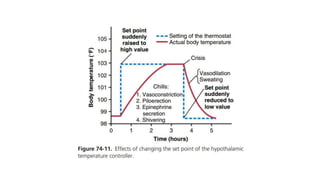
• Temperature signals from the peripheral receptors, also contribute
slightly to body temperature regulation by altering the set point of
the hypothalamic temperature control center.
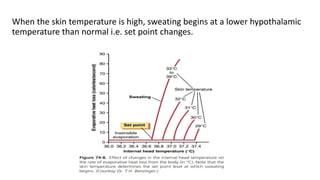
When the skin temperature is high, sweating begins at a lower hypothalamic
temperature than normal i.e. set point changes.
A 16-year-old high school student is brought to the emergency department
after being found lying in the front yard of a neighbour’s house, where he was
mowing the lawn. The patient has a part-time yard service and has been
mowing for several months without problems. The patient was finishing his
sixth yard for the day during a summer month with temperatures exceeding
100°F. His mowing partner noticed that the patient had been complaining of
fatigue, light-headedness, nausea, and profuse sweating in the previous yard.
While mowing the last yard, he became very confused and behaved oddly
before finally losing consciousness. In the emergency department, he is
tachycardic, with a temperature of 106°F. He is lethargic, and his skin is dry.
Case
Heatstroke
It is the most severe form of hyperthermia in which body temperature
rises beyond the critical range upto 105-108°F.
Symptoms include-
1. Dizziness
2. Abdominal distress
3. Delirium
4. Loss of consciousness (eventually)
These symptoms are often worsened by a degree of circulatory shock due
to excessive loss of fluid and electrolyte in sweat.
Fever
Increase in body temperature due to chemical substances that affect the
hypothalamus from an infection or due to abnormality (lesion) in the brain.
Fever due to brain lesions
Also know as non infectious fever.
Any brain tumor that compresses the hypothalamus can affect regulation.
In NICUs whenever a surgeon operates in the region of hypothalamus, severe
fever almost always sets in.
More frequent in patients with Subarachnoid haemorrhage.
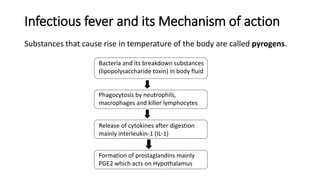
Infectious fever and its Mechanism of action
Substances that cause rise in temperature of the body are called pyrogens.
Bacteria and its breakdown substances
(lipopolysaccharide toxin) in body fluid
Phagocytosis by neutrophils,
macrophages and killer lymphocytes
Release of cytokines after digestion
mainly interleukin-1 (IL-1)
Formation of prostaglandins mainly
PGE2 which acts on Hypothalamus
Since at higher temperature the activity of infection causing micro-organism is
reduced and antibody production is increased therefore hypothalamus raises
the value of set point.
Once the set point value increases all the mechanisms for raising the body
temperature by heat conservation and increased heat production become
active.
Fever above 105°F can extremely harmful as it causes local haemorrhages
and cellular degeneration, specially to the brain.
Antipyretic drugs like Aspirin and Ibuprofen reduce/prevent fever by impeding
the formation of prostaglandins from arachidonic acid
Hypothermia
• The ability of the hypothalamus to regulate temperature is greatly
impaired when the body temperature falls below about 94°F.
• At rectal temperatures of about 82.5°F (28°C), the ability to
spontaneously return the temperature to normal is lost.
• The individual continues to survive and if rewarmed with external
heat, returns to a normal state.
Artificial Hypothermia
• Used during heart surgery so that the heart can be stopped
artificially for many minutes at a time.
• First there is administration of a strong sedative to depress the
reactivity of the hypothalamic temperature controller.
• Then cooling the person with ice or cooling blankets until the
temperature falls.
• Cooling to this extent does not cause tissue damage, but it does
slow the heart and greatly depresses cell metabolism.
Sources
• Guyton and Hall
• Ganong
• Pretest
• Pubmed
THANK YOU.

Body Temperature Regulation.pptx

  • 1.
  • 2.
    Introduction • The normalbody temperature range is 97°F (36°C) to 99°F (37.4°C) i.e. on an average 98.8°F (37°C) when measured orally by a thermometer (0.5-1°F higher if measured rectally). • This body temperature is actually the core temperature which remains constant except for when the person is suffering from febrile illness. • There is also the skin temperature which in contrast to the core rises and falls with the temperature of the surroundings. • The temperature of the scrotum is as carefully regulated at 32°C.
  • 3.
    Why is temperatureregulation necessary? • As we are warm blooded animals, the body temperature remains within a limited constant value 37°C (±1°C). • The internal temperature is independent of the environmental temperature. • Body maintains this temperature because- • Speed of reactions in our body varies with temperature • Enzymes in our body have a narrow range for optimum functioning.
  • 4.
    The body (core)temperature homeostasis is controlled by balancing heat gain and the heat loss.
  • 5.
    Heat Gain Heat canbe gained from the surrounding by radiation and conduction. It can also be produced as a by-product of metabolism. Main factors for production are - • BMR of all the cells of the body. • Hormonal effect, mainly by Thyroxin (to lesser extent by GH and testosterone). • extra rate of metabolism due to muscle activity and work. • extra rate of metabolism for food digestion, absorption and storage. • sympathetic stimulation by the effect of epinephrine and norepinephrine.
  • 6.
    Heat Loss • Heatis primarily lost from the exposed body surface. • Body heat is lost by- • Radiation ~ 70% • Vaporization of sweat ~27% • Respiration ~2% • Urination and defecation ~1%
  • 7.
    Role Of Hypothalamus •The temperature of the body is regulated almost entirely by nervous feedback mechanisms. • The anterior hypothalamic-preoptic area contains large numbers of heat-sensitive neurons, as well as about one-third as many cold- sensitive neurons. • The heat-sensitive neurons increase their firing rate 2 to 10 fold in response to a 10°C increase in body temperature. • When the preoptic area is heated, the skin all over the body sweats profusely, whereas the skin blood vessels become greatly dilated. • Any excess heat production is also inhibited.
  • 8.
    • Additional peripheraltemperature receptors are present in the skin and in a few specific deep tissues (the spinal cord, abdominal viscera, and in or around the great veins) of the body. • Deep receptors function differently from the skin receptors because they are exposed to the body core temperature rather than the body surface temperature. Yet, both temperature receptors, detect mainly cold rather than warmth. • It is probable that peripheral receptors are concerned primarily with preventing hypothermia. • The temperature sensory signals from the central and the peripheral receptors are transmitted into posterior hypothalamus for integration and regulation.
  • 9.
    Temperature-Decreasing Mechanisms Whenthe Body Is Too Hot • Vasodilation • Sweating • Decrease in thermogenesis Temperature-Increasing Mechanisms When the Body Is Too Cold • Vasoconstriction • Piloerection • Increased in thermogenesis • Increased secretion of Epinephrine
  • 10.
    Thermogenesis • Heat productionby the body to increase the temperature. • By following means- 1. Shivering thermogenesis 2. Chemical or Nonshivering thermogenesis a) Brown fat b) Thyroxin (Long term)
  • 11.
    Brown Fat • Alsoknown as brown adipose tissue (BAT). • It produces heat to help maintain the body temperature in cold conditions. • It contains special mitochondria where uncoupled oxidation occurs. • It is richly supplied with sympathetic nerves that release norepinephrine, which causes expression of mitochondrial uncoupling protein 1 (UCP1, also called thermogenin) and increases thermogenesis. • Most abundant in infants and decreases with age.
  • 12.
    Thyroxine • Cooling theanterior hypothalamic-preoptic area also increases production of thyrotropin-releasing hormone by the hypothalamus. • This stimulates anterior pituitary to produce TSH, which acts on Thyroid to produce Thyroxine. • This increased amount of thyroxine activates uncoupling protein and causes thermogenesis. • This increase in metabolism does not occur immediately but requires long term (weeks) exposure to cold to make the thyroid gland hypertrophy and reach its new level of thyroxine secretion.
  • 13.
    Temperature elevated byas much as 0.5°C when the metabolic rate is high, as in hyperthyroidism, and lowered when the metabolic rate is low, as in hypothyroidism
  • 14.
    Set Point fortemperature control • The critical body core temperature i.e. 37°C (98.8°F) is called the “set point”. • All the temperature control mechanisms continually attempt to bring the body temperature back to this set point level. • Temperature signals from the peripheral receptors, also contribute slightly to body temperature regulation by altering the set point of the hypothalamic temperature control center.
  • 16.
    When the skintemperature is high, sweating begins at a lower hypothalamic temperature than normal i.e. set point changes.
  • 17.
    A 16-year-old highschool student is brought to the emergency department after being found lying in the front yard of a neighbour’s house, where he was mowing the lawn. The patient has a part-time yard service and has been mowing for several months without problems. The patient was finishing his sixth yard for the day during a summer month with temperatures exceeding 100°F. His mowing partner noticed that the patient had been complaining of fatigue, light-headedness, nausea, and profuse sweating in the previous yard. While mowing the last yard, he became very confused and behaved oddly before finally losing consciousness. In the emergency department, he is tachycardic, with a temperature of 106°F. He is lethargic, and his skin is dry. Case
  • 18.
    Heatstroke It is themost severe form of hyperthermia in which body temperature rises beyond the critical range upto 105-108°F. Symptoms include- 1. Dizziness 2. Abdominal distress 3. Delirium 4. Loss of consciousness (eventually) These symptoms are often worsened by a degree of circulatory shock due to excessive loss of fluid and electrolyte in sweat.
  • 19.
    Fever Increase in bodytemperature due to chemical substances that affect the hypothalamus from an infection or due to abnormality (lesion) in the brain. Fever due to brain lesions Also know as non infectious fever. Any brain tumor that compresses the hypothalamus can affect regulation. In NICUs whenever a surgeon operates in the region of hypothalamus, severe fever almost always sets in. More frequent in patients with Subarachnoid haemorrhage.
  • 20.
    Infectious fever andits Mechanism of action Substances that cause rise in temperature of the body are called pyrogens. Bacteria and its breakdown substances (lipopolysaccharide toxin) in body fluid Phagocytosis by neutrophils, macrophages and killer lymphocytes Release of cytokines after digestion mainly interleukin-1 (IL-1) Formation of prostaglandins mainly PGE2 which acts on Hypothalamus
  • 21.
    Since at highertemperature the activity of infection causing micro-organism is reduced and antibody production is increased therefore hypothalamus raises the value of set point. Once the set point value increases all the mechanisms for raising the body temperature by heat conservation and increased heat production become active. Fever above 105°F can extremely harmful as it causes local haemorrhages and cellular degeneration, specially to the brain. Antipyretic drugs like Aspirin and Ibuprofen reduce/prevent fever by impeding the formation of prostaglandins from arachidonic acid
  • 22.
    Hypothermia • The abilityof the hypothalamus to regulate temperature is greatly impaired when the body temperature falls below about 94°F. • At rectal temperatures of about 82.5°F (28°C), the ability to spontaneously return the temperature to normal is lost. • The individual continues to survive and if rewarmed with external heat, returns to a normal state.
  • 23.
    Artificial Hypothermia • Usedduring heart surgery so that the heart can be stopped artificially for many minutes at a time. • First there is administration of a strong sedative to depress the reactivity of the hypothalamic temperature controller. • Then cooling the person with ice or cooling blankets until the temperature falls. • Cooling to this extent does not cause tissue damage, but it does slow the heart and greatly depresses cell metabolism.
  • 24.
    Sources • Guyton andHall • Ganong • Pretest • Pubmed
  • 25.