Body Temperature measurement
Definition body temperature
 Is the difference between the amount
of heat production and heat lost to
the external environment.
Heat produced- Heat lost =Body temperature
• Core temperature: Temperature inside the
body; normal body temperature ranges
between 36.5º and 37.5ºC (97.6º and 99.6ºF)
Regulation of body temperature
In human, the hypothalamus (a structure within
the brain that helps control various metabolic
activities) acts as a center for a temperature
regulation.
The anterior hypothalamus: promotes heat loss
through vasodilatation and sweating.
The posterior hypothalamus: promotes two functions,
heat conservation and heat production.
Normal Body
Temperature
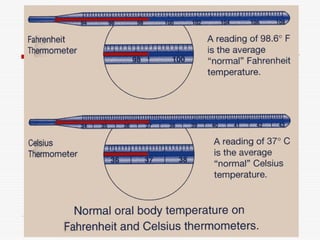
 The normal range of body temperature is
36.5˚C:37.5˚C
 The average normal oral temperature for
adults is 37˚C
 The average normal rectal temperature is
37.5˚C
 The average normal axillary temperature
is 36.5˚C
Measurement sites of core and
surface temperature:
Core temperature
-Rectum
-Tympanic membranes
-Temporal artery
 Core body Temperature
 It is the temperature inside the body;
and humans maintain a consistent
internal body temperature.
Core temperature in cold and
warm environment
 The 'core'
is defined as the metabolically active organs
(heart, lungs, liver, kidneys, brain and the
blood).
This may be increased by up to four degrees
°C with maximal exercise (e.g. marathon
runners). So, rectal temperature
measurement is accurately predict a true core
temperature measured
 Sites to measure Core
temperature are:
 -Rectum
 -Tympanic membranes
 -Temporal artery
 But Surface temperature can be
measured in the following sites
 Oral
 Axilla
 Body temperature readings vary
between temperature of the Core
body and temperature of body
surface at the same time.
 For example, nurse has measured the
body temperature for Mr. Ahmed at 6
pm at 2 sites in the same time, from
axilla (ie, body surface) was
36.5˚C, but from rectum (ie, body
core) was 37.5˚C
Variations in body temperature
readings:
 Normal Body Temperature
 The average normal temperature
for adults is 37˚C
 The average normal rectal
temperature is 37.5˚C
 And the average normal axillary
temperature is 36.5˚C
 The normal range of body
temperature is 36.5˚C:37.5˚C
 Temperature of 34˚C to 41˚C is the
approximate range within
 If body temperature decreased
than 34˚C or increased than 41˚C
body cells cannot function
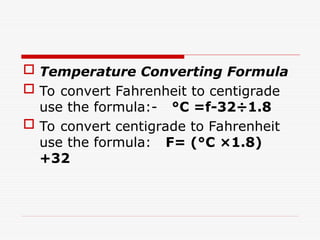
 Temperature Converting Formula
 To convert Fahrenheit to centigrade
use the formula:- °C =f-32÷1.8
 To convert centigrade to Fahrenheit
use the formula: F= (°C ×1.8)
+32
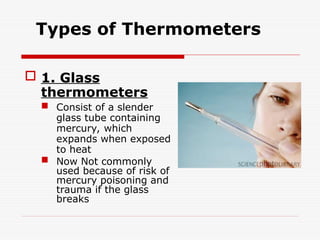
Types of Thermometers
 1. Glass
thermometers
 Consist of a slender
glass tube containing
mercury, which
expands when exposed
to heat
 Now Not commonly
used because of risk of
mercury poisoning and
trauma if the glass
breaks
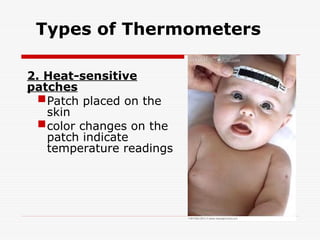
Types of Thermometers
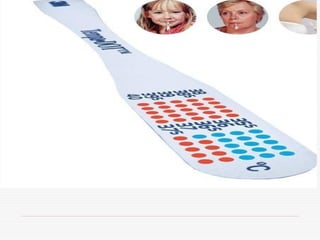
2. Heat-sensitive
patches
Patch placed on the
skin
color changes on the
patch indicate
temperature readings
Types of Thermometers
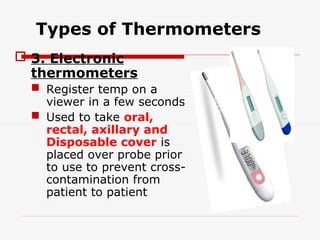
 3. Electronic
thermometers
 Register temp on a
viewer in a few seconds
 Used to take oral,
rectal, axillary and
Disposable cover is
placed over probe prior
to use to prevent cross-
contamination from
patient to patient
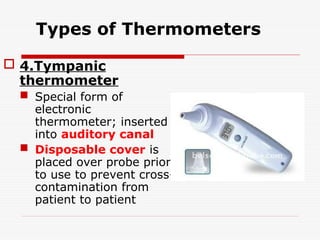
Types of Thermometers
 4.Tympanic
thermometer
 Special form of
electronic
thermometer; inserted
into auditory canal
 Disposable cover is
placed over probe prior
to use to prevent cross-
contamination from
patient to patient
Temperature regulation
 There are various regulating factors
that affect body temperature These
are:
 Physical control.
 Chemical control.
 Nervous system control.
 1-Physical control
 The body gains heat from its
environment, for example clothing,
sun and ingestion of hot food
Chemical control
 The body produces heat through the
metabolism of food.
 Body metabolism increases in order to
produce more heat for the body as
necessary.
 An increase in the metabolism rate
will result in an increase in body
temperature and vice versa.
3
-
Nervous system control
 Body temperature is maintained by the
hypothalamus in the central nervous
system, located at the base of the brain.
 The anterior portion of the
hypothalamus is concerned with heat
dissipation (loss), and the posterior
portion of the hypothalamus governs
heat conservation (gain).
heat production mechanisms
 1–vasoconstriction
 2-shivering
 3-increase activity
 4-increase metabolism
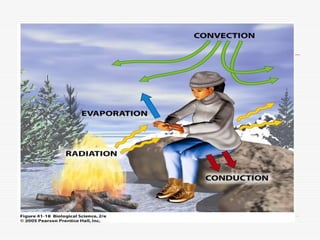
heat loss mechanisms
 1-Radiation
 Means the transfer of heat from
surface to the surface of another
object without contact between
two objects? Up to 85% of the
human body's surface area radiates
heat to the environment.
 2-Conduction
 Means the transfer of heat from
one object to another with direct
contact. Conduction occurs when the
warm skin touch an cooler. e.g.
(patient contact with ice pack).
 3-Convection
 Means the transfer of heat away
by air movement a fan promoting
heat loss.
 4-Evaporation
 Is the conversion of a liquid to a
vapor evaporation about (600 to
900) ml
 evaporated through skin
(sweating, diaphoresis).
EXTRINSIC FACTORS THAT
INFLUENCE TEMPERATURE
 Environment temperature
▲or in body temperature by
▼
extremes of Environment
temperature
 Circadian rhythm or Time of day
▲ In evening
▼ In early hours of morning
INTRINSIC FACTORS THAT
INFLUENCE TEMPERATURE
 Thyroid hormones
▲ Body temperature
Secretion of thyroxin leads to Metabolic
rate
 Ovulation
▲Body temperature
When progesterone is high body
→
temperature above base line during
ovulation and progesterone enter the
circulation.
 Stress
▲Heat production
stimulation of sympathetic and
parasympathetic nervous system and
production of epinephrine and nor
epinephrine  metabolic activity
 Age
old age person 75 yrs has inadequate diet,
loss of subcutaneous tissue, reduced
efficiency of thrmoregulation
 Exercise
▲ Body temperature
Muscle activity  an increased blood supply
and an increased carbohydrate, fate
breakdown  heat production
 Depression of the nervous system
▼ Heat production
due to use of narcotic drugs, all act to
lessen body activity and thus
decrease
 Fasting
▼ Heat production
due to inadequate supply of food.
 Sleep
▼ Heat production
the body is less active
 Assessing Body Temperature
The four most common sites for
measuring body temperature are
oral, rectal, axillary, and the
tympanic membrane.
Orally: It reflects changing body
temperature more quickly.
Contra indication of oral
temperature
:
 Breathing is difficult or rapid
 Can't close mouth for any reason
 Breathing through mouth
 Persistent frequent coughing.
 Mouth is inflamed
 Infant or young children
 Oral surgery/ broken jaw
 Unconscious/agitated people
 Very old and weak patient who
cannot close his mouth well.
 Patient with seizure disorder
 After drinking hot fluids or cold
fluids.
Rectally: are considered to be
very accurate
.
Contra indication of rectal
temperature
 Diarrhea.
 Rectal surgery.
 Clotting disorders.
 Hemorrhoids "pile"
 Disease or inflammation of the rectum.
 Axillary: is the preferred site for
measuring temperature newborn because it
is accessible.
 Contraindication of axillary
temperature
 Thin patient
 Local inflammation.
 Unconsciousness, shocked patients
 Axillary operation.
 Constricted peripheral blood vessels.
Alteration in body
temperature
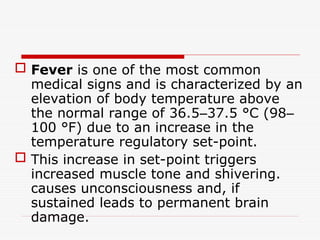
 Fever is one of the most common
medical signs and is characterized by an
elevation of body temperature above
the normal range of 36.5–37.5 °C (98–
100 °F) due to an increase in the
temperature regulatory set-point.
 This increase in set-point triggers
increased muscle tone and shivering.
causes unconsciousness and, if
sustained leads to permanent brain
damage.
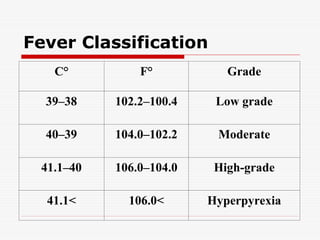
Fever Classification
Grade
°
F
°
C
Low grade
100.4
–
102.2
38
–
39
Moderate
102.2
–
104.0
39
–
40
High-grade
104.0
–
106.0
40
–
41.1
Hyperpyrexia
>
106.0
>
41.1
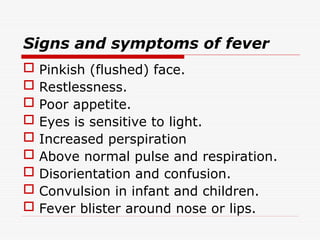
Signs and symptoms of fever
 Pinkish (flushed) face.
 Restlessness.
 Poor appetite.
 Eyes is sensitive to light.
 Increased perspiration
 Above normal pulse and respiration.
 Disorientation and confusion.
 Convulsion in infant and children.
 Fever blister around nose or lips.
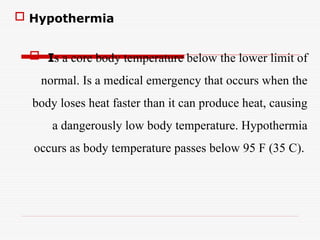
 Hypothermia
 Is a core body temperature below the lower limit of
normal. Is a medical emergency that occurs when the
body loses heat faster than it can produce heat, causing
a dangerously low body temperature. Hypothermia
occurs as body temperature passes below 95 F (35 C).
 The clinical signs of hypothermia:
 Decreased body temperature, pulse, and
respiration, Severe shivering
 Feelings of cold and chills
 Pale, cool skin, Hypotension
 Decreased urinary output
 Lack of muscle coordination
 Disorientation
 Drowsiness progressing to coma
Raising body temperature
 Remove layers of
clothing/bedding. Do not remove
all at once or you may cause the
client to shiver, which will have the
overall effect of increasing rather
than decreasing body temperature
 Encourage the client to wear
natural cotton fibers as these
absorb heat
 Use a fan positioned on the
client’s back as this forms a larger
surface area
 Give the client cold drinks if allowed or
ice to suck
 If possible reduce the room
temperature or place the client near
an open window but not in a draught
 Adults and older children can be helped
or encouraged to wash their hands
and face in tepid water. Tepid
sponging of the whole body where the
client is allowed to dry by the process of
evaporation is not generally
recommended as this can reduce the
temperature too rapidly
 7. Monitor the client’s temperature
when actively intervening and ensure in the
case of adults that it does not fall more
rapidly than 1oC per hour as this can
lead to shock. In the case of infants high
temperatures can cause febrile convulsions;
it is therefore appropriate to reduce their
temperature more rapidly. This can be
achieved by immersing them fully in a cool
water bath
 An antipyretic such as paracetamol
may be prescribed if other methods of
temperature reduction have failed,
though this should not be the action of
first resort as it can interfere with the
body’s natural defense mechanisms
lowering body temperature
 Add extra layers of thin clothing or
bedding. Multiple layers of thin clothing
are more effective than one or two thick
layers, as they trap the warm air.
 Encourage the client to wear a hat or
cover the head, as most heat is lost
through the scalp
 If possible close any open windows
and Doors
 Give the client warm drinks if
allowed
 If possible increase the room
temperature
 Adults and older children can be
helped or encouraged to wash their
hands and face in warm water
provided that they have full
sensation. Otherwise there is a risk of
burn injury. For this reason hot-water
bottles and high-temperature heat
pads are not recommended and are
indeed banned in most institutions
 Monitor the client’s temperature
when actively intervening and ensure
that it does not rise more rapidly
than 1oC per hour as this can lead
to shock. If the client requires their
temperature restoring more quickly,
this should be undertaken in a
critical-care area where the client can
be closely monitored
 8.If the client is seriously hypothermic (i.e.
a temperature of 32.5oC or below) and
continuously monitored a foil blanket may
be used with caution, but again care should
be taken to ensure that the body
temperature does not increase too rapidly.
Warmed intravenous fluids may also
sometimes be prescribed for this client
group but again great care is needed
temp-2015.ppt qadfffffffghyhhhhhhhhhhhhhh

temp-2015.ppt qadfffffffghyhhhhhhhhhhhhhh

  • 1.
    Body Temperature measurement BodyTemperature measurement
  • 2.
    Definition body temperature Is the difference between the amount of heat production and heat lost to the external environment.
  • 3.
    Heat produced- Heatlost =Body temperature • Core temperature: Temperature inside the body; normal body temperature ranges between 36.5º and 37.5ºC (97.6º and 99.6ºF)
  • 4.
    Regulation of bodytemperature In human, the hypothalamus (a structure within the brain that helps control various metabolic activities) acts as a center for a temperature regulation.
  • 5.
    The anterior hypothalamus:promotes heat loss through vasodilatation and sweating. The posterior hypothalamus: promotes two functions, heat conservation and heat production.
  • 6.
    Normal Body Temperature  Thenormal range of body temperature is 36.5˚C:37.5˚C  The average normal oral temperature for adults is 37˚C  The average normal rectal temperature is 37.5˚C  The average normal axillary temperature is 36.5˚C
  • 7.
    Measurement sites ofcore and surface temperature: Core temperature -Rectum -Tympanic membranes -Temporal artery
  • 8.
     Core bodyTemperature  It is the temperature inside the body; and humans maintain a consistent internal body temperature.
  • 9.
    Core temperature incold and warm environment  The 'core' is defined as the metabolically active organs (heart, lungs, liver, kidneys, brain and the blood). This may be increased by up to four degrees °C with maximal exercise (e.g. marathon runners). So, rectal temperature measurement is accurately predict a true core temperature measured
  • 10.
     Sites tomeasure Core temperature are:  -Rectum  -Tympanic membranes  -Temporal artery
  • 11.
     But Surfacetemperature can be measured in the following sites  Oral  Axilla
  • 12.
     Body temperaturereadings vary between temperature of the Core body and temperature of body surface at the same time.  For example, nurse has measured the body temperature for Mr. Ahmed at 6 pm at 2 sites in the same time, from axilla (ie, body surface) was 36.5˚C, but from rectum (ie, body core) was 37.5˚C Variations in body temperature readings:
  • 13.
     Normal BodyTemperature  The average normal temperature for adults is 37˚C  The average normal rectal temperature is 37.5˚C  And the average normal axillary temperature is 36.5˚C
  • 14.
     The normalrange of body temperature is 36.5˚C:37.5˚C  Temperature of 34˚C to 41˚C is the approximate range within  If body temperature decreased than 34˚C or increased than 41˚C body cells cannot function
  • 15.
     Temperature ConvertingFormula  To convert Fahrenheit to centigrade use the formula:- °C =f-32÷1.8  To convert centigrade to Fahrenheit use the formula: F= (°C ×1.8) +32
  • 17.
    Types of Thermometers 1. Glass thermometers  Consist of a slender glass tube containing mercury, which expands when exposed to heat  Now Not commonly used because of risk of mercury poisoning and trauma if the glass breaks
  • 18.
    Types of Thermometers 2.Heat-sensitive patches Patch placed on the skin color changes on the patch indicate temperature readings
  • 19.
    Types of Thermometers 3. Electronic thermometers  Register temp on a viewer in a few seconds  Used to take oral, rectal, axillary and Disposable cover is placed over probe prior to use to prevent cross- contamination from patient to patient
  • 20.
    Types of Thermometers 4.Tympanic thermometer  Special form of electronic thermometer; inserted into auditory canal  Disposable cover is placed over probe prior to use to prevent cross- contamination from patient to patient
  • 22.
    Temperature regulation  Thereare various regulating factors that affect body temperature These are:  Physical control.  Chemical control.  Nervous system control.
  • 23.
     1-Physical control The body gains heat from its environment, for example clothing, sun and ingestion of hot food
  • 24.
    Chemical control  Thebody produces heat through the metabolism of food.  Body metabolism increases in order to produce more heat for the body as necessary.  An increase in the metabolism rate will result in an increase in body temperature and vice versa.
  • 25.
    3 - Nervous system control Body temperature is maintained by the hypothalamus in the central nervous system, located at the base of the brain.  The anterior portion of the hypothalamus is concerned with heat dissipation (loss), and the posterior portion of the hypothalamus governs heat conservation (gain).
  • 26.
    heat production mechanisms 1–vasoconstriction  2-shivering  3-increase activity  4-increase metabolism
  • 27.
    heat loss mechanisms 1-Radiation  Means the transfer of heat from surface to the surface of another object without contact between two objects? Up to 85% of the human body's surface area radiates heat to the environment.
  • 28.
     2-Conduction  Meansthe transfer of heat from one object to another with direct contact. Conduction occurs when the warm skin touch an cooler. e.g. (patient contact with ice pack).  3-Convection  Means the transfer of heat away by air movement a fan promoting heat loss.
  • 29.
     4-Evaporation  Isthe conversion of a liquid to a vapor evaporation about (600 to 900) ml  evaporated through skin (sweating, diaphoresis).
  • 31.
    EXTRINSIC FACTORS THAT INFLUENCETEMPERATURE  Environment temperature ▲or in body temperature by ▼ extremes of Environment temperature  Circadian rhythm or Time of day ▲ In evening ▼ In early hours of morning
  • 32.
    INTRINSIC FACTORS THAT INFLUENCETEMPERATURE  Thyroid hormones ▲ Body temperature Secretion of thyroxin leads to Metabolic rate  Ovulation ▲Body temperature When progesterone is high body → temperature above base line during ovulation and progesterone enter the circulation.
  • 33.
     Stress ▲Heat production stimulationof sympathetic and parasympathetic nervous system and production of epinephrine and nor epinephrine  metabolic activity
  • 34.
     Age old ageperson 75 yrs has inadequate diet, loss of subcutaneous tissue, reduced efficiency of thrmoregulation  Exercise ▲ Body temperature Muscle activity  an increased blood supply and an increased carbohydrate, fate breakdown  heat production
  • 35.
     Depression ofthe nervous system ▼ Heat production due to use of narcotic drugs, all act to lessen body activity and thus decrease  Fasting ▼ Heat production due to inadequate supply of food.
  • 36.
     Sleep ▼ Heatproduction the body is less active
  • 37.
     Assessing BodyTemperature The four most common sites for measuring body temperature are oral, rectal, axillary, and the tympanic membrane. Orally: It reflects changing body temperature more quickly.
  • 38.
    Contra indication oforal temperature :  Breathing is difficult or rapid  Can't close mouth for any reason  Breathing through mouth  Persistent frequent coughing.  Mouth is inflamed  Infant or young children
  • 39.
     Oral surgery/broken jaw  Unconscious/agitated people  Very old and weak patient who cannot close his mouth well.  Patient with seizure disorder  After drinking hot fluids or cold fluids.
  • 40.
    Rectally: are consideredto be very accurate . Contra indication of rectal temperature  Diarrhea.  Rectal surgery.  Clotting disorders.  Hemorrhoids "pile"  Disease or inflammation of the rectum.
  • 41.
     Axillary: isthe preferred site for measuring temperature newborn because it is accessible.  Contraindication of axillary temperature  Thin patient  Local inflammation.  Unconsciousness, shocked patients  Axillary operation.  Constricted peripheral blood vessels.
  • 42.
  • 43.
     Fever isone of the most common medical signs and is characterized by an elevation of body temperature above the normal range of 36.5–37.5 °C (98– 100 °F) due to an increase in the temperature regulatory set-point.  This increase in set-point triggers increased muscle tone and shivering. causes unconsciousness and, if sustained leads to permanent brain damage.
  • 44.
  • 45.
    Signs and symptomsof fever  Pinkish (flushed) face.  Restlessness.  Poor appetite.  Eyes is sensitive to light.  Increased perspiration  Above normal pulse and respiration.  Disorientation and confusion.  Convulsion in infant and children.  Fever blister around nose or lips.
  • 46.
     Hypothermia  Isa core body temperature below the lower limit of normal. Is a medical emergency that occurs when the body loses heat faster than it can produce heat, causing a dangerously low body temperature. Hypothermia occurs as body temperature passes below 95 F (35 C).
  • 47.
     The clinicalsigns of hypothermia:  Decreased body temperature, pulse, and respiration, Severe shivering  Feelings of cold and chills  Pale, cool skin, Hypotension  Decreased urinary output  Lack of muscle coordination  Disorientation  Drowsiness progressing to coma
  • 48.
    Raising body temperature Remove layers of clothing/bedding. Do not remove all at once or you may cause the client to shiver, which will have the overall effect of increasing rather than decreasing body temperature
  • 49.
     Encourage theclient to wear natural cotton fibers as these absorb heat  Use a fan positioned on the client’s back as this forms a larger surface area
  • 50.
     Give theclient cold drinks if allowed or ice to suck  If possible reduce the room temperature or place the client near an open window but not in a draught
  • 51.
     Adults andolder children can be helped or encouraged to wash their hands and face in tepid water. Tepid sponging of the whole body where the client is allowed to dry by the process of evaporation is not generally recommended as this can reduce the temperature too rapidly
  • 52.
     7. Monitorthe client’s temperature when actively intervening and ensure in the case of adults that it does not fall more rapidly than 1oC per hour as this can lead to shock. In the case of infants high temperatures can cause febrile convulsions; it is therefore appropriate to reduce their temperature more rapidly. This can be achieved by immersing them fully in a cool water bath
  • 53.
     An antipyreticsuch as paracetamol may be prescribed if other methods of temperature reduction have failed, though this should not be the action of first resort as it can interfere with the body’s natural defense mechanisms
  • 54.
    lowering body temperature Add extra layers of thin clothing or bedding. Multiple layers of thin clothing are more effective than one or two thick layers, as they trap the warm air.  Encourage the client to wear a hat or cover the head, as most heat is lost through the scalp  If possible close any open windows and Doors
  • 55.
     Give theclient warm drinks if allowed  If possible increase the room temperature
  • 56.
     Adults andolder children can be helped or encouraged to wash their hands and face in warm water provided that they have full sensation. Otherwise there is a risk of burn injury. For this reason hot-water bottles and high-temperature heat pads are not recommended and are indeed banned in most institutions
  • 57.
     Monitor theclient’s temperature when actively intervening and ensure that it does not rise more rapidly than 1oC per hour as this can lead to shock. If the client requires their temperature restoring more quickly, this should be undertaken in a critical-care area where the client can be closely monitored
  • 58.
     8.If theclient is seriously hypothermic (i.e. a temperature of 32.5oC or below) and continuously monitored a foil blanket may be used with caution, but again care should be taken to ensure that the body temperature does not increase too rapidly. Warmed intravenous fluids may also sometimes be prescribed for this client group but again great care is needed