UNDERSTANDING DISCIPLINES AND SUBJECTS
Unit I
Disciplines and Subjects
Prepared by
Mrs. Mary Hilda V
Asst. Professor of Physical Science
Loyola College of Education, Chennai
Content
 What Discipline?
 Academic Discipline
 School Subjects
 Aim of Schooling
 Relationships
 Difference
 Need for school subjects
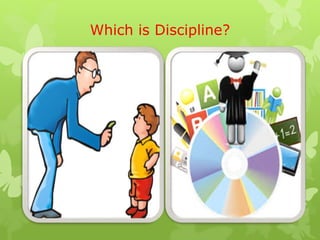
Which is Discipline?
Disciplines
Originated- Latin - “Discipulus” - pupil and
teaching.
Differ with each other- Subjects, respect
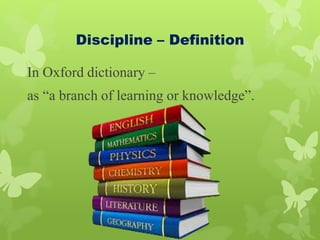
Discipline – Definition
In Oxford dictionary –
as “a branch of learning or knowledge”.
Academic disciplines -
Definition
“An academic discipline or field of study is a
branch of knowledge that is taught and
researched as part of higher education”.
- Anthony Biglan
The main focus of the study of
the discipline
 Methods used to expand disciplinary
knowledge
 Impact of these disciplines on our lives
 Professions and the disciplines
 Emergence of academic disciplines
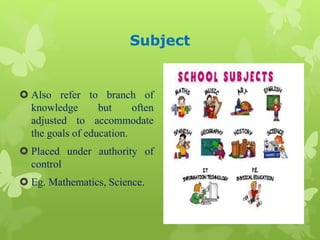
Subject
 Also refer to branch of
knowledge but often
adjusted to accommodate
the goals of education.
 Placed under authority of
control
 Eg. Mathematics, Science.
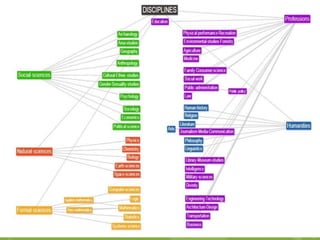
Academic disciplines and
subjects
a) Humanities
b) Social Sciences
c) Natural Sciences
d) Mathematics
e) Business Geosciences
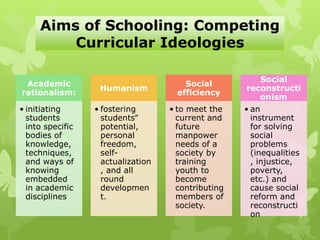
Aims of Schooling: Competing
Curricular Ideologies
Academic
rationalism:
• initiating
students
into specific
bodies of
knowledge,
techniques,
and ways of
knowing
embedded
in academic
disciplines
Humanism
• fostering
students‟
potential,
personal
freedom,
self-
actualization
, and all
round
developmen
t.
Social
efficiency
• to meet the
current and
future
manpower
needs of a
society by
training
youth to
become
contributing
members of
society.
Social
reconstructi
onism
• an
instrument
for solving
social
problems
(inequalities
, injustice,
poverty,
etc.) and
cause social
reform and
reconstructi
on
Aims of Schooling: Recent
Discourses
Participatory
citizenship
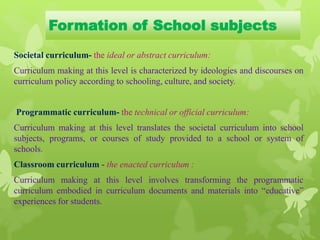
Formation of School subjects
Societal curriculum- the ideal or abstract curriculum:
Curriculum making at this level is characterized by ideologies and discourses on
curriculum policy according to schooling, culture, and society.
Programmatic curriculum- the technical or official curriculum:
Curriculum making at this level translates the societal curriculum into school
subjects, programs, or courses of study provided to a school or system of
schools.
Classroom curriculum - the enacted curriculum :
Curriculum making at this level involves transforming the programmatic
curriculum embodied in curriculum documents and materials into “educative”
experiences for students.
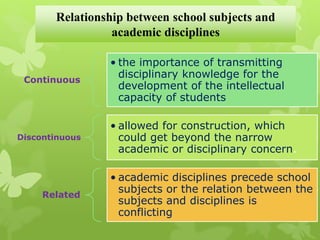
Relationship between school subjects and
academic disciplines
Continuous
• the importance of transmitting
disciplinary knowledge for the
development of the intellectual
capacity of students
Discontinuous
• allowed for construction, which
could get beyond the narrow
academic or disciplinary concern.
Related
• academic disciplines precede school
subjects or the relation between the
subjects and disciplines is
conflicting
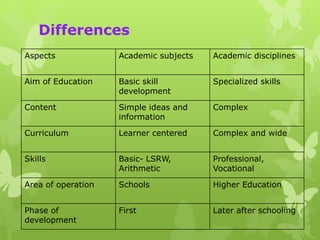
Differences
Aspects Academic subjects Academic disciplines
Aim of Education Basic skill
development
Specialized skills
Content Simple ideas and
information
Complex
Curriculum Learner centered Complex and wide
Skills Basic- LSRW,
Arithmetic
Professional,
Vocational
Area of operation Schools Higher Education
Phase of
development
First Later after schooling
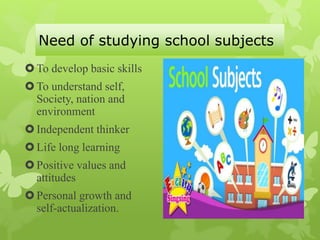
Need of studying school subjects
To develop basic skills
To understand self,
Society, nation and
environment
Independent thinker
Life long learning
Positive values and
attitudes
Personal growth and
self-actualization.
References:
1) Deng, Z (2013), School subjects and academic disciplines. In A
Luke, A woods & K weir (Eds.), Curriculum, Syllabus design and
equity: A primer and model. Routledge
2) Ivor F. Goodson and Colin J. Marsh, Studying school subjects, A
guide (1996), Routledge

Unit I understanding disciplines and subjects

  • 1.
    UNDERSTANDING DISCIPLINES ANDSUBJECTS Unit I Disciplines and Subjects Prepared by Mrs. Mary Hilda V Asst. Professor of Physical Science Loyola College of Education, Chennai
  • 2.
    Content  What Discipline? Academic Discipline  School Subjects  Aim of Schooling  Relationships  Difference  Need for school subjects
  • 3.
  • 4.
    Disciplines Originated- Latin -“Discipulus” - pupil and teaching. Differ with each other- Subjects, respect
  • 5.
    Discipline – Definition InOxford dictionary – as “a branch of learning or knowledge”.
  • 6.
    Academic disciplines - Definition “Anacademic discipline or field of study is a branch of knowledge that is taught and researched as part of higher education”. - Anthony Biglan
  • 7.
    The main focusof the study of the discipline  Methods used to expand disciplinary knowledge  Impact of these disciplines on our lives  Professions and the disciplines  Emergence of academic disciplines
  • 9.
    Subject  Also referto branch of knowledge but often adjusted to accommodate the goals of education.  Placed under authority of control  Eg. Mathematics, Science.
  • 10.
    Academic disciplines and subjects a)Humanities b) Social Sciences c) Natural Sciences d) Mathematics e) Business Geosciences
  • 11.
    Aims of Schooling:Competing Curricular Ideologies Academic rationalism: • initiating students into specific bodies of knowledge, techniques, and ways of knowing embedded in academic disciplines Humanism • fostering students‟ potential, personal freedom, self- actualization , and all round developmen t. Social efficiency • to meet the current and future manpower needs of a society by training youth to become contributing members of society. Social reconstructi onism • an instrument for solving social problems (inequalities , injustice, poverty, etc.) and cause social reform and reconstructi on
  • 12.
    Aims of Schooling:Recent Discourses Participatory citizenship
  • 13.
    Formation of Schoolsubjects Societal curriculum- the ideal or abstract curriculum: Curriculum making at this level is characterized by ideologies and discourses on curriculum policy according to schooling, culture, and society. Programmatic curriculum- the technical or official curriculum: Curriculum making at this level translates the societal curriculum into school subjects, programs, or courses of study provided to a school or system of schools. Classroom curriculum - the enacted curriculum : Curriculum making at this level involves transforming the programmatic curriculum embodied in curriculum documents and materials into “educative” experiences for students.
  • 14.
    Relationship between schoolsubjects and academic disciplines Continuous • the importance of transmitting disciplinary knowledge for the development of the intellectual capacity of students Discontinuous • allowed for construction, which could get beyond the narrow academic or disciplinary concern. Related • academic disciplines precede school subjects or the relation between the subjects and disciplines is conflicting
  • 15.
    Differences Aspects Academic subjectsAcademic disciplines Aim of Education Basic skill development Specialized skills Content Simple ideas and information Complex Curriculum Learner centered Complex and wide Skills Basic- LSRW, Arithmetic Professional, Vocational Area of operation Schools Higher Education Phase of development First Later after schooling
  • 16.
    Need of studyingschool subjects To develop basic skills To understand self, Society, nation and environment Independent thinker Life long learning Positive values and attitudes Personal growth and self-actualization.
  • 17.
    References: 1) Deng, Z(2013), School subjects and academic disciplines. In A Luke, A woods & K weir (Eds.), Curriculum, Syllabus design and equity: A primer and model. Routledge 2) Ivor F. Goodson and Colin J. Marsh, Studying school subjects, A guide (1996), Routledge