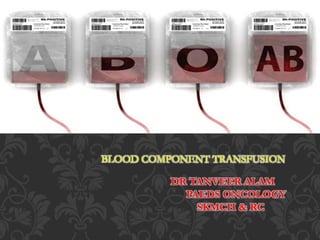
BLOOD COMPONENT TRANSFUSION
DR TANVEER ALAM
PAEDS ONCOLOGY
SKMCH & RC
 What is history of transfusion?
 What are Blood components ?
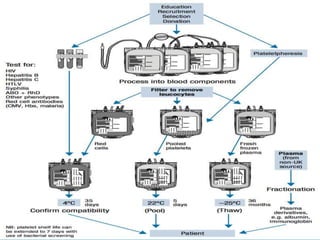
 How are the blood component separated ?
 What are the Indications for transfusion ?
 What is the dose of administration in paeds?
 What are complications?
 How to minimize the errors?
 What are the SKMCH protocol?
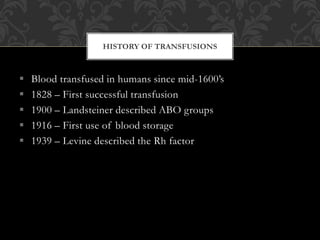
 Blood transfused in humans since mid-1600’s
 1828 – First successful transfusion
 1900 – Landsteiner described ABO groups
 1916 – First use of blood storage
 1939 – Levine described the Rh factor
HISTORY OF TRANSFUSIONS
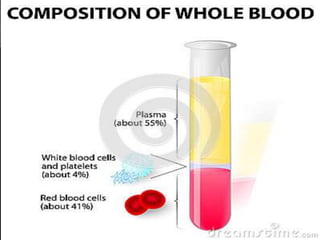
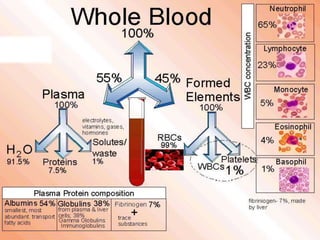
BLOOD components
Any therapeutic substance prepared from human blood
WHOLE BLOOD
Unseparated blood collected into an approved container
containing an anticoagulant preservative solution
BLOOD COMPONENT
• RBCs
• platelets
• Plasma
• Cryoprecipitate
• GCSF
• Human albumin 4.5%
DEFINITIONS
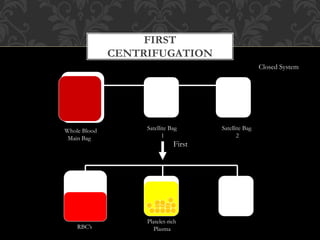
FIRST
CENTRIFUGATION
Whole Blood
Main Bag
Satellite Bag
1
Satellite Bag
2
RBC’s
Platelet-rich
Plasma
First
Closed System
SECOND
CENTRIFUGATION
Platelet-rich
Plasma
RBC’s
Platelet
Concentrate
RBC’s
Plasma
Second
Storage
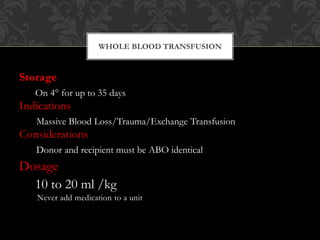
On 4° for up to 35 days
Indications
Massive Blood Loss/Trauma/Exchange Transfusion
Considerations
Donor and recipient must be ABO identical
Dosage
10 to 20 ml /kg
Never add medication to a unit
WHOLE BLOOD TRANSFUSION
Storage
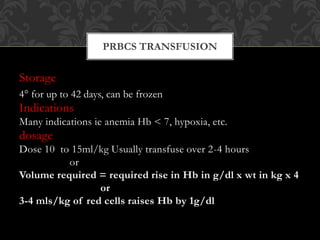
4° for up to 42 days, can be frozen
Indications
Many indications ie anemia Hb < 7, hypoxia, etc.
dosage
Dose 10 to 15ml/kg Usually transfuse over 2-4 hours
or
Volume required = required rise in Hb in g/dl x wt in kg x 4
or
3-4 mls/kg of red cells raises Hb by 1g/dl
PRBCS TRANSFUSION
Storage
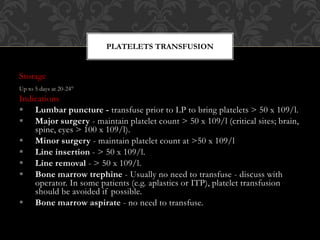
Up to 5 days at 20-24°
Indications
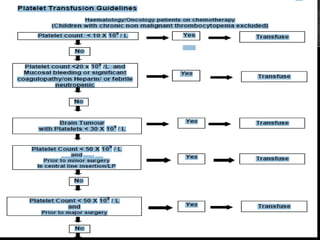
 Lumbar puncture - transfuse prior to LP to bring platelets > 50 x 109/l.
 Major surgery - maintain platelet count > 50 x 109/l (critical sites; brain,
spine, eyes > 100 x 109/l).
 Minor surgery - maintain platelet count at >50 x 109/l
 Line insertion - > 50 x 109/l.
 Line removal - > 50 x 109/l.
 Bone marrow trephine - Usually no need to transfuse - discuss with
operator. In some patients (e.g. aplastics or ITP), platelet transfusion
should be avoided if possible.
 Bone marrow aspirate - no need to transfuse.
PLATELETS TRANSFUSION
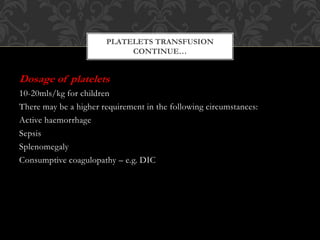
Dosage of platelets
10-20mls/kg for children
There may be a higher requirement in the following circumstances:
Active haemorrhage
Sepsis
Splenomegaly
Consumptive coagulopathy – e.g. DIC
PLATELETS TRANSFUSION
CONTINUE…
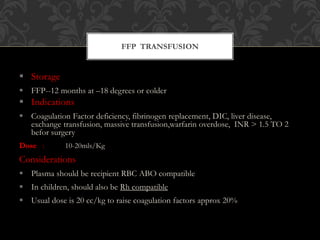
 Storage
 FFP--12 months at –18 degrees or colder
 Indications
 Coagulation Factor deficiency, fibrinogen replacement, DIC, liver disease,
exchange transfusion, massive transfusion,warfarin overdose, INR > 1.5 TO 2
befor surgery
Dose : 10-20mls/Kg
Considerations
 Plasma should be recipient RBC ABO compatible
 In children, should also be Rh compatible
 Usual dose is 20 cc/kg to raise coagulation factors approx 20%
FFP TRANSFUSION
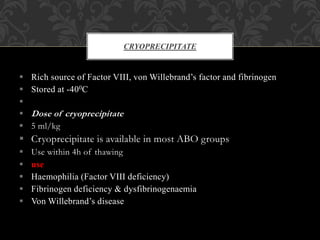
 Rich source of Factor VIII, von Willebrand’s factor and fibrinogen
 Stored at -400C

 Dose of cryoprecipitate
 5 ml/kg
 Cryoprecipitate is available in most ABO groups
 Use within 4h of thawing
 use
 Haemophilia (Factor VIII deficiency)
 Fibrinogen deficiency & dysfibrinogenaemia
 Von Willebrand’s disease
CRYOPRECIPITATE
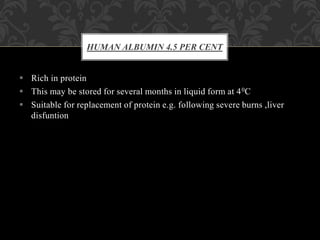
 Rich in protein
 This may be stored for several months in liquid form at 40C
 Suitable for replacement of protein e.g. following severe burns ,liver
disfuntion
HUMAN ALBUMIN 4.5 PER CENT
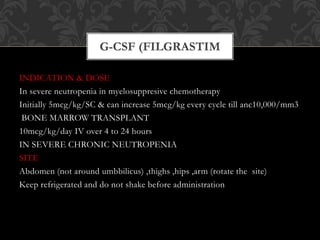
INDICATION & DOSE
In severe neutropenia in myelosuppresive chemotherapy
Initially 5mcg/kg/SC & can increase 5mcg/kg every cycle till anc10,000/mm3
BONE MARROW TRANSPLANT
10mcg/kg/day IV over 4 to 24 hours
IN SEVERE CHRONIC NEUTROPENIA
SITE
Abdomen (not around umbbilicus) ,thighs ,hips ,arm (rotate the site)
Keep refrigerated and do not shake before administration
G-CSF (FILGRASTIM
21
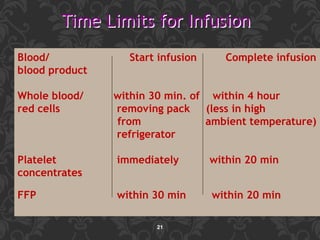
Blood/ Start infusion Complete infusion
blood product
Whole blood/ within 30 min. of within 4 hour
red cells removing pack (less in high
from ambient temperature)
refrigerator
Platelet immediately within 20 min
concentrates
FFP within 30 min within 20 min
Time Limits for Infusion
Acute
Late
Infective
COMPLICATIONS OF BLOOD TRANSFUSION
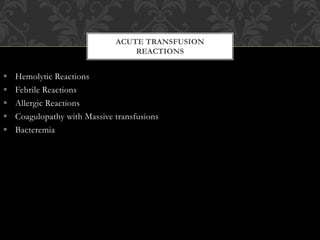
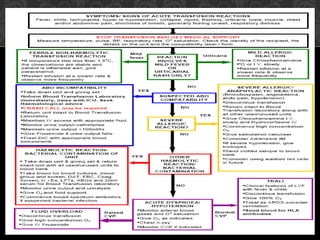
ACUTE TRANSFUSION
REACTIONS
 Hemolytic Reactions
 Febrile Reactions
 Allergic Reactions
 Coagulopathy with Massive transfusions
 Bacteremia
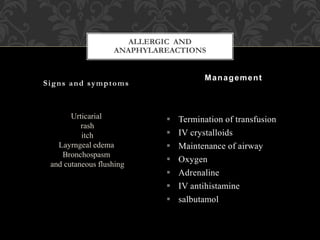
Urticarial
rash
itch
Layrngeal edema
Bronchospasm
and cutaneous flushing
 Termination of transfusion
 IV crystalloids
 Maintenance of airway
 Oxygen
 Adrenaline
 IV antihistamine
 salbutamol
Signs and symptoms
Management
ALLERGIC AND
ANAPHYLAREACTIONS
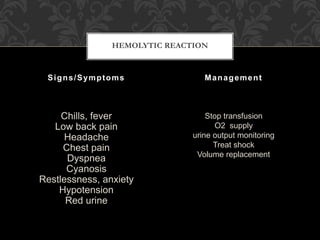
Chills, fever
Low back pain
Headache
Chest pain
Dyspnea
Cyanosis
Restlessness, anxiety
Hypotension
Red urine
Stop transfusion
O2 supply
urine output monitoring
Treat shock
Volume replacement
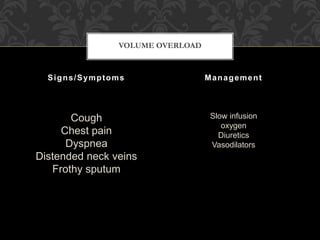
Signs/Symptoms Management
HEMOLYTIC REACTION
Cough
Chest pain
Dyspnea
Distended neck veins
Frothy sputum
Slow infusion
oxygen
Diuretics
Vasodilators
Signs/Symptoms Management
VOLUME OVERLOAD
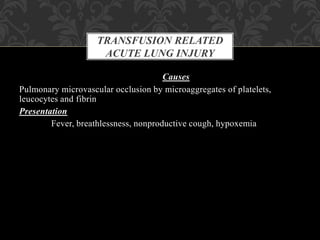
Causes
Pulmonary microvascular occlusion by microaggregates of platelets,
leucocytes and fibrin
Presentation
Fever, breathlessness, nonproductive cough, hypoxemia
TRANSFUSION RELATED
ACUTE LUNG INJURY
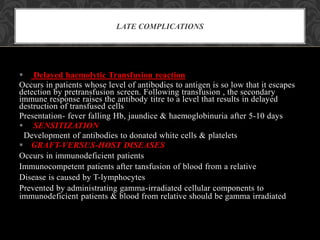
 Delayed haemolytic Transfusion reaction
Occurs in patients whose level of antibodies to antigen is so low that it escapes
detection by pretransfusion screen. Following transfusion , the secondary
immune response raises the antibody titre to a level that results in delayed
destruction of transfused cells
Presentation- fever falling Hb, jaundice & haemoglobinuria after 5-10 days
 SENSITIZATION
Development of antibodies to donated white cells & platelets
 GRAFT-VERSUS-HOST DISEASES
Occurs in immunodeficient patients
Immunocompetent patients after tansfusion of blood from a relative
Disease is caused by T-lymphocytes
Prevented by administrating gamma-irradiated cellular components to
immunodeficient patients & blood from relative should be gamma irradiated
LATE COMPLICATIONS
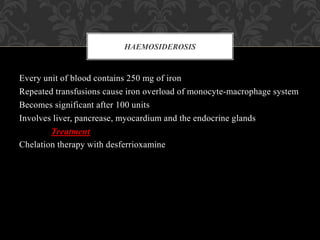
Every unit of blood contains 250 mg of iron
Repeated transfusions cause iron overload of monocyte-macrophage system
Becomes significant after 100 units
Involves liver, pancrease, myocardium and the endocrine glands
Treatment
Chelation therapy with desferrioxamine
HAEMOSIDEROSIS
Transmission of infective diseases
Serum hepatitis virus
HIV
Bacterial infection-result of faulty storage
Malaria
INFECTIVE COMPLICATIONS
 Arrange required blood product as you suspect any need
 If a patient need blood in emergency doctor can request blood bank
 Patient can get blood at exchange basis too
 We take consent for all type of blood transfusion when patient admit on
floor
 Written orders for blood transfusion should be given by Dr
 Repeat the sample after completion of transfusion
 If any reaction occur manage the patient immedietly
 Fill the blood reaction form and send the blood sample for culture and
recross match and remaining blood to the blood bank
 Document the probelum online
HOW DO WE DO IT IN SKMCH
&RC
Blood product transfusion

Blood product transfusion

  • 2.
    BLOOD COMPONENT TRANSFUSION DRTANVEER ALAM PAEDS ONCOLOGY SKMCH & RC
  • 3.
     What ishistory of transfusion?  What are Blood components ?  How are the blood component separated ?  What are the Indications for transfusion ?  What is the dose of administration in paeds?  What are complications?  How to minimize the errors?  What are the SKMCH protocol?
  • 4.
     Blood transfusedin humans since mid-1600’s  1828 – First successful transfusion  1900 – Landsteiner described ABO groups  1916 – First use of blood storage  1939 – Levine described the Rh factor HISTORY OF TRANSFUSIONS
  • 5.
    BLOOD components Any therapeuticsubstance prepared from human blood WHOLE BLOOD Unseparated blood collected into an approved container containing an anticoagulant preservative solution BLOOD COMPONENT • RBCs • platelets • Plasma • Cryoprecipitate • GCSF • Human albumin 4.5% DEFINITIONS
  • 8.
    FIRST CENTRIFUGATION Whole Blood Main Bag SatelliteBag 1 Satellite Bag 2 RBC’s Platelet-rich Plasma First Closed System
  • 9.
  • 11.
    Storage On 4° forup to 35 days Indications Massive Blood Loss/Trauma/Exchange Transfusion Considerations Donor and recipient must be ABO identical Dosage 10 to 20 ml /kg Never add medication to a unit WHOLE BLOOD TRANSFUSION
  • 12.
    Storage 4° for upto 42 days, can be frozen Indications Many indications ie anemia Hb < 7, hypoxia, etc. dosage Dose 10 to 15ml/kg Usually transfuse over 2-4 hours or Volume required = required rise in Hb in g/dl x wt in kg x 4 or 3-4 mls/kg of red cells raises Hb by 1g/dl PRBCS TRANSFUSION
  • 13.
    Storage Up to 5days at 20-24° Indications  Lumbar puncture - transfuse prior to LP to bring platelets > 50 x 109/l.  Major surgery - maintain platelet count > 50 x 109/l (critical sites; brain, spine, eyes > 100 x 109/l).  Minor surgery - maintain platelet count at >50 x 109/l  Line insertion - > 50 x 109/l.  Line removal - > 50 x 109/l.  Bone marrow trephine - Usually no need to transfuse - discuss with operator. In some patients (e.g. aplastics or ITP), platelet transfusion should be avoided if possible.  Bone marrow aspirate - no need to transfuse. PLATELETS TRANSFUSION
  • 15.
    Dosage of platelets 10-20mls/kgfor children There may be a higher requirement in the following circumstances: Active haemorrhage Sepsis Splenomegaly Consumptive coagulopathy – e.g. DIC PLATELETS TRANSFUSION CONTINUE…
  • 16.
     Storage  FFP--12months at –18 degrees or colder  Indications  Coagulation Factor deficiency, fibrinogen replacement, DIC, liver disease, exchange transfusion, massive transfusion,warfarin overdose, INR > 1.5 TO 2 befor surgery Dose : 10-20mls/Kg Considerations  Plasma should be recipient RBC ABO compatible  In children, should also be Rh compatible  Usual dose is 20 cc/kg to raise coagulation factors approx 20% FFP TRANSFUSION
  • 17.
     Rich sourceof Factor VIII, von Willebrand’s factor and fibrinogen  Stored at -400C   Dose of cryoprecipitate  5 ml/kg  Cryoprecipitate is available in most ABO groups  Use within 4h of thawing  use  Haemophilia (Factor VIII deficiency)  Fibrinogen deficiency & dysfibrinogenaemia  Von Willebrand’s disease CRYOPRECIPITATE
  • 19.
     Rich inprotein  This may be stored for several months in liquid form at 40C  Suitable for replacement of protein e.g. following severe burns ,liver disfuntion HUMAN ALBUMIN 4.5 PER CENT
  • 20.
    INDICATION & DOSE Insevere neutropenia in myelosuppresive chemotherapy Initially 5mcg/kg/SC & can increase 5mcg/kg every cycle till anc10,000/mm3 BONE MARROW TRANSPLANT 10mcg/kg/day IV over 4 to 24 hours IN SEVERE CHRONIC NEUTROPENIA SITE Abdomen (not around umbbilicus) ,thighs ,hips ,arm (rotate the site) Keep refrigerated and do not shake before administration G-CSF (FILGRASTIM
  • 21.
    21 Blood/ Start infusionComplete infusion blood product Whole blood/ within 30 min. of within 4 hour red cells removing pack (less in high from ambient temperature) refrigerator Platelet immediately within 20 min concentrates FFP within 30 min within 20 min Time Limits for Infusion
  • 22.
  • 23.
    ACUTE TRANSFUSION REACTIONS  HemolyticReactions  Febrile Reactions  Allergic Reactions  Coagulopathy with Massive transfusions  Bacteremia
  • 25.
    Urticarial rash itch Layrngeal edema Bronchospasm and cutaneousflushing  Termination of transfusion  IV crystalloids  Maintenance of airway  Oxygen  Adrenaline  IV antihistamine  salbutamol Signs and symptoms Management ALLERGIC AND ANAPHYLAREACTIONS
  • 26.
    Chills, fever Low backpain Headache Chest pain Dyspnea Cyanosis Restlessness, anxiety Hypotension Red urine Stop transfusion O2 supply urine output monitoring Treat shock Volume replacement Signs/Symptoms Management HEMOLYTIC REACTION
  • 27.
    Cough Chest pain Dyspnea Distended neckveins Frothy sputum Slow infusion oxygen Diuretics Vasodilators Signs/Symptoms Management VOLUME OVERLOAD
  • 28.
    Causes Pulmonary microvascular occlusionby microaggregates of platelets, leucocytes and fibrin Presentation Fever, breathlessness, nonproductive cough, hypoxemia TRANSFUSION RELATED ACUTE LUNG INJURY
  • 29.
     Delayed haemolyticTransfusion reaction Occurs in patients whose level of antibodies to antigen is so low that it escapes detection by pretransfusion screen. Following transfusion , the secondary immune response raises the antibody titre to a level that results in delayed destruction of transfused cells Presentation- fever falling Hb, jaundice & haemoglobinuria after 5-10 days  SENSITIZATION Development of antibodies to donated white cells & platelets  GRAFT-VERSUS-HOST DISEASES Occurs in immunodeficient patients Immunocompetent patients after tansfusion of blood from a relative Disease is caused by T-lymphocytes Prevented by administrating gamma-irradiated cellular components to immunodeficient patients & blood from relative should be gamma irradiated LATE COMPLICATIONS
  • 30.
    Every unit ofblood contains 250 mg of iron Repeated transfusions cause iron overload of monocyte-macrophage system Becomes significant after 100 units Involves liver, pancrease, myocardium and the endocrine glands Treatment Chelation therapy with desferrioxamine HAEMOSIDEROSIS
  • 31.
    Transmission of infectivediseases Serum hepatitis virus HIV Bacterial infection-result of faulty storage Malaria INFECTIVE COMPLICATIONS
  • 32.
     Arrange requiredblood product as you suspect any need  If a patient need blood in emergency doctor can request blood bank  Patient can get blood at exchange basis too  We take consent for all type of blood transfusion when patient admit on floor  Written orders for blood transfusion should be given by Dr  Repeat the sample after completion of transfusion  If any reaction occur manage the patient immedietly  Fill the blood reaction form and send the blood sample for culture and recross match and remaining blood to the blood bank  Document the probelum online HOW DO WE DO IT IN SKMCH &RC