BLOOD TRANSFUSION
Presenter – Dr. Pranjal S Jain
CONTENTS
 Introduction
 Blood
 Types
 Blood products
 Administration
 Complication
 Summary
 Conclusion
 Discussion
5/17/2021 BLOOD TRANSFUSION 2
INTRODUCTION
Blood transfusion is the procedure of transferring blood or
blood components from one person into the blood stream of
another person. Transfusion is life saving procedure to replace
blood cells or blood products lost through bleeding or some
other reasons.
Blood transfusion is a routine medical procedure . In these
procedure two phases are important first one is collection of
blood from donor and second is administration of blood to the
recipient.
5/17/2021 BLOOD TRANSFUSION 3
History
William Harvey's in 1628 discovered the blood circulates
through the body in one direction. By the end of 17th century,
physicians using quills as needles and silver pipes to transfer
blood from donor to recipient, but the donor usually animal.
James Blundell started using human blood to replace blood lost
in the early 1800s. Physicians Karl Landsteiner set out to figure
out why some blood transfusion patients lived and others died, a
line of inquiry that led him to discover the ABO blood type
groups in 1901. it was Landsteiner ground-breaking work that
helped classify blood into one of four categories ( A, B, AB and
O)
5/17/2021 BLOOD TRANSFUSION 4
Blood
 Blood is a connective tissue in fluid form.
 It is also called “fluid of life, fluid of growth, fluid of health”.
 Properties :-
1. colour:- Red
2.Volume:- Average 5lit, in new born it is 4.5lit
3.Reaction and pH:- Slightly alkaline and pH 7.4
4.Specific gravity:- 1.052 to 1.061
5.Viscocity:- 5 times more viscous than water
5/17/2021 BLOOD TRANSFUSION 5
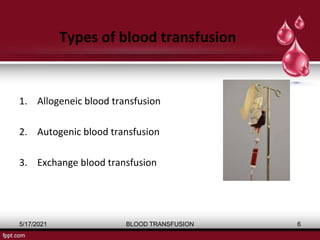
Types of blood transfusion
1. Allogeneic blood transfusion
2. Autogenic blood transfusion
3. Exchange blood transfusion
5/17/2021 BLOOD TRANSFUSION 6
Allogeneic blood transfusion
Allogeneic transfusion occurs when a donor and recipient are
not the same person.
Indication:-
Both elective and emergency situations.
Advantages:-
Can be life saving when your own blood is not available.
Disadvantages:-
There is a risk of disease transmission , allergic reaction.
5/17/2021 BLOOD TRANSFUSION 7
Autogenic blood transfusion
Reinfusion of patient΄s own blood or blood components.
Types-
1. Pre-deposit:- 2 - 5 units of blood may be donated over 2 – 3
weeks before surgery.
2. Pre-operative haemodilution :- Just before surgery, 1-2 units
of blood are removed (orthopaedic surgery, plastic surgery)
3. Blood salvage :- Blood lost during surgery is collected, mixed
with anticoagulant solution, washed and re-infused.
5/17/2021 BLOOD TRANSFUSION 8
Cont.…
Advantages:-
All risks involved in blood transfusion are avoided.
Disadvantages:-
May not acceptable to patient.
5/17/2021 BLOOD TRANSFUSION 9
Exchange blood transfusion
 It is the procedure which involves removal of patients blood
completely and replacement with fresh blood or plasma of
the donor.
 It is also known as replacement transfusion.
 It is the life saving procedure carried out in conditions such as
severe jaundice, sickle cell anaemia, erythroblastosis fetalis
etc.
5/17/2021 BLOOD TRANSFUSION 10
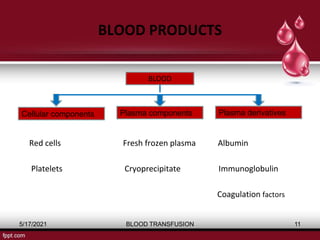
BLOOD PRODUCTS
Red cells Fresh frozen plasma Albumin
Platelets Cryoprecipitate Immunoglobulin
Coagulation factors
BLOOD
Cellular components Plasma components Plasma derivatives
5/17/2021 BLOOD TRANSFUSION 11
5/17/2021 BLOOD TRANSFUSION 12
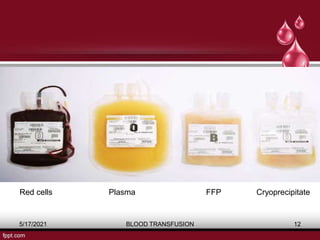
Red cells Plasma FFP Cryoprecipitate
WHOLE BLOOD
 Whole blood provides both oxygen carrying capacity and
volume expansion.
 Whole blood stored at 4⁰C.
 It is the ideal component for patients who have sustained
acute haemorrhage of 25%
 Whole blood is not readily available since it is routinely
processed into components.
 Dose:- 10 ml/ kg body weight
5/17/2021 BLOOD TRANSFUSION 13
PACKED RED BLOOD CELLS
 Each bag of packed cells contains approximately 250-300ml
with red cells concentration of 70%
 Indication:-
Hb 7% Trauma Delivery
Chemotherapy Sickle cell anaemia
 Each cell of packed cells increase haemoglobin by 1% and
haematocrit by 3%
 Dose:- 10 ml/ kg body weight
5/17/2021 BLOOD TRANSFUSION 14
PLATELETS
 Each unit (50ml) should contain at least 5.5 × 10 ⁱ⁰ platelet
and each unit should elevate platelet count by 5 - 10,000
cells/ cu mm ( 20-40 × 10⁹/ L.) in a 70kg person.
 Platelets may be transfused prophylactically or for
therapeutic purposes.
 prophylactically platelet transfusion:-
Platelet count is < 10,000 cells/cu mm in oncology patient
Platelet count is < 5000 cells/ cu mm in leukaemia
5/17/2021 BLOOD TRANSFUSION 15
 Platelets are usually given to the patient with
Thrombocytopenia or those with platelet dysfunction who are
bleeding or undergoing surgery and in patients with bone
marrow failure.
 Platelets must be transfused within 4hrs of commencement
of the infusion.
5/17/2021 BLOOD TRANSFUSION 16
FRESH FROZEN PLASMA
 Plasma (150-300ml) stored in frozen form at 18 ͦC for 1yr
 It contains coagulation factor, plasma protein, antithrombin
 FFP must be transfused as soon as possible after thawing and
definitely within 24 hrs of thawing.
 A hanging unit must be transfused within 6hrs of
commencement of transfusion.
 Indication:- Actively bleeding
To correct coagulation factor deficiencies
Thrombotic thrombocytopenic purpura.
 Dose :- 10-20 ml/ kg weight
5/17/2021 BLOOD TRANSFUSION 17
CRYOPRECIPITATE
 The FFP may be further treated to produce cryoprecipitate.
 Cryoprecipitate is a source of fibrinogen, factor VΙΙΙ and von
Willebrand factor.
 Indication:- Replcement of fibrinogen
Von Willebrand diseases
Haemophilia
 Dose :- 0.2 units/ kg body weight but usually 10 unit
 10 – 20ml contains Fibrinogen 150-300mg, factor VII & Von
Willebrand factor 80-120 U
5/17/2021 BLOOD TRANSFUSION 18
PLASMA DERIVATIVES
Plasma may be pooled to derive specific protein concentrates
including albumin, immunoglobulin, coagulation factor
1.Albumin :- This is commonly prepared as 5% albumin and
20% albumin. Its stored at 2 ͦC to 25 ͦC
Indication :-
hypovolemic shock , burns
2.Immunoglobulin:- It is a concentrate of IgG fraction of
human plasma.
It is available as intramuscular grade and intravenous grade.
5/17/2021 BLOOD TRANSFUSION 19
a)Intramuscular immunoglobulin :- prophylaxis for viral
infections like hepatitis A and measles.
b)Intravenous immunoglobulin :- Antibody deficiency
syndrome, recurrent infection, thrombocytopenic purpura.
3. Coagulation factors :- factors IX, X, VII
It is storage at 4 ͦC to 8 ͦC
Indication:-
Haemophilia A, B
5/17/2021 BLOOD TRANSFUSION 20
NEED OF TRANSFUSION
Transfusion is needed in both elective and emergency condition
some of _
1. Anemia
2. Trauma
3. Hemorrhage
4. Surgery
5. Leukemia
6. Malaria
7. Dengue
5/17/2021 BLOOD TRANSFUSION 21
Selection of donor
 Age :- Min:- 17 yr
 Body weight – 50 kg
 Hb:- MIN – 12 gm/dl
 Frequency :- Min 12 wks.
 No recent history of jaundice, malaria, typhoid
 Absence of hypertension, tuberculosis, diabetes and allergy.
 Donors on medication are not accepted for blood donation.
5/17/2021 BLOOD TRANSFUSION 22
During donation:-
 Blood should not be collected empty stomach or should not
be dehydrated.
 Following donation donor should be offered sweetened drink
and asked to take a rest at least 1-2 hrs.
 Check the vital signs frequently before leaving the centre and
also observed for any giddiness, colour changes.
5/17/2021 BLOOD TRANSFUSION 23
Storage of blood
 Donor΄s blood is collected in sterile container containing
anticoagulant solution.
 All the articles used for collection of blood must be sterile.
 All blood for transfusion must be stored in special blood bank
refrigerators controlled at 4 ͦC +/- 2 ͦC
 Blood kept at higher temperatures for more han 2hrs is in
danger of transmitting infection.
 Each donor unit should be labelled as –Name, date, time, ABO
grouping, Rh type, Date of drawing, Date of expiry, result for
test (hepatitis, syphilis).
5/17/2021 BLOOD TRANSFUSION 24
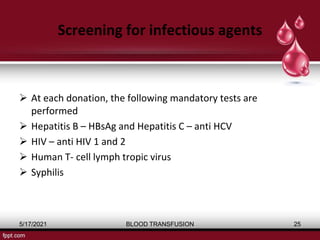
Screening for infectious agents
 At each donation, the following mandatory tests are
performed
 Hepatitis B – HBsAg and Hepatitis C – anti HCV
 HIV – anti HIV 1 and 2
 Human T- cell lymph tropic virus
 Syphilis
5/17/2021 BLOOD TRANSFUSION 25
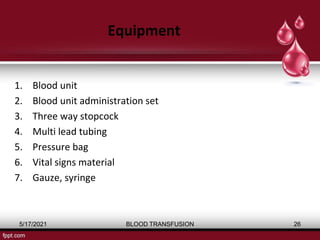
Equipment
1. Blood unit
2. Blood unit administration set
3. Three way stopcock
4. Multi lead tubing
5. Pressure bag
6. Vital signs material
7. Gauze, syringe
5/17/2021 BLOOD TRANSFUSION 26
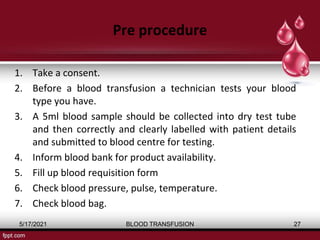
Pre procedure
1. Take a consent.
2. Before a blood transfusion a technician tests your blood
type you have.
3. A 5ml blood sample should be collected into dry test tube
and then correctly and clearly labelled with patient details
and submitted to blood centre for testing.
4. Inform blood bank for product availability.
5. Fill up blood requisition form
6. Check blood pressure, pulse, temperature.
7. Check blood bag.
5/17/2021 BLOOD TRANSFUSION 27
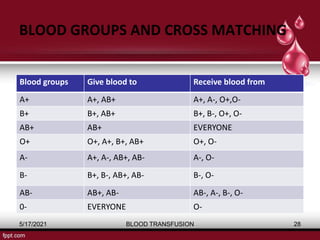
BLOOD GROUPS AND CROSS MATCHING
Blood groups Give blood to Receive blood from
A+ A+, AB+ A+, A-, O+,O-
B+ B+, AB+ B+, B-, O+, O-
AB+ AB+ EVERYONE
O+ O+, A+, B+, AB+ O+, O-
A- A+, A-, AB+, AB- A-, O-
B- B+, B-, AB+, AB- B-, O-
AB- AB+, AB- AB-, A-, B-, O-
0- EVERYONE O-
5/17/2021 BLOOD TRANSFUSION 28
5/17/2021 BLOOD TRANSFUSION 29
During transfusion
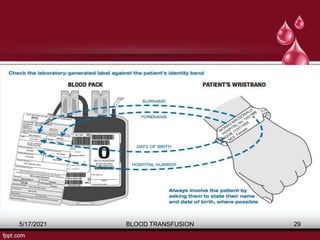
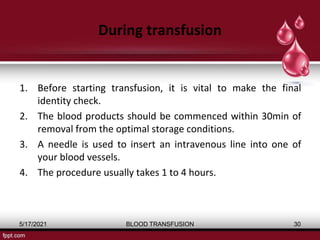
1. Before starting transfusion, it is vital to make the final
identity check.
2. The blood products should be commenced within 30min of
removal from the optimal storage conditions.
3. A needle is used to insert an intravenous line into one of
your blood vessels.
4. The procedure usually takes 1 to 4 hours.
5/17/2021 BLOOD TRANSFUSION 30
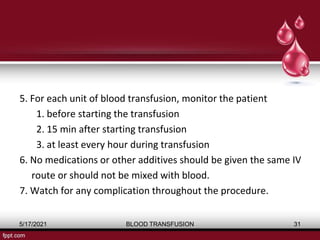
5. For each unit of blood transfusion, monitor the patient
1. before starting the transfusion
2. 15 min after starting transfusion
3. at least every hour during transfusion
6. No medications or other additives should be given the same IV
route or should not be mixed with blood.
7. Watch for any complication throughout the procedure.
5/17/2021 BLOOD TRANSFUSION 31
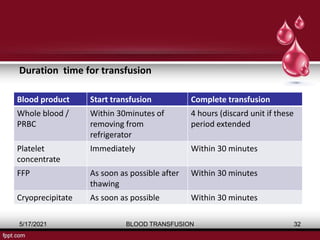
Duration time for transfusion
5/17/2021 BLOOD TRANSFUSION 32
Blood product Start transfusion Complete transfusion
Whole blood /
PRBC
Within 30minutes of
removing from
refrigerator
4 hours (discard unit if these
period extended
Platelet
concentrate
Immediately Within 30 minutes
FFP As soon as possible after
thawing
Within 30 minutes
Cryoprecipitate As soon as possible Within 30 minutes
After transfusion
1. After blood transfusion your vital signs are
checked(temperature, blood pressure, heart rate)
2. The intravenous line is taken out.
3. May develop some bruising or soreness at the site of
insertion
4. May need blood tests that shows how your body is reacting
to transfusion.
5/17/2021 BLOOD TRANSFUSION 33
ADVERSE REACTION
1.) Immune-mediated reactions
a.) Haemolytic reaction
b.) Non haemolytic reaction
2.) Nonimmunologic reactions
3.)Infectious complications
4.)Plasma protein reaction
5.)Massive blood transfusion complication
6.)Other complication
7.)Complication due to faulty technique
5/17/2021 BLOOD TRANSFUSION 34
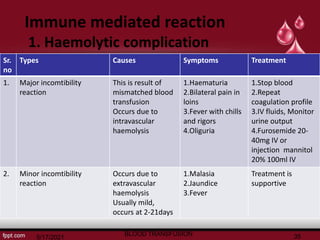
Sr.
no
Types Causes Symptoms Treatment
1. Major incomtibility
reaction
This is result of
mismatched blood
transfusion
Occurs due to
intravascular
haemolysis
1.Haematuria
2.Bilateral pain in
loins
3.Fever with chills
and rigors
4.Oliguria
1.Stop blood
2.Repeat
coagulation profile
3.IV fluids, Monitor
urine output
4.Furosemide 20-
40mg IV or
injection mannitol
20% 100ml IV
2. Minor incomtibility
reaction
Occurs due to
extravascular
haemolysis
Usually mild,
occurs at 2-21days
1.Malasia
2.Jaundice
3.Fever
Treatment is
supportive
Immune mediated reaction
1. Haemolytic complication
5/17/2021
BLOOD TRANSFUSION 35
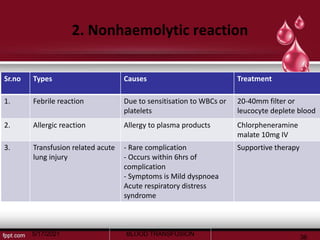
2. Nonhaemolytic reaction
Sr.no Types Causes Treatment
1. Febrile reaction Due to sensitisation to WBCs or
platelets
20-40mm filter or
leucocyte deplete blood
2. Allergic reaction Allergy to plasma products Chlorpheneramine
malate 10mg IV
3. Transfusion related acute
lung injury
- Rare complication
- Occurs within 6hrs of
complication
- Symptoms is Mild dyspnoea
Acute respiratory distress
syndrome
Supportive therapy
5/17/2021 BLOOD TRANSFUSION
36
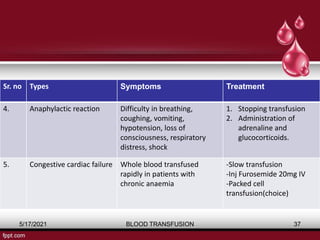
Sr. no Types Symptoms Treatment
4. Anaphylactic reaction Difficulty in breathing,
coughing, vomiting,
hypotension, loss of
consciousness, respiratory
distress, shock
1. Stopping transfusion
2. Administration of
adrenaline and
glucocorticoids.
5. Congestive cardiac failure Whole blood transfused
rapidly in patients with
chronic anaemia
-Slow transfusion
-Inj Furosemide 20mg IV
-Packed cell
transfusion(choice)
5/17/2021 BLOOD TRANSFUSION 37
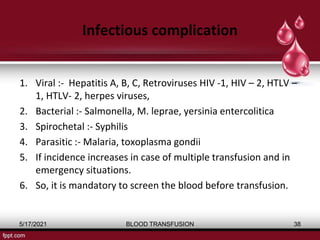
Infectious complication
1. Viral :- Hepatitis A, B, C, Retroviruses HIV -1, HIV – 2, HTLV –
1, HTLV- 2, herpes viruses,
2. Bacterial :- Salmonella, M. leprae, yersinia entercolitica
3. Spirochetal :- Syphilis
4. Parasitic :- Malaria, toxoplasma gondii
5. If incidence increases in case of multiple transfusion and in
emergency situations.
6. So, it is mandatory to screen the blood before transfusion.
5/17/2021 BLOOD TRANSFUSION 38
Plasma protein reaction
1. Urticaria
2. Anaphylaxis (IgA deficiency in the recipient )
5/17/2021 BLOOD TRANSFUSION 39
Massive blood transfusion complication
 Massive transfusion is the transfusion of blood equivalent or
more than the patient΄s own blood volume.
 Replacement of > 500ml over 5min
> ½ the patient΄s blood volume in 6hrs
> whole blood volume in 24hrs
 Massive blood loss may occur with trauma, PPH or during
major surgeries.
5/17/2021 BLOOD TRANSFUSION 40
Cont.…
It leads to -
1. Circulatory shock
2. Hyperkalaemia
3. Hypocalcaemia
5/17/2021 BLOOD TRANSFUSION 41
OTHER COMPLICATION
1.Hypothermia
2. Electrolyte Toxicity
a. Hyperkalaemia
b. Hypocalcaemia
3. Hemosiderosis (iron overloaded)
4. Hypotensive reaction
5/17/2021 BLOOD TRANSFUSION 42
Complication due to faulty techniques
1. Thrombophlebitis ( inflammation of vein, associated with
formation of thrombus).
2. Infiltration and hematoma at the site of needle
3. Air embolism ( obstruction of blood vessel due to entrance
of air into the bloodstream )
5/17/2021 BLOOD TRANSFUSION 43
Acute complication
1. Febrile non – haemolytic reactions
2. Allergic reactions
3. Septicaemia
4. Transfusion related acute lung injury
5. Hypothermia
6. Volume overload
5/17/2021 BLOOD TRANSFUSION 44
Delayed complication
1. Transfusion associated Graft versus host disease.
2. Post transfusion Purpura
3. Hypokalaemia
4. Hepatitis
5. HIV
6. Syphilis
7. Malaria
5/17/2021 BLOOD TRANSFUSION 45
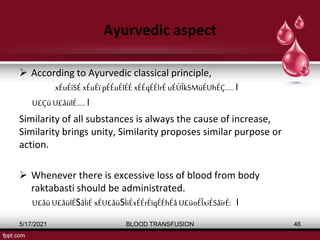
Ayurvedic aspect
 According to Ayurvedic classical principle,
xÉuÉïSÉ xÉuÉï pÉÉuÉlÉÉ xÉÉqÉÉlrÉ uÉÚÎkSMüÉUhÉÇ..... Ι
U£Çü U£åülÉ.....Ι
Similarity of all substances is always the cause of increase,
Similarity brings unity, Similarity proposes similar purpose or
action.
 Whenever there is excessive loss of blood from body
raktabasti should be administrated.
U£åüU£åülÉSåÌiÉ xÉU£åüSÌiÉxÉÉrÉïqÉÉhÉå U£üoÉÎxiÉSåïrÉ: Ι
5/17/2021 BLOOD TRANSFUSION 46
DISCUSSION
 Blood is a precious gift given by a donor.
 Blood donation is a easy and safe process. Depending upon
your height, weight you can give upto 2 units of blood
 Whenever there is a need of blood transfusion various blood
products are available.
 During blood transfusion various complication occurs so first
step is stop blood immediately and check vitals, observe urine
output and gives supportive treatment as per complication
occurs.
5/17/2021 BLOOD TRANSFUSION 47
CONCLUSION
 Blood is a essential substance present in our body.
 Whenever there is a loss of blood due to any reason, blood
transfusion therapy is effective.
 Blood transfusion only done when there is necessary of
transfusion.
 Cross matching of blood is an mandatory process before
transfusion.
 Early transfusions used whole blood but modern medical
practice commonly used components of blood.
 Transfusion reaction should be identified and treated
immediately.
5/17/2021 BLOOD TRANSFUSION 48
5/17/2021 BLOOD TRANSFUSION 49

Blood transfusion

  • 1.
  • 2.
    CONTENTS  Introduction  Blood Types  Blood products  Administration  Complication  Summary  Conclusion  Discussion 5/17/2021 BLOOD TRANSFUSION 2
  • 3.
    INTRODUCTION Blood transfusion isthe procedure of transferring blood or blood components from one person into the blood stream of another person. Transfusion is life saving procedure to replace blood cells or blood products lost through bleeding or some other reasons. Blood transfusion is a routine medical procedure . In these procedure two phases are important first one is collection of blood from donor and second is administration of blood to the recipient. 5/17/2021 BLOOD TRANSFUSION 3
  • 4.
    History William Harvey's in1628 discovered the blood circulates through the body in one direction. By the end of 17th century, physicians using quills as needles and silver pipes to transfer blood from donor to recipient, but the donor usually animal. James Blundell started using human blood to replace blood lost in the early 1800s. Physicians Karl Landsteiner set out to figure out why some blood transfusion patients lived and others died, a line of inquiry that led him to discover the ABO blood type groups in 1901. it was Landsteiner ground-breaking work that helped classify blood into one of four categories ( A, B, AB and O) 5/17/2021 BLOOD TRANSFUSION 4
  • 5.
    Blood  Blood isa connective tissue in fluid form.  It is also called “fluid of life, fluid of growth, fluid of health”.  Properties :- 1. colour:- Red 2.Volume:- Average 5lit, in new born it is 4.5lit 3.Reaction and pH:- Slightly alkaline and pH 7.4 4.Specific gravity:- 1.052 to 1.061 5.Viscocity:- 5 times more viscous than water 5/17/2021 BLOOD TRANSFUSION 5
  • 6.
    Types of bloodtransfusion 1. Allogeneic blood transfusion 2. Autogenic blood transfusion 3. Exchange blood transfusion 5/17/2021 BLOOD TRANSFUSION 6
  • 7.
    Allogeneic blood transfusion Allogeneictransfusion occurs when a donor and recipient are not the same person. Indication:- Both elective and emergency situations. Advantages:- Can be life saving when your own blood is not available. Disadvantages:- There is a risk of disease transmission , allergic reaction. 5/17/2021 BLOOD TRANSFUSION 7
  • 8.
    Autogenic blood transfusion Reinfusionof patient΄s own blood or blood components. Types- 1. Pre-deposit:- 2 - 5 units of blood may be donated over 2 – 3 weeks before surgery. 2. Pre-operative haemodilution :- Just before surgery, 1-2 units of blood are removed (orthopaedic surgery, plastic surgery) 3. Blood salvage :- Blood lost during surgery is collected, mixed with anticoagulant solution, washed and re-infused. 5/17/2021 BLOOD TRANSFUSION 8
  • 9.
    Cont.… Advantages:- All risks involvedin blood transfusion are avoided. Disadvantages:- May not acceptable to patient. 5/17/2021 BLOOD TRANSFUSION 9
  • 10.
    Exchange blood transfusion It is the procedure which involves removal of patients blood completely and replacement with fresh blood or plasma of the donor.  It is also known as replacement transfusion.  It is the life saving procedure carried out in conditions such as severe jaundice, sickle cell anaemia, erythroblastosis fetalis etc. 5/17/2021 BLOOD TRANSFUSION 10
  • 11.
    BLOOD PRODUCTS Red cellsFresh frozen plasma Albumin Platelets Cryoprecipitate Immunoglobulin Coagulation factors BLOOD Cellular components Plasma components Plasma derivatives 5/17/2021 BLOOD TRANSFUSION 11
  • 12.
    5/17/2021 BLOOD TRANSFUSION12 Red cells Plasma FFP Cryoprecipitate
  • 13.
    WHOLE BLOOD  Wholeblood provides both oxygen carrying capacity and volume expansion.  Whole blood stored at 4⁰C.  It is the ideal component for patients who have sustained acute haemorrhage of 25%  Whole blood is not readily available since it is routinely processed into components.  Dose:- 10 ml/ kg body weight 5/17/2021 BLOOD TRANSFUSION 13
  • 14.
    PACKED RED BLOODCELLS  Each bag of packed cells contains approximately 250-300ml with red cells concentration of 70%  Indication:- Hb 7% Trauma Delivery Chemotherapy Sickle cell anaemia  Each cell of packed cells increase haemoglobin by 1% and haematocrit by 3%  Dose:- 10 ml/ kg body weight 5/17/2021 BLOOD TRANSFUSION 14
  • 15.
    PLATELETS  Each unit(50ml) should contain at least 5.5 × 10 ⁱ⁰ platelet and each unit should elevate platelet count by 5 - 10,000 cells/ cu mm ( 20-40 × 10⁹/ L.) in a 70kg person.  Platelets may be transfused prophylactically or for therapeutic purposes.  prophylactically platelet transfusion:- Platelet count is < 10,000 cells/cu mm in oncology patient Platelet count is < 5000 cells/ cu mm in leukaemia 5/17/2021 BLOOD TRANSFUSION 15
  • 16.
     Platelets areusually given to the patient with Thrombocytopenia or those with platelet dysfunction who are bleeding or undergoing surgery and in patients with bone marrow failure.  Platelets must be transfused within 4hrs of commencement of the infusion. 5/17/2021 BLOOD TRANSFUSION 16
  • 17.
    FRESH FROZEN PLASMA Plasma (150-300ml) stored in frozen form at 18 ͦC for 1yr  It contains coagulation factor, plasma protein, antithrombin  FFP must be transfused as soon as possible after thawing and definitely within 24 hrs of thawing.  A hanging unit must be transfused within 6hrs of commencement of transfusion.  Indication:- Actively bleeding To correct coagulation factor deficiencies Thrombotic thrombocytopenic purpura.  Dose :- 10-20 ml/ kg weight 5/17/2021 BLOOD TRANSFUSION 17
  • 18.
    CRYOPRECIPITATE  The FFPmay be further treated to produce cryoprecipitate.  Cryoprecipitate is a source of fibrinogen, factor VΙΙΙ and von Willebrand factor.  Indication:- Replcement of fibrinogen Von Willebrand diseases Haemophilia  Dose :- 0.2 units/ kg body weight but usually 10 unit  10 – 20ml contains Fibrinogen 150-300mg, factor VII & Von Willebrand factor 80-120 U 5/17/2021 BLOOD TRANSFUSION 18
  • 19.
    PLASMA DERIVATIVES Plasma maybe pooled to derive specific protein concentrates including albumin, immunoglobulin, coagulation factor 1.Albumin :- This is commonly prepared as 5% albumin and 20% albumin. Its stored at 2 ͦC to 25 ͦC Indication :- hypovolemic shock , burns 2.Immunoglobulin:- It is a concentrate of IgG fraction of human plasma. It is available as intramuscular grade and intravenous grade. 5/17/2021 BLOOD TRANSFUSION 19
  • 20.
    a)Intramuscular immunoglobulin :-prophylaxis for viral infections like hepatitis A and measles. b)Intravenous immunoglobulin :- Antibody deficiency syndrome, recurrent infection, thrombocytopenic purpura. 3. Coagulation factors :- factors IX, X, VII It is storage at 4 ͦC to 8 ͦC Indication:- Haemophilia A, B 5/17/2021 BLOOD TRANSFUSION 20
  • 21.
    NEED OF TRANSFUSION Transfusionis needed in both elective and emergency condition some of _ 1. Anemia 2. Trauma 3. Hemorrhage 4. Surgery 5. Leukemia 6. Malaria 7. Dengue 5/17/2021 BLOOD TRANSFUSION 21
  • 22.
    Selection of donor Age :- Min:- 17 yr  Body weight – 50 kg  Hb:- MIN – 12 gm/dl  Frequency :- Min 12 wks.  No recent history of jaundice, malaria, typhoid  Absence of hypertension, tuberculosis, diabetes and allergy.  Donors on medication are not accepted for blood donation. 5/17/2021 BLOOD TRANSFUSION 22
  • 23.
    During donation:-  Bloodshould not be collected empty stomach or should not be dehydrated.  Following donation donor should be offered sweetened drink and asked to take a rest at least 1-2 hrs.  Check the vital signs frequently before leaving the centre and also observed for any giddiness, colour changes. 5/17/2021 BLOOD TRANSFUSION 23
  • 24.
    Storage of blood Donor΄s blood is collected in sterile container containing anticoagulant solution.  All the articles used for collection of blood must be sterile.  All blood for transfusion must be stored in special blood bank refrigerators controlled at 4 ͦC +/- 2 ͦC  Blood kept at higher temperatures for more han 2hrs is in danger of transmitting infection.  Each donor unit should be labelled as –Name, date, time, ABO grouping, Rh type, Date of drawing, Date of expiry, result for test (hepatitis, syphilis). 5/17/2021 BLOOD TRANSFUSION 24
  • 25.
    Screening for infectiousagents  At each donation, the following mandatory tests are performed  Hepatitis B – HBsAg and Hepatitis C – anti HCV  HIV – anti HIV 1 and 2  Human T- cell lymph tropic virus  Syphilis 5/17/2021 BLOOD TRANSFUSION 25
  • 26.
    Equipment 1. Blood unit 2.Blood unit administration set 3. Three way stopcock 4. Multi lead tubing 5. Pressure bag 6. Vital signs material 7. Gauze, syringe 5/17/2021 BLOOD TRANSFUSION 26
  • 27.
    Pre procedure 1. Takea consent. 2. Before a blood transfusion a technician tests your blood type you have. 3. A 5ml blood sample should be collected into dry test tube and then correctly and clearly labelled with patient details and submitted to blood centre for testing. 4. Inform blood bank for product availability. 5. Fill up blood requisition form 6. Check blood pressure, pulse, temperature. 7. Check blood bag. 5/17/2021 BLOOD TRANSFUSION 27
  • 28.
    BLOOD GROUPS ANDCROSS MATCHING Blood groups Give blood to Receive blood from A+ A+, AB+ A+, A-, O+,O- B+ B+, AB+ B+, B-, O+, O- AB+ AB+ EVERYONE O+ O+, A+, B+, AB+ O+, O- A- A+, A-, AB+, AB- A-, O- B- B+, B-, AB+, AB- B-, O- AB- AB+, AB- AB-, A-, B-, O- 0- EVERYONE O- 5/17/2021 BLOOD TRANSFUSION 28
  • 29.
  • 30.
    During transfusion 1. Beforestarting transfusion, it is vital to make the final identity check. 2. The blood products should be commenced within 30min of removal from the optimal storage conditions. 3. A needle is used to insert an intravenous line into one of your blood vessels. 4. The procedure usually takes 1 to 4 hours. 5/17/2021 BLOOD TRANSFUSION 30
  • 31.
    5. For eachunit of blood transfusion, monitor the patient 1. before starting the transfusion 2. 15 min after starting transfusion 3. at least every hour during transfusion 6. No medications or other additives should be given the same IV route or should not be mixed with blood. 7. Watch for any complication throughout the procedure. 5/17/2021 BLOOD TRANSFUSION 31
  • 32.
    Duration time fortransfusion 5/17/2021 BLOOD TRANSFUSION 32 Blood product Start transfusion Complete transfusion Whole blood / PRBC Within 30minutes of removing from refrigerator 4 hours (discard unit if these period extended Platelet concentrate Immediately Within 30 minutes FFP As soon as possible after thawing Within 30 minutes Cryoprecipitate As soon as possible Within 30 minutes
  • 33.
    After transfusion 1. Afterblood transfusion your vital signs are checked(temperature, blood pressure, heart rate) 2. The intravenous line is taken out. 3. May develop some bruising or soreness at the site of insertion 4. May need blood tests that shows how your body is reacting to transfusion. 5/17/2021 BLOOD TRANSFUSION 33
  • 34.
    ADVERSE REACTION 1.) Immune-mediatedreactions a.) Haemolytic reaction b.) Non haemolytic reaction 2.) Nonimmunologic reactions 3.)Infectious complications 4.)Plasma protein reaction 5.)Massive blood transfusion complication 6.)Other complication 7.)Complication due to faulty technique 5/17/2021 BLOOD TRANSFUSION 34
  • 35.
    Sr. no Types Causes SymptomsTreatment 1. Major incomtibility reaction This is result of mismatched blood transfusion Occurs due to intravascular haemolysis 1.Haematuria 2.Bilateral pain in loins 3.Fever with chills and rigors 4.Oliguria 1.Stop blood 2.Repeat coagulation profile 3.IV fluids, Monitor urine output 4.Furosemide 20- 40mg IV or injection mannitol 20% 100ml IV 2. Minor incomtibility reaction Occurs due to extravascular haemolysis Usually mild, occurs at 2-21days 1.Malasia 2.Jaundice 3.Fever Treatment is supportive Immune mediated reaction 1. Haemolytic complication 5/17/2021 BLOOD TRANSFUSION 35
  • 36.
    2. Nonhaemolytic reaction Sr.noTypes Causes Treatment 1. Febrile reaction Due to sensitisation to WBCs or platelets 20-40mm filter or leucocyte deplete blood 2. Allergic reaction Allergy to plasma products Chlorpheneramine malate 10mg IV 3. Transfusion related acute lung injury - Rare complication - Occurs within 6hrs of complication - Symptoms is Mild dyspnoea Acute respiratory distress syndrome Supportive therapy 5/17/2021 BLOOD TRANSFUSION 36
  • 37.
    Sr. no TypesSymptoms Treatment 4. Anaphylactic reaction Difficulty in breathing, coughing, vomiting, hypotension, loss of consciousness, respiratory distress, shock 1. Stopping transfusion 2. Administration of adrenaline and glucocorticoids. 5. Congestive cardiac failure Whole blood transfused rapidly in patients with chronic anaemia -Slow transfusion -Inj Furosemide 20mg IV -Packed cell transfusion(choice) 5/17/2021 BLOOD TRANSFUSION 37
  • 38.
    Infectious complication 1. Viral:- Hepatitis A, B, C, Retroviruses HIV -1, HIV – 2, HTLV – 1, HTLV- 2, herpes viruses, 2. Bacterial :- Salmonella, M. leprae, yersinia entercolitica 3. Spirochetal :- Syphilis 4. Parasitic :- Malaria, toxoplasma gondii 5. If incidence increases in case of multiple transfusion and in emergency situations. 6. So, it is mandatory to screen the blood before transfusion. 5/17/2021 BLOOD TRANSFUSION 38
  • 39.
    Plasma protein reaction 1.Urticaria 2. Anaphylaxis (IgA deficiency in the recipient ) 5/17/2021 BLOOD TRANSFUSION 39
  • 40.
    Massive blood transfusioncomplication  Massive transfusion is the transfusion of blood equivalent or more than the patient΄s own blood volume.  Replacement of > 500ml over 5min > ½ the patient΄s blood volume in 6hrs > whole blood volume in 24hrs  Massive blood loss may occur with trauma, PPH or during major surgeries. 5/17/2021 BLOOD TRANSFUSION 40
  • 41.
    Cont.… It leads to- 1. Circulatory shock 2. Hyperkalaemia 3. Hypocalcaemia 5/17/2021 BLOOD TRANSFUSION 41
  • 42.
    OTHER COMPLICATION 1.Hypothermia 2. ElectrolyteToxicity a. Hyperkalaemia b. Hypocalcaemia 3. Hemosiderosis (iron overloaded) 4. Hypotensive reaction 5/17/2021 BLOOD TRANSFUSION 42
  • 43.
    Complication due tofaulty techniques 1. Thrombophlebitis ( inflammation of vein, associated with formation of thrombus). 2. Infiltration and hematoma at the site of needle 3. Air embolism ( obstruction of blood vessel due to entrance of air into the bloodstream ) 5/17/2021 BLOOD TRANSFUSION 43
  • 44.
    Acute complication 1. Febrilenon – haemolytic reactions 2. Allergic reactions 3. Septicaemia 4. Transfusion related acute lung injury 5. Hypothermia 6. Volume overload 5/17/2021 BLOOD TRANSFUSION 44
  • 45.
    Delayed complication 1. Transfusionassociated Graft versus host disease. 2. Post transfusion Purpura 3. Hypokalaemia 4. Hepatitis 5. HIV 6. Syphilis 7. Malaria 5/17/2021 BLOOD TRANSFUSION 45
  • 46.
    Ayurvedic aspect  Accordingto Ayurvedic classical principle, xÉuÉïSÉ xÉuÉï pÉÉuÉlÉÉ xÉÉqÉÉlrÉ uÉÚÎkSMüÉUhÉÇ..... Ι U£Çü U£åülÉ.....Ι Similarity of all substances is always the cause of increase, Similarity brings unity, Similarity proposes similar purpose or action.  Whenever there is excessive loss of blood from body raktabasti should be administrated. U£åüU£åülÉSåÌiÉ xÉU£åüSÌiÉxÉÉrÉïqÉÉhÉå U£üoÉÎxiÉSåïrÉ: Ι 5/17/2021 BLOOD TRANSFUSION 46
  • 47.
    DISCUSSION  Blood isa precious gift given by a donor.  Blood donation is a easy and safe process. Depending upon your height, weight you can give upto 2 units of blood  Whenever there is a need of blood transfusion various blood products are available.  During blood transfusion various complication occurs so first step is stop blood immediately and check vitals, observe urine output and gives supportive treatment as per complication occurs. 5/17/2021 BLOOD TRANSFUSION 47
  • 48.
    CONCLUSION  Blood isa essential substance present in our body.  Whenever there is a loss of blood due to any reason, blood transfusion therapy is effective.  Blood transfusion only done when there is necessary of transfusion.  Cross matching of blood is an mandatory process before transfusion.  Early transfusions used whole blood but modern medical practice commonly used components of blood.  Transfusion reaction should be identified and treated immediately. 5/17/2021 BLOOD TRANSFUSION 48
  • 49.