By
DrTanveer alam khan
 What is hypertension
 How to diagnose hypertension in children
 Measuring BP in children
 Learning normal BP range for children
 Causes of hypertension in children
 Evaluating the cause
 Management
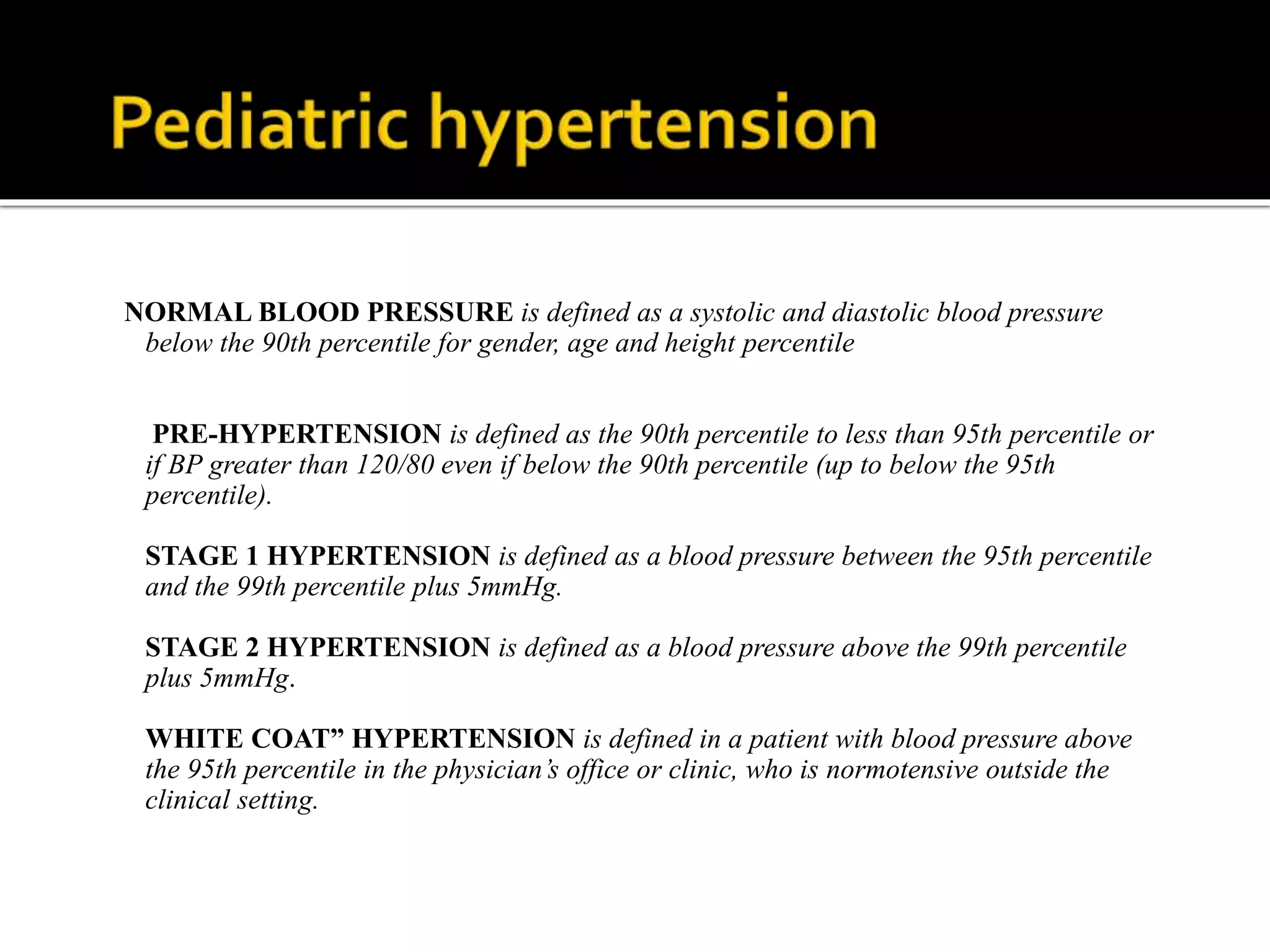
NORMAL BLOOD PRESSURE is defined as a systolic and diastolic blood pressure
below the 90th percentile for gender, age and height percentile
PRE-HYPERTENSION is defined as the 90th percentile to less than 95th percentile or
if BP greater than 120/80 even if below the 90th percentile (up to below the 95th
percentile).
STAGE 1 HYPERTENSION is defined as a blood pressure between the 95th percentile
and the 99th percentile plus 5mmHg.
STAGE 2 HYPERTENSION is defined as a blood pressure above the 99th percentile
plus 5mmHg.
WHITE COAT” HYPERTENSION is defined in a patient with blood pressure above
the 95th percentile in the physician’s office or clinic, who is normotensive outside the
clinical setting.
 Children >3Years must check BP
 Children <3 years who have congenital heart
defect/renal disease/malignancies ,recurrent
Uti ,solid organ transplant, raised icp.
 The preferred method ?.
 Appropriate to the size of cuff ?
 Repeated elevated BP must be confirmed
 Ambulatory BP monitoring (ABPM)
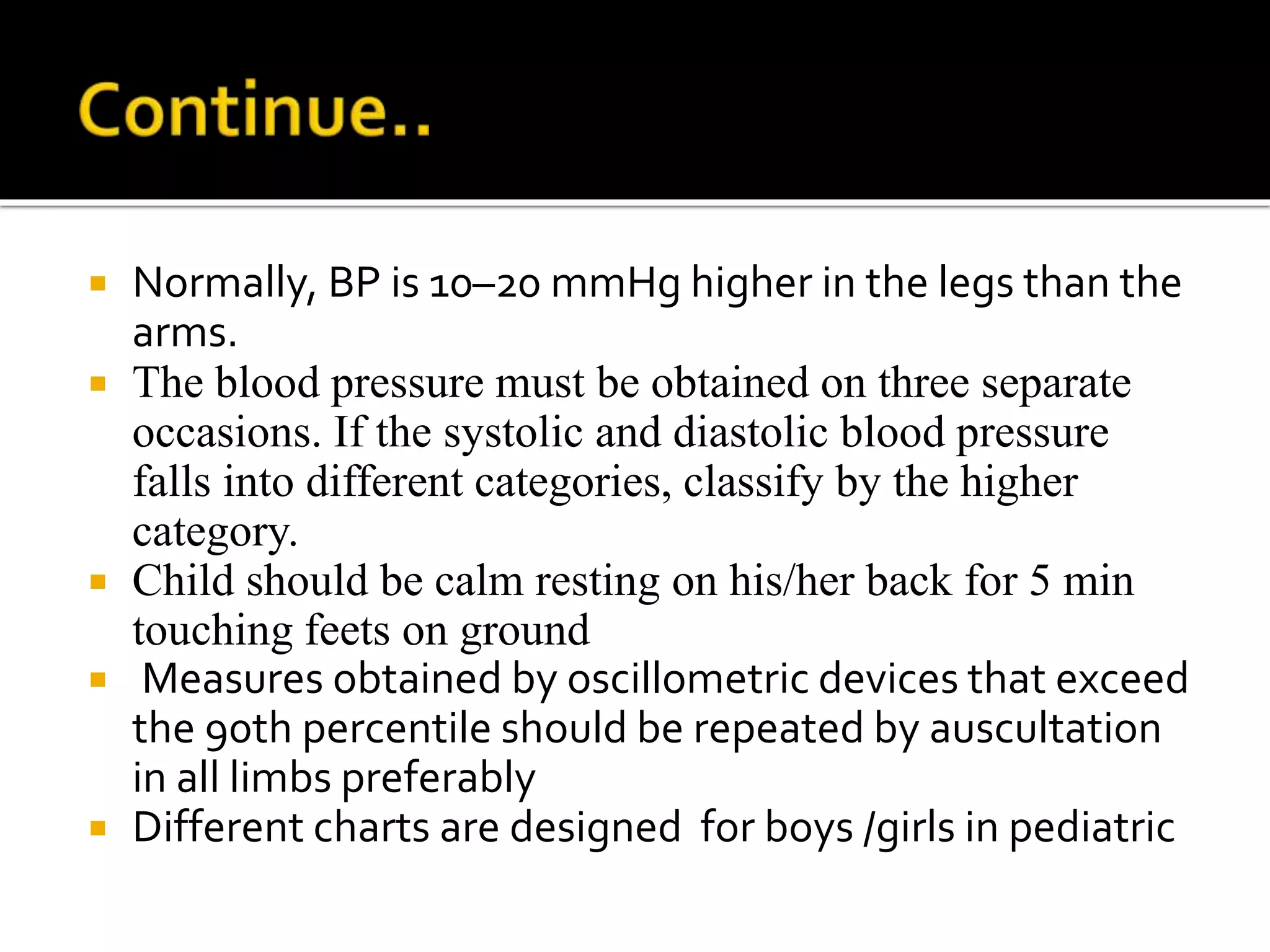
 Normally, BP is 10–20 mmHg higher in the legs than the
arms.
 The blood pressure must be obtained on three separate
occasions. If the systolic and diastolic blood pressure
falls into different categories, classify by the higher
category.
 Child should be calm resting on his/her back for 5 min
touching feets on ground
 Measures obtained by oscillometric devices that exceed
the 90th percentile should be repeated by auscultation
in all limbs preferably
 Different charts are designed for boys /girls in pediatric
(Year) Percentile 5th 10th 25th 50th 75th 90th 95th 5th 10th 25th 50th 75th 90th 95th
12 50th 102 103 104 105 107 108 109 61 61 61 62 63 64 64
90th 116 116 117 119 120 121 122 75 75 75 76 77 78 78
95th 119 120 121 123 124 125 126 79 79 79 80 81 82 82
99th 127 127 128 130 131 132 133 86 86 87 88 88 89 90
Boys SBP, mmHg
Percentile Height
DBP, mmHg
Percentile Height
Must begin with:
 Thorough history (including hx of sleep disorder)
 Physical examination
 Laboratory evaluation
 Assessment of cardiovascular risk factors:
overweight
low plasma HDL cholesterol
high plasma triglycerides
abnormal glucose tolerance
Basic:
 Serum chemistries, BUN, Cr, PRA, Aldosterone level
 CBC
 Urinalysis and Urine culture
 Renal ultrasound with doppler
Evaluation for comorbidity:
 Fasting Lipid profile
 Fasting glucose
 Drug screen (if hx of drug use)
 Polysomnography (if hx of sleep disorder)
Evaluation for end-organ damage:
 Echocardiogram
 Retinal exam
 24hr ABPM (white coat /masked HTN)
 Reno vascular imaging
-Renal scan
-Duplex Doppler flow studies
-MRA, CTA
-Arteriogram
 Other labs
- Urine forVma
-Plasma and urine metanephrines
-Plasma and urine steroids
Classification of
Hypertension
Therapy Recommendations
Normal Encourage healthy diet, sleep, & physical activity
Recheck on next visit
Prehypertension Physical activity & diet management; No medication
unless compelling indications such as CKD, DM, HF or
LVH exist
Stage 1 Hypertension Physical activity & diet management; Initiate therapy if
indicated as above + Symptomatic hypertension +
Persistent hypertension despite
nonpharmacologic measures
Stage 2 Hypertension Physical activity & diet management; Initiate therapy
 Weight reduction
Dietary modifications:
consumption of more fruits, vegetables, fiber, nonfat diary,
reduced sodium intake (1.2g/day in younger kids and 1.5g/day
in older kids)
Indications:
1. Symptomatic hypertension
2. Secondary hypertension
3. Target-organ damage
4. Poor response to non pharmacologic therapy
5. Diabetes mellitus
 Goal is to reduce BP <95th percentile (<90th percentile if
concurrent conditions or LVH present)
 Treat severe symptomatic BP with IV antihypertensives
Class of Drugs Patients’ Characteristics
ACE-Is/ARBs First-line therapy
CCBs First-line therapy
(recommended >6years)
Diuretics Adjunct second-line drug
β–Blocker controversial in diabetes
 Machanism of action
 prevents conversion of angiotensin I to angiotensin II, which leads to an increase
in plasma renin activity and a reduction in aldosterone secretion
 Characteristic:
Renal insufficiency (unilateral renovascular hypertension, renal parenchymal
disease, renal proteinuria)
Congestive heart failure
Diabetes
Hyperlipidemia
 Comments:
 Monitor serum potassium and SCr
 Cough and angioedema
 May require a dosing adjustment in renal impairment
 Mechanism of action
 angiotensin II receptor antagonist blocks the vasoconstrictor and
aldosterone-secreting effects of anigotensin II
 Characteristic :
 same as ACE-I
 Coments:
 Less cough/ angioedema
• Monitor K & s-cr
• Less studies then ACE I in pediatrics
 mode of action:
 decrease intracellular calcium concentrations and results in dilation of
peripheral arterioles
 Characteristics:
 Emergency hypertension (nifedipine)
 Diabetes
 Chronic obstructive lung disease
 Broncho-pulmonary dysplasia
 Gout
 Hyperlipidemia
 PeripheralVascular Disease
 RenalTransplant (cyclosporine-induced)
Coments:
edema, arrhythmias, headache, fatigue, dizziness, flushing
May need adjustment in hepatic impairment
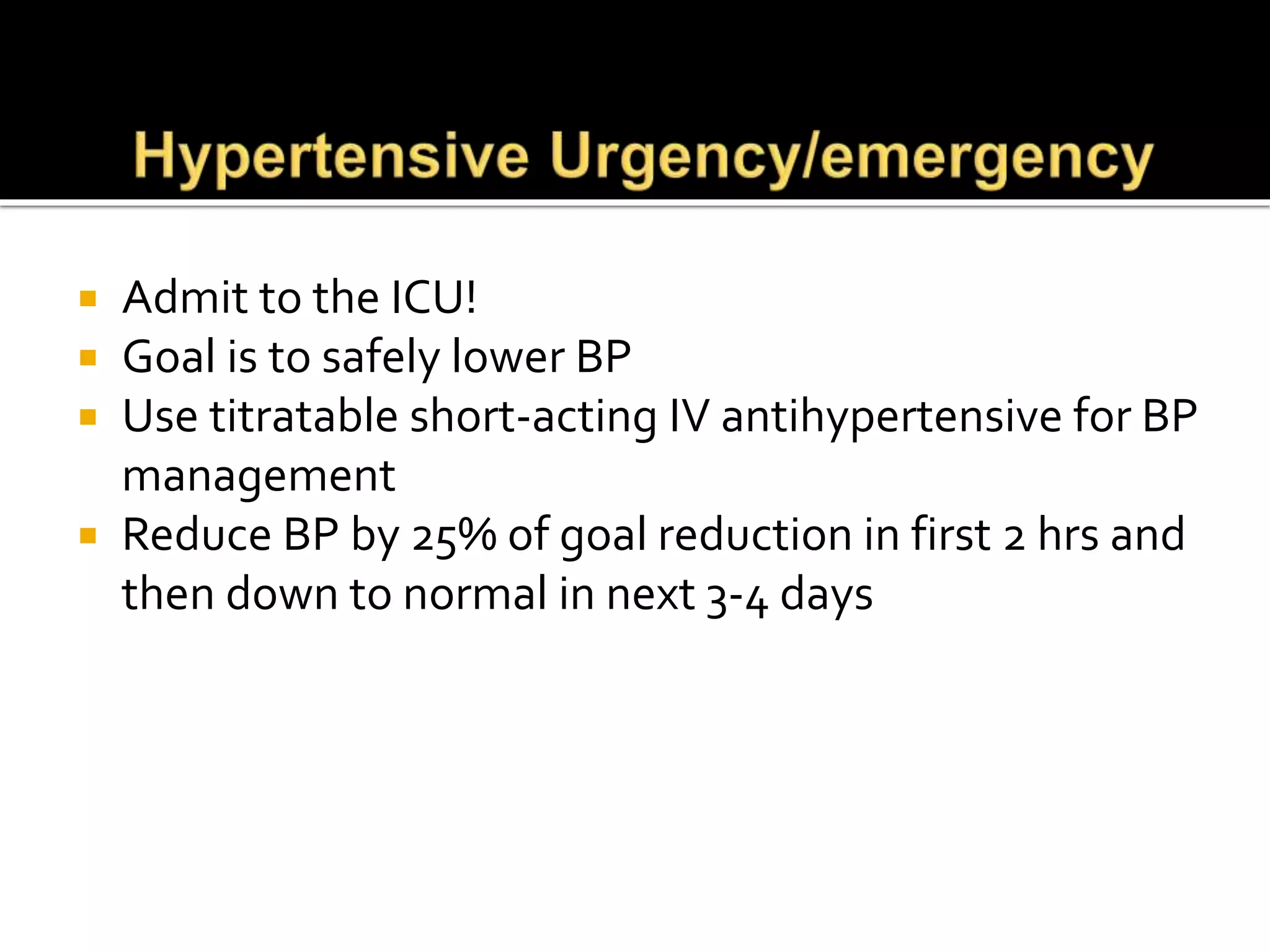
 Admit to the ICU!
 Goal is to safely lower BP
 Use titratable short-acting IV antihypertensive for BP
management
 Reduce BP by 25% of goal reduction in first 2 hrs and
then down to normal in next 3-4 days
hypertension in pediatric

hypertension in pediatric

  • 2.
  • 3.
     What ishypertension  How to diagnose hypertension in children  Measuring BP in children  Learning normal BP range for children  Causes of hypertension in children  Evaluating the cause  Management
  • 4.
    NORMAL BLOOD PRESSUREis defined as a systolic and diastolic blood pressure below the 90th percentile for gender, age and height percentile PRE-HYPERTENSION is defined as the 90th percentile to less than 95th percentile or if BP greater than 120/80 even if below the 90th percentile (up to below the 95th percentile). STAGE 1 HYPERTENSION is defined as a blood pressure between the 95th percentile and the 99th percentile plus 5mmHg. STAGE 2 HYPERTENSION is defined as a blood pressure above the 99th percentile plus 5mmHg. WHITE COAT” HYPERTENSION is defined in a patient with blood pressure above the 95th percentile in the physician’s office or clinic, who is normotensive outside the clinical setting.
  • 5.
     Children >3Yearsmust check BP  Children <3 years who have congenital heart defect/renal disease/malignancies ,recurrent Uti ,solid organ transplant, raised icp.  The preferred method ?.  Appropriate to the size of cuff ?  Repeated elevated BP must be confirmed  Ambulatory BP monitoring (ABPM)
  • 6.
     Normally, BPis 10–20 mmHg higher in the legs than the arms.  The blood pressure must be obtained on three separate occasions. If the systolic and diastolic blood pressure falls into different categories, classify by the higher category.  Child should be calm resting on his/her back for 5 min touching feets on ground  Measures obtained by oscillometric devices that exceed the 90th percentile should be repeated by auscultation in all limbs preferably  Different charts are designed for boys /girls in pediatric
  • 10.
    (Year) Percentile 5th10th 25th 50th 75th 90th 95th 5th 10th 25th 50th 75th 90th 95th 12 50th 102 103 104 105 107 108 109 61 61 61 62 63 64 64 90th 116 116 117 119 120 121 122 75 75 75 76 77 78 78 95th 119 120 121 123 124 125 126 79 79 79 80 81 82 82 99th 127 127 128 130 131 132 133 86 86 87 88 88 89 90 Boys SBP, mmHg Percentile Height DBP, mmHg Percentile Height
  • 13.
    Must begin with: Thorough history (including hx of sleep disorder)  Physical examination  Laboratory evaluation  Assessment of cardiovascular risk factors: overweight low plasma HDL cholesterol high plasma triglycerides abnormal glucose tolerance
  • 14.
    Basic:  Serum chemistries,BUN, Cr, PRA, Aldosterone level  CBC  Urinalysis and Urine culture  Renal ultrasound with doppler Evaluation for comorbidity:  Fasting Lipid profile  Fasting glucose  Drug screen (if hx of drug use)  Polysomnography (if hx of sleep disorder) Evaluation for end-organ damage:  Echocardiogram  Retinal exam
  • 16.
     24hr ABPM(white coat /masked HTN)  Reno vascular imaging -Renal scan -Duplex Doppler flow studies -MRA, CTA -Arteriogram  Other labs - Urine forVma -Plasma and urine metanephrines -Plasma and urine steroids
  • 17.
    Classification of Hypertension Therapy Recommendations NormalEncourage healthy diet, sleep, & physical activity Recheck on next visit Prehypertension Physical activity & diet management; No medication unless compelling indications such as CKD, DM, HF or LVH exist Stage 1 Hypertension Physical activity & diet management; Initiate therapy if indicated as above + Symptomatic hypertension + Persistent hypertension despite nonpharmacologic measures Stage 2 Hypertension Physical activity & diet management; Initiate therapy
  • 18.
     Weight reduction Dietarymodifications: consumption of more fruits, vegetables, fiber, nonfat diary, reduced sodium intake (1.2g/day in younger kids and 1.5g/day in older kids)
  • 19.
    Indications: 1. Symptomatic hypertension 2.Secondary hypertension 3. Target-organ damage 4. Poor response to non pharmacologic therapy 5. Diabetes mellitus  Goal is to reduce BP <95th percentile (<90th percentile if concurrent conditions or LVH present)  Treat severe symptomatic BP with IV antihypertensives
  • 20.
    Class of DrugsPatients’ Characteristics ACE-Is/ARBs First-line therapy CCBs First-line therapy (recommended >6years) Diuretics Adjunct second-line drug β–Blocker controversial in diabetes
  • 23.
     Machanism ofaction  prevents conversion of angiotensin I to angiotensin II, which leads to an increase in plasma renin activity and a reduction in aldosterone secretion  Characteristic: Renal insufficiency (unilateral renovascular hypertension, renal parenchymal disease, renal proteinuria) Congestive heart failure Diabetes Hyperlipidemia  Comments:  Monitor serum potassium and SCr  Cough and angioedema  May require a dosing adjustment in renal impairment
  • 24.
     Mechanism ofaction  angiotensin II receptor antagonist blocks the vasoconstrictor and aldosterone-secreting effects of anigotensin II  Characteristic :  same as ACE-I  Coments:  Less cough/ angioedema • Monitor K & s-cr • Less studies then ACE I in pediatrics
  • 25.
     mode ofaction:  decrease intracellular calcium concentrations and results in dilation of peripheral arterioles  Characteristics:  Emergency hypertension (nifedipine)  Diabetes  Chronic obstructive lung disease  Broncho-pulmonary dysplasia  Gout  Hyperlipidemia  PeripheralVascular Disease  RenalTransplant (cyclosporine-induced) Coments: edema, arrhythmias, headache, fatigue, dizziness, flushing May need adjustment in hepatic impairment
  • 26.
     Admit tothe ICU!  Goal is to safely lower BP  Use titratable short-acting IV antihypertensive for BP management  Reduce BP by 25% of goal reduction in first 2 hrs and then down to normal in next 3-4 days