A blood donor donates the product known as whole blood, from which
components are prepared.
The ability to separate various components from whole blood is
desirable for the following reasons:
1.Separation of blood into components allows optimal survival of each
constituents.
2. Component preparation allows transfusing only specific blood
component that the patient requires.
3. Transfusion of only the specific constituent of the blood needed
avoids the use of unnecessary component, which could be
contraindicated in a patient.
4. By using blood components, several patients can be treated with the
blood from one donor, giving optimal use of every unit of donated blood.
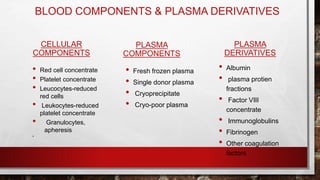
BLOOD COMPONENTS & PLASMA DERIVATIVES
CELLULAR
COMPONENTS
• Red cell concentrate
• Platelet concentrate
• Leucocytes-reduced
red cells
• Leukocytes-reduced
platelet concentrate
• Granulocytes,
apheresis
•
PLASMA
COMPONENTS
• Fresh frozen plasma
• Single donor plasma
• Cryoprecipitate
• Cryo-poor plasma
PLASMA
DERIVATIVES
• Albumin
• plasma protien
fractions
• Factor VIII
concentrate
• Immunoglobulins
• Fibrinogen
• Other coagulation
factors
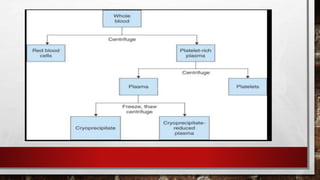
Preparation of blood components is possible due
to :
• Multiple Plastic packs system
• Refrigerated centrifuge
•Different specific gravity of cellular components:
1)Red cells specific gravity 1.08 - 1.09
2)Platelet specific gravity 1.03 - 1.04
3) Plasma specific gravity 1.02 - 1.03
WHOLE BLOOD
• 350-450 ml of blood
• 49-63ml of anticoagulant solution
• Hct- 30-40%
• No components removed
• Stored at 1- 6 degree celsius
• Shelf life : • Citrate –phosphate –Dextrose(CPD)- 21days
• CPDA (adenine) – 35 days
• AS-1, AS-3, AS-5 – 42 days
•Increase Hb by 1 g/dl
•Rate of blood transfusion -3ml/kg/hr
FUNCTIONS OF WHOLE BLOOD
• Red cells in whole blood carry O2 to tissues
• Plasma in whole blood is blood volume expander
• whole blood is a source of proteins with oncotic properties
• Is a source of non-labile coagulation factors
INDICATION
•For those patients who have hypovolemia with shock.
• The patients of trauma and for major surgery
Whole blood Drawbacks
• After storage for 24 hours at 1-6 degree celsius platelets and
WBC are non functional
•Factor V and Viii decrease with storage
•Fluid overload
FRESH BLOOD
•Whole blood or red blood cells concentrates less than 12-24 hours old from
the time of collection are considered fresh.
• Provides the greatest oxygen-carrying capacity because it has the maximum
level of 2, 3 - di-phosphoglycerate (2, 3-DPG) and minimum amount of
potassium as compared with older blood.
• Indicated in newborns because they have high percentage of fetal
hemoglobin, which does not release oxygen to the tissues as well as the adult
hemoglobin.
RED BLOOD CELL (PRC)
•Shelf life – 35 days with CPDA and 42 days with additive solutions
•Storage temp- 2 – 6 Degree celsius
•QC Requirements: PCV 80% (Range 65-80%)
•Volume- 250- 300 ml
•Contents : • red cells- 65-80%, • Plasma 20- 35%, • Some platelets, •
white blood cell and anticoagulant preservative solutions
INDICATION OF PRC
•In decreased bone marrow production conditions
leukemia ,aplastic anemia
•In decreased red cells survival conditions hemolytic
anemia ( eg. Thalassaemia)
•In bleeding patients surgical bleeding traumatic bleeding
• Hemoglobin of less than 6.0 g/dl in the absence of disease and
between 8 and 10 g/dl with disease need transfusion of red
cells.
•Each unit of transfused red cells prepared from 450 ml of whole
blood increase hemoglobin by about 1 g/dl (hct 3 per cent) in a
patient of 70 kg body weight
Advantages of transfusion of PRC (over
whole blood)
•Reduce risk of circulatory overload due to less volume of anticoagulant and
plasma
•Lessens severity and incidence of allergic reactions
•ABO antibodies are reduced, red cells non-ABO identical to patient’s group can
be given, if compatible
•Removed plasma can be used for preparing FFP and cryoprocipitate (factors VIII
and V).
Contraindications of PRC:
•To correct protein and coagulation factors deficiency
• Preoperative transfusion to raise Hb above 10 g/dl
•To enhance general well being, promote wound healing, prevent infection,
expand blood volume when oxygen-carrying capacity is adequate
LEUKOCYTES REDUCED RED BLOOD CELLS
Methods of the preparation of leucocyte reduced red cells
•Centrifugation and removing of buffy coat
• Filtration
• Washing of red cells with saline
•Freezing and thawing of red cells
Indications:
•Multitransfused patients like thalassaemic
•Leukemia
•Aplastic anemia
• Immunosupressed
•Immunodeficient
CONTINUED…..
• Multiparous women
•Prevention of recurrent FNHTRs (Febrile non haemolytic
transfusion reactions)
• Prevention or delay of primary alloimmunization to HLA antigen
• Prevention of CMV transmission in at risk individual
LEUKOCYTES IN BLOOD COMPONENTS CAN CAUSE:
•Non-hemolytic febrile transfusion reaction (NHFTR)
•Human leukocyte antigen (HLA) alloimmunizaion
•Transmission of leukotropic viruses (cytomegalovirus(cmv), epstein- barr
virus (EBV) and human t-cell lymphotropic virus type 1 (HTLV-1)
•Transfusion related graft versus host disease
•Transfusion related acute lung injury (TRALI)
• Transfusion related immunosuppression
WASHED RED CELLS
Washing of red cells removes 70 - 95 % of leukocytes and there is
concomitant loss of 15 - 20 ml of red blood cells, but it is effective in
removal of plasma proteins and microaggregates.
Indications
•Patients having recurrent attacks FNHTRs and urticarial
reactions.
•Patients who have developed antibodies to plasma proteins.
•IgA deficient patient who has developed anti-IgA (incidence of
IgA deficiency is 1 in 700 persons).
•Paraoxymal noctural hemglobiuria (PNH), sensitive to
complement
FROZEN/DEGLYCEROLIZED RED
CELLS
Indications
• Storage of rare blood group
•Autologous units of patients with multiple red cells alloantibodies stored for
future surgery.
• Prevention of non hemolytic febrile transfusion reaction in patients sensitized
to leukocytes, platelets or plasma protein.
•Prevention of sensitization against HLA antigen.
PLATELET CONCENTRATES
•Shelf life: 1 day if no storage cabinet & 5 days in platelet
incubator and agitator
•Storage temp :20-24 degree celsius
•Q.C requirements: to be prepared within 6hr of collection and pH
should be >6.2
•Volume: 30 to 50 ml
•contents: 5.5x10¹⁰ unit/bag
INDICATIONS
•Platelet count is < 5000 / µl regardless of clinical condition
•Effect: increases platelet count by 5000-10000/ µl per unit
•Dosage: Adults: 1 Unit of RDP for every 10 kg increases platelet
count by approx. 50x109 /l (50,000/mm3).
Pediatric: 0.2unit/kg of RDP will raise platelet count to
50x109 /L (50,000/mm3).
•Platelet concentrates can be prepared from:
•1. Random donor platelet (prepared from 450ml whole blood)
•2. Single donor platelet prepared by apheresis.
Platelet Apheresis (single donor
platelet)
Random donor platelet
Average >3x10¹¹ platelet (equal to
platelet obtained from 5-6 donations)
5.5x10¹⁰ platelets
Leukocytes<5.5x10⁶ 108 in each unit
Red cell traces more
Single donor platelet Random donor platelet
Exposes a patient to one donor Exposes a patient to multiple donor
Less exposure to infections More exposure to infections
Low risk to alloimunization Relatively more risk to alloimunization
HLA or platelet matched donor
product can be prepared
Not Possible
Highly trained person and equipment
required
Not much
SINGLE DONOR PLATELET
•Obtained by plasmapheresis technique
•6 to 8 times more platelets as in random donor unit
•Larger volumes and HLA compatibility results in increase of 30 to
60 k
•Leucoreduced because of apheresis technique
•ABO Matched platelets preferred
GRANULOCYTE (GC)
Granulocyte products available :
•buffy coat
•granulocytes, apheresis
Buffy coat prepared from 450 ml of blood contains :
• 0.60 x 10⁹ granulocytes
• Contaminated with red cells, platelets, other leukocytes
• 15-20 ml plasma
INDICATIONS OF GC
•Septicaemia not responding to antibiotics.
• Infections in patients undergoing chemo / radio therapy for
neoplastic diseases
•Neutrophil count less than 0.50 x 10⁹/L (500 / mm3), having gram-
negative infection which fail to respond with antibiotics
•Temporary bone marrow depression for 1 - 2 weeks.
Doses and Administration of
Granulocytes
• In adult lxl010 granulocytes daily e.g. 1 unit of granulocytes prepared
by apheresis (equivalent to 18 - 20 units of buffy coat)
• Infected neonates need 0.5 - 0.6 x 10⁹ granulocytes daily
Granulocytes transfusion should be discontinued when the patient
becomes afebrile, or when granuolcyte count exceeds 1.0 x 10⁹/L.
FRESH FROZEN PLASMA
• Fresh frozen plasma (FFP) is plasma that is separated
from whole blood and is frozen within 6-8 hours of
collection.
• FFP contains plasma proteins and all coagulation factors,
including the labile Factors V and VIII if stored at - 30°C or
below
Contents of 1 unit of FFP prepared from 450
ml Of whole blood
•Plasma :175 - 230 ml
•All coagulation Factors (including Factors V & VIII) :1
i.u. / ml of each factor
•Fibrinogen : 200-400mgm
Indications of Fresh Frozen Plasma ƒ
1.Actively bleeding and multiple coagulation factors deficiencies in
• Liver diseases
• Disseminated intravascular coagulation (D1C)
• Coagulopathy in massive transfusion
• TTP
• When specific disorder cannot be or has not yet been identified
2.Familial Factor V deficiency If concentrated Factor V is not
available, FFP can be used as a source of Factor V.
3.Deficiency of Factors II, VII, IX,, and X
4.Antithrombin III deficiency
5.Congenital or acquired coagulation factor deficiency
6.Use of FFP in conjunction with red cells has largely replaced the
transfusion of fresh blood
DOSAGE OF FFP
•About 10 ml / Kg of body weight.
•Post transfusion assessment of levels of aPTT, PT and fibrinogen is
done for monitoring the effect of FFP.
•FFP should be thawed at 30-37°C in circulating water bath.
•Thawed plasma should be transfused as soon as possible, or
within 12 hours, if stored at2-4°C.
PLASMA ABO COMPATIBILITY
Recipient’s blood group Plasma donor’s blood gop
O O, A, B, AB
A A, AB
B B, AB
AB AB
CONTRAINDICATIONS FOR THE USE OF
FRESH FROZEN PLASMA
•Blood volume expander
• Hypoproteinaemia
•Source of immunoglobulins
•When the prothrombin time is < 18 seconds
SOLVENT / DETERGENT PLASMA
•Plasma is treated with the solvent tri (n-butyl) phosphate (TNPB)
and the detergent triton X-100 to inactivate lipid-enveloped viruses
such as hepatitis B and C and HIV.
•Indications for its use are the same as that of FFP.
•Out date :12 hours at room temperature after thawing, do not
refrigerate.
• Doses and Administration is the same as that for FFP.
CONTRAINDICATIONS
• Pregnant women, except at the time of delivery
• Neonates
• Chronic hemolytic anemia
• Sickle cell disease
• Patients under going treatment with bone marrow damaging
chemotherapy or radiation
• Bone marrow transplant patients
SINGLE DONOR AND CRYOPRECIPITATE-
POOR PLASMA
• Plasma separated from one unit of whole blood on or before the
fifth day of the expiration date is called as single donor plasma.
•Cryoprecipitate-poor plasma is a by product of cryoprecipitate
preparation.
• Both these products lack the labile coagulation factors V and VIII,
but contain stable clotting factors II, VII, IX, and X. Cryo-poor
plasma lacks fibrinogen also.
INDICATIONS
•In deficiency of stable clotting factors (e.g. coagulopathies due to
warfarin drugs)
• Burn
Doses : are the same as that of FFP.
CRYOPRECIPITATE:
Precipitated proteins of plasma rich in factor VII and fibrinogen,obtained
from a single unit of fresh plasma by rapid freezing within 6 hrs of
collection.
Plasma 10-15 ml
Factor VIII 80-100 iu
Fibrinogen 150-250 mg
von-Willebrand Factor 40 - 70%
Fibronectin 55 mgm
Factor XIII 20 - 30% of the original
Indications:
• Hemophilia A
•Von Willebrand’s disease
•Congenital or acquired fibrinogen deficiency
•Acquired Factor VIII deficiency (e.g. DIC, massive transfusion)
• Factor XIII deficiency
• Source of Fibrin Glue used as topical hemostatic agent in surgical procedures and to remove
fragmented renal calculi.
•Factor VIII concentrate, 500 i.u. bottle, available as pharmaceutical product, is the product of
choice for most of the hemophiliacs.
components composition Approx
volume
Indications
Whole Blood RBC (approx. Hct
40%) WBC & some
platelets; Plasma
deficient in factors V,
VIII
350-
450ml
Increase red cells and
plasma volume
Red Blood cells RBC (approx. Hct
75%) WBC and
some platelets,
reduced plasma
250ml Increase Red cell mass in
symptomatic anaemia.
Components Composition Approx
volume
Indications
Leukocytes
reduced
RBCs
RBC>85% of original
volume WBC<5x10⁸ to
< 5x10⁶ Few platelets
and minimal plasma
225ml Increase red cell mass,
reduce FNHTR, decrease
HLA immunization and
CMV transmission.
Components Composition Approx
volume
Indications
Washed RBCs RBC (approx. 75%)
WBC<5x10⁸
No Plasma
180ml Increase red cell mass,
reduce risk of allergic
reaction to plasma
proteins.
RBCs frozen/
Deglycerolized
RBC (approx. Hct 75%)
WBC< 5x10⁶
No platelets and
plasma
180 ml Increased red cell mass,
minimize febrile or
allergic reactions, Used
for prolonged
RBCstorage.
Components Composition Approx
volume
Indications
Platelet,
Concentrate
(Random donor)
Platelets 5.5x10¹⁰
/unit, few RBCs,
Wbc, Plasma
50ml Bleeding due to
thrombocytopenia or
thrombocytopathy
Plateletpheresis Platelet>3x10¹¹
WBC<5.5x10⁶ ,
plasma & minimal
RBCs
300ml Same as platelets
concentrates,
sometimes HLA
matched or cross
matched platelets are
prepared.
Components Composition Approx
volume
Indications
Granulocytes
pheresis
Granulocytes> 1x
1010 Lymphocytes,
some RBCs and
Platelets
220ml Used in selected cases with
sepsis and severe neutropenia
Fresh Frozen
Plasma
Plasma having all
coagulation factors
220ml Coagulation disorders, if PT> 18
sec, aPTT> 60 sec (>1.5 to 1.8
times of controls)
Components Composition Approx
volume
Indicaions
Single donor
and
cryoprecipitate
poor plasma
Plasma, stable
clotting factors, no
platelets
220ml Stable clotting factor
deficiencies( II, VII, IX, X,
XI)
Cryoprecipitat
ed AHF
(FactorVII)
Factor VIII, VWF,
Fibrinogen
15ml Hemophilia A, VWD,
Deficiency of fibrinogen
and Factor XIII
THANK YOU

Blood components

  • 2.
    A blood donordonates the product known as whole blood, from which components are prepared. The ability to separate various components from whole blood is desirable for the following reasons: 1.Separation of blood into components allows optimal survival of each constituents. 2. Component preparation allows transfusing only specific blood component that the patient requires.
  • 3.
    3. Transfusion ofonly the specific constituent of the blood needed avoids the use of unnecessary component, which could be contraindicated in a patient. 4. By using blood components, several patients can be treated with the blood from one donor, giving optimal use of every unit of donated blood.
  • 4.
    BLOOD COMPONENTS &PLASMA DERIVATIVES CELLULAR COMPONENTS • Red cell concentrate • Platelet concentrate • Leucocytes-reduced red cells • Leukocytes-reduced platelet concentrate • Granulocytes, apheresis • PLASMA COMPONENTS • Fresh frozen plasma • Single donor plasma • Cryoprecipitate • Cryo-poor plasma PLASMA DERIVATIVES • Albumin • plasma protien fractions • Factor VIII concentrate • Immunoglobulins • Fibrinogen • Other coagulation factors
  • 5.
    Preparation of bloodcomponents is possible due to : • Multiple Plastic packs system • Refrigerated centrifuge •Different specific gravity of cellular components: 1)Red cells specific gravity 1.08 - 1.09 2)Platelet specific gravity 1.03 - 1.04 3) Plasma specific gravity 1.02 - 1.03
  • 9.
    WHOLE BLOOD • 350-450ml of blood • 49-63ml of anticoagulant solution • Hct- 30-40% • No components removed • Stored at 1- 6 degree celsius • Shelf life : • Citrate –phosphate –Dextrose(CPD)- 21days • CPDA (adenine) – 35 days • AS-1, AS-3, AS-5 – 42 days
  • 10.
    •Increase Hb by1 g/dl •Rate of blood transfusion -3ml/kg/hr
  • 11.
    FUNCTIONS OF WHOLEBLOOD • Red cells in whole blood carry O2 to tissues • Plasma in whole blood is blood volume expander • whole blood is a source of proteins with oncotic properties • Is a source of non-labile coagulation factors
  • 12.
    INDICATION •For those patientswho have hypovolemia with shock. • The patients of trauma and for major surgery
  • 13.
    Whole blood Drawbacks •After storage for 24 hours at 1-6 degree celsius platelets and WBC are non functional •Factor V and Viii decrease with storage •Fluid overload
  • 14.
    FRESH BLOOD •Whole bloodor red blood cells concentrates less than 12-24 hours old from the time of collection are considered fresh. • Provides the greatest oxygen-carrying capacity because it has the maximum level of 2, 3 - di-phosphoglycerate (2, 3-DPG) and minimum amount of potassium as compared with older blood. • Indicated in newborns because they have high percentage of fetal hemoglobin, which does not release oxygen to the tissues as well as the adult hemoglobin.
  • 15.
    RED BLOOD CELL(PRC) •Shelf life – 35 days with CPDA and 42 days with additive solutions •Storage temp- 2 – 6 Degree celsius •QC Requirements: PCV 80% (Range 65-80%) •Volume- 250- 300 ml •Contents : • red cells- 65-80%, • Plasma 20- 35%, • Some platelets, • white blood cell and anticoagulant preservative solutions
  • 17.
    INDICATION OF PRC •Indecreased bone marrow production conditions leukemia ,aplastic anemia •In decreased red cells survival conditions hemolytic anemia ( eg. Thalassaemia) •In bleeding patients surgical bleeding traumatic bleeding
  • 18.
    • Hemoglobin ofless than 6.0 g/dl in the absence of disease and between 8 and 10 g/dl with disease need transfusion of red cells. •Each unit of transfused red cells prepared from 450 ml of whole blood increase hemoglobin by about 1 g/dl (hct 3 per cent) in a patient of 70 kg body weight
  • 19.
    Advantages of transfusionof PRC (over whole blood) •Reduce risk of circulatory overload due to less volume of anticoagulant and plasma •Lessens severity and incidence of allergic reactions •ABO antibodies are reduced, red cells non-ABO identical to patient’s group can be given, if compatible •Removed plasma can be used for preparing FFP and cryoprocipitate (factors VIII and V).
  • 20.
    Contraindications of PRC: •Tocorrect protein and coagulation factors deficiency • Preoperative transfusion to raise Hb above 10 g/dl •To enhance general well being, promote wound healing, prevent infection, expand blood volume when oxygen-carrying capacity is adequate
  • 21.
    LEUKOCYTES REDUCED REDBLOOD CELLS Methods of the preparation of leucocyte reduced red cells •Centrifugation and removing of buffy coat • Filtration • Washing of red cells with saline •Freezing and thawing of red cells
  • 22.
    Indications: •Multitransfused patients likethalassaemic •Leukemia •Aplastic anemia • Immunosupressed •Immunodeficient
  • 23.
    CONTINUED….. • Multiparous women •Preventionof recurrent FNHTRs (Febrile non haemolytic transfusion reactions) • Prevention or delay of primary alloimmunization to HLA antigen • Prevention of CMV transmission in at risk individual
  • 24.
    LEUKOCYTES IN BLOODCOMPONENTS CAN CAUSE: •Non-hemolytic febrile transfusion reaction (NHFTR) •Human leukocyte antigen (HLA) alloimmunizaion •Transmission of leukotropic viruses (cytomegalovirus(cmv), epstein- barr virus (EBV) and human t-cell lymphotropic virus type 1 (HTLV-1) •Transfusion related graft versus host disease •Transfusion related acute lung injury (TRALI) • Transfusion related immunosuppression
  • 25.
    WASHED RED CELLS Washingof red cells removes 70 - 95 % of leukocytes and there is concomitant loss of 15 - 20 ml of red blood cells, but it is effective in removal of plasma proteins and microaggregates.
  • 27.
    Indications •Patients having recurrentattacks FNHTRs and urticarial reactions. •Patients who have developed antibodies to plasma proteins. •IgA deficient patient who has developed anti-IgA (incidence of IgA deficiency is 1 in 700 persons). •Paraoxymal noctural hemglobiuria (PNH), sensitive to complement
  • 28.
    FROZEN/DEGLYCEROLIZED RED CELLS Indications • Storageof rare blood group •Autologous units of patients with multiple red cells alloantibodies stored for future surgery. • Prevention of non hemolytic febrile transfusion reaction in patients sensitized to leukocytes, platelets or plasma protein. •Prevention of sensitization against HLA antigen.
  • 29.
    PLATELET CONCENTRATES •Shelf life:1 day if no storage cabinet & 5 days in platelet incubator and agitator •Storage temp :20-24 degree celsius •Q.C requirements: to be prepared within 6hr of collection and pH should be >6.2 •Volume: 30 to 50 ml •contents: 5.5x10¹⁰ unit/bag
  • 31.
    INDICATIONS •Platelet count is< 5000 / µl regardless of clinical condition •Effect: increases platelet count by 5000-10000/ µl per unit •Dosage: Adults: 1 Unit of RDP for every 10 kg increases platelet count by approx. 50x109 /l (50,000/mm3). Pediatric: 0.2unit/kg of RDP will raise platelet count to 50x109 /L (50,000/mm3).
  • 32.
    •Platelet concentrates canbe prepared from: •1. Random donor platelet (prepared from 450ml whole blood) •2. Single donor platelet prepared by apheresis.
  • 35.
    Platelet Apheresis (singledonor platelet) Random donor platelet Average >3x10¹¹ platelet (equal to platelet obtained from 5-6 donations) 5.5x10¹⁰ platelets Leukocytes<5.5x10⁶ 108 in each unit Red cell traces more
  • 36.
    Single donor plateletRandom donor platelet Exposes a patient to one donor Exposes a patient to multiple donor Less exposure to infections More exposure to infections Low risk to alloimunization Relatively more risk to alloimunization HLA or platelet matched donor product can be prepared Not Possible Highly trained person and equipment required Not much
  • 37.
    SINGLE DONOR PLATELET •Obtainedby plasmapheresis technique •6 to 8 times more platelets as in random donor unit •Larger volumes and HLA compatibility results in increase of 30 to 60 k •Leucoreduced because of apheresis technique •ABO Matched platelets preferred
  • 38.
    GRANULOCYTE (GC) Granulocyte productsavailable : •buffy coat •granulocytes, apheresis Buffy coat prepared from 450 ml of blood contains : • 0.60 x 10⁹ granulocytes • Contaminated with red cells, platelets, other leukocytes • 15-20 ml plasma
  • 39.
    INDICATIONS OF GC •Septicaemianot responding to antibiotics. • Infections in patients undergoing chemo / radio therapy for neoplastic diseases •Neutrophil count less than 0.50 x 10⁹/L (500 / mm3), having gram- negative infection which fail to respond with antibiotics •Temporary bone marrow depression for 1 - 2 weeks.
  • 40.
    Doses and Administrationof Granulocytes • In adult lxl010 granulocytes daily e.g. 1 unit of granulocytes prepared by apheresis (equivalent to 18 - 20 units of buffy coat) • Infected neonates need 0.5 - 0.6 x 10⁹ granulocytes daily Granulocytes transfusion should be discontinued when the patient becomes afebrile, or when granuolcyte count exceeds 1.0 x 10⁹/L.
  • 41.
    FRESH FROZEN PLASMA •Fresh frozen plasma (FFP) is plasma that is separated from whole blood and is frozen within 6-8 hours of collection. • FFP contains plasma proteins and all coagulation factors, including the labile Factors V and VIII if stored at - 30°C or below
  • 43.
    Contents of 1unit of FFP prepared from 450 ml Of whole blood •Plasma :175 - 230 ml •All coagulation Factors (including Factors V & VIII) :1 i.u. / ml of each factor •Fibrinogen : 200-400mgm
  • 44.
    Indications of FreshFrozen Plasma ƒ 1.Actively bleeding and multiple coagulation factors deficiencies in • Liver diseases • Disseminated intravascular coagulation (D1C) • Coagulopathy in massive transfusion • TTP • When specific disorder cannot be or has not yet been identified
  • 45.
    2.Familial Factor Vdeficiency If concentrated Factor V is not available, FFP can be used as a source of Factor V. 3.Deficiency of Factors II, VII, IX,, and X 4.Antithrombin III deficiency 5.Congenital or acquired coagulation factor deficiency 6.Use of FFP in conjunction with red cells has largely replaced the transfusion of fresh blood
  • 46.
    DOSAGE OF FFP •About10 ml / Kg of body weight. •Post transfusion assessment of levels of aPTT, PT and fibrinogen is done for monitoring the effect of FFP. •FFP should be thawed at 30-37°C in circulating water bath. •Thawed plasma should be transfused as soon as possible, or within 12 hours, if stored at2-4°C.
  • 47.
    PLASMA ABO COMPATIBILITY Recipient’sblood group Plasma donor’s blood gop O O, A, B, AB A A, AB B B, AB AB AB
  • 48.
    CONTRAINDICATIONS FOR THEUSE OF FRESH FROZEN PLASMA •Blood volume expander • Hypoproteinaemia •Source of immunoglobulins •When the prothrombin time is < 18 seconds
  • 49.
    SOLVENT / DETERGENTPLASMA •Plasma is treated with the solvent tri (n-butyl) phosphate (TNPB) and the detergent triton X-100 to inactivate lipid-enveloped viruses such as hepatitis B and C and HIV. •Indications for its use are the same as that of FFP. •Out date :12 hours at room temperature after thawing, do not refrigerate. • Doses and Administration is the same as that for FFP.
  • 50.
    CONTRAINDICATIONS • Pregnant women,except at the time of delivery • Neonates • Chronic hemolytic anemia • Sickle cell disease • Patients under going treatment with bone marrow damaging chemotherapy or radiation • Bone marrow transplant patients
  • 51.
    SINGLE DONOR ANDCRYOPRECIPITATE- POOR PLASMA • Plasma separated from one unit of whole blood on or before the fifth day of the expiration date is called as single donor plasma. •Cryoprecipitate-poor plasma is a by product of cryoprecipitate preparation. • Both these products lack the labile coagulation factors V and VIII, but contain stable clotting factors II, VII, IX, and X. Cryo-poor plasma lacks fibrinogen also.
  • 52.
    INDICATIONS •In deficiency ofstable clotting factors (e.g. coagulopathies due to warfarin drugs) • Burn Doses : are the same as that of FFP.
  • 53.
    CRYOPRECIPITATE: Precipitated proteins ofplasma rich in factor VII and fibrinogen,obtained from a single unit of fresh plasma by rapid freezing within 6 hrs of collection. Plasma 10-15 ml Factor VIII 80-100 iu Fibrinogen 150-250 mg von-Willebrand Factor 40 - 70% Fibronectin 55 mgm Factor XIII 20 - 30% of the original
  • 54.
    Indications: • Hemophilia A •VonWillebrand’s disease •Congenital or acquired fibrinogen deficiency •Acquired Factor VIII deficiency (e.g. DIC, massive transfusion) • Factor XIII deficiency • Source of Fibrin Glue used as topical hemostatic agent in surgical procedures and to remove fragmented renal calculi. •Factor VIII concentrate, 500 i.u. bottle, available as pharmaceutical product, is the product of choice for most of the hemophiliacs.
  • 55.
    components composition Approx volume Indications WholeBlood RBC (approx. Hct 40%) WBC & some platelets; Plasma deficient in factors V, VIII 350- 450ml Increase red cells and plasma volume Red Blood cells RBC (approx. Hct 75%) WBC and some platelets, reduced plasma 250ml Increase Red cell mass in symptomatic anaemia.
  • 56.
    Components Composition Approx volume Indications Leukocytes reduced RBCs RBC>85%of original volume WBC<5x10⁸ to < 5x10⁶ Few platelets and minimal plasma 225ml Increase red cell mass, reduce FNHTR, decrease HLA immunization and CMV transmission.
  • 57.
    Components Composition Approx volume Indications WashedRBCs RBC (approx. 75%) WBC<5x10⁸ No Plasma 180ml Increase red cell mass, reduce risk of allergic reaction to plasma proteins. RBCs frozen/ Deglycerolized RBC (approx. Hct 75%) WBC< 5x10⁶ No platelets and plasma 180 ml Increased red cell mass, minimize febrile or allergic reactions, Used for prolonged RBCstorage.
  • 58.
    Components Composition Approx volume Indications Platelet, Concentrate (Randomdonor) Platelets 5.5x10¹⁰ /unit, few RBCs, Wbc, Plasma 50ml Bleeding due to thrombocytopenia or thrombocytopathy Plateletpheresis Platelet>3x10¹¹ WBC<5.5x10⁶ , plasma & minimal RBCs 300ml Same as platelets concentrates, sometimes HLA matched or cross matched platelets are prepared.
  • 59.
    Components Composition Approx volume Indications Granulocytes pheresis Granulocytes>1x 10¹⁰ Lymphocytes, some RBCs and Platelets 220ml Used in selected cases with sepsis and severe neutropenia Fresh Frozen Plasma Plasma having all coagulation factors 220ml Coagulation disorders, if PT> 18 sec, aPTT> 60 sec (>1.5 to 1.8 times of controls)
  • 60.
    Components Composition Approx volume Indicaions Singledonor and cryoprecipitate poor plasma Plasma, stable clotting factors, no platelets 220ml Stable clotting factor deficiencies( II, VII, IX, X, XI) Cryoprecipitat ed AHF (FactorVII) Factor VIII, VWF, Fibrinogen 15ml Hemophilia A, VWD, Deficiency of fibrinogen and Factor XIII
  • 61.

Editor's Notes

  • #3 For example after 24 hours storage of whole blood at 2-6°C, it has few viable platelets and levels of labile Factors V and VIII decrease, while after separation platelets can be stored for 5 days at 22°C and Factors V and VIII can be stored as FFP for 1 year at- 30°C or below.
  • #4 3.For example, because of the risk of hypervolemia, an elderly anemic patient in congestive heart failure may not easily tolerate the transfusion of two units of whole blood, while the same patient can be transfused two units of red blood cells easily.
  • #6 Due to different specific gravity of cellular components, they can be separated by centrifuging at different centrifugal force
  • #7 First light spin at 2000 rpm for min at 20 deg Celsius and then harder spin at 4000rpm for 5 min at 20 degree..
  • #18 For increasing red blood cells mass in symptomatic anemia who require increased oxygen-carrying capacity.
  • #21 Well compensated anemic patients such as chronic renal failure. Nutritional anemia such as iron deficiency or pernicious anemia responsive to iron, folic acid, recombinant erythropoietin
  • #22 Filteraton by using leukocyte microaggregate filters (polyesters)
  • #26 Can be done manually or by hemonetic cell washing machine
  • #29 Freezing damages red cells due to intracellular ice formation and due to hypertonicity. .. Glycerol is cryoprotective agent so it can be frozen and thawed without damage…. Frozen cell are deglycerolized before transfusion,,,, by washing with decreasing concentration of normal saline and then finally with dextrose… frozen red cell can be stored fo 10 yrs
  • #34 Apheresis means to separate or remove.. Blood is drawn from donor in anticoagulant solution and separated into components.. One or more components are retained and remaining constituents are returned to the individual.